Minneapolis, MN
Despite years of denial, Minneapolis police used secretive process for serious misconduct


Minneapolis police leaders used a secretive process to handle serious officer misconduct cases while keeping the details confidential, despite repeated claims to the contrary.
In public meetings and statements to media, police and city officials long claimed they use coaching, a form of one-on-one mentoring, only in response to the lowest-level policy violations, like uniform infractions or not wearing a seatbelt. But new court documents reveal that some of the misconduct quietly coached in recent years is more severe.
Three officers mishandled their service weapons, one of whom fired a round into the wall of a precinct.
Another failed to report a colleague’s use of force, which resulted in injury to an individual in their custody.
And another, who has since been promoted, let a police K-9 off leash, allowing the dog to attack a civilian.
All were coached, the documents say, meaning all records of the misconduct were shielded from public view.
The Minneapolis Police Department has used coaching more than any other means of dealing with police complaints over the past decade. Attorneys for the city say this gentler form of corrective action doesn’t amount to real discipline, and they don’t have to disclose any records to the public under Minnesota law. Critics have for years contested that the lack of transparency amounts to a rhetorical loophole the police department uses to keep bad behavior hidden.
Last year, in charging Minneapolis with a pattern of discriminatory policing, the U.S. Department of Justice criticized coaching as part of the city’s “fundamentally flawed” accountability system. Only one in four cases referred for coaching through a city oversight office ended up being coached, the charges say, and some allegations were “far from ‘low-level,’” including an officer who “smacked, kicked, and used a taser on a teen accused of shoplifting.”
The new court filings, made public as part of a government watchdog’s lawsuit, offer the fullest window yet into the police department’s convoluted coaching process. The records include nine examples of MPD using coaching to handle more serious misconduct than what the city officials have publicly claimed. They also show how city leaders have misrepresented this process in public meetings in the wake of George Floyd’s murder, even as they sought to mend fractured trust.
In May 2021, a group of top police officials and city leaders gave a presentation on coaching to the Police Conduct Oversight Commission (PCOC), a volunteer board created by the city to make recommendations on police policy. Members of the commission pressed the officials on whether secrecy around coaching allowed former officer Derek Chauvin to work for nearly two decades unencumbered by serious excessive force complaints.
Then-Deputy Police Chief Amelia Huffman said she couldn’t speak directly to Chauvin’s case, but that coaching is only reserved for the lowest-level violations, such as problems in writing a report.
“So… something like excessive force would not be eligible for coaching?” asked Commissioner Abigail Cerra.
“Yes, that’s correct,” replied Huffman.
But it wasn’t correct.
When a lawyer pressed Huffman about this exchange in a deposition last fall, Huffman acknowledged the Minneapolis Police Chief can, in fact, institute coaching for excessive force — or any other violation on the discipline matrix.
The Chief could technically coach a police officer for murder “to the extent it was a policy violation,” then-Deputy Chief Troy Schoenberger said in a separate deposition this February.
‘As discipline…you will receive coaching’
These revelations were made public in connection to a lawsuit filed by Minnesota Coalition On Government Information (MNCOGI), an all-volunteer organization made up of current and former journalists, attorneys, librarians and others interested in government transparency.
The lawsuit, filed in June 2021, alleges Minneapolis willfully misinterprets Minnesota public records laws by labeling coaching documents as private data. This practice has promoted a culture of secrecy, allowing the Minneapolis Police Department to operate without accountability to the people it serves, according to the civil complaint.
“We’re not telling the city it has to stop coaching officers,” said attorney Leita Walker. “What we are saying, is that if it looks like discipline and quacks like discipline — and if it’s for serious misconduct – then it’s discipline and it’s public. It doesn’t matter what made-up word the city uses to describe it.”
Walker and Isabella Salomão Nascimento, of Ballard Spahr, and the Minnesota chapter of the American Civil Liberties Union are representing MNCOGI. Walker has also represented several local media organizations, including the Star Tribune, in cases related to public records and the pre Amendment.
The city is expected to file its own motion asking Hennepin County District Judge Karen Janisch to dismiss the lawsuit on Wednesday.
The documents, including hours of on-the-record deposition transcripts of eight city employees, still leave open questions, such as the breadth of the more serious misconduct handled through coaching. But they offer many striking details, including:
♦ Coaching looks a lot like discipline. The paperwork is virtually identical to a letter of reprimand, which the city recognizes as discipline. Some coaching letters from the police chief explicitly say to officers, “as discipline for this incident you will receive coaching.”
♦ Coaching is sometimes offered as an alternative to formal discipline. In one case, former Lt. Bob Kroll called a group of coworkers the “lesbian Mafia.” He was given the option of a coaching session with the chief or formal discipline, the latter he could fight through the grievance process.
♦ Officers often feel that coaching is a disciplinary action, because it can feel like punishment. One officer even described being “strong armed” into coaching. The Federation has and continues to grieve B-level coaching administered by the Chief.
♦ When MNCOGI filed a data request for coaching documents, a city clerk summarily closed their request within three minutes — without bothering to identify, redact or disclose relevant records, even though dozens were considered public under the city’s definition.
‘Coaching…will not go away’
Leading up to the May 2021 Police Conduct Oversight Commission meeting, the issue of coaching was becoming a problem.
As Chauvin headed to trial for murder, court records showed he’d been the subject of at least 15 misconduct complaints, and the city labeled all but one as “private data,” meaning Chauvin was either coached or the complaints were dropped without discipline. Some incidents of excessive force were caught on video: in one case, which years later led to a federal charge and conviction, Chauvin choked and knelt on a handcuffed 14-year-old’s neck.
In August 2020, Abigail Cerra, a former public defender who’d also worked for Minneapolis as a civil rights investigator, introduced a measure in the Police Conduct Oversight Commission to ask the city attorney to reclassify coaching documents as public data. Cerra said at the time that Minneapolis seemed to be violating its own policy, which said discipline “shall” be imposed when a code of conduct infraction is sustained.
Later that year, the policy manual language was quietly changed to say misconduct “will subject the employee to discipline and/or legal action,” granting the agency more latitude on whether to impose corrective actions.
As several news organizations covered the push to open up these records, city and police officials continued to downplay the coaching process.
Assistant City Attorney Trina Chernos said in an email to a PCOC member that only the lowest category of policy violations — called “A-level” — are eligible for non-disciplinary action like coaching.
A city spokesman told the Star Tribune coaching is used for violations like “verbal tone and language,” and not “improper or excessive use of force.”
A WCCO report featured an unnamed Police Officers Federation of Minneapolis official saying “complaints can’t come from outside the department and result in coaching.”
All these statements were false.
In September 2020, City Council Member Andrew Johnson emailed City Clerk Casey Carl to ask for an update on a city working group to examine coaching.
Carl assured Johnson they were working on it with multiple departments, including human resources. “It hasn’t left our radar,” he said.
In March 2021, Carl sent an email to several high-ranking city officials: “The confusing issue of coaching as discipline has not/will not go away until addressed.”
The city addressed it by sending a blitz of its top leaders from the police department, city attorneys office and human resources department to the PCOC meeting to make presentations on the benefits of coaching.
Chief Medaria Arradondo described coaching as the “bedrock” of a system that allows police to grow professionally, used to “address an officer’s attitude as well as help with training.”
Huffman, after falsely stating that coaching isn’t ever used for excessive force, continued to say the police manual is written to only refer “low-level violations” to coaching. “And so, force violations — use of force violations — themselves are not included in those coaching referrals.”
None of the five city officials who presented at the meeting mentioned that the police chief also has the authority to implement coaching.
Huffman’s defense
In her deposition last fall , Huffman denied that she intentionally misled the police oversight commissioners that day.
Huffman insisted that she was talking about one pathway in the city’s complaint bureaucracy that leads to coaching — a combination of internal affairs and civilian review called Joint Supervisors. But in another pathway, the Chief may impose coaching after an investigation sustains a complaint and the officer is afforded the ability to fight it.
“It did not occur to me to talk about any coaching that came out of a chief’s discipline process,” Huffman said, in acknowledging that she and others who presented at the meeting “didn’t discuss every possible detailed part of the coaching process.”
Huffman, who later became the interim police chief, now works in the city attorney’s office, implementing reforms mandated by the Minnesota Department of Human Rights.
The City Council has yet to have a formal briefing on this case, which has been pending for almost exactly three years.
Judge Janisch will have 90 days to rule on MNCOGI’s arguments that the city violated the state’s public records law and should release unredacted copies of disciplinary actions “hidden under the coaching label,” along with the city’s request for dismissal, following oral arguments on June 26.
Read the court filing:
(Can’t see the document? Click here.)


What does it look like to carry your culture with you? When Minneapolis architect and photographer Patricia Mutebi posted a casting call on TikTok in December, she was looking for a way to map how immigrants and diaspora communities in Minnesota keep their heritage close.
She initially planned to photograph Twin Cities residents in their homes, but Operation Metro Surge, the federal immigration enforcement crackdown in Minnesota, forced her to reconsider the safety of her subjects.
“I didn’t think that people would feel comfortable letting a stranger into their home, trying to take pictures of them,” Mutebi said. “From January all through April, I photographed those who were comfortable coming into the downtown [Minneapolis] area.”
The result is “Threads of Us,” a portrait exhibit featuring 20 Hmong, Thai, Indian, African, Pakistani and Indigenous people who have built a life in the Twin Cities.
After seeing the exhibit, spend the rest of the weekend at the annual Taste of Minnesota, revisit soul music of the 1990s at the Dakota or watch Saturday’s World Cup matches at a street fair in Minneapolis.
Finding home in Minnesota
In “Threads of Us,” Mutebi asked each person she photographed the same question: What does home look like after you’ve left it behind?
“Each person I photographed taught me something new about perseverance and resilience,” Mutebi said. “They’ve come into a new place that doesn’t necessarily welcome them openly, but they’re choosing to show up as their authentic self regardless. Nothing could honestly beat that.”
Mutebi understands the feeling. She was born in Uganda, studied architecture in Kenya, and moved to Minnesota in 2019.
“I have friends here who have families that know how to cook Kenyan food, and whenever I go visit them, there’s a smell that just hits me, and I’m taken back to a time when I was an undergrad,” she said. “In the first house that I bought, I have this gallery wall that shows the journey I’ve traveled. It has art from Kenya, from Uganda, and pictures of friends and family. That’s the most treasured thing I have.”
She also draws inspiration from architects like Burkinabé-German designer Diébédo Francis Kéré, whose work centers on Indigenous materials and community-led design across Africa.
He “didn’t try to bring the Western world with him,” Mutebi said. “He was designing for the culture — where it sat, and using the materials they have to help people understand that we have these resources already.”
For “Threads of Us,” participants arrived in traditional clothing — from Hmong vests and Ethiopian habesha dresses to Ghanaian kente cloth and Pakistani shalwar kameez. They brought meaningful objects, including wedding garments, family heirlooms, Oromo beadwork, Somali incense burners and Ethiopian coffee ceremony sets. Each item served as a tangible bridge to their families and homelands.
“I found people who have photographed cultures in the most beautiful way and have captured joy without trying to modernize the culture,” Mutebi said. “I want to photograph people where they’re at and how they move through life without trying to change them one way or another.”
Threads of Us, now on view at The Residency by Modern Day Me in Minneapolis, is Mutebi’s first exhibit — but she’s already thinking about what comes next. She was recently selected for the cohort of the Little Africa residency program, where she will partner with local African-descent business owners to tell their stories through photography.
“Unless you’re Indigenous, you came from somewhere,” Mutebi said. “I want people to take the time to think about what it means to them and how they can show up in the places they are now.”
Date: Friday, July 3 through Friday, July 17.
Time: 10 a.m. to 5 p.m. Monday through Friday
Location: The Residency by Modern Day Me, 401 N. 1st Ave., Minneapolis
Cost: Free
For more information: Visit patriciamutebi.studio/portfolio/threadsofus

Taste of Minnesota
Spend your Fourth of July weekend at the Taste of Minnesota, where 18 local musicians and more than 100 food vendors will take over downtown Minneapolis for the annual two-day festival.
The main stage will feature grunge-pop band Gully Boys, hip-hop artist Nur-D, singer-songwriter Dessa, and DJ Sophia Eris. The North Star Stage will spotlight emerging acts, including Frankie Torres, Adam David Bohanan, and Solana and the Sunsets.
Date: Friday, July 3 and Saturday, July 4
Time: 4 to 10 p.m. on Friday. Noon to 10 p.m. on Saturday
Location: At the intersection of Nicollet Mall and Washington Avenue
Cost: Free. RSVP here.
For more information: Visit tasteofmn.com
A night of ’90s soul
If music from the 1995 film “Waiting to Exhale” still has a place on your playlist, head to the Dakota this Friday for the Ladies of Soul tribute show.
Local singers Solorah, Ashley Commodore and Monique Blakey will perform the soundtrack from start to finish, revisiting songs by Whitney Houston, Toni Braxton, Mary J. Blige, Brandy and Aretha Franklin.

World Cup watch party
Catch the knockout rounds between Canada and Morocco and Paraguay and France at the World Cup Street Fair in Minneapolis this Saturday.
Utepils Brewing will show both games on large indoor and outdoor screens, while the street fair will feature food trucks, art vendors, mini soccer games and DJ sets between kickoffs.

As we approach America’s 250th birthday, patriotism is running high. Minnesota has a long history with a deep sense of patriotism. In the 1860s as the county was divided over slavery, young Minnesota men stepped up and volunteered to defend and fight for the principles the United States was established on. Local author and historian Hampton Smith tells the stories of patriotism through letters written by soldiers. FOX 9’s Randy Meier has more.

This month’s column comes to you from the People’s Pride event at Powderhorn Park, where the temperature wasn’t the only thing that was hot. I spoke with five Pridegoers about personal style evolution, where they find inspiration, and what the Twin Cities is doing right about fashion.
Ana Evenson
How would you describe your personal style?
Thrifty and funky.
Where do you find style inspiration?
Pinterest, TikTok, friends, random people.
Where do you like to shop?
The Goodwill bins, Depop—I’m on Depop a lot—and garage sales.
What are the Twin Cities doing right in the style scene?
The creativity and people who think outside of the box. I will see stuff I haven’t seen on social media anywhere, so I think it’s really cool that people come up with their own stuff.
Has your style changed over the years? How?
Yes! I used to live in rural Wisconsin, where I was one of the only queer women there. I think that [lately] I have been more open about expressing my sexuality and gender and experimenting not only dressing hyper-feminine but masculine in some ways, too. I think that’s how it’s changed.
What’s your go-to outfit when you feel like you have nothing to wear?
I think my comfort outfits are the ones I share with my partner. We have collective baggy sweaters that we both use, so I think those.
How do you dress up an outfit?
I love pins, so popping some pins on. I’ve been really into ties so I’ll wear a tie over a T-shirt. Also accessories, like rings, necklaces, putting things in my hair and stuff like that.
Tell me about your outfit today.
My partner and I have a collection of bandanas. We have pretty much every color in the rainbow, so I like to color coordinate a lot for monochrome moments. The shirt is from Etsy. The [shorts] are from Depop. I just got them because they’re kind of in style and thought they were cute. Rings are mostly thrifted, like this amethyst one which is my birthstone. I got one from a local queer market too. Glasses are from EyeBuyDirect; they have a lot of really great frames there. Socks are from my parents. And the shoes are also from Depop, I think. They have little butterflies on them which I thought was really cute.
What style trends do you really like or dislike right now?
I feel like I will hate certain things but then I will see certain people wearing them and go, ‘Never mind, it’s just me that can’t work it.’
What advice do you have for dressing without fear?
I had anxiety picking my outfit out today. But you go to the place and there’s someone else that’s going to be dressing as cool as you or cooler than you. So it’s like, no one is going to remember what you wore the next day unless you want them to. I would just say to go for that. There have been outfits I’ve worn in the past that I would probably never wear today, but I’m glad I tried it because it made me more comfortable to wear something else in the future.
Gillian Mueller, James E-T, Aya Lee
How would you describe your personal style?
E-T: Recently it’s been fruity cowboy.
Lee: A somewhat hardcore eclectic but fun springtime girl.
Mueller: I would say kind of a softer eclectic, movement based.
Where do you find style inspiration?
Lee: Pinterest is always your friend. I think a lot of the time just going shopping and looking at everything helps. I shop a lot and I try on a lot of things, all the time. I love finding and figuring out outfits for specific events. That helps me curate a theme in my mind and figure out what is going to be the most dynamic for the environment, like what’s worth moving in but also what’s exciting and fun.
E-T: I love my phone; I’m on her all the time. Instagram and me are really tight and I see a lot of workwear, vintage clothes. If I have the energy I’ll go through a Goodwill and dig through it all. I like Japanese designers and designs, too, like Issey Miyake.
Mueller: I’m shopping constantly, but I think for me a lot of it is just internal. I like to just see how it would look on me. But I’m also always looking at every outfit around me like, ‘Oh, I haven’t thought about putting that together!’
What are the Twin Cities doing right in the style scene?
Lee: I think queer people like to have fun with their fashion here. I have loved finding ways to be naked and not be naked at the same time. In Minneapolis, where we are actively making the most of the summertime, a lot of our events have this heavy emphasis on showing out with a visual aspect of our outfits. And it’s hot as fuck, which we don’t experience a lot. So I think it’s fun to experiment with what it means to wear clothes that are interesting but also not wearing clothes at all.
Mueller: I love that there’s every single possible kind of person here so there’s so much going on all of the time. You can see every brand of outfit.
E-T: I feel like there’s so many different subcultures that thrive here that it’s hard to have a generalized through line between those and speak to Minneapolis’s style in a broader sense. But maybe one thing is there’s a lack of pretentiousness that lives here that is exciting. I would love to see more people wearing niche Japanese designers that I like. I love the punk scene here. In the Powderhorn area specifically, there’s a lot of people leaning into simplicity but also things that are worn, lived in, and have history to them.
Tell me about your outfit today.
E-T: Fruity cowboy is the vibe. A friend of mine works in a vintage shop and they have a lot of vintage polos and they cropped this one. I was really excited when I saw it and spent a little more than I would have liked on it. Then some Levi’s and boots.
Lee: Today I’m wearing my NikeSKIMS Rifts [shoes], some shorts I bought for a music festival last year–they’re very tiny–and this flowy piece that I’m pretty sure is a swimsuit coverup with a bikini top under it that I got from Turnstyle. I wanted to go for something that has some sort of edge to it but I’m also venturing out with colors for the summer. I usually wear black. I don’t usually do pink so I’m getting into making colors feel a little more edgy for me. When I wear things that aren’t dark, I feel out of place or not intimidating enough. So I substituted the dark colors for attaching chains to my top and having these drop down [lace straps] from my shorts and dark shoes. And the bag with some heavy hardware. I’m just trying to harden [the outfit] up a bit while still looking sweet.
Mueller: I feel like I’m on an opposite journey right now from a lot of color to adding more basics. I haven’t owned a pair of jean shorts in probably over five years, so we’re making a huge debut today. I will say it is too much fabric touching my skin, but I’m brave and I’m strong. I like basics, they’re fun. I’m not wearing all of my rings today but I think when the outfit is toned down it makes the jewelry pop more which is really fun.
Connor Myrick
How would you describe your personal style?
If I’m trying to choose an outfit or giving someone advice, I’ll be like, “What feels more playful or fun?” Sometimes I’ll go for a classic look for an event. I like a vest; I think they’re funky.
Where do you find style inspiration?
Pinterest is always a great one. People-watching at an event like this is a perfect [way to find inspiration]. You see art or you see something cool and it’s like, “I’m going to steal that.” I’ll tell all my friends that I saw someone else wearing that at a festival, but now this is my idea because I made my own piece.
Where do you like to shop?
I don’t shop as much anymore but clothing swaps, thrift sales, and community events are great. I generally have enough clothes that I can do something else with [a piece of clothing] so I have definitely reduced how much I shop.
What’s your go-to outfit when you feel like you have nothing to wear?
In the winter I’ll do a crewneck and a good pair of jeans. Having two pairs of jeans that you can rotate through never hurts. In summer it’s tank tops. Summer is hot, so it’s sun’s out guns out. I think in the winter it’s so focused on layering and nailing that so, in summer, it’s nice to counterbalance that and wear what I couldn’t wear in winter.
What are the Twin Cities doing right in the style scene?
Honestly, I think it’s pretty good. I see a lot of people with clothes that they have made their own, either ripping or embellishing in some ways. I think that is the most, or best, glimpse of someone’s personal style that we could ever see.
Tell me about your outfit today.
The Chaco [sandals] I got when I was a guide so I got them for free. These have been with me for a while; they’re great outdoors shoes. My shorts are from South Carolina years and years ago but they’ve traveled with me everywhere. They’re my go-to and my semi-cargo short. The vest is actually thrifted at a vintage shop in London on Notting Hill. It was in the back of this tall closet. I didn’t need new clothes, but when in Europe!
What advice do you have for someone who wants to dress true to their style but is hesitant?
Wear it around the house when you’re alone. That’s how I started wearing crop tops and tank tops in general. They started as my workout clothes, then my around the house clothes, which helped because I try to dress very comfortably.
-
 Entertainment5 minutes ago
Who is on Elle Woods’ playlist? ’90s bands like No Doubt and Sleater-Kinney
-
 Lifestyle11 minutes ago
L.A. Affairs: He wanted L.A. I wanted New York. A panic attack changed everything
-
 Politics15 minutes ago
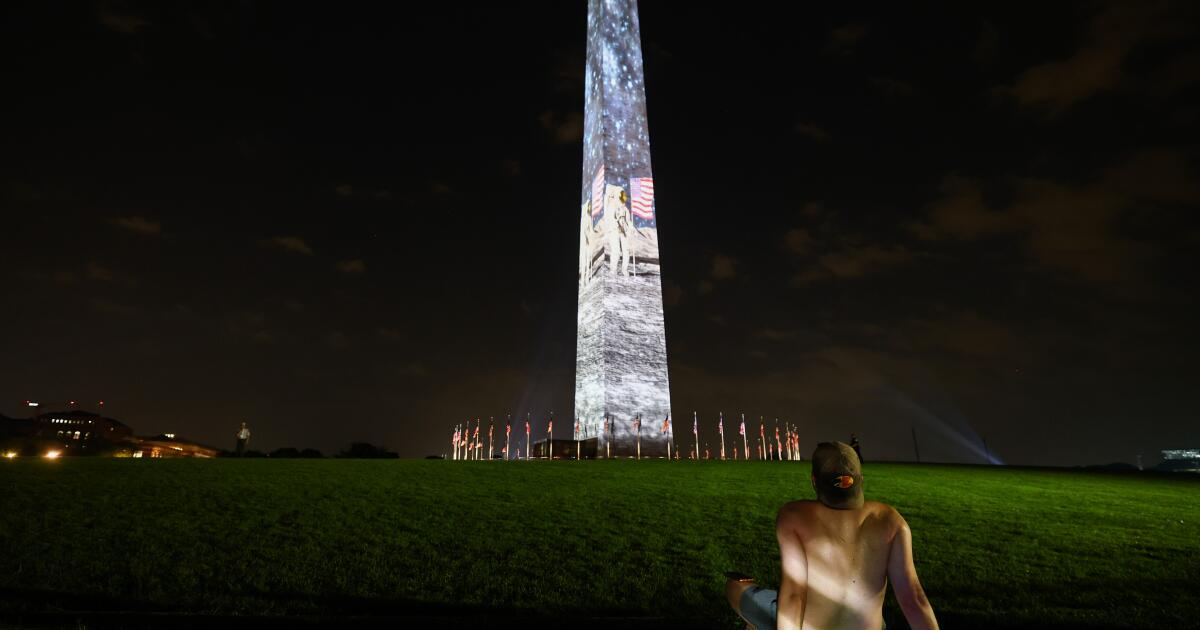
Trump refashions America’s 250th as a celebration of himself
-
 Sports30 minutes ago
How Dodgers’ Max Muncy, vying for his third All-Star selection, continues to evolve
-

 World42 minutes ago
Germany’s Merz defends NATO spending after Trump calls it ‘ridiculous’
-
 News1 hour ago
Oregon ER doctors win a ‘David and Goliath’ battle against a national company
-

 Videos2 hours ago
Iran gets ready for Khamenei’s funeral • FRANCE 24 English
-

 Los Angeles, Ca2 hours ago
2 arrested after 3 LASD deputies injured during East L.A. World Cup celebration

