Milwaukee, WI
Summer 2024 was one of Milwaukee’s warmest in history, setting multiple records


Summer in Milwaukee from a bird’s-eye view
Take a look of the Milwaukee lakefront, downtown, the Milwaukee River and Atwater Park in Shorewood via a drone.
Chelsey Lewis and Mike De Sisti, Milwaukee Journal Sentinel
September is here, meaning meteorological summer is officially over.
But, before we welcome cooler weather, colorful leaves and pumpkin spice, let’s recap this summer’s weather.
Summer in Milwaukee had average temperatures slightly above normal, with multiple periods of record-setting, well-above-normal temps driving up the overall average, the Milwaukee-Sullivan National Weather Service reported.
According to the NWS, this summer ― defined by the weather service as June 1 through Aug. 31 ― was Milwaukee’s 19th-warmest, per Weather Service data dating to the 1870s.
The summer’s three-month average temperature of 71.8 degrees was 0.7 degrees warmer than the 30-year climate normal. Milwaukee’s warmest summer ever was in 2012, when the three-month average temperature was 74.1 degrees. Five of the 10 warmest summers in the city’s history have occurred since 2010, according to NWS data.
How warm was summer 2024 in Milwaukee?
Though the summer’s average temperature wasn’t too far off normal, multiple periods of extreme heat set daily temperature records for Milwaukee.
The summer’s hottest recorded temperature in the city was 94 degrees, on June 17 and 18 and again on Aug. 26 and 27. This set Milwaukee’s June 17 record high and came close to the city’s Aug. 26 record high of 96 degrees, set in 1953.
Milwaukee also had three record-warm low temperatures this summer: 78 degrees on June 18 and Aug. 26 and 75 degrees on Aug. 27. Due to heat indices around 100 degrees, a heat advisory was issued in Milwaukee County on Aug. 26, and an excessive heat warning was in effect the next day.
June 2024 was Milwaukee’s eighth-warmest June on record, according to NWS data. The month’s average recorded temperature of 70.4 degrees was nearly 3 degrees warmer than the city’s 30-year normal. Meanwhile, this summer was only the 46th-warmest July on record, with average temps actually 0.8 below normal. According to an NWS Facebook post, this August had an average temp of 72.3 degrees, identical to the 30-year normal.
What does Milwaukee’s warm summer mean for this fall and winter?
According to the National Oceanic and Atmospheric Administration’s long-range forecast, Wisconsin is expected to see above-normal temperatures this fall, with chances highest in the far-southeastern portion of the state, including the Milwaukee area.
By winter, a naturally occurring weather phenomenon known as La Niña is expected to bring a colder and snowier-than-normal winter to the northern U.S. La Niña is caused by the cooling of water temperatures in the central Pacific Ocean to below average for several months.
According to the NOAA, these cold waters in the Pacific push the polar jet stream northward. This often brings drought to the southern U.S. and heavy rains in the northwest and Canada. La Niña tends to produce colder winter temperatures in the northern U.S. and warmer temps in the south. It can also generate a more active hurricane season.
NOAA issued a La Niña watch in mid-June, predicting La Niña conditions to emerge between September and November and persist through the winter.
Last winter, Milwaukee and Wisconsin strongly experienced the effects of El Niño, the opposite of La Niña. During an El Niño year, warmer-than-average temperatures in the Pacific bring warmer, drier winter conditions to the northern U.S. Numerous local weather experts and meteorologists told the Journal Sentinel that El Niño was the main culprit behind Wisconsin’s record-setting warm winter.
More: This has been one of Milwaukee’s warmest and wettest summers. Here’s why



Milwaukee, WI
Where to watch San Antonio Spurs vs Milwaukee Bucks: Live stream, start time, TV channel, odds for Saturday, March 28

The San Antonio Spurs can clinch no worse than the Western Conference’s No. 2 playoff seed with a victory over the Milwaukee Bucks in an afternoon matinee game on Amazon.San Antonio is heavily favored with a moneyline of -2500, while Milwaukee is at +1100.
How to watch San Antonio Spurs vs. Milwaukee Bucks
-
Time: 3 p.m. ET / 12 p.m. PT
-
Where: Fiserv Forum, Milwaukee, Wis.
Advertisement
Team records
-
San Antonio Spurs: 55-18 (No. 1 in Southwest Division)
-
Milwaukee Bucks: 29-43 (No. 3 in Central Division)
Odds
-
Spread: San Antonio Spurs -18.5
-
Moneyline: Milwaukee Bucks +1100) / San Antonio Spurs -2500
Milwaukee, WI
Travelers see shorter lines at Milwaukee Mitchell despite the ongoing partial government shutdown

MILWAUKEE — Despite a partial government shutdown causing long TSA lines at airports across the country, travelers at Milwaukee Mitchell airport are experiencing short wait times ahead of spring break.
John Wahlen and his colleague Joe Orendorf were coming back home from North Carolina and prepared for a much different scene.
“We were remarkably surprised that it was as easy as it was,” Wahlen said.
Brendyn Jones/TMJ4
A national TSA spokesperson told TMJ4 that over 3,450 TSA officers called out across the country on Thursday. The national call-out rate was at 11.83% percent, the highest since the shutdown began.
While the TSA could not provide specific numbers for Milwaukee Mitchell, the airport was not in the top-10 for call-out rates.
The highest percentages of call-offs came from much larger airports, including George Bush Intercontinental in Houston at 44 percent, Atlanta at almost 41 percent, and Baltimore at 37 percent.
“We were in smaller airports, Raleigh-Durham, I think we waited for two people, and one of them was him,” Orendorf said.
Watch: Travelers see shorter lines at Milwaukee Mitchell despite the ongoing partial government shutdown
Travelers see shorter lines at Milwaukee Mitchell despite the ongoing partial government shutdown
A spokesperson for Milwaukee Mitchell told TMJ4 that around 11,000 people are expected this Friday and Saturday, and next Friday and Saturday as spring break travel peaks.
President Trump signed an executive order to pay TSA agents, meaning a resolution may be on the horizon. Travelers, including Selena Mauricio, said they are thankful for the agents who are still showing up.

Brendyn Jones/TMJ4
“Their jobs aren’t easy, and I commend the ones that still come to work, definitely,” Mauricio said.
This story was reported on-air by Brendyn Jones and has been converted to this platform with the assistance of AI. Our editorial team verifies all reporting on all platforms for fairness and accuracy.
Let’s talk:
Hey there! At TMJ4 News, we’re all about listening to our audience and tackling the stuff that really matters to you. Got a story idea, tip, or just want to chat about this piece? Hit us up using the form below. For more ways to get in touch, head over to tmj4.com/tips.
It’s about time to watch on your time. Stream local news and weather 24/7 by searching for “TMJ4” on your device.
Available for download on Roku, Apple TV, Amazon Fire TV, and more.
Report a typo or error // Submit a news tip
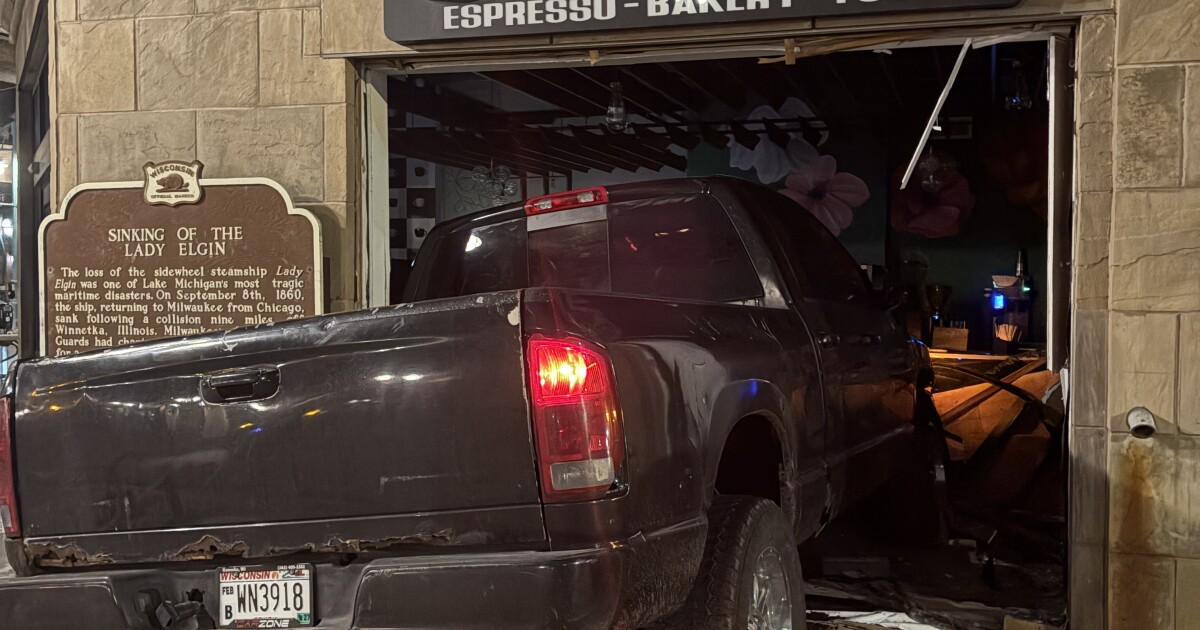
MILWAUKEE — A truck drove through the Grace Coffee Co. in Milwaukee’s Historic Third Ward on early Friday morning, the owners announced in a social media post.
Due to the extensive damage that was done, the coffee shop will be closed until further notice.
TMJ4
“We’re incredibly grateful no one was hurt, and we’ll keep you updated as we begin repairs,” the coffee shop said in the post.
TMJ4 reached out to the Milwaukee Police Department but have yet to hear back.
Let’s talk:
Hey there! At TMJ4 News, we’re all about listening to our audience and tackling the stuff that really matters to you. Got a story idea, tip, or just want to chat about this piece? Hit us up using the form below. For more ways to get in touch, head over to tmj4.com/tips.
It’s about time to watch on your time. Stream local news and weather 24/7 by searching for “TMJ4” on your device.
Available for download on Roku, Apple TV, Amazon Fire TV, and more.
Report a typo or error // Submit a news tip

6 Alaska high school track and field athletes to watch, plus top Big C Relays performances

Jenae Berry’s strongest outing as a Wildcat secures Arizona softball’s series win over Baylor

Renegade wins 2026 Arkansas Derby

Central California Women’s Facility Hosts Groundbreaking Film Festival, Showcasing Incarcerated and Formerly Incarcerated Filmmakers – News Releases

+)WAY TO WATCH Free New Mexico United vs Colorado Springs Switchbacks FC LIVE

Florida High School Football Rankings: Top 25 teams – Oct. 21

How old is Bo Nix? What to know about Oregon quarterback ahead of 2024 NFL Draft

Cleary's 21 help Le Moyne down Central Connecticut State 69-64 in OT

99th annual Pony Swim held in Virginia

Indiana Members Credit Union announced as new anchor tenant at Bottleworks District

Jeffries declines to break with indicted Democrat after ethics panel’s guilty verdict

Hundreds of thousands march through London in stand against the far right

2 students killed, 7 other people injured in Tennessee bus crash during school field trip

Dem senators dodge crucial question on illegal alien accused of killing Chicago college student

EU Parliament unblocks key political hurdle in digital euro talks
-

 Detroit, MI1 week ago
Drummer Brian Pastoria, longtime Detroit music advocate, dies at 68
-

 Movie Reviews1 week ago
‘Youth’ Twitter review: Ken Karunaas impresses audiences; Suraj Venjaramoodu adds charm; music wins praise | – The Times of India
-

 Sports1 week ago
IOC addresses execution of 19-year-old Iranian wrestler Saleh Mohammadi
-

 New Mexico6 days ago
Clovis shooting leaves one dead, four injured
-
 Business1 week ago
Disney’s new CEO says his focus is on storytelling and creativity
-

 Tennessee5 days ago
Tennessee Police Investigating Alleged Assault Involving ‘Reacher’ Star Alan Ritchson
-

 Technology6 days ago
YouTube job scam text: How to spot it fast
-

 Texas1 week ago
How to buy Houston vs. Texas A&M 2026 March Madness tickets