Indiana
Still no harvest: Marijuana bills continue to stall in Indiana General Assembly – Indianapolis Business Journal


To some, it seemed like the 2023 session of the Indiana General Assembly marked a turning point for marijuana-related legislation.
In 2023, House Bill 1297, authored by Rep. Heath VanNatter, R-Kokomo, made history by actually getting a legislative hearing. That bill would have decriminalized possession of two ounces or less of marijuana.
Advocates and legislators who support decriminalization, or legalizing marijuana for recreational or medical uses, held out hope that the legislative momentum would continue in 2024.
That didn’t prove to be the case.
This year, there were 10 marijuana-related bills filed in the Indiana House and Senate.
None made it out of committee.
VanNatter, who co-authored HBs 1349, 1350 and 1410 this year, said he hears from constituents all the time about the state’s need to legalize marijuana for either recreational or medical reasons.
The Kokomo representative said there’s still hesitation from the Legislature and Gov. Eric Holcomb to pass bills linked to legalization.
Still, given last year’s historic hearing, VanNatter said he remains confident Indiana will join surrounding states in legalizing marijuana.
“We’re going to get there at some point,” he said.
Polls show support
The 2022 Hoosier Survey, a poll conducted by Indiana Public Broadcasting and Ball State University’s Bowen Center for Public Affairs, showed more than 85% of the 600 respondents supported marijuana legalization in some form, compared to 15% who said it should be illegal.
Against that backdrop, legislators in the 2024 session filed bills like Senate Bill 126, authored by Senate Minority Leader Greg Taylor of Indianapolis, that looked to establish a medical marijuana program and to permit caregivers and patients who have received a physician recommendation to possess a certain quantity of marijuana for treatment of certain medical conditions.
Taylor’s bill also sought to establish a regulatory agency to oversee the program.

In the Indiana House, VanNatter co-authored HB 1349 and 1350 with Rep. Jake Teshka, R-North Liberty, and Rep. Steve Bartels, R-Eckerty.
Like last year’s HB 1297, HB 1349 would have decriminalized possession of two ounces or less of marijuana. HB 1350 looked to establish a procedure for the lawful production and sale of cannabis in Indiana.
In 2023, Teshka also authored House Bill 1039, a piece of legislation that sought to legalize and provide a regulatory infrastructure for medical and adult use cannabis after marijuana is removed as a federal Schedule I controlled substance.
Teshka told Indiana Lawyer that the Legislature needs to be having discussions about legalization, particularly given that most surrounding states have approved marijuana for both recreational and medical use.
“We’ve got to be having the conversation now,” he said.

National efforts
In neighboring Ohio, voters approved a ballot initiative in November 2023 legalizing recreational marijuana. Passage of Issue 2 made Ohio the 24th state to allow adult cannabis use for nonmedical purposes.
Each state surrounding Indiana has legalized either recreational or medical marijuana, with some states legalizing the drug for both uses.
Nationwide, California was the first state to legalize medical marijuana in 1996. Since then, the medical use of cannabis has been legalized in 40 states and the District of Columbia.
Back in Indiana, Sens. Eric Bassler, R-Washington, and Rodney Pol, D-Chesterton, this year co-authored SB 294 for medical cannabis.
After marijuana is removed as a federal Schedule I controlled substance, the bill sought to permit the use of cannabis by a person with a serious medical condition as determined by the person’s physician. It would also establish a cannabis program to permit the cultivation, processing, testing, transportation and sale of cannabis by holders of a valid permit, as well as set up an Indiana Cannabis Commission as a state agency to oversee, implement and enforce the program.
Pol said he and other supporters of legalization have been running into the same talking points from legislative opponents for years.
He said arguments against legalizing marijuana have shifted from, “The state needs to wait for the federal government to reschedule marijuana,” to, “The Legislature doesn’t have time to deal with the issue.”
“It’s becoming clear it’s an avoidance tactic,” Pol said.
Last August, the U.S. Department of Health and Human Services delivered a recommendation to the Drug Enforcement Administration that marijuana be moved from a Schedule I to a Schedule III controlled substance.
Republican Gov. Holcomb has held firm that Indiana should wait until marijuana is federally legalized before considering legalization in the state.
Next year?
Pol said he’s filed marijuana-related bills every year he’s been in the Senate.
That won’t change next year.
“I filed for three years in a row since I started, and I’ll continue to do so,” he said.
Pleas to pass some form of marijuana legislation are among the most common requests from his constituents, Pol added.
Given his area’s close proximity to Illinois and Michigan, Pol said he and residents in northwest Indiana have seen the good economic effects of marijuana legalization, as well as the benefits of decriminalizing the drug.
Pol said he thinks the hesitation to legalize in Indiana comes primarily from the Legislature.
Also, with Holcomb leaving office at the end of the year, Pol said he hasn’t seen any Republican gubernatorial candidates speak out about the need for marijuana legalization.
Conversely, Pol pointed to Democratic candidate Jennifer McCormick, who he said seems to be more open to the idea of legalization.
Teshka said he would probably be a lead author or co-author for marijuana-related bills in the state’s 2025 legislative session.
Like Pol, Teshka said he finds broad support for legalization in his district from Republicans, Democrats, independents and people with other political affiliations.
Likewise, VanNatter said he’s definitely going to introduce legislation next year, with the Kokomo representative noting there will be a new governor and several new representatives and senators at the Statehouse in 2025.
He said decriminalization is his biggest priority.
“Every election cycle, there’s more and more people that are supportive,” VanNatter said.•



![++[LIVESTREAMS]TV!! New Mexico United vs Colorado Springs Switchbacks FC Live 𝖲𝗍𝗋𝖾𝖺𝗆](https://i2.wp.com/res.cloudinary.com/pgatour-prod/w_854,h_480,c_fill,f_auto,q_auto/pgatour/pages/pga-tour-live/live-header-tl.png?w=400&resize=400,240&ssl=1 "++[LIVESTREAMS]TV!! New Mexico United vs Colorado Springs Switchbacks FC Live 𝖲𝗍𝗋𝖾𝖺𝗆")


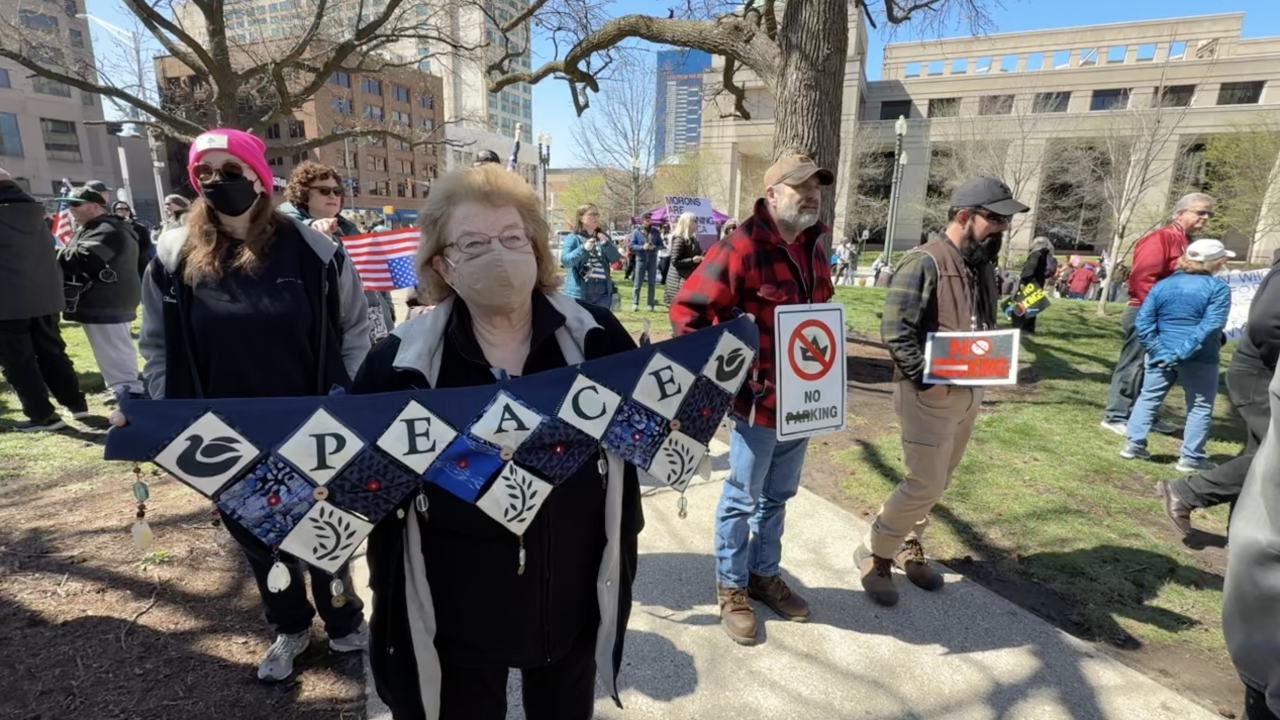
INDIANAPOLIS — Hundreds of Hoosiers gathered at the Indiana Statehouse Saturday morning as part of nationwide ‘No Kings’ events to voice their concerns about the current administration.
WATCH FULL STORY BELOW
Hundreds gather at Indiana State Capitol for ‘No Kings’ protest
“I’m out here today because what’s happening in our government is completely trash,” Donna Sipes told WRTV. “It’s wrong. We need to do something about it.”
“I’m tired of every single day when the TV comes on to see what stupid thing he’s done next,” Lindi Marti said.
WRTV
Attendees noted the growing popularity of the demonstrations.
“This is my fourth one to come to. I didn’t come to all of them when it was really cold, but I’m glad to see that they are getting a lot more people out here every time,” Marti added. “It seems like there’s more and more coming.”
Demonstrators highlighted specific foreign policy concerns, including the administration’s handling of the war in Iran.
“We’re bombing the heck out of them. We’re killing civilians,” Marti’s husband said. “We’re getting ready to send our Marines.”
WRTV
Others focused on the administration’s handling of immigration.
“That’s what I’m concerned about,” Reverend Kenny Little told WRTV. “Little kids, they’re taking them away from their family. And I’m just one of those people, I think everyone got rights.”
Indiana medical students also attended the rally to speak out against changes to the healthcare system.
“We’re really worried about the attacks on the health care system in general, but with Medicaid… current estimates range from anywhere from 325,000 to 450,000 Hoosiers will lose coverage by 2032,” Wade Catt said with concern.
WRTV
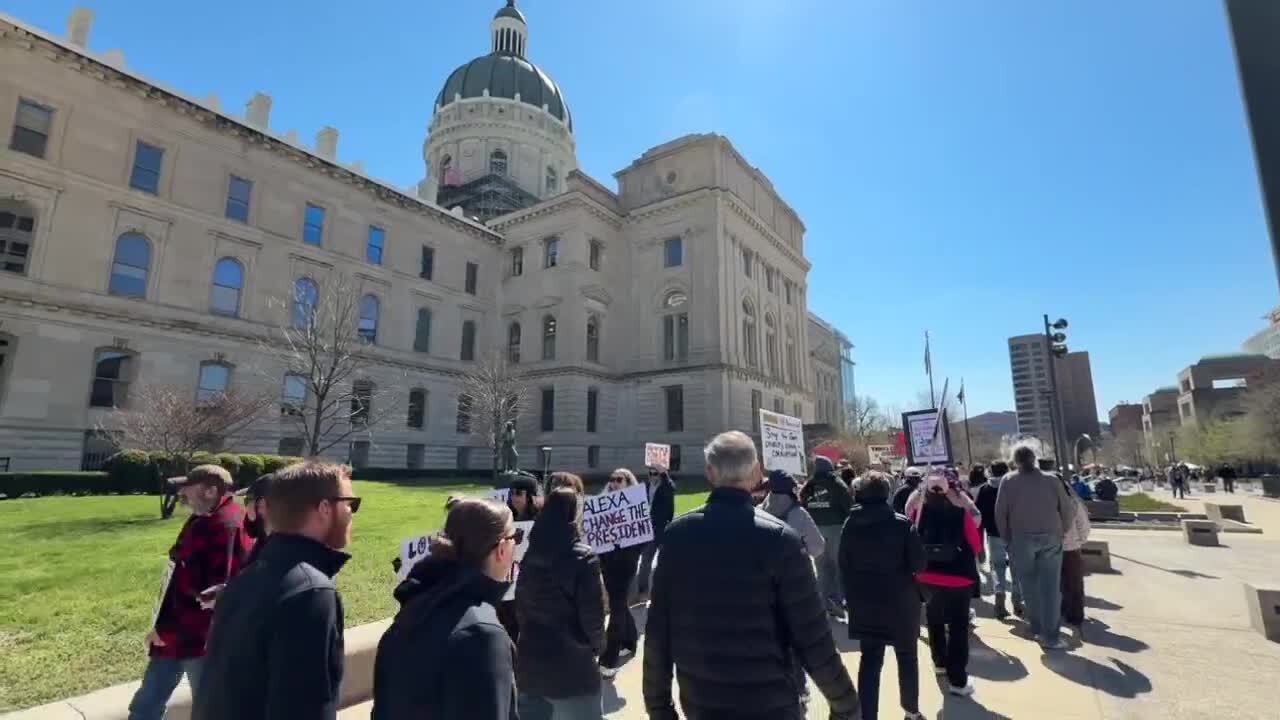
With midterm elections approaching later this year, attendees emphasized the importance of now taking action at the ballot box.
“If we don’t vote, then things are gonna not, they’re gonna stay the same,” a protester said.
Meanwhile, Indiana Lieutenant Governor Micah Beckwith says he’s happy to see Hoosiers exercise their First Amendment right to protest.
However, he takes issue with the idea that President Trump is acting like a king. Beckwith says the fact that people have the freedom to protest is proof that the president is not acting like a tyrant.
He acknowledges that bridging the gap between the sides is probably an uphill battle, but believes communication is key.
“I think when you sit down with people face to face, you’re confronted with humanity. There’s another human sitting across that table from you and talking to you. And so, all I have to say, I think that’s probably the thing I would encourage all Hoosiers to do is say, ‘Hey, if you don’t agree with somebody or if you don’t like somebody, why don’t you try grabbing coffee with them? And give it 30 minutes, and just see what happens.’ I bet most of the time people will walk away with a much softer heart and spirit towards that person before they came in,” Beckwith said.
Beckwith is currently on a 92-county tour of the state. He says all sides are welcome to attend his events.
__

INDIANAPOLIS (WISH) — Police say one “young man” is dead after a shooting at the 1200 block of Rue Rabelais at about 7:19 p.m. according to the Indianapolis Metropolitan Police Department.
That is near the intersection of 56th Street and Binford Boulevard.
Police say the victim was taken to Riley Hospital where he later died. Investigators say they are still working to identify the victim.
There was no known information about a suspect. Police did say that they believe this is a targeted incident.
There was no other information immediately available.
This story has been updated with information from the Indianapolis Metropolitan Police Department.

This story contains descriptions of distressing circumstances involving children.
INDIANAPOLIS (WISH) – A mother and her boyfriend were accused of causing the death of a 4-year-old-boy found dead in a basement closet on Monday.
Indianapolis Metropolitan Police Department arrested Angel Lovely, 37, and Nicholas Bergdoll, 36, on preliminary charges of neglect of a dependent causing death. The Marion County Prosecutor’s Office by Friday had not filed formal charges.
A sibling found the 4-year-old dead on Monday, according to investigators. Lovely and Bergdoll were in the home at the time but told police they were asleep when he died.
Born premature with cerebral palsy, the 4-year old couldn’t walk, was nonverbal, and ate through a feeding tube. Lovely claimed she would rarely put the child in the closet, only “when he won’t stop screaming” or when she “needed a break.”
But when investigators interviewed Lovely’s three other children, they said that the boy “stays in the closet all day,” and that “mom locks him in the closet” and “does not pay attention to him.”
An exact cause of death hasn’t been determined, but the child was found with blood in his mouth. Lovely said he’d been aspirating.
One of Lovely’s children told investigators they heard the 4-year-old gagging but didn’t say anything because it wasn’t unusual.
A neighbor living on Monticello Drive, Michelle Johnson, told News 8, “It’s horrible. It breaks my heart.”
Johnson had seen the other children outside the home but never knew there was a boy in a wheelchair living there. She said if she suspected they were being neglected, she would have called police or the Indiana Department of Child Services.
“We’re supposed to be a village and raise kids together,” Johnson said. “That’s really heartbreaking.”
Bergdoll told police, according to the investigators’ report, that he didn’t agree with putting the child in the closet: “I am not going to tell her how to f****** raise her kids.”
“I’m sickened,” IMPD Public Information Officer Tommy Thompson told News 8 in an interview.
“Think about putting yourself in that situation. Every day, do you want to be in a closet? Locked up, no light?”
Court records show the Department of Child Services had removed the boy from Lovely’s care because of medical neglect, but she regained custody last year against DCS recommendations.
Thompson, the neighbor, hopes the tragedy can be an opportunity for others to speak up when they see a child who can’t speak up for themselves. “Maybe you’ve got to make that tough phone call. Reach out. The city has resources.”
Johnson wishes she would have known what was happening so she could have said something. “Children don’t have a voice and we’re supposed to be their voice.”
Help is available for victims of domestic violence, child abuse, and sexual assault. Below is a list of suggested resources, both national and local:

Suspect in custody after fleeing Arizona troopers and barricading inside a Phoenix neighborhood shed

Arkansas Storm Team Forecast: Midweek Rain Chances

Corn tortillas in California now must contain folic acid. More states are looking at it
![++[LIVESTREAMS]TV!! New Mexico United vs Colorado Springs Switchbacks FC Live 𝖲𝗍𝗋𝖾𝖺𝗆](https://i2.wp.com/res.cloudinary.com/pgatour-prod/w_854,h_480,c_fill,f_auto,q_auto/pgatour/pages/pga-tour-live/live-header-tl.png?w=80&resize=80,80&ssl=1 "++[LIVESTREAMS]TV!! New Mexico United vs Colorado Springs Switchbacks FC Live 𝖲𝗍𝗋𝖾𝖺𝗆")
++[LIVESTREAMS]TV!! New Mexico United vs Colorado Springs Switchbacks FC Live 𝖲𝗍𝗋𝖾𝖺𝗆

Two arrested after armed robbery in Wethersfield Saturday night

Florida High School Football Rankings: Top 25 teams – Oct. 21

How old is Bo Nix? What to know about Oregon quarterback ahead of 2024 NFL Draft

Cleary's 21 help Le Moyne down Central Connecticut State 69-64 in OT

99th annual Pony Swim held in Virginia

Indiana Members Credit Union announced as new anchor tenant at Bottleworks District

JD Vance says he was ‘obsessed’ with UFOs, believes aliens are actually ‘demons’
The EU's recipe for trade deals : easy on beef, tough on wine

Photos: ‘No Kings’ protests across the country

Jeffries declines to break with indicted Democrat after ethics panel’s guilty verdict

Hundreds of thousands march through London in stand against the far right
-

 Sports1 week ago
IOC addresses execution of 19-year-old Iranian wrestler Saleh Mohammadi
-

 New Mexico7 days ago
Clovis shooting leaves one dead, four injured
-

 Tennessee6 days ago
Tennessee Police Investigating Alleged Assault Involving ‘Reacher’ Star Alan Ritchson
-

 Technology7 days ago
YouTube job scam text: How to spot it fast
-

 Minneapolis, MN3 days ago
Boy who shielded classmate during school shooting receives Medal of Honor
-

 Science1 week ago
Record Heat Meets a Major Snow Drought Across the West
-

 Politics1 week ago
Schumer gambit fails as DHS shutdown hits 36 days and airport lines grow
-

 Politics1 week ago
Trump gives Iran 48-hour ultimatum to reopen Strait of Hormuz or face strikes on power plants