Indiana
Indiana Gov. Eric Holcomb signs proclamation condemning antisemitism while vetoing bill defining it


INDIANAPOLIS — Indiana Gov. Eric Holcomb vetoed a bill Monday that would have defined antisemitism in state education code while simultaneously signing a proclamation condemning all forms of antisemitism.
The Republican governor cited changes made to the bill in the final days of the legislative session in a news release. Aimed at addressing antisemitism on college campuses, the bill’s opponents argued that early versions of it would penalize people for criticizing Israel.
Disagreements between lawmakers in the Republican-controlled state House and Senate threatened to kill the bill before reaching a compromise in the final hours of the legislative session on March 8.
This is the second time the state House has tried to pass the legislation; an identical bill died last year after failing to reach a committee hearing in the state Senate.
Around the country, similar legislation rose to prominence this session amid the ongoing Israel-Hamas war.
The proposal would broadly define antisemitism as religious discrimination, claiming it would “provide educational opportunities free of religious discrimination.”
Defined in 2016 by the International Holocaust Remembrance Alliance, antisemitism is “a certain perception of Jews, which may be expressed as hatred toward Jews. Rhetorical and physical manifestations of antisemitism are directed toward Jewish or non-Jewish individuals and/or their property, toward Jewish community institutions and religious facilities.”
The original House bill used the organization’s definition, which its author has since warned against using in law. It also included “contemporary examples of antisemitism” provided by the group, which make explicit references to Israel. These have been adopted by the U.S. Department of State and under former President Donald Trump, through executive order.
Over 30 states have adopted the definition in some way either through proclamation, executive order or legislation.
State senators, however, passed an amended version of the bill earlier this month that still included the IHRA’s broad definition of antisemitism but deleted the group’s name and examples that include explicit references to Israel. Opponents including the Indiana Muslim Advocacy Network and Jewish Voice for Peace Indiana had argued that such direct references would stifle criticism of Israel in academic settings and activism on campuses in support of Palestinians facing a worsening humanitarian crisis and widespread starvation.
The disagreement between the chambers prompted the bill to go to conference committee, a body consisting of lawmakers from both chambers. The committee reached an agreement on the last day of the legislative session to add the IHRA attribution back to the bill but remove the clause with examples. The final version was approved in both chambers with bipartisan support.
“The language that emerged in the final days of the legislative session fails to incorporate the entire International Holocaust Remembrance Alliance (IHRA) definition and its important contemporary examples,” Holcomb said about vetoing the bill. “Additionally, the confusing language included in the bill could be read to exclude those examples.”
The Indianapolis Jewish Community Relations Council (JCRC) said the group supported the final version of the bill after it passed, as did the Indiana Muslim Advocacy Network, which was opposed to the original version over concerns about academic freedom and advocacy.
Holcomb’s support wasn’t clear after its passage. Last week, he expressed concern that Indiana would be an “outlier” among other states thanks to the changes and said he wanted to ensure there is no “ambiguity” in Indiana law.
Republican Indiana Attorney General Todd Rokita called on Holcomb to veto the bill, saying it is “toothless” without the mention of the examples.
Holcomb’s proclamation condemning antisemitism cites the IHRA definition and its examples. In a statement, Holcomb said the proclamation “ensures we join numerous states and countries by supporting the entire IHRA definition with its inextricable examples.”
The JCRC thanked Holcomb in a statement for his “thoughtful” consideration of “the concerns raised in recent days by national experts and the Attorney General.”
The group said it will work closely with lawmakers and the state to “ensure that the guidance of Governor Holcomb’s proclamation is correctly applied to identify and confront antisemitism and meet the needs of Jewish students in K-12 and higher educational settings.”
Holcomb has not vetoed a bill since 2022. Lawmakers can easily overturn a veto in Indiana and only need a simple majority to do so. It’s unclear though if or when lawmakers might reconvene.
The push to define antisemitism in numerous states predates the Oct. 7 attacks in which Hamas killed some 1,200 people, mostly civilians, sparking a war that has killed more than 31,000 Palestinians. But the war gave supporters of the push another motivation. This year, governors in Arkansas, Georgia and South Dakota signed measures and a proposal is still awaiting gubernatorial review in Florida.



INDIANAPOLIS (WISH) – The 2026 NCAA Division I Men’s Basketball Tournament’s Final Four is set.
Four teams have advanced to the Final Four and will compete for the national championship this upcoming weekend in Indianapolis.
The two national semifinal matchups will take place on Saturday. Tip times for the two games have been announced:
- 6:09 p.m. EDT – No. 3 seed Illinois vs. No. 2 seed UConn
- 8:49 p.m. EDT – No. 1 seed Michigan vs. No. 1 seed Arizona
The winners of Saturday’s games will then play in the National Championship Game on Monday, April 6.
Each game will take place inside Lucas Oil Stadium.

INDIANAPOLIS — Hundreds of Hoosiers gathered at the Indiana Statehouse Saturday morning as part of nationwide ‘No Kings’ events to voice their concerns about the current administration.
WATCH FULL STORY BELOW
Hundreds gather at Indiana State Capitol for ‘No Kings’ protest
“I’m out here today because what’s happening in our government is completely trash,” Donna Sipes told WRTV. “It’s wrong. We need to do something about it.”
“I’m tired of every single day when the TV comes on to see what stupid thing he’s done next,” Lindi Marti said.
WRTV
Attendees noted the growing popularity of the demonstrations.
“This is my fourth one to come to. I didn’t come to all of them when it was really cold, but I’m glad to see that they are getting a lot more people out here every time,” Marti added. “It seems like there’s more and more coming.”
Demonstrators highlighted specific foreign policy concerns, including the administration’s handling of the war in Iran.
“We’re bombing the heck out of them. We’re killing civilians,” Marti’s husband said. “We’re getting ready to send our Marines.”
WRTV
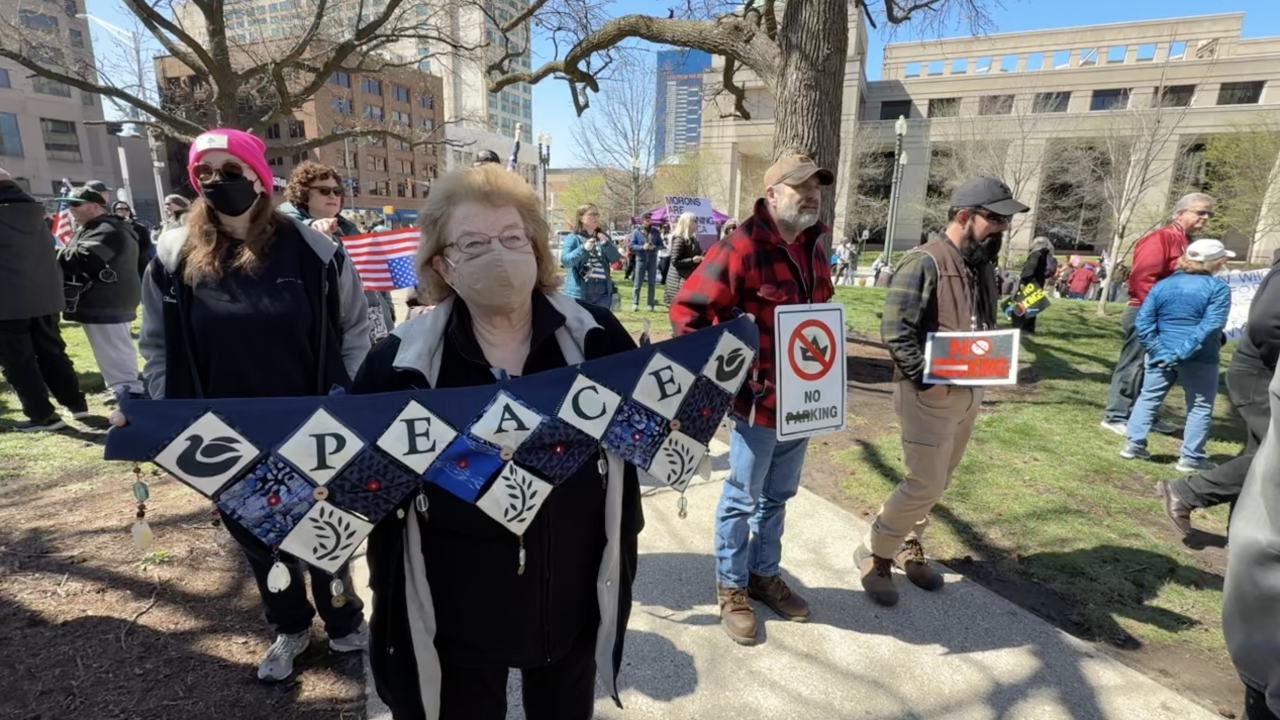
Others focused on the administration’s handling of immigration.
“That’s what I’m concerned about,” Reverend Kenny Little told WRTV. “Little kids, they’re taking them away from their family. And I’m just one of those people, I think everyone got rights.”
Indiana medical students also attended the rally to speak out against changes to the healthcare system.
“We’re really worried about the attacks on the health care system in general, but with Medicaid… current estimates range from anywhere from 325,000 to 450,000 Hoosiers will lose coverage by 2032,” Wade Catt said with concern.
WRTV
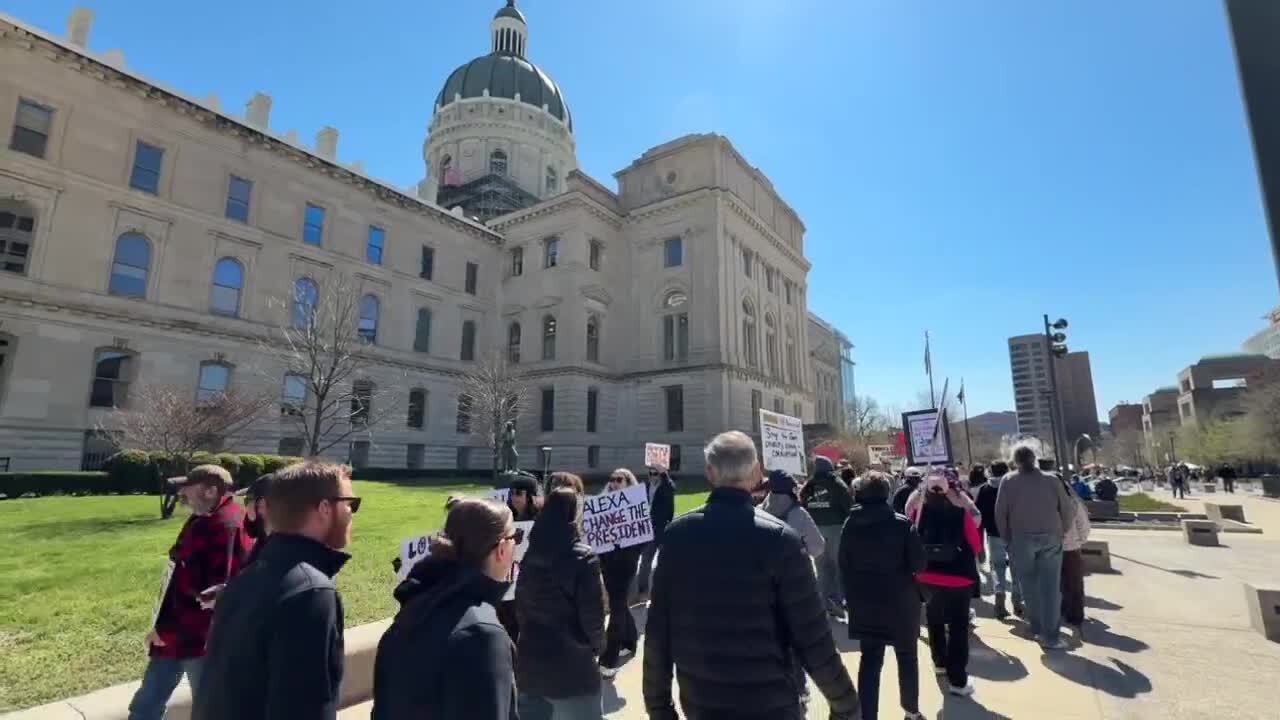
With midterm elections approaching later this year, attendees emphasized the importance of now taking action at the ballot box.
“If we don’t vote, then things are gonna not, they’re gonna stay the same,” a protester said.
Meanwhile, Indiana Lieutenant Governor Micah Beckwith says he’s happy to see Hoosiers exercise their First Amendment right to protest.
However, he takes issue with the idea that President Trump is acting like a king. Beckwith says the fact that people have the freedom to protest is proof that the president is not acting like a tyrant.
He acknowledges that bridging the gap between the sides is probably an uphill battle, but believes communication is key.
“I think when you sit down with people face to face, you’re confronted with humanity. There’s another human sitting across that table from you and talking to you. And so, all I have to say, I think that’s probably the thing I would encourage all Hoosiers to do is say, ‘Hey, if you don’t agree with somebody or if you don’t like somebody, why don’t you try grabbing coffee with them? And give it 30 minutes, and just see what happens.’ I bet most of the time people will walk away with a much softer heart and spirit towards that person before they came in,” Beckwith said.
Beckwith is currently on a 92-county tour of the state. He says all sides are welcome to attend his events.
__

INDIANAPOLIS (WISH) — Police say one “young man” is dead after a shooting at the 1200 block of Rue Rabelais at about 7:19 p.m. according to the Indianapolis Metropolitan Police Department.
That is near the intersection of 56th Street and Binford Boulevard.
Police say the victim was taken to Riley Hospital where he later died. Investigators say they are still working to identify the victim.
There was no known information about a suspect. Police did say that they believe this is a targeted incident.
There was no other information immediately available.
This story has been updated with information from the Indianapolis Metropolitan Police Department.
ICE officers could remain at airports after TSA workers are paid

Wolverines make Frozen Four

Bay Area residents hold rally in SF as war with Iran enters 2nd month

Dallas Jenkins says he is the ‘evangelical mascot of the LDS church’ and talks Easter celebrations

New video shows aftermath of police shooting in Downtown Miami

Florida High School Football Rankings: Top 25 teams – Oct. 21

How old is Bo Nix? What to know about Oregon quarterback ahead of 2024 NFL Draft

Cleary's 21 help Le Moyne down Central Connecticut State 69-64 in OT

99th annual Pony Swim held in Virginia

Indiana Members Credit Union announced as new anchor tenant at Bottleworks District
ICE officers could remain at airports after TSA workers are paid

Scathing report claims nation’s oldest labor union ‘betrayed’ MAGA members through ‘shocking’ spending

Republican US lawmaker demands Congress vote on any Iran troop deployment

So you went to a No Kings protest. Now what?

JD Vance says he was ‘obsessed’ with UFOs, believes aliens are actually ‘demons’
-

 Sports1 week ago
IOC addresses execution of 19-year-old Iranian wrestler Saleh Mohammadi
-

 New Mexico1 week ago
Clovis shooting leaves one dead, four injured
-

 Miami, FL4 days ago
Jannik Sinner’s Girlfriend Laila Hasanovic Stuns in Ab-Revealing Post Amid Miami Open
-

 Tennessee6 days ago
Tennessee Police Investigating Alleged Assault Involving ‘Reacher’ Star Alan Ritchson
-

 Minneapolis, MN4 days ago
Boy who shielded classmate during school shooting receives Medal of Honor
-

 Politics1 week ago
Schumer gambit fails as DHS shutdown hits 36 days and airport lines grow
-

 Science1 week ago
Record Heat Meets a Major Snow Drought Across the West
-

 Technology1 week ago
YouTube job scam text: How to spot it fast