Midwest
Illinois city slapped with lawsuit over 'unconstitutional' reparations plan: 'Using race as a proxy'

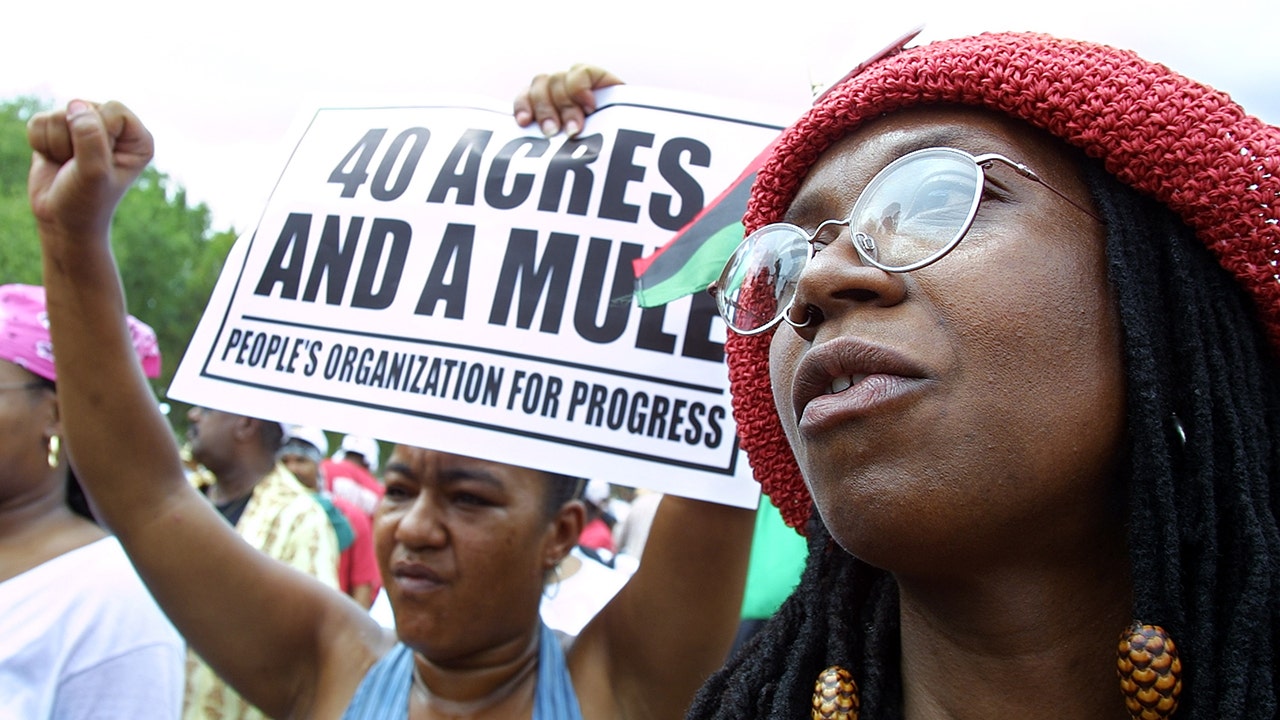
Some residents of Evanston, Illinois, are suing their city for doling out reparation payments in what they call an “unconstitutional” program.
The Illinois city made history in 2019 by becoming the first in the nation to create a government-funded reparations program for current and former Black residents. In 2021, the Evanston City Council voted 8-1 to approve a reparations plan that would provide $25,000 for qualifying Black residents to address harms caused by a pattern of housing discrimination and segregation that existed between 1919 and 1969.
Six non-Black residents attacked this since-implemented program for being “presumptively unconstitutional” based on its racial requirement.
Some Evanston citizens are accusing a reparations program of violating the Equal Protection clause by favoring Black residents. (Photo by Manny Ceneta/Getty Images)
“Defendant [Evanston], acting under color of law, is depriving Plaintiffs of their right to equal protection by purposefully and intentionally discriminating against Plaintiffs on the basis of race. Defendant’s use of race as an eligibility requirement injures Plaintiffs because it is a barrier that prevents Plaintiffs from participating in and obtaining payments under the program on an equal footing with persons who are able to satisfy Defendant’s race requirement,” the lawsuit read.
‘WE’VE PROVEN’ REPARATIONS CAN WORK, EVANSTON ACTIVIST SAYS: ‘CITY HASN’T BLOWN UP’
It added, “Plaintiffs also are injured by Defendant’s use of race as an eligibility requirement because, but for the requirement, Plaintiffs would each be eligible for and in line to receive $25,000 under the program.”
The lawsuit seeks $25,000 payments to all eligible applicants regardless of race. (iStock)
The lawsuit also called the program “overinclusive,” as some groups eligible for payment were not required to provide evidence that they or their ancestors experienced housing discrimination and segregation. The city, the plaintiffs claim, is “using race as a proxy for having experienced discrimination during this time period.”
“Plaintiffs are being irreparably harmed by Defendant’s deprivation of their rights to equal protection and will continue to be irreparably harmed unless Defendant’s use of race as an eligibility requirement for the program is declared unconstitutional and enjoined,” the lawsuit claimed.
Evanston committed $10 million to the program and pledged another $10 million to the program in 2022. According to city records cited by the lawsuit, the city approved 454 “direct descendant” applications and plans to pay at least 80 applicants in 2024. 129 “ancestor” applications, people who lived in Evanston between 1919 and 1969, have already received payments.
REPARATIONS IN AMERICA: HOW CITIES FROM SAN FRANCISCO TO WILMINGTON ARE TRYING TO GET IT DONE
Plaintiffs are calling for Evanston to remove race as an eligibility requirement and award all eligible applicants, including non-Black citizens, the $25,000 promised in the program.
Evanston launched a committee to distribute reparations in 2019. (Ira L. Black/Corbis via Getty Images)
In a statement to Fox News Digital, Communications and Engagement Manager Cynthia Vargas said, “The City of Evanston does not comment on the specifics of pending litigation, but we will vehemently defend any lawsuit brought against our city’s reparations program.”
Fox News’ Kendall Tietz contributed to this report.
Read the full article from Here


This forecast is outdated and inaccurate. Get the latest forecast here.
CLEVELAND (WJW) — (WJW) — The National Weather Service has extended its EXTREME HEAT WARNING for all of Northeast Ohio.
It will remain in effect until 8 p.m. on Friday, July 3, in Ashland, Ashtabula, Crawford, Cuyahoga, Erie, Geauga, Holmes, Huron, Lake, Lorain, Mahoning Medina, Ottawa, Portage, Richland, Sandusky, Stark, Summit, Trumbull and Wayne counties; and until 10 p.m. Friday, July 3, in Carroll, Coshocton and Tuscarawas counties.
The heat waves continues! An EXTREME HEAT WARNING will remain in effect through 8 p.m. Friday. Heat indices could top 105 degrees during the hottest time of day on Friday.
Once again, there will not be much relief from the heat and humidity overnight. Tonight lows will be in the mid to upper 70s again. Feeling warmer with the higher humidity. Mostly clear skies.

Friday will be the last sweltering summer day before the heat starts to back off for the Fourth of July holiday weekend. There is the chance of rain and storms Friday evening, around 7pm that could go through the late evening. This may impact some 4th of July celebrations on Friday. Any storm that pops up we’ll have to watch for the potential of gusty winds, heavy downpours and large hail.

This is what the radar could look like by the time some Fireworks celebrations are expected Friday evening. We have a level 2 out of 5 chance of any storm turning severe, meaning that 1 or 2 have the chance.


The upper-level ridge, or heat dome, will start to breakdown on Friday. This means two things. The first is it will go from being very hot and humid to being very warm and humid. The second thing is the chance of rain and threat of storms will return.

The Fourth of July holiday weekend will be far from a washout! There will be more dry time than time with downpours and storms. However, clusters of downpours and storms will move through Northeast Ohio at times. This means some Fourth of July events, backyard BBQs, pool parties, and firework shows could be impacted by rain and storms.

With all the heat and humidity around, any downpours or storms that develop could be strong and produce gusty winds, small hail, torrential rain, and lightning. Here’s the latest 8 Day Forecast:

Keep up with FOX 8 News for the latest weather updates.

Celebrations around the country recall not only the events leading up to the adoption of the Declaration of Independence by the Continental Congress on July 4, 1776, but also look forward and aim to make the 4th of July weekend a massive, multigenerational cultural moment focused on community connections and charitable giving.
America’s Block Party, an unprecedented coast-to-coast initiative, is one of the signature events of America 250, the congressionally chartered nonprofit overseeing the semiquincentennial celebration.
A Times Square Ball Drop, a rolling series of ball drops, timed to occur at midnight on July 3 in every U.S. time zone from Guam to American Samoa, is part of the “Giving 4th Broadcast Benefit Show,” creating a nearly 24-hour celebration of the 250th anniversary. It’s part of the broader “Giving 4th” initiative that aims to make and establish Independence Day the biggest annual day of giving.
A time capsule will be buried in Philadelphia to be opened in 2276 on July 4. It contains a carefully curated collection of letters and artifacts reflecting the leadership, institutions, and communities that shape the country today. It will include contributions from all three branches of the U.S. federal government and submissions from each of the 50 states, Washington D.C., and five territories.
Separately, the White House’s Freedom 250’s biggest spectacles are the Great American State Fair on the National Mall, running June 25 to July 10; the July 4 Salute to America Fireworks, also on the National Mall; “Sail 4th 250,” billed as the largest-ever flotilla of tall ships from around the world in New York Harbor; and Rushmore 250, an iconic 4th of July fireworks on July 3 alongside military concerts and live presidential reenactors.

After bouncing between nine different cities in the years following the nation’s founding on July 4, 1776, the United States’ capital finally settled into its permanent home in Washington, D.C. on December 1, 1800.
That same year, Indiana gained the first of its three capitals at a former French trading post near the site of a pivotal battle in the Revolutionary War.
The journey of Indiana’s seat of government from Vincennes to Indianapolis via a stop in Corydon reflects the growth of the state in the early years of the nation’s history.
Founded by French explorers in 1732, Vincennes was Indiana’s first permanent European settlement. France ceded control to the British in 1763, who built Fort Sackville in 1777 to protect the Western front during the Revolutionary War. Americans took over the fort in 1778, but lost it to the British a few months later.
Then in 1779, Lieutenant Colonel George Rogers Clark successfully led a daring expedition 180 miles across the flooded plains from Kaskaskia, Illinois, to recapture Fort Sackville for the United States and secure the area that would later become the Northwest Territory.
In 1800, Congress carved out the western portion of the Northwest Territory to create the new Indiana Territory which encompassed Indiana, Illinois, Wisconsin and parts of Michigan. Vincennes was named the capital of the Indiana Territory.
By 1810, the size of the Indiana Territory had shrunk to the state’s current boundaries. Lawmakers sought to move the territorial capital to a new location in the southeastern part of the state where the center of population had shifted. Madison, Charlestown, Lawrenceburg, Clarksville and Jeffersonville were all in the running for the prized seat of government, but Corydon eventually won out in 1813 because of its centralized location and its new limestone courthouse that would make an ideal site for the legislature to meet.
After serving three years as the territorial capital, Corydon became the first official state capital when Indiana was granted statehood in 1816. Under the state constitution this was a temporary arrangement that would end in 1825 when a permanent state capital would be established on land the federal government had donated.
In 1820, a group of commissioners met at William Conner’s house near Noblesville to begin their search for a new capital that would be carved out of the wilderness. Two sites landed on their short list – a well-known waystation for travelers on the bluffs of the White River in present-day Morgan County and a small pioneer settlement at the confluence of the White River and Fall Creek. The latter was approved by the commissioners on June 7, 1820 partly because they mistakenly believed that the White River was deep enough to serve as a major artery for commercial shipping.
The General Assembly approved the commissioners’ recommendation on January 6, 1821. After rejecting “Tecumseh” and “Suwarrow,” lawmakers named the new capital “Indianapolis,” for city of Indiana. Because most of its residents were sick with malaria during the summer of 1821, the city’s first Fourth of July celebration was held in 1822. The entire town was invited, and a freshly killed buck was barbecued in the middle of Washington Street. Near the end of the day and after much alcohol was consumed, pioneer leader Calvin Fletcher offered the following toast: “Indianapolis. May it not prove itself unworthy of the honor the state has conferred upon it by making it her seat of government.”
As it turned out, however, being designated the state capital and becoming the state capital were two different things. The Indiana General Assembly needed to pass legislation to relocate state government from Corydon to Indianapolis, but southern Indiana lawmakers balked at relinquishing their power base. And so the nascent city of Indianapolis lacked representation in the General Assembly until 1823. Finally in January 1824, state lawmakers authorized the move and later that year the official relocation began.
On a sunny day in October 1824, a small wagon train led by State Treasurer Samuel Merrill left Corydon to begin the arduous journey through the backwoods to Indianapolis. A large covered wagon carried important state documents and a strong box containing the state treasury.
As later recounted by Merrill’s son, the party made quite an impression when it reached Indianapolis after 11 days on the road.
Feeling like this was the proudest day of his life, the wagon driver decked out the horses with sleigh bells as they approached the city and asked a man who passed them on horseback to ride forward and let the townspeople know that the seat of government was coming.
According to Samuel Merrill, Jr.’s account, “At the word, out poured most of the five hundred inhabitants – boys, girls, men and women – to see a sight that will never again be seen in Indiana.”
The capital had finally arrived.
Libby Cierzniak is a retired attorney who has written extensively about Indianapolis history for HistoricIndianapolis.com and in her own blog, Indypolitan.com. She is a frequent guest on Hoosier History Live and a regular contributor to Retro Indy. Contact her via Indypolitan.com.
-

 Augusta, GA32 seconds ago
As temps rise, Augusta officials open May Park cooling center
-

 Washington, D.C2 minutes ago
What’s that noise? What you need to know about D.C. flyovers Friday and Saturday – WTOP News
-

 Cleveland, OH8 minutes ago
Extreme heat warning ends Friday evening: What to expect
-

 Austin, TX16 minutes ago
Texas May Have the Best Defensive Back Class in America
-

 Alabama18 minutes ago
American Village to host Alabama’s official America 250 celebration in Montevallo
-
Alaska23 minutes ago
How the Trump-Putin summit in Alaska spawned the Kremlin’s myth of the ‘spirit of Anchorage’ — and why it collapsed — Meduza
-

 Arizona31 minutes ago
Your language, your news, sign up for La Voz newsletter
-

 Arkansas33 minutes ago
Boating expert shares lessons from fatal crash as Fourth of July crowds hit Arkansas lakes


