Midwest
Expert reveals key factor that led to massive Minnesota fraud scheme

NEWYou can now listen to Fox News articles!
An ongoing decline in American assimilation and a deep fear of being accused of racism were key factors in the massive fraud scheme in Minnesota that is now coming to light, according to an expert.
Minnesota is facing one of the largest social-services fraud scandals in U.S. history after federal prosecutors uncovered what they describe as “schemes stacked upon schemes” by Somali-run non-profits that siphoned hundreds of millions of taxpayer dollars from child-nutrition and Medicaid housing programs.
Prosecutors have since charged more than 70 defendants, a large percentage of whom are members of Minnesota’s Somali community, securing dozens of convictions as new waves of indictments continue. The scandal has triggered state and federal investigations, congressional scrutiny, and calls for accountability over why warnings were missed and how the fraud was allowed to reach this scale.
Simon Hankinson, a senior research fellow at the Heritage Foundation’s Border Security and Immigration Center, said that the decline in immigrant assimilation in America was key during an interview with Fox News Digital.
INSIDE ‘LITTLE MOGADISHU’: MINNESOTA’S BELEAGUERED SOMALI COMMUNITY UNDER A CLOUD OF FRAUD AND TRUMP ATTACKS
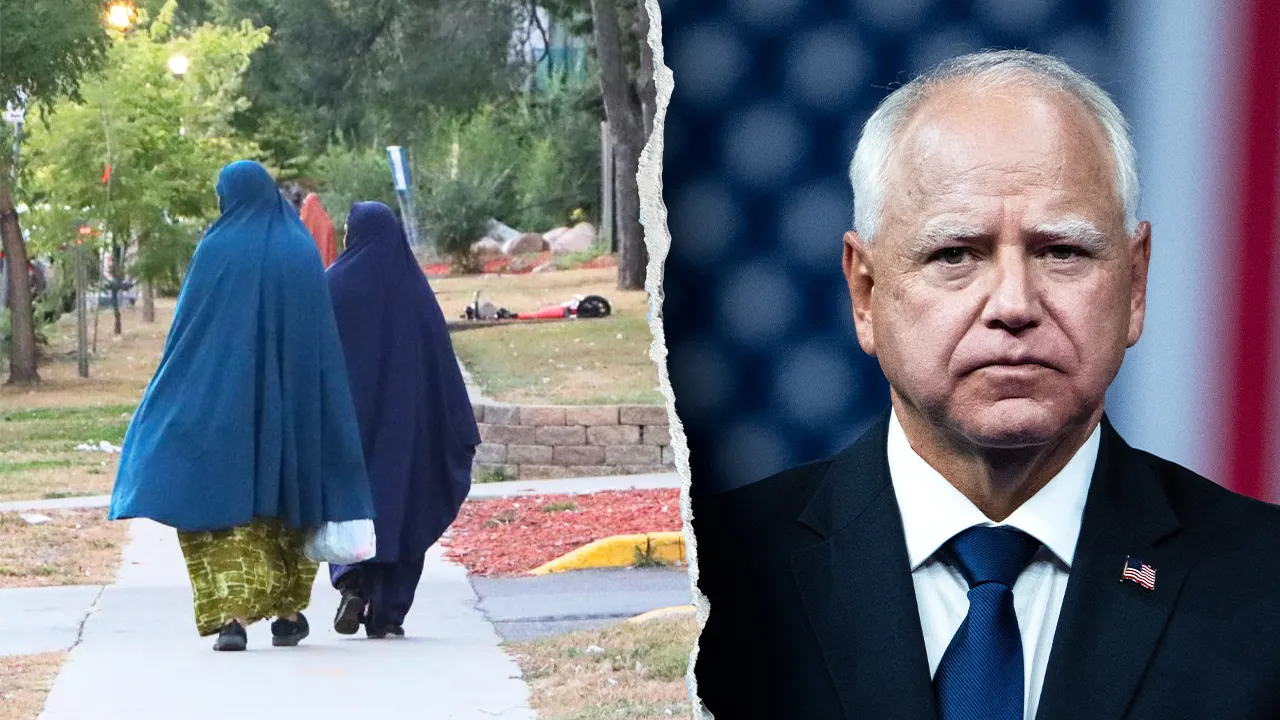
Two Somali women walk through a Minneapolis neighborhood as Minnesota Gov. Tim Walz appears in a split image. Lawmakers say the state’s oversight failures and political sensitivity around Somali-run nonprofits helped fuel the $1 billion welfare fraud scandal now under federal investigation. (Williams/CQ-Roll Call, Inc via Getty Images; Michael Dorgan/Fox News Digital)
“Assimilation is a two-sided coin. The pressure comes from inside, from you wanting to assimilate so you can make it in the new society, but it also comes from outside, where the society says, ‘Hey, we expect you to do this. We expect you, if you want a driver’s license, to be able to speak and read English at a basic level.’ We don’t do that anymore in America. We don’t we don’t really expect anything of our immigrants,” explained Hankinson.
“There are a lot of people who are American-born,” he went on, “who really don’t like this country and what it stands for. And so, they don’t think anyone else ought to accept it and adapt to it either.”
Hankinson noted that in no way can the fraud scheme be blamed writ large on the Minnesota-Somali community, which is estimated to have around 80,000 people. He said that those involved in the scam are a minority. However, the fact that the tight-knit community has by and large not assimilated into the broader American society and customs meant that many of the factors that could have exposed the scheme earlier were not there, according to Hankinson.
“When you come from a culture that provides you with nothing from the center, everything is family, everything is clan, everything is local, then it’s almost impossible for you to understand how a federal system would work. And if your neighbor came to you and said, ‘Hey, we got this cool thing going, if you just say your kid’s autistic, I’ll give you a thousand dollars a month.’ I mean, that’s a no-brainer for an awful lot of people,” he explained.
“Even if they thought that maybe it was wrong on some level, they might think, ‘Well, hang on, in my new country, maybe that’s frowned upon,’ they’re not going to rat out the clan member, the family member,” he added.
TIM WALZ CALLED OUT BY WASHINGTON POST FOR REFUSING TO TAKE RESPONSIBILITY FOR MINNESOTA FRAUD SCANDAL
Men take part in a weekly Friday Jum’ah prayer session at Abubakar As-Saddique Islamic Center amid a reported ongoing federal immigration operation targeting the Somali community in Minneapolis, Minnesota, U.S. Dec. 5, 2025. (Tim Evans/Reuters)
That, combined with the existence of generous taxpayer-funded welfare programs and Minnesota being what Hankinson called a “high trust state,” made the state “ill-equipped to handle fraud.”
“In Minnesota, these programs were low-hanging fruit. They were so easy to fleece, it’s almost farcical,” said Hankinson. “So, the carrot is there to commit fraud, and there’s no stick.”
He pointed to one aspect of the scheme in which prosecutors say Minnesota’s Medicaid autism program was exploited by companies recruiting families, securing fraudulent diagnoses, and billing for therapy that never happened, draining millions from the program.
“That is outrageous. Somebody should have noticed at some point that, ‘Hang on a minute, why have the autism rates in Somali kids gone from one in a hundred to like one in three or whatever it was?’” he said. “There should have been some oversight, and there again you get into the whole American racial guilt, which is a particular issue that we have, where if you’re an unscrupulous scammer, you can always play the race card, and that will often get you away with it because people are terrified.”
“Nobody likes to be called a racist. It’s about one of the worst things you could be called,” he went on. “But I do think liberal Americans, in particular white liberal Americans, are more afraid of that label than anything else. So, some of these scammers, they threatened to make a fuss about being targeted on account of race or immigrant status or religion. And that probably contributed to state authorities being a little slower.”
ILHAN OMAR SAYS SHE’S FRUSTRATED SINCE SOMALIS ARE ALSO VICTIMS IN ‘FEEDING OUR FUTURE’ SCAM
Somali illegal alien Abdul Dahir Ibrahim, who was convicted of fraud, has been photographed with Rep. Ilhan Omar, D-Minn., (left) and Democratic Minnesota Gov. Tim Walz (right). (ICE)
This dynamic has also played out on the national level. Following the Trump administration’s announcement of its crackdown on illegal immigrant Somalis in Minnesota, Democratic Gov. Tim Walz has accused it of “demonizing an entire group of people just by their race and their ethnicity.”
“I can’t take Tim Walz seriously, honestly, because he was the governor who was in charge while all this was happening. Where was he?” said Hankinson. “He was asleep at the switch.”
CLICK HERE TO DOWNLOAD THE FOX NEWS APP
“It’s not a question of scapegoating,” he said. “It’s a good thing to send a message, not to the Somali community per se, but to all of Minnesota and the rest of the 49 states that this is America, we have laws, we have rules. When you break those rules, you are going to get punished.”
Hankinson added that ultimately, he hopes to see many Somalis joining in the effort to crack down on the minority involved in fraud so that they can “give their community the reputation that it deserves.”
Read the full article from Here



Richard D. “Rick” Langowski, age 78 of Minto, North Dakota passed away on Thursday, April 16, 2026 at his home in Minto.
Rick was born March 10, 1948 in Grafton, North Dakota, the son of the late Julian and Catherine (Wysocki) Langowski. In 1967, he volunteered for the military bringing him to Germany as a Motor Sargent. After an Honorable Discharge he took a job at the International Airport in Grand Forks, ND. His duties included: refueling planes and jets as well as maintaining the grounds. He had the opportunity to meet the famous singer Mr. James Brown.
Rick was united in marriage to Alice Odegard on June 17, 1982 in Minto, North Dakota. The family made their home in Minto where they raised Jason and Angela. Rick was very proud of his children and loved them more than anything. He told everyone and bragged about the children he raised. He cherished his grandchildren and loved to be present in every aspect of their lives.
His career changed to semi driving where he drove for Cenex Transportation for four years and ten years for Valley Transports. His love for the open road directed him into the used car business. He opened Minto Auto Sales and Services in 1987, proudly operating for 39 years. He had the privilege to meet many people and travel to many places. He enjoyed riding his many Harley Davidson Motorcycles. In 2025, he sold the business to his longtime mechanic and friend, Aaron Anderson. In Rick’s opinion, “Minto Auto is one of the best mechanical shops in the area.”
He was a member of the Sacred Heart Catholic Church, Minto, ND. He loved hunting with Jason, watching sports, especially the Yankees and Twins. In 2017, Rick was able to enjoy a father/son trip of a lifetime to Alaska. He thoroughly enjoyed every aspect of the trip and thought was the best time of his life.
Rick is survived by his children: Jason Odegard, Reynolds, ND; Angela (Nick) Eppert, Goshen, IN; grandchildren: Ashlyn, Kaia, Annika, Boden and Caelan; sisters: Carol King, Grand Forks, ND; Connie Jones, Argyle, MN; seven nieces and nephews. He is also survived by his very close friend and confidant, Yvette Estep, Grafton, ND. He was preceded in death by his parents and siblings: Robert and Ronald.
Rick’s family would like to extend a very special thank you to Yvette Estep, an employee of Rick’s, affectionately known as “hotrod.” She was there for Rick, along with Aaron for doctor’s appointments, treatments and helped comfort him throughout his battle. Jason and Angela will be forever indebted to her and consider her family.
Mass of Christian Burial will be Wednesday, April 22, 2026 at 10:30 A.M. at the Sacred Heart Catholic Church of Minto. Visitation will be for one hour prior to the service at the church. Interment will be at the Sacred Heart Catholic Cemetery, Minto, ND. Military Rites will be provided by the Minto American Legion Post and the North Dakota National Guard Honor Guard.
or send flowers to the family in memory of Richard D. Langowski, please visit our
.

Fans got their first glimpse of the 2026-2027 Buckeyes during their spring game earlier today. In contrast to last year’s offensive takeover, it was the defense this year that shined for the most part.
With this, we still saw plenty of Buckeyes that proved that they are ready to play, and ready to play now. Here are three standouts from the Ohio State Spring Game.
Chris Henry Jr.
Coming into the game, most Ohio State fans had already penciled Chris Henry Jr., the No. 1 WR in the 2026 class according to ESPN, as the successor to Carnell Tate in the Buckeye offense.
Anyone that didn’t, probably should now.
The freshman wideout hauled in 4 passes for 96 yards, including a 40-yard touchdown catch in the second quarter.
Playing all snaps on the outside, Henry Jr. looked very poised, showcasing smooth route running and breakaway speed. The connection between him and another Buckeye on this list was the highlight of the offense for the day. There is no doubt he should be an immediate contributor in this Ohio State offense.
Tavien St. Clair
After a subpar showing at the spring game last year, Tavien St. Clair showed flashes of the top-10 recruit he was just two years ago.
He dazzled early with two big completions to Chris Henry Jr., showing off his big arm in the process.
His touchdown pass to Henry Jr. was a beautiful look off from St. Clair, who launched it right to the right pylon to find the freshman wideout.
It was not all sunshine and rainbows for St. Clair on the day though, as he was forced into a couple three-and-outs as well as a few balls that could have been intercepted.
All in all, all tools are there for St. Clair to be great when his number is called, and another year of growth under Julian Sayin should help him get there.
Beau Atkinson
Buckeye fans were surprised when Beau Atkinson was basically a non-factor on the defensive line a season ago, as the hype around him coming from North Carolina was immense.
The player they expected to see last year was on full display, as the senior finished the day with a sack and an interception off a Julian Sayin batted ball at the line of scrimmage.
His high motor was one to watch early, as his get-off and confidence at the position looked vastly improved from last year. He is one to seriously watch to be the starter next to Kenyatta Jackson Jr. come September.
Follow

(SOUTH DAKOTA SEARCHLIGHT) – Democrats are running for 46 of South Dakota’s 105 legislative seats — leaving 56% of seats without a Democratic candidate.
That doesn’t bode well for the party ahead of November, said Michael Card, professor emeritus of political science at the University of South Dakota.
“It doesn’t put them in a position to actually put forward their ideological policy preferences and have much of a success at getting those enacted,” Card said.
In the state Senate alone, Democrats have failed to field a candidate for 22 seats, which is nearly two-thirds of the chamber. In the House, Democrats have failed to field a candidate for 38 seats, which is 54% of the chamber.
There is only one Democratic legislative primary in the state: a state Senate race in District 26, which includes the Rosebud Reservation.
There are no statewide Democratic primaries, after announced candidates for governor and U.S. House dropped out or failed to gather enough petition signatures to make the ballot, leaving one Democrat in each of those races.
Statewide candidates will have less name recognition than Republican candidates ahead of the general election, since they didn’t have primaries, Card said. In the Legislature, Card said Democrats “are guaranteeing they won’t get a majority.”
In contrast, Republicans have primary races for governor, U.S. House and U.S. Senate. Five legislative districts do not have Republican primaries, but do have Republican candidates. There is a Republican candidate running for every legislative seat, except for one House seat in District 27, which includes the Pine Ridge Reservation.
Card said there are several factors leading to poor candidate turnout among Democrats, including a self-fulfilling cycle of failure.
“A lack of winning makes fewer people willing to take a chance on running for office,” Card said. “Why run if I think I’m going to lose?”
Democrats haven’t held a statewide office since 2015, and they haven’t held a majority of either legislative chamber since 1994.
Joe Zweifel, deputy executive director of the South Dakota Democratic Party, said the organization worked “really, really hard” to convince Democrats to run for office.
“But you can’t force people to run for office,” said Zweifel, of Sioux Falls, who’s running for a legislative seat himself in District 12.
He’s heard the open seats called a “failure.” But he disagrees, choosing to focus on the Democrats who did step forward.
“We’re running quality, good candidates in those races,” Zweifel said.
The South Dakota Democratic Party hopes to build on legislative successes, such as a new law from Rep. Kadyn Wittman, D-Sioux Falls, that commits state funding to cover the family portion of reduced-price school meals.
“That specifically is a return on investment for our donors, and it shows that Democrats are doing good things for the people of South Dakota,” Zweifel said.
Wittman’s success helped inspire Democratic District 13 House of Representatives candidate Ali Rae Horsted, of Sioux Falls, to take a second run at the Legislature. Horsted ran unsuccessfully for the Senate against Sen. Sue Peterson in 2024, garnering 42% of the vote.
Horsted plans to build on that success and the name recognition she already has in the district. She hopes she’ll have “better odds” in this election, since there are two House seats for every district.
Horsted said it would better serve South Dakota if the state had a more balanced Legislature. While the latest Legislature was 92% Republican, 52% of voters in South Dakota are Republican. South Dakota has the lowest percentage of Democrats, 7.6%, in the Legislature nationwide.
“I think it’s important that people have options on the ballot,” Horsted said, “and people are able to vote for candidates that represent their values and their vision for the future of South Dakota.”
Makenzie Huber is a lifelong South Dakotan who regularly reports on the intersection of politics and policy with health, education, social services and Indigenous affairs. Her work with South Dakota Searchlight earned her the title of South Dakota’s Outstanding Young Journalist in 2024, and she was a 2024 finalist for the national Livingston Awards.
South Dakota Searchlight is part of States Newsroom, the nation’s largest state-focused nonprofit news organization.
See a spelling or grammatical error in our story? Please click here to report it.
Do you have a photo or video of a breaking news story? Send it to us here with a brief description.
Copyright 2026 KOTA. All rights reserved.
-
North Dakota5 minutes ago
Richard D. Langowski Obituary April 16, 2026 – Tollefson Funeral Home
-

 Ohio11 minutes ago
Three Buckeyes Who Proved They Belong at Ohio State Spring Game
-

 Oklahoma17 minutes ago
Oklahoma’s Jahsiear Rogers ‘Knew It Was Time to Showcase’ His Talents In Spring Game
-

 Oregon23 minutes ago
Oregon Tight End Jamari Johnson Speaks Openly About New Role
-

 Pennsylvania29 minutes ago
Pennsylvania State Police investigating incident in Salisbury Township
-

 Rhode Island35 minutes ago
2 dead, 1 seriously hurt after crash on I-95 South in Warwick
-

 South-Carolina41 minutes ago
Missouri beats South Carolina in game two
-

 South Dakota47 minutes ago
Democrats fail to field candidates for a majority of South Dakota legislative seats

