Lifestyle
Ziggy Marley turns grief into light on ‘Brightside’ and brings the vibration to the Hollywood Bowl


It’s Friday afternoon in North Hollywood and Ziggy Marley is perched on a stool inside his newly built Rebel Lion Studio, tucked in one of the neighborhood’s creative enclaves.
The nine-time Grammy winner is surrounded by a collection of lion figurines, guitars, traditional hand drums and a piano. Along the walls hang two replicas of backdrops his legendary father, Bob Marley, used on tour in the 1970s. The murals, depicting Rastafari icons and Haile Selassie I and Marcus Garvey, were featured in the 2024 biopic “Bob Marley: One Love.”
“These are what we used as the backdrop for the concert scenes. Them spiritual to me,” Marley says in patois as the smell of palo santo dances around the rehearsal space.
Music has been both an inheritance and lifelong pursuit for Marley. From sitting in studio sessions with his father as a child to building a five-decade career of his own, he has remained a curious student of the craft, one willing to challenge convention in search of a deeper meaning. That spirit is evident on “Brightside,” his ninth solo album, which was released on vinyl on April 18 (Record Store Day) and May 1 on streaming.
Rather than recording the eight-track project in 440 Hz, the standard tuning frequency for most modern music, he opted for 432 Hz, a tuning some musicians and theorists believe creates a warmer, more meditative listening experience. He also slowed down his songwriting process, giving each lyric room to carry its message of hope through turbulent times. The album, which may be his most personal yet, also features “Many Mourn for Bob,” the first song he has written directly about his late father.
“I think it shows the next stage that I probably am in,” says Marley, adding that he felt connected to his father on a spiritual level. “We took another step in the relationship, to another place that it’s never been before.”

Ziggy Marley is bringing his “Brightside” tour to the Hollywood Bowl on June 21 alongside reggae star Burning Spear.
(Dania Maxwell / For The Times)
He adds, “When I was doing the song, it kind of came to me like this song could’ve been my father’s song. It could’ve been a song that he wrote.”
The reflective nature of “Brightside” arrives at another pivotal time in Marley’s career. This year marks the 20th anniversary of “Love Is My Religion,” the Grammy-winning album that launched his solo career and crystallized a personal philosophy he still carries today. He is also set to release his sixth children’s book, “True to Myself,” in September.
As we wrap up our conversation, Marley has only a few minutes before Rebel Lion Studio shifts back into work mode. Within minutes, bandmates, background singers and production crew members begin funneling into the space, hauling in stacks of equipment as promotion and preparations continue the “Brightside” tour, which stops at the Hollywood Bowl on June 21.
This interview has been lightly edited for length and clarity.
You recorded your latest album, “Brightside,” here at Rebel Lion Studio, which you designed and built from the ground up. Can you take me back to the beginning of that process and why you wanted to do it?
I grew up around my father and my mother as growing musicians trying to succeed and there was one thing I kept hearing over and over throughout my life: independence. Their whole mission was to be independent. I saw them work and I saw my father build a studio. I saw him have a space where he can do more music and control his own time. That was a dream of mine for a long time, ever since I started doing music because usually we use other people’s studios. I couldn’t have this in my house. It’s too much. It’s a dream come true.
We’re surrounded by two beautiful murals. Is there a particular item that is personal to you?
The murals are replicas of my father’s backdrops that they used. The original artwork is by Neville Garrick, but he helped us re-create them for the Bob Marley movie. These are the murals we used as the backdrop for the concert scenes. They are spiritual to me cause that’s Haile Selassie and Marcus Garvey, two very important beings for us. Inspirational.

On “Brightside,” Ziggy Marley dedicated a song to his father, Bob Marley, for the first time in his career.
(Dania Maxwell / For The Times)
“Brightside” is your ninth solo album. What mindset were you in emotionally and spiritually when you started working on it?
I never thought about making an album, I was just writing songs. You just tap into things in your subconscious that are waiting to become music, I feel like. Then when the time comes for writing songs, the time comes. It’s like a season. Like you have blueberry or orange season. So there’s a season for me when I write songs. Then you say, “All right, let’s make an album then.” But you don’t think about an album before. It’s just an expression or a feeling just to make music, not for any reason but to make it. It happened over a period of years. Ideas and experiences that eventually come out. But closer to the time I [made] the album, I remember writing some of the later songs like “Why Let the World.” It was a song that I wrote because I was feeling down and everything that was happening in the world and the country. Just so much negativity and I just felt like I needed to take a break from it. To recharge yourself. We cannot fight every day. We need to take a break and then get back to it. I needed to teach myself to take some time. It was more of a mental thing than an emotional thing. Stuff I deal with my father, personal life and stuff with my spirituality and my faith. So there’s a lot of me in this record.
“Many Mourn for Bob” is the first song you’ve explicitly written about your father. Your brother, Stephen, is also on the vocals. What surprised you emotionally once that song was finished?
I’m not sure I thought about it like that. The experience of expressing that emotion, it’s a spiritual experience. I think it shows the next stage that I probably am in and even my relationship with my father on that spiritual level. It’s a different place. We took another step in the relationship, to another place that it’s never been before. When I was doing the song, it kind of came to me like this song could’ve been my father’s song. It could’ve been a song that he wrote. That’s how I felt about it. This is partly his song. It’s me and him making this song. This song is his song too.

How has your relationship with grief changed over the years?
It’s more of a comrade, understanding, empathy and having the maturity and the experience to understand what he went through as a man, as a human being. I think that’s what it is, really. A better understanding of what he went through, not the glory. The pain, the mental and emotional state. You’re more than just an idol. You’re more than just a legend. You’re more than just a father. To go deeper than that, so that’s the next level.
Yeah, the skit you used of him saying “I’m just a man from the ghetto” on the song really summarizes that.
That’s the real him. That’s him right there. Even in the tone of his voice, you can hear the real Robert coming out.
Another standout song from the album is “Racism Is a Killa.” One thing that you do well is having a heavy topic, but finding a way to still make it feel hopeful and joyful. Why was it important for you to approach the track this way rather than from a place of anger, heaviness or sounding preachy?
I think it started out preachy and angry, but over time, it kind of evolved and I kind of evolved too ‘cause my own evolution is represented in the music. And you know something, doing that song helped me evolve because I had to think about it differently without the anger. The song made me do that. Like how else can I approach this? It’s inspiration that causes these things. It’s not an intellectual thing. I didn’t do that intellectually. Like over time, something just started coming out of me. I never really thought about it before, but I can see it now.
In the video, which features your daughter, Zuri, you referred to the condition as “Racismosis” in the video and sang about how it can be cured.
It’s kind of like a sickness, a disease. It’s a virus. We can minimize the virus and stop the disease. It’s true. Racism is a killa. This virus can kill ya. Literally kill ya. Spirtually kill ya. Emotionally kill ya. Mentally kill ya. It kill ya in different ways. It kills the victim and it kills the person perpetrating it. It’s killing everyone, but we can cure it though. It starts with the children. I have a friend of mine who said, “Yo, my little son loves this song. He doesn’t want to stop. He says ‘Put on “Racism is a Killa.”’ So that’s where the antidote is starting. The minds of the children. The music with a conscious message gives them the right consciousness that they grow up with. That is how we take our time and lower the spread of the virus.
You recently released an alternate version for “Racism Is a Killa” with Big Boi. How did that collaboration come together and what excited you about working with him?
I’ve loved Big Boi and Outkast from a long time ago. He’s a legend and a strong voice. There’s different layers to it and I feel like Big Boi took it to that other layer. So yeah, we just love Big Boi and I’m going to jump on something he does. [Laughs]
I’d be remiss if I didn’t ask your approach for your album and how you swapped the typical 440 Hz for 432 Hz. Do you remember the first time you heard the music played back that way?
It’s a long journey because for most of my life in music, I’ve tried to be a student. I’ve tried to keep an open mind and learn more and more. With this album, there’s an inspirational side of music and that’s where I lean into most of the time, but as I grew up, I started to understand there’s also a science too. It’s also mathematics. The universe, it’s all mathematics and science, and I shouldn’t shun the science of music just because I think the inspiration is all it should be. I think a part of that was learning that for myself and opening up and saying, “Yo, let me put some science into this.” Frequency. What does frequency do to people? Frequency affects people. Frequency is a weapon. It’s a tool. I’m sure the army has some kind of frequency thing. So frequency is powerful. I wanted to try something different anyway. I want to be different. I want my frequency to be different from the majority of frequencies that’s being played out there, because it’s fun for me to be different.
When I was working on the demos, I was like “Let me try this 432 Hz thing” and I like how it feels for me personally, how I sing on the frequencies. It resonates differently and makes me feel different. We did it and it felt good, and we did it live, and from my point of view, I felt a different energy with the audience too. So all of those experiments led me to the final conclusion to say, “Yeah, let me do the record in 432.” It’s really nice vibes, which the world needs a different frequency. We can use it.
This year marks the 20th anniversary of “Love Is My Religion,” your first solo Grammy-winning album. When you think back to that era of your life, who was Ziggy back then?
A lot was changing because I moved to L.A. during that time.
You got married around that time too, right?
Yeah. I don’t really fight change. I just try to navigate them and figure them out cause sometimes change is hard. There was a lot of change living here, moving around, trying to find a place, music, but then it’s like we are continuously updating ourselves. I’m continually updating. You know how you update your OS. I’m updating my OS. My operating system is being updated throughout my experience in life. There’s always something else out there for me to evolve to. So during that period of my life, “Love Is My Religion” came to me when someone asked me, “What religion are you?” And I just said “Love is my religion.” I never thought about it before, never contemplated it, never even thought of those words together before in my life, and they just came out to me that day. So the album represents a time in my life when I realized there’s a spiritual awakening that I had. “Love Is My Religion” is a spiritual awakening. That’s my thing. That’s who I am. That’s why it’s a milestone.

“If you think you’re going to change this world with music and you’re trying to send a message out there, you have to speak to children,” Ziggy Marley says.
(Dania Maxwell / For The Times)
You’re kicking off the “Brightside” tour this month, which includes a stop at the Hollywood Bowl. What are you most excited about when it comes to bringing this album to people for the first time live?
I’m excited about playing the music. I think it’s about the music. These new songs, they vibrate very highly for me and I’m excited about experiencing and expressing that. And also kind of not doing it for the audience. I don’t want to do it for the audience. I want the audience to experience what I’m experiencing, what I’m expressing. I want them to feel me. I don’t want them to be like “Hey look at me.” [Laughs] There’s still connectivity going on, but I want them to feel the songs the real way. That’s what I’m excited about for people to feel it the way that I feel it.
You even posted the lyrics and told fans to get to practicing, so they can really understand the message.
Yeah. Just reading them for me, I really like the writing I did on this. I also took some time with this too. I was saying to someone that I developed a deeper relationship with the lyrics and the words than I did before. My relationship with the words here are very mature. I feel good about it. That’s why I want people to know the words because words are very important. Words are very important. If you know the words you get a deeper understanding of what I’m talking about and what I’m feeling.

After nearly 50 years of making music, Ziggy Marley built his own studio in North Hollywood called Rebel Lion Studio. He plans to turn it into a multipurpose creative space.
(Dania Maxwell / For The Times)
Look on the bright side is a phrase that people say often, but what do those words mean to you right now?
Sometimes we can get in a place [where] we can’t see the other side of things because we’re so caught up in that one place. Like the cliché, there’s two sides to a story, ya know? The universe is always yin and yang, but there’s always another side of things. But I feel like the way we are being programmed in a way through media and everything, it’s like there’s only one side. Everything is like this, there’s nothing else going on over there that we need to see, we only need to see this. This is all that’s going on in the world. There’s nothing good, there’s nothing nice, there’s no good people, there’s no love. So it’s a realization too. A realization that there’s the other side. Never get to that place where we think it’s just that side alone because we get so much of it. It’s a reminder, I think, for us like “Come on guys.” The thing about it too, sometimes you can feel like — even for me — some people say, “Hey look on the bright side,” some people find that like “Why are you happy? Why you so chirpy?” [Laughs]
That’s true.
I’m proud that I’m on the bright side. I’m living on the bright side, I don’t care. You don’t like me because I’m living on the bright side? You want me to be like you, you want me just live on the dark side with you, right? So it’s like a proudness of being positive and having that outlook in life, and not feeling like you have to [fall to] peer pressure. More positivity in life, not just the negativity. I’m confident in that too. So it’s kind of like that too, you know, like being proud, lifting up that side of me. Yeah, I’m happy to be living on the bright side.

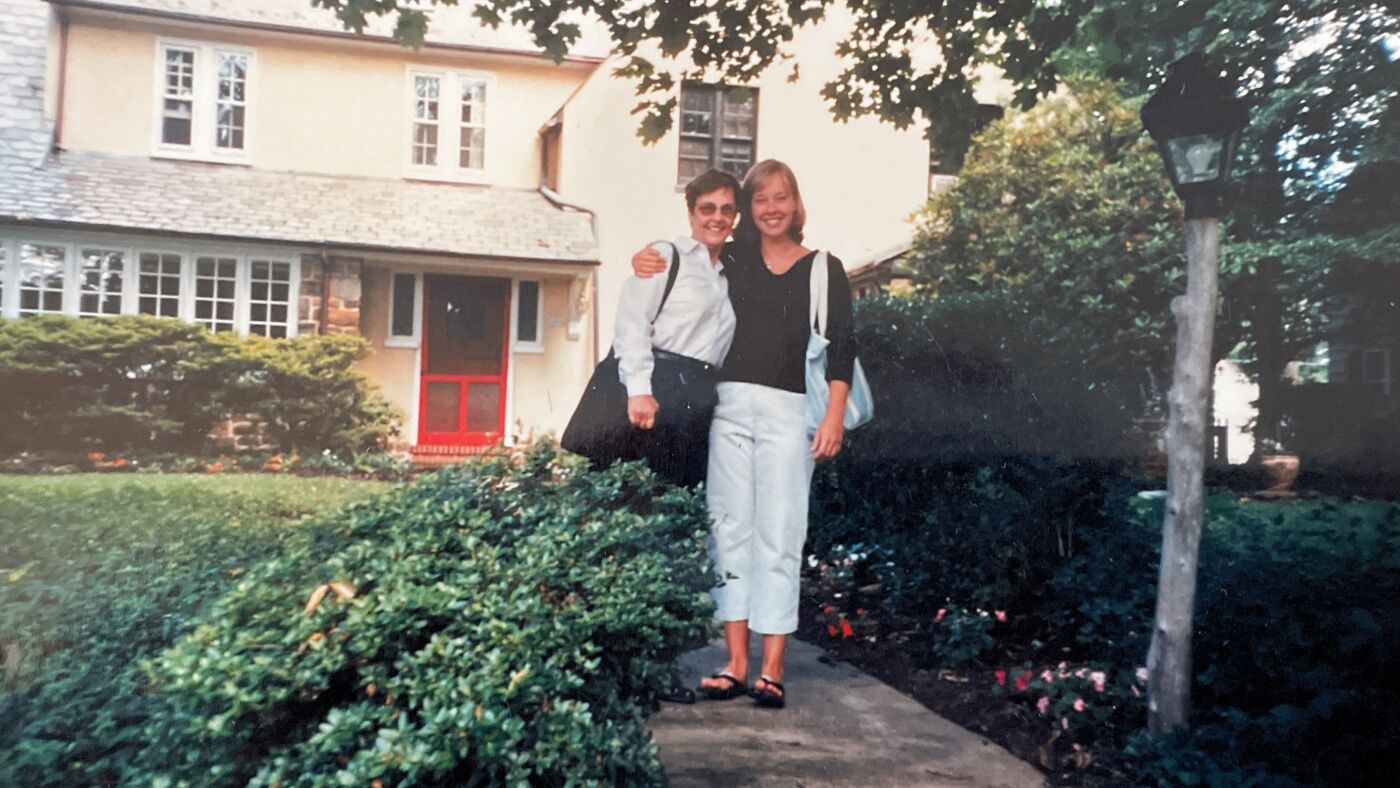
Rebecca Simonitsch (right) smiles with her mother in 2001, the year she had her surgery.
Rebecca Simonitsch
hide caption
toggle caption
Rebecca Simonitsch
In the summer of 1995, when she was 15, Rebecca Simonitsch woke up in the hospital. She later learned she had had a series of convulsive seizures that put her into a coma. For the next three years, she took medication to prevent future episodes.
At 18, before she left for college, her doctors took her off the medication. That’s when she began noticing more subtle kinds of seizures, known as focal seizures. She later realized she had probably been experiencing them on and off ever since she left the hospital.
“The average person would likely have never known when I was having a seizure,” Simonitsch said.
“[But] if I tried to speak during them, my words would come out sounding a little like gibberish. And then I would also feel nausea, weakness and fatigue.”
Simonitsch was diagnosed with epilepsy. She cycled through multiple medications to stop the seizures, but nothing worked. She could no longer drive, and the side effects of the medication became unmanageable.

By the time she was 20, it was clear something had to change. That winter, she flew from Charleston to Baltimore to meet with a neurologist at Johns Hopkins Hospital. After many tests, he identified the source of her seizures — scar tissue in her left temporal lobe — and told her she was a candidate for brain surgery.
On the flight home, Simonitsch kept replaying what the doctor had told her.
“And like so many patients who receive difficult or big news, I had really only absorbed 10 to 15% of the conversation. And now I had so many questions,” Simonitsch said.
“So I just recall being on the plane, looking out the window and feeling so many emotions in that moment … everything from fear to worry to relief.”
As she continued to grapple with these feelings, the man sitting next to her struck up a conversation. He asked her what she was doing in Baltimore, and she told him about the surgery.

“He turned to look at me. And he shared with me that he had an expertise in neuropsychology, and he had worked with patients like me.”
For the rest of the two-hour flight, the man listened as she shared what the doctor had told her and the questions she still had. He clarified what the surgery would involve and made sure she understood. Then he reached for his bag and pulled out a notebook and pen.
“He had some really old school graph-like paper that he put on the airplane table,” she said.
“And then he just started drawing pictures of the brain. And even marking sections of his drawing as he spoke … and ‘This is what they would do with the surgery and how they would remove that scarred region.’”
Twenty-five years later, she still remembers how that conversation made her feel.
“I’ll just never forget his kindness and the warmth that he exuded. And how it helped my anxiety fade,” she said. “And that was what I needed on that flight back to Charleston by myself.”
Simonitsch went on to have the surgery, and today, she remains seizure-free. She still has that piece of paper with the man’s drawing of the brain.
“He gave me something that I deeply needed that day: realistic hope, reassurance and compassion,” she said. “All from a complete stranger sitting beside me on a crowded flight.”
My Unsung Hero is also a podcast — new episodes are released every Tuesday. To share the story of your unsung hero with the Hidden Brain team, record a voice memo on your phone and send it to myunsunghero@hiddenbrain.org.

Artist Lex Marie taken by Stephen L.A Miller
hide caption
toggle caption
Multidisciplinary artist Lex Marie has gone viral on TikTok and Instagram for her artwork confronting discipline within Black households.
At Lex Marie’s art studio, a belt is no longer just a belt.
I met the multidisciplinary artist in Washington, D.C., at the American University’s Katzen Arts Center.
She led me to her studio, where some belts are stretched across a canvas in meticulously organized rows and columns.
Others are used as a tool. Marie dips them in paint and swings them like a brush, leaving thick, violent marks across a white canvas.
Marie says each piece of work carries a story about childhood, discipline, survival and the complicated ways love can be expressed.
She is building a body of work that confronts a topic many families know well but rarely discuss openly: corporal punishment in Black households.
“I’m critiquing discipline in Black households specifically,” Marie says. “But I’m trying to tackle the history behind discipline in black households, behind spankings and whippings, and speak to the difference in how millennials are raising their children as well.”
The work is personal for her. Marie is 33 and the mother of an eight-year-old boy. As her son continues to grow, she says the questions that shape her art often come directly from her parenting.
“Through motherhood, I’m starting to think about my own childhood, and I’m comparing and contrasting it. So some of these works are just speaking from my experiences with spankings, and they’re also going from the perspective of how I feel.”
One of the larger works in the series is called “Watch Your Tone.” The six-by-six-foot piece is composed entirely of belts — dozens of them — arranged carefully across the canvas. They are an assortment of different shades of brown, black and pink to represent the color of flesh.
The title of the piece echoes a phrase many children hear growing up: “Watch your tone when talking to me.”
But Marie says the belts also represent something deeper.
She explains that she created this piece to convey multiple meanings. The different skin tones help her explain the different ways punishment is tied to American history.
For some historians and scholars, the conversation around corporal punishment in Black American households cannot be separated from the legacy of slavery. During enslavement, physical violence, such as being beaten with whips, was used to control Black bodies. Over generations, those discipline practices have evolved into modern parenting practices.
Yohuru Williams, founding director of the Racial Justice Initiative at the University of St. Thomas, believes that the link between corporal punishment and African Americans is rooted in slavery.
“This idea of whipping, this idea that black bodies require extreme punishment — that there’s something about the constitution of blackness that requires excessiveness in terms of discipline — has deep roots. Roots that extend beyond slavery. But it [was] really reinforced by the enslavement of Africans. And then once they come to the United States, you have this adoption of punishment systems within slavery that continue after slavery; that continue that process with that practice of brutalization of … black and brown bodies,” he said.
“Because I Love You, another piece in Marie’s series, highlights the physical act of enforcing punishment.
Marie painted a wooden panel white, dipped a belt in acrylic paint and struck the surface again and again, leaving marks scattered across the piece like scars and welts.
“I spent hours just kind of beating the same thing over and over,” she said.
The process left her physically sore the next day.
The piece’s title comes from a phrase many children hear after a whipping: “This hurts me more than it hurts you” or “I’m doing this because I love you.”
Marie explains how making this work has been cathartic and difficult. When the videos of her art began circulating online, the reactions were immediate.
Thousands of people commented on her post, sharing their own childhood stories. Some were painful and defensive, while others were grateful the topic was being discussed.
But Marie stands firm that the goal of this work isn’t to accuse or shame. It creates space for a conversation that is often buried.
Williams says that in order to have these discussions, Black families have to reimagine how they think about discipline.
“I think a lot of parents — black parents — struggle with this because there is this inherent knowledge that this is the way that we came up. And there is this belief that, well, you know, … maybe we’re more stable, maybe we’re more durable, maybe we’ve been able to endure more. We’ve developed a particular type of grip because of this experience,” Williams said.
Williams says it’s time to have an “honest” conversation about the historical legacy of corporal punishment within the Black community. “That would be far more communal and affirmative of human dignity and the dignity of black life,” he said. “Coming out of the Black Lives Matter movement, you kind of look back at this, and you go, ‘We understand it from a historical standpoint.’ But from a humanistic and community-centered, restorative justice practices standpoint, there’s something that just doesn’t sit right with me about this practice. And I think we owe it to ourselves as a community to revisit that.”
Marie sees her art as a pathway to discuss extremely difficult and triggering conversations about childhood trauma, especially for people who might struggle to find the words themselves — just like her.
The project will continue to grow over the next year as Marie develops more pieces for a planned exhibition this fall. The series has nearly 20 pieces, and she has even sold two to filmmaker Spike Lee, who is known for his films Do the Right Thing and Malcolm
X
Lex Marie has a solo show at The Bishop gallery in Brooklyn, New York this fall which will feature this series.
For Marie, the most important outcome isn’t agreement. It’s recognition.
This story was edited by Olivia Hampton and produced by Nia Dumas. The digital story was written by Nia Dumas.

U.S. Sen. Raphael Warnock, D-Ga., attends a rally opposing the SAVE America Act outside the U.S. Capitol on March 18 in Washington.
Heather Diehl/Getty Images
hide caption
toggle caption
Heather Diehl/Getty Images
Sen. Raphael Warnock, a Georgia Democrat, became the state’s junior U.S. senator over a decade after he was selected to serve as senior pastor of Ebenezer Baptist Church in Atlanta, Georgia, a church that was once led by the Rev. Martin Luther King Jr. His role as a senator brought him to Washington National Cathedral in 2023, where he marked Juneteenth that year with a sermon framed around the life of the prophet Isaiah.
“Every valley shall be exalted, every mountain and hill shall be made low, the crooked places shall be made straight, the rough places smooth, and the glory of the Lord shall be revealed, and all flesh shall see it together,” Warnock said during the sermon.
Warnock expands on that message in his new book, The Crooked Places Made Straight: Reflections on the Moral Meaning of America, where he argues that democracy is “the political enactment of a spiritual idea.”
In an interview with Morning Edition host Michel Martin, Warnock said the country’s divisions are less political than moral. “What we’re dealing with right now is not the difference between right and left, it’s really the difference between right and wrong,” Warnock said. He added that “it’s really too bad when my party cedes so much of the faith and values space … to those on the right.”
In his conversation with Martin, he explains why he believes faith should confront systemic injustice, not just personal behavior, and calls for a broader moral imagination in American politics.
Listen to the interview by clicking on the blue play button above.
-

 Pennsylvania2 minutes ago
Pennsylvania legislation seeks more safeguards for online gamblers after a record year
-

 Rhode Island5 minutes ago
Backyard Cookout Costs Rise: What Rhode Island Hosts Can Expect
-

 South-Carolina10 minutes ago
South Carolina bans ‘laughing gas’ sales to minors under new nitrous oxide law
-

 South Dakota17 minutes ago
South Dakota Sheriff sworn in as President of National Sheriff’s Association
-

 Tennessee20 minutes ago
A New Miss Tennessee Will Be Crowned This Week
-

 Texas25 minutes ago
Texas renews 3 disaster orders covering drought, flooding and border
-

 Utah32 minutes ago
Here’s why Bosnia-Herzegovina fans in Utah are living a ‘dream’ during the World Cup
-

 Vermont35 minutes ago
2 people found dead after house fire in Chelsea, Vt.

