Lifestyle
Writer Ted Chiang on AI and grappling with big ideas


Ted Chiang was recently awarded the PEN/Faulkner Foundation’s prize for short story excellence.
Alan Berner
hide caption
toggle caption
Alan Berner
Science fiction author Ted Chiang wishes he could write faster.
His entire body of work from the last 34 years almost completely fits into two book-length collections of short stories, and he says he feels the pressure that many writers do — to be more prolific.
“I can’t claim any moral high ground or deliberate strategy. It’s mostly just that I’m just a very slow writer,” Chiang said.

But each of his stories is meticulously crafted, the result of big philosophical questions that gnaw at him for months or even years. And he is no stranger to success: His novella-length “Story of Your Life” was the basis of the film Arrival. Many of his works have won science fiction’s highest accolades and prizes.
Chiang recently added another prestigious award to that list. He is the recipient of this year’s PEN/Malamud Award, which celebrates “excellence in the short story.”
Chiang sat down with All Things Considered host Scott Detrow to talk about his writing process, the philosophical ideas that undergird science fiction and why he doesn’t think AI is capable of making art.
This interview has been edited for length and clarity.

Ted Chiang’s “Story of Your Life” was the basis of the film Arrival.
Penguin Random House
hide caption
toggle caption
Penguin Random House
Interview highlights
Scott Detrow: I want to start really broadly because I think so many of your stories seem to be asking big questions, whether it’s how humans would behave when they encounter a disruptive new technology, or an alien race, or the physical presence of God. But then all the stories come back to the human reaction to that, as opposed to the existential problem itself. When you’re coming up with these stories, do you start with the big question? Do you start with the character? Where does your mind typically drift first?
Ted Chiang: I usually start with what you would call “the big question.” I am interested in philosophical questions, but I think that thought experiments are often very abstract, and it can be somewhat hard for people to engage with them. What science fiction is good at is, it offers a way to dramatize thought experiments. The way it happens for me is that ideas come and ideas go. But when an idea keeps recurring to me over a period of time, months or sometimes years, that is an indicator to me that I should pay more attention to this idea, that this idea is gnawing at me. The only way for me to really get it to stop gnawing at me is to write a story.
Detrow: In the last year or so, you’ve published a series of articles in The New Yorker taking a critical look at AI and often making arguments that this is being framed the wrong way when popular culture talks about artificial intelligence [or] large language models like ChatGPT. What is it about AI in this moment that interests you?
Chiang: As a science fiction writer, I’ve always had a certain interest in artificial intelligence. But as someone who studied computer science in college, I’ve always been acutely aware of the vast chasm between science-fictional depictions of AI and the reality of AI. I think the companies who are trying to sell you AI benefit from blurring this distinction. They want you to think that they are selling a kind of science-fictional vision of your superhelpful robot butler. But the technology they have is so radically unlike what science fiction has traditionally depicted.

Detrow: In one of these essays that I think perhaps got the most attention, you were making the argument that AI is not going to be making great art. Can you walk us through your thinking, your argument about the fact that ChatGPT probably isn’t going to write a great novel or DALL-E is not going to be creating really valuable fundamental works of art?
Chiang: So the premise of generative AI is that you, as the user, expend very little effort, and then you get a high-quality output. You might enter a short prompt, and then you get a long piece of text, like a short story or maybe a novel. Or you enter a short prompt, and then you get a highly detailed image, like a painting. You cannot specify a lot in a short text prompt. An artist needs to have control of every aspect of a painting. A writer needs to have control over every sentence in a novel. And you simply cannot have control over every sentence in a novel if all you gave was a pretty short text prompt.
Detrow: Tying this back to your fictional work, I think a lot of your stories will propose a new innovation or a scientific discovery that just rocks the society that it comes upon. Is it fair to say that, at least when we’re talking about generative AI, when we’re talking about AI in the current conversation, is it fair to say that you do not see it as that kind of game-changing development?
Chiang: I think that generative AI will have massive repercussions, not because it is fundamentally a transformative tool, but because companies will be quick to adopt it as a way of cutting costs. And by the time they realize that it is not actually that effective, they may have destroyed entire industries. But in the meantime, they might have made a lot of short-term money. And it costs thousands or millions of people their jobs.

Detrow: There are these big societal changes in your pieces. But in a lot of the stories, the main character won’t necessarily change that much of their identity. Whatever massive shift is happening seems just kind of to confirm their sense of purpose or their sense of identity. I’m wondering how you think about that, and if you think that’s maybe a hopeful takeaway from some of these stories.
Chiang: So, I would say that big technological changes, they often will demand that we kind of rethink a lot of things, but they don’t automatically change our fundamental values. If you loved your children before, you should continue to love your children — there’s no technological advance that will make you think, “Oh, actually, loving my children, I guess I’m going to discard that idea.” So, I wouldn’t say that the characters are unaffected or that they just go on being the same. It’s more that they hopefully find some way to live, which allows them to be faithful to their core beliefs, their core values, even in the face of a world that has changed in a very unexpected way.



Jeffrey Epstein’s Zorro Ranch
Police Turned Blind Eye to Pedophilia …
New Owner Says
Published
The new owner of Jeffrey Epstein‘s notorious Zorro Ranch in New Mexico is speaking out, claiming the property was never visited by police despite numerous allegations women and girls were sex trafficked there for years.
Don Huffines — a wealthy Texas businessman and former Republican state senator with ties to MAGA — posted a message on X Monday night, saying he and his family purchased the ranch in 2024 and “maintained an open line of communication with local authorities.”
In 2023, four years after Epstein’s death, San Rafael Ranch had been listed on the open market for years and was scheduled for public auction.
At the time of the sale, it was marketed that the proceeds would go to the victims. It has since been confirmed by the estate’s…
@DonHuffines
However, law enforcement never requested access to the Santa Fe property even though Epstein was accused of sex trafficking and sexually assaulting women and girls there when he was alive, according to Huffines. There was also talk about bodies being buried on the property … but that was never proven.
In his X post, Huffines noted he always made it clear he would allow police to have full access to the property with his total cooperation, yet the authorities never took him up on his offer.
Now, Huffines is doing some good with the property by renaming it San Rafael Ranch — after the saint associated with healing — and turning it into a Christian retreat. He and his family purchased the ranch 4 years after Epstein’s death at a public auction.
In 2019, Epstein died by suicide in his cell at the Metropolitan Correctional Center in Manhattan while awaiting trial on federal sex trafficking charges.

Oksana Masters and Aaron Pike at the Beijing 2022 Winter Paralympics. They bonded at a Para Nordic competition in 2013 over their love of coffee.
Michael Steele/Getty Images
hide caption
toggle caption
Michael Steele/Getty Images
Want more Olympics updates? Subscribe here to get our newsletter, Rachel Goes to the Games, delivered to your inbox for a behind-the-scenes look at the 2026 Milan Cortina Winter Olympics.
MILAN — Hundreds of incredible athletes are taking part in these Winter Games. And a number of them just happen to be dating — or engaged or married to — each other.
Some participate in the same sports, as teammates or even opponents, while others come from different athletic backgrounds.

Take U.S. Paralympians Oksana Masters and Aaron Pike, who both compete in several summer and winter sports. They first met at a Para Nordic competition in 2013, where they bonded over their love of coffee, before connecting on a deeper level at the 2014 Sochi Games.
“We had a really special moment where we kind of realized on a gondola that this is more than just a friend — like a hug that spoke a thousand words kind of thing,” Masters told NPR in October. “[I] realized, ‘Oh my gosh, this is not just something like a small attraction here.’”
Fast forward to 2022, and Pike proposed to Masters on a gondola in Wyoming. Masters has very publicly gone dress shopping — even bringing her two Paris 2024 gold medals with her — but they haven’t announced a wedding date yet. They said they were considering getting married after the Paralympics in Italy, while their families are already gathered together.
“In Italy would be a perfect way for our forever journey [to] start together, because of skiing in the mountains,” Masters said. “But, then, you need to ask him, too — more — because he’s doing nothing for the planning at all.”

NPR did ask Pike.
“I made a joke one time like: I proposed, now it’s your turn,” he said with a laugh. “And she will not let that go.”
Below are some of the Team USA winter power-couples to know, plus a few honorable mentions.
Hilary Knight and Brittany Bowe
At the socially-distanced Beijing Games in 2022, Hilary Knight asked Brittany Bowe if she wanted to go for a walk.
“That became our routine,” said Bowe. “We’d walk the Village after dinner and just talk. It was cool living in a bubble and not having outside distractions.”

Now they’re sharing another Olympics together.
It’s the fifth for Knight, the women’s hockey captain and all-time leading scorer for Team USA, and the fourth for Bowe, a two-time medalist in long-track speed skating. And this time, they’re not isolated in a bubble.
“It’s always nice to be able to support Hilary, and when we can see each other’s events,” Bowe said after attending Knight’s first match. “Her family was there, my whole family was there. It just brings additional energy to the atmosphere.”
Kaysha Love and Hunter Powell
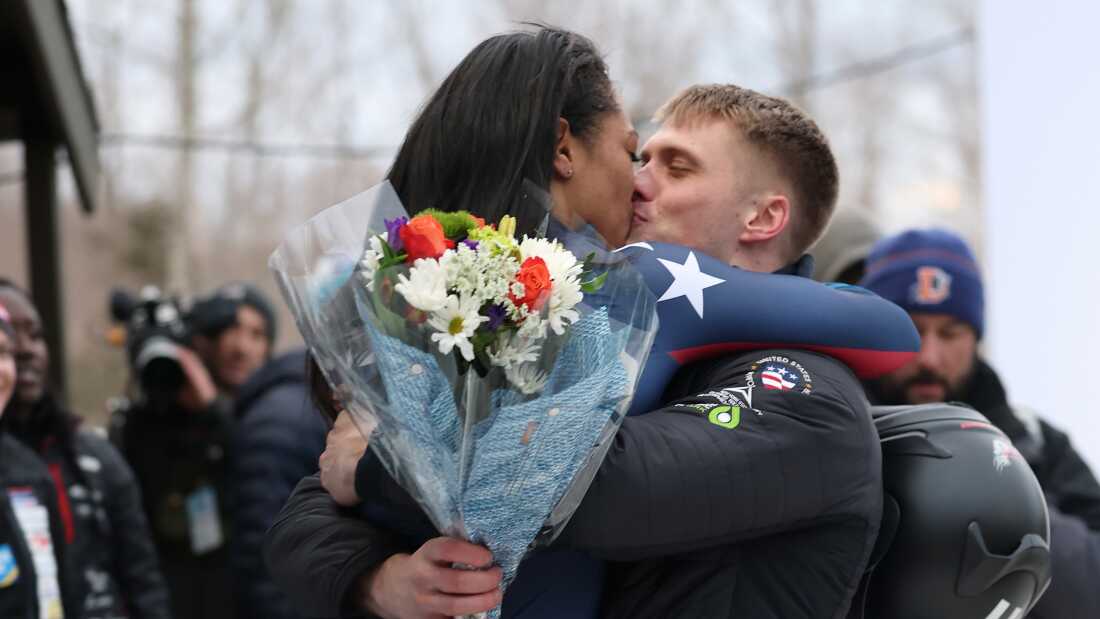
Bobsledders Kaysha Love and Hunter Powell celebrate after Love won a race in Lake Placid, N.Y., in March 2025. The couple is now engaged.
Al Bello/Getty Images
hide caption
toggle caption
Al Bello/Getty Images
Bobsled athletes Kaysha Love and Hunter Powell met when they were track and field stars at their respective colleges. Love switched to bobsled and made the 2022 Olympics, then urged Powell to do the same.
“She convinced me to go to #SlideToGlory [a USA recruitment event,] which I was very resistant to, but she talked me into it, and I’m so thankful that she did,” Powell said from Cortina.
They got engaged in July 2025. Now, they’re Olympic teammates.
“It’s the coolest thing in the world,” Powell added. “I’m travelling the world for the first time in my life, chasing the dream, with the woman I love and my best friend. It doesn’t get cooler than that.”
Red Gerard and Hailey Langland

Snowboarders Red Gerard and Hailey Langland at an event in 2023 at Park City, Utah.
Joe Scarnici/Getty Images for JBL
hide caption
toggle caption
Joe Scarnici/Getty Images for JBL
Snowboarders Red Gerard and Hailey Langland have known each other since they were 12, and have been in a relationship for the past eight years.
They both competed at the Olympics in Pyeongchang in 2018 — where Gerard won gold — and 2022 in Beijing. He is competing again this year. She’s sidelined by an ACL injury, but staying with him and his parents in Italy.
Madison Chock and Evan Bates
Evan Bates took Madison Chock on a date on her 16th birthday, though it didn’t immediately lead to anything.
Several years later, in 2011, they partnered up in ice dance. Six years later, Bates confessed his feelings.
“Well, I pretty much told Maddie that I loved her,” Bates told NBC in 2018. “Last year I told (her) how I really felt and that changed things a lot.”

The two got engaged in 2022 and married in the summer of 2024 in Hawaii, where Chock’s parents are from. Bates told NPR in October that while “the skating career is short and finite, the relationship is much, much longer.”
“We love what we do, but we also really love each other,” Chock added. “And we’re able to take this passion and use it to foster our connection as a couple. And I think from that we’ve grown a lot through our sport, and that’s been such a great teacher for us.”
They’re not the only ice dance power couple on Team USA: Emilea Zingas and Vadym Kolesnik have been partners on and off the ice since 2022.
Other couples to know

Marie-Philip Poulin, right, and Laura Stacey of Team Canada celebrate after winning the hockey gold medal match against Team United States.
Elsa/Getty Images
hide caption
toggle caption
Elsa/Getty Images
- Hockey greats Marie-Philip Poulin and Laura Stacey play together for the Montreal Victoire, and for Team Canada (of which Poulin is the captain). They’ve been together since 2017 and married since 2024.
- Kim Meylemans and Nicole Silveira are both skeleton racers, representing opposing teams (Belgium and Brazil). They’re also newlyweds, having married less than a year ago after sparking up a relationship during the COVID-19 pandemic.
- Anna Kjellbin and Ronja Savolainen met while playing together in the Swedish pro women’s hockey league, before getting signed to separate teams in Canada. The now-fiances are playing for separate teams at the Olympics, too: Sweden and Finland.
- There are three married couples in this year’s 10-team mixed doubles curling field:
- Italian ice dancers Charlene Guignard and Marco Fabbri have been together since 2009, with the on-ice PDA to prove it.
- Jocelyn Peterman and Brett Gallant of Canada, Switzerland’s Yannick Schwaller and Briar Schwaller-Hürlimann, and Kristin Skaslien and Magnus Nedregotten of Norway.

The way Sheila E. remembers it, she received her first call about a gig as a working Los Angeles musician as she was busy unpacking the moving truck with which she’d just moved to L.A.
“‘Can you come do a session?’ — that type of thing,” the Oakland native recalls with a laugh. “It was pretty awesome.”

In Sunday Funday, L.A. people give us a play-by-play of their ideal Sunday around town. Find ideas and inspiration on where to go, what to eat and how to enjoy life on the weekends.
This was 1980 or ’81, she reckons, just after she’d come off the road playing percussion for the jazz star George Duke; by 1984, she’d become a star herself with the pop hit “The Glamorous Life,” which she cut with her mentor Prince and which went to No. 7 on Billboard’s Hot 100.
Over the decades that followed, Sheila E. went on to record or perform with everyone from Ringo Starr to Beyoncé. Yet her latest projects look back to her earliest days playing Latin jazz with her father, fellow percussionist Pete Escovedo: “Bailar” is a salsa album with guest vocal spots by the likes of Rubén Blades and Gloria Estefan, while an accompanying instrumental disc features appearances by players such as bassist Marcus Miller and trumpeter Chris Botti.
Sheila E. will tour Europe in April. Here, she runs down her routine for a welcome day off at home in L.A.

10 a.m.: Parents in the pews
I would get up around 7:30 or 8, and the first thing I’ll do is go to church. My church is called Believe L.A., and it’s in Calabasas. My pastor is Aaron Lindsey, who’s an incredible gospel producer who’s won many Grammys. The band is always on point, and it feeds my soul — it’s what I need as part of my food. You just walk out so happy. I mean, I walk in happy most of the time. But you walk out filled with love and peace. It’s a joyful time, especially when I get to bring my parents with me. Still having them around is a huge blessing. They just celebrated their 69th anniversary. That’s really rare.

Noon: No juice required
After church we’ll go to brunch at Leo & Lily in Woodland Hills. Sometimes I’ll order the breakfast, which is two eggs and turkey bacon and potatoes. But sometimes that’s a little bit too heavy, so I’ll get the orzo salad, which is really good. I might have an espresso, or I might have a glass of Champagne. I don’t like mimosas — just give it to me straight.

1:30 p.m.: Retail therapy
My parents love driving down Ventura Boulevard. We’ll stop at some places and go window shopping, or maybe we’ll go to the Topanga Westfield mall. And when we finish at the mall, I have to go to Costco. The Costco run is really just for my dog — I have to get all her food. I get turkey and vegetables, and I cook all that and pre-make her meals for two weeks so I don’t have to deal with it. I can just open it, warm it up and feed her. She’s a mixed pit rescue, and her name is Emma. I got her when she was 5 months old in Oakland while we were performing, and now she’s 12. She’s a sweetheart.

4 p.m.: Family secret
We’re sports fans, so if it’s football season, we have to hurry up and get back to my house for the game. We’re a 49ers family. I would say the Raiders because we’re from Oakland, but we’ve always been 49ers fans. I mean, when it’s time to root for the Raiders, we do. We don’t hate like the Raiders hate on us. I’ll cook food depending on who all’s coming over — my nephews and various friends and so on. I grill a lot, so I’ll do steaks or lamb chops or chicken wings. My mom loves making potato salad. I can’t tell you the recipe — it’s a secret. It’s actually her mother’s potato salad, and they’re Creoles. Those Creoles don’t mess around with their potato salad.
8:30 p.m.: Games after the game
I never tell anyone to leave. Sometimes people spend the night — it’s an open house. If we’re not too tired, we’ll start playing board games or card games. Don’t get us started on poker.

11:30 p.m.: Steam time
Before bed I’ll get into the sauna just to relax and do a little sweating. Then I go take a shower with jazz or spa music playing. Sometimes I’ll do a little stretching before I get in the bed. I usually don’t read before I go to sleep. My go-to is HGTV — I set it for an hour and a half, and I’m out.

‘Here Lies Love’ finally lands in L.A. — with its musical take on corruption as relevant as ever

Jeffrey Epstein’s Infamous Zorro Ranch Never Visited by Police, New Owner Says

Warner Bros. Discovery reopens bidding, gives Paramount seven days to make its case

Olympic curling scandal threatens to forever alter the sport’s culture of trust

Mapping forced displacements and settler attacks by Israel in the West Bank

Florida High School Football Rankings: Top 25 teams – Oct. 21

Cleary's 21 help Le Moyne down Central Connecticut State 69-64 in OT

How old is Bo Nix? What to know about Oregon quarterback ahead of 2024 NFL Draft

99th annual Pony Swim held in Virginia

Indiana Members Credit Union announced as new anchor tenant at Bottleworks District
Mapping forced displacements and settler attacks by Israel in the West Bank

Rev. Jesse Jackson, a civil rights icon, dies at 84

Video: At Least 2 Killed During High School Hockey Game in Rhode Island

Tom Emmer blasts Democrats’ double standard on SAVE Act: ‘They require photo IDs’ at their own DNC
Delaying digital euro harms Europe, German vice-chancellor says
-

 Alabama1 week ago
Geneva’s Kiera Howell, 16, auditions for ‘American Idol’ season 24
-

 Illinois1 week ago
2026 IHSA Illinois Wrestling State Finals Schedule And Brackets – FloWrestling
-

 Culture1 week ago
Try This Quiz on Passionate Lines From Popular Literature
-
 Science1 week ago
Torrance residents call for the ban of ‘flesh-eating’ chemical used at refinery
-

 Politics1 week ago
West Virginia worked with ICE — 650 arrests later, officials say Minnesota-style ‘chaos’ is a choice
-
 Science1 week ago
TrumpRx is launched: How it works and what Democrats say about it
-

 North Dakota1 week ago
5 North Dakotans have announced their candidacy for the state’s U.S. House seat
-

 Fitness1 week ago
13 best fitness watches for 2026, tried and tested