Lifestyle
With Pitchfork in peril, a word on the purpose of music journalism


Unionized staff picket outside the Condé Nast offices in New York on Jan. 23. The company is merging the popular digital music publication Pitchfork with the men’s magazine GQ, which has triggered anger over the resulting layoffs and concern for the outlet’s future.
Angela Weiss/AFP via Getty Images
hide caption
toggle caption
Angela Weiss/AFP via Getty Images

Unionized staff picket outside the Condé Nast offices in New York on Jan. 23. The company is merging the popular digital music publication Pitchfork with the men’s magazine GQ, which has triggered anger over the resulting layoffs and concern for the outlet’s future.
Angela Weiss/AFP via Getty Images
Last week was a tough one for music nerds. I use that phrase with love and kinship — I am (like you are, perhaps) the kind of listener who loves music so much that it hurts. And that kind of passion for new and beloved sounds can make those like us odd, or at least amusing, to “normal” people who maybe only listen to their college favorites and only go to one concert a year, because it happens to be in a park or at the pier.
I offer this declaration of fellowship because that sometimes petty distinction surfaced in a real way last Wednesday, when the editorial director of media behemoth Condé Nast sat in a conference room wearing sunglasses and told the staff at Pitchfork that the renowned music webzine would be absorbed, Star Trek-style, into the men’s magazine GQ, and that most people present would be laid off pretty immediately. Her memo condescendingly thanking Pitchfork’s editor-in-chief, Puja Patel (who was let go) leaked online soon after, announcing that this decimation is what Condé thinks “is the best path forward for the brand.” While its renowned reviews section will live on, Pitchfork’s remaining staff is a skeleton crew. GQ‘s paywall is likely to diminish the reach of what the site publishes, and its identity — the thing that led musicians and fans alike to make it their home page or check the day’s new reviews at midnight — will inevitably be challenged. I’ve been through similar bloodlettings at other publications, and what they do to morale and manageable workloads can’t be overstated.
The days since have seen myriad tributes and jeremiads published in article form and as social media threads, alongside heartfelt goodbyes from staffers and regular contributors celebrating the great work they did at the publication. Pitchfork’s long life and evolution both dominated and embodied 21st century music writing: It began as a blog, basically, powered by the attitude of its mostly white-guy founders, and established itself through creatively nasty pans of popular artists and paeans to arty but cool hipster bands like Grizzly Bear and Animal Collective that were augmented by a numerical scoring system that wasn’t unique (hail Robert Christgau’s Consumer Guide, 51 years old and still going) but which reinforced its status as the tastemaker within those circles where Jonny Greenwood is a god.
Even before its owners struck a deal with Condé Nast in 2015, though, Pitchfork had begun transforming, becoming more like a conventional magazine with features and news alongside its reviews. As its authority solidified, mid- and late-period editors like Patel, Mark Richardson, Amy Phillips, Jill Mapes, Jessica Hopper and more dedicated themselves to expanding and diversifying Pitchfork’s coverage, reassessing its legacy as an indie “kingmaker” (LOL sexist) and transforming it into the publication best equipped to cover the vast, atomized waterfront of contemporary music. In the past decade Pitchfork has nurtured many of the best and most influential music writers working today. Now several of them are looking for work.
If you’re not a super, super-nerd, you may wonder why Pitchfork’s half-demise has generated so much anguish. The links I’ve provided above tell the story; I’ll just add a few more thoughts:
Great culture writing reflects the world it covers
The diversity of Pitchfork’s recent masthead, and coverage, matters. It’s only been four months since Rolling Stone founder Jann Wenner’s dismissive comments about women and BIPOC musicians set off its own firestorm as many former Stone employees came forward with stories of structural sexism and racism at the company, spurring a larger conversation about the exclusionary history of the music press. Pitchfork was part of that problematic lineage until its editors chose to actively confront it. Features like the Sunday Review, in which previously ignored albums from beyond its indie-rock core are given the attention they deserve, were the public expression of what was happening behind the scenes as more women, BIPOC and LGBTQIA+ people assumed positions of power. Pitchfork’s absorption into a men’s-magazine brand feels like a highly conservative move at a time when music has proven to be one of our culture’s most beautifully progressive spaces. Scholar Robin James has written insightfully on how such moves reflect the false assumption that “bros” are more reliable as consumers than women. I find this particularly bizarre coming out of a year in which the biggest entertainment stories have all been dominated by women and BIPOC creators, from Taylor Swift to Barbie to Beef.
Critics are also explorers
This blow affects more than just music journalists; it contributes to the larger downward spiral imperiling everyone in music beyond that Swiftian one percent. I’m not the first to point this out. Publicist Judy Miller Silverman noted that Pitchfork’s coverage of “out” subgenres like experimental jazz, electronic music and even Hawaiian slack key guitar “helped an entire ‘economy’ of musicians succeed.” Writer Marc Masters made the connection between this consolidation and the paradoxical narrowing effect of streaming’s dominance — platforms like Spotify offer galaxies of music, yet their algorithms confine most listeners to tiny areas of taste and offer no context or real community. To those who say music writing is irrelevant in an age of discovery through TikTok and other video-based platforms — ask any artist who doesn’t have the time or money to also be a shiny happy influencer if they’re going to miss the old Pitchfork. Plenty poured one out for it after the news broke.
Usefulness is overrated
While the role of music writing as a form of discovery, promotion and gatekeeping is undeniable within popular music’s history, I also want to push back against the well-intentioned attempts to assert its productive role within the entertainment biz. To me, the best thing about music writing is that compared to other elements of the culture economy, it’s relatively useless. Some forms of entertainment journalism feed the star-maker machinery more than others: celebrity profiles, for example, flesh out the personae that turn artists into fetish objects. And as those Pitchfork scores both assert and satirize, many people enjoy the game of trying to quantify art, to judge it as performance or product.
What I love about music writing, though, is that it can sidestep that productive, competitive side of culture, the market-driven need to sell more tickets, more records, more streams. Instead, great music writing messes with productivity by creating a space to slow down and really immerse in someone else’s creative work. To really listen. The best writing at Pitchfork or anywhere reflects that process and is as variegated as the human experience itself. Maybe what a writer finds inside an album or a song is a new way of thinking about a particular musical practice as she gets meticulous about analyzing song structure or studio tools. Maybe she discovers lost histories, whole scenes and subcultures. Sometimes she uncovers something she’d forgotten about her own life story, of the hidden coves of her own feeling. Maybe the sonic innovations she confronts cause her to use language in a different way, and what she ends up with is a kind of poetry. Reading the most powerful writing in Pitchfork – the kind that some surveyors of the media landscape are declaring obsolete, replaced by influencers and algorithms – I feel nourished by the daring of my fellow scribes, by the way their words are indeed extraneous to the churn of art and emotion as product, carving out a zone where the pause matters, time spent thinking, laughing at a good line, feeling my brain crackle as it absorbs an insight.
What I am talking about is pleasure. In the end, what matters about music writing is exactly the same as what matters about music: It isn’t leading anywhere productive. Instead, it’s offering a break from the grind, a free zone for thought and a few glorious, rejuvenating moments of fun. This is a different kind of pleasure than the quick nervous kind TikTok brings, always moving on to another source of stimulus, always ratcheting up the competition for attention. Music writing says: Slow down. Pay attention. It witnesses the unfolding of meaning within measured time, and calls back to it.
The singer-songwriter Josh Ritter said it well in a tweet the other day: “Loving music is one thing, but to then attempt to translate those ineffable emotions into words for the rest of us, takes talent and bravery and beautiful human optimism.” Optimism is exactly right. To believe that on any given day, a person can make room to absorb something soothing or electrifying or challenging, something that others made with their whole souls, and then find a way to share it with others – that’s a gift worth cultivating. At its best Pitchfork offered many people a chance to live in the optimistic, gloriously pointless space of loving music. I know that the writers it nurtured will always continue to seek out ways to do so; that’s where my hope remains.
This essay was originally published in the NPR Music newsletter. Subscribe here for more.


Sunday Puzzle
NPR
hide caption
toggle caption
NPR
This week’s challenge
Today’s puzzle is a tribute to Mimi. Every answer is a familiar two word phrase or name in which each word starts with the letters MI-.
Ex. Assignment for soldiers –> MILITARY MISSION
1. Pageant title for a contestant from Detroit
2. One of the Twin Cities
3. Nickname for the river through New Orleans
4. Super short skirt
5. Neighborhood in Los Angeles that contains Museum Row
6. Just over four times the distance from the earth to the moon
7. Goateed sing-along conductor of old TV
8. American financier who pioneered so-called “junk bonds”
9. Little accident
10. Land-based weapon in America’s nuclear arsenal
11. In “Snow White,” the evil queen’s words before “on the wall”
Last week’s challenge
Last week’s challenge comes from Benita Rice, of Salem, Ore. Name a famous foreign landmark (5,4). Change the eighth letter to a V and rearrange the result to make an adjective that describes this landmark. What landmark is it?
Answer
Notre Dame –> Renovated
Winner
Chee Sing Lee of Bangor, Maine
This week’s challenge
This week’s challenge comes from James Ellison, of Jefferson City, Mo. Think of a popular movie of the past decade. Change the last letter in its title. The result will suggest a lawsuit between two politicians of the late 20th century — one Republican and one Democrat. What’s the movie and who are the people?
If you know the answer to the challenge, submit it below by Thursday, April 23 at 3 p.m. ET. Listeners whose answers are selected win a chance to play the on-air puzzle.
This story is part of Image’s April’s Thresholds issue, a tour of L.A. architecture as it’s actually experienced.
A landmark is a landmark because it tells you that you’re home now — the piece of earth you’ve chosen to inhabit saying, “You’ve made it back, congratulations.” We identify our cities with their landmarks, and because we identify with our cities, we identify with the landmarks too. They are us and we are them, mirroring each other through eternity. A city like New York or Chicago, with the Chrysler Building, the Bean, etc., has landmarks that exist in the world’s popular consciousness. But L.A.’s most cherished landmarks belong to us and us alone, a secret you’re let in on if you live here long enough and pay attention.
The Fashion Nova baddie in horizontal sprawl off the Vertigo, for example, is an emblem for those in the know. Our twisted version of a capitalist guardian angel, patron saint of spandex in a cropped matching set. Welcome to El Pueblo de Nuestra Señora la Reina de los Ángeles de Fashion Nova. Merging on the 110 South from the 10 East while the sunset burns and traffic thickens is a miracle in more ways than one, and in the spirit of compulsively performing the sign of the cross when you pass a church on the freeway, this billboard is deserving of its own acknowledgment.
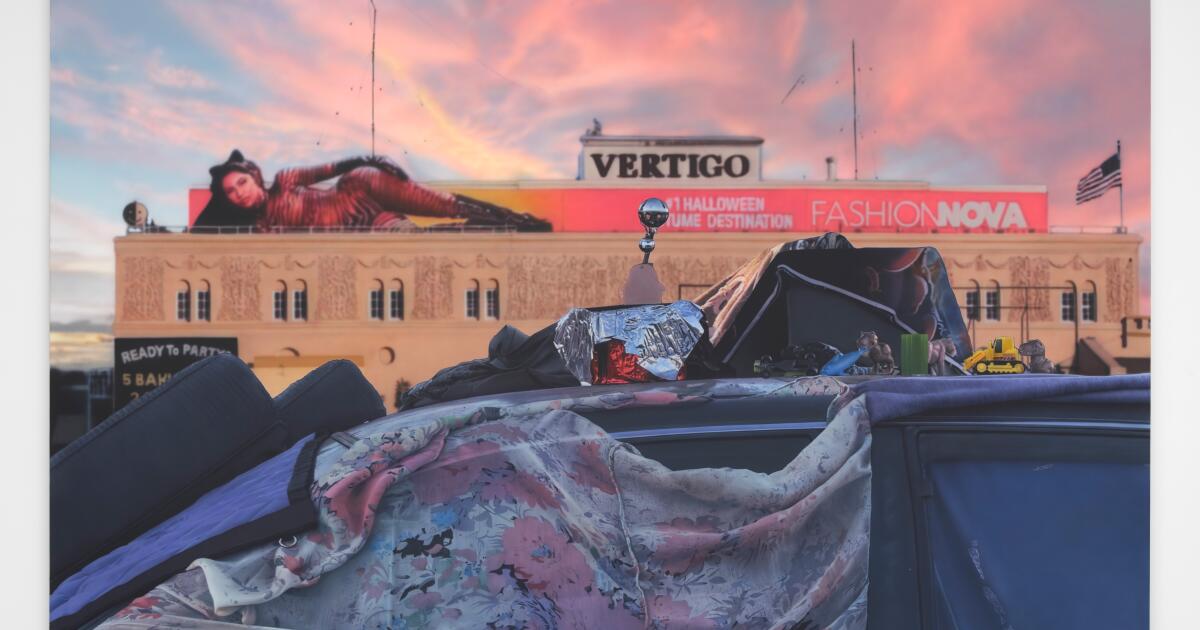
It may not be the landmark L.A. asked for, but in Sayre Gomez’s painting “Vertigo,” you begin to understand why it’s the one we deserve. At the opening for “Precious Moments,” Gomez’s solo show at David Kordansky, the room was vibrating. A game of energetic ping-pong unfolded underneath the gallery’s fluorescent light, beams of identification, recollections or stabs of grief bouncing off each piece in the exhibition. People were seeing hyperspecific parts of a city they love reflected in a hyperspecific way — for better and for worse. Recognition has two edges and they both happen to be sharp. Gomez twists the knife deeper for a good cause: He wants you not just to look but to really see.
In his work exist iconic signs of beloved local establishments — like the Playpen — the blinding glint reflecting off downtown’s skyline, telephone poles regarded as totems. The line to see Gomez’s replica of L.A.’s graffiti towers, “Oceanwide Plaza,” snaked through the gallery’s courtyard. Once inside, at least three graffiti writers whose names were blasted on the replica pointed it out proudly, even gave out stickers to take home. The truth can be beautiful and it can be ugly — in this case it’s both — on the flip side showing up in the form of smog, tattered flags and an abandoned graffiti tower that starkly represents the pitfalls of capitalism and greed, a neon arrow pointing to the homelessness crisis.
Because the Vertigo is something everybody who lives here recognizes as central to a sort of framework of Los Angeles. And I think the encampment has become that as well. It’s connecting these integral components — something that’s more revelatory and more fun with something that’s more grave.
— Sayre Gomez
In the main gallery, I was stuck on “Vertigo.” On the 12-foot canvas, my eye went to the place out of focus: the thin strip of billboard in the background featuring a young woman with sand-dune hips, patent knee-high boots and long black hair laid up on her side, wearing cat ears and a tiger bodysuit as flush as second skin. The model made the kind of eye contact that felt dangerous — might cause an accident if you’re not careful. “#1 Halloween Destination … FASHION NOVA,” it read. I knew her, anyone who has driven through the two main arteries of Los Angeles knows her. The black-and-white smiley motif of the Vertigo, an events space, sat right next to her face, just happy to be there, it seemed, above a painted sign that says “Ready to Party?”
The sky was the color of cotton candy, but the stale kind that’s been hardening in a plastic bag for days after the fair. Something rancid about it. In the foreground of the painting was a car encampment with a tattered floral sheet woven through the windows, cloth tarps and couch cushions creating a shield against the elements. Small plastic children’s toys lined at the top of the car — dinosaurs and dump trucks and sharks — creating their own shrunken skyline in front of the Vertigo, signaling that young kids likely lived there. It’s less juxtaposition for juxtaposition’s sake and more an accurate reflection of the breakneck duality of living in a place like L.A.
Even angels exist within the context of their environments. Our Fashion Nova baddie hangs off the Vertigo, a building that has used its ad space as physical clickbait and political posturing for over a decade. It’s promoting the kind of fast fashion brand that’s been regarded as a case study on the industry’s environmental impact. In the years the billboard has been up, it’s looked over dozens and dozens of car encampments like the one depicted in Gomez’s piece.
She feels dubious, yes. But no less like ours.
Julissa James: I’ve lived in L.A. for 13 years now. For me, the city and the architecture of the city is less the Frank Lloyd Wrights and Frank Gehrys — there’s that — but other landmarks that signal, “Oh, I’m home.” The Fashion Nova baddie above the Vertigo has always been that for me. Your piece is layered and there’s so much more to it than just that, but that’s the first thing I saw and was like, “Whoa. I need to talk to Sayre. We need to talk about ‘Vertigo.’”
Sayre Gomez: It’s like L.A.’s Statue of Liberty. It’s the city of anti-landmarks, you know what I mean? I mean, there’s the Hollywood sign, which I think is so telling, because it’s the remnants of a real estate venture. The city is built by real estate schemes and 100 years later we’re feeling the effects of it. You’ve got empty skyscrapers and a massive homeless catastrophe. L.A. doesn’t really have real landmarks. It has anti-landmarks.
JJ: When did the Fashion Nova billboard above the Vertigo click for you as something that felt representative of the city, or something that you wanted to depict?
SG: My studio is in Boyle Heights, so I pass that billboard multiple times a week. This is my 20th year in L.A. and that building’s always been a big mystery to me. It was empty when I moved here before this guy Shawn Farr bought it and turned it into Casa Vertigo. I think he probably makes more money on it with the ad space than anything. I know nobody who has ever been there. Very mysterious to me. So that’s what I was drawn to.

(Paul Salveson from David Kordansky Gallery)
The Vertigo has always been mysterious to me. And that whole fashion industry is mysterious to me — the kind of shmatta, American Apparel-adjacent, or maybe coming out of the wake of that. These kinds of businesses, or the representations of these businesses, how do they function and how do they flourish? Is it aboveboard? What more perfectly encapsulates that than that building? It’s this weird thing you can’t quite figure out but somehow it has a lot of money and then it’s an event space, supposedly billed as that. Clearly it’s this big ad thing, and I’m very interested in the changing dynamics of capital. The capital of yesteryear, which was based on the brick and mortar, where things are being made in a specific location, maybe on an assembly line or in a specific way, to a kind of capital that is based solely on advertising or on viewership. These beautiful buildings acting as pedestals for some kind of ad space, you know? It becomes an anti-landmark for me. Something where I’m like, “Oh, there’s that thing again.”
JJ: It’s this gorgeous Beaux Arts building …
SG: It’s a Freemason building!
JJ: When I’ve talked to some people about the Vertigo, they’re like, “the Fashion Nova building?”
SG: They always have the woman in the same pose — same pose, different clothes. If you remember before Fashion Nova, they would have these provocative ad campaigns or provocative slogans. “Twerk Miley” was up, remember that? They did a Trump one: “TRUMP NOW.” They did one for Kanye when he ran for president. The 10 and the 110 are literally the crossroads of the city, so it’s really poised to be a special building. It has a special designation because of the location.
JJ: Talk to me about the process of doing this piece. Where did it start and how did it evolve?
SG: I was cruising around that vicinity trying to see if I could get a good vantage point to take photos of Vertigo. And then I stumbled upon this car — the car that’s in the foreground of the painting. Anytime I see an encampment that has kids’ toys, things that reference back to the lives of children, it hits hard. But I like to lay it all out there. I like to make things confrontational. I want it to be difficult. The painting isn’t based on a one-to-one photo [Gomez paints from a composite rendering of images he’s taken around town], but I knew that I wanted to use that car, and I knew I wanted to get the Vertigo building, and so I started just messing around with different iterations. I could never find a good angle to take a good photo of the building, so I just went on Vertigo’s website and I was like, “I’m just using these.” I switched the sky and put a more moody, atmospheric sky in.
JJ: Which I loved, because we know that feeling — you’re merging onto the 110 and you see a beautiful sunset. The euphoria of like, “L.A. is the best city in the world.” But you know what? What I found so interesting about your piece is that it was revealing to me about myself, but also about so many of us that live in L.A. and have lived here for years and have developed a jadedness. When I saw your piece, immediately I was like, “Oh my God, the Vertigo! The Vertigo! The Vertigo!” And then I was like, “OK, wait, hold on, there’s so much more going on here.” But the fact that my eye went to that first instead of the car encampment, the kids’ toys, brought up a lot of questions about my own relationship to the city and the things that we choose to see, the things that maybe we’ve seen so much of that we subconsciously filter it out. Why was it important for you to put these two things up against each other in this way?
SG: Because the Vertigo is something everybody who lives here recognizes as central to a sort of framework of Los Angeles. And I think the encampment has become that as well. It’s connecting these integral components — something that’s more revelatory and more fun with something that’s more grave. That’s what I’m doing in my work at large. I use the sunsets and the beauty to create a dialogue, to entice people to sort of look a little bit at how things are contextualized, how things act, what’s actually happening. I don’t make things in a vacuum. I was working on this show and I was going to really push this agenda of incorporating more of my experience with my kids into the work. That’s also a double-edged sword. I wanted to interject some levity, because the work can get so dark. I wanted to bring in some iconography from their world and things that they get excited about. When you’re juxtaposing that with really stark things, it becomes darker. I want to thicken the stock a little bit. Make things a little more complex.

Phil Pritchard of the Hockey Hall of Fame works the 2019 NHL Awards at the Mandalay Bay Events Center on June 19, 2019 in Las Vegas, Nevada. (Photo by Bruce Bennett/Getty Images)
Bruce Bennett/Getty Images
hide caption
toggle caption
Bruce Bennett/Getty Images
This week’s show was recorded in Chicago with host Peter Sagal, judge and guest scorekeeper Alzo Slade, Not My Job guest Phil Pritchard and panelists Alonzo Bodden, Adam Burke, and Dulcé Sloan. Click the audio link above to hear the whole show.
Who’s Alzo This Time
The Don Vs The Poppa; World’s Worst Doctor; Should We Eat That?
Panel Questions
Big Cheese News!
Bluff The Listener
Our panelists tell three stories about someone missing a huge opportunity in the news, only one of which is true.
Not My Job: Phil Pritchard, the NHL’s Keeper of the Stanley Cup, answers three questions about the other NHL, National Historic Landmarks
Peter talks to Phil Pritchard, the NHL’s Keeper of the Stanley Cup. Phil plays our game called, “Let’s Go Visit The NHL” Three questions about National Historic Landmarks.
Panel Questions
The Trump Dump and Air Traffic Control Becomes Animal Control
Limericks
Alzo Slade reads three news-related limericks: Spice Up Your Spring Cleaning; A Fizzy Meaty Drink; The Right Way to Eat Peeps.
Lightning Fill In The Blank
All the news we couldn’t fit anywhere else
Predictions
Our panelists predict the next big AirBnB story in the news
-

 Culture13 minutes ago
Famous Authors’ Less Famous Books
-

 Lifestyle19 minutes ago
Sunday Puzzle: For Mimi
-

 Technology31 minutes ago
The future of local TV news has taken a Trumpian turn
-

 World37 minutes ago
Pope Leo says remarks about world being ‘ravaged by a handful of tyrants’ were not aimed at Trump: report
-

 Politics43 minutes ago
Trump renews bridge, power plant threat against Iran in push for deal, mocks ‘tough guy’ IRGC
-

 Health49 minutes ago
Loneliness may be silently eroding your memory, new research reveals
-

 Sports55 minutes ago
ESPN’s Stephen A Smith hears boos from WrestleMania 42 crowd
-

 Technology1 hour ago
Chinese robot breaks human world record in Beijing half-marathon