Lifestyle
What it's like to travel to Maui right now — one year after the catastrophic wildfires

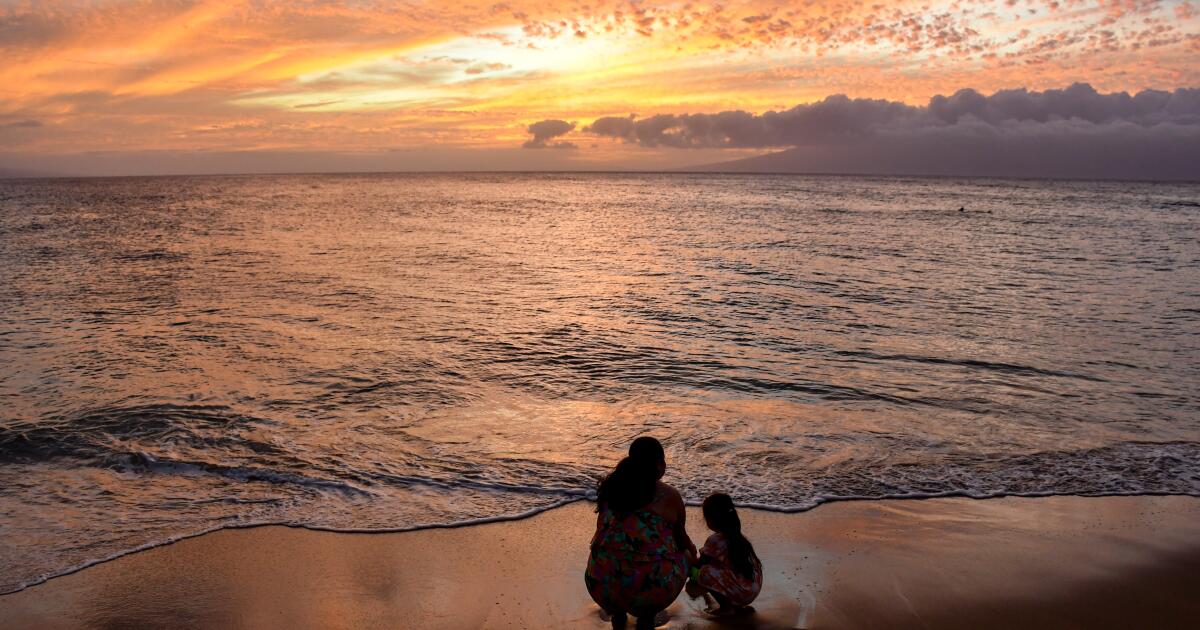
Five hundred feet outside the Lahaina burn zone, the tourists receive their leis.
As the torches of the Old Lahaina Luau flicker, bartenders mix mai tais and hula dancers get ready. After dinner, dancer and emcee Niki Rickard gathers the performers in a circle and asks the audience for “a moment of silence … to acknowledge all we have lost.”
A year after the deadliest U.S. wildfire in a century, which killed at least 102 people and leveled 2,200 structures, this is what passes for business as usual in West Maui. Though 98% of the island carries no visible signs of the fire, most of the city of Lahaina was leveled and remains behind roadblocks as crews begin the transition from cleanup to reconstruction.
Most of Lahaina burned and at least 102 people died in the wildfire that erupted on Maui last August. An image from the aftermath on Aug. 16, 2023.
(Robert Gauthier / Los Angeles Times)
In the first two weeks after the fire, most of the city’s 12,700 residents moved into hotels, with FEMA footing many bills. Since then, amid ferocious debate about the island housing shortage and how to rebuild, most fire survivors have moved to longer-term housing or left the island. Many are back at work now, tending to tourists.
This tangle of mourning, recovery and tourism has many travelers wondering if it’s possible or respectful to spend a vacation on Maui now.
The answer is yes, according to every resident, worker and visitor I asked in three days on the island. But tourism lags about 25% behind pre-fire levels, and the situation can seem as layered as a Maui onion. While the average hotel room rents for more than $500 per night, residents scramble for housing and equilibrium.
It’s easy to spend a week on the island in full vacation mode without setting foot in Lahaina. Conversely, the island’s recovery campaign includes a variety of “voluntourism” options (detailed below) for those who want to dedicate half a day or more to pitching in.
But some curious visitors fall between those extremes. Tourism workers say this can lead to hard feelings, especially when visitors try to photograph damage or ask intrusively about lost homes and loved ones. That’s when many Mauians turn away, get angry or post signs at the end of their block reading, “Locals still grieving. Show Respect. No tourists.”
“Be sensitive,” said Siobhan Wilson, co-owner of the Maui Butterfly Farm in Olowalu. “Don’t go up and ask people, ‘What did you see and what happened?’ If people want to talk, they will.”
“Come with aloha. Leave with aloha,” said longtime resident George Pali, sitting at a Wahikuli Wayside Park picnic table near some long-term tents. “You guys [in California] have wildfires all the time, right? So you have some idea.”
Here’s an update for anyone considering travel to Maui, including reasons why you might or might not want to include a stop in Lahaina.
What’s open in Lahaina, and what’s gone
Most of Front Street, Lahaina’s commercial backbone, is no more. Little remains to remind a visitor that this was the capital of the Hawaiian Kingdom in the early 19th century under King Kamehameha II. But the flames didn’t claim everything.
At the north end of the street, a handful of restaurants and a dive shop were left largely intact, including the Old Lahaina Luau, despite its thatched roofs. It reopened in March and attracts up to 350 guests nightly, many of them happy to be adding dollars to the diminished local economy.
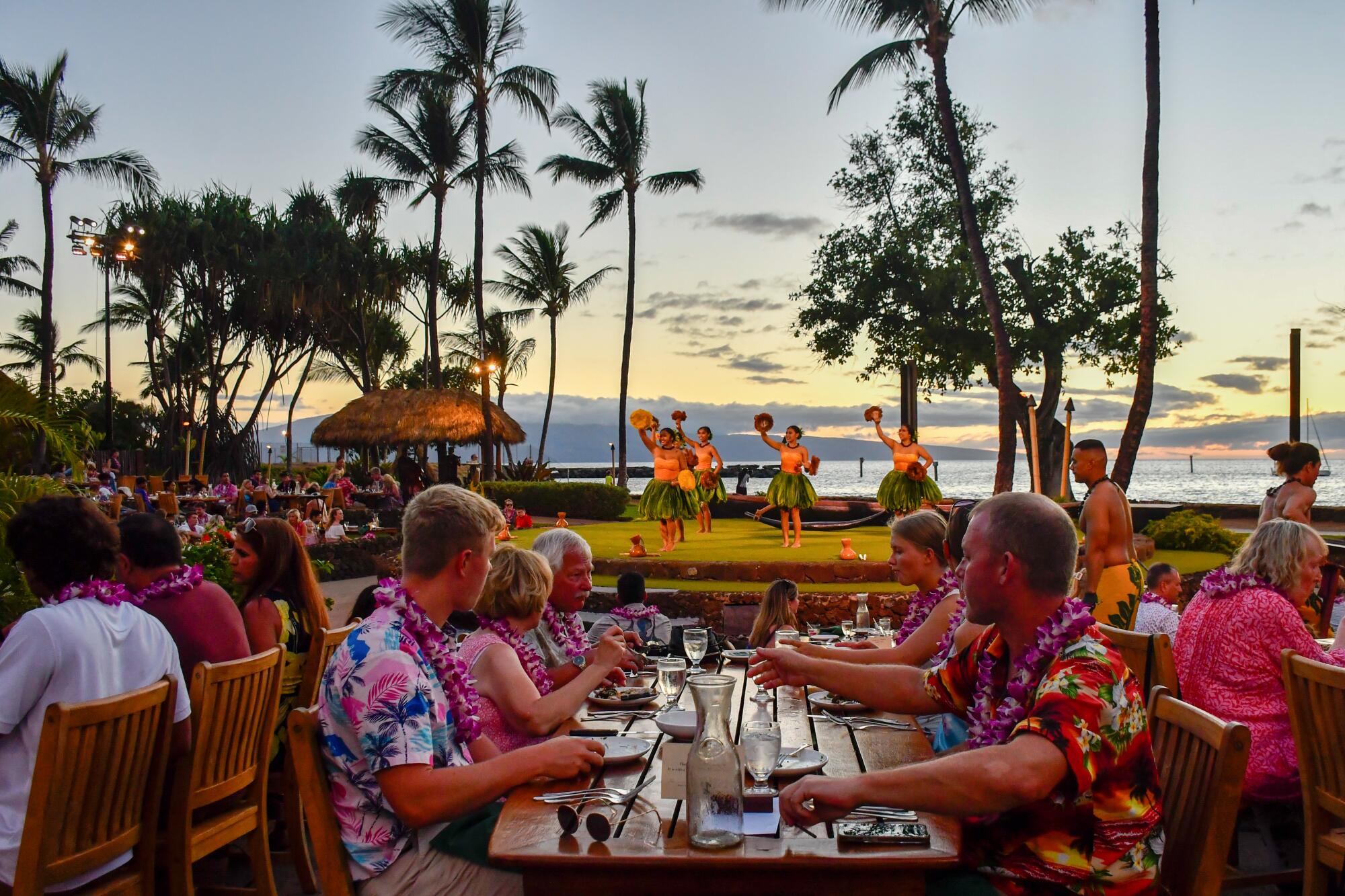
The Old Lahaina Luau reopened in March. The luau features dinner and an hourlong performance, including hula dancers, on the waterfront in West Maui.
(Christopher Reynolds / Los Angeles Times)
When Niki Rickard takes the microphone before those luau audiences, she doesn’t mention her own story. But it’s a potent one, and it hints at the experiences of many survivors.
Both of her parents are longtime employees of the luau, which started in 1986. Beginning about age 4, Rickard dreamed of dancing there, then landed a job doing just that. Now 30, she also handles sales and emcee duties, summarizing the island’s history of migration, colonization, whaling, plantations and resilience in diplomatically measured tones.
Last August, she had just returned from maternity leave when the fire broke out.
Neither Rickard, her husband or their daughter was injured, but their home burned.
“My daughter was 3 months old,” Rickard said in an interview.
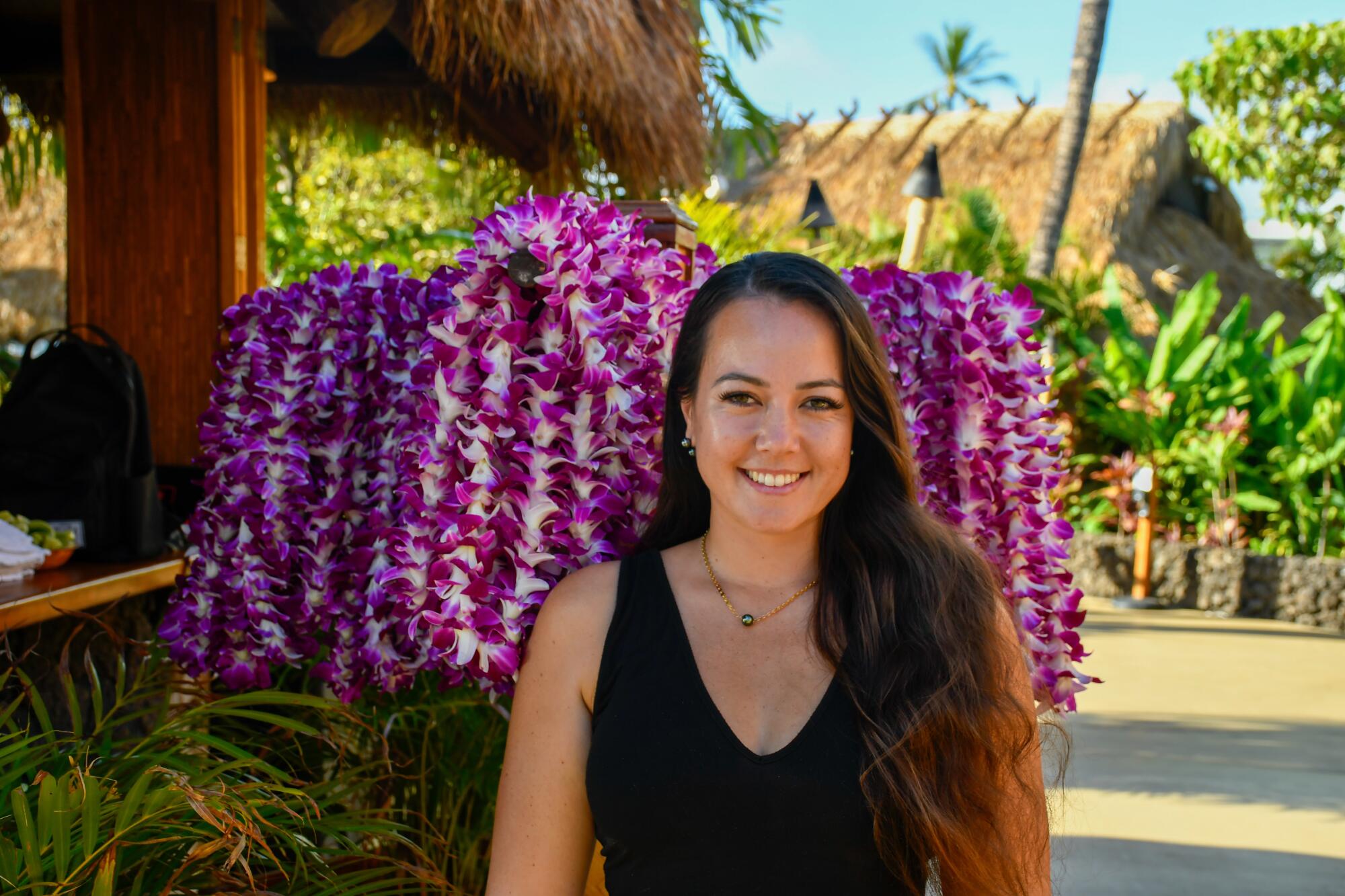
Niki Rickard, a dancer, emcee and sales agent for the Old Lahaina Luau.
(Christopher Reynolds / Los Angeles Times)
Since the fire, Rickard has been among the thousands of residents dealing with temporary housing, an island-wide child-care shortage and plenty of government and insurance red tape.
“A lot of people in the community are not so happy with the government,” she said carefully.
The luau’s director of public and cultural relations, Kawika Freitas, also acknowledged “a lot of negative feelings” from those who believe the island reopened to tourism too soon. But people need work, Freitas said, and the luau employs about 160 people.
On the same block, the Mala Ocean Tavern reopened in February. Aloha Mixed Plate and Star Noodle (siblings of the luau under the same owner) reopened in March and Aug. 1, respectively. Honu Oceanside is to follow in late summer or fall.
Many more reopenings are expected in the coming weeks and months, giving visitors more reasons to stop and perhaps spend. Meanwhile, because of Maui’s layout, many others will be driving through on their way north.

Parasailers soar off the Ka’anapali coast near Lahaina, the slopes of West Maui rising in the background.
(Christopher Reynolds / Los Angeles Times)
The drive along Lahaina Bypass highway
The August fire, which began near downed utility poles amid drought conditions and gusting winds, blackened 6,721 acres in Lahaina and the up-country area near Kula. It didn’t reach Maui’s east coast (which includes the famed road to Hana) or the southwest coast (which includes the city of Kihei and the Wailea resort area) or the northern coast (which includes Kahului airport).
Nor did flames get to the west coast hotels and condos that begin with Ka’anapali, just a mile north of Lahaina.
But to reach those resorts, visitors do drive the Lahaina Bypass highway. Just before the highway passes over Lahainaluna Road, those visitors see a sobering roadside shrine on their right — scores of crosses and photos, strewn with leis. (Having been warned that many residents see the memorial as a place for victims’ families and survivors only, I didn’t approach on foot.)
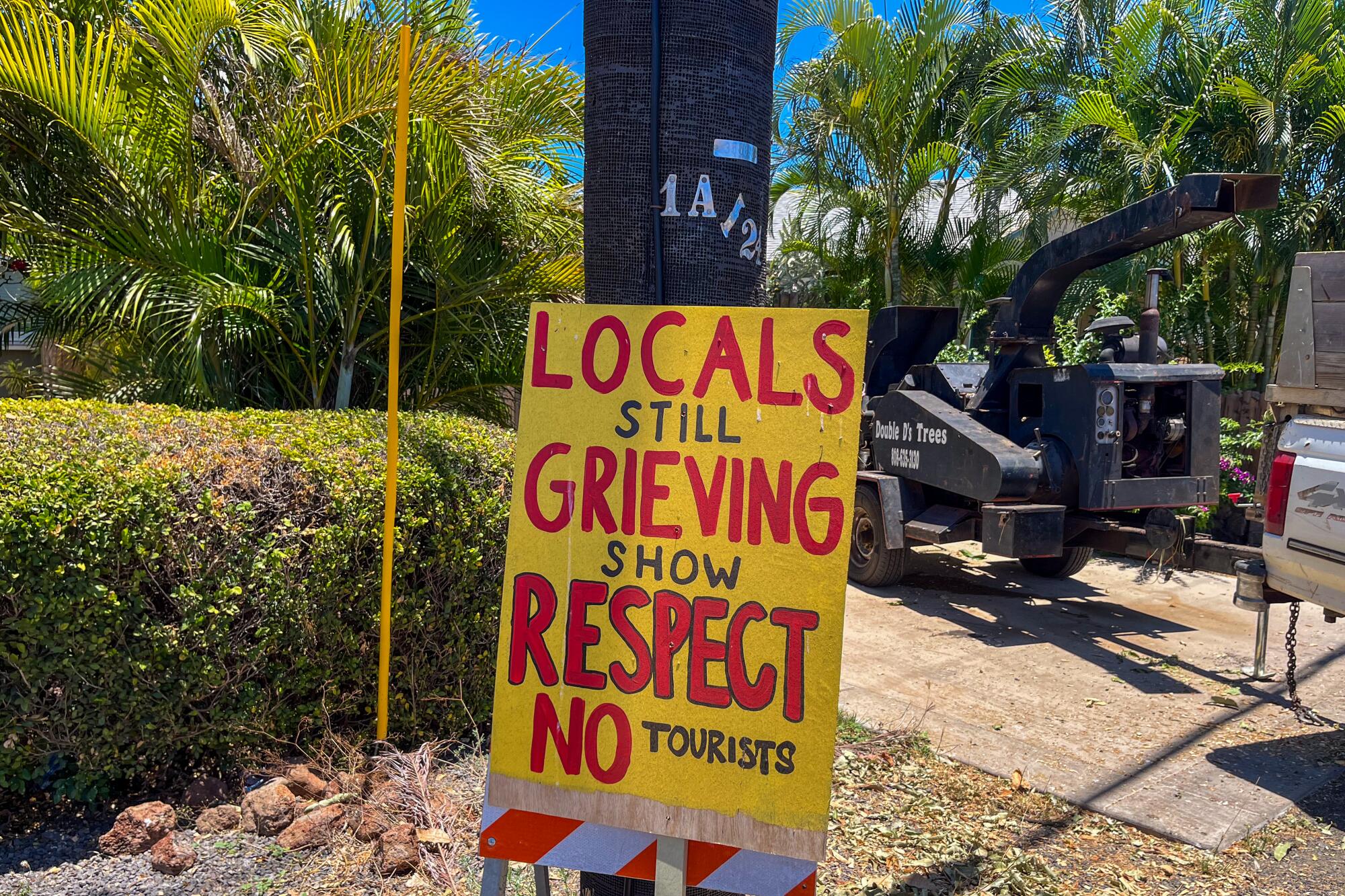
A cautionary sign hangs near a residential neighborhood in Lahaina, Maui, where cleanup and reconstruction continue.
(Christopher Reynolds / Los Angeles Times)
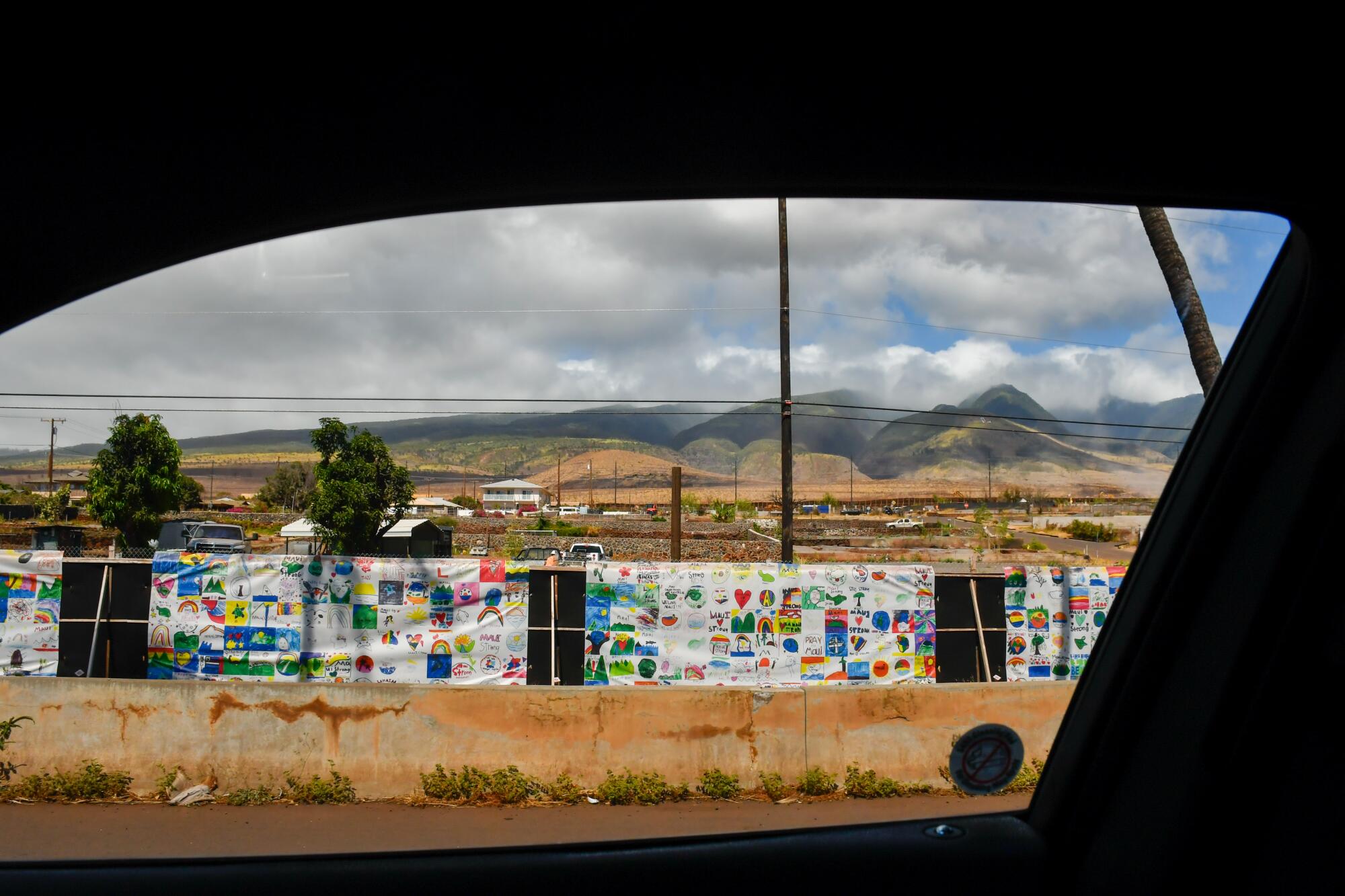
Roadside screens are decorated with artwork in Lahaina.
(Christopher Reynolds / Los Angeles Times)
In the next mile, as drivers transition from the highway to Keawe Street and Honapiilani Highway, several signs thank first responders, exhort the community to be strong and call for tourists to show respect. Only a few charred ruins are visible from the road. Six-foot-high roadside screens shield many properties from view.
Visitors won’t see Waiola Church, Lahaina Hongwanji Mission, the historic Baldwin Home or popular restaurants like Kimo’s, Fleetwood’s on Front Street or Cheeseburger in Paradise, all burned. The city’s iconic banyan tree, damaged but recuperating, remains off-limits.
FEMA reports that by July 31, cleanup crews had cleared 319,000 tons of fire debris, nearly 34 tons of asbestos and 3,000 fire-damaged cars, with 47 rebuilding permits issued by Maui County.
On Saturday, utility company Hawaiian Electric, the state of Hawaii and five other defendants announced a $4-billion settlement agreement with fire victims, pending court approval. Total damages have been estimated at $5.5 billion or more.
One Maui resident, asking to be unnamed, told me he’d just finished a six-month job in the burn zone, wearing a Tyvek suit and respirator, waiting for blessings before stepping onto home sites, scraping ash and asbestos, finding class rings, guns, jewels and puddles of melted aluminum.
Yet just north of Lahaina, a visitor reenters the Maui seen on postcards and screensavers.
What West Maui’s resorts look like and what they cost
In the morning, catamarans glide up to the beach, kids line up for surf lessons, and golfers head to the courses at Kapalua. At day’s end, legions gather to watch the sunset as daredevils leap from the Black Rock Beach boulders to the sea.
Though the Royal Lahaina and Outrigger resorts in Ka’anapali housed many fire survivors as recently as early July, state and federal officials say the vast majority have moved on to intermediate or permanent housing.

A custom paint job on an outrigger canoe on the Ka’anapali coast. (Christopher Reynolds / Los Angeles Times)

A surfing class in Ka’anapali. (Christopher Reynolds / Los Angeles Times)
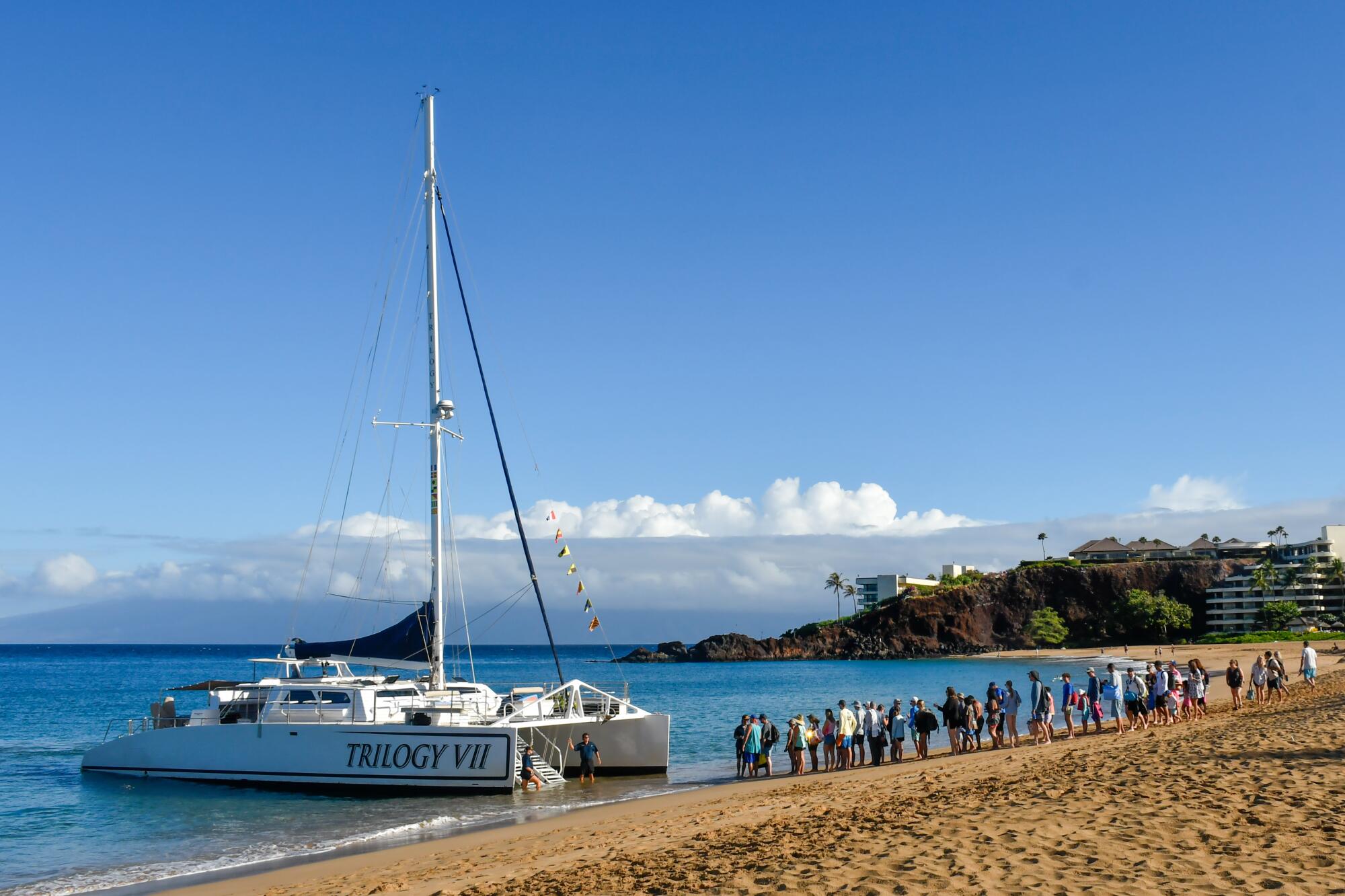
A catamaran waits near Black Rock Beach, Ka’anapali, West Maui.
(Christopher Reynolds / Los Angeles Times)
In June, Hawaii’s state tourism statistics show, visitor arrivals to Maui were down 21.8% from the year before, with spending down 27.1%.
The average Maui County hotel rate that month: $554 per night, down 10.5% from the year before, with a third of rooms empty.
The average vacation rental cost less — $401 per night, with a 44% vacancy rate. But that may soon change. Maui Mayor Richard Bissen has proposed converting 7,000 condo units from short-term use to long-term within three years, creating more housing for residents.
“We’ve been coming here for years, and I have never seen the [Ka’anapali] walkway so clear,” said Russ Hill of Santa Clarita, who has a West Maui timeshare.
A moment later, he strapped into a parasailing rig, zoomed 500 feet above Ka’anapali Beach and saw exactly what he wanted to see: island slopes under clear blue skies, a line of hotels along the beach, a few leaping dolphins and no reminders of the fire except the boat captain’s “Maui Strong” T-shirt.
How visitors become volunteers
Napili Noho, an emergency service hub in Napili Park, stands about three miles north of Ka’anapali. It didn’t exist before the fire. Now it often gets 200 guests in a day.
They browse a free store stocked with food, shoes and hygiene items, sit for meals (prepared with help from other charities) or step into the lomi lomi tent, where masseurs and chiropractors give free treatments.
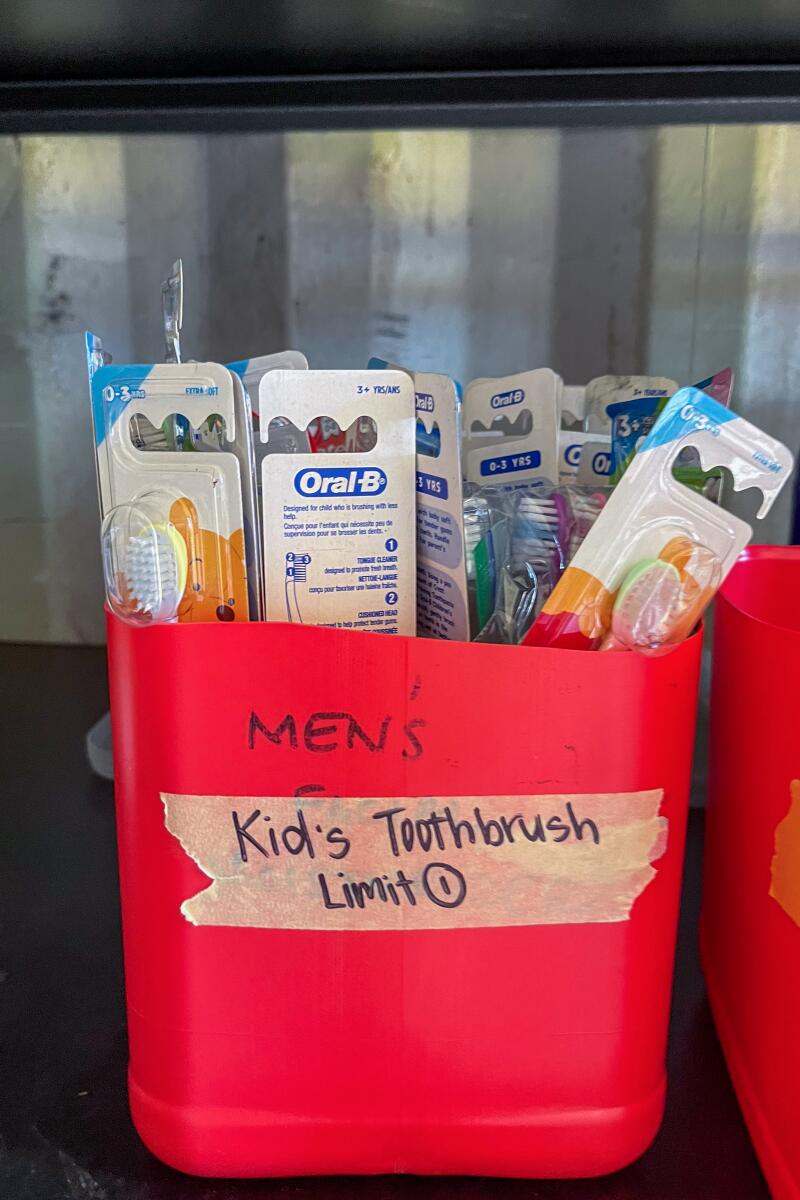
The Napili Noho emergency resource hub, created after last year’s fire, offers food and household items for those in need. (Christopher Reynolds / Los Angeles Times)
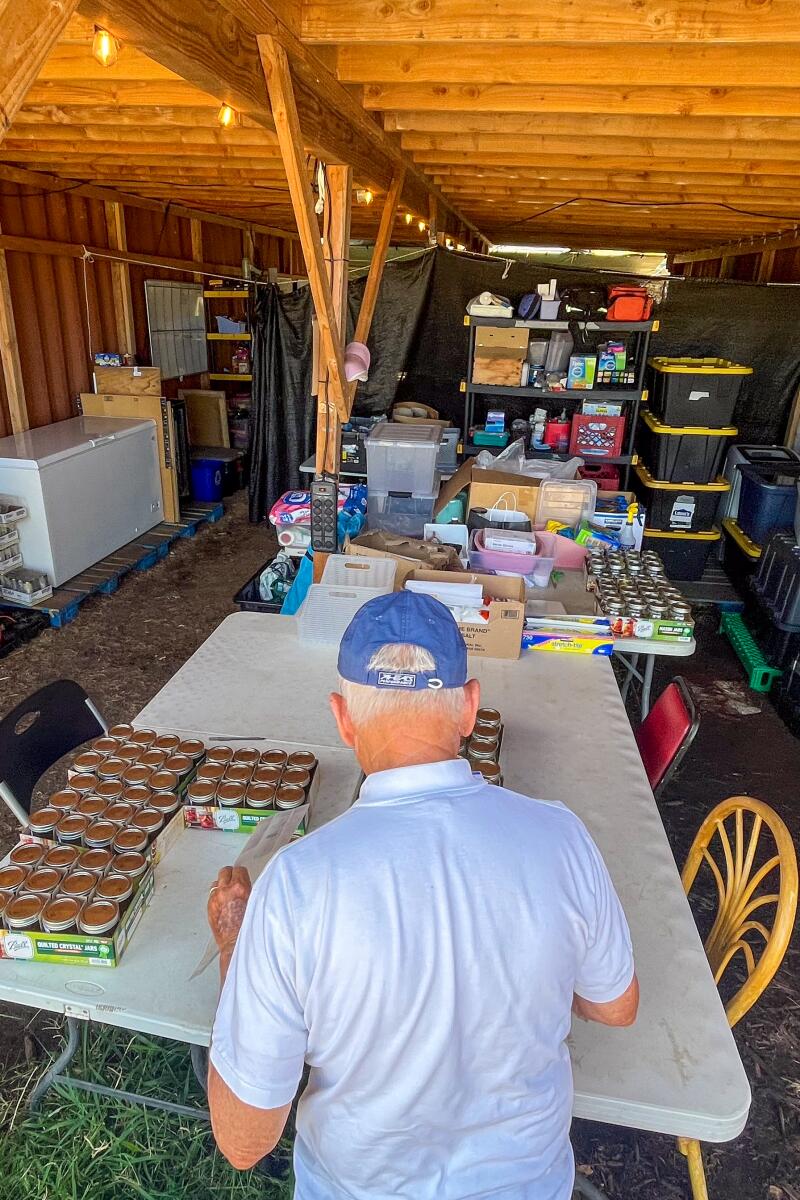
Volunteer Tom Fox, visiting from California, works at Napili Noho. (Christopher Reynolds / Los Angeles Times)
Most days, at least one short-term volunteer visitor shows up, having signed up online. On the Tuesday I arrived it was Tom Fox, 81, a semiretired real estate agent from Pleasanton.
For years, Fox and his wife have been visiting West Maui to play golf and lie low. They were at their Napili condo when the fire struck and wound up inviting their housekeepers to stay in the condo for several weeks.
Now the housekeepers have moved on, Fox said, and he’s found that he’s not as good as his wife is at keeping busy.
“So I found out about this place and came on down,” Fox said. The day before, he’d bought Mason jars for storing cooking oil. Now he was labeling them for community members who might speak English, Hawaiian, Spanish, Chinese, Tagalog, Tongan or Samoan.
Around him, other workers were breaking down bulk packages of salt, soap and other goods, including another volunteer from off-island, a 38-year-old man who goes by the name Savage.
“I was supposed to be here five days,” he told me.
Until last August, Savage said, he was working as a health-focused life coach in Las Vegas. After the Maui disaster, he joined an island-bound group of volunteers from his church.
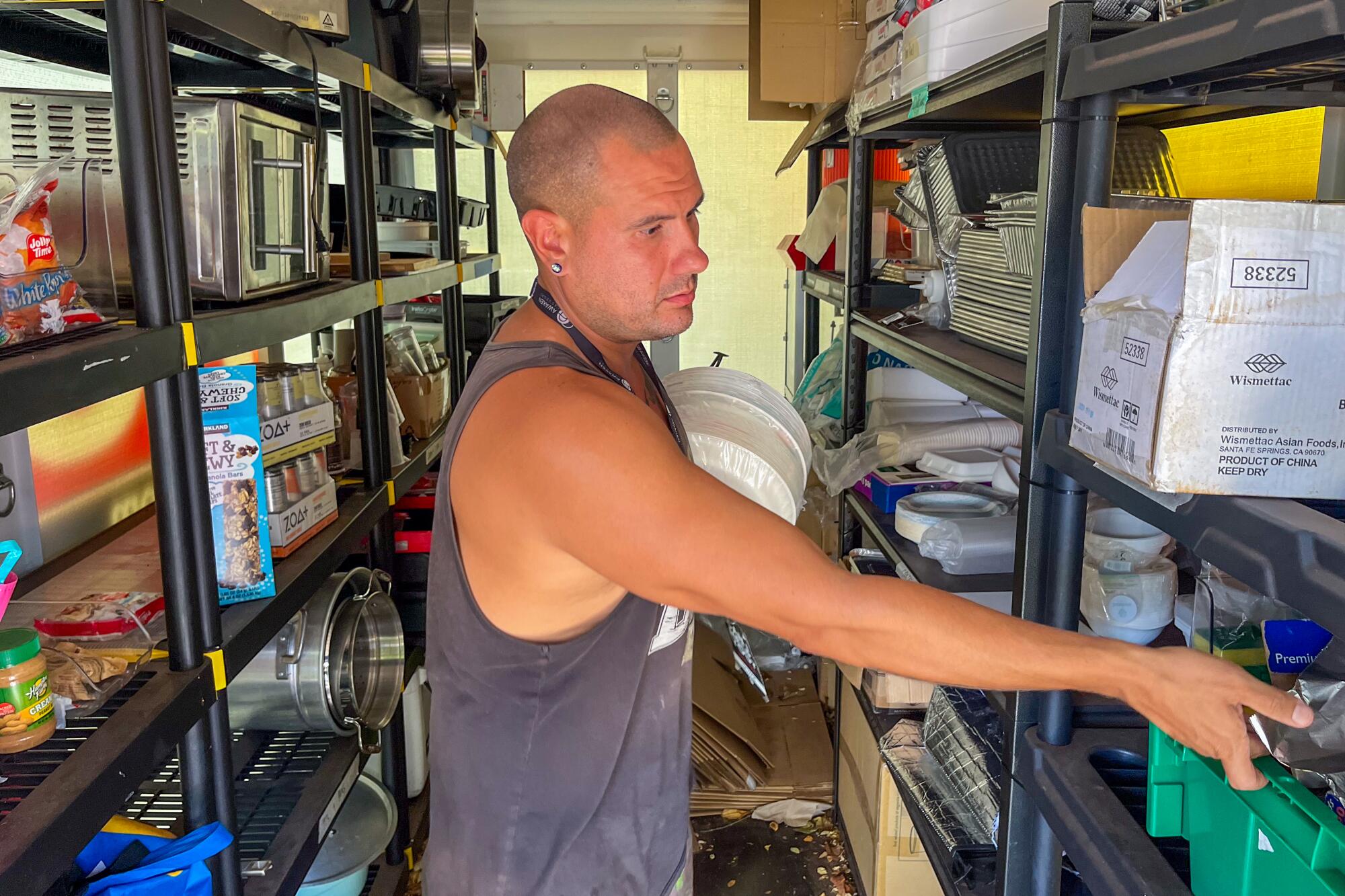
A volunteer who goes by the name Savage tends to supplies at the Napili Noho hub.
(Christopher Reynolds / Los Angeles Times)
Once he arrived, Savage, who said he has Dakota Sioux heritage and is an Air Force combat veteran, found that “this was very familiar to me.”
Eleven months after arriving, Savage moves from task to task in his flip-flops, walkie-talkie in hand, four days a week, helping displaced residents feed families and cope with makeshift living situations. He’ll be here “until I’m at peace that it’s time to move on.”
The key, Savage said, is offering comfort without giving advice or trying to counsel anyone. That might mean “asking aunties for cooking recipes,” he said. “Just talking story. Our community may not need to shop as much as they need distractions from life. They might not know where they’re going to be next week.”
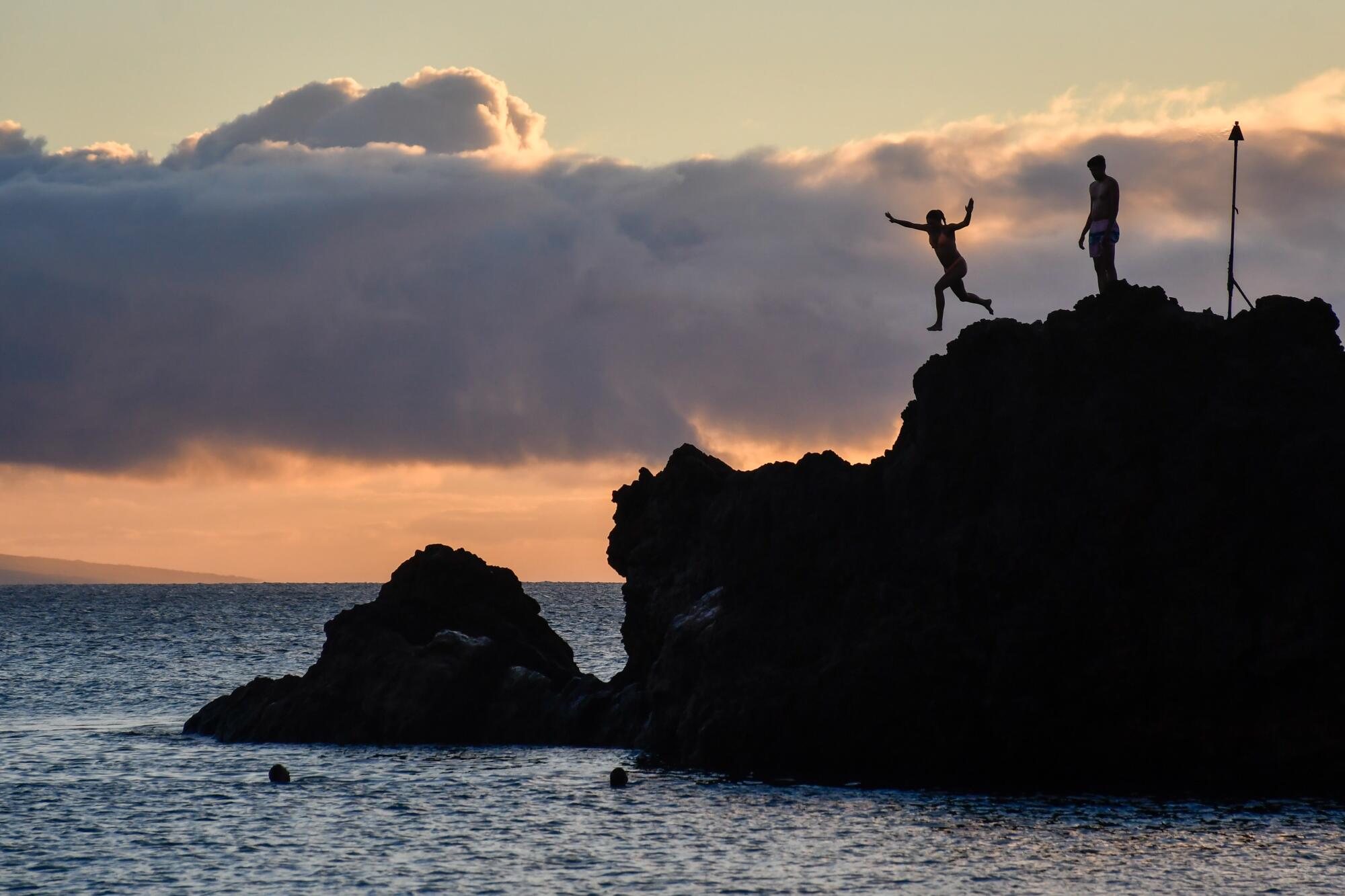
Black Rock Beach, Ka’anapali, West Maui.
(Christopher Reynolds / Los Angeles Times)
If you go
What to eat
Old Lahaina Luau, 1251 Front St., Lahaina; (808) 667-1998. Lavish dinner al fresco with open bar, followed by an hourlong show with hula, drumming and chanting. Adult admission: $230.37, including gratuity.
Aloha Mixed Plate, 1251 Front St., Lahaina; (808) 661-3322. Patio restaurant (moved down the street since the fire) offering breakfast, lunch and dinner. The Chow Funn noodle bowl (ground pork, bean sprouts, green onions; $15) makes a tasty lunch.
Mala Ocean Tavern,1307 Front St., Lahaina; (808) 667-9394. Brunch and dinner. Perhaps the most elegant restaurant you’ll find with a tin roof and walls. Website includes a link for donations to staff. The signature cocktail is a Makai Tai ($18). Dinner main dishes $28-$61.
Ulu Kitchen, Westin Ka’anapali, 2365 Ka’anapali Pkwy., Lahaina; (808) 868-0081. Breakfast, lunch and dinner on the beach in Ka’anapali. Main dishes $28-$69.
Where to stay
Outrigger Kaanapali Beach Resort, 2525 Ka’anapali Pkwy., Lahaina; (808) 661-0111. A three-star hotel on a coastline of mostly four-star resorts, its location impeccable, with a whale-shaped pool. Rates start at about $370, plus a $35 daily resort fee.
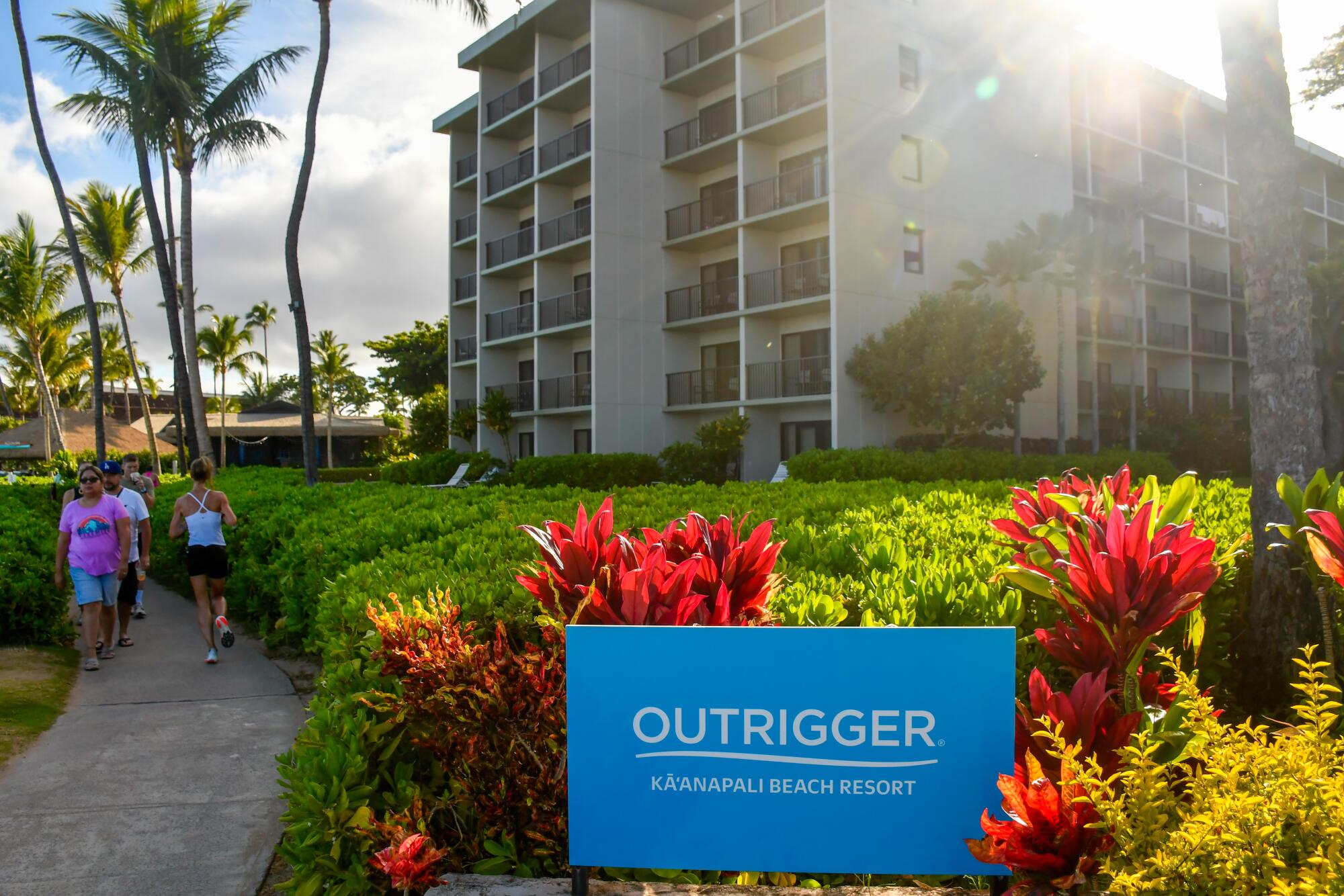
The Outrigger Ka’anapali Beach Resort, in West Maui, is one of many hotels that housed displaced residents after the Lahaina wildfire.
(Christopher Reynolds / Los Angeles Times)
Things to note
In the high country at the south end of Maui, Haleakala National Park’s popular Crater Road and summit area have been closed periodically because of nearby brushfires. Check the park website before planning a visit.
To volunteer on Maui, don’t rely on last-minute suggestions from your hotel’s concierge or activities desk. Make a plan in advance. Mauinuistrong.info includes many volunteering options, as does the website of the Hawaiian Tourism Authority. Malama Kula operates in the up-country area. Napili Noho runs the emergency services hub in Napili Park. Maui Cultural Lands runs programs to protect cultural resources, plant native vegetation and battle invasive species, with volunteer workdays every Saturday in the Honokowai Valley above Ka’anapali. Similar work happens Wednesdays and Thursdays at Kipuka Olowalu, south of Lahaina.
The Lahaina Cannery and Lahaina Gateway malls are open, and more Lahaina businesses are reopening every month. This website tracks reopenings.


Xie Miao and Yang Enyou in The Furious.
Norachai Kajchapanont/Lionsgate
hide caption
toggle caption
Norachai Kajchapanont/Lionsgate
There have been some fantastic movies released this year, and we know you can’t see them all. So we’re recommending four recent movies we missed that you should add to your watchlist: The Furious, Tuner, She’s The He, and Heresy.
If you need a few more fun film recommendations, check out these episodes:
Fun movies you may have missed
Our favorite movies on Tubi
We debate the best movies to watch on an airplane
Connect with Pop Culture Happy Hour:
Letterboxd / Facebook
Our weekly newsletter
Support Pop Culture Happy Hour+

A tarp covers the facade of the John F. Kennedy Memorial Center for the Performing Arts in Washington, D.C., on June 13. A federal judge has asked the arts complex’s leadership to explain the purpose of the tarp and the surrounding scaffolding.
Alex Wroblewski/AFP via Getty Images
hide caption
toggle caption
Alex Wroblewski/AFP via Getty Images
On Wednesday, the federal judge overseeing the Kennedy Center lawsuit ordered the center to give him a status report on the center’s operation and programming within the next few weeks. Judge Christopher R. Cooper also said that the Kennedy Center must explain the purpose and status of the tarp and scaffolding that have been placed over the front of the arts complex, where until recently both President Trump and President John F. Kennedy’s names were both displayed.
In a directive issued last Tuesday, Judge Cooper had given Kennedy Center administrators three days to update him on the arts complex’s immediate plans regarding construction, programming and public access. Trump, who now serves as the center’s chairman, had announced July 5 as the date the venue would close for major renovations.

Last Friday, on Cooper’s due date, lawyers for the Kennedy Center filed a request asking for an extension. In that filing, Matt Floca, who was promoted as the center’s president and CEO in March, said that the Kennedy Center’s current management intends to present its board with “an array of options” for trustees to vote on at their next meeting on an unspecified date in mid-July.
According to Floca, the options are a complete closure for extensive renovations; a partial closure “enabling some continued public access and limited programming” while some renovations are undertaken; and “a highly limited series of phased closures to address only the center’s most serious infrastructure needs while scheduling and maintaining a full slate of programming.”
In his newest order, Cooper denied Floca’s request for an extension. And he mandated that the center file a status report within seven days of the center’s July board meeting or by July 31, whichever date is earliest. He also ruled that the report must “indicate the purpose for and status of the tarp and scaffolding,” which were erected by workers over the center’s front signage in the early morning hours of June 13.
When asked for comment Wednesday, the Kennedy Center pointed back to the documents its legal team submitted to the court.
The tarp and scaffolding on the center’s front portico went up after the Kennedy Center’s administration slow-walked the court-mandated removal of President Trump’s name from the front of the center and from all digital materials, which was supposed to happen no later than June 12. Workers removed the lettering overnight into the following morning, hours after the federal court’s original deadline, and covered the center’s sign with a tarpaulin.
As of Monday, the sign remains hidden from the public.

Trump’s name was scrubbed from all of the Kennedy Center’s digital content on June 4, the same day an email order to do so was issued by the complex’s legal team; NPR obtained this memo the day it was sent out to Kennedy Center staff.
These court orders are part of the ongoing lawsuit filed by Rep. Joyce Beatty, D-Ohio, against President Trump and the board of the Kennedy Center. Earlier this year, Cooper ruled that Beatty, an ex-officio member of the Kennedy Center board, must be allowed to participate in board meetings. NPR has asked Beatty if she plans to vote at the July board meeting, but did not receive an immediate response.
It would be very difficult for the Kennedy Center to revive a thriving programming lineup for the months ahead. Over the past year, many prominent artists canceled their planned appearances, citing the politicization of the venue. Most of the center’s programming staff have departed, either via layoffs or resignations. Unlike top administrators at other major performing arts venues around the country, Matt Floca has no experience in artistic direction, fundraising or arts administration; formerly, he was the center’s head of facilities, and he holds a bachelor’s degree in construction management.
Established artists who typically perform at the Kennedy Center generally have their touring schedules set at least a year in advance, if not multiple years ahead. In years past, the center has publicly announced its upcoming season in mid-spring for performances beginning in September and running through the following summer.

Currently, only a handful of outdoor free movie screenings of nostalgic favorites like The Princess Diaries and Clue appear on the center’s calendar of events, along with some participatory workshops for kids. In the past, the Kennedy Center presented over 2,000 arts and education events each year.
The center also recently became ensnarled in litigation with one of its longtime tenants and artistic partners. On June 12, the Washington National Opera, a company formerly in residence at the Kennedy Center, sued the complex for $17 million. It claims that the Kennedy Center had withheld “years’ worth of donor gifts, bequests and endowment funds” that had been intended specifically for the WNO.

Denis Novikov/Getty Images
I tend to romanticize summer. The movies and TV shows I grew up with made me think that the season was about adventure and big-time transformation.
I imagined myself building a tight-knit friend group and getting out of a pickle together, like in The Sandlot or Camp Nowhere. Or traveling across the world, say, to Greece, like Lena Kaligaris, a character in The Sisterhood of the Traveling Pants, having a whirlwind summer romance and returning an entirely different person.
I’ve never actually had a summer like that.
Even when your expectations are more modest than mine, “so often, the summer just flies by, and we haven’t taken the picnics or gone for the day trip or whatever it was that we thought we were gonna do,” says happiness expert Gretchen Rubin.
Rubin, author of The Happiness Project and host of the podcast Happier With Gretchen Rubin, has been sharing ideas on social media about how to make the season more memorable and satisfying.
She walks through four exercises to help you get what you want — and more — out of the season. Print out our worksheet here, fill it out and stick it on your fridge to keep you accountable. Or take a screenshot and post it to Instagram (don’t forget to tag @NPRLifeKit!).
🍑 Give your summer a theme
Pick a single word or phrase that you want to embrace this season — something that captures the feeling you want to have over the next few months.
“My theme for the summer is ‘ketchup,’” Rubin says. “It has a kind of a summer feeling, because you think of putting ketchup on your burger.”
“It’s a metaphor,” she says. It means to look for “whatever I could add [this season] to make something elevated and more fun.”
Meanwhile, my theme word this summer is “juice.” I no longer think that I need to travel far or completely transform to have a delicious summer. I just need to take advantage of the abundance that the season offers: ripe peaches and tomatoes, juicy softball pitches and the opportunity to feel juicy in my body when I wear a bathing suit.

Print out our worksheet here, fill it out and stick it on your fridge to keep you accountable. Or take a screenshot and post it to Instagram (don’t forget to tag @NPRLifeKit!).
Malaka Gharib/NPR
hide caption
toggle caption
Malaka Gharib/NPR
🪣 Create a summer bucket list
What do you want to do this summer? On my bucket list: ride the Ferris wheel at a summer fair, have more barbecues at my parents’ house and see the sunrise at least once.
There might even be something you don’t necessarily want to do but have been trying to accomplish for a long time — like cleaning out the garage or learning how to swim.
“Some people love a long list with a lot of easy things to cross off,” Rubin says. “I’m a fan of that approach myself.”
But some people like a list with fewer goals that are more ambitious. If you take this path, just make those items realistic, she says. “It’s easy to get discouraged if you set the bar too high.”
🏁 Set a fun challenge
It could be fun to gamify a few of the items on your bucket list — or to come up with an entirely different kind of dare for yourself.
You might try 10 new taco joints this summer or read five romance novels. Or you might come up with a theme, like “Freaky Flavor Friday,” Rubin says. Every Friday, you go to a different ice cream shop and try a new and ambitious flavor.
A good challenge can make your summer feel more memorable, she says. “If you did ‘Freaky Flavor Friday’ all summer long, that would stand out in your mind. Years later, you’d be like, ‘That’s the summer I discovered creamed corn ice cream.’”
Two challenges I’m considering: taking a swim class and rewatching all the best Pixar movies.
🖼️ Take a “five-senses portrait”
Experience the summer through your five senses — then reflect on each one. What does summer look like, smell like, taste like, sound like and feel like?
“It’s one thing to look at photographs, but that’s very flat,” Rubin says. “A ‘five-senses portrait’ puts you back into that experience. It’s a creative, fun way to look back on summer and capture the memories that you’ve created.”
Do this exercise either for your whole summer or for a specific summer adventure, she says. Do it with yourself or with a group. You can journal about it, make a collage, draw a picture or simply have a conversation.
When I think of summer, here’s what comes to mind: the smell of smoke from a crackling outdoor fire and the taste of toasted marshmallows on a stick.
More summer-worthy goals from Life Kit
Learn how to swim. Knowing how to swim can help you have fun at the pool or beach this summer. But it could also save your life. Here are some tips to start swimming at any age.
Focus on rest and relaxation. In Dr. Saundra Dalton-Smith’s book Sacred Rest, she outlines different kinds of rest you may be craving. From the mental to the physical, Dalton-Smith shares how to identify what kind of respite you need and how to embrace rest.
Get into running. Ready to kick-start a new running habit? Coach Martinus Evans breaks down a common misconception to get you into the mindset and offers quick tips on pace, form and more.
Declutter your home. Got piles of stuff you just can’t seem to get rid of? Professional organizer Star Hansen explains how to let go of unnecessary items and keep your home neat and tidy.
This episode was produced by Clare Marie Schneider. The story was edited by Meghan Keane. The visual editor is CJ Riculan. We’d love to hear from you. Leave us a voicemail at 202-216-9823, or email us at LifeKit@npr.org.
Listen to Life Kit on Apple Podcasts and Spotify, and sign up for our newsletter. Follow us on Instagram: @nprlifekit.
-
 Denver, CO3 minutes ago
Denver Transplant Games sets Guinness World Record for most living donors, recipients in one place at one time
-

 Seattle, WA10 minutes ago
17-year-old boy shot in High Point, multiple suspects seen running from crashed car
-

 San Diego, CA13 minutes ago
Foodie forecast: A new cafe opens in La Jolla’s Arcade building
-

 Milwaukee, WI18 minutes ago
Preparing for move, museum has already packed more than 600,000 items
-

 Atlanta, GA25 minutes ago
Fallen tree damages cars, blocks I-285 WB in Fulton County
-

 Minneapolis, MN28 minutes ago
MN weather: Pleasant Thursday before major heat arrives
-
 Indianapolis, IN33 minutes ago
Hogsett’s former chief of staff quickly took job at major city contractor
-

 Pittsburg, PA40 minutes ago
Strong storms with a possible tornado threat expected on Thursday in Pittsburgh

