Lifestyle
What if Black boys in L.A. were afforded the grace to dream?


In the soundtrack of his youth, Walter Thompson-Hernández and his friends liked to devise a game of escape. Extending their arms in a v-formation at their side, they would race down the street on weekend afternoons imagining the freedom of the airplanes soaring across the blue infinity of their Huntington Park neighborhood.
Thompson-Hernández never lost that sense of dreaming. This month, he made his feature-length debut at the 2026 Sundance Film Festival with “If I Go Will They Miss Me,” a film of audacious sight and attentive storytelling that unfolds from the perspective of its protagonist Lil Ant, a Watts-raised, 12-year-old obsessed with airplanes and Greek mythology. Where coming-of-age stories often confront the crush of innocence — the fracture and shock of stolen virtue — Thompson-Hernández instead renders one about preservation. A preservation, in part, held together by Lozita (Danielle Brooks), a mom and wife working to keep her family whole now that Big Ant (J. Alphonse Nicholson) is home from prison.
The film isn’t trying to absorb or recklessly mirror the traumas of the Black family so much as make a case for its nuance. In “If I Go,” Thompson-Hernández scraps the three-act structure for something more novelistic, a risk that a lesser director might have fumbled but one he turns into a profound taxonomy on grace. It is a story that interrogates — with a searching and brutal tenderness — the how, why and who of our emotional being. Even as Lil Ant yearns to be closer to his father, what the film doesn’t do is beg you to empathize with the conditions that its characters war against; instead, it demands that you simply acknowledge their presence, their wounds and their dreaming.

Walter Thompson-Hernández, director of “If I Go Will They Miss Me.”
(Michael “Cambio” Fernandez)
Thompson-Hernández’s cinematic canvas recalls a Los Angeles rarely afforded witness on screen. You won’t find any wasted thinking about the tired pathologies of urban decay; the film takes pleasure in depicting Black Angelenos in the fullness of their complexity, celebrating the toil and wonder of how people come together and fall apart, of how love is broken and remade. “There’s already a lyricism that exists in each of our lives,” he tells me. “In how we speak, in how our bodies move through the world, and how we touch each other. I’m sensitive to that.”
Though today he primarily works in the medium of film, Thompson-Hernández has a kaleidoscopic approach to craft. A former journalist for the New York Times, he’s as comfortable writing about the legacy of Black cowboys in Southern California (his 2020 book, “The Compton Cowboys: The New Generation of Cowboys in America’s Urban Heartland,” was a New York Times bestseller) as he is directing a Beats By Dre commercial for the Super Bowl or shooting a sports documentary for Netflix. In 2025, his Portuguese-language film “Kites” — a story about personal reclamation in favelas of Rio de Janeiro — won the Special Jury Mention for Viewpoints at the Tribeca Film Festival. What Thompson-Hernández’s art so easily dispels, no matter the genre it finds a home in, are all the knotty, misguided and trite representations of otherness in our contemporary world. He is a seer of the unseen.


(Vladimir Santos) (Kemal Cilengir)
Jason Parham: A major theme in the film wrestles with what it means to find your place at home when you return. Was that a personal story?
Walter Thompson-Hernández: So much happens to the figures in our lives who travel away from us and eventually come back home. Thematically, this movie is about flight and transportation — both the physical flights that one takes, but also the emotional and spiritual flights. Big Ant, the father [character], returns after doing a stint in prison, but what his son sees as a Grecian 10-year war. That’s been my relationship to so many of the men who I grew up around.
JP: How so?
WTH: They would be gone for a while and we wouldn’t know where they would be. Then they would just show up after two or three or four years. We’d ask questions. It would be, “So-and-so was locked up” or “So-and-so had to go away for a while but now he’s back.” Greek mythology became a North Star for understanding very complicated characters in my own life.
JP: Why was that sense of imagination important to explore?
WTH: The aperture from which I lived my life was very small. It was a very contained world that only existed around a few geographic locations and a few blocks. Eventually I was able to leave. But very few of us get to make it out. Which is a weird sentence — get to make it out — because so many people want to be here and come here all the time. But there are those of us that got the chance to travel and to essentially fly. The older I got, the more I realized how small my world was as a child, but also how expansive and imaginative it was. In Ta-Nehisi Coates’s book “Between the World and Me,” there’s a passage that I always think about. I’m paraphrasing, but he tells his son something to the extent of — James Baldwin, Toni Morrison, Alice Walker, those are yours. And then he says Karl Marx, Leon Trotsky and Simone de Beauvoir — listing all these European artists and thinkers — those are also yours. I’m extending that care and grace to the boy in this movie. A lot of us, we don’t get to dream in that way as Black or brown boys in L.A.


JP: What did young Walter dream about?
WTH: Our home was right in between both LAX flight paths. The sound of these airplanes is something that I’ll never forget. My mom and aunts still live in that neighborhood. When I go back, I forget how strong the sound of the airplanes are, how abrasive and all-encompassing. As a child, I was drawn to the mystery of them — where they were coming from and where they were going. I would imagine who was in them. My friends and I, we made up games where we would race airplanes on our bikes or we’d sprint down the block extending our arms. They had this power over us. The movie is me making sense of that mystery and beauty while also understanding that I have asthma because of them.
JP: You’re referring to the health complications people suffer from in areas downwind of the flight paths.
WTH: Cancer rates and asthma are so prevalent among the people who I grew up around. There is an irony in airplanes. On one hand, we can dream about them and all the places they can take us, but the tangible effects are that they are harming us. Jet fuelers, all those things. As children, how do we wrestle with those complex ideas, while on the ground wrestling with complex ideas about adolescence, about our parents. To say growing up under the LAX flight path is a complicated experience, there’s so much truth in that. Taking the mythology of these airplanes and applying that to the mythology that we create about adults in our lives is something that I hope people really feel in this movie.
JP: There are a lot of smart technical choices in the film, from the sound to the set design. Who were your influences?
WTH: I could reference films like “Killer of Sheep” or “The Battle of Algiers” or “Gummo” or “He Got Game”; there’s a list of at least 50 movies. But there’s something about looking at a Jacob Lawrence painting that offers me the biggest inspiration in terms of the dexterity and freedom and elasticity of Black bodies in space. There’s something about painting as a medium for me that lives outside of the limits of photography and film. There aren’t a lot of barriers and boundaries to how painters experience the world. Whether it’s Jacob Lawrence or Henry Taylor or Winfred Rembert or Kerry James Marshall. I obviously study literature, photography and film, but painting is where I go for ideas around framing and composition.


(Vladimir Santos)
JP: The film plays with different interpretations of light. How would you describe your relationship to light?
WTH: I am so drawn to natural lighting. I’m drawn to patient frames. Usually the frame is a middle shot or a wide shot. And there’s inserts and close-ups sometimes, but I feel very confident in the way that we stage and we block the scene. I feel confident that the information is gonna exist on screen. When I was a journalist at the New York Times, I didn’t just write everything, I also photographed everything I worked on. In terms of creating a visual language, I feel very, very comfortable framing and creating compositions in film. A lot of times you watch movies that feel over-lit. There’s too much information that we are able to gather. Working with our cinematographer, Michael Fernandez, we trust the audience so much, almost too much. If something feels a bit darker, if something is not lit in a way that feels a little too highly produced, I trust that someone will still be able to recognize and find the truth and honesty in every frame.
JP: So much so that L.A. begins to feel like its own character. Was there a certain story — one that hasn’t been told about the city — that you wanted to illuminate?
WTH: So many of us grew up watching ’90s L.A. movies: “South Central,” “Menace II Society,” “Friday.” All the Chicano gangster movies, “Blood In Blood Out.” There was also “Heat.” There’s so many movies about Los Angeles in the ’90s that really got L.A. in a way that most modern day movies about Los Angeles don’t. Something happened along the way where people who weren’t from L.A. started to make movies about Los Angeles. It felt a bit tropey often. It created a checklist. “Oh, it needs a lowrider. It needs a palm tree. It needs perfect orange, cotton candy lighting.” It feels kinda corny, if I’m being honest. For a lot of us, I don’t have to tell you that this movie is set in L.A. You feel it, you hear it.
JP: Yes, you hear it. I appreciated how the sonic texture — whether it was a Nate Dogg track or radio spots from Power 106 — helped ground the viewer not only in what they were witnessing, but why.
WTH: Sonically, I’m having a conversation in this movie about how this once-primarily Black community set in Nickerson Gardens in Watts was once over 90% Black, today is over 80% Latino. Which is a real conversation about change, about how Black people have been getting pushed out for generations, but also a complex story about immigration. It’s not always violence, there’s also peace and all this other stuff. The way I explore that is through sound and music. If you notice, this family, the Harris family, they hear a lot of Spanish-language music coming from a neighbor’s home, coming from the outside. There’s a version of that that feels more soapboxy, where I’m telling somebody in dialogue or in the scene that this community was once Black and it’s almost no longer Black. For me, it just felt more interesting to hear that. We’re hearing a Mexican ice cream truck and all these other things. That’s also telling us that this family is experiencing demographic change.


JP: If we can, I want to talk about the state of Hollywood —
WTH: It was so hard to get this movie made, man. It was a challenge. If I’m being incredibly honest with you, I think there was a run beginning in 2020 or so, where a lot of people felt the urge and maybe pressure to support movies made by women and people of color.
JP: Without question.
WTH: And people were supported in ways that were incredible. But for one reason or another, some of those movies didn’t do too well. They didn’t make the money back, which we can sit here and debate about why that happened. I tried to make this movie at the tail end of that run of support. Everyone in Hollywood loved the script. Everyone in Hollywood loved me. Everyone said, “Hey man, we love this. And we love you so much. But we supported something similar a year or two ago and we’re not doing that anymore.” I heard that so much, and from people that would surprise you. Then, in 2023, I got involved in the Sundance Catalyst program. The program invites financiers to finance eight independent movies. [“If I Go”] really took a lot of support and a lot of effort from people who believed in me and believed in the script. It was an interesting time to make an independent movie about a Black family from Los Angeles.
JP: Does the reality of industry have any bearing on the art you want to create versus the art it’s ready for?
WTH: The art that I want to make looks at humans making sense of their lives and the world in a way that maybe we haven’t seen before. There’s a lot of lyricism. There’s all sorts of things. I don’t know if I’m necessarily thinking about the movie industry when I make the art that I make. People don’t know what they want until they see it, until they feel it. I always say this: Sometimes you make something that exists in time and sometimes you make things that are of time. When people are making things that are of time, it’s responding to the zeitgeist or weird ideas around marketing and what’s popular.
JP: What’s trending on TikTok.
WTH: Exactly. It feels so reactionary. That’s of time. I like to think about making things that are in time. In time, for me, is making art that is in conversation with this beautiful legacy of artistry and of filmmaking. It’s making things without thinking about the moment. It’s thinking about truth in character, truth in dialogue, truth in scene, truth in composition, truth in sound. That’s what I’m thinking about. I’m thinking about honesty. When it comes to my art, I always want to be in time.
Jason Parham is a senior writer at Wired and a documentary producer. He is a frequent contributor to Image.

(Michael “Cambio” Fernandez)


Can you say no to a friend’s wedding?
Getty Images/Getty images
hide caption
toggle caption
Getty Images/Getty images
Are we spending too much on other people’s weddings?
Going to a friend’s weddings can be so fun and meaningful… but it can also really hurt your wallet. A survey by LendingTree found that 31% of people who had been to a wedding in the past five years had accrued debt to attend. So what’s driving up the cost of weddings for guests? And what makes it so hard to say no to these expenses?
Brittany breaks it down with Allyson Rees, senior analyst at trend forecasting firm WGSN, and Annie Joy Williams, assistant editor at The Atlantic.
This episode was produced by Liam McBain, with additional support from Corey Antonio Rose. It was edited by Neena Pathak. Our Supervising Producer is Cher Vincent. Our Executive Producer is Barton Girdwood. Our VP of Programming is Yolanda Sangweni.
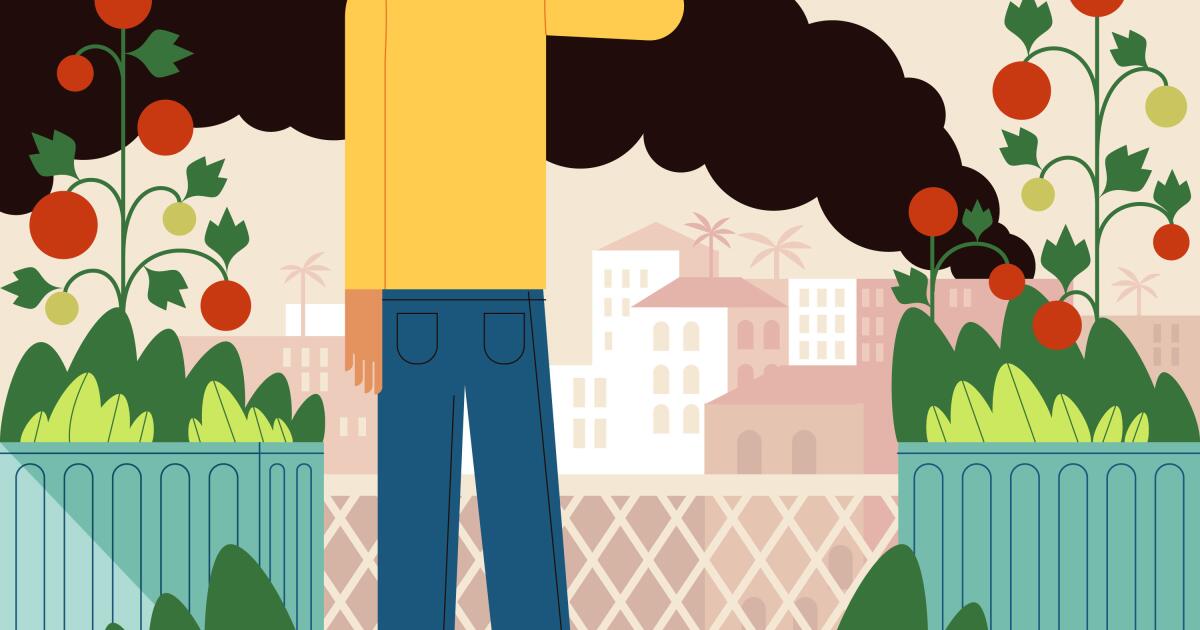
After the eight-day-long fire in a 500,000-square-foot Boyle Heights warehouse, eastern Los Angeles residents are contending with putrid smells, soot and potentially hazardous airborne chemicals after heavy plumes of smoke spread throughout the city. But those who grow food in nearby neighborhoods may also be wondering: How will the fires affect the plants and produce in my garden?
The Boyle Heights warehouse, owned by Lineage — a global temperature-controlled storage facility operator — housed 85 million pounds of frozen food and other products. In the days since the fire, local emergency visits for smoke inhalation and throat pain spiked while agencies still scramble to measure the amount of PM 2.5 — harmful fine particles — and heavy metals, like lead and arsenic, in the air.
According to researchers, any toxic airborne chemicals would likely stem from the charred foam insulation, metal exterior, burned solar panels and any lithium batteries that might have been present inside the warehouse.
After a fire, heavy metal particles can spread through ash and smoke over gardens and inhibit growth, said Olukayode Jegede, an agricultural toxicologist and assistant professor at UC Davis. Since the warehouse fire is so recent and cleanup has just begun, Jegede said the precise impact on gardens can’t be measured until comprehensive soil tests are conducted in the area.
While the L.A. city government hasn’t announced plans for soil testing, the Contaminant Level Evaluation and Analysis for Neighborhoods project at USC is offering free contaminant testing for Boyle Heights and East L.A. residents. Residents can collect soil samples and deliver them to Boyle Heights City Hall and other locations for an evaluation of lead, arsenic, chromium and mercury levels.
The good news is produce, plants and roots can still be preserved. According to Jegede, many of the soil tests conducted last year in the Altadena area after the Eaton fire showed that gardens and poultry were not as contaminated as one might expect.
“Quite a number of the soils we tested [in Altadena] were not really contaminated,” Jegede said. “We weren’t seeing many soils with concerning elevated levels of metal, so gardeners should not be too alarmed when these things happen.”
Nevertheless, there are several measures that gardeners can take to keep themselves, their children, plants and produce safe from potentially harmful contaminants stemming from the fire. Researchers, gardening experts and horticulturists offered some guidance on the handling, recultivation and cleanup that can keep you and your garden in good health.
How do I remove ash and contaminants from my garden?
Altadena horticulturist Leigh Adams said Boyle Heights plants and produce already live in a difficult environment, surrounded by industrial warehouses that spread contaminants daily.
“That area has been used industrially for 100 years, and the soil is impacted by many, many, many things,” Adams said. “Low-income neighborhoods and gardens usually don’t have a lot of resistance against dominant manufacturing.”
This means that the contamination of gardens in eastern L.A. won’t be as catastrophic as compared with those in Altadena, a more suburban environment, Adams said. But fallen ash still poses major health risks if ingested or inhaled.
An advisory from University of California Agricultural and Natural Resources last year recommended suiting up in an N95/KN95 mask, long sleeves, pants, close-toed shoes and gloves before attempting to deal with ash in the garden to limit exposure to potentially toxic contaminants. The advisory added that individuals should make sure all of this gear is cleaned thoroughly before bringing it back inside.
Once in the proper gear, Adams recommends removing the top two inches of topsoil from gardens, where the highest concentration of contaminants will settle after a fire. Using a plastic bag to collect the soil and disposing of it in the garbage — not green yard waste bins — will help to reduce the spread of airborne chemicals.
Gardeners with raised beds are advised to remove approximately six inches of soil, because excess ash can raise the pH level and prevent nutrients from soaking into the soil bed.
After this, watering the garden gently but plentifully will help to promote soil health and get rid of most of the ash present on plant leaves and stems. Adams said replacing the top two inches of soil with store-bought mulch or straw will help to contain any remaining ash and prevent it from spreading any further.
Experts say to avoid using leaf blowers if ash is present in the garden because they can send particles airborne. Doing so will increase the likelihood of heavy metal particles, which can carry lung irritants and carcinogens, being spread and inhaled.
A Boyle Heights resident keep a watchful eye on the fire at the 5,000-square-foot commercial building, which stores 85 million pounds of frozen food.
(Genaro Molina / Los Angeles Times)
Is it safe for me to eat produce from my garden?
Several studies, including one from the UC Cooperative Extension of Sonoma County, have shown that consuming produce in a fire-affected area poses minimal health risks.
Jegede said most root vegetables like potatoes and carrots, along with any fruit that has an outer layer, can be washed to remove potential contaminants, even if they were covered in ash. Peeling the outer layer of your produce can also help to reduce potential risks, he said.
Lettuce and other leafy foods with multiple layers pose a higher risk of contamination, but with a vigorous wash and peeling the outer layers, even the greens can be saved. The County of Los Angeles Department of Public Health recommends soaking leafy produce and fuzzy fruits like peaches in a 10% white vinegar and 90% water mixture.
Jegede said if the leaves or fruit are too delicate to wash or ash is still visible, it would be best to dispose of the produce.
How can I tell if my soil is contaminated?
After ridding your garden of visible ash, you might wonder how to tell if your plants will still thrive in the soil.
At-home soil tests that measure for alkaline, fertility and pH levels are widely available and can be purchased for $15 to $100 (for more detailed results) online. But Jegede said these tests can’t tell the full story of soil health.
Comprehensive soil testing is “something you can’t do properly at home,” Jegede said. “In labs, we are testing for metals like lithium and zinc, stuff that an at-home test will not show … If it comes to the point that you’re worried about your soil, I would just send it out to a lab.”
Wallace Laboratories in El Segundo, Babcock Laboratories in Riverside, Waypoint Analytical in Anaheim and other labs offer more detailed soil tests that measure heavy metal particles in addition to other fertility factors. Prices at Wallace Laboratories can range from $115 to $295 for a complete compost test.
The soil below two inches should be unharmed, Adams said, so long as new compost is set and plants are watered plentifully, which will promote natural biological cycles.
“What you’re doing is capping the soil, so that moisture stays in there, and instead of being dirt, it’s a living system called soil,” Adams said. “The more carbon we can get into our soil, the better.”
What can I do to help my soil recover?
For the last 12 years, Adams has been working with Metabolic Studio, a Los Angeles-based art and research hub focused on environmentalism, on methods for bioremediation, the practice of using additional fungi, plants and compost to decontaminate ash and break down contaminants.
Adams said straw, mushrooms, corn, rye and sunflowers are great bioremediators that can help to repair damage to soils. She said certain samples she’s worked on with Metabolic Studio have gone from testing at high heavy metal levels to nearly contaminant-free.
But for a more immediate fix, wash your produce, water your plants and have a little patience during ash cleanups. Your garden should look better in no time, Adams and Jegede said.

Inde Navarrette and Michael Johnston in Obsession.
Focus Features
hide caption
toggle caption
Focus Features
Two big horror films, Obsession and Backrooms, just smashed all box office expectations. So much of their success has been driven by Gen Z, which is now the biggest moviegoing demographic. But what makes a movie a Gen Z movie? Today we’re bringing you an episode of NPR’s It’s Been a Minute. Host Brittany Luse talks about this trend with Sam Adams and Reanna Cruz.
If you want to hear more about these movies, check out these episodes:
In ‘Obsession,’ love hurts. It really, really, really hurts.
‘Backrooms’ brings YouTube horror to the big screen
Zendaya brings ‘The Drama,’ we bring the spoilers
Connect with Pop Culture Happy Hour:
Letterboxd / Facebook
Our weekly newsletter
Support Pop Culture Happy Hour+
-

 New Hampshire5 minutes ago
New hampshire set to approve world’s first $100 million bitcoin-backed municipal bond
-

 New Jersey8 minutes ago
Police conclude investigation at Walmart in Cherry Hill, officials say
-

 New Mexico12 minutes ago
Monsoon high shifts slightly west but rain is still possible Wednesday in New Mexico
-

 North Carolina20 minutes ago
North Carolina Republican operative shaping the state’s early voting plans is reassigned
-

 North Dakota22 minutes ago
West Fargo Attorney Chosen for North Dakota Ethics Commission Position
-

 Ohio28 minutes ago
Jeff’s Donuts opens first Ohio location, open 24 hours
-

 Oklahoma35 minutes ago
5 Things To Know: Oklahoma County inmate death, deadly OKC hit-and-run
-

 Oregon38 minutes ago
Oregon to ask court to delay Paramount deal for 60 days while it reviews records

