Lifestyle
Trump touts newly released plans for D.C. triumphal arch


Artist renderings and diagrams for President Trump’s proposed triumphal arch released by the U.S. Commission of Fine Arts on April 10, 2026.
Jon Elswick/AP
hide caption
toggle caption
Jon Elswick/AP
President Trump on Friday unveiled official architectural renderings for the triumphal arch he plans to add to the National Mall in Washington, D.C.
The proposed monument would stand at one end of the Arlington Memorial Bridge next to the Arlington National Cemetery.
In addition to the president’s post on Truth Social, the plans were released by the Commission on Fine Arts, a federal agency that has review authority over the design and aesthetics of construction within Washington, D.C., and produced by Harrison Design, an architecture, interior and landscape design firm with offices in six U.S. cities, including D.C. The mockup shows a structure very similar to the 3D model that Trump touted at a fundraising dinner at the White House last October.

This model of President Trump’s proposed triumphal arch was shown at a White House press conference on Oct. 15, 2025.
Kevin Dietsch/Getty Images
hide caption
toggle caption
Kevin Dietsch/Getty Images
At 250 feet tall, the overall height of the structure is intended to serve as, “a fitting recognition of America’s 250th birthday,” the White House said in an email to NPR.
A monument aimed at honoring what and whom?
The proposed arch bears a striking resemblance to the Arc de Triomphe in Paris — though would stand almost 100 feet taller — and is topped with two golden eagles and a winged, crowned figure reminiscent of the Statue of Liberty (which was gifted to the U.S. by France in 1884.) On one side, the words “One nation under God” appear, with the phrase “Liberty and justice for all” on the other.
The structure would also loom over the nearby Lincoln Memorial — at more than twice the height.
“The Triumphal Arch in Memorial Circle is going to be one of the most iconic landmarks not only in Washington, D.C., but throughout the world,” said White House spokesperson Davis Ingle in an email to NPR. “It will enhance the visitor experience at Arlington National Cemetery for veterans, the families of the fallen, and all Americans alike, serving as a visual reminder of the noble sacrifices borne by so many American heroes throughout our 250 year history so we can enjoy our freedoms today. President Trump will continue to honor our veterans and give the greatest Nation on earth — America — the glory it deserves.”
When asked by CBS political correspondent Ed O’Keefe whom the monument was intended to honor after Trump initially unveiled his plans in October, Trump responded: “Me.” The exchange was captured in a social media video.
A group of Vietnam War veterans launched a lawsuit in February seeking to bar the Trump administration from constructing the arch. The plaintiffs argued the project violates statutes requiring express congressional authorization for the erection of commemorative works or any “building or structure” on federal park grounds in D.C., among other issues.
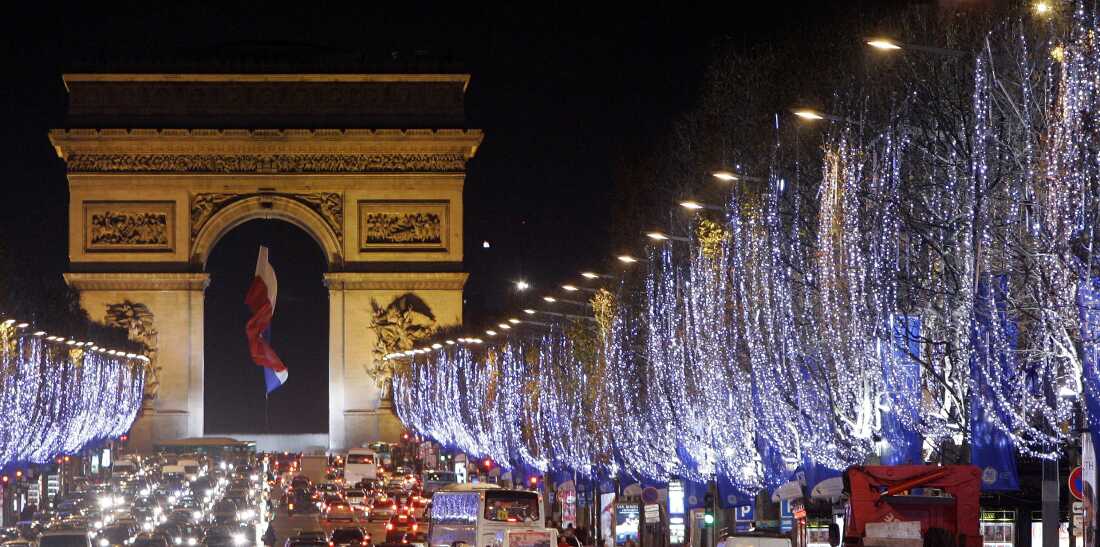
The Arc de Triomphe in Paris as part of the city’s Christmas celebrations (2007).
Christophe Ena/AP
hide caption
toggle caption
Christophe Ena/AP
“It’s textbook Trump,” said Sue Mobley, director of research at Monument Lab, of the proposed plans for the arch, in an interview with NPR. The nonprofit design studio based in Philadelphia reimagines public art and structures. “It has to be the biggest. That’s the authoritarian impulse.” Trump has repeatedly pushed back on accusations of authoritarianism, rejecting the label of dictator.
Mobley added that she doesn’t think the plans will come to fruition. “It will likely get tied up in court,” she said.
Approval process
The White House said it will “follow all legal requirements” in constructing the triumphal arch. As part of that process, it mentioned the National Park Service’s recent request to present potential designs to the Commission on Fine Arts. The plans are scheduled to be reviewed next week. At this point, that commission is composed entirely of members appointed by Trump. (In October 2025, Trump took the unusual step of firing six sitting members of the commission.) The National Capital Planning Commission, the federal government’s central planning agency for the National Capital Region, is also expected to weigh in on the plans.
The White House said the estimated cost of the project, which it anticipates will draw on a combination of public and private funds, is still being calculated. Harrison Design, the architecture firm behind the plans, did not immediately respond to NPR’s request for information about the price tag.
Multiple D.C. makeover projects
The arch plans are the latest in a series of current and potential architectural interventions from the White House in and around Washington, D.C.
Most dramatically, the administration is pushing for the creation of a $400 million neoclassical ballroom at the White House. A federal appeals court on Saturday temporarily allowed the construction of the ballroom to move forward while the administration challenges a March ruling that it required congressional approval. Whatever the outcome, the historic East Wing has already been demolished to make room for the new structure.
Trump has converted the White House Rose Garden into a stone-covered patio. He aims to shut down The Kennedy Center for two years to facilitate a major renovation (a coalition of groups including the National Trust for Historic Preservation, the American Institute of Architects, and the D.C. Preservation League, filed a lawsuit in the U.S. District Court for the District of Columbia in March opposing the plans.) And he has proposed architectural changes to the Washington Dulles International airport through an initiative the Department of Transportation launched late last year to overhaul the Northern Virginia airport. Several prominent architecture firms including Zaha Hadid Architects and Adjaye Associates have submitted proposals.
In August, the president also signed an executive order requiring that new federal buildings with construction budgets of more than $50 million be designed in “classical” or “traditional” styles.
Anastasia Tsioulcas contributed to this story.


Jean Smart.
HBO Max
hide caption
toggle caption
HBO Max
This review of the Hacks series finale includes spoilers for the episode.
It also discusses suicide.
The truth — my truth — about the fifth and final season of HBO Max’s Hacks is that I would have left it at the end of the penultimate episode last week. Deborah’s show in Central Park, improvised after she was thwarted in her efforts to play Madison Square Garden, was a triumph. The story has always been, after all, about Deborah and Ava together, outdoing the expectations other people have for them and outfoxing the people who try to thwart them. So being embraced by a huge outdoor crowd, surrounded by people who love them, was just the right ending. Not too heavy for a comedy, not too idealized and neat.
In this week’s series finale, you get a much more melodramatic story. The earlier hints about Deborah’s health problems mature into the news that she has cancer, but she has decided to forgo treatment and travel to Switzerland to undergo an assisted suicide. She also wants Ava to go with her. Ava is furious and panicked, wanting Deborah to choose differently, but Deborah’s mind is made up. In the end, encouraged by Jimmy to respect Deborah’s decision, Ava appears at the airport, and the two go to Paris for a final vacation before they travel on to Zurich. They laugh and walk, and Deborah gives Ava her first taste of Parisian bread. They shop for skin care, they go to the Louvre (which Deborah buys out just for them), and they debate Van Gogh. They even go dancing.
Perhaps I was naive to never believe the show was going to end with Deborah’s suicide. Perhaps it might have ended that way. But it doesn’t. (Here, I am tempted to say, “Of course it doesn’t.”) After Ava fights Deborah, concedes, fights her again, and concedes again, Deborah suddenly (very suddenly) realizes she still likes writing jokes, and she decides to write a new hour with Ava and begin cancer treatment instead of going to Zurich and ending her life. “Happy Days Are Here Again” plays as they walk together in Paris, and then later in Vegas. The end.
I’ve always been of two minds about Hacks: the scene-level writing is impeccable, the jokes have a high hit rate, and the performances are utterly singular, but I’ve always found the plot choices frustrating. By Season 4, the basic story was repeating over and over (they feud; they make up; they feud; they make up). But even then, the jokes were still working, and the performances were exceptional.
Similarly, in this finale, the scenes in Paris are not only great to look at; they are very funny and wildly charming. Even in a short, slapstick bit where Deborah cracks herself up by making Ava try to learn stick shift driving a boxy little rental car through a roundabout, the kicker line from Ava, “Why am I in the rough draft of a car?” is just a straight-up great line. These are gorgeous scenes between the actresses (who are co-leads and always have been; do not let the Emmys deceive you), and they are a great gift to the many people who have loved Hacks over its very successful run. These characters are soul mates, and it is delightful seeing them, once and for all, on the same side.
But the flip side is this: When you incorporate a story about illness and death, especially very late in a show’s run, and especially if it resolves abruptly, it can seem maudlin or manipulative. Death is just a big bat to swing in a comedy series, and there’s a good argument that Hacks just didn’t need it. There is plenty of emotional heft in the history of Deborah and Ava, and in the stories of their careers, without a death scare. And because it was a death scare, some things got awkward, like … Why did D.J., Deborah’s daughter, play no role in any of this? Certainly, Deborah might not want to tell her, but when begging Deborah not to die and pulling out all the stops, would Ava not have talked about her family? Might “please don’t leave me,” touching as it was, have been accompanied by “or your daughter”?
It’s not that the Hacks finale was bad, not by a longshot. (Though the Jimmy/Kayla triumph where they re-enter Latitude to literal applause was perhaps a bit pat.) It’s the capper to a very successful and very good show, which has been richly rewarded with awards and seems highly likely to rack up a few more this fall. But it did, in the end, feel a bit like a hat on a hat, like they didn’t quite trust what’s been built between those two characters enough to pack a wallop without the Grim Reaper stalking the episode. But perhaps it would not have been a Deborah Vance production if it weren’t just a bit over the top.
If you or someone you know may be considering suicide or is in crisis, call or text 9 8 8 to reach the Suicide & Crisis Lifeline.
This piece also appears in NPR’s Pop Culture Happy Hour newsletter. Sign up for the newsletter so you don’t miss the next one, plus get weekly recommendations about what’s making us happy.
Listen to Pop Culture Happy Hour on Apple Podcasts and Spotify.
Lifestyle
‘Wait Wait’ for May 30, 2026: Our Endless Summer with Tiffany Haddish, Lucy Dacus, and more!

Lucy Dacus of Boygenius performs at the Outdoor Theatre during the 2023 Coachella Valley Music and Arts Festival on April 15, 2023 in Indio, California. (Photo by Emma McIntyre/Getty Images for Coachella)
Emma McIntyre/Getty Images
hide caption
toggle caption
Emma McIntyre/Getty Images
This week, we celebrate an early start to summer by revisiting our interviews with Tiffany Haddish, Taimane, Becca Mann, and Lucy Dacus!

Fresh Air critic Justin Chang says All of a Sudden (starring Tao Okamoto and Virginie Efira) was his favorite movie at the 2026 Cannes Film Festival.
Courtesy of the Cannes Film Festival.
hide caption
toggle caption
Courtesy of the Cannes Film Festival.
The first Cannes Film Festival I ever attended, in May 2006, was a deliriously star-studded affair. Penélope Cruz, Ethan Hawke and Kirsten Dunst walked up the red-carpeted steps. Future Oscar hopefuls like Volver, Babel and Marie Antoinette competed for the Palme d’Or, the festival’s top prize. There were world premieres of blockbusters like The Da Vinci Code and X-Men: The Last Stand — terrible movies, but great photo ops. And near the end of the festival, I walked into a film I knew nothing about called Pan’s Labyrinth and emerged knowing I’d seen a classic.
This year’s Cannes kicked off with a 20th-anniversary screening of Pan’s Labyrinth, but otherwise, there wasn’t much of that 2006-era razzle-dazzle. The major Hollywood studios tightened their belts and stayed home, perhaps with still-fresh memories of the stinging Cannes reception for the last Indiana Jones movie back in 2023.
But there were stars here and there. Demi Moore and Stellan Skarsgård were on this year’s jury. Adam Driver and Miles Teller showed up for the world premiere of James Gray’s terrific 1986-set crime drama, Paper Tiger, in which they play brothers who unwisely go into business with the Russian mob. Driver and Teller are outstanding, and Scarlett Johansson is heartbreakingly good as a family member forced to deal with the fallout.
Paper Tiger deserved a prize, but it left the festival empty-handed. Instead, the jury awarded the Palme d’Or to the gripping and sometimes infuriating small-town drama Fjord. It’s the second Palme win for the Romanian filmmaker Cristian Mungiu; he won his first in 2007 for the movie 4 Months, 3 Weeks and 2 Days.
In Fjord, Sebastian Stan and Renate Reinsve are almost unrecognizable as an evangelical Christian couple who have recently moved from Romania to a small Norwegian town with their five children. When the couple are accused of child abuse, Fjord becomes a fierce battle between the forces of religious conservatism and secular liberalism. It may be set in Norway, but it’s likely to resonate with American audiences when it opens later this year.
I hope there will also be robust turnout for Minotaur, a perfectly chilled tale of adultery and murder that won the Grand Prix, or second place. It’s a remake of the 1969 Claude Chabrol drama La Femme Infidèle, this time set in Russia, not long after the 2022 invasion of Ukraine. The director of Minotaur, Andrey Zvyagintsev, nearly died of COVID during the pandemic, and it was moving to see him back in Cannes with a film this powerful and uncompromising in its critique of the Putin regime.
One of the buzziest out-of-competition titles was Club Kid, a hugely enjoyable comedy directed by the actor, writer, comedian and social-media star Jordan Firstman. He plays a gay New York City club promoter who’s sent reeling when he learns that he has a 10-year-old son. The result is basically a ketamine-laced version of every adult-bonds-with-cute-kid movie you’ve ever seen, but Firstman is a real talent.
Firstman’s also one of several queer filmmakers who made a bold impression at the festival this year. Jane Schoenbrun, the director of the inventive transgender allegory I Saw the TV Glow, came to Cannes with their third feature, Teenage Sex and Death at Camp Miasma. Starring a very game Hannah Einbinder and Gillian Anderson, the movie is a clever homage to, and deconstruction of, ’80s and ’90s slasher thrillers, digging deep into the often-unspoken connections between our love of pop culture and our hang-ups about sex and desire.
Along with Paper Tiger, Club Kid and Camp Miasma were welcome reminders that American cinema isn’t close to dead, at Cannes or anywhere else. Even so, I can’t say that I minded the general absence of Hollywood at the festival this year. One of the reasons I keep returning to Cannes is that it shows interesting movies from all over the world — movies like the gorgeous and moving Rwanda-set drama, Ben’Imana, about efforts to bring about truth and reconciliation years after the 1994 genocide. The film earned its director, Marie-Clémentine Dusabejambo, the Caméra d’Or prize for best debut feature.
My favorite film at Cannes this year was All of a Sudden, from the Japanese director Ryûsuke Hamaguchi. Set in and around a Parisian elder-care home, it uses the close bond between two women — one French and one Japanese — to raise haunting questions about how we live, how we die, and most of all, how we talk to each other. Like Hamaguchi’s Oscar-winning Drive My Car, All of a Sudden is a reminder that something as simple as a conversation between friends can make for sublimely moving cinema. I can’t wait to see it again, and I can’t wait for you to see it, too.
-

 Nevada6 minutes ago
The Girl Scouts of Southern Nevada names Warren Kay to board of directors
-
 New Hampshire9 minutes ago
Let’s Talk Nature: The Value of Conserved Land
-

 New Jersey14 minutes ago
Simon Nemec’s contract demand could ruin any return for New Jersey Devils
-

 New Mexico21 minutes ago
Land prices soar along High Road to Taos, spurring concerns of cultural loss
-
North Carolina23 minutes ago
NC Lottery Powerball, Pick 3 Day results for May 30, 2026
-

 North Dakota29 minutes ago
Deacons have their day, capping unbeaten season with ND girls soccer state title
-
Ohio36 minutes ago
Ohio Lottery Powerball, Pick 3 Midday winning numbers for May 30, 2026
-

 Oklahoma39 minutes ago
Wembanyama leads San Antonio Spurs past Oklahoma City Thunder in Game 7 to reach NBA Finals

