Lifestyle
This novel about family drama is so good you may want to re-read it immediately


Some 20 years ago, a cobweb descended over my right eye. What I thought was a migraine, turned out to be a semi-detached retina. Even saying those words now makes me flinch.
After surgery, I lay still for days on my side, eye patch in place. Back then, my husband and daughter went to our local library to find books on tape for me. Since I’d reviewed Allegra Goodman’s novel Intuition just before this scary event happened, they brought home cassettes of two of Goodman’s earlier novels: Kaaterskill Falls and The Family Markowitz.
I was lucky and my sight recovered, so I now think of that interlude of being marooned on the couch listening to Goodman’s novels unspool as one of the most idyllic reading experiences of my life. Which is why, even though I’ve kept up with Goodman’s work, I was hesitant to read her new novel, This Is Not About Us.

Most of her books have explored intense and enclosed worlds: from the labs of cancer researchers in Intuition, to rare book zealots in The Cookbook Collector, to the island prison of a 16th-century castaway in last year’s Isola. This Is Not About Us, however, is different: It’s a throwback, in form and subject to The Family Markowitz, which came out 30 years ago.
Both novels are domestic tales about three generations of a Jewish family and both are structured as a series of linked stories in which various family members take center stage. I worried that returning to a familiar formula might mean that Goodman was running out of energy as a writer. Then, I started reading and stopped worrying.

When I finished This Is Not About Us — I kid you not — I read it a second time, just to savor all the interconnections, all the shifts in family members’ opinions of each other.
This Is Not About Us opens at the prolonged deathbed of Jeanne who, at 74, is the youngest of the three Rubenstein sisters. Jeanne’s house is packed with flowers:
[T]he sunflowers from her daughter-in law, Melanie, the roses from the Auerbachs next door. …
The flowers depressed her, especially those already wilting. When she looked at the mums, she felt she wasn’t dying fast enough.
Sardonic Jeanne does inevitably depart and that’s when the mood here darkens — not because of her death, but because of an apple cake that middle sister Sylvia serves at Jeanne’s shiva. The apple cake recipe originally came from the eldest Rubinstein sister, Helen, but Helen is not a gifted baker like Sylvia.
When Sylvia entices the entire extended family to gather around a Bundt cake that emits the warm sweet fragrance of apples, Helen storms out of the shiva. And she refuses to forgive Sylvia for … well, Goodman postpones the emotionally overwhelming ending to this preposterous and painful family rift till the very last pages of her novel.

The 17 chapters of This Is Not About Us can stand as independent stories, but they accrue power from the subtle ways in which they alter our initial impressions of family members. “Deal Breaker,” for example, focuses on Helen’s older daughter Pam who’s in her early 50s and single. In an earlier story, another character describes Pam as: “a black hole”; someone who “[a]t the best of times, … looked askance.”
But in “Deal Breaker,” we see Pam cut to the quick when she realizes the man she loves will always put his ex-wife and teenaged daughter first. That’s when her mother Helen’s superhuman ability to hold a grudge (remember the apple cake?) becomes a quality that fortifies Pam.
Talking with her parents about the reason for the break-up, Pam struggles to characterize her ex-boyfriend’s steadfast loyalty to his ex-wife and daughter. She asks her mother for the word that describes those trees that hold onto their leaves all winter:
“‘Marcescent,’ says Helen, because she knows the word for everything. She is such a puzzler.
“That’s how he is,” Pam tells [her parents].
“Good for him,” says Helen, and Pam knows she means good riddance. …
Pam can’t help but admire her mother’s clarity.
Helen is difficult. She’s daunting, but she’s crisp.
She never clings.
Goodman herself is pretty “marcescent” as a writer. She holds fast to the gifts that have marked her since her earliest books: psychological acuity, humor and an abiding curiosity about the volatile chemistry of people bound together by affinity, profession or blood.



In central London’s Waterloo Place, a life-size statue that emerged overnight in late April has been creating a stir. When I visited a few weeks after it was erected, local authorities had already set up protective barriers around it.
The installation — signed by the famed street artist Banksy — depicts a man in a suit hoisting a flag as he strides over a precipice. As he marches on, the flag blows backward to cover his face, leaving him unaware he’s only a step away from a perilous fall.
Set among grand monuments celebrating Britain’s past, the “flag man” takes on a particular visual irony at a time when the country — and much of the world — is debating its path forward.
Like many viewers there, I found myself wondering whether this statue is Banksy’s warning about the consequences of uncritical nationalism, or simply a reflection on human shortsightedness. Or, perhaps, it is just prompting us to ponder a broader question: What happens when devotion to a symbol prevents us from seeing what lies ahead?
Whatever the message, the work feels remarkably attuned to the current moment.
For more Far-Flung Postcards, click here.
Lifestyle
Wait, it’s a candle? Her beeswax fruit and veggie ones look so real, you’ll want to take a bite
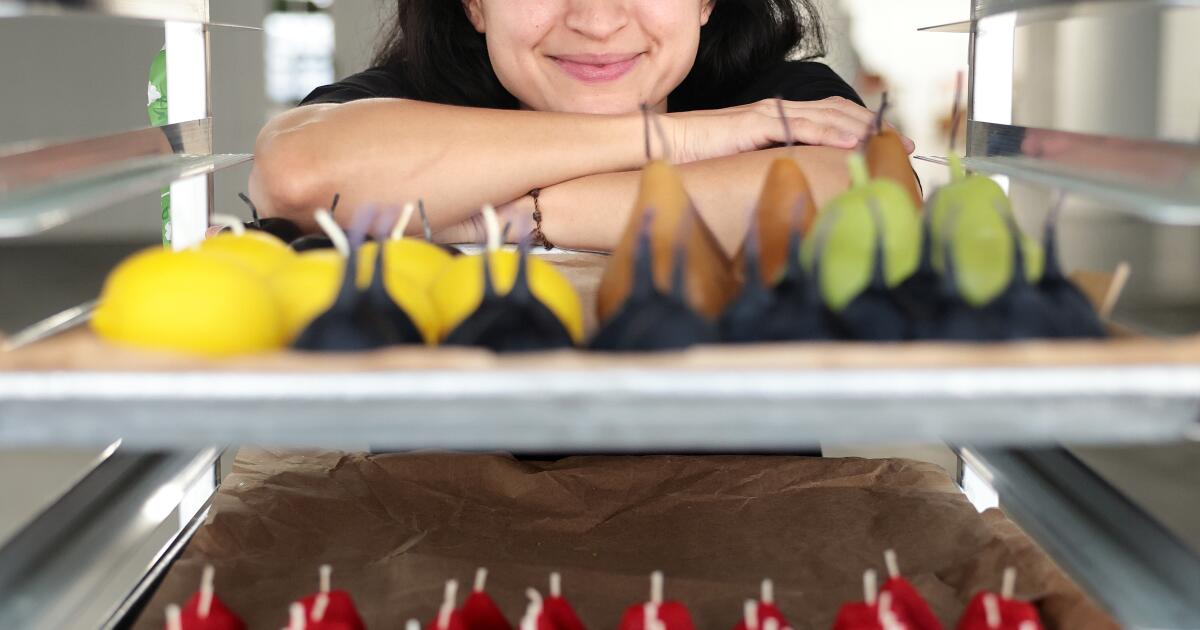
Jessica Gonzalez hustles behind her booth at the recent Renegade Craft Fair, frantically ringing up sales, answering questions and packaging her beeswax candles.
It’s hot on the grounds of the Los Angeles State Historic Park in April, but 35-year-old Gonzalez and her fiancé, Jordan Colindres, keep their cool as a crowd gathers to admire her Happy Organics candle collection, a homage to her family’s produce company in the Central Valley that looks like real fruits and vegetables.
“I love doing in-person events because it’s so fun to see people’s reactions,” she said a few months later. “It makes me feel good to see other people finding joy in my candles. They often say, ‘Oh, that’s really funny.’ And it is funny to have a cherry candle on top of your birthday cake.”

3

1. A staff member pulls a beeswax corn candle, $26, out of its mold at Happy Organics’ studio in downtown Los Angeles. 2. Each Beeswax Mixed Berry Birthday Candles set is cast from real mixed berries — strawberries, raspberries, blackberries, blueberries and cherries. A set of 10 is $30. 3. Bartlett green pears and heirloom tomatoes, $24 to $40.
Judging by the smiles and charmed looks on shoppers’ faces, her produce-inspired candles are less about illuminating rooms and more about sharing the joy she sought when she first started the company in 2018.
In this series, we highlight independent makers and artists, from glassblowers to fiber artists, who are creating original products in and around Los Angeles.
But then, it’s hard not to smile at the playfully elegant Bosc pears, puckered mandarins and green-and-purple asparagus taper candles which range in price from $12 to $40. Some are molded into corn on the cob, celery and rhubarb shapes. Others are made to look like mushrooms, figs, tomatoes and snap peas. The most popular are the small birthday candles shaped like raspberries, cherries and blackberries, packed in molded-pulp baskets just like you’d find at the grocery store or farmers market.

-
Share via
Gonzalez didn’t start out as a designer. The youngest of nine children, she was born in 1991 in Salinas and later moved to Merced, where she grew up on a 10-acre farm. She studied computer science at Mills College, then worked in tech consulting in the Bay Area and eventually became the CTO of an ag-tech company. When her mother, Angela, became ill in 2016, she returned to Merced to be with her family.
When her mom died suddenly soon after she moved home, Gonzalez left the tech industry. “I wasn’t connected with what I was doing,” she said. “I wanted to find something more meaningful; something I loved. I didn’t want my ego to keep me stuck in what I studied in college. I decided to let myself try new hobbies and passions and look for joy again.”
After her mother’s death, she began working with her father, Salvador, and her uncles at the family’s apiary, where they managed more than 30 hives. (Her grandfather was also a beekeeper in Michoacán, Mexico.) Soon, she began selling their raw honey at local farmers markets. In a heartbreaking turn, her father was diagnosed with cancer a year later, so she started making cannabis-infused honey, balms and chocolates to help ease his pain.
When she saw that the beeswax candles, which last significantly longer than paraffin candles, were selling faster than the honey, she decided to focus on making candles from the leftovers from her uncles’ hives.
She was only 25, but it was a turning point. “It was one of those moments where I felt like I needed to change my path,” she said. “I needed to change everything in my life.”

Jessica Gonzalez and her father Salvador on their family farm in Merced. (Gonzalez family)

Gonzalez at Happy Organics’ studio in downtown Los Angeles. (Christina House / Los Angeles Times)
When her father died in 2018, she inherited his bees and started Happy Organics, although she hadn’t planned on starting a business. After experiencing so much loss, making candles became a kind of therapy. “It felt great to work with my hands again, something I thought I’d never have time for,” she said.
Her oldest sister, Sonia Gonzalez, said Gonzalez reminds her a lot of their father, who reinvented himself many times over the years.


The nopal cactus is cast from a real nopal and hand-poured in 100% pure beeswax in the Los Angeles studio.
“He grew up as a village boy in the rural mountains of Michoacán, Mexico, and went on to work in restaurants, cut down Christmas trees and pick strawberries and broccoli in the fields of Salinas,” she wrote in an email. “From there, he started selling produce door-to-door, then at flea markets and eventually built his own produce distribution business from the ground up. As the youngest of nine kids from a working-class family, Jessica’s always been incredibly resourceful, responsible, and amazing at reinventing herself.”
Like a lot of millennials, Gonzalez taught herself how to make candles by watching YouTube videos. She started with hand-dipped tapers, working in the garage on the farm that helped her feel safe and connected to her parents. “It was a really nice environment to try something new and creative,” she said.
Inspired by her family’s produce, she cast real corn, strawberries and cherries in plaster, then made a silicone mold to create copies. Even when using the same mold, color can vary from batch to batch, and how it cools also affects the result. “That’s just how handmade things are,” she said. “There’s always some variation.”

Cherry molds make cherry candles at Happy Organics’ studio in downtown Los Angeles.

A variety of fruit and veggie candles.
When she moved to Los Angeles in 2023 to be with Colindres, her business took off. “L.A. is a great place to grow,” she said. “There’s so much opportunity here. When I go to a farmers market, I never know who I’ll meet.”
She sold her candles in person at craft shows, the Hollywood Farmers’ Market and most recently, during a residency at the P.F. Candle Co. showroom in Echo Park.

2

3

1. A staff member trims the wicks on a pair of carrot birthday candles, $22. 2. Gonzalez passes by shelves of candles at Happy Organics’ studio in downtown Los Angeles. 3. Asparagus taper candles, $30.
“I have a lot of respect for her as a fellow candle maker (making molds is not easy), but getting to know her story more and how her choice of foods and wax is reflective of her family’s history gave it so much meaning,” P.F. Candle Co. founder and creative director Kristen Pumphrey said in an email. “It’s been a tough couple of years for L.A. businesses, so we gotta stick together — there’s this wonderful sense of community hosting a local brand that’s so passionate about their work.”
As her business has expanded, her products are now available at Terrain, Joan’s on Third and the MoMA Design Store in addition to her website. She has also had to source beeswax from other vendors across the country to keep up with demand.
Kimberly Curtis, owner of Hide & Seek Vintage in Studio City, said Gonzalez’s strawberry and cherry birthday candles “flew off the shelves last year” during the holidays. “Our customers love them,” she added.

Gonzalez holds a cabbage candle.
Still, Gonzalez stays connected to her Central Valley roots. Everything she and her small team make in downtown Los Angeles is handmade and “takes time,” she said, describing the steps involved in crafting quality candles. Right now, her favorite is the Nopal Cactus candle, which she made using a clipping from an employee’s yard. While others help her with production, wholesale management and packaging, she focuses on sales, content and all-new product development.
When asked if she has advice for others who want to start their own business, Gonzalez admits she sometimes feels overwhelmed.

In 2013, Gonzalez and her family gathered at their Merced ranch to celebrate her parents’ anniversary.
(Gonzalez family)
“The biggest thing that has gotten me through the toughest spots is my why or my reason for starting,” she said. “I think that has to be really strong. That’s what brought me a lot of comfort when I felt like quitting: going back to the beginning and remembering why I started this.”
For Gonzalez, her reason is always close to her heart. “I wanted to feel connected to my parents in some way,” she said. “This was a good representation of my upbringing.”
-
 Entertainment5 minutes ago
Danny Glover reveals Alzheimer’s diagnosis, says family has his back
-

 Lifestyle8 minutes ago
François-Henri Bennahmias to Launch New Luxury Swiss Watch Brand N3W5
-
 Politics13 minutes ago
Bill to ban sex offenders from running for office fails in California senate committee
-
 Science20 minutes ago
After Trump axed federal employees running climate site, thousands crowdfund its comeback
-
 Sports23 minutes ago
Dodgers’ Will Smith won’t return before the All-Star break
-

 World34 minutes ago
‘Positive progress’ as US, Iran wrap up indirect technical talks in Doha
-
 News58 minutes ago
What the SCOTUS campaign finance ruling means, according to an expert
-

 Los Angeles, Ca2 hours ago
Knife-wielding man rushes at LAPD officers in tense body cam video

