Lifestyle
This hidden L.A. stargazing party is 'more interesting than going to a bar'

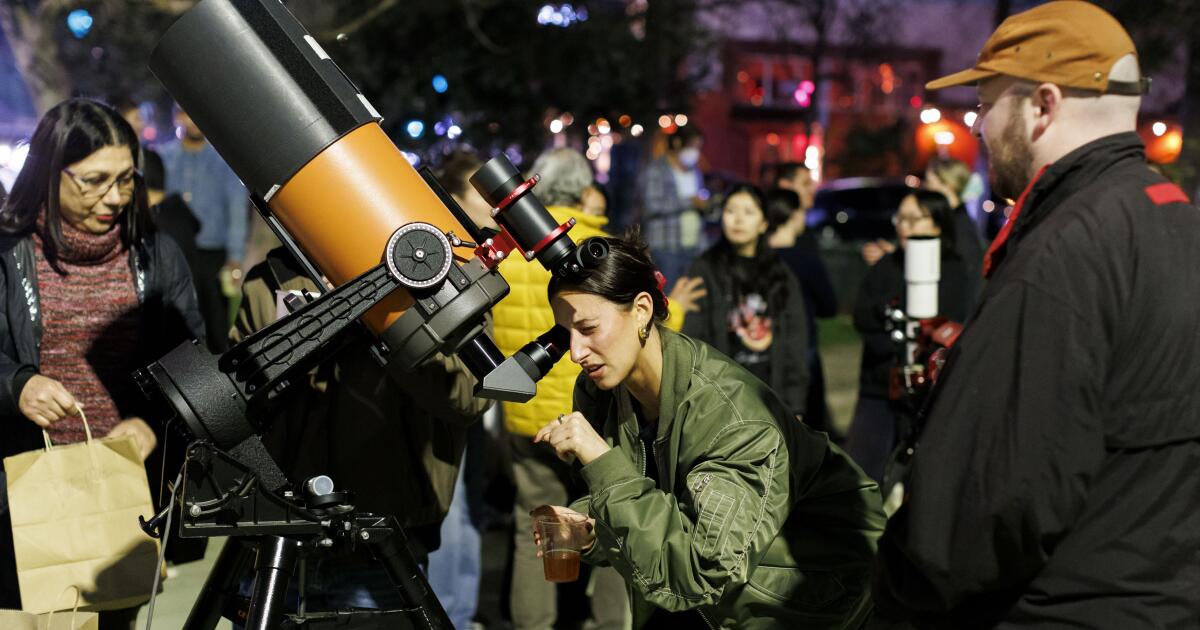
When Dylan Anderson was eight years old, he discovered an old telescope of his grandfather’s. The pirate-esque rig was dusty from years in the garage, but Anderson was instantly intrigued.
“I was like, ‘Hey, what’s this?’ ” the now-18-year-old member of the Los Angeles Astronomical Society said. “I saw Jupiter and its four moons, and I was hooked.”
You’ll hear similar stories from a lot of astronomy enthusiasts, who say that seeing their first big planet was what sparked a lifelong enchantment with the stars. So perhaps it should come as no surprise that the line to see Jupiter, with its milky stripes and four moons, seemed to never end last Thursday evening at the Los Angeles Astronomical Society’s (LAAS) monthly Star Party Silverlake.
The premise for the party is simple: members of the 100-year-old society set up their personal telescopes; community members can circle through and gaze at whatever is on view that night.
This month’s event featured free wine and live music — singer and gayageum player Joyce Kwon accompanied by two harpists. It was also the first time LAAS co-hosted Star Party with Usal Project, an outdoors club dedicated to “newfound nature enthusiasts.” With the additional draw from Usal’s network, over 200 people came to the Sunset Triangle Plaza in Silver Lake to, as LAAS encourages, “look up.”
“We walk around with the pressures of the world, but there’s a lot of reward in just looking up at the universe,” said Bobby Cabbagestalk, 37, an LAAS member who created Star Party in October 2024.
Keith Armstrong, left, president of LAAS, stands with Bobby Cabbagestalk, who created the party.
(Carlin Stiehl / For The Times)
“The idea of ‘looking up’ really translates from an ethos standpoint for the whole reason we both started our projects,” said Michael Washington, 34, the founder of Usal Project. “Being curious, stepping outside your comfort zone, and trying something new.”
Cabbagestalk joined LAAS last summer after running into a group of members stargazing at the Sunset Triangle Plaza, a Thursday night tradition which began in the fall of 2023. The experience immediately sent him back to growing up stargazing with his mom — he recalled that on his 12th birthday, she woke him up in the middle of the night to watch the 2001 Perseid meteor shower. After getting involved with the group, he decided to expand the weekly gatherings with a party once a month, complete with music, drinks and programming, such as happy hour provided by the restaurant Pine and Crane. Cabbagestalk said he hopes guests will have the same sense of childlike wonder that he had when they come to these events.
And if the chatter from the animated crowd was any indication, Star Party was successful in accomplishing its mission.

Anjalika Lobo looks at Mars.
(Carlin Stiehl / For The Times)
“Can I ask a really silly question? … What’s a nebula?”
“Is this the line for Jupiter?
“It better change my life.”
“They should have this here every night!”
Anjalika Lobo, 33, walked from her apartment to the event where she met her friend Katy Maravala, 35. Both women expressed that in a city that can feel so “sceney,” Star Party offered a “low-key” opportunity for community.
“I feel like this is the event that so many people have been craving,” Lobo said. “It’s like that mythical third space that everyone has been whining about.”
“It’s more interesting than going to a bar,” said Maravala. “It’s nice to be surrounded by people who are just as interested in doing something different on their Thursday night.”
“We needed this!” the women laughed.

Usal Project founder Michael Washington, left, talks with fellow stargazers.
(Carlin Stiehl / For The Times)
That same sense of joy in community has buoyed membership of LAAS, which skyrocketed from 300 to 900 members during the pandemic, and now sits at around 1,100 members, according to the president Keith Armstrong.
“We’re all just kinda like orphans, who didn’t have friends and family who were into it, so we all kinda found each other,” said Armstrong, 47. “Because of that, it’s easy to make friends here.”
Armstrong explained that the society is made of everyone from tech bros to actual scientists to astrophotography nerds — and everyone got into it for a different reason. For Alex Vidal, 46, the owner of the telescope that was trained on Jupiter, joining LAAS was about sharing the night sky with as many people as possible; for Justin Hawkins, 40, whose great uncle designed astronaut helmets, exploring astronomy was inevitable as soon as he could budget for his first telescope; for Nasir Jeevanjee, 68, the joy comes from taking long exposure photographs of the stars from his backyard.

The California Nebula imaged by Nasir Jeevanjee, a longtime LAAS member, who photographs the stars from his backyard in Lake Balboa.
(Nasir Jeevanjee)
But for Armstrong, it always comes back to community: even if the weather conditions are poor and the planets aren’t visible, it’s still a chance for the stargazing regulars to grab a beer together on Thursday nights.
“For every unit of energy I put into this thing, I get a unit and a half back,” he said.
At this star party, Jupiter and its moons, Mars, and constellations like Orion, were visible despite Los Angeles’ light pollution. Like Cabbagestalk had hoped, people spilled into the plaza from nearby establishments like El Condor or the Win-Dow to try something different. For most, the wait to see Jupiter was worth it.
“It’s a good reminder that there’s things bigger than us,” said Emily Guarin, 26, whose far-flung group of friends had reconnected specifically for the event. “I was staring at the lines of Jupiter, and it’s like I am here and Jupiter is there, and it doesn’t even know I’m looking at it.”

Stargazers gather to look at the celestial bodies at the Star Party.
(Carlin Stiehl / For The Times)




Hungarian director Béla Tarr at the Berlin International Film Festival in 2011.
Andreas Rentz/Getty Images
hide caption
toggle caption
Andreas Rentz/Getty Images
Béla Tarr, the Hungarian arthouse director best known for his bleak, existential and challenging films, including Sátántangó and Werckmeister Harmonies, has died at the age of 70. The Hungarian Filmmakers’ Association shared a statement on Tuesday announcing Tarr’s passing after a serious illness, but did not specify further details.
Tarr was born in communist-era Hungary in 1955 and made his filmmaking debut in 1979 with Family Nest, the first of nine feature films that would culminate in his 2011 film The Turin Horse. Damnation, released in 1988 at the Berlin International Film Festival, was his first film to draw global acclaim, and launched Tarr from a little-known director of social dramas to a fixture on the international film festival circuit.
Tarr’s reputation for films tinged with misery and hard-heartedness, distinguished by black-and-white cinematography and unusually long sequences, only grew throughout the 1990s and 2000s, particularly after his 1994 film Sátántangó. The epic drama, following a Hungarian village facing the fallout of communism, is best known for its length, clocking in at seven-and-a-half hours.
Based on the novel by Hungarian writer László Krasznahorkai, who won the Nobel Prize in Literature last year and frequently collaborated with Tarr, the film became a touchstone for the “slow cinema” movement, with Tarr joining the ranks of directors such as Andrei Tarkovsky, Chantal Akerman and Theo Angelopoulos. Writer and critic Susan Sontag hailed Sátántangó as “devastating, enthralling for every minute of its seven hours.”

Tarr’s next breakthrough came in 2000 with his film Werckmeister Harmonies, the first of three movies co-directed by his partner, the editor Ágnes Hranitzky. Another loose adaptation of a Krasznahorkai novel, the film depicts the strange arrival of a circus in a small town in Hungary. With only 39 shots making up the film’s two-and-a-half-hour runtime, Tarr’s penchant for long takes was on full display.
Like Sátántangó, it was a major success with both critics and the arthouse crowd. Both films popularized Tarr’s style and drew the admiration of independent directors such as Jim Jarmusch and Gus Van Sant, the latter of which cited Tarr as a direct influence on his films: “They get so much closer to the real rhythms of life that it is like seeing the birth of a new cinema. He is one of the few genuinely visionary filmmakers.”
The actress Tilda Swinton is another admirer of Tarr’s, and starred in the filmmaker’s 2007 film The Man from London. At the premiere, Tarr announced that his next film would be his last. That 2011 film, The Turin Horse, was typically bleak but with an apocalyptic twist, following a man and his daughter as they face the end of the world. The film won the Grand Jury Prize at the Berlin International Film Festival.
After the release of The Turin Horse, Tarr opened an international film program in 2013 called film.factory as part of the Sarajevo Film Academy. He led and taught in the school for four years, inviting various filmmakers and actors to teach workshops and mentor students, including Swinton, Van Sant, Jarmusch, Juliette Binoche and Gael García Bernal.
In the last years of his life, he worked on a number of artistic projects, including an exhibition at a film museum in Amsterdam. He remained politically outspoken throughout his life, condemning the rise of nationalism and criticizing the government of Hungarian leader Viktor Orbán.

California’s wet winter continued Sunday, with the heaviest rain occurring into the evening, and more precipitation forecast for Monday before tapering off on Tuesday, according to the National Weather Service.
A flood advisory was in effect for most of Los Angeles County until 10 p.m.
Los Angeles and Ventura counties’ coastal and valley regions could receive roughly half an inch to an inch more rain, with mountain areas getting one to two additional inches Sunday, officials said. The next two days will be lighter, said Robbie Munroe, a meteorologist at the weather service office in Oxnard.
Rains in Southern California have broken records this season, with some areas approaching average rain totals for an entire season. As of Sunday morning, the region had seen nearly 14 inches of rain since Oct. 1, more than three times the average of 4 inches for this time of year. An average rain season, which goes from July 1 to June 30, is 14.25 inches, officials said.
“There’s the potential that we’ll already meet our average rainfall for the entire 12-month period by later today if we end up getting half an inch or more of rain,” Munroe added.
The wet weather prompted multiple road closures over the weekend, including a 3.6-mile stretch of Topanga Canyon Boulevard between Pacific Coast Highway and Grand View Drive as well as State Route 33 between Fairview Road and Lockwood Valley Road in the Los Padres National Forest. The California Department of Transportation also closed all lanes along State Route 2 from 3.3 miles east of Newcomb’s Ranch to State Route 138 in Angeles National Forest.
Los Angeles County Department of Public Health officials say beachgoers should stay out of the water to avoid the higher bacteria levels brought on by rain.
After storms, especially near discharging storm drains, creeks and rivers, the water can be contaminated with E. coli, trash, chemicals and other public health hazards.
The advisory, which will be in effect until at least 4 p.m. Monday, could be extended if the rain continues.
In Ventura County on Sunday, the 101 Freeway was reopened after lanes were closed due to flooding Saturday. But there was at least one spinout as well as a vehicle stuck in mud on the highway Sunday, according to the National Weather Service. The freeway was also closed Saturday in Santa Barbara County in both directions near Goleta due to debris flows but reopened Sunday, according to Caltrans.
Santa Barbara Airport reopened and all commercial flights and fixed-wing aircraft were cleared for normal operations Sunday morning. The airport had shut down and grounded all flights Saturday due to flooded runways.
In Orange County early Sunday afternoon, firefighters rescued a man clinging to a section of a tunnel in cold, fast-moving water in a storm channel at Bolsa Avenue and Goldenwest Street in Westminster, according to fire officials.
A swift-water rescue team deployed a helicopter, lowered inflated firehoses and positioned an aerial ladder to allow responders to secure the man and bring him to safety before transporting him to a hospital for evaluation.
Heavy rains continued to batter Southern California mountain areas. Wrightwood in San Bernardino County — slammed recently with mud and debris — was closed Sunday except to residents as heavy equipment was brought in to clear mud and debris from roadways, the news-gathering organization OnScene reported.
After canceling live racing on New Year’s Eve and New Year’s Day due to heavy showers, Santa Anita Park also called off events Saturday and Sunday.
After several atmospheric river systems have come through, familiar conditions are set to return to the region later this week.
“We’ll get a good break from the rain and it’ll let things dry out a little bit, and we may even be looking at Santa Ana conditions as we head into next weekend,” Munroe said. The weather will likely be “mostly sunny” and breezy in the valleys and mountains.

Millie Bobby Brown in the final season of Stranger Things.
Netflix
hide caption
toggle caption
Netflix
After five seasons and almost ten years, the saga of Netflix’s Stranger Things has reached its end. In a two-hour finale, we found out what happened to our heroes (including Millie Bobby Brown and Finn Wolfhard) when they set out to battle the forces of evil. The final season had new faces and new revelations, along with moments of friendship and conflict among the folks we’ve known and loved since the night Will Byers (Noah Schnapp) first disappeared. But did it stick the landing?
To access bonus episodes and sponsor-free listening for Pop Culture Happy Hour, subscribe to Pop Culture Happy Hour+ at plus.npr.org/happy.

Dynamite, Floods and Feuds: Washington’s forgotten river wars

3 takeaways as Wisconsin Badgers ‘showed some fight’ in win over UCLA
West Virginia Lottery results: See winning numbers for Mega Millions, Daily 3 on Jan. 6, 2026

Abortion-rights advocates cheer Wyoming Supreme Court ruling; opponents plan constitutional amendment – WyoFile

35 Best Bitcoin Casinos to Play in January 2026

Florida High School Football Rankings: Top 25 teams – Oct. 21

Cleary's 21 help Le Moyne down Central Connecticut State 69-64 in OT

How old is Bo Nix? What to know about Oregon quarterback ahead of 2024 NFL Draft

99th annual Pony Swim held in Virginia

Video: ‘It Didn’t Have to Happen This Way:’ U.Va. Faculty Call for Review of Police Response to Protests

Wyoming Supreme Court rules laws restricting abortion violate state constitution

How strong are Latin America’s military forces, as they face US threats?

Trump says Venezuela will turn over 30 million to 50 million barrels of oil to US | CNN Business

Video: Nvidia Shows Off New A.I. Chip at CES

Pelosi heir-apparent calls Trump’s Venezuela move a ‘lawless coup,’ urges impeachment, slams Netanyahu
-

 World1 week ago
Hamas builds new terror regime in Gaza, recruiting teens amid problematic election
-
 News1 week ago
For those who help the poor, 2025 goes down as a year of chaos
-
 Business1 week ago
Instacart ends AI pricing test that charged shoppers different prices for the same items
-

 Health1 week ago
Did holiday stress wreak havoc on your gut? Doctors say 6 simple tips can help
-

 Technology1 week ago
ChatGPT’s GPT-5.2 is here, and it feels rushed
-
 Business1 week ago
A tale of two Ralphs — Lauren and the supermarket — shows the reality of a K-shaped economy
-

 Science1 week ago
We Asked for Environmental Fixes in Your State. You Sent In Thousands.
-

 Politics1 week ago
The biggest losers of 2025: Who fell flat as the year closed