Lifestyle
This country karaoke night in L.A. is a rootin', tootin' hootenanny with a queer twist

“I’m gay so I can’t do the guitar solo,” quips Sam Buck.
A grin plays across his face as the unmistakable jangle of Tim McGraw’s “I Like It, I Love It” wafts through the room. Members of the audience chuckle knowingly — the tall, bearded musician could absolutely shred it if he wanted to, but on this night, fun trumps virtuosity.
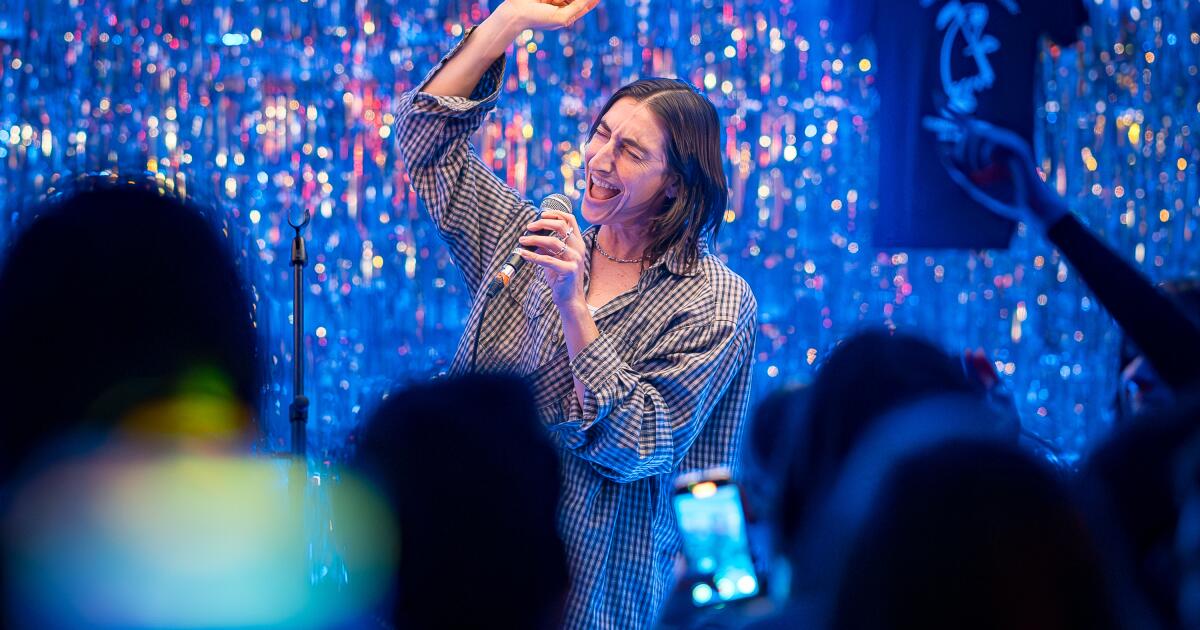
Buck stands under the soft glow of Tiffany-style fixtures, his guitar slung casually over his shoulders and his brown cowboy hat casting a shadow over his black denim jacket. Behind him, silver tinsel sparkles, a Nashville-glam backdrop to the intimate stage at Permanent Records Roadhouse, a cozy bar-cum-record store in Glassell Park. He’s kicking off the KFM Karaoke Country Revue, a monthly celebration where honky-tonk culture meets the queer community to toast, twang and tumble through songs like old friends in a Garth Brooks ballad.
“What I love about this show is that it’s like Goldilocks — it’s never just right,” Buck says before announcing the night’s singers.
Rosie Ruell sings “El Toro Relajo” at Karaoke Country Revue.
This isn’t just a showcase; it’s a haven. A place where country music, with all its contradictions and complexities, embraces its messiest, queerest, most joyful self. Trans, nonbinary, queer, gay, cis and straight performers all take the stage with the same goal: to make space to celebrate country music for those who aren’t usually embraced by its stubbornly conservative circles.
Over its two-year run, KFM, named after Buck’s podcast KFM Country Radio, has drawn talent like Julianna Barwick, Dougie Poole and Jae Matthews of electronic duo Boy Harsher. One of the night’s guests, Amber Coffman, the former co-frontperson of the Brooklyn-based indie band Dirty Projectors, stirs the crowd with her rendition of “Hard Candy Christmas,” a Dolly Parton classic from 1978, which she officially covered in 2020.

Attendees cheer performers at Karaoke Country Revue at Permanent Records Roadhouse.
L.A.-based singer Sedona, wearing a vintage T-shirt that says “Rodeo Girls,” performs a rocking version of Bonnie Raitt’s “Angel From Montgomery.” And Loren Kramar, an up-and-coming orchestral singer-songwriter, smolders through Little Big Town’s “Girl Crush.”
The microphone isn’t only for seasoned performers; however, Buck ensures that the show runs smoothly by curating the lineup and requiring everyone to rehearse beforehand. The setup feels like karaoke, with Buck cueing backing tracks, but there is no lyrics screen to lean on. “Bad karaoke can be so rough if someone’s wasted or they don’t know the song,” Buck says. “[KFM performers] have to learn the song, and there is some care that needs to go into it.”
For example, comedian John Early belts out the Chicks’ “Wide Open Spaces,” prancing about dramatically to choreographed moves, while Nicholas Braun from HBO’s “Succession” watches from the audience.

Comedian John Early, who starred on the HBO Max show “Search Party,” belts out the Chicks’ “Wide Open Spaces.”
Other shows have featured comedians like Kate Berlant and Casey Jane Ellison. Longtime KFM regulars like Chloe Coover and Maddie Phinney, hosts of the popular perfume podcast “Nose Candy,” bring their own fabulous flair — Phinney leaves a trail of Céline’s sophisticated Black Tie perfume, and Coover is dressed in a full-length ball gown while she sings NewSong’s fascinatingly sentimental Christian country ballad “The Christmas Shoes.” Artist Erin Bagley takes on Fleetwood Mac’s 1977 country-rock “Silver Springs.” And Buck’s partner, JT Friedman, leads a raucous rendition of Alan Jackson’s “Honky Tonk Christmas” while passing out candy canes from a stocking.
Rosie Ruel, a hopeful pop star who sunlights as an energy worker and a real estate agent, belts out the bombastic bullfighting song “El Toro Relajo” (The Toublesome Bull), that both floors the audience and underscores a tenet of KFM: that the genre’s lines are meant to be toed. Mariachi is really just Mexican country music, Ruel later tells me.

Sam Buck gives Maddie Phinney a birthday present after Phinney sang Squeeze’s “Tempted” at the Karaoke Country Revue.
Mary Rachel Kostrova, owner of the vintage eye-wear boutique Eyefi, delivers a sultry performance of Melissa Etheridge’s “I’m the Only One,” her voice dripping with raw emotion. Growing up in Georgia, Kostrova witnessed country music’s polarizing presence — ubiquitous, yet embraced only by those unafraid to claim it openly. Among her peers, she recalls the familiar chestnut about listening to all genres but rap and country. A wry smile forms on her face. “And now a lot of people are like, ‘I only listen to rap and country,’” she says.
“Country is in such an interesting place,” muses Buck, who is playing a show with Mercedes Kilmer (the singer-songwriter daughter of Val) at Zebulon on Feb. 9. Pop stars like Beyoncé and Post Malone are experimenting with the genre, while country’s own Kacey Musgraves and Taylor Swift drift closer to pop. Meanwhile, the industry is cautiously diversifying, but the support is uneven. “There’s not any mainstream gay musician,” says Buck. “I am not sure there ever will be.”
Buck’s journey into the genre is its own kind of outlaw story. Born and raised in coastal Massachusetts — a place far removed from the South’s storied hollers — he grew up feeling like an outsider for being a Miranda Lambert fan. “I’m a Yankee through and through,” he says. “But anyone from a rural place knows that country doesn’t have to come from the Deep South. In terms of stolen country valor, I’ve probably stolen more than most.”

JT Friedman, right, talks with Chloe Coover after Coover’s performance.
KFM began as a pandemic-era podcast. Buck spins country records, tells meandering stories and indulges in sharp gossip about county elite. “I have to be careful,” he jokes. “If I talk about [so-and-so’s] ex-cop husband and his disgusting bow-tie pasta, I don’t want that getting back to her, just in case I end up playing a show with her.” He doesn’t shy away from skewering controversial figures like right-wing influencer Brittany Aldean (“She only believes in evil things,” he says), but the podcast’s charm lies in its mix of irreverence and authentic reverence for country music.
For Buck, who also works as an artist (and recently showcased paintings of architecturally significant L.A. homes at the historic Echo Park restaurant Taix), the appeal of the KFM Karaoke Country Revue — the next one takes place Jan. 23 — lies in its intimacy and chaos. “It’s messy, it’s beautiful, it’s small,” he says. “People feel like they connect with each other here. And in a time when everything’s about getting bigger and louder, I think small things are good.”
And as the night rolls on — voices rising, drinks flowing and silver tinsel shimmering under the lights — Buck reflects on the strange universality of country music. “The more time goes on, the more I realize that everywhere is country. Especially Los Angeles.”


Lifestyle
L.A. Affairs: It’s hot when a man drives to me. But would this new guy make the trek from the Valley?

I met Dan on Hinge.
He lives in Woodland Hills, and I live in Venice. In Los Angeles, this is considered a long-distance relationship. In another city it might be nothing. Here, it’s a factor.
But I believe that with the right person, you can make anything work, so I stay open. I’m a native New Yorker, and if I were living in Brooklyn and a guy lived on the Upper West Side, that would be a 45-minute subway ride, which is truly nothing in New York. So with that same logic, I try to have flexibility with men in L.A.
When we started planning our first date, Dan suggested three options: a hike on mushrooms, a wine tasting or a walk on the beach.
A hike on mushrooms is something I’d only do with someone I already trust, not someone I just met online. I don’t do first-date hikes because I don’t like feeling trapped if the guy’s a dud. So I chose the wine tasting.
Then I learned the wine tasting was in West Hills.
On a Friday night, driving there from Venice would be insane. So I said I didn’t want to meet there because of the traffic. He suggested Malibu. That was also not ideal on a Friday.
I was getting annoyed — this was a pink flag because in my dating world, the guy is supposed to come to the woman’s neighborhood in the early days. I’ve gone out with plenty of men from the Valley who effortlessly suggested they come to me. It’s not rare or impossible.
I suggested he come to the Westside. I didn’t specifically say Venice, and in hindsight, I probably should have. He landed on Brentwood, which was manageable for both of us. On our first date, we met at an Irish pub on Wilshire Boulevard. He was cuter and more interesting than I had expected, and with the Guinness flowing, we had fun.
When I got home, he texted me: “Well, I like you 🙂 Less the tik tok and the lack of rock music in your life, but it’s not a deal breaker — there are other qualities 🙂 What are your thoughts?”
I noticed the slight negativity but was mostly dazzled that a man texted immediately after the date to say he liked me. In the modern dating economy, this felt rare.
The next day, both of our evening plans fell through, so we made a last-minute date. The wine tasting he originally suggested still sounded like fun, and although it meant me driving to the Valley, I was up for it now that we’d met.
We sipped flights at Malibu Wines & Beer Garden in its airy, romantic courtyard and played a flirty version of Truth or Dare. Halfway through, he dared me to kiss him.
We ended with sushi on Ventura Boulevard and a short make-out session in his car. He invited me to Thanksgiving at his uncle’s, which felt too soon, but also sweet.
After the second date, he texted and said he had his kids that week and was also hosting an event on Thursday, so his only day to meet was Wednesday. I said great.
On Tuesday night, he checked if we were still on, and I said yes.
Then he texted: “I’m flexible on time but not on location. I have a big event on Thursday, hopefully you can come to me again.”
My stomach tightened. This again?
So I texted back: “I drove to you last time, which was a bit of an exception for me especially in the early days, but the wine tasting location sounded special. Usually guys come to my area. How about we switch it up this time?”
He replied: “I appreciate the effort! Because of my event, I’d rather be close to a computer just if needed … Here is what i offer:
— I’ll come to your area anytime next week/end
— Lunch/dinner on me
I want to continue where we stopped last time 😉 No pressure of course, but let’s snuggle”
I responded: “Ok let’s meet next week. Snuggles sound nice … let’s see what happens …”
Then he wrote: “So I won’t see you tomorrow?”
I replied: “Unless you wanna come to me and bring your laptop along, let’s rain check until you have more flexibility.”
He said: “Dang, you are hard. I’ll let you know tomorrow around midday if it’s ok.”
And then — surprise — he decided to come.
He drove to Venice for a 5 p.m. date. He said his ETA was 5 p.m., and it ended up being 5:25 p.m., typical 405 Freeway.
When he showed up, he was in a cranky mood. On our way to KazuNori in Marina del Rey, I thanked him for picking me up and told him I think it’s hot when the guy comes to the girl.
“You’re just saying that because you want me to come to you more,” he said, not playfully, but aggressively.
That was basically the end for me. But there I was, in his car, heading to dinner. So I stayed pleasant and tried to make the best of it.
I shared that in the early stages of dating, I find it’s good etiquette for the guy to come to the woman’s neighborhood. He immediately disagreed and started ranting about how dating rules are ridiculous and how they swing in women’s favor. He resented paying for dates and declared he wasn’t looking to “sponsor a woman’s life.”
“If women want equality and equal rights,” he said, “then it should apply all across the board, including dating, and the man shouldn’t have to pay.”
I said women don’t actually have equal rights because we get paid less than men and often receive lower salaries than men in the same position.
I tried to change the subject and reset the mood, but he insisted we keep hashing it out.
I tried to explain masculine/feminine dynamics: providing and protecting, giving and receiving.
“What does the man get out of this arrangement?” he asked.
It was like watching someone’s personality warp into Mr. Hyde. Then he brought up another point: He’s a single dad of two kids, so he gets tired; and because I don’t have kids, that should factor into who drives where.
At this point, I was barely engaging and focused on eating my hand rolls, and I couldn’t wait to get home.
The check came, and I happily split it, wanting nothing further from him.
In the car back to my place, he remarked: “It’s obvious we’re never gonna see each other again.”
Obvious, but did it need to be stated?
Then he showed me a Spotify playlist he’d made for me of his favorite electronic music, because he knows I like EDM.
“Oh, that’s sweet,” I said.
“Yeah, that’s how I show interest. Through things like this, not who drives to who,” he replied.
When I got out of the car, we wished each other luck, and I headed inside and shut the door.
Two hours later, he sent me the playlist. I’ve yet to listen to it.
It wasn’t the distance that ruined it. It was the resentment. I’m not looking for a man who feels burdened by the effort. I’m looking for a man who sees the value of courting a woman in the first place.
The author is a writer, comedian and former psychologist who lives in Venice. She is the creator of the new vertical series “Manfari.” She’s on Instagram: @solange_neue and @manfari.show.
L.A. Affairs chronicles the search for romantic love in all its glorious expressions in the L.A. area, and we want to hear your true story. We pay $400 for a published essay. Email LAAffairs@latimes.com. You can find submission guidelines here. You can find past columns here.

Lonnie Bunch III is the 14th Secretary of the Smithsonian. He’s pictured above in September 2017.
J. Scott Applewhite/AP
hide caption
toggle caption
J. Scott Applewhite/AP
In a memo addressed to staffers sent Tuesday, the secretary of the Smithsonian, Lonnie G. Bunch III, defended the institution after the White House issued a 162-page report that characterizes the National Museum of American History as a place which has become “subject to institutional capture by a radical, activist ideology that is fundamentally opposed to telling the noble, honest story of the great country we know and love.”
In his email, which NPR has obtained, Bunch wrote in part: “While there will always be room for improvement, this report is not a fair characterization of the work and totality of the National Museum of American History. At the Smithsonian, our work is driven by scholarship, accuracy and an uncompromising commitment to tell the fullness of America’s story. As public servants and the keepers of this institution, we are charged with helping a nation find understanding, hope and clarity and as part of that duty, we are dedicated to excellence, reflection and growth.”

He continued: “We remain focused on what grounds us: a steadfast commitment to scholarship, nonpartisanship, independence, accuracy and integrity. For nearly 180 years, the Smithsonian has worked alongside partners across government — from the White House to Congress to our governing Board of Regents — guided by our enduring mission to increase and diffuse knowledge. That purpose remains: to pursue knowledge with rigor and to serve the American public with clarity and care.”
The White House report was issued on July 4 by the Domestic Policy Council under the title “Saving America’s Story: How Ideological Capture at the Smithsonian Institution’s National Museum of American History Erases Our Heritage.”

The council faults the National Museum of American History on a multitude of fronts, saying it underemphasized the Founding Fathers and early colonial and Revolutionary history; was not sufficiently celebratory of the country’s 250th anniversary; and that it engaged in “anti-white,” “illegal alien” and transgender activism.
It also accuses the museum of trying to “indoctrinate” teachers and students through its exhibitions, programming and teaching resources.
In the report, the council also specifically criticizes museum director Anthea Hartig, who has led the National Museum of American History since 2019 and is concurrently the president of the Organization of American Historians, calling her “an activist advancing an ideological agenda contradictory to the museum’s founding purpose of fostering patriotism.”

The Trump administration has made the Smithsonian museums one of its primary targets in its efforts to reshape cultural narratives to align with its viewpoints. In August 2025, the White House requested a “comprehensive internal review” of eight Smithsonian museums, including the National Museum of American History, following an executive order issued by President Trump in March 2025 in which he called for the removal of “improper ideology” from the Smithsonian’s offerings.
According to the Smithsonian’s charter, all of its 21 museums, 14 education and research centers, and the National Zoo are meant to be run independently of the federal government. The Smithsonian is overseen by Bunch and a board of regents, which includes Vice President Vance, Supreme Court Chief Justice John Roberts and other members appointed by Congress.
In an interview with NBC’s Meet the Press on Sunday, Bunch spoke about the Smithsonian’s 250th anniversary special exhibition at the Smithsonian Castle, which is called “American Aspirations.”
He told NBC: “It’s really important for people to understand that America is much an ideal as it is a place, that it’s a series of aspirations that have really shaped who this country is. And so for me, what is so powerful is to say, ‘Let us honor the words of Thomas Jefferson and the founders, but let us use those to challenge us to be better.’”
Jennifer Vanasco edited this story.

-

 Detroit, MI7 minutes ago
Detroit Evening Report: Waymo cars blocking first responders – WDET 101.9 FM
-

 San Francisco, CA15 minutes ago
San Francisco Mayor Daniel Lurie Blocks Vacant Grocery Store Tax Proposal | KQED
-

 Miami, FL20 minutes ago
Oregon Battling Miami, Mario Cristobal for Four-Star EDGE Recruit
-

 Dallas, TX22 minutes ago
FC Dallas Forward Logan Farrington Inks Contract Extension
-

 Boston, MA30 minutes ago
Red Sox face lengthy travel issues ahead of series vs. Mets
-

 Denver, CO37 minutes ago
What’s going on with the Nuggets? Unpacking an NBA offseason on hold
-

 Seattle, WA40 minutes ago
Seattle Kraken Sign Goaltender Victor Östman and Defenseman Ville Ottavainen to One-Year Deals | Seattle Kraken
-

 San Diego, CA45 minutes ago
An executive shuffle at San Diego’s Sempra

