Lifestyle
This blue, curvy Baldwin Hills house is Black postmodernism in motion

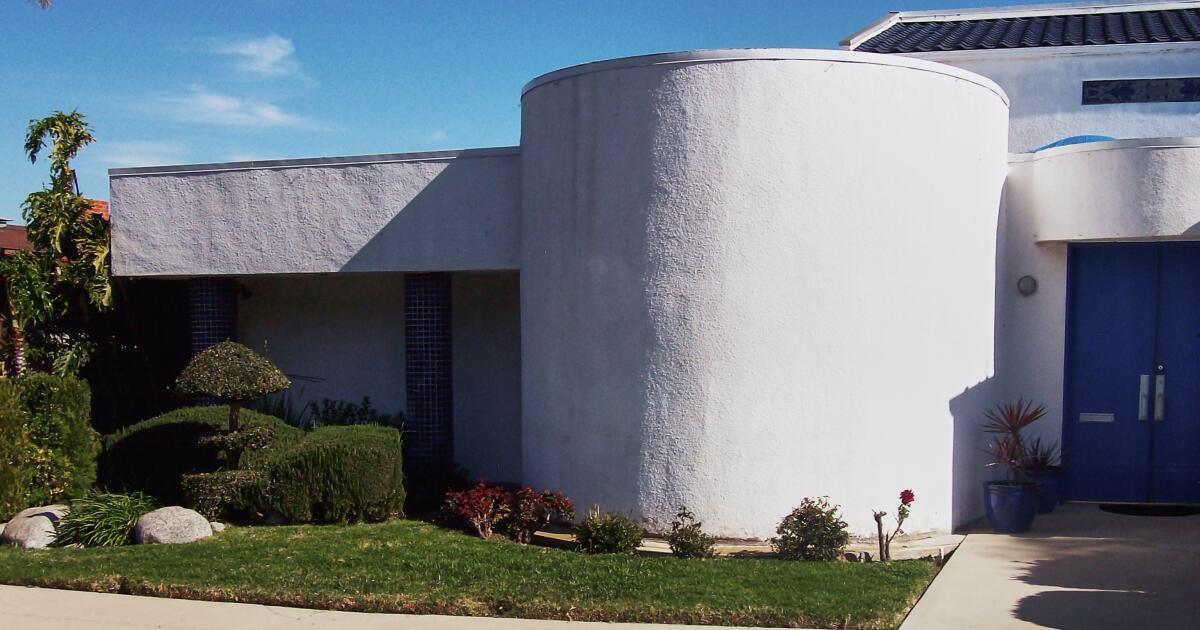
The first time Felema Yemaneberhan invited me over was maybe in 2025. I know it was sunny and warm, but I can’t figure out the season in L.A. from that. Pulling up to Felema’s home in Baldwin Hills Estates, the first thing I saw was a Japanese garden tucked on the right side of the home’s facade. The Black neighborhoods like Baldwin Hills Estates, Ladera Heights and View Park all sit hillside with some of the illest views in the city. Nah, like for real. The white curved walls offset with those two Miami Beach electric-blue mosaic columns, a single rose and an ADT home security sign took my eye. I didn’t even notice the facade was windowless until Felema said something.
The home was developed in 1983 by Edward and Lynn Edward Ivie, and designed and completed by Black builder and Cal Poly grad E. Michael White in 1985, who lived in the home with his family. Felema and her family moved in just five years later. As soon as she told me the crib was built by a brother I said, “Yo, is this some Black postmodernist architecture?”

Felema Yemaneberhan in front of her family home in Baldwin Hills.
I won’t assume y’all know what that postmodern design is. Emerging in the late ’60s and hitting its stride by the ’80s, postmodernism is defined as a reaction against that less-is-more, strict-type of modernism that came from Europe. Postmodernism reintroduced that playful, ornamental, whimsical design to everything from homes to shoes to pop culture.
So what is Black postmodernism then?
Walking into that long, blue-hued foyer with the marble floors, built-in planters and the spiral staircase that winds you through the home, left and right, mimics the feeling of descending these same hills. The speckled print on the walls behind the family bookshelf gives that Memphis design energy (or “Afro-Memphis” if y’all hip!). The home feels like a very intentional example of Black postmodernism. Playful, lived in, like a hug made from curved walls and different levels that guide you through the rooms.
I met Felema in 2020, online. She was one of the first Black architects I had ever met. She has designed homes and spaces in the U.S., Africa and Europe, and she has her own design studio, Felemaye, which she describes as “rooted in memory, material culture, and spatial intelligence.” In talking with Felema, it became immediately clear that she is super-knowledgeable about everything concerning the hood. She would tell me about where her family came from, the Eritrean capital, Asmara, and its complex history, rooted in years of Italian occupation and Art Deco infrastructure. In many ways, both subconsciously and intentionally, that Italian Art Deco city must have become the inspiration for not only Felema’s childhood home, but a profession that has driven her to really look at her neighborhood much differently.
A few days after the shoot, I chatted again with Felema. This time along with Rossen Ventzislavov, an educator who brought me out to Woodbury University last spring as a fellow to teach a one-of-a-kind semester on Black modernism in architecture, design and popular culture. All three of us share a focus on researching, archiving and documenting Black modernism and space. Yeah, it’s architecture and design, but it’s also everything from civic awareness to infrastructure, or what I’ve recently been calling, “us and the city.”
At the house with Felema, we looked through family photos, chatting with her sister Delina and playing with her son, Hyabna. She told us about this Amharic word tizita, that speaks to nostalgia, memory and longing. I saw it in her family’s decisions all through the house. Hers too. The crib looks exactly the same as it did in the ’90s. Her father’s mono bloc chair hasn’t moved from the spot it was last in since he passed. I wondered a lot about why her family chose this home in the first place.
— Jerald “Coop” Cooper

Walking into the long, blue-hued foyer with marble floors, and the spiral staircase that winds you through the home, left and right, mimics the feeling of descending the surrounding hills.
Jerald Cooper: To start off, tell us where we are right now.
Felema Yemaneberhan: We are in the heart of the city, 90008 to be exact. We are in a subdivision called Baldwin Hills, or Baldwin Hills Estates. South L.A.
JC: Tell us about the origin story of this space. How did your family end up here?
FY: The home was originally developed and designed between 1983-1985 by father and son Edward and Lynn Edward Ivie alongside structural engineer Ronald Greene. The project was then purchased and completed between 1987-1988 by E. Michael White. When White got the property, only a few rooms were finished. He worked with contractor Travis Randolph to design the interior architecture and finish the home before my family bought it in the late ‘80s. This property’s history represents a rare lineage of design across two distinct chapters. Every hand that shaped this home was Black, an intentional choice that documents a standard of excellence often omitted from the traditional architectural narrative.
My family looked at countless homes throughout Los Angeles, and they didn’t really feel moved by anything, until one day they stumbled upon this. My parents made the transaction immediately, because the house, the views and the intentionality of the way the space was designed just spoke to them both. They are design nerds. They value the preciousness of beauty, be it in a space or an object. They just wanted to make sure that their future family would live in a beautiful and serene place.
Rossen Ventzislavov: Could you tell us about the official designation of your house?
FY: If you’re familiar with the building tradition in Eritrea, it’s not a special or glamorous thing to title a house. So most houses are named after the family. For the purpose of creating a sense of anonymity for our family we call our home “Geza Ḥlmi.” “Geza” is equivalent to villa or casa. “Hil’mi” means dreams. So it’s more of an ode to the feeling, a space to dream.


“I was a dancer my whole life,” says Yemaneberhan. “So even in the way that the body moves, and the movement through the space, there’s compression and there’s release.”
RV: How does the house connect your African existence and your L.A. existence?
FY: We’re not as exotic as we might romanticize it. I’m very much an Angelena. I was born and raised in L.A., but actually, a lot of Eritreans, when they first meet my sister and myself, assume we were born back home. We were raised with English, but we didn’t speak English in this house. We didn’t mix with the diasporic children of Los Angeles. We went back to Eritrea every summer. My parents’ choice to settle down in Los Angeles had to do with climate. It was very important when you looked outside to feel as close to home as possible. This explains the cute parallels around, like the veranda. My parents used to dress us up in our traditional clothes and take photos of us in front of the bougainvillea or the jacaranda tree. If you look at the natural landscape in Eritrea, it’s the same exact atmosphere.
JC: Tell us about some of your earlier memories of the home.
FY: We have countless memories. We used to have pool parties up here with our cousins. We did every major event here, prom, homecoming, all the homies would come here and take photos across the different points of the house. My mom’s incredible cooking. Both sides of our family used to come here, and it was just a beautiful time. And you know, the people who had to come over here due to various reasons, often reminisce on what they had back home. I often wrestled with it as a young adult, if the past had actually been better than the present day. And I could fully, wholeheartedly say, yes, it was a beautiful, charmed childhood, and in a way this home sheltered us from a lot of the chaos that was going on in the ’90s here in L.A. The inner city, gang terror, it’s all not too far from here.
RV: What is the thrill for you living in this house as an architect?
FY: There are many undulations in the space. I was a dancer my whole life. So even in the way that the body moves, and the movement through the space, there’s compression and there’s release. The main atrium, or as I call it the “Hall of Mirrors,” is kind of compressed. Then there are the heights of the house, fluctuating greatly. I also like the specific corners and the way we have created unofficial wings. If you look at the facade, there’s absolutely no windows. So it is basically a house of secrets. There are specific times of day that I particularly love, and then there are other points when I don’t want to be here. I love this house at 10 o’clock because of the cantilever and the shadows. I have my coffee on the balcony, I relax, I write my emails. I don’t really particularly enjoy the house at night. There is a playfulness in the day and there’s a seriousness at night. I also like the idea of creating a permanence in the playfulness. I have a child, and I’m very much a child, and I think it’s a testament to the spirit of this home and my father’s spirit.


JC: One gets the sense that living here triggered your choice of profession? Is that true?
FY: Absolutely! My father had a tremendous influence in terms of my career choice. There’s a beautiful image that my uncle took of us at the kitchen table where I’m coloring. My uncle would say, “Color in the lines.” And my dad’s, like, “No, let her do what she wants to do.” If I wanted to be something, I’d find the proper avenues to make it happen. We didn’t watch TV growing up, there was always an activity. So from seventh grade on, I wanted to be an architect. Which is atypical. If you’re the child of an immigrant family, you go with specific professions. You’re a doctor, a lawyer, an engineer. It’s very rare to be in this field, in the creative arts. But I think it is a testament to my parents saying to me, “OK, you can do whatever you want, just be really good at it. Take all the honest steps, do the hard work, but just be free.” That freedom has allowed me to kind of come in and out of different subsets within architecture, and really handle my curiosity. Because every part of this house, now that I think about it, has had a point of activation of curiosity.
RV: Since Hood Century [a.k.a. Jerald Cooper] has brought us together, I have a question that is consistent with Coop’s own practice. He speaks of Black inhabitation as transformative living, a nexus between design and humanity. What does it mean to you?
FY: I think that architects and designers have to be anthropologists. What is precedence without the people? If anything, Coop studies people, studies groups of folks and systems, and how informal and formal systems of specific societies interact. What are the systems that have been put in place for these people, and what are the organic solutions that the people have made for themselves because they know that the system is not serving them?


“If it’s a well-designed building, you don’t have to do anything. You just have to steward and preserve.”
To your point, I think people feel compelled to make fundamental design moves like the blueness of this house. We put in the skylights this year because we were trying to protect the plants from light exposure and the rising heatwaves. And, if you can have simple and gentle conversations about the modifications, it’s important to consider the original design intent, but also what inhabitants do right in terms of respecting heritage, and what standards we’re using to evaluate their contribution. We have designers in the family and they would come here and give different suggestions. But my argument is, if it’s a well-designed building, you don’t have to do anything. You just have to steward and preserve.
JC: Talking about stewardship and preservation, tell us about your current indexing project of Black homes here in the neighborhood.
FY: The “90008 Index.” It’s an anthropological, architectural and sociological study of the people who’ve lived within the 90008 ZIP Code from 1950 to 2000. It’s important to study and establish provenance. My argument is that there are just as many, if not more, architecturally significant buildings on this side of town, and we need to study them. In the 2000s, the media cast this neighborhood as the Black Beverly Hills. And I’m trying to step back from the exclusive focus on financial affluence. I want to study the people, because there are everyday people who built and lived here. The subtitle I’m using for this project is “L.A.’s Last Enclave of Black Glory.” I want to establish legitimacy for the architects and contractors that created here. I want to honor the families, because the intentional inhabitation of these spaces was an act of resistance. These were some of the movers and shakers of Black foundation, of Black American society. The first of many things — the first person to join the L.A. Philharmonic as a brass player is here, the first judge. These were just really decent people who wanted to make a change in their respective industries. They could have chosen to live anywhere, but they chose to live amongst their own. There was a powerful sense of Black belonging within a larger landscape. I just want to be able to capture a moment that will not be replicated.
Jerald “Coop” Cooper is an artist and founder of Hood Century, a media agency researching, archiving and educating the masses on Black folks lived experience with the city, via architecture, design and popular culture.
Rossen Ventzislavov is a philosopher and cultural critic from Bulgaria who lives in Los Angeles and teaches at Woodbury University.

Words Jerald “Coop” Cooper and Rossen Ventzislavov
Photography Jerald “Coop” Cooper
Art director and editor Savannah Sinhal
Producer and photo editor/retoucher Randy Scott Hounkpe
Videographer Devin Williams



Lifestyle
Zohran Mamdani reflects on his first 100 days as NYC mayor, and what else is left to do : NPR’s Newsmakers

A shovel, hand weights and a construction hat now displayed in the foyer of New York City Hall are symbols of what Mayor Zohran Mamdani says are the “pothole politics” behind key achievements in his first 100 days in office. That’s where we started our conversation this week during a wide-ranging interview for NPR’s Newsmakers video podcast.
Sitting in the ornate Blue Room of City Hall underneath a portrait of Alexander Hamilton, a founding father who helped shape the nation, 34-year-old Mamdani ticked off all that he’s been able to get done on his list of promises to voters:
“On day eight, we delivered $1.2 billion to make universal child care a reality across our city.”
“We secured more than $30 million in settlements with bad landlords, [and] repaired more than 6069 apartments.”
“We were able to secure nearly $100,000 a day for workers and small businesses that had been exploited by mega-corporations and delivery apps.”
“And we showed that the government can do all of these big transformative things while also doing the little things … filling in 102,000 potholes in that same length of time.”
“I share this with all of you, to give you a sense of where we are on what animated so many,” Mamdani said. “It shows people the very things they were told they would be wrong to believe in are in fact the ones that we can deliver on.”
Just after our interview there was another big win for the energetic young mayor. New York Governor Kathy Hochul announced she’s now backing a plan to tax the multi-million dollar homes of out-of-state residents. It’s money that will go toward paying down the $5.4 billion city budget shortfall.
Mamdani quickly turned to social media to tout the move.
“When I ran for mayor, I said I was going to tax the rich,” he tells the camera in a video post showing him standing in front of a $238 million penthouse.
He leans in, knocks on the lens and says, “Well today, we’re taxing the rich.”
You can watch the Newsmakers interview with Mamdani above. Below are highlights from our conversation.
Mamdani says there’s a lot more to do
Following through on some of his other campaign promises has proven challenging for the mayor. He has promised to disband a police unit accused of heavy handed tactics with protesters, but has not yet done so. It is a key part of Mamdani’s police reform.
I asked where he stands on the issue now.
“I’m committed to disbanding the Strategic Response Group and decoupling our city’s response to protests versus threats of terrorism,” he said. “Part of what you’re seeing in our administration is that we want to deliver this in a manner that isn’t just checking a box, but in a manner that both upholds the sanctity of the First Amendment, the freedom of expression of protest, and also does so in a manner that keeps New Yorkers safe.”
Overcoming Skepticism
There was a lot of doubt from the political establishment when Mamdani, a democratic socialist, swept into office on the promise of affordability.
He shared that message walking the streets of New York City and creating playful videos that talked economics through “halalflation” or poked fun at the focus on his youth with a promise to get older every year. Those are now a signature of his administration. He uses these videos to announce new plans from his administration or to mark major religious holidays important to New Yorkers such as Ramadan and Passover.
In office he’s been a pragmatist and some of his doubters are now key allies on some issues, including Democratic Governor Hochul, who is a partner in his push for universal childcare and now this new tax levied on the most wealthy part-time residents of New York City.
The proposed “pied-a-terre” tax got a sharp reaction from the president who accused the mayor of “destroying” the city in a Thursday post online.
Many Republicans continue to paint the mayor as a radical to be feared. He still faces bigoted attacks on his faith and ethnicity. I asked if he feels pressure to show his brand of democratic socialism works before the midterms this fall, knowing that those attacks are only going to ramp up.
Mamdani said he doesn’t think about how Republicans try to characterize him.
“I think about the fact that the power of an ideology is judged in the worth of its delivery,” he said. “Because for a long time, Republicans have sought to describe themselves as being driven by the needs of working people, when in reality we’ve seen a chasm in what they’ve actually delivered for those people.”
The war in Iran speaks to a “broken kind of politics”
That chasm is most clear in his deep opposition to the U.S. war on Iran, he said.
“We’re talking about a federal administration that has spent close to $30 billion dollars killing thousands of people at a time when working class people across this country cannot afford the bare minimum,” he said. “And to be told that a city-run grocery store is implausible, but spending more than $500 million a day to kill people in Iran and Lebanon is not only plausible but necessary, it speaks to a broken kind of politics.”
He said that New Yorkers feel the effects of that war beyond their pocketbook.
“At the core of any war is a dehumanization that takes place, and that dehumanization is not limited to any battlefield,” he said. “It extends into the lives of people across this country.”
He shared the story of a young Muslim woman he called after seeing the news that she had been thrown to the ground at a New York City subway stop.
“She told me that the first thing her attacker said to her before he attacked her was, ‘I wonder how many Iranians we killed today,’” he said. “That is what we are allowing to take hold in our politics.”
“He’s the President and I’m the Mayor”
Mamdani captured the nation’s attention all over again when he met President Trump in November after he won the mayor’s office.
The president had referred to him as a “communist lunatic” and Mamdani had called the president a “fascist” and promised to “Trump-proof” New York City.
Yet he appeared to charm the president, even as he smiled and said “yes” when he was asked if he still thinks Trump is a fascist.
“I think that one of the few things that we have in common is that we are both New Yorkers,” Mamdani said. “One part of being a New Yorker is both, to be honest and to be direct. And when I’m sitting with the president, we talk about places of potential collaboration … But we’re also very clear about places of disagreement.”
On his new life at Gracie Mansion
So what’s life like now that he’s moved from a one-bedroom in Queens to a literal mansion?
“You never realize how small your one-bedroom is until you try and move it into the larger bedroom that we have there,” he said.
Mamdani hasn’t had time to really think about all that space he now has, because he spends most of his time at City Hall and around New York City. He tries to keep a semblance of his old life by getting around the city on foot, by bike or train.
“If you spend every single day driving around in a tinted window security detail, you will have a very specific view of the city,” he said. “You actually meet other New Yorkers and you break out of the bubble that so many have come to expect of politics, where politicians only seem to be spending time with other politicians or the people who donated to make them politicians.”
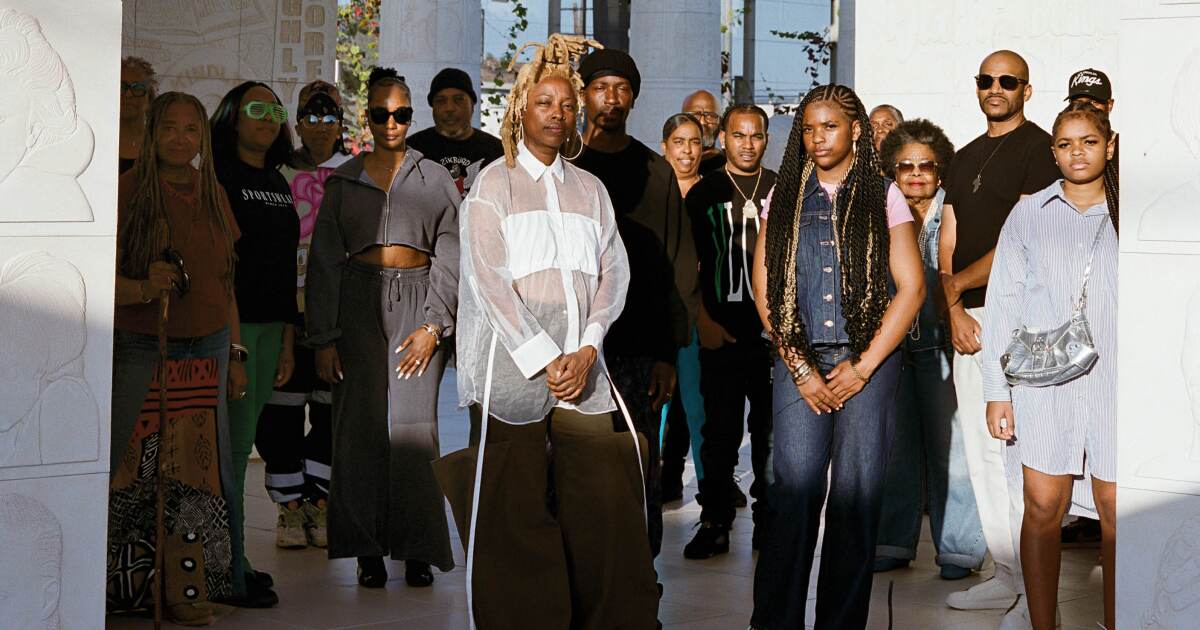
This story is part of Image’s April’s Thresholds issue, a tour of L.A. architecture as it’s actually experienced.

I lived part of my teen years in Brasília, the capital built from scratch whose architecture and urban planning have drawn equal parts fascination and disdain. Over the years I’ve grown accustomed to comments about how “wild” the spaceship-like buildings designed by Oscar Niemeyer must have looked, how “alienating” the car-centric city must have been. But when I first heard these kinds of comments, I was admittedly surprised, because my memories of living in the city were much more mundane — eating hot dogs on the dusty sidewalks, hanging with friends at the base of our apartment building, movie-hopping at the mall. In other words, I was just living my life.
Now that I live in L.A., I sometimes hear echoes of what I used to hear about Brasília. They are both places with a mythic allure that nonetheless draw the same kinds of criticisms. How do you live in such a sprawling city where you have to drive everywhere? Isn’t it isolating? But as with Brasília, I’ve found that the way L.A. is perceived is much different than how it is lived.
Our April issue is about the lived experience of the city and its architecture. A postmodernist house in Baldwin Hills becomes a place for a family to dream. A billboard on the drive home becomes a personal landmark. A therapist’s room becomes a container for everything. A museum is held up as much by its walls as the people who work within them. We are part of our built environments, and nothing encompasses this more than our cover story on Lauren Halsey and her much-anticipated sculpture park, “sister dreamer lauren halsey’s architectural ode to tha surge n splurge of south central los angeles,” which is literally etched with the faces and stories of people from South-Central, where the artist grew up and still lives. On the cover photo, the artist stands in the back, in the shadows, allowing the people who shaped her project to take center stage.
Architects, I’m told, are obsessed with the idea of thresholds — corners, crossings, the in-between. This makes sense to me when I look at this cover, the group standing between four walls that don’t quite meet, the sky above and around them, inside and outside at the same time. It is a moving illustration of how a space can hold and contain — feel safe — while also holding an open sense of possibility.

Elisa Wouk Almino Editor in chief
Jess Aquino de Jesus Design Director
Julissa James, Staff Writer
Claire Salinda Staff Writer
Keyla Marquez Fashion Director at Large
Elizabeth Burr Art Director
Jamie Sholberg Art Director, Web
Samantha Lee Editorial Intern
Jennelle Fong Contributing Photographer
Tyler Matthew Oyer Contributing Photographer
Mere Studios Contributing Producer
Cecilia Alvarez Blackwell Contributing Producer
Dave Schilling Contributing Writer
Harmony Holiday Contributing Writer
Goth Shakira Contributing Writer
Cover
Photography Shaniqwa Jarvis
Featuring Cheryl Ward, Margaret Prescod, Autumn Luckey, Lauren Halsey, Monique Hatter, Andre “Sketch” Hampton, Monique McWilliams, Kenneth Blackmon, Robin Daniels, Michael Towler, Emmanuel Carter, Dyani Luckey, Dominique Moody, Rosie Lee Hooks, Damien Goodmon, Londyn Garrison and Christopher Blunt.


A federal jury found that Live Nation and Ticketmaster, which merged in 2010, have been stifling competition and overcharging consumers when it comes to live events.
Paul Sakuma/AP
hide caption
toggle caption
Paul Sakuma/AP
A federal jury in Manhattan found that Ticketmaster and its parent company, Live Nation, have been acting as a monopoly, stifling competition and overcharging consumers.
But that doesn’t mean your next concert ticket will automatically be a better deal.
Wednesday’s verdict is a legal win for the 33 states and Washington, D.C., that accused the company of wielding its immense power over too many aspects of the live entertainment industry, from concert promotion and artist management to venue operations and ticketing services.

And it’s vindication for the many disgruntled artists, venues and fans who say they have been paying the price. The verdict has the potential to reshape the live music industry in the U.S. But the fight isn’t over.
States’ attorneys general now have to argue in favor of specific “remedies and financial penalties” — as many of them put it in celebratory press releases — at a separate trial. The lead lawyer for the plaintiffs, Jeffrey Kessler, declined to comment to NPR because that trial has not been scheduled.
One remedy that many ticketing advocates and Democratic lawmakers want is for the government to force the breakup of Live Nation and Ticketmaster — which merged in 2010 — separating the concert promoter from the ticket seller.
Meanwhile, Live Nation said in a statement that “the jury’s verdict is not the last word on this matter.” It has not responded to NPR’s request for comment.
The company said several motions are still pending in front of the court, including one to strike some expert testimony from the trial.

“Of course, Live Nation can and will appeal any unfavorable rulings on these motions,” it added.
Rebecca Haw Allensworth, a visiting professor at Harvard Law School who specializes in antitrust law, said a verdict from a jury is generally harder to fight successfully than one from a judge. In any case, she said, whatever remedy the court orders would likely be paused while an appeal plays out.
“So it’s not like next month … certainly not in 2026, will Live Nation be severed from Ticketmaster,” she said.
What about the long-term?
Thales Teixeira, a professor at UC San Diego’s Rady School of Management, says this next phase is “a little bit complicated because there’s so many parties involved … that might want different things out of a potential settlement or a trial.”
Beyond major restructuring, Live Nation could be forced to take steps like end exclusive contracts, cap service fees and open booking at its venues to competing platforms like SeatGeek and AXS.

The company is also likely to face financial penalties, which could include payouts to some consumers: The jury found that Live Nation overcharged customers by $1.72 per ticket in 22 states. Live Nation said that applies to only a fraction of tickets sold, and estimated total damages below $150 million (which it says the court would triple, per legal standards).
But that money most likely won’t go directly to consumers, Allensworth says, unlike in a class-action lawsuit (which the company also faces). She says any judgment amount would go back to the participating states, which can use it as they see fit — most likely for some sort of consumer-related issue, not back into ticket-buyers’ pockets.
“Really, here, the win for the consumers is the future and the restoration of competition, if that happens, which is why I think it’s so important for the remedy to go beyond this dollar amount,” she says.

A young fan tries her luck outside Taylor Swift’s concert in London in August 2024. A chaotic Eras Tour presale in 2022 crashed Ticketmaster, canceled the general fueled calls for the platform to be held accountable.
Alishia Abodunde/Getty Images Europe
hide caption
toggle caption
Alishia Abodunde/Getty Images Europe
Teixeira says consumers in the U.S. have gotten used to the high cost of concert tickets, not to mention food, parking and other expenses. If anything, he says some of fans’ anger may have been alleviated by Ticketmaster’s implementation (to comply with federal regulations) of all-in pricing in 2025, labeling fees upfront rather than revealing them at checkout.
And he doesn’t think the outcome of this case will lower ticket prices in the long term. For one, he says Live Nation can make up any lost fees in other ways, like upping the cost of a parking spot at one of the many venues it controls.
“My view is that even in the best-case scenario, if the states that have gone forward with the trial win most of their claims, I’d say very little will change for the average concertgoer,” he said.
What about the settlement?
While many states’ attorneys general have uniformly referred to their effort as a “coalition,” Teixeira says it’s possible that some could leave the process early, depending on which of their demands are met.
A version of that has happened in this case already: About half a dozen states joined a tentative $280 settlement between President Trump’s Justice Department and Live Nation last month, just days into the trial.
As part of the settlement, the company agreed to do things like cap service fees at 15% and divest exclusive booking agreements with about a dozen amphitheaters, which ticketing organizations and Democratic lawmakers say does not go nearly far enough. That settlement must undergo a 60-day public comment period and get federal court approval before it can be finalized.

Just this week, several of the most vocal Democrats on this topic — including Sens. Amy Klobuchar of Minnesota, Elizabeth Warren of Massachusetts and Richard Blumenthal of Connecticut — submitted a letter urging the judge in the case to “closely scrutinize this settlement,” which they called insufficient.
Live Nation said in its Wednesday statement that it is confident “that the ultimate outcome of the States’ case will not be materially different than what is envisioned by the DOJ settlement.”
Allensworth says that Live Nation can point to the settlement to show the judge that it is already taking steps to restore competition, in hopes of less intrusive remedies. But she expects states to have the same response as the Democratic lawmakers: “It’s a slap on the wrist and, your Honor, you need to impose something more meaningful here.”
Even if the company is forced to split up, she says, it’s not clear how long it would take for the live events landscape — which Live Nation and Ticketmaster have dominated for so long — to feel the effects. But she says the pressure of competition would undoubtedly improve the experience for venues, artists and fans alike.
“It’s one of the wonderful, and I think frustrating, things about organizing our whole economy through competition, is that we don’t know what new ideas will come forward,” Allensworth says. “We don’t know how they will affect consumers. But we do know that the best way to provide long-term consumer welfare is to have a place for new ideas to come to life.”

Tornadoes touch down in Rochester area

13 Actors You Should Never Miss on the New York Stage

Detroit Tigers call up prospect Hao-Yu Lee, place Zach McKinstry on IL

Maria Isabel Is a Masterclass in Mariscos and Moles

The Dallas Stars’ Secret Weapon Is a Canadian Hockey Genius

Florida High School Football Rankings: Top 25 teams – Oct. 21

How old is Bo Nix? What to know about Oregon quarterback ahead of 2024 NFL Draft

Cleary's 21 help Le Moyne down Central Connecticut State 69-64 in OT

99th annual Pony Swim held in Virginia

Indiana Members Credit Union announced as new anchor tenant at Bottleworks District
Tornadoes touch down in Rochester area

Minnesota Republicans reveal which far-left candidate they want to challenge in open Senate race

Swedish rights groups slam ‘honest living’ criteria for migrants

Orbán’s defeat is a win for democracy and a warning to Trump, some say

Firefighters Likely Had Limited View of Approaching Plane in LaGuardia Crash
-

 Ohio3 days ago
‘Little Rascals’ star Bug Hall arrested in Ohio
-

 Arkansas1 week ago
Arkansas TV meteorologist Melinda Mayo retires after nearly four decades on air
-

 Austin, TX1 week ago
ABC Kite Fest Returns to Austin for Annual Celebration – Austin Today
-

 Politics3 days ago
Dem fundraising giant in the hot seat as GOP lawmakers demand answers over dodged subpoena
-

 Politics6 days ago
Trump blasts Spanberger ahead of Virginia meetings, says state faces tax base exodus like New York, California
-
 Science3 days ago
‘Dr. Pimple Popper’ Sandra Lee had a stroke last fall. Here’s how the TV doc is bouncing back
-

 Health1 week ago
Woman discovers missing nose ring traveled to her lungs, causing month-long cough
-

 San Francisco, CA5 days ago
President Trump terminates Presidio Trust