Lifestyle
They cut their water bill by 90% and still have a 'showstopping' L.A. garden


Water-hungry lawns are symbols of Los Angeles’ past. In this series, we spotlight yards with alternative, low-water landscaping built for the future.
Looking out the front windows of their northeast L.A. home, Kyle Anido and Katie Cordeal say their front yard is barely recognizable from a year ago when it was a lawn.
“It’s crazy to see how lively the garden is now,” says Anido, a 37-year-old camera operator. “There is so much bee activity.”
A bee is drawn to the Bird’s-Eye Gilia in Katie Cordeal and Kyle Anido’s front yard.
“It has absolutely exploded,” adds Cordeal, 38. “It’s pretty incredible what has happened over the past 12 months. And we haven’t even watered the yard this year.”
The colorful ecosystem, which thrives without sprinklers, amendments, fertilizers, gardeners and gas-powered lawn equipment, is not lost on the couple’s 2½-year-old son, Owen.
“Bees!” he yelled with delight from the front porch, pointing to the pollinators feeding on the native California flowers in his front yard.
“Owen loves bugs,” Anido says of the boy’s vibrant playground.
When the couple purchased their first home in 2021, the front yard was an uninspired swath of Bermuda grass, an oddly placed palm that real estate agents hastily planted for staging purposes and white gravel.
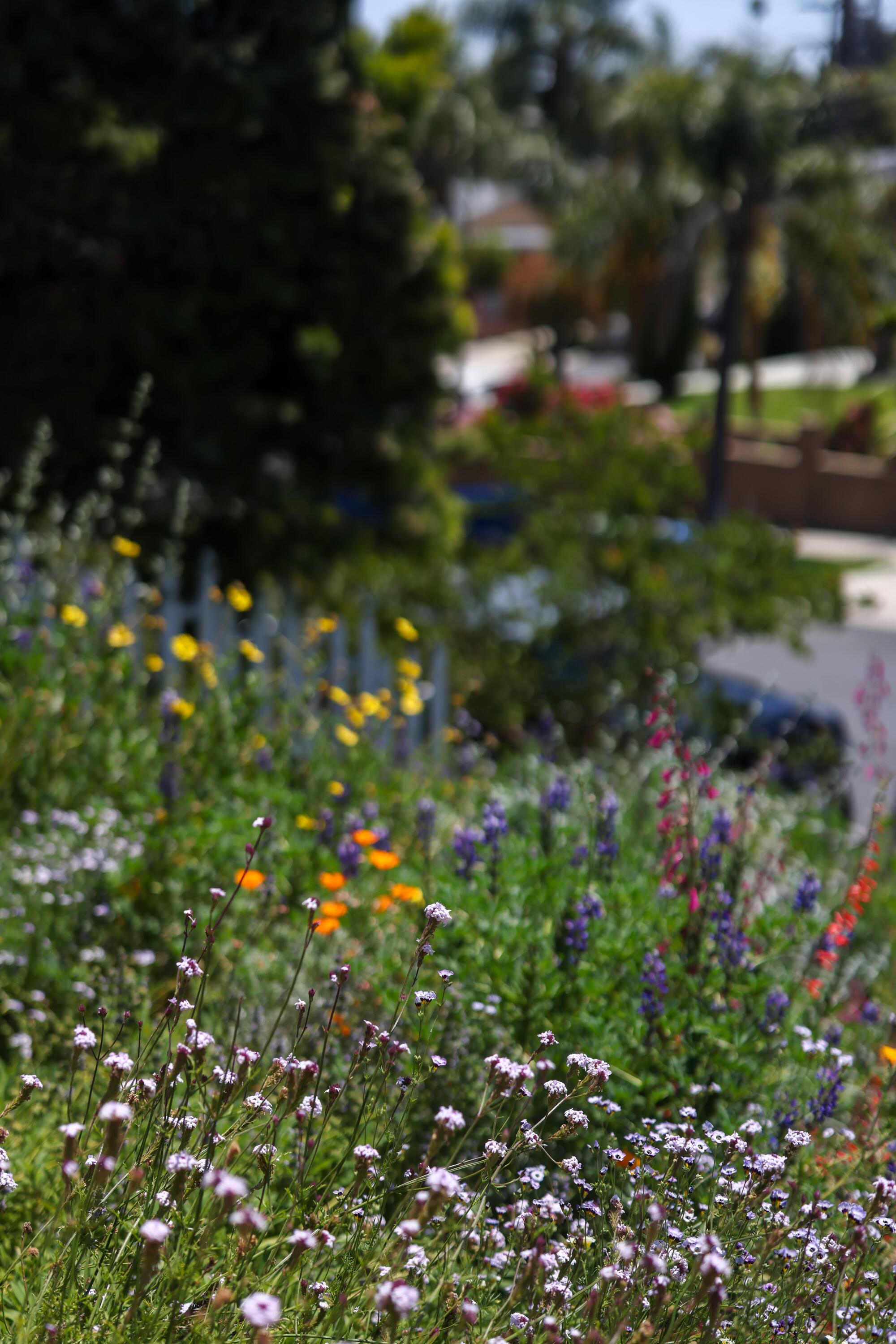
Homeowners Katie Cordeal and Kyle Anido wanted a colorful, drought-tolerant landscape.
(Dania Maxwell/Los Angeles Times)
After renting an apartment in Brooklyn, the couple felt intimidated by the prospect of caring for a home and yard and decided to keep the previous owners’ gardener. They did this, they say, because it was easy, but the noise and environmental pollution from the weekly “mow and blow” proved difficult for Cordeal, who works from home as a film and television production accountant.
“We would have to close all the doors and windows because the gas-powered leaf blower was so loud,” she says. “I hated the gas smell.”
Interested in conservation and drought-tolerant plants, the couple contacted garden designer Sophie Pennes of Urban Farms L.A. after viewing her before-and-after turf transformations — and lawn rants — on TikTok.
“I identified with what seems to be Sophie’s primary drivers — to support biodiversity, revitalize natural ecosystems, and conserve water,” Cordeal says. “Also, I could tell she is educated and passionate about what she does, and I enjoyed her dry humor.”
While this year’s record-setting rainfall may feel like an excuse to reconsider the argument for removing thirsty turf, that’s ludicrous, says Pennes, who specializes in edible gardens and California native gardens.
“Tearing out your lawn is about so much more than saving water,” the landscape designer says. “You don’t need to be a scientist to see the negative impact of lawns on the native habitat in any given city or ecology. It’s obvious when you’re walking through a neighborhood, and you stand in front of a grass lawn, and then you stand in front of a native garden: you can see the wildlife. We need to engage in the places where we live.”
Before and after photos courtesy of Katie Cordeal.

Mexican marigolds repel pests and attract birds.
After agreeing on a plant palette that included lots of color, wistfulness, texture and tall grasses, the couple hired a landscape contractor to remove their lawn by hand. They then sheet mulched the front yard — smothering it in wet cardboard — and waited for three months.
When it was time to plant, Pennes installed repeat groupings of three, including ceanothus, Canyon Prince Wild Rye and penstemon. “I wanted to have a bold effect when things were in bloom,” she says of the homeowners’ request for a colorful landscape. “I didn’t want it to be casual; I wanted it to be showstopping.”
A year later, the front yard is what they had hoped for. From the street, the 1937 residence appears modest, a two-bedroom house with two large picture windows. But the garden is indeed a showstopper. “It is such a magical walk to the front door,” Cordeal says of the lupine, poppies, penstemon and sage blooming on either side of the stairs up to the house.
Pennes designed the garden so that something is always in bloom regardless of the season. The purple Showy Penstemon is starting to fade, for instance, but the clarkia flowers are ready to open. On the parking strip, Hollyleaf Cherry and hardy Canyon Prince Wild Rye counter the pink clarkias and California bluebells. “Canyon Prince Wild rye has such a beautiful gray-green color that pops against the backdrop of the gray house,” Pennes notes.
Non-native plants include African Basil, “which the bees love,” Cordeal says, as well as Meyer lemon and Hass avocado trees, which the couple feed with water from their bathtub through a graywater system installed by Greywater Corp. Pennes also planted Mexican marigold to help repel pests and attract wildlife. “The finches love it,” Pennes says. “As soon as you put the plants in, the butterflies and birds find them. It really is an ‘if you build it, they will come,’” she laughs.
The couple estimates they paid around $14,900 for the transformation, including the design, labor, plants, trees and mulch. After removing 1,150-square-feet of lawn in the front yard and the parking strip, their $5,750 turf replacement rebate from the Department of Water and Power brought the total down to $9,150. Over the past year, the couple also saw their water bill decrease by 90%. “Our June/July 2022 water bill was $210.99,” says Cordeal. Their bill for June/July 2023 water was $24.28, including the extra water used to establish the 1-gallon plants.
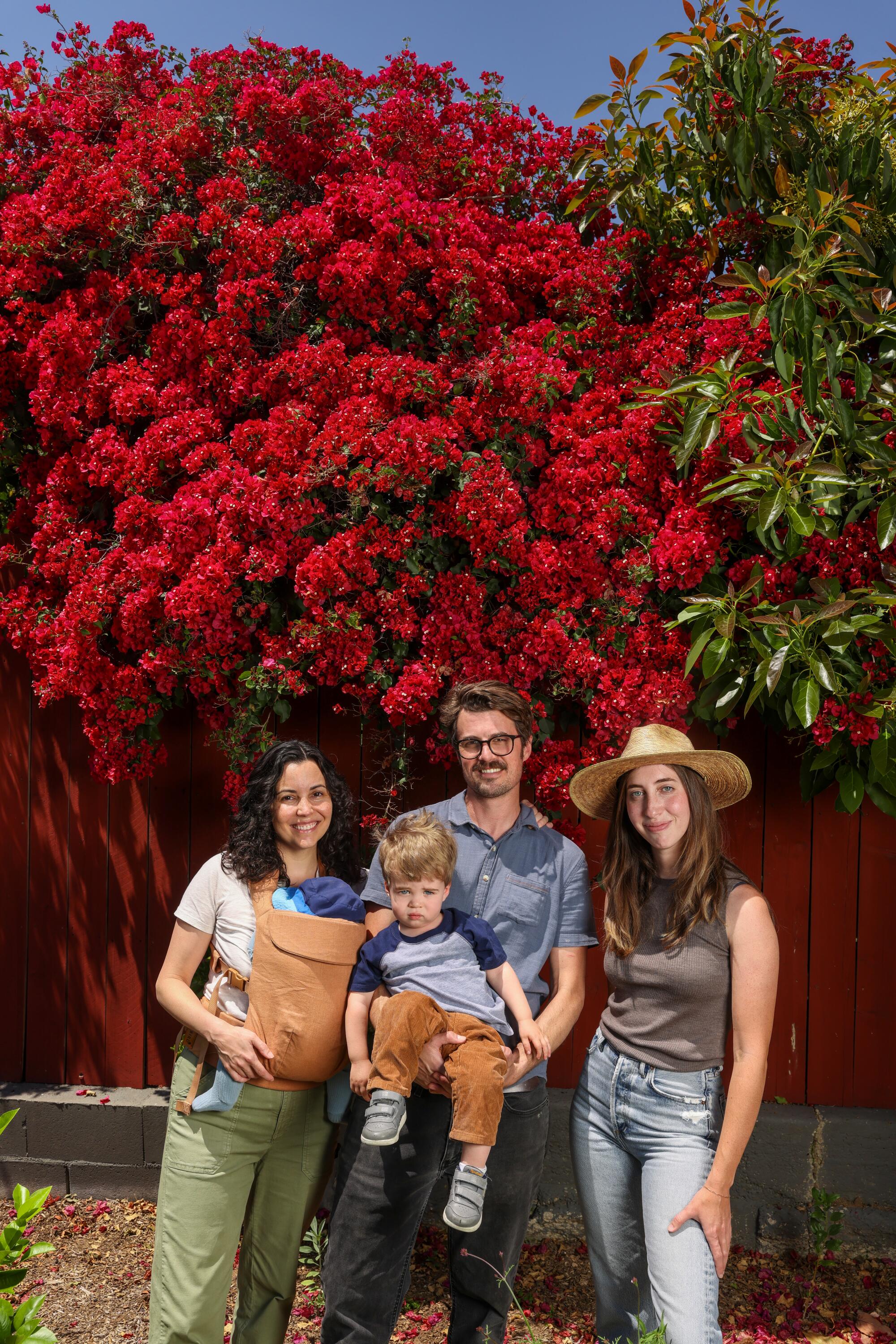
Homeowners Katie Cordeal and Kyle Anido with their newborn Felix, toddler Owen and Sophie Pennes of Urban Farms L.A., right, who helped landscape the yard.
But they are not stopping there. They are in preliminary talks with Pennes to overhaul their excessively hot backyard.
“We want to remove most of the concrete,” says Cordeal. “We want a veggie garden and another fruit tree that can use graywater. We want a lot more foliage in general to cool the backyard. We also need to figure out lots of play space for our two boys, but we’re not sure what ground cover that will be.”
You can be sure it won’t be artificial turf.
“My biggest enemy is plastic turf,” Pennes says. “Even if I get the opportunity to tear it out, it ends up being plastic garbage in a landfill.”
Cordeal says the beauty of the garden is more than just visual.
“Our front yard is an environmentally friendly site,” she says. “It’s so nice to look outside and see all the color and wildlife. I have a chair right by our front window, and when I’m nursing my 3-month-old, I can stare outside instead of at my phone. It’s a joy.”


Paul Tremblay has made a career of pushing the horror genre – and the novel format – in strange and exciting new directions.
In his latest, Dead but Dreaming of Electric Sheep, the author offers an amalgamation of genre elements that can be best described as psychological-dystopian-science-fiction horror. It’s a mouthful, but the narrative does all of that and more in a way that defies categorization.
Julia Flang is a former semiprofessional gamer working two mediocre jobs she dislikes and living in a modest ranch house in a San Fernando Valley suburb with her retired uncle, whom she calls Uncle Fun. Julia likes movies and gaming but there’s little else going on in her life, so when her estranged mother, the CFO of a large tech company, contacts her with a possible job offer – a “once-in-a-lifetime thing” that pays handsomely just for doing the interview – she hesitantly agrees.

The job is relatively simple and perfect for someone with gaming skills: using a controller built into a phone to get a man, who is stuck in a vegetative state, from California to the East Coast. It will require her to learn how to control his body – walking, moving, sitting, standing, using his arms – so she can maneuver him out of the facility where he is located and into cars and planes and through crowded airports. A fan of movies, Julia decides to call the man Bernie – after the movie Weekend at Bernie’s. When the ethics of the job start to bother her, Julia realizes it’s too late and she must go through with it. However, she’s soon contacted by people interested in sabotaging the whole thing, people who, like her, don’t align with the shady interests of conglomerates and those set to make “gobs of money” from this new, somewhat inhuman technology.

As with every Tremblay novel, any synopsis barely scratches the surface. The novel’s chapters alternate between Julia and you (yes, you). Julia’s chapters are “normal” in the sense that they obey a chronological order and have action, basic descriptions of movement and places, and dialogue. The chapters in second person are like fever dreams from a shadow world; the desperate experiences of a man trapped inside his own body with no control of it, no clue what’s happening to him, and only a few fragmented memories of his life. Also, Tremblay uses a similarly fragmented style of storytelling (including words and sentences trapped in boxes and/or “moving” on the page) to keep things interesting but also confusing and creepy.
This novel operates on several different levels and – planes of existence? Bernie has a head full of AI that controls his body, but his consciousness is still there and struggling to regain control, struggling to remember things. There are monsters, leeches, mysterious rabbits, and eerie shadows in his world, but the true horror comes from the lack of control, from being moved around against his will and having no clue what comes next. Bernie is the embodiment of losing control to AI, and when taken together with the commentary of creativity and AI and the meta interludes in which the author takes a wrecking ball to the fourth wall and addresses readers, this is the best anti-Generative AI story horror has produced so far.
Despite the horror of it, this is a very funny novel. Julia is sarcastic and struggles to keep her comebacks in line, but the conversations she has and messages she writes are always entertaining. However, the humor is far from the crown jewel here. That title belongs to a plethora of big ideas Tremblay juggles. The nature of life, death, and consciousness, the evils of conglomerates, inhuman practices in the name of capitalism, and AI, and even what it means to be human are all explored here: “Is Bernie alive? Is he feeling pain? Is he experiencing everything as a prisoner looking through the bars of his body? Has his consciousness been winnowed to a metaphysical keyhole? Where does consciousness begin or end?” There are no definite answers here, but the way Tremblay infuses humanity, love, the importance of relationships, and humor throughout the narrative provides the kind of answers that can’t and don’t need to be spelled out.
A genre-bender full of big ideas that constantly switches between a world full of real or uncomfortably plausible nightmares and a bizarre hellscape in which loss of self, memory, and autonomy are only the tip of the proverbial iceberg, Dead but Dreaming of Electric Sheep is a horrific and terrifyingly disorienting novel that invites readers to consider a future that already started. Tremblay has always been an innovator, but this beautifully written collection of real and imagined grotesqueries cements him not only as one of the most original and exciting voices in horror but also as one of the smartest, most engaging authors in contemporary fiction.
Gabino Iglesias is an author, book reviewer and professor living in Austin, Texas. Find him on X, formerly Twitter, at @Gabino_Iglesias.


Give a girl a bow and arrow, take her to the woods, and anything feels possible.
That’s what I was thinking as I positioned myself in front of bales of hay in an open field at the Woodley Park Archery Range in Van Nuys. Channeling my inner Katniss, I took a “power stance:” shoulders back, legs slightly bent, bow cradled in my upper body. I slid a small but fierce-looking arrow bearing orange feathers onto the bow “nock,” filled my lungs with air, then heaved the tense bowstrings back to my jaw, one eye closed and the other narrowed in concentration.
Then I did what often feels impossible for me: I let go.
-
Share via
The arrow hurdled forward, unleashing an audible woosh followed by a distant thwack. I missed my target entirely, stabbing the hunk of hay more than a foot away from the bull’s-eye. But the feeling of release as the bowstrings were left vibrating in my arms was palpable, intensely satisfying.
This was Mindful Archery.

Angie Fadel, founder of Soulcare, leads Mindful Archery.
(Eric Thayer / Los Angeles Times)
The seemingly militaristic act of archery and peaceful meditation may seem diametrically opposed. But at Angie Fadel Soulcare, they make perfect sense together. Fadel leads workshops in Mindful Archery that combine meditation, somatic practices such as breathwork, immersive nature therapy and archery instruction.
The idea, Fadel says, is for participants to gather in a healing nature setting while becoming mindful of something they want to either let go of (an unfulfilling job or toxic relationship, for example) or something they’re aiming for and want to bring into their lives. Fadel leads a short guided meditation at the start of the workshop for participants to relax and get grounded, followed by a nature walk so they can further sink into the moment and become clear on what, exactly, their targets will be for the day — what they’ll be shooting for, or at. Then participants draw their individual targets on paper with colored markers that Fadel provides.

Attendees hold up their targets during a Mindful Archery class.
(Eric Thayer / Los Angeles Times)
One target might look like an abstract drawing representing a feeling, another might be a jumble of words and symbols such as “Love,” “$” and “Health.” Or an illustration of Donald Trump, as one past archer aimed for.
“I’ve seen everything,” Fadel says. “People have put their parents, their exes, people have put rapists — the most damaging things that have happened to them — on a target because if you can hit that thing, it feels better in your body. The same thing happens when you hit something good, it’s a hopeful mechanism in the body.”
Fadel’s archery instruction is as much about how the sport feels in the body as it is about technical precision. The slow and steady, intentional steps of deep breathing, taking aim and shooting at a carefully considered target is a powerful act, she says.
“Even if the arrow doesn’t go where you want, there’s this immediate thing that happens in your body that feels good,” Fadel says. “When you let go of that string, there’s an energy, there’s a movement — actual, physical energy moves. Something magical happens. It helps the things that are stuck in the body get unstuck. It’s somatic. Then it’s an extra bonus if you do hit your target, because the slap of the paper feels even better.”

Angie Fadel readies bows.
(Eric Thayer / Los Angeles Times)
Fadel, who lives in Portland, Ore., and calls herself “a soul-collaborator,” has a masters in spiritual companionship and spent a decade working as a pastor in a Portland church helping members find untraditional spiritual paths. She’s also been an archer for more than 15 years. She came to both practices — spiritual companionship and archery — separately before they organically entwined. Midway through pursuing her master’s in 2011 she discovered a friend was a master archer. She’d always wanted to learn archery, since she was a kid growing up in rural Washington, and she persuaded him to give her a lesson.
“It was just one lesson, but it changed my life,” Fadel says. “I was doing something that I’d always dreamed of doing. It unlocked something I didn’t realize could be unlocked.”

Targets pinned to a hay bale allow participants to take aim at what they want to bring into their lives.
(Eric Thayer / Los Angeles Times)
Fadel found archery increasingly therapeutic. She was doing a lot of introspective Jungian journaling at the time. As life challenges came up in her journaling — the stress of school or a difficult roommate, “or just society as a whole,” she says — she’d put them on targets in the form of words. Shooting at them helped her process the conflict. She thought the beneficial side effects of archery were particular to her, however. Then she took a struggling friend out for her first archery lesson and the response was profound.
“I realized, you know what? This works. I can take you from never touching a bow to your leaving with your nervous system relaxed. I thought: I have to figure out how to give this to other people.”
Now with Soulcare, Fadel conducts multiple types of archery workshops in Portland and around the country, including in Colorado, Texas and throughout California. She comes to Los Angeles to lead workshops several times a year. One workshop is a Mindful Archery class, not to be confused with her other course Meditative Archery, which involves Jungian journaling; and there’s a one-on-one archery session with spiritual guidance.
Empowering women and minorities, Fadel says, is a key part of her archery workshops.
“An archery range can be a very white, male-dominated space,” she says. “And the stance, with a bow and arrow in your hand, shooting — it’s very male. And [men] don’t have any problem, most of the time, taking up space. So it is a practice to remind ourselves, as a queer woman, a trans person, nonbinary person, anybody that’s kind of othered in our society, to be able to take up space. To adopt a power stance and be, like, I’m allowed to be here.”
Inside the Mindful Archery workshop
Our workshop began with gentle stretching in an open field. It was a cool, overcast day and as the wind rustled the tree leaves, a baby coyote raced across the lawn in the distance. During introductions, attendees shared why they were here.

Archery is about “letting go” and here, a student lets her arrow fly.
(Eric Thayer / Los Angeles Times)
“I’m actually a very anxious person,” said Rachel Clipper, 26, “so I’m always looking for something to help me feel more grounded and promote mind-body connection.”
Kati Lee, 29, said that as a “‘Hunger Games’ girlie,” she’d always thought archery was cool. “But what drew me to keep coming back was the mindful part of it,” she said. “My favorite part is that we make our own targets.”
During the nature walk, we ambled down a tangle of dirt trails as Fadel pointed out wild rose bushes, Aspen trees and elderberry, giving a recipe for syrup. When we came to a body of water in a clearing — the Woodley Park Wetlands — we watched as a majestic-looking cormorant stretched its wings in the distance.
“Think about what would feel good to either annihilate,” Fadel said as we returned to the range. “Or bring in, or let go of, or make peace with. You can put all of it on your target.”
And so we did. We hunkered down at a picnic table by the archery range for crafting and snacks that Fadel provided, every one of us falling into silent sketching and scribbling as we munched on peanuts and granola bars. It felt like summer camp.
Lee set her markers down. “Done,” she said, contemplating her target. It was adorned with words such as “Health,” “Love,” “Family” and “Friends” inside concentric hearts.
Yvonne Golomb, 70, said she’d done archery as a high school student in gym class. She was shy back then, but archery had made her feel bold. Now that she’s retired, she’s craving that feeling again and is returning to the sport for sustenance.
“It’s this nice memory, it made me feel strong, it was freeing,” she said. “Now that I’m retired I’m exploring it. I wanted to bring back those memories.”
When it was time for our archery lesson, Fadel conducted one last somatic exercise to loosen us up. She had us tap up and down our body parts, from our feet to our ears, before shaking out any remaining stress.
Then she coached us, individually, as we took aim at our targets in sets of three.
“Breathe, zero in on your target, OK, now smooth …,” she said, hovering over one attendee.
May Claire La Plante, 31, said she was doing archery today, in an “adaptive stance” Fadel had taught her, to build up her arm strength after a surgery.

Kati Lee, right, and Tristan Gonzales affix their targets during a Mindful Archery class.
(Eric Thayer / Los Angeles Times)
“I was feeling very frustrated that I couldn’t get it at the beginning,” La Plante said. “I didn’t even finish my arrows. But getting back up and the act of trying again — despite the injury and all the baggage that comes with it — is really empowering.”
“Bull’s-eye!” Clipper cheered nearby, her anxiety seemingly dissipated. She’d hit her target, dead center. What was on it? A labyrinth-like spiral of words with “Peace,” “Love” and “Creative Control” at the epicenter.
I wasn’t having as much luck and was missing my target repeatedly.
“Try loosening your grip,” Fadel coached. She adjusted my stance. “Now breathe.”
It seemed counterintuitive to slacken my grip given such a precise goal — to land a slender arrow in the epicenter of a black dot. But I did, letting the edge of the bow sit loosely, even wobbly, between my fingers. I took aim and shot. This time the arrow flew strong and straight.

One participant hit the bull’s-eye, which calls for “peace” and “love,” dead center.
(Eric Thayer / Los Angeles Times)
Another round later and it landed smack on the paper target, just above my bull’s-eye.
“See?” Fadel said, elated. “Archery isn’t about doing it right, it’s about repetition. The more you can be in your body, and relaxed with the repetition, the better you are. Rarely do I have someone not hit their target at least one time.”
She squinted at my target, then turned to me.
“It’s because they’re relaxed and it’s because they trust me,” she added. “And they learn to trust themselves more.”

-

 Miami, FL5 minutes ago
Reports: Heat add potent bench scorer in Tim Hardaway Jr.
-

 Boston, MA8 minutes ago
Boston Pops gearing up for major July 4th celebration: ‘You only turn 250 once’ – Boston News, Weather, Sports | WHDH 7News
-

 Denver, CO13 minutes ago
Colorado wildfires destroy more than 100 structures, force more evacuations
-

 Seattle, WA20 minutes ago
Will Katie Wilson’s endorsements help or hurt Seattle’s position in Olympia?
-
 San Diego, CA23 minutes ago
Marine missing after training activity off San Diego is declared dead
-

 Milwaukee, WI28 minutes ago
Career minor-leaguer Garrett Stallings gets his shot with the Brewers
-

 Atlanta, GA35 minutes ago
FIFA Fan Festival Atlanta bracing for huge crowds, high heat
-

 Minneapolis, MN38 minutes ago
North Minneapolis Heritage Park tenants swelter as $500K grant sits locked for furnaces

