Lifestyle
There’s a jazz renaissance happening in Los Angeles. Why now?


From top to bottom: Bobby Hutcherson, Dexter Gordon, Esperanza Spalding, Abbey Lincoln, Herbie Hancock and Charles Mingus.
(Getty Images)

Backstage at the Blue Note L.A., Herbie Hancock and Wayne Shorter’s widow, Carolina, have come, along with me and a friend, to see Esperanza Spalding between sets one late summer Sunday. The club is new and the dressing room feels more humane than most, like a hotel banquet room. Esperanza makes an altar on the vanity and prepares the space for chanting, a prayer meeting but more unapologetic, ritualistic and communal. We make an impromptu jazz orchestra in clipped Sanskrit, and my mind wanders to the first time I heard this Lotus Sutra, when Tina Turner performed it on CNN’s “Larry King Live,” explaining that it’s how she got into her transcendent mode when she still lived with Ike in Inglewood — her means of escaping him in spirit before she ran away physically. When she finally left, she hid from Ike at Wayne Shorter’s home. With my mind on Turner, I do transcend; I feel so emboldened I could leave anything behind in peace after the session. On the way to the car, we pass Turner’s star on the Walk of Fame. Think it not strange; one perfect improvisation leads to another, jazz music is a way of life, collective improvisation is — one note calls to another, one star lights another. One runner in need of sanctuary clears another’s path, and every jazz club is half house of worship and rebellion that way.
There’s an ongoing jazz renaissance in Los Angeles, one loosely rooted in the genre’s prematurely and cyclically proclaimed death — the same way the city’s celebrities tend to become franchises in the afterlife, worth more dead than alive. Jazz haunts with debts owed to its creators, and has a knack for revivals, collectives, new venues in the old forms, and stalwart clubs revivified by benefactors and grant funding. The West Coast Blue Note to complement the one in New York’s West Village opened on Sunset Boulevard last August, enticing tourists and supper club enthusiasts. Leimert Park’s World Stage just received substantial Mellon funding. There are musicology programs, like the one at UCLA helmed by Herbie Hancock, and local hip-hop producers like Madlib (nephew of a jazz trumpeter) and the Alchemist who have been sampling and looping jazz records until they’re part of a canon beyond themselves.
Why there is renewed interest in the genre now is the question. What about the ecosystem or nervous system of Los Angeles is baiting jazz music out from its malleable shadow into a renewed prominence and even granting it rank in the clout economy? I think it has to do with the genre’s ability to orient and organize social life through collective improvisation, the fact that hip-hop, now in its 50s, is aging out of the night club and needs to highlight its proximity to jazz to reinvent aspects of its image as more subdued and inviting, less reminiscent of Diddy parties and more chanting wholesomely with elders backstage. Ultimately, the desire for a new jazz age is a wish for a new national identity as glamorous and unassailable as old Hollywood. Jazz is diplomatic yet just elitist and gatekept enough to feel like it belongs to the state and the people alike, it’s democratic with hints of classist rhetoric in some of its spheres and jazz is Black music, but that has never stopped borderline-racists from appropriating and loving it.
Jazz lore is concentrated in New York, Chicago and New Orleans, however, and even finds Paris, Antibes, Milan and Tokyo before it settles into the elements of its reputation that include L.A.-born, -raised or -influenced players and scenes. As is common for Los Angeles, the sense of exile and wasteland here makes it an overlooked frontier, a place where new worlds incubate undetected and experts are mistaken for philistines in the glare of year-round sunshine and casualness conflated with lack of rigor. L.A. and its music scenes tend to be fervently, rigorously casual — daylight blinds the spotlight as the preferred illumination for concerts and parties. And we would be right to laugh or clap back more often, retaliating against those towns that take themselves too seriously. If we had a public transportation system that didn’t induce depression, alienation and self-loathing and meaningfully breached the seemingly willful segregation covenants between neighborhoods and zones here, you could take a jazz tour of L.A. that would be heartbreaking in its range. As it is, the durability and versatility of a Los Angeles jazz consciousness depends as much on real estate as on fans and musicians; it’s as territorial and precarious as the land, which burns, trembles or courts dysfunction on a whim indiscriminate of season and somehow remains photogenic and certain of its appeal. There are awards season, fire season and season of the witch, and beneath the intersection of Kendrick and Flying Lotus, of laid-back rap and half-hippie psychedelia, jazz is each season’s encrypted soundtrack, it scores our city.

A roll call of local jazz heroes raised here: There are Charles Mingus and Eric Dolphy in Watts, coming of age together. There’s Dexter Gordon, son of a Black doctor who treated Duke Ellington whenever he was in L.A. One Christmas, Ellington and Dexter’s dad had plans to meet at the Dunbar Hotel on Central Avenue, then the city’s primary jazz mecca, a West Coast version of Manhattan’s 52nd Street, lined with venues and shops carrying an attitude that matched the textures of the music. Dr. Gordon didn’t show; he died that night of a heart attack. Dexter went from sheltered son of a doctor to brooding child hipster who left home early to tour with big bands. There is the It Club, owned by a Black gangster and visited by everyone from Miles to Coltrane to Monk, who recorded an album there. There’s Hampton Hawes, born in L.A. the same year as Dolphy, imprisoned for heroin possession after serving in Japan and eventually pardoned by Kennedy. His style on the piano carries the relaxed tension of a man for whom syncretism comes naturally, East and West, sun and sorrow. Then, there’s Abbey Lincoln, escaping to Los Angeles to pursue theater and film alongside music. There’s Dial Records, founded by Glendale-born Ross Russell, which recorded Charlie Parker and Django Reinhardt. There’s vibraphonist Bobby Hutcherson, trumpeter Don Cherry, and Ornette Coleman, who came through L.A. and worked as an elevator operator while developing bands with locals like Bobby Bradford. I interviewed Bradford a couple months back and he emphasized how modest their band-building had been. Conversations during day jobs at department stores led to woodsheds and studio recordings.

American Jazz musician Ornette Coleman (1930–2015) plays saxophone as he performs onstage at the University of Illinois, Chicago, Illinois, May 1982.
(Steve Kagan/Getty Images)

Portrait of American blues singer Ella Fitzgerald. She is shown posing in a studio in a sequined dress. Undated photo circa 1940s.
(Bettmann Archive/Getty Images)
There was less glamour in the way of the making of an avant-garde in L.A., less of a hip reputation at stake, so that these bands ended up innovating more than those in New York in some cases. Horace Tapscott built a whole hyperlocal arkestra exemplary of this freedom. And there’s Chet Baker’s sound, there’s Ella Fitzgerald returning to Beverly Hills, Miles in Malibu, who also delivered his final performance at the Hollywood Bowl. L.A. eventually became a refuge for those who became too famous or comfortable elsewhere, as it still is now. But most of the jazz world ended up moving in the other direction, fleeing to New York and Paris and never looking back as if chasing elite romance, and this was as valid an impulse as chasing the sun. Decades passed, some L.A.-reared jazzmen died young or in middle age, and then the exodus yielded a return, not always physical, but in the spirit of relentlessly laid-back improvisers who refuse to feel inferior to their East Coast counterparts.
In the belly of a whale at a jazz venue in Little Tokyo, early 2014, I gathered with Fred Moten, Kima Jones and others to memorialize Amiri Baraka a week or so after his death. I was visiting from New York at the time, Fred lived here then and taught at UC Riverside, and I emailed the owner of the Blue Whale explaining that we should be on the East Coast at Baraka’s funeral but because we were here, we had to do something to celebrate him, it was urgent. The owner, Joon Lee, responded in kind and gave us a Monday night to improvise our grief; we read Baraka’s poems to one another and told stories. It’s what he might have done if stranded in Los Angeles on the week of his death, or what he would have joined us to do, and had, while alive. A few years later, having moved back to L.A., I went to Blue Whale to see Jason Moran with his band, and it felt close to being back at the Village Vanguard hearing them, close to a real night out. In 2021 Blue Whale closed after the year in the dark we’d all had, leaving jazz in the city barren and institutionally driven. Clubs nationwide were folding, but in L.A., if one or two music venues went under, it meant monopoly by Goldenvoice-owned spaces and well-intentioned hipster havens like Zebulon, gentrifying both neighborhoods and music.
At Zebulon I can see a Black jazz performance and be one of three Black people in the audience. At World’s Stage you can see local acts with a Black crowd but fewer out-of-town groups are invited because it’s exceedingly expensive to fly a band out and lodge them for days for shows. At Catalina’s, an older crowd with less current tastes convenes. At Hollywood Bowl, you have to be ready for an Event, not just a concert or show and not quite a festival. At Sam First, you’re so far into the Westside it feels conniving and like a tech monster might hold you hostage until you give up all your data. At the new Blue Note, you’ll see blockbuster acts in the jazz world but be rushed out to make room for the next set’s crowd as if on a ride called jazz at an amusement park. The wayward party “Jazz Is Dead” has turned the hype of that phrase into a brand that angers so many of the genre’s elders and angels, to sell jazz’s death and displacement back to you as big concerts with legends like Stanley Cowell, Azymuth and Sun Ra’s Arkestra.
The true renaissance is annexed to hidden places and in our collective will to excavate them: house and private parties, venues that go under the radar and book jazz avant-gardists sans fanfare, archival interest in jazz migration to and from Los Angeles, and the fact that more young people want to find ways to hear jazz music in defiance of how they’re told to access it — in backyards and nontraditional venues. The venues are like decoys, real estate ventures that would find a way no matter the acts or genre, it turns out. I cannot be visited by the ghost of Tina Turner by way of Herbie Hancock, Esperanza and the Lotus Sutra while scrolling, and nothing in the live sets will be identical to what’s on their albums even if they play the same songs in name. What’s really making a comeback with unlimited momentum is our collective will toward experiences that can only happen live, which is what makes jazz important beyond any institutional, cultural or regional capture. In a city that feels rigid with concern about its own image projection, jazz is the only music that demands we abandon script.

American jazz musician Don Cherry (1936–1995) plays a pocket trumpet at a World Music Institute ‘Improvisations’ concert at Symphony Space, New York, New York, June 8, 1991.
(Linda Vartoogian/Getty Images)


Can you say no to a friend’s wedding?
Getty Images/Getty images
hide caption
toggle caption
Getty Images/Getty images
Are we spending too much on other people’s weddings?
Going to a friend’s weddings can be so fun and meaningful… but it can also really hurt your wallet. A survey by LendingTree found that 31% of people who had been to a wedding in the past five years had accrued debt to attend. So what’s driving up the cost of weddings for guests? And what makes it so hard to say no to these expenses?
Brittany breaks it down with Allyson Rees, senior analyst at trend forecasting firm WGSN, and Annie Joy Williams, assistant editor at The Atlantic.
This episode was produced by Liam McBain, with additional support from Corey Antonio Rose. It was edited by Neena Pathak. Our Supervising Producer is Cher Vincent. Our Executive Producer is Barton Girdwood. Our VP of Programming is Yolanda Sangweni.
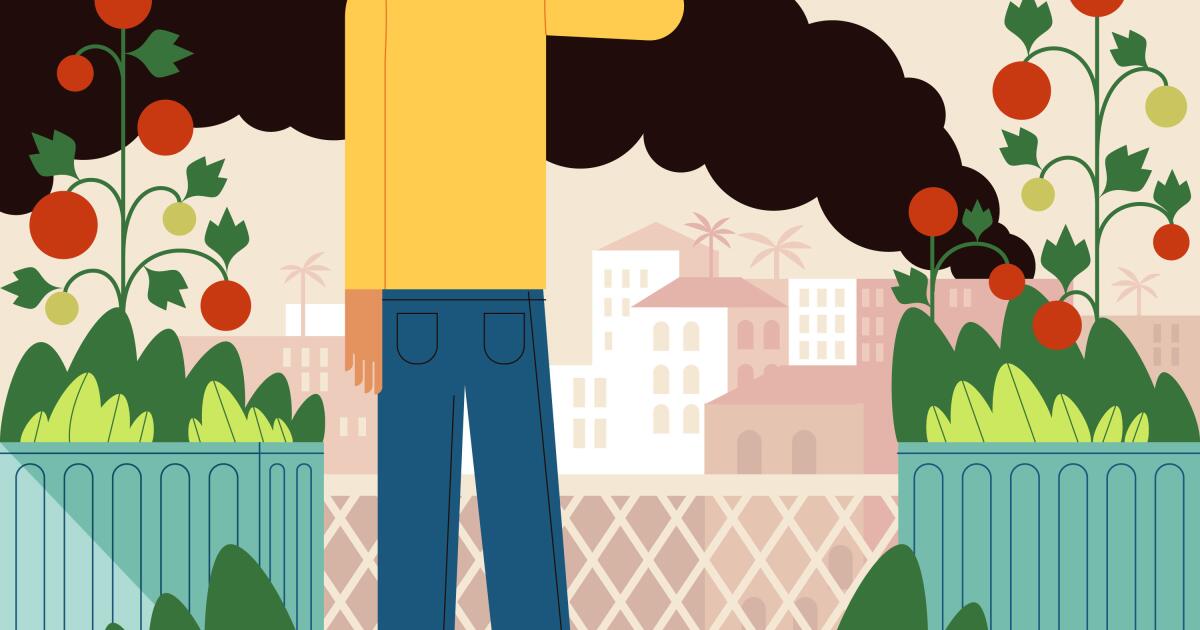
After the eight-day-long fire in a 500,000-square-foot Boyle Heights warehouse, eastern Los Angeles residents are contending with putrid smells, soot and potentially hazardous airborne chemicals after heavy plumes of smoke spread throughout the city. But those who grow food in nearby neighborhoods may also be wondering: How will the fires affect the plants and produce in my garden?
The Boyle Heights warehouse, owned by Lineage — a global temperature-controlled storage facility operator — housed 85 million pounds of frozen food and other products. In the days since the fire, local emergency visits for smoke inhalation and throat pain spiked while agencies still scramble to measure the amount of PM 2.5 — harmful fine particles — and heavy metals, like lead and arsenic, in the air.
According to researchers, any toxic airborne chemicals would likely stem from the charred foam insulation, metal exterior, burned solar panels and any lithium batteries that might have been present inside the warehouse.
After a fire, heavy metal particles can spread through ash and smoke over gardens and inhibit growth, said Olukayode Jegede, an agricultural toxicologist and assistant professor at UC Davis. Since the warehouse fire is so recent and cleanup has just begun, Jegede said the precise impact on gardens can’t be measured until comprehensive soil tests are conducted in the area.
While the L.A. city government hasn’t announced plans for soil testing, the Contaminant Level Evaluation and Analysis for Neighborhoods project at USC is offering free contaminant testing for Boyle Heights and East L.A. residents. Residents can collect soil samples and deliver them to Boyle Heights City Hall and other locations for an evaluation of lead, arsenic, chromium and mercury levels.
The good news is produce, plants and roots can still be preserved. According to Jegede, many of the soil tests conducted last year in the Altadena area after the Eaton fire showed that gardens and poultry were not as contaminated as one might expect.
“Quite a number of the soils we tested [in Altadena] were not really contaminated,” Jegede said. “We weren’t seeing many soils with concerning elevated levels of metal, so gardeners should not be too alarmed when these things happen.”
Nevertheless, there are several measures that gardeners can take to keep themselves, their children, plants and produce safe from potentially harmful contaminants stemming from the fire. Researchers, gardening experts and horticulturists offered some guidance on the handling, recultivation and cleanup that can keep you and your garden in good health.
How do I remove ash and contaminants from my garden?
Altadena horticulturist Leigh Adams said Boyle Heights plants and produce already live in a difficult environment, surrounded by industrial warehouses that spread contaminants daily.
“That area has been used industrially for 100 years, and the soil is impacted by many, many, many things,” Adams said. “Low-income neighborhoods and gardens usually don’t have a lot of resistance against dominant manufacturing.”
This means that the contamination of gardens in eastern L.A. won’t be as catastrophic as compared with those in Altadena, a more suburban environment, Adams said. But fallen ash still poses major health risks if ingested or inhaled.
An advisory from University of California Agricultural and Natural Resources last year recommended suiting up in an N95/KN95 mask, long sleeves, pants, close-toed shoes and gloves before attempting to deal with ash in the garden to limit exposure to potentially toxic contaminants. The advisory added that individuals should make sure all of this gear is cleaned thoroughly before bringing it back inside.
Once in the proper gear, Adams recommends removing the top two inches of topsoil from gardens, where the highest concentration of contaminants will settle after a fire. Using a plastic bag to collect the soil and disposing of it in the garbage — not green yard waste bins — will help to reduce the spread of airborne chemicals.
Gardeners with raised beds are advised to remove approximately six inches of soil, because excess ash can raise the pH level and prevent nutrients from soaking into the soil bed.
After this, watering the garden gently but plentifully will help to promote soil health and get rid of most of the ash present on plant leaves and stems. Adams said replacing the top two inches of soil with store-bought mulch or straw will help to contain any remaining ash and prevent it from spreading any further.
Experts say to avoid using leaf blowers if ash is present in the garden because they can send particles airborne. Doing so will increase the likelihood of heavy metal particles, which can carry lung irritants and carcinogens, being spread and inhaled.
A Boyle Heights resident keep a watchful eye on the fire at the 5,000-square-foot commercial building, which stores 85 million pounds of frozen food.
(Genaro Molina / Los Angeles Times)
Is it safe for me to eat produce from my garden?
Several studies, including one from the UC Cooperative Extension of Sonoma County, have shown that consuming produce in a fire-affected area poses minimal health risks.
Jegede said most root vegetables like potatoes and carrots, along with any fruit that has an outer layer, can be washed to remove potential contaminants, even if they were covered in ash. Peeling the outer layer of your produce can also help to reduce potential risks, he said.
Lettuce and other leafy foods with multiple layers pose a higher risk of contamination, but with a vigorous wash and peeling the outer layers, even the greens can be saved. The County of Los Angeles Department of Public Health recommends soaking leafy produce and fuzzy fruits like peaches in a 10% white vinegar and 90% water mixture.
Jegede said if the leaves or fruit are too delicate to wash or ash is still visible, it would be best to dispose of the produce.
How can I tell if my soil is contaminated?
After ridding your garden of visible ash, you might wonder how to tell if your plants will still thrive in the soil.
At-home soil tests that measure for alkaline, fertility and pH levels are widely available and can be purchased for $15 to $100 (for more detailed results) online. But Jegede said these tests can’t tell the full story of soil health.
Comprehensive soil testing is “something you can’t do properly at home,” Jegede said. “In labs, we are testing for metals like lithium and zinc, stuff that an at-home test will not show … If it comes to the point that you’re worried about your soil, I would just send it out to a lab.”
Wallace Laboratories in El Segundo, Babcock Laboratories in Riverside, Waypoint Analytical in Anaheim and other labs offer more detailed soil tests that measure heavy metal particles in addition to other fertility factors. Prices at Wallace Laboratories can range from $115 to $295 for a complete compost test.
The soil below two inches should be unharmed, Adams said, so long as new compost is set and plants are watered plentifully, which will promote natural biological cycles.
“What you’re doing is capping the soil, so that moisture stays in there, and instead of being dirt, it’s a living system called soil,” Adams said. “The more carbon we can get into our soil, the better.”
What can I do to help my soil recover?
For the last 12 years, Adams has been working with Metabolic Studio, a Los Angeles-based art and research hub focused on environmentalism, on methods for bioremediation, the practice of using additional fungi, plants and compost to decontaminate ash and break down contaminants.
Adams said straw, mushrooms, corn, rye and sunflowers are great bioremediators that can help to repair damage to soils. She said certain samples she’s worked on with Metabolic Studio have gone from testing at high heavy metal levels to nearly contaminant-free.
But for a more immediate fix, wash your produce, water your plants and have a little patience during ash cleanups. Your garden should look better in no time, Adams and Jegede said.

Inde Navarrette and Michael Johnston in Obsession.
Focus Features
hide caption
toggle caption
Focus Features
Two big horror films, Obsession and Backrooms, just smashed all box office expectations. So much of their success has been driven by Gen Z, which is now the biggest moviegoing demographic. But what makes a movie a Gen Z movie? Today we’re bringing you an episode of NPR’s It’s Been a Minute. Host Brittany Luse talks about this trend with Sam Adams and Reanna Cruz.
If you want to hear more about these movies, check out these episodes:
In ‘Obsession,’ love hurts. It really, really, really hurts.
‘Backrooms’ brings YouTube horror to the big screen
Zendaya brings ‘The Drama,’ we bring the spoilers
Connect with Pop Culture Happy Hour:
Letterboxd / Facebook
Our weekly newsletter
Support Pop Culture Happy Hour+
-

 South Dakota40 seconds ago
As travel costs rise, many families find summer adventures closer to home
-

 Tennessee8 minutes ago
In-N-Out’s fifth Tennessee location is opening soon. Here’s how many stores are planned
-

 Texas11 minutes ago
Triple-digit heat returns to North Texas before weekend storms bring relief
-

 Utah16 minutes ago
Planned 60-foot long Liberty Arch in Utah sparks patriotism, but also concerns
-

 Vermont23 minutes ago
Vermont offers money to replace diesel vehicles with electric
-

 Virginia26 minutes ago
Virginia reports 10 cases of cyclosporiasis
-

 Washington31 minutes ago
Washington law says to alert the public when doctors are accused of misconduct. It can take months
-

 Wisconsin38 minutes ago
Former Wisconsin judge to be sentenced after conviction in obstructing arrest of Mexican immigrant

