Lifestyle
The second death of Cesar Chavez and his legacy


Cesar Chavez attends a Labour Party press conference in the United Kingdon on September 17, 1974.
Les Lee/Getty Images/Hulton Archive
hide caption
toggle caption
Les Lee/Getty Images/Hulton Archive
A version of this essay first appeared in the Up First newsletter. Subscribe here so you don’t miss the next one. You’ll get the news you need to start your day, plus a little fun every weekday and Sundays.
My phone kept going off on Wednesday afternoon with texts from different friends — each wanting to trade thoughts on what felt like the second death of Cesar Chavez. His first death happened on April 23, 1993. He was 66 and died of natural causes. Over 50,000 people attended his funeral in Delano, Calif. And he was posthumously awarded the Presidential Medal of Freedom in 1994.
At that time, I was in elementary school in suburban Chicago, far from California. It was then that I first learned of Chavez and his movement’s hard-fought efforts to secure better wages and improved working conditions for farm workers. As a daughter of janitors and a factory worker, I knew what better pay and the right to a union meant for people like us.
Chavez’s second death landed on Wednesday after a The New York Times investigation revealed he had been accused of sexual abuse and rape. NPR has not independently confirmed the allegations against Chavez in the Times investigation.
For several years before joining Morning Edition as an editor, I covered sexual violence for ProPublica, an investigative newsroom. My work there was often not about catching the bad guys but rather about listening, for extended periods of time, to the people they hurt. This work took me to places such as Alaska and Utah where I met a broad range of people who were assaulted in recent years and some, who like Huerta, never spoke of their experiences for decades.
Consistent with national statistics, the perpetrators whom I wrote about were often family, bosses, clergy or others in positions of power.

“I have kept this secret long enough. My silence ends here,” Dolores Huerta, 95, said in a statement on Wednesday.
JC Olivera/Getty Images for State of the Ar/Getty Images North America
hide caption
toggle caption
JC Olivera/Getty Images for State of the Ar/Getty Images North America
This week, many of the voices of the victims I spoke with hearkened back to the experiences that the New York Times‘s investigation revealed in telling of the sexual abuse that Ana Murguia, Debra Rojas and Dolores Huerta shared with the publication. I was grateful to learn Murguia’s and Rojas’ names alongside the much more familiar one of Huerta, the civil rights icon in her own right who co-led the United Farm Workers movement that made Chavez famous.
I’ve learned that there is no timeline for naming what was done to you by people you trusted. I’ve learned that justice for many means the world recognizing the harm done to them — and the difficult work they have done to no longer live defined by it. I’ve learned that people care about protecting others. And that sometimes by sharing their stories, survivors hope to prevent future harm.
My friends and I may be down a hero this week. But, we gained two new heroes in Ana Murguia and Debra Rojas, who, alongside Dolores Huerta, showed us it’s never too late to speak up. In fact, it might be the only way out for them and others.



For 20 years, Dutch art detective Arthur Brand has acted as an intermediary between the police and people who know where stolen artwork might be hiding.
Rebecca Rosman for NPR
hide caption
toggle caption
Rebecca Rosman for NPR
AMSTERDAM – In his modest IKEA-furnished apartment, Arthur Brand paces to distract himself.
“I’m nervous,” he says, with the honesty of a man who has learned that bravado is useless in his line of work. He lights a cigarette, leans out the window, and scans the street below.
“The waiting is the hardest part.”
Brand, 56, has made a career out of waiting: for a phone call, a knock at the door, and, every once in a blue moon, a Picasso or a Van Gogh left discreetly on his doorstep.
“Those are the moments you realize it’s worth it,” he says.
Until, of course, everything resets, and the waiting game begins again.

In another life, Brand says, he’ll take his mother’s advice and “find a normal job.” But in this one, he’s helped recover stolen art for two decades — often the cases police can’t solve alone.
Some call him the “Indiana Jones of the art world.” Brand insists he’s closer to a certain Pink Panther character.
“Do you know Peter Sellers, Inspector Clouseau? Well, I’m like that,” he says. “I always follow the wrong lead.”
Maybe it’s true. Maybe it’s just modesty. Or maybe it’s Brand’s ability to follow every wrong lead — and keep going — that keeps him in the game.
He says he has recovered more than 150 stolen paintings and artifacts. His cases regularly make international headlines.
There’s the stolen Van Gogh that showed up on his doorstep in 2023, stuffed into a blood-soaked pillow in a blue IKEA bag. The Salvador Dali painting he recovered in 2016. The Picasso he tracked down for a Saudi sheikh in 2019.
Brand’s path into this work wasn’t planned.
“You know, you cannot go to university and say, I want to become an art detective,” Brand says. “This is a job created more or less out of lack of other opportunities.”

He traces his entry point to Michel van Rijn, a notorious Dutch figure in the art underworld who introduced Brand says to a shadowy ecosystem of smugglers, thieves and forgers — and law enforcement.
After making a cold call to van Rijn’s office, Brand says he became his apprentice in London — which regularly involved sitting quietly in a corner while older men swapped stories. “Everybody thought — who is this idiot?” he says.
Van Rijn, Brand later discovered, was straddling two sides. In 2009, he walked away after learning his boss was working with police while still keeping “one leg” in the criminal world.
The experience left him with a simple rule for survival: In a world where people expect betrayal, being honest — and keeping your word — is its own form of power. It’s a lesson that underpins just about everything Brand does now.
A bridge between informants and the police
Brand says his work lives between two worlds that don’t trust each other: police and the people who might know where the stolen art is hiding.
“The police don’t trust the informants. The informants don’t trust the police. So I want to form a bridge between them to see what can be done. And in most cases, it’s possible.”
The bridge only holds if Brand is seen as independent. “I’m not hired by an insurance company,” he says. “The police, of course, don’t pay me. So I do this work [at] my own costs.”
He supports himself by consulting for art galleries and helping Jewish families trace art looted during World War II. But the majority of his energy goes to the work he does on his own dime — acting as a go-between when someone wants to quietly unload a masterpiece they can’t keep.
Stolen masterpieces, he says, are hard to enjoy and even harder to sell. “Who buys stolen art? You cannot show it to your friends. You cannot leave it to your children.”
Dutch police say Brand’s motive matters.
Richard Bronswijk, who heads the Dutch police art crime unit, says he’s seen private detectives create problems when money is the driver. “I’ve worked before with private detectives who are doing this for the money,” Bronswijk says. “And then it’s always dangerous.”
Brand, he points out, has always been driven by something else: the thrill of the chase.
“Everybody’s in it for the money, and I’m not,” Brand says. “They cannot buy me.”
The art thief and the art detective: An unlikely pair
Still, sometimes Brand’s trust isn’t enough on its own. When an informant is deciding whether to return stolen art, Brand says fear can take over … of the police, of retaliation, of being tricked.
That’s when he calls in his ace — Octave Durham.
In 2002, Durham, already a seasoned bank robber, stole two Van Gogh paintings from the Van Gogh Museum in Amsterdam.
“You have born soccer players, born teachers, born policemen,” Durham says. “I’m a born burglar,” adding he doesn’t steal anymore but “still can.”
Today, he works with Brand to recover stolen art.
Brand has legitimacy. “But I have contacts on the streets,” Durham says.
“What takes [Brand] sometimes five, six years to figure something out, I could go up to somebody right away.”
Durham says he trusts Brand because Brand’s focus is consistent. “He shows how he works, and it’s all about recovering the art,” Durham says — “and not to send somebody to jail … or go for the reward.”
The Van Gogh in the IKEA bag
In 2020, another Van Gogh — The Spring Garden — was stolen from the Singer Laren Museum. Police caught the thief a year later, but the painting was still missing.
Then Brand says he got a tip from an informant.
A gang, he said, was holding the Van Gogh as leverage until the attention made it too risky to keep.
“Everybody wanted to get rid of it,” Brand says.
Brand says the informant told him he could return it — but only if could be guaranteed confidentiality. And he needed proof he could trust Brand.
So Brand turned to Durham. Durham sent the informant a message on Brand’s behalf. “I don’t know who you are,” Durham texted. “The only thing I can say is that I guarantee you won’t get into trouble if you talk to [Brand].”
It worked.
One afternoon, Brand says he opened his door and found a blue IKEA bag on his doorstep. Inside, he says, was a pillow soaked in blood. Wrapped within it was the missing Van Gogh.
“It was one of the most beautiful moments of my life,” Brand says.
He says moments like the Van Gogh discovery explain why he keeps doing his work — and why, despite the danger, he keeps answering the phone.
He compares it to living inside a thriller. That’s when he has a confession to make.
“It all started with Dan Brown, this whole idiot story,” he says.
Earlier this year, it all came full circle when he met the author at a book signing in Amsterdam.
Brand shows off a framed note Brown gave him at the signing. “To Arthur, the real world Robert Langdon, with gratitude for all you do.”

There is no such thing as a day of rest for artist Kenny Scharf, not even Sunday. “I wake up super early. It’s still dark outside,” the Los Angeles native says.
Rising before the sun anchors his active day. “I always have to keep moving,” Scharf says. “Otherwise, I’ll get very depressed.”
An avid hiker and swimmer, Scharf, 67, also maintains a disciplined yoga practice and cycles daily from his Culver City home to his Inglewood studio. There almost everything serves as a canvas, including painted trash doubling as decor and the silkscreened couch on which he’s seated.

In Sunday Funday, L.A. people give us a play-by-play of their ideal Sunday around town. Find ideas and inspiration on where to go, what to eat and how to enjoy life on the weekends.
“I don’t like to waste good paint and silkscreen ink. Why wash it? We apply it everywhere until we use it up,” Scharf says.
Scharf, who grew up in the Valley before making his way to New York City, first gained acclaim in the ‘80s East Village art scene alongside his friends and contemporaries Jean-Michel Basquiat and Keith Haring, his former roommate. The trio also befriended Andy Warhol, who predicted Scharf’s fame.
Renowned for his self-coined “pop surrealism,” Scharf often populates his bold, colorful work with grinning cartoon faces, elastic blobs, and sci-fi creatures floating through cosmic landscapes. Anxieties about overconsumption and environmental degradation lie beneath the playfulness.
Like their creator, Scharf’s works are always on the move, either rolling down the street on the cars he’s painted — featured in his recently published book “Karbombz!” — or traveling to forthcoming exhibitions in Wuhan, Tokyo and Paris.
This interview has been lightly edited and condensed for length and clarity.
5:30 a.m.: Wake up and feed the cats.
My cats, Cutie and Socks — one’s a tabby and the other is a tuxedo cat — wake me up by mewing and walking on me. They’re like, “Hey, I’m hungry.” So I get up and crack open the cans. They like that disgusting, smelly canned food. And then they go out into the yard.
I got the cats because I went to New York for a show. I was gone for five days and I live next to a park, so there are a lot of animals. I came back and my entire house was overrun by mice. I was like, “What the hell am I gonna do? I need cats.” The mice are gone and now I have these cats. They’re so cute and so much fun. They take over my life.

6 a.m.: Detox
I make lemon and hot water. It’s a good way to start the day and clear out the toxins. Right now, I have a lot of citrus because Ed Ruscha’s studio is across the street from my house, and in the back of the studio he has a citrus farm. I go there, especially during this time of year, and get bags of citrus. It’s like a farm community in the middle of L.A. I love L.A. because you can surround yourself with trees and gardens and kind of pretend that you’re not living in a giant metropolitan area.
8:30 a.m.: Iyengar yoga
An Iyengar yoga instructor comes to my house. I find Iyengar is great for aging. You use ropes and gravity to hang and do different things, using your body weight so you can relax into the positions. I also have a swing to go upside down on. When people walk into my living room, they go, “What’s going on here?” because of the ropes on the wall.
In the summer, I’ll go to the beach in Venice and swim in the ocean. It’s wonderful when I’m out in the water. It’s cathartic and cleansing, and sometimes I see dolphins. I’ll go early in the morning before the crowds come.

11:30 a.m.: Mar Vista Farmers’ Market
It’s fun to go there with my daughter Zena, who’s a chef, and my grandkids. We stroll around and get food. All the food stands are delicious. I grew up here in L.A., so I’m into Mexican food. I don’t really want to eat American food. I’m not into hamburgers. I want all the stuff with the culture. I like hot and spicy.
I also buy apples and berries, whatever I can’t grow, because I grow my own food at home.
And I buy stuff from an Indian man who sells Chyawanprash, which is kind of a jam. It’s really concentrated and like an elixir. He also sells Shilajit, which almost looks like tar. You put a little bit under your tongue and it dissolves, and it’s got like every single mineral in it.

2 p.m.: Painting at the studio
I’m painting seven days a week, but I really love coming here on Sundays because nobody’s here and the phone doesn’t ring. Sometimes, my granddaughter, Lua, will come. She paints. Upstairs at the studio I have a little painting area with easels for my grandkids, but my grandson, Jet, isn’t that into painting. I do my work, and Lua’s up there keeping herself busy painting, and it’s great.
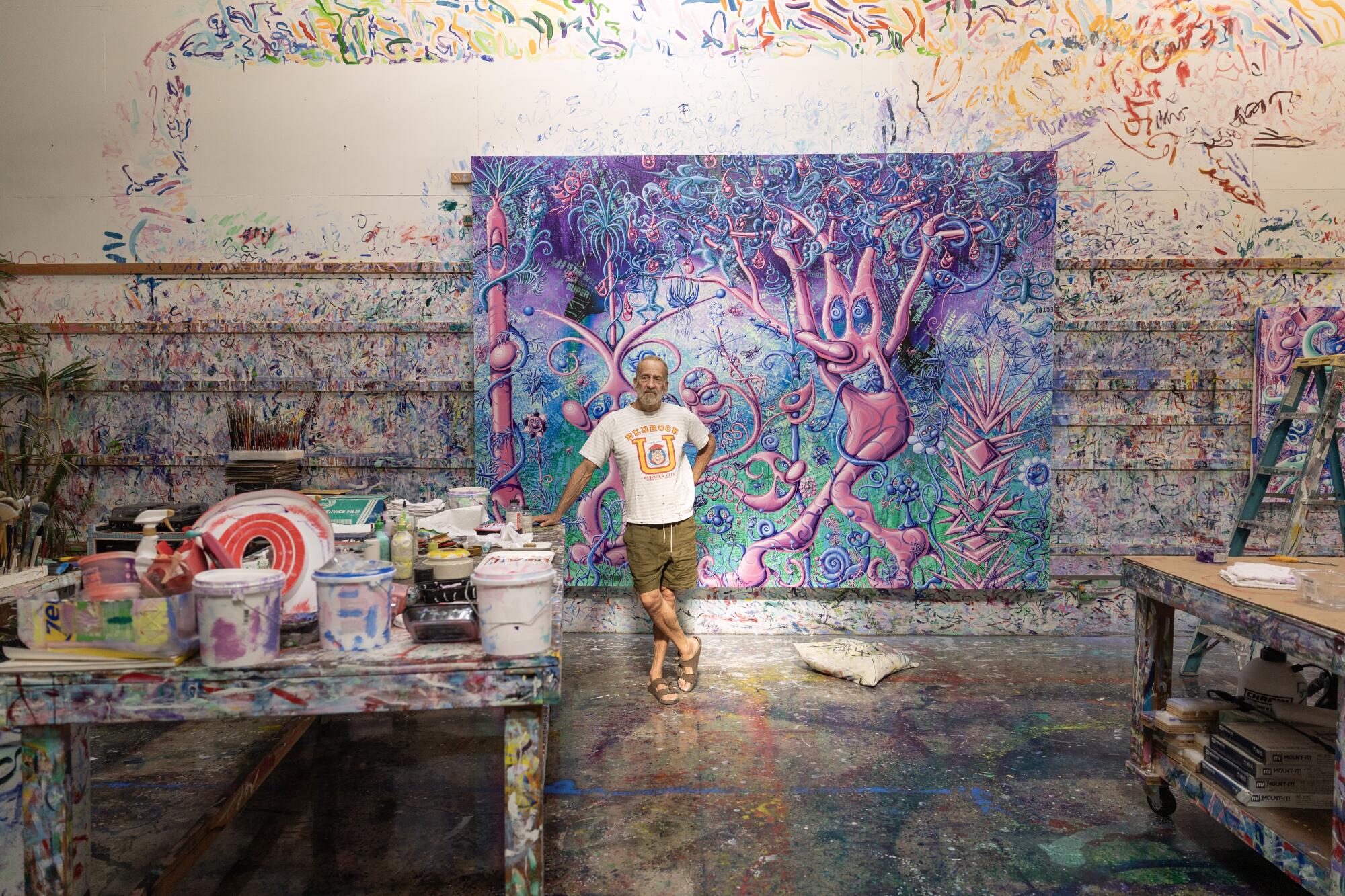
Kenny Scharf in his paint-splattered studio he bikes to every day.
(Myung J. Chun / Los Angeles Times)
5 p.m.: Hike
The easiest one is right behind my house. It goes up to the top of the Baldwin Hills Scenic Overlook where the [Culver City] Stairs go. It’s one of the best views in all of L.A. You can see from the airport to the ocean, downtown, Mount Baldy. You can see almost all the way to Palm Springs, Mount San Gorgonio. The view is amazing.
We also hike a lot in Kenneth Hahn [State Recreation Area].
My grandkids often like to go on a waterfall hike, so there are a couple in Malibu. There are also a couple over in the San Gabriel [Mountains]. We’ll get into the car and drive an hour and hike.
6:30 p.m.: Dinner at a restaurant
Zena, Lua and Jet live close to me, so we have dinner together at least three or four times a week. Because Zena’s a chef, we don’t go out to eat that often, but sometimes we go to a restaurant called Madre that I love. It’s on National [Boulevard]. The food is so good. They often have squash blossoms. They fry them and put a little cheese in them.
I also love Gjelina in Venice. Sometimes I take people from Europe there because it is quintessential California. All the food they make is from the farmers market, so you get a tomato salad with incredible tomatoes.

8 p.m.: Read
I just finished Patti Smith’s latest book, “Bread of Angels.” It’s beautiful. I love her. I saw her perform at Disney Hall recently, and she was selling this book. I actually saw her perform at the Santa Monica Civic [Auditorium] when I was 19. I’d been wanting to move to New York for a lot of reasons, but when I saw her performance, it was, “I’m moving there.” There was so much energy in her.

9 p.m.: Bedtime
Usually I’m in bed by 9 and asleep by 10. When I was young, I was very involved in nightlife. I was working in nightclubs, all of my friends were in nightclubs, so I lived that big time. But now I’m jaded. I don’t want to sound above it all, but I don’t see anything going on that I’m getting excited about the way it was. And I’m not a nostalgic person, so I choose not to go out. I’m happier getting a good night’s sleep.

Replacing Griffith Park’s historic but idle swimming pool is likely to take at least three years and cost $40 million while delivering a competition pool, a neighboring recreational pool and a rehabilitated pool house with a gender-neutral bathhouse facility, city officials and designers told Los Feliz residents at an open house meeting Thursday night.
“The pool is being completely replaced. It leaks like a sieve,” said Stephanie Kingsnorth, principal of the architecture firm Perkins Eastman, addressing about 50 community members in a room next to the park’s visitor center.
Perkins Eastman, which is leading the design of the pool site, also worked on the renovation and expansion of Griffith Observatory from 2002 to 2006, when the firm was known as Pfeiffer Partners.
While neighbors look on, an artist’s rendition shows the proposed replacement of the Griffith Park Pool and rehabilitation of the pool house. The meeting was held at the Griffith Park Visitor Center Auditorium.
(Gina Ferazzi / Los Angeles Times)
The pool and pool house at Riverside Drive and Los Feliz Boulevard date to 1927, long before Interstate 5 was routed just east of the site in 1964. After decades as a popular spot for children’s swim lessons and recreational lap swimmers, the pool was shut down amid COVID-19 pandemic measures in early 2020. When the city tried to refill the pool, workers found that it no longer held water.
At one point early in planning to replace it, the city Bureau of Engineering forecast construction costs of $28 million. City officials say the project is complicated because of the nearness of the freeway and the Los Angeles River.
Kingsnorth said the project is nearing the end of its design development stage, with many details still under discussion.
In place of the existing seasonal pool, schematic drawings now show a new year-round competition pool, 50 meters long, 25 yards wide and from 3-foot, 6-inches to 12-foot, 9-inches deep.
Next to it, drawings show a training pool 25 yards long and 50 feet wide, with an ADA-compliant gentle slope down to about 4 feet deep.
The two-story pool house’s red tile roof, wooden trellises and Spanish Colonial Revival features will look roughly the same on the outside, Kingsnorth said, and the rehabilitation will comply with federal standards for historic structures.
But some formerly open-air areas will now be covered. An elevator and second set of stairs will be added inside, along with features to boost energy sustainability and meet modern accessibility laws. The site’s open-air showers will be rinse-only.
On the ground floor, the building’s open-air male and female changing rooms will merge into one larger indoor gender-neutral area with private changing rooms and toilet stalls, Kingsnorth said.
“Every single toilet room and dressing room is an individual room,” Kingsnorth said.
Kingsnorth said the gender-neutral dressing room design was not mandated by state or federal restrictions but was a priority for the city’s Recreation and Parks Department. On projects like this, Kingsnorth said, “this is something that’s more common for equity and inclusion.”
Questions from the community focused on features of the pool, public access, cost and effects of the construction work.
“We’re very anxious to have the school come back, so that the kids can learn to swim,” said Marian Dodge, a longtime area resident and past president of the Los Feliz Improvement Assn.

The Griffith Park Pool, seen here in 2023, has been closed since 2020, when city workers found major leakage problems.
(Dania Maxwell / Los Angeles Times)
The pool site is within City Council District 4, represented by Nithya Raman, who was not present. Her staffers organized the meeting and urged residents to send questions and comments to griffithparkpool@lacity.org.
The next steps, a handout from the city and design firm read, include creation of construction documents (estimated at six months), obtaining city permits (five months), selecting a construction contractor (five months), construction (18 months), and “project close-out” (six months). If that schedule is met, completion would come in a little over 40 months, around July 2029.
“This is ambitious, but we’re confident that we can get there,” Kingsnorth said.
In an hourlong presentation, followed by about a dozen questions and answers, Kingsnorth was joined by city officials, including Ohaji Abdallah, assistant division head of the Bureau of Engineering’s architectural division, and
Maha Yateem, the Recreation and Parks Department’s principal recreation supervisor for citywide aquatics.
The plan calls for three rows of shaded concrete bleachers for spectators alongside the competition pool. Yateem said the competition pool will include a diving board, adding that “we’re working on a location for that now.”
Because the project means removing tons of existing pool materials and bringing in new ones, “the construction here is going to be quite intense,” Abdallah said. He and Kingsnorth said the “haul route” of construction trucks has not been decided, and Abdallah said he and other officials are discussing the plan’s possible impact on Los Feliz Nursery School, which stands near the pool.
When considering construction costs and “soft costs” like design and environmental review, “I expect this to be about $40 million,” Abdallah said, adding that the project will be vying with other city priorities for dollars from the general fund. He also noted that current estimates were made “before the war started” in Iran and gas prices surged.
After the meeting, Kingsnorth said, “We’re ready to pause if we need to because of the outlying state of the world.”

Movie Review: “FORBIDDEN FRUITS” – On Wednesdays We Cast Spells – Rue Morgue

Former FBI Director Robert Mueller, who investigated Russia-Trump campaign ties, dies

Record Heat Meets a Major Snow Drought Across the West
Meet the Dutch art detective who tracks down stolen masterpieces

The AirPods Pro 3 are $50 off right now, nearly matching their best-ever price

Florida High School Football Rankings: Top 25 teams – Oct. 21

How old is Bo Nix? What to know about Oregon quarterback ahead of 2024 NFL Draft

Cleary's 21 help Le Moyne down Central Connecticut State 69-64 in OT

99th annual Pony Swim held in Virginia

Indiana Members Credit Union announced as new anchor tenant at Bottleworks District

Schumer gambit fails as DHS shutdown hits 36 days and airport lines grow

Trump threatens to deploy ICE to airports amid Homeland Security shutdown

Alabama student reportedly fell to his death in Barcelona waters by accident

Read the Ruling in The Times’s Lawsuit Against the Pentagon

NYC Mayor Mamdani’s wife glorified terrorists in online posts, criticized US military: report
-

 Detroit, MI3 days ago
Drummer Brian Pastoria, longtime Detroit music advocate, dies at 68
-

 Oklahoma7 days ago
Family rallies around Oklahoma father after head-on crash
-

 Nebraska1 week ago
Wildfire forces immediate evacuation order for Farnam residents
-

 Georgia5 days ago
How ICE plans for a detention warehouse pushed a Georgia town to fight back | CNN Politics
-

 Massachusetts1 week ago
Massachusetts community colleges to launch apprenticeship degree programs – The Boston Globe
-

 Alaska6 days ago
Police looking for man considered ‘armed and dangerous’
-

 Southwest1 week ago
Talarico reportedly knew Colbert interview wouldn’t air on TV before he left to film it
-

 Michigan1 week ago
Michigan-based Stryker hit with cyberattack