Lifestyle
The best freebies and discounts for L.A.'s 50-plus crowd


According to the census, nearly a third of Los Angeles residents are over 50. And we’re aging collectively — according to a Times report, L.A. County’s median age rose 2.6 years between 2012 and 2022.
Thankfully, L.A. is an enticing place to grow older, and not just because of the temperate climate. The city is one of the few municipalities in the world with a “purposeful aging” initiative (though the budget for senior programs will be reduced in 2025). It’s a place that understands that older Angelenos are our cultural core.
“Older people tend to be the holders of culture, of language, of sharing [these things], and so they’re always at the forefront of creating that experience for all of us,” says Dr. Laura Trejo, director of Los Angeles County’s Aging and Disabilities Department.
Which is why it’s so important for older Angelenos to have resources — and bounties — as they age. Here are some free (and almost free) services and experiences that older people have access to — and younger generations can hopefully look forward to.
50+
Crack open the books with free college classes
Whether you want to learn a new skill or just challenge yourself, community college classes are some of the best free resources for older Angelenos. Santa Monica College has been offering a free non-credit Emeritus program for 50 years, and Pierce College in Woodland Hills has a similar program called Encore. Both are set up for adults over 50 to audit a variety of classes from art and concert music to political science and occupational training. Los Angeles Community College also offers free non-credit courses for all adults.
UCLA’s Senior Scholars Program at Longevity Center isn’t free, but it offers the ability to audit one class for $175 and up to four classes for $625. UC Irvine has a similar program called the Osher Lifelong Learning Institute that costs $25 in the summer, $160 per semester during the spring and fall, and $235 for the whole year and allows older adults to take unlimited classes.
Most of these programs also offer online classes, if that suits you best.
55+
Enjoy a free drink or cheap(er) food
A lot of fast food spots have discounts for seniors, but Dairy Queen and KFC go one step further, offering a free drink for adults 55 and up. Restaurants are a classic spot to find “senior discounts.” TheSeniorList, a website resource for older people, has a regularly updated list of restaurants that offer discounts and freebies, but perks may differ from location to location so call before you go. There are a ton of places that offer discounts for people over 55 — the best thing to do is ask.
60+
Come down with a case of senior-center-itis
Los Angeles County has a senior center geared for adults age 60-plus in nearly every neighborhood, and each of them has a slate of activities where older Angelenos can participate in everything from line dancing and jewelry-making classes to nutrition courses and pickleball. A full list of activities at L.A.’s senior centers can be found on the Department of Parks and Recreation’s website.
“In Los Angeles County, we have over 140 of them, so you’re not that far away from one of them,” says Trejo, who calls senior centers a “focal point” of the communities they serve.
62+
Reconnect with nature at our national and state parks
Cap Rock Nature Trail in Joshua Tree National Park.
(Christopher Reynolds / Los Angeles Times)
The United States Geological Survey offers a Lifetime Senior Pass that covers all of the national parks. This one isn’t technically free — it’s $80 plus about $10 in fees — but it’s a lifetime pass for the cost of a regular yearly pass. By that logic, after a year, it’s free. There are nine national parks in California, four of which — Joshua Tree, the Channel Islands, Sequoia and Death Valley — are within a four-hour drive from L.A.
What is free is the Golden Bear pass issued by California State Parks. For Californians over 62 and earning a monthly income below $1,677 (or $2,269 for the household), the pass allows for car access to most of the state’s 280 parks. This is the largest parks system in the country, so there’s plenty to explore. If you don’t meet the income threshold, there is a Limited Use Golden Bear pass that costs $20 and is only active during the offseason between Labor Day and the Friday before Memorial Day, but it beats the $195 annual pass younger Angelenos have to shell out.
Catch a flick
There aren’t any completely free movie screenings at the major cinema chains, but older adults can find discounts at most of them, including Cinemark theaters, where “senior day” tickets can be as low as $5 for people 62 and older. There are also plenty of film screenings at senior centers and, of course, since this is the city of cinema, there are free screenings all over the city at any given time.
Get around in style
Driving around L.A. can be terrible for people of any age. Great news, this isn’t the L.A. Metro you grew up with. The public transit system has had a serious makeover and is getting even more upgrades to cover more areas in the future. Lucky for Angelenos 62 and older because the city offers deep discounts and fare-capping, which means you’ll never pay more than $5 a week. Regular fares are discounted too, with single rides costing older Angelenos 75 cents during peak hours and only 35 cents per ride during off-peak hours.
“Plus, Metro has a program that helps older adults learn how to use it more effectively,” Trejo says. “So that’s another opportunity if people want to consider giving up their cars.”
65+
This sporting life

A golfer at the Wilson Golf Course, one of the L.A. city golf courses that offers discounts for older L.A. residents.
(Carlin Stiehl / For The Times)
Golfing is a long-standing tradition for older people. Maybe it’s the slow pace of the game or maybe it’s just an excuse to get outside with a group of friends. It’s rarely free, but if you’re savvy, you can play on one of the L.A. city golf courses for almost free. For Angelenos 65 and up, there’s a yearly fee of $28, and then you’ll pay green fees as low as $4.50 for a weekday round. Make sure to reserve a tee time, and get out there on the links.
Also, strength training has been linked to longevity, as The Times’ Deborah Vankin reported recently. You might be eligible for SilverSneakers, a program that has workouts like tai chi, Zumba and outdoor walking groups, as well as scores of live online classes. It’s free for older people on most health plans in California, and for people on Medicare Advantage.
And we’ve all heard about the rise of pickleball. It can be a great, free workout for older Angelenos who might not be up for a tennis match. Most of L.A.’s city courts are free to everyone.
Become a cultural maven by visiting L.A. museums for free

View from the balcony of the outer peristyle at the Getty Villa in Malibu.
(Mel Melcon / Los Angeles Times)
Many L.A. museums offer free admission for everyone — the Getty Villa and the Getty Center, the Museum of Contemporary Art, the California Science Center’s permanent galleries, the Institute of Contemporary Art, Los Angeles, the Broad and the Hammer Museum — but some offer additional perks for older adults. The Los Angeles County Museum of Art and the Natural History Museum are both free for L.A. County residents after 3 p.m. on weekdays, and both offer a discount for adults 65 and up with an ID during all open hours. The Norton Simon, the Academy Museum, the Huntington Library, Art Museum and Botanical Gardens, and the Craft Contemporary also offer discounts to older Angelenos.
Perks with no specific age requirement
Shhh! Your library card holds many secrets for seniors
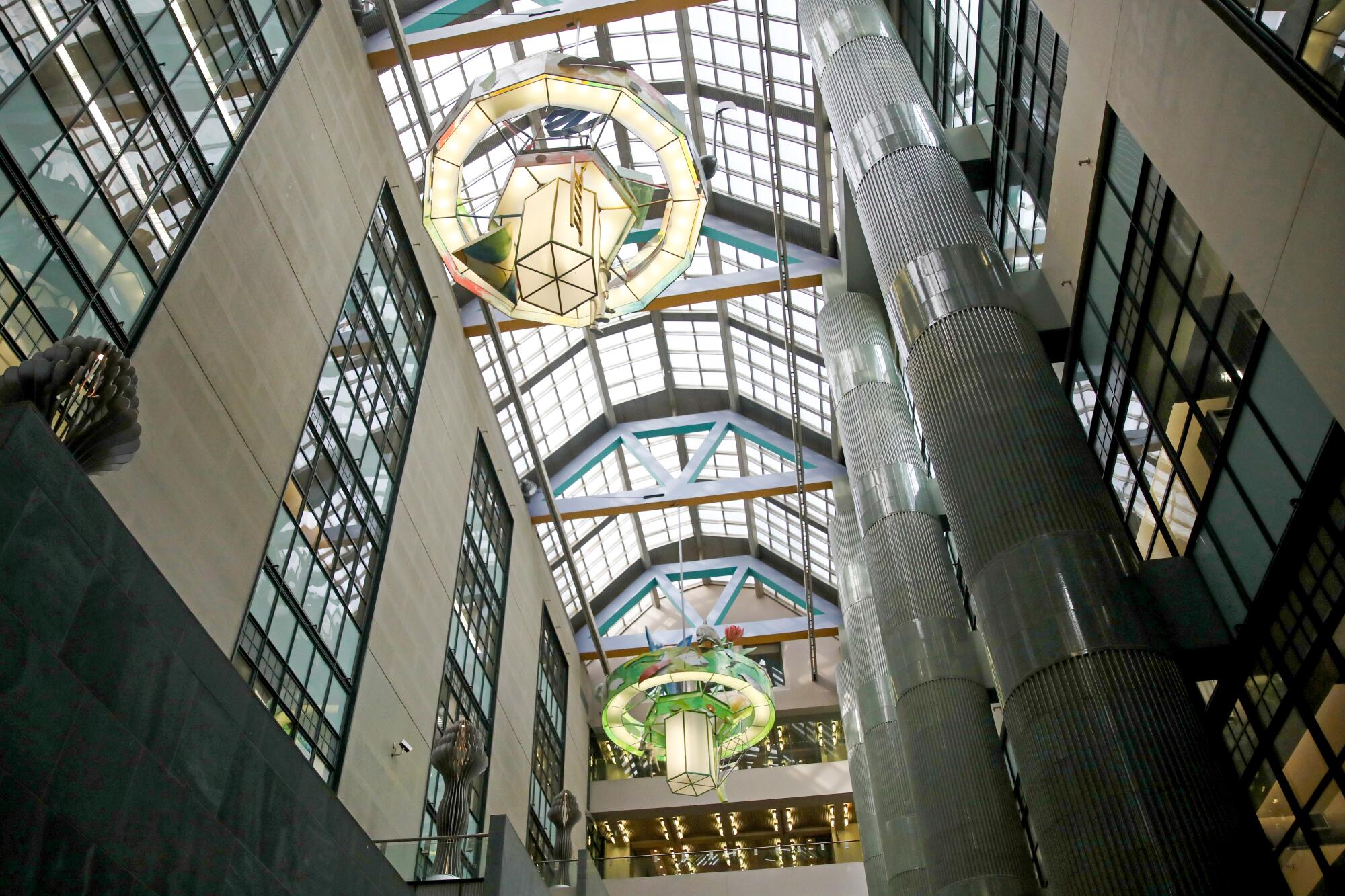
The glass-roof atrium at the Los Angeles Central Library.
(Gary Coronado / Los Angeles Times)
Libraries are one of the most powerful resources for anyone, let alone older Angelenos, but they remain a vital hub of our communities, particularly for our aging residents. I stopped by my local library recently — the Lincoln Heights Branch, housed in the beautiful Italian Renaissance Revival building funded by Andrew Carnegie in 1916 — which was filled with older Angelenos quietly reading or on the computer.
It’s no surprise, as the library is a friendly place for older people. For those with limited vision, the library is packed with large-print books. Looking to catch up to technology so you can keep in touch with loved ones? The library has tutorials on basic computer skills from Gmail to Instagram. And the library caters to homebound patrons with a program linking them with neighbors who can pick up and drop off materials.
Not only that, but your library card comes with a bevy of perks through the library’s Discover & Go program (have your library card handy to enter the site). On offer right now are four complimentary passes to the L.A. Zoo and Botanical Gardens, free tickets to select screenings at the Academy Museum (normally $10), and deeply discounted L.A. Kings tickets to select games.
“Your library card is worth its weight in gold these days because of the tremendous resources available at our libraries,” says Trejo.
What’s the 211?
211 LA is the city’s hub of resources for nonprofit services, connecting Angelenos with everything from suicide hotlines to nonprofits that will help them quit smoking. There’s a whole page called the Aging and Disability Resource Connection that helps older Angelenos find a caregiver, navigate health insurance and even offers legal services.
“When in doubt, reach out to 211,” Trejo says. “They are my partners. They are my information and referral provider for all of L.A. County. And they are actually there. They work with us. We train them, we share resources with them so that they’re always up to date on services and support available for older adults and their families.”
Stay connected
As we get older, keeping in touch with friends and loved ones seems to get more important, but it can come at a high cost. If you’re low income, that can be a burden. The state has a program called California LifeLine that offers low-income older people discounts on cellphones or home phones of up to $19 per month. That may or may not cover the whole bill, but it’ll help keep you in touch.



Lifestyle
Cheddar bay biscuits, cheap margs and memories: Readers share their nostalgia for chain restaurants

Affordable, familiar and reassuring are the features that make American chain restaurants a near-ubiquitous presence throughout the country; it is almost as if they are baked into our roadside culture.
Despite well-documented financial struggles, a tough economy and shifting diet trends, these restaurants withstand time.
This series explores why these places have such strong staying power and how they stay afloat at a time of rapid change.
Read our first three pieces in this series, including how these restaurants leverage nostalgia to attract diners, how they attempt to keep costs affordable, and how social media has changed the advertising game – and become a vital key to restaurants’ success.
America’s chain restaurants are not the most glamorous places to eat. And yet, as we’ve reported, they hold a special place in many Americans’ hearts.
We asked readers what comes to mind when they think of restaurants like Olive Garden, Applebee’s or Texas Roadhouse — and you shared plenty of stories.
Not all of the respondees waxed poetic about the merit of these restaurants. David Horton, 62, from New York, for example, said: “The food is mostly frozen and only has flavor from the incredible amounts of sodium they use.”
But overwhelmingly, responses described vivid childhood memories shared in booths looking excitedly over laminated menus and the type of adolescent rites of passage that seem right at home in the parking lot of a suburban chain restaurant.
There’s a science behind why these sorts of memories have such a hold on us.

The feeling of nostalgia is linked closely to food and smell, and these restaurant chains are often where core memories – like graduation celebrations or first dates – are made.
Chelsea Reid is an associate professor at the College of Charleston who studies nostalgia. And she’s no more immune to nostalgic feelings than anyone else even though she has a better understanding of the chemistry behind the feeling.
“Even just saying Red Lobster, I can kind of picture the table and the things that we would do and the things we’d order, and my mom getting extra biscuits to take home,” she said.

A Red Lobster restaurant is seen in Fairview Heights, Ill., in 2005.
James A. Finley/AP
hide caption
toggle caption
James A. Finley/AP
Her nearest Red Lobster closed down, but a local farmers’ market sells a scone reminiscent of Red Lobster’s famed Cheddar Bay Biscuits – a scent she says immediately transports her back to those childhood family outings to the seafood chain.
“I can see my mom wrapping these up in a napkin and putting them in her purse for when we would be like, ‘hey, we’re hungry,’ and she pulls out a purse biscuit.”
Full disclosure: Your intrepid reporters are not without sentimentality. Before launching this project, when it was just a kernel of an idea, we talked frequently about the role these restaurants played in our own lives.
Jaclyn: I distinctly remember cramming into a booth at my local Chili’s in my hometown, Cromwell, Ct., for most birthday dinners until the age of 13 or so.
I’d be surrounded by my mom, dad and brother, and I got to pick whatever I wanted. Except I always chose the same thing: Chicken crispers with a side of fries, topping the night off with the molten lava chocolate cake we’d share as a family.
I can picture it so clearly, down to the booth we’d sit in. Now, my family is spread out. But my love for Chili’s runs deep, and I still get warm and fuzzy when I think about it.
These days, I’m in my 30s, and I need to worry about my health and getting in 10,000 steps a day. So, no, I don’t regularly go to Chili’s now.
But when I do? Those chicken crispers I had as a kid are still on the menu, and yes, I’m likely to order them today (even if on my adult tastebuds, the salt content quickly turns my mouth into the Sahara Desert).
And it’s not to celebrate my birthday. It’s because one of my best friends is telling me she’s getting a divorce over cheap, and sugary, margaritas.
Alana: When the pandemic struck in 2020 and much of the country went into lockdown, there I was mostly alone in my one bedroom apartment, staring at the walls.
After what seemed like a lifetime, I was finally able to expand my tiny COVID bubble.
One of my first “dining out” experiences during that time was in the parking lot of the Hyattsville, Md., Olive Garden where my friend and I sat in absolute glee to be reunited – not just with one another, but also the chain’s staple soup (zuppa toscana for me, please), salad and breadsticks (you can have all the breadsticks if I can have your share of the salad tomatoes).
Since then, that friend and many others have moved away – too far to meet up for a sit-down over a (mostly) hot meal at a reasonably priced restaurant in a city not famed for being cheap.
I recently revisited the Hyattsville Olive Garden for this story. And even though my life is now different, my friends have moved away, and the world has shifted, there it was, exactly the same.
And I liked it.
Many readers said that these restaurants were the type of place a family who could rarely afford to eat outside a home could treat themselves on rare occasions.
Like Julie Philip, 51, from Dunlap, Ill., who wrote: “Growing up in the 70’s and 80’s, Red Lobster was an Easter tradition. We would dress up, go to church, then drive close to an hour to Red Lobster.”

She continued, “It was one of only a few days a year that we could afford to eat at a ‘fancy restaurant.’ I remember my parents remarking that they had to spend $35 for our family of four. I no longer consider Red Lobster a ‘fancy restaurant,’ but as an adult, my family and I often still eat there at Easter. I remind my kids that we are keeping up a family tradition and I tell them stories of my childhood while eating.”
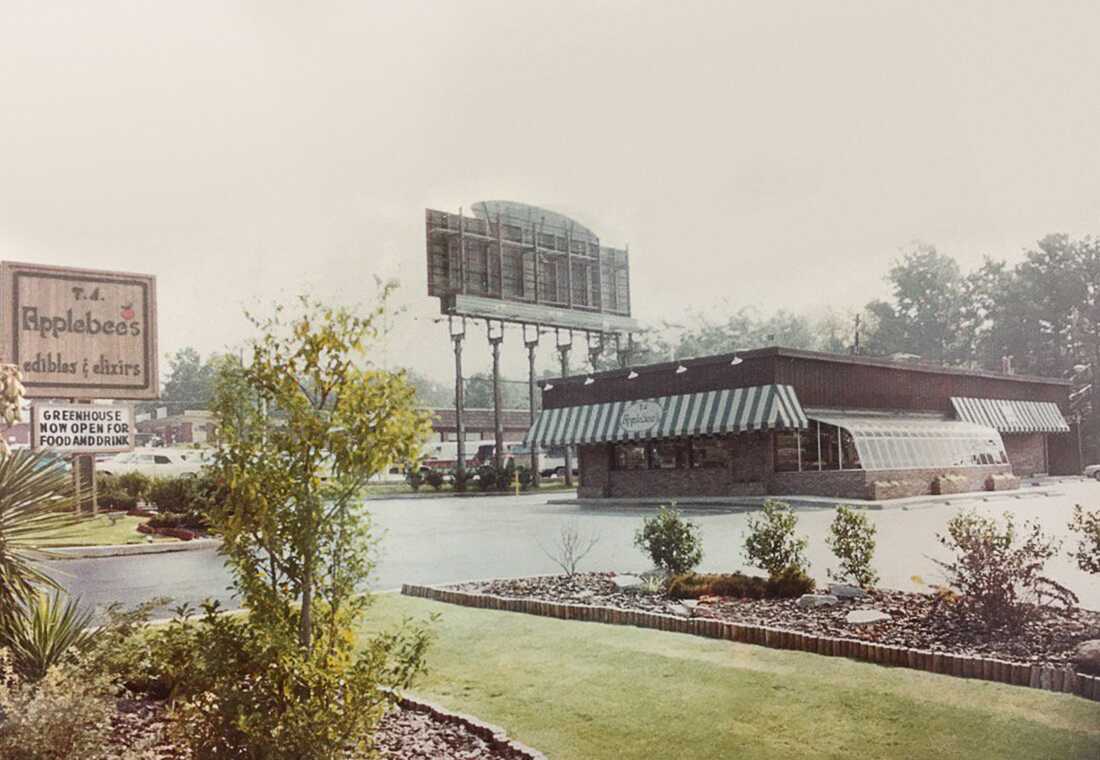
The original Applebee’s restaurant was called T.J. Applebee’s Rx for Edibles & Elixirs and it opened in Decatur, Ga., in 1980.
Applebee’s
hide caption
toggle caption
Applebee’s
For Sarah Duggan, an Applebee’s parking lot evokes a key memory from young adulthood.
Duggan, 32, from North Tonawanda, N.Y., wrote that every time she sees an Applebee’s, she remembers the time her friend, in an act of teenage rebellion, got her belly button pierced in the parking lot of a Long Island Applebee’s — inside the trunk of the piercer’s “salvage-title PT Cruiser.”
Duggan held the flashlight.
She wrote, “I can’t picture those sorts of college kid shenanigans happening in the parking lot of a regular Long Island diner or other independent restaurant, but it seems right that it was at Applebee’s.”
She continued, “It makes me think about how nobody, from riotous camp counselors to your spouse’s grandparents, looks or feels out of place at a chain restaurant.”


NASCAR’s Gregg Biffle
Jet Turns Into Ball Of Flames …
Shocking Video Shows
Published
Brevin Renwick
Horrifying new video shows the precise moment a plane carrying NASCAR driver Greg Biffle and his family crashed and exploded in flames Thursday, killing everyone on board.
Security footage captured the corporate jet turning into a ball of fire as it crash-landed near a runway at Statesville Regional Airport in North Carolina. The aircraft was scheduled to fly to Florida, but not long after takeoff, it turned back to the airport before crashing.
As you can see from the clip, the plane was reduced to what looks like a burning oil slick with black smoke rising into the sky. All seven people on the plane died, including Biffle, his wife, Cristina and two children — Emma, 14, and Ryder, 5.
PEOPLE reported minutes before impact, Cristina sent her mom a chilling text, stating, “We’re in trouble.”
The Federal Aviation Administration is investigating the cause of the crash.

President Donald Trump stands in the presidential box as he visits the John F. Kennedy Center for the Performing Arts in Washington, D.C, on March 17, 2025.
Jim Watson/AFP via Getty Images
hide caption
toggle caption
Jim Watson/AFP via Getty Images
The John F. Kennedy Center for the Performing Arts will now have a new name — the “Trump-Kennedy Center.” White House press secretary Karoline Leavitt announced the news on social media Thursday, saying that the board of the center voted unanimously for the change, “Because of the unbelievable work President Trump has done over the last year in saving the building.”
Shortly after the announcement, Ohio Democrat Rep. Joyce Beatty, an ex-officio member of the board, refuted the claim that it was a unanimous vote. “Each time I tried to speak, I was muted,” she said in a video posted to social media. “Participants were not allowed to voice their concern.”
When asked about the call, Roma Daravi, vice president of public relations at the Kennedy Center, sent a statement reiterating the vote was unanimous: “The new Trump Kennedy Center reflects the unequivocal bipartisan support for America’s cultural center for generations to come.”
Other Democrats in Congress who are ex-officio members of the Kennedy Center Board, including Sen. Chuck Schumer and Rep. Hakeem Jeffries issued a statement stating that the president is renaming the institution “without legal authority.”
“Federal law established the Center as a memorial to President Kennedy and prohibits changing its name without Congressional action,” the statement reads.


Earlier this year, Trump installed himself as the chairman of the center, firing former president Deborah Rutter and ousting the previous board chair David Rubenstein, along with board members appointed by President Biden. He then appointed a new board, including second lady Usha Vance, White House Chief of Staff Susie Wiles, Fox News host Laura Ingraham and more.

Trump hinted at the name change earlier this month, when he took questions before becoming the first president to host the Kennedy Center Honors. He deferred to the board when asked directly about changing the name but said “we are saving the Kennedy Center.”

The president was mostly hands off with the Kennedy Center during his first term, as most presidents have been. But he’s taking a special interest in it in his second term, touring the center and promising to weed out programming he doesn’t approve of. His “One Big Beautiful Bill” included $257 million for the building’s repairs and maintenance.
Originally, it was called The National Cultural Center. In 1964, two months after President Kennedy was assassinated, President Lyndon Johnson signed legislation authorizing funds to build what would become the John F. Kennedy Center for the Performing Arts.

Game Preview: 12.20.25 at Montreal Canadiens | Pittsburgh Penguins

Ga. gubernatorial candidate Geoff Duncan visits Augusta

Cleveland salt mine works year-round to keep Ohio roads safe

Photo of the Week: Texas K-9 care

Alabama vs. Oklahoma live updates: College Football Playoff game score, predictions, latest

Florida High School Football Rankings: Top 25 teams – Oct. 21

Cleary's 21 help Le Moyne down Central Connecticut State 69-64 in OT

How old is Bo Nix? What to know about Oregon quarterback ahead of 2024 NFL Draft

99th annual Pony Swim held in Virginia

Video: ‘It Didn’t Have to Happen This Way:’ U.Va. Faculty Call for Review of Police Response to Protests

Takeaways from an eventful 2025 election cycle

Judge tosses Trump-linked lawsuit targeting Chief Justice Roberts, dealing setback to Trump allies

Who was Osman Hadi; why is Bangladesh on fire over his death?

Putin tells news conference that Kremlin’s military goals will be achieved in Ukraine

Video: Trump Mocks Obama, Biden in His Presidential ‘Walk of Fame’
-

 Iowa5 days ago
Addy Brown motivated to step up in Audi Crooks’ absence vs. UNI
-

 Iowa6 days ago
How much snow did Iowa get? See Iowa’s latest snowfall totals
-

 Maine3 days ago
Elementary-aged student killed in school bus crash in southern Maine
-

 Maryland5 days ago
Frigid temperatures to start the week in Maryland
-

 Technology1 week ago
The Game Awards are losing their luster
-

 South Dakota5 days ago
Nature: Snow in South Dakota
-

 Nebraska1 week ago
Nebraska lands commitment from DL Jayden Travers adding to early Top 5 recruiting class
-

 Sports1 week ago
Pro Football Hall of Famer Troy Aikman critiques NIL landscape, transfer rules and Lane Kiffin’s LSU move