Lifestyle
The best freebies and discounts for L.A.'s 50-plus crowd


According to the census, nearly a third of Los Angeles residents are over 50. And we’re aging collectively — according to a Times report, L.A. County’s median age rose 2.6 years between 2012 and 2022.
Thankfully, L.A. is an enticing place to grow older, and not just because of the temperate climate. The city is one of the few municipalities in the world with a “purposeful aging” initiative (though the budget for senior programs will be reduced in 2025). It’s a place that understands that older Angelenos are our cultural core.
“Older people tend to be the holders of culture, of language, of sharing [these things], and so they’re always at the forefront of creating that experience for all of us,” says Dr. Laura Trejo, director of Los Angeles County’s Aging and Disabilities Department.
Which is why it’s so important for older Angelenos to have resources — and bounties — as they age. Here are some free (and almost free) services and experiences that older people have access to — and younger generations can hopefully look forward to.
50+
Crack open the books with free college classes
Whether you want to learn a new skill or just challenge yourself, community college classes are some of the best free resources for older Angelenos. Santa Monica College has been offering a free non-credit Emeritus program for 50 years, and Pierce College in Woodland Hills has a similar program called Encore. Both are set up for adults over 50 to audit a variety of classes from art and concert music to political science and occupational training. Los Angeles Community College also offers free non-credit courses for all adults.
UCLA’s Senior Scholars Program at Longevity Center isn’t free, but it offers the ability to audit one class for $175 and up to four classes for $625. UC Irvine has a similar program called the Osher Lifelong Learning Institute that costs $25 in the summer, $160 per semester during the spring and fall, and $235 for the whole year and allows older adults to take unlimited classes.
Most of these programs also offer online classes, if that suits you best.
55+
Enjoy a free drink or cheap(er) food
A lot of fast food spots have discounts for seniors, but Dairy Queen and KFC go one step further, offering a free drink for adults 55 and up. Restaurants are a classic spot to find “senior discounts.” TheSeniorList, a website resource for older people, has a regularly updated list of restaurants that offer discounts and freebies, but perks may differ from location to location so call before you go. There are a ton of places that offer discounts for people over 55 — the best thing to do is ask.
60+
Come down with a case of senior-center-itis
Los Angeles County has a senior center geared for adults age 60-plus in nearly every neighborhood, and each of them has a slate of activities where older Angelenos can participate in everything from line dancing and jewelry-making classes to nutrition courses and pickleball. A full list of activities at L.A.’s senior centers can be found on the Department of Parks and Recreation’s website.
“In Los Angeles County, we have over 140 of them, so you’re not that far away from one of them,” says Trejo, who calls senior centers a “focal point” of the communities they serve.
62+
Reconnect with nature at our national and state parks
Cap Rock Nature Trail in Joshua Tree National Park.
(Christopher Reynolds / Los Angeles Times)
The United States Geological Survey offers a Lifetime Senior Pass that covers all of the national parks. This one isn’t technically free — it’s $80 plus about $10 in fees — but it’s a lifetime pass for the cost of a regular yearly pass. By that logic, after a year, it’s free. There are nine national parks in California, four of which — Joshua Tree, the Channel Islands, Sequoia and Death Valley — are within a four-hour drive from L.A.
What is free is the Golden Bear pass issued by California State Parks. For Californians over 62 and earning a monthly income below $1,677 (or $2,269 for the household), the pass allows for car access to most of the state’s 280 parks. This is the largest parks system in the country, so there’s plenty to explore. If you don’t meet the income threshold, there is a Limited Use Golden Bear pass that costs $20 and is only active during the offseason between Labor Day and the Friday before Memorial Day, but it beats the $195 annual pass younger Angelenos have to shell out.
Catch a flick
There aren’t any completely free movie screenings at the major cinema chains, but older adults can find discounts at most of them, including Cinemark theaters, where “senior day” tickets can be as low as $5 for people 62 and older. There are also plenty of film screenings at senior centers and, of course, since this is the city of cinema, there are free screenings all over the city at any given time.
Get around in style
Driving around L.A. can be terrible for people of any age. Great news, this isn’t the L.A. Metro you grew up with. The public transit system has had a serious makeover and is getting even more upgrades to cover more areas in the future. Lucky for Angelenos 62 and older because the city offers deep discounts and fare-capping, which means you’ll never pay more than $5 a week. Regular fares are discounted too, with single rides costing older Angelenos 75 cents during peak hours and only 35 cents per ride during off-peak hours.
“Plus, Metro has a program that helps older adults learn how to use it more effectively,” Trejo says. “So that’s another opportunity if people want to consider giving up their cars.”
65+
This sporting life

A golfer at the Wilson Golf Course, one of the L.A. city golf courses that offers discounts for older L.A. residents.
(Carlin Stiehl / For The Times)
Golfing is a long-standing tradition for older people. Maybe it’s the slow pace of the game or maybe it’s just an excuse to get outside with a group of friends. It’s rarely free, but if you’re savvy, you can play on one of the L.A. city golf courses for almost free. For Angelenos 65 and up, there’s a yearly fee of $28, and then you’ll pay green fees as low as $4.50 for a weekday round. Make sure to reserve a tee time, and get out there on the links.
Also, strength training has been linked to longevity, as The Times’ Deborah Vankin reported recently. You might be eligible for SilverSneakers, a program that has workouts like tai chi, Zumba and outdoor walking groups, as well as scores of live online classes. It’s free for older people on most health plans in California, and for people on Medicare Advantage.
And we’ve all heard about the rise of pickleball. It can be a great, free workout for older Angelenos who might not be up for a tennis match. Most of L.A.’s city courts are free to everyone.
Become a cultural maven by visiting L.A. museums for free

View from the balcony of the outer peristyle at the Getty Villa in Malibu.
(Mel Melcon / Los Angeles Times)
Many L.A. museums offer free admission for everyone — the Getty Villa and the Getty Center, the Museum of Contemporary Art, the California Science Center’s permanent galleries, the Institute of Contemporary Art, Los Angeles, the Broad and the Hammer Museum — but some offer additional perks for older adults. The Los Angeles County Museum of Art and the Natural History Museum are both free for L.A. County residents after 3 p.m. on weekdays, and both offer a discount for adults 65 and up with an ID during all open hours. The Norton Simon, the Academy Museum, the Huntington Library, Art Museum and Botanical Gardens, and the Craft Contemporary also offer discounts to older Angelenos.
Perks with no specific age requirement
Shhh! Your library card holds many secrets for seniors
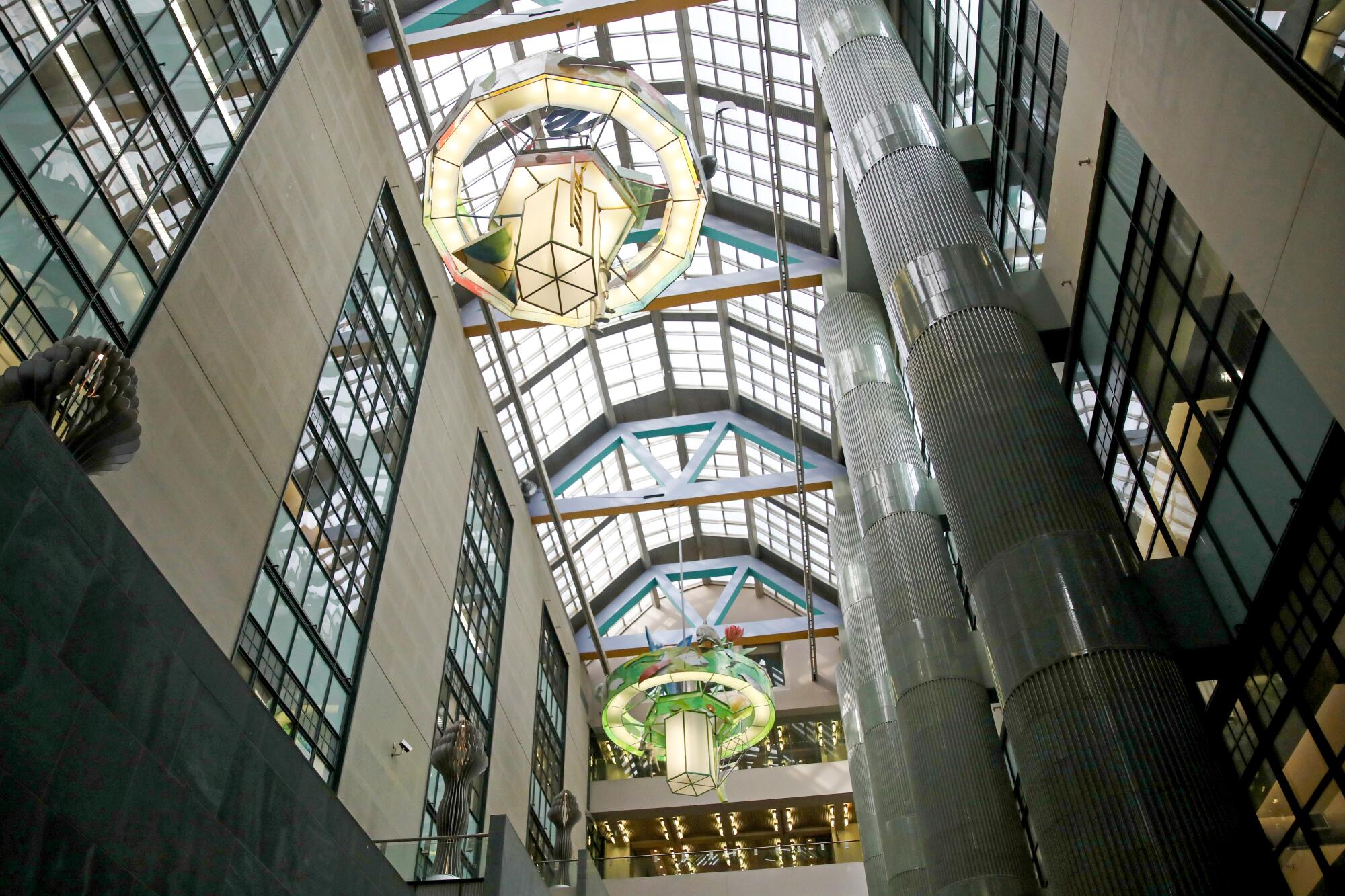
The glass-roof atrium at the Los Angeles Central Library.
(Gary Coronado / Los Angeles Times)
Libraries are one of the most powerful resources for anyone, let alone older Angelenos, but they remain a vital hub of our communities, particularly for our aging residents. I stopped by my local library recently — the Lincoln Heights Branch, housed in the beautiful Italian Renaissance Revival building funded by Andrew Carnegie in 1916 — which was filled with older Angelenos quietly reading or on the computer.
It’s no surprise, as the library is a friendly place for older people. For those with limited vision, the library is packed with large-print books. Looking to catch up to technology so you can keep in touch with loved ones? The library has tutorials on basic computer skills from Gmail to Instagram. And the library caters to homebound patrons with a program linking them with neighbors who can pick up and drop off materials.
Not only that, but your library card comes with a bevy of perks through the library’s Discover & Go program (have your library card handy to enter the site). On offer right now are four complimentary passes to the L.A. Zoo and Botanical Gardens, free tickets to select screenings at the Academy Museum (normally $10), and deeply discounted L.A. Kings tickets to select games.
“Your library card is worth its weight in gold these days because of the tremendous resources available at our libraries,” says Trejo.
What’s the 211?
211 LA is the city’s hub of resources for nonprofit services, connecting Angelenos with everything from suicide hotlines to nonprofits that will help them quit smoking. There’s a whole page called the Aging and Disability Resource Connection that helps older Angelenos find a caregiver, navigate health insurance and even offers legal services.
“When in doubt, reach out to 211,” Trejo says. “They are my partners. They are my information and referral provider for all of L.A. County. And they are actually there. They work with us. We train them, we share resources with them so that they’re always up to date on services and support available for older adults and their families.”
Stay connected
As we get older, keeping in touch with friends and loved ones seems to get more important, but it can come at a high cost. If you’re low income, that can be a burden. The state has a program called California LifeLine that offers low-income older people discounts on cellphones or home phones of up to $19 per month. That may or may not cover the whole bill, but it’ll help keep you in touch.

For Iris van Herpen, couture is a laboratory as much as a runway. Our chief fashion critic, Vanessa Friedman, takes us inside this Dutch designer’s latest Paris show — from sci-fi-inspired gowns to an audacious attempt at a dress made of charged plasma.
Lifestyle
The BoF Podcast | Decoding Paris Haute Couture: Wonder, Restraint and the Call of the Void


-

 Detroit, MI3 minutes ago
Metro Detroit weather forecast, July 10, 2026 — 11 p.m. Update
-

 San Francisco, CA13 minutes ago
Classical music series helps reconnect downtown San Francisco community
-

 Dallas, TX17 minutes ago
Dallas police officers, paramedics recall saving woman stuck in a ravine for days;
-

 Boston, MA27 minutes ago
Red Sox win 7th straight game just hours after landing in New York
-
 Denver, CO33 minutes ago
One tree at a time: Denver nonprofit works to close shade gap as heat dome threatens neighborhoods
-

 Seattle, WA39 minutes ago
VIDEO: West Seattle Summer Fest 2026 day 1, evening report
-

 San Diego, CA43 minutes ago
The World’s Number One Wellness Retreat is Right in Our Backyard
-
 Milwaukee, WI48 minutes ago
Festivalgoers say Milwaukee’s summer events fill a gap in downtown entertainment

