Lifestyle
Star Bassist Carol Kaye rejects Rock & Roll Hall of Fame honor


Bassist Carol Kaye plays an Epiphone hollowbody electric guitar in April 1966 in Los Angeles, California.
Jasper Dailey/Michael Ochs Archives/Getty Images
hide caption
toggle caption
Jasper Dailey/Michael Ochs Archives/Getty Images
Carol Kaye, one of the most prolific bassists in rock and pop history, said she does not want to be inducted into the Rock & Roll Hall of Fame.
The in-demand musician, who collaborated with Barbra Streisand, Stevie Wonder, The Beach Boys and The Supremes among many other hitmakers starting in the 1960s, was listed as a 2025 Hall of Fame inductee in April alongside the late record producer Thom Bell and the late pianist Nicky Hopkins in the Musical Excellence category. The category honors artists whose “originality and influence have had a dramatic impact on music.”
Kaye, 90, announced her decision to turn her back on one of rock music’s most famous accolades on Facebook earlier this week, according to Bass Magazine and other outlets.
The magazine described the news of Kaye’s induction as “as a triumph to her fans and to bassists everywhere.” (Very few women bassists have been inducted into the Rock & Roll Hall of Fame. Others include Tina Weymouth of Talking Heads and The Go-Go’s Kathy Valentine.)
Kaye’s Facebook post was taken down on Thursday, but Bass Magazine and other outlets shared its contents: “It wasn’t something that reflects the work that Studio Musicians do and did in the golden era of the 1960s Recording Hits…….. you are always part of a TEAM, not a solo artist at all,” Kaye reportedly wrote on Facebook. “I refuse to be part of a process that is something else rather than what I believe in, for others’ benefit and not reflecting on the truth — we all enjoyed working with EACH OTHER……..Thank-You for understanding.”
Another likely issue is Kaye’s aversion to the name “Wrecking Crew.” Coined by drummer Hal Blaine, it was given to a group of in-demand session musicians in the 1960s and 70s which included, among others, Blaine, Dr. John, Glen Campbell, and Kaye. Kaye has publicly refuted the name in the past, including in her now-deleted Facebook post: “I was never a ‘wrecker’ at all….that’s a terrible insulting name.”
The Rock & Roll Hall of Fame does not reference The Wrecking Crew in connection with Kaye in its current online content about the artist. But an old version of the artist’s biography on the Rock & Roll Hall of Fame website does explicitly connect Kaye to this group: “A first-call member of the elite stable of Los Angeles session musicians known as the Wrecking Crew, Kaye played on an estimated 10,000 recordings, making her one of the most recorded bassists in history,” the biography states.
Neither the Rock & Roll Hall of Fame nor Kaye immediately responded to NPR’s requests for comment.
In a Facebook post on Thursday, musician Benny Goodman, who goes by the moniker The Neurotic Guitarist and has close to 45,000 subscribers on YouTube, said the Rock & Roll Hall of Fame, “kept saying she [Kaye] was from The Wrecking Crew over and over.” Goodman, who described Kaye as being like “a grandma” to him, added: “That name holds trauma for her.”
Kaye isn’t the first potential inductee to push back against the accolade. Dolly Parton initially rejected her induction in 2022. The county music star posted a statement on social media saying she was grateful for the nomination, but didn’t think she had necessarily “earned that right.” Despite her qualms, the artist ultimately acquiesced and went ahead with the induction.
The 2025 Rock & Roll Hall of Fame induction ceremony will take place on Nov. 8 at the Peacock Theater in Los Angeles.



Lifestyle
Cheddar bay biscuits, cheap margs and memories: Readers share their nostalgia for chain restaurants

Affordable, familiar and reassuring are the features that make American chain restaurants a near-ubiquitous presence throughout the country; it is almost as if they are baked into our roadside culture.
Despite well-documented financial struggles, a tough economy and shifting diet trends, these restaurants withstand time.
This series explores why these places have such strong staying power and how they stay afloat at a time of rapid change.
Read our first three pieces in this series, including how these restaurants leverage nostalgia to attract diners, how they attempt to keep costs affordable, and how social media has changed the advertising game – and become a vital key to restaurants’ success.
America’s chain restaurants are not the most glamorous places to eat. And yet, as we’ve reported, they hold a special place in many Americans’ hearts.
We asked readers what comes to mind when they think of restaurants like Olive Garden, Applebee’s or Texas Roadhouse — and you shared plenty of stories.
Not all of the respondees waxed poetic about the merit of these restaurants. David Horton, 62, from New York, for example, said: “The food is mostly frozen and only has flavor from the incredible amounts of sodium they use.”
But overwhelmingly, responses described vivid childhood memories shared in booths looking excitedly over laminated menus and the type of adolescent rites of passage that seem right at home in the parking lot of a suburban chain restaurant.
There’s a science behind why these sorts of memories have such a hold on us.

The feeling of nostalgia is linked closely to food and smell, and these restaurant chains are often where core memories – like graduation celebrations or first dates – are made.
Chelsea Reid is an associate professor at the College of Charleston who studies nostalgia. And she’s no more immune to nostalgic feelings than anyone else even though she has a better understanding of the chemistry behind the feeling.
“Even just saying Red Lobster, I can kind of picture the table and the things that we would do and the things we’d order, and my mom getting extra biscuits to take home,” she said.

A Red Lobster restaurant is seen in Fairview Heights, Ill., in 2005.
James A. Finley/AP
hide caption
toggle caption
James A. Finley/AP
Her nearest Red Lobster closed down, but a local farmers’ market sells a scone reminiscent of Red Lobster’s famed Cheddar Bay Biscuits – a scent she says immediately transports her back to those childhood family outings to the seafood chain.
“I can see my mom wrapping these up in a napkin and putting them in her purse for when we would be like, ‘hey, we’re hungry,’ and she pulls out a purse biscuit.”
Full disclosure: Your intrepid reporters are not without sentimentality. Before launching this project, when it was just a kernel of an idea, we talked frequently about the role these restaurants played in our own lives.
Jaclyn: I distinctly remember cramming into a booth at my local Chili’s in my hometown, Cromwell, Ct., for most birthday dinners until the age of 13 or so.
I’d be surrounded by my mom, dad and brother, and I got to pick whatever I wanted. Except I always chose the same thing: Chicken crispers with a side of fries, topping the night off with the molten lava chocolate cake we’d share as a family.
I can picture it so clearly, down to the booth we’d sit in. Now, my family is spread out. But my love for Chili’s runs deep, and I still get warm and fuzzy when I think about it.
These days, I’m in my 30s, and I need to worry about my health and getting in 10,000 steps a day. So, no, I don’t regularly go to Chili’s now.
But when I do? Those chicken crispers I had as a kid are still on the menu, and yes, I’m likely to order them today (even if on my adult tastebuds, the salt content quickly turns my mouth into the Sahara Desert).
And it’s not to celebrate my birthday. It’s because one of my best friends is telling me she’s getting a divorce over cheap, and sugary, margaritas.
Alana: When the pandemic struck in 2020 and much of the country went into lockdown, there I was mostly alone in my one bedroom apartment, staring at the walls.
After what seemed like a lifetime, I was finally able to expand my tiny COVID bubble.
One of my first “dining out” experiences during that time was in the parking lot of the Hyattsville, Md., Olive Garden where my friend and I sat in absolute glee to be reunited – not just with one another, but also the chain’s staple soup (zuppa toscana for me, please), salad and breadsticks (you can have all the breadsticks if I can have your share of the salad tomatoes).
Since then, that friend and many others have moved away – too far to meet up for a sit-down over a (mostly) hot meal at a reasonably priced restaurant in a city not famed for being cheap.
I recently revisited the Hyattsville Olive Garden for this story. And even though my life is now different, my friends have moved away, and the world has shifted, there it was, exactly the same.
And I liked it.
Many readers said that these restaurants were the type of place a family who could rarely afford to eat outside a home could treat themselves on rare occasions.
Like Julie Philip, 51, from Dunlap, Ill., who wrote: “Growing up in the 70’s and 80’s, Red Lobster was an Easter tradition. We would dress up, go to church, then drive close to an hour to Red Lobster.”

She continued, “It was one of only a few days a year that we could afford to eat at a ‘fancy restaurant.’ I remember my parents remarking that they had to spend $35 for our family of four. I no longer consider Red Lobster a ‘fancy restaurant,’ but as an adult, my family and I often still eat there at Easter. I remind my kids that we are keeping up a family tradition and I tell them stories of my childhood while eating.”
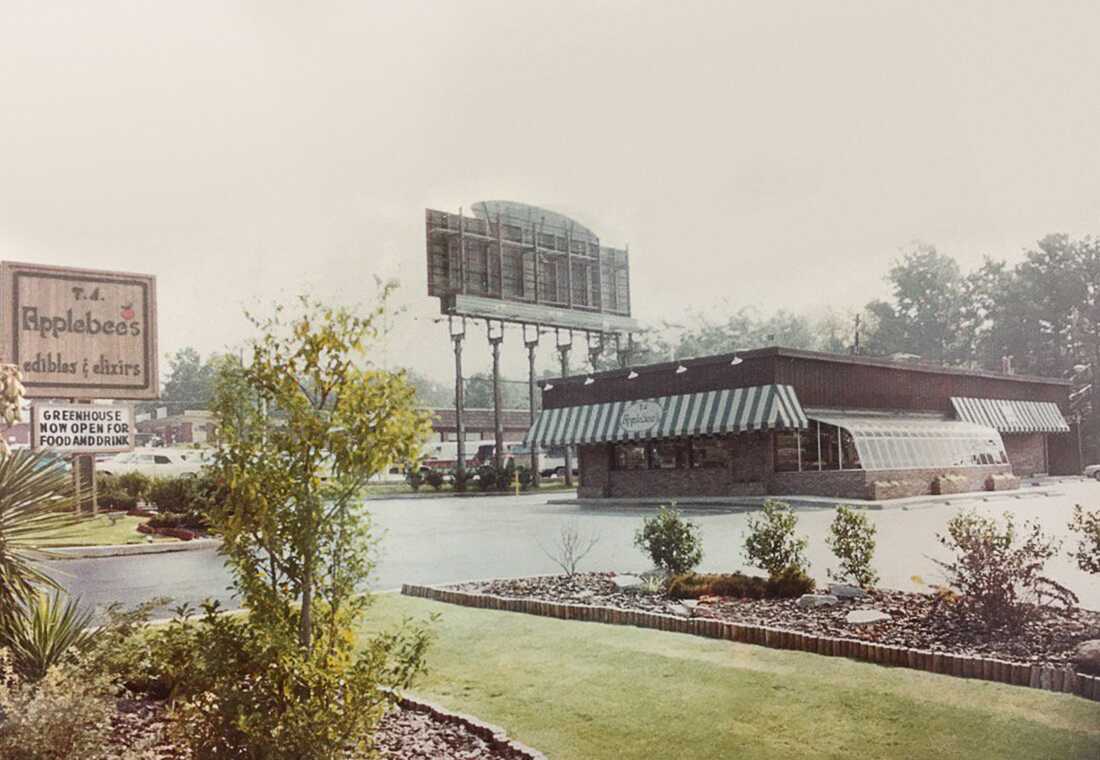
The original Applebee’s restaurant was called T.J. Applebee’s Rx for Edibles & Elixirs and it opened in Decatur, Ga., in 1980.
Applebee’s
hide caption
toggle caption
Applebee’s
For Sarah Duggan, an Applebee’s parking lot evokes a key memory from young adulthood.
Duggan, 32, from North Tonawanda, N.Y., wrote that every time she sees an Applebee’s, she remembers the time her friend, in an act of teenage rebellion, got her belly button pierced in the parking lot of a Long Island Applebee’s — inside the trunk of the piercer’s “salvage-title PT Cruiser.”
Duggan held the flashlight.
She wrote, “I can’t picture those sorts of college kid shenanigans happening in the parking lot of a regular Long Island diner or other independent restaurant, but it seems right that it was at Applebee’s.”
She continued, “It makes me think about how nobody, from riotous camp counselors to your spouse’s grandparents, looks or feels out of place at a chain restaurant.”


NASCAR’s Gregg Biffle
Jet Turns Into Ball Of Flames …
Shocking Video Shows
Published
Brevin Renwick
Horrifying new video shows the precise moment a plane carrying NASCAR driver Greg Biffle and his family crashed and exploded in flames Thursday, killing everyone on board.
Security footage captured the corporate jet turning into a ball of fire as it crash-landed near a runway at Statesville Regional Airport in North Carolina. The aircraft was scheduled to fly to Florida, but not long after takeoff, it turned back to the airport before crashing.
As you can see from the clip, the plane was reduced to what looks like a burning oil slick with black smoke rising into the sky. All seven people on the plane died, including Biffle, his wife, Cristina and two children — Emma, 14, and Ryder, 5.
PEOPLE reported minutes before impact, Cristina sent her mom a chilling text, stating, “We’re in trouble.”
The Federal Aviation Administration is investigating the cause of the crash.

President Donald Trump stands in the presidential box as he visits the John F. Kennedy Center for the Performing Arts in Washington, D.C, on March 17, 2025.
Jim Watson/AFP via Getty Images
hide caption
toggle caption
Jim Watson/AFP via Getty Images
The John F. Kennedy Center for the Performing Arts will now have a new name — the “Trump-Kennedy Center.” White House press secretary Karoline Leavitt announced the news on social media Thursday, saying that the board of the center voted unanimously for the change, “Because of the unbelievable work President Trump has done over the last year in saving the building.”
Shortly after the announcement, Ohio Democrat Rep. Joyce Beatty, an ex-officio member of the board, refuted the claim that it was a unanimous vote. “Each time I tried to speak, I was muted,” she said in a video posted to social media. “Participants were not allowed to voice their concern.”
When asked about the call, Roma Daravi, vice president of public relations at the Kennedy Center, sent a statement reiterating the vote was unanimous: “The new Trump Kennedy Center reflects the unequivocal bipartisan support for America’s cultural center for generations to come.”
Other Democrats in Congress who are ex-officio members of the Kennedy Center Board, including Sen. Chuck Schumer and Rep. Hakeem Jeffries issued a statement stating that the president is renaming the institution “without legal authority.”
“Federal law established the Center as a memorial to President Kennedy and prohibits changing its name without Congressional action,” the statement reads.


Earlier this year, Trump installed himself as the chairman of the center, firing former president Deborah Rutter and ousting the previous board chair David Rubenstein, along with board members appointed by President Biden. He then appointed a new board, including second lady Usha Vance, White House Chief of Staff Susie Wiles, Fox News host Laura Ingraham and more.

Trump hinted at the name change earlier this month, when he took questions before becoming the first president to host the Kennedy Center Honors. He deferred to the board when asked directly about changing the name but said “we are saving the Kennedy Center.”

The president was mostly hands off with the Kennedy Center during his first term, as most presidents have been. But he’s taking a special interest in it in his second term, touring the center and promising to weed out programming he doesn’t approve of. His “One Big Beautiful Bill” included $257 million for the building’s repairs and maintenance.
Originally, it was called The National Cultural Center. In 1964, two months after President Kennedy was assassinated, President Lyndon Johnson signed legislation authorizing funds to build what would become the John F. Kennedy Center for the Performing Arts.

Detroit Fire Department brings Christmas joy to family who lost everything in house fire

New SF supervisor supports reopening Great Highway on weekdays

Don Stone, Dallas philanthropist and arts advocate, dies

Jumpshots Galore: Keys for the Miami Heat to overcome the Boston Celtics

Power outages in Massachusetts affecting tens of thousands amid stormy weather

Florida High School Football Rankings: Top 25 teams – Oct. 21

Cleary's 21 help Le Moyne down Central Connecticut State 69-64 in OT

How old is Bo Nix? What to know about Oregon quarterback ahead of 2024 NFL Draft

99th annual Pony Swim held in Virginia

Video: ‘It Didn’t Have to Happen This Way:’ U.Va. Faculty Call for Review of Police Response to Protests

Takeaways from an eventful 2025 election cycle

Judge tosses Trump-linked lawsuit targeting Chief Justice Roberts, dealing setback to Trump allies

Who was Osman Hadi; why is Bangladesh on fire over his death?

Putin tells news conference that Kremlin’s military goals will be achieved in Ukraine

Video: Trump Mocks Obama, Biden in His Presidential ‘Walk of Fame’
-

 Iowa5 days ago
Addy Brown motivated to step up in Audi Crooks’ absence vs. UNI
-

 Iowa6 days ago
How much snow did Iowa get? See Iowa’s latest snowfall totals
-

 Maine3 days ago
Elementary-aged student killed in school bus crash in southern Maine
-

 Maryland5 days ago
Frigid temperatures to start the week in Maryland
-

 Technology1 week ago
The Game Awards are losing their luster
-

 South Dakota5 days ago
Nature: Snow in South Dakota
-

 Nebraska1 week ago
Nebraska lands commitment from DL Jayden Travers adding to early Top 5 recruiting class
-

 Sports1 week ago
Pro Football Hall of Famer Troy Aikman critiques NIL landscape, transfer rules and Lane Kiffin’s LSU move