Lifestyle
Seeking a simpler life, he built an urban homestead. Now his family keeps it growing

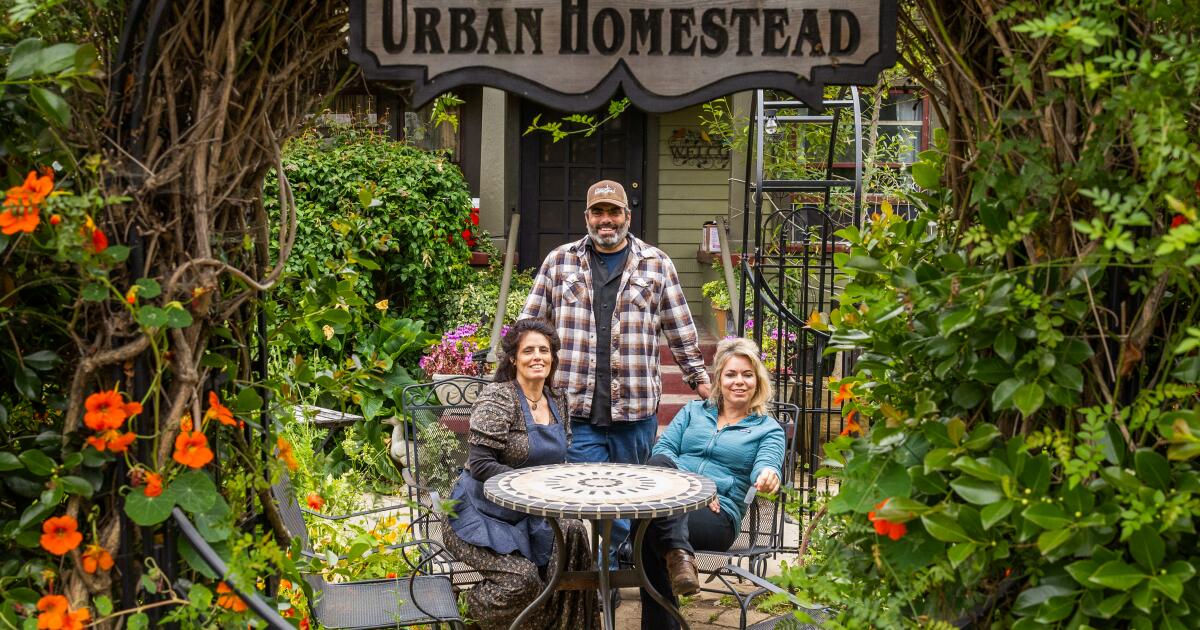
In 1984, a determined back-to-earther named Jules Dervaes Jr. brought his wife and children from a 10-acre farm in rural Florida to study theology in Pasadena but ultimately decided on a different ministry: creating a self-sufficient urban farm on a rundown residential property less than a block from the 210 freeway.
Jules Dervaes Jr. didn’t have a long-range plan when he started an organic farm in the front and back yards of his Pasadena home, but he did have a vision of creating a simpler life that his children continue today, nearly eight years after his death.
His wife left not long after — homesteading was not the life she signed up for — but his four children, now in their 40s, remained and today three of the four still work the farm known as the Urban Homestead, providing produce and flowers to more than 100 subscribing families every week, along with multiple restaurants and caterers.
“At first we were just gardening to grow food for our family, but then Dad took on organic gardening as a business,” said Anäis Dervaes, the eldest daughter. “In 1989, we took out our front yard — even the concrete — to grow more food, and our neighbors thought we were crazy, but the business took off, so you can make a living by removing your lawn.”
And, as all farmers know, working very hard.
Dervaes died in 2016 from a pulmonary embolism, but his children Anäis, 49, Justin, 46, and Jordanne, 41, keep building on his vision. Through the nonprofit Urban Homestead Institute established in 2001, they provide food boxes for needy families, offer internship positions to volunteers who want to help at the farm and welcome scores of schoolchildren to see how real food is grown — a program that started after Dervaes encouraged Anäis to try a new thing called blogging in 2000.
It was a time of big protests against genetically modified food, and Anäis wanted to join the demonstrators, “but Dad said, ‘What if we just write about what we’re doing here on a daily basis, living a simple life?’ And I think I said something like, ‘So I’ll write, ‘Today I harvested corn?’ Nobody is going to care about that.’”
But as it turned out, people did. The family got a following, and teachers from Compton High School wrote, asking if they could bring some students to tour their urban farm, “and we’ve been doing outreach with students ever since,” Anäis said.
Not as much as they’d like to, because space is at such a premium they can only accommodate small groups. The garage is now a small store and distribution center for food boxes. The covered patio is a place for classes, demonstrations and their homemade pizza oven. The driveway is lined with trays of plant and flower seedlings. Chickens and ducks live in a rustic L-shaped structure in the back and fruit trees line the property’s perimeter. The rest of the yard is filled with raised beds planted thickly with vegetables, herbs and flowers, accessible by narrow walking paths.
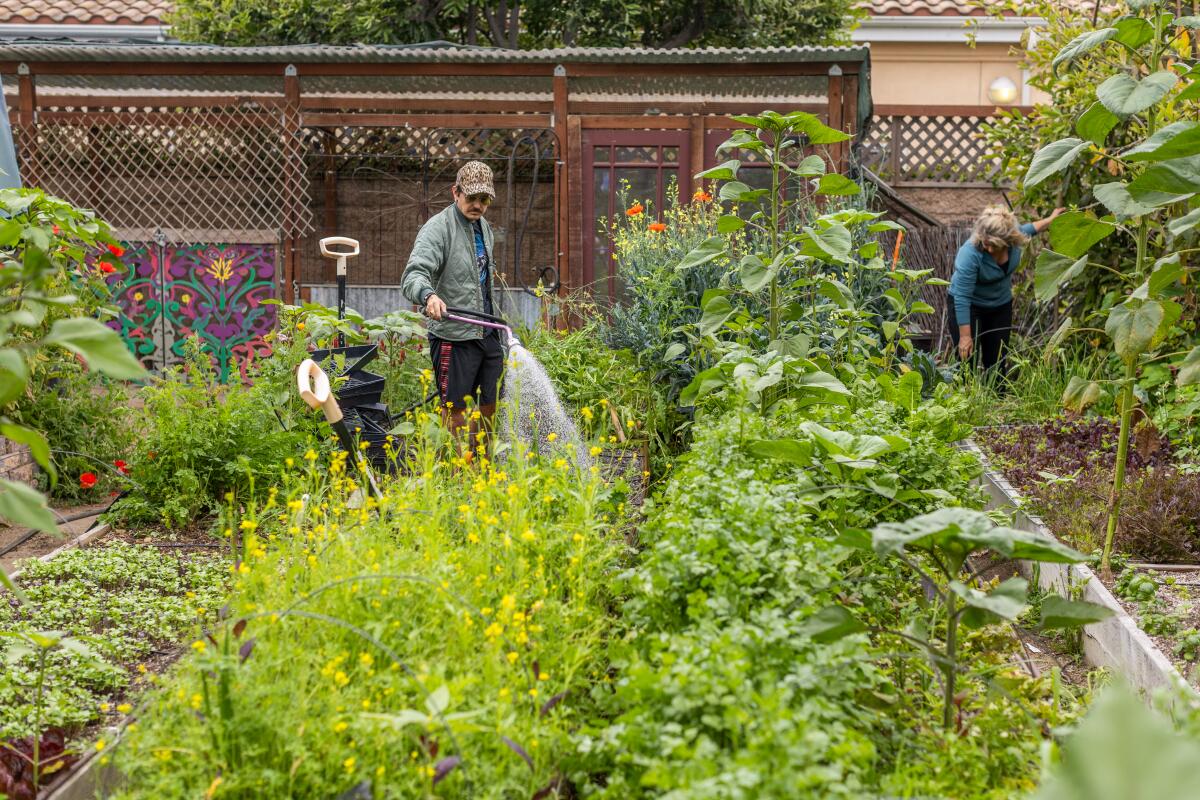
Volunteer and customer Tristan Lahoz, left, and Jordanne Dervaes tend to the densely planted beds at Urban Homestead.
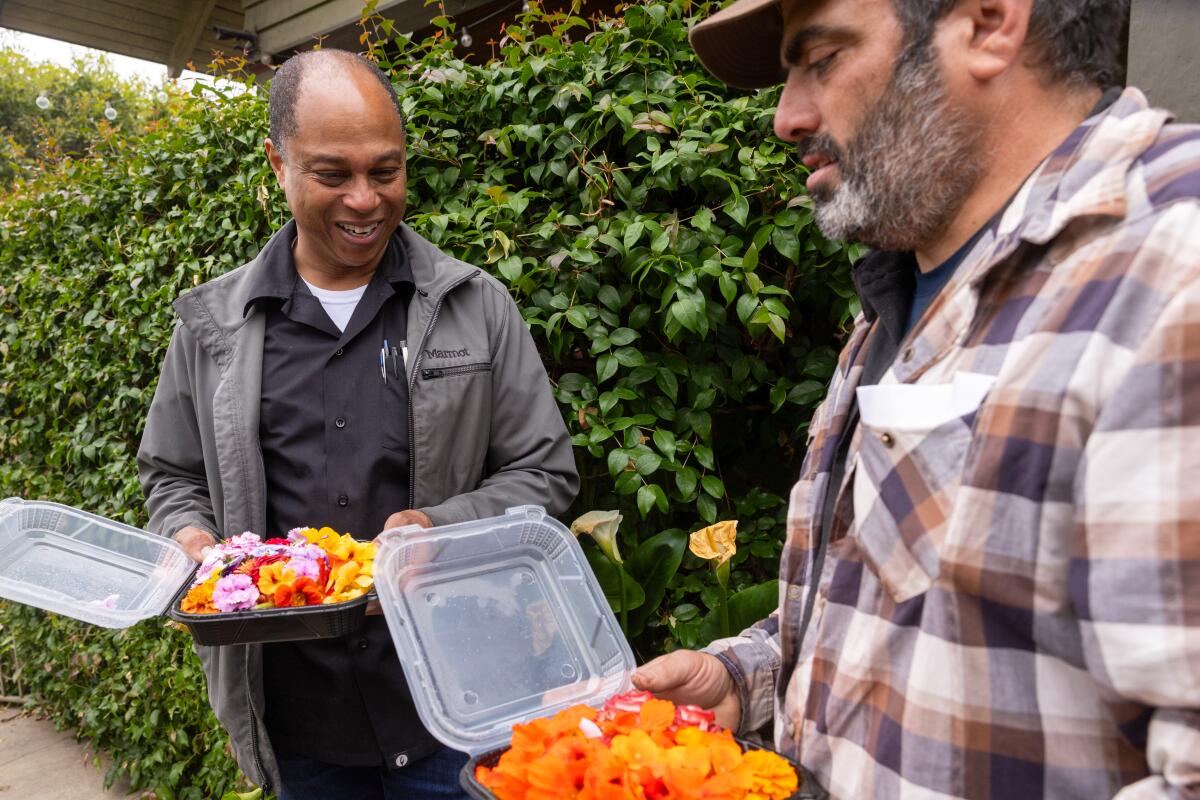
Chef Onil Chibas, left, picks up his order of edible flowers and salad greens from farmer Justin Dervaes.
But you don’t have to do much walking to see plenty at the Urban Homestead. Almost every bed has dense plantings of something — lettuces, spinach, arugula and red-stemmed dandelions (a zesty salad green) — embellished with sunflowers. There’s a big bin of compost-enriched soil where a handheld seed block contraption gets regular use, pressing out four uniform cubes of soil in one squeeze that can easily fill a tray and just as easily be planted once the seeds sprout and grow — a critical tool when you’re constantly harvesting and replanting.
The garden is busy with butterflies, bees and other beneficial insects, especially out front, where flowers are the predominant crop, a jungle of red Flanders poppies and fragrant sweet peas (for bouquets) and sunny nasturtiums, calendulas and roses (for eating).
Dervaes’ children aren’t getting rich, but they’re making a living, thanks to long hours, few expenses and the courage to experiment. The family installed solar panels back in 2003 and a greywater system that keeps their water bill under $1,000 a year. For a time they even recycled cooking oil from local restaurants to make their own biodiesel for their diesel truck, and in 2009, they made a short film called “Homegrown Revolution” that won awards at multiple film festivals.
A few years ago, they used a rent-to-buy plan to acquire a neighbor’s home two doors down and expanded their farm to its front yard. Jordanne, and Anäis live there now, while Justin lives in the main house, oversees the main farm operation and rents out a couple of the bedrooms.
Anäis calls herself the “cook and educator,” making products like jams and teaching workshops in knitting and other home skills. Jordanne, the youngest, oversees their bee hives (kept at another location) and their flock of chickens and ducks, a job she’s had since she was a child. All three do outside consulting on various aspects of gardening, homesteading and raising chickens, which led to Occidental College recruiting Jordanne to teach a popular class in regenerative gardening and sustainable animal care, with occasional input from her siblings. And just recently, Jordanne got her real estate license to pursue her interest in preserving old homes.
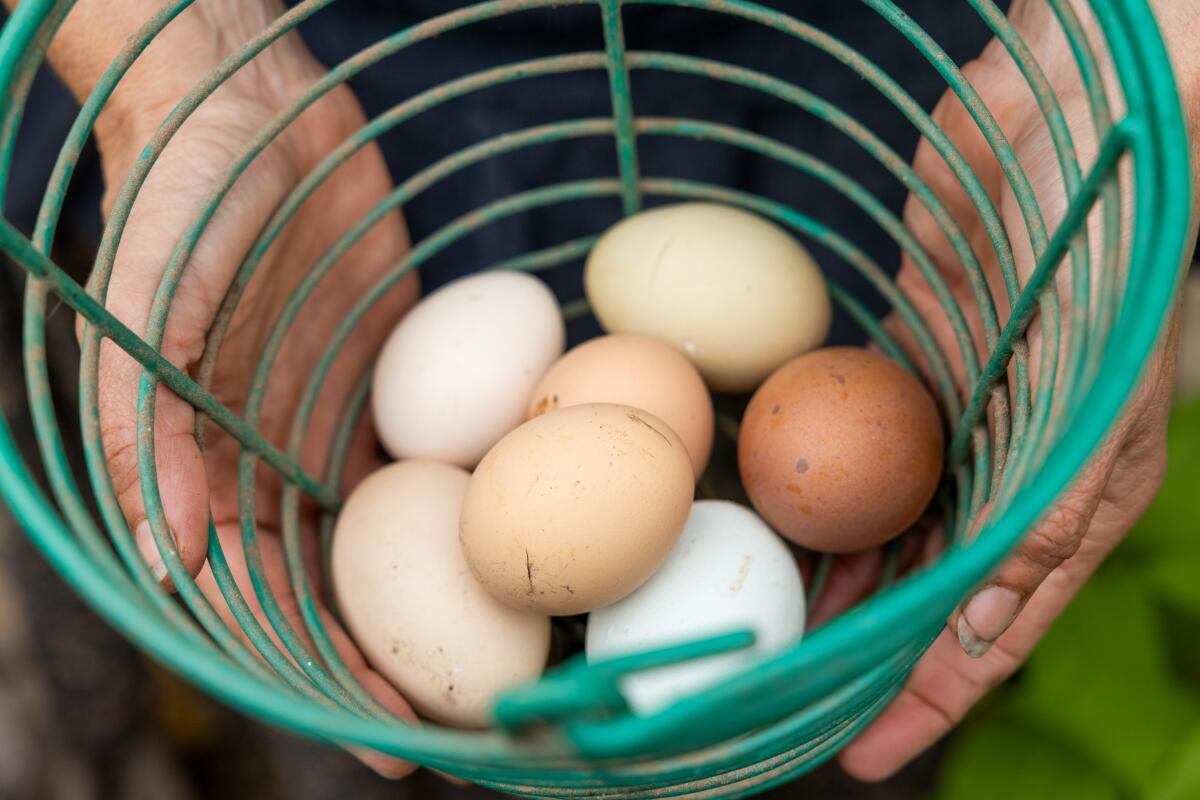
The Urban Homestead’s poultry eat much of the farm’s garden waste and provide plenty of nutrient-rich poop to feed the soil. Their eggs are an added bonus for the family.
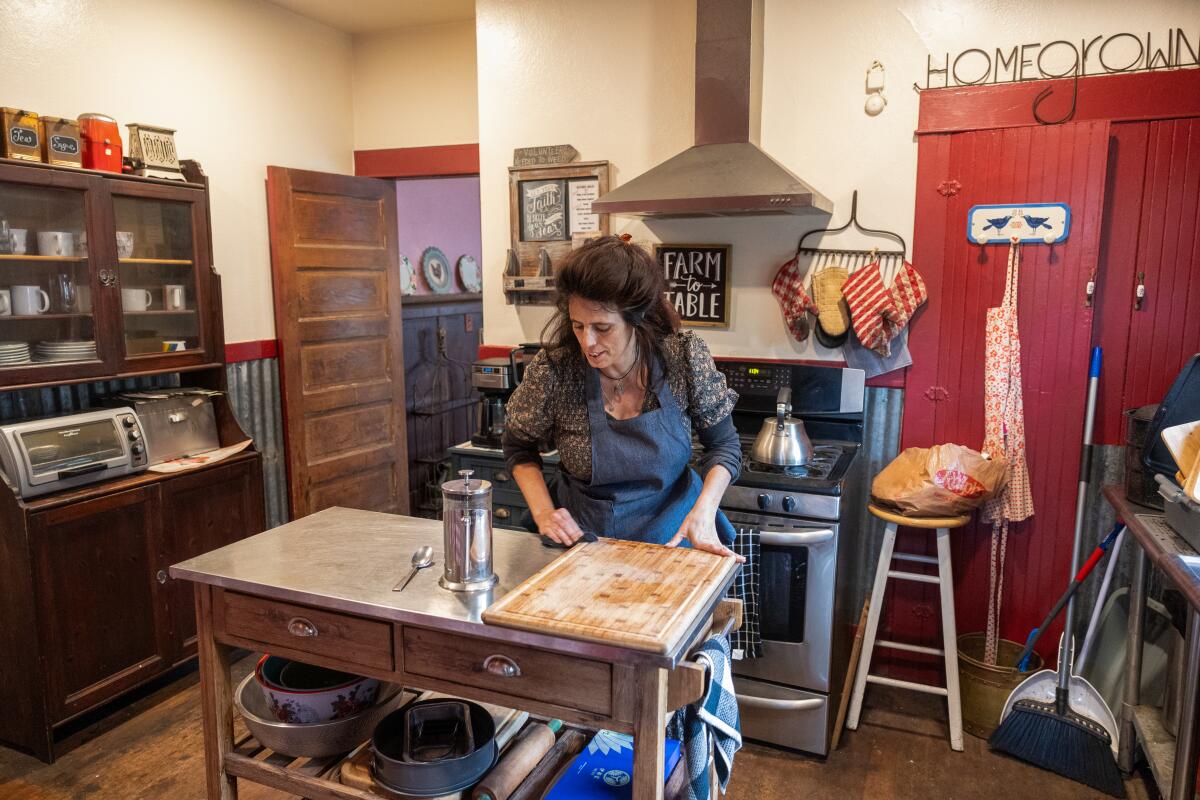
Anäis Dervaes tidies up the kitchen at her family’s house, built in 1917.
But the family farm is still their main focus, and it keeps them so busy that it interferes with their dating lives, said Anäis. All three are single and would like long-term relationships someday, but it’s hard to find people who share their priorities.
“The dating life is just something we haven’t mastered yet,” said Jordanne, laughing. “I can take on any challenge, but this one baffles me.”
Partly it’s time and partly it’s priorities, Anäis said, like when she gets frost warnings on her phone and has to cut a date short so she can run home to cover crops to protect them from damage.
“We live a farming lifestyle in the city, so we look at things different than most city dwellers, and they don’t always understand,” Anäis said. “But this is our livelihood; this is our life.”
It wasn’t always wonderful, she said. They became a vegetarian household when they were all very young, and as teenagers they all had moments of rebellion. They were homeschooled, but neighborhood kids taunted them about what they were missing — Nikes and hamburgers and sodas in a can.
“We were just granola kids, running around barefoot on the street, and I was feeling like I didn’t fit in,” said Anäis. “I’d say, ‘Dad, why do we have to shop at thrift stores? Why do we only eat out of the garden? Why don’t we eat normal stuff instead of Swiss chard?’”
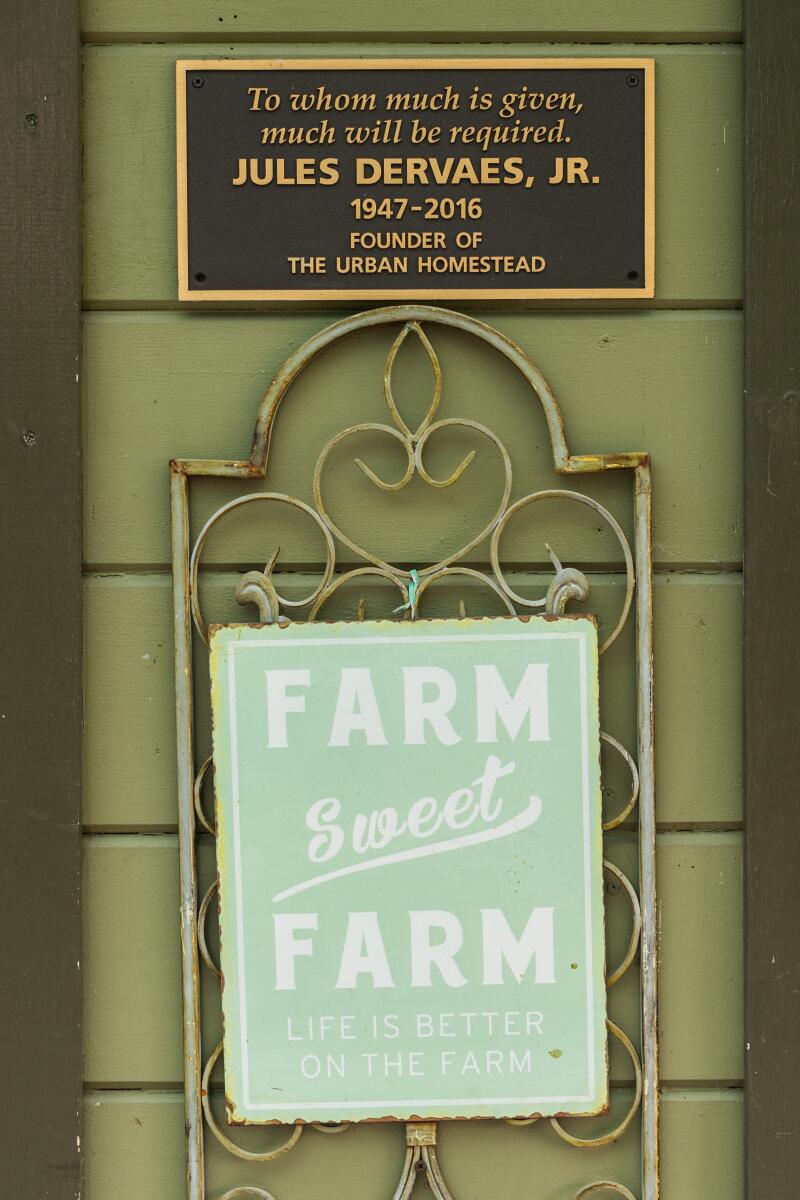
A plaque memorializes Jules Dervaes Jr.
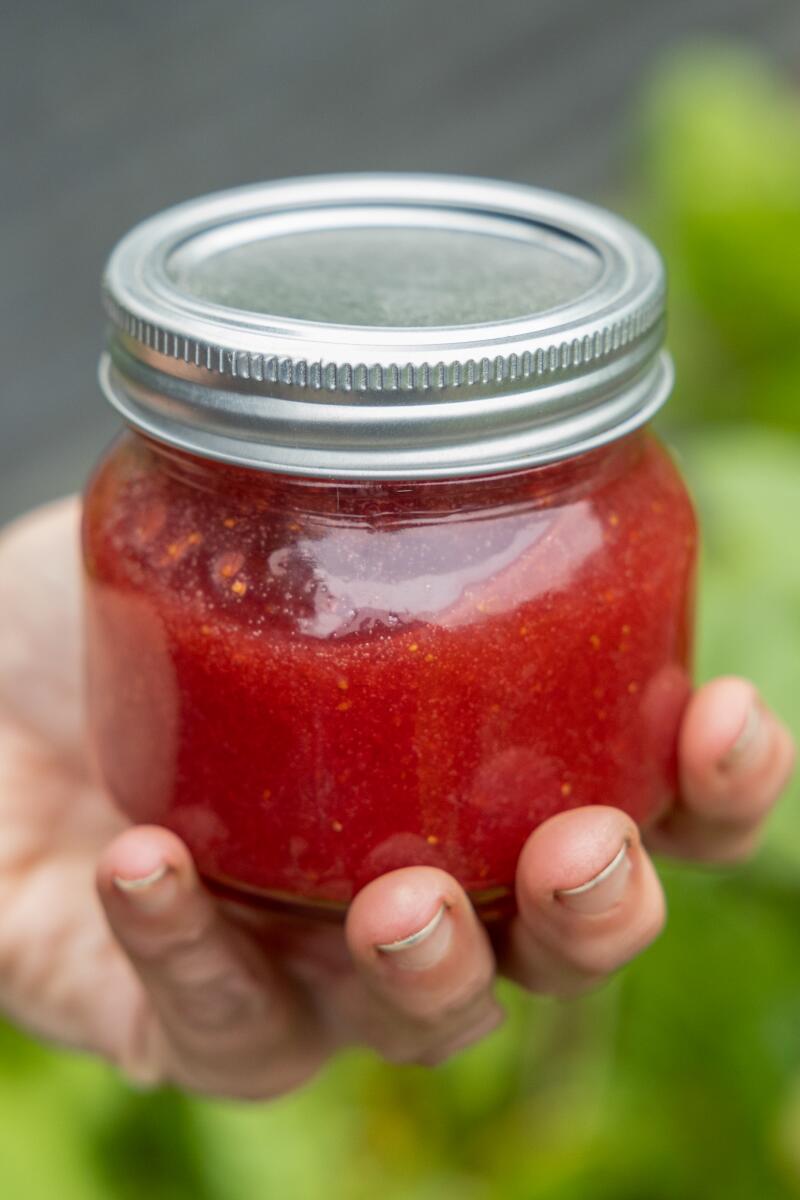
Handmade jams are available at Urban Homestead.
But once she read the book that inspired her father’s vegetarianism, John Robbins’ ”Diet for a New America,” “It was like a light bulb went off,” she said, “and this lifestyle became mine.”
It wasn’t like their father forced them to do what they didn’t want to do, Jordanne said. “We had a lot of pushback, but he always encouraged us to question everything in our lives,” she said. “And we had responsibilities. There was a sense of pride in growing all these plants, and the business was ours. Dad would always say, ‘If you want to do it, read about it and go do it.’ He challenged us to learn and do our own problem solving.”
There were some limits — Jordanne’s desire to have a horse and a cow just wasn’t possible — but ultimately, it was the freedom to experiment that drew them back whenever they strayed, Anäis said. “There was a sense of identity here, and family survival. It gave us purpose and a passion. I would plant on the moon if I had to.”
The farm is open to visitors the second Sunday of every month, during two-hour “Learning Tours” (tickets are $75). But Justin has a few tips for people who want to remove their lawn and become urban microfarmers — or just landscape with food.
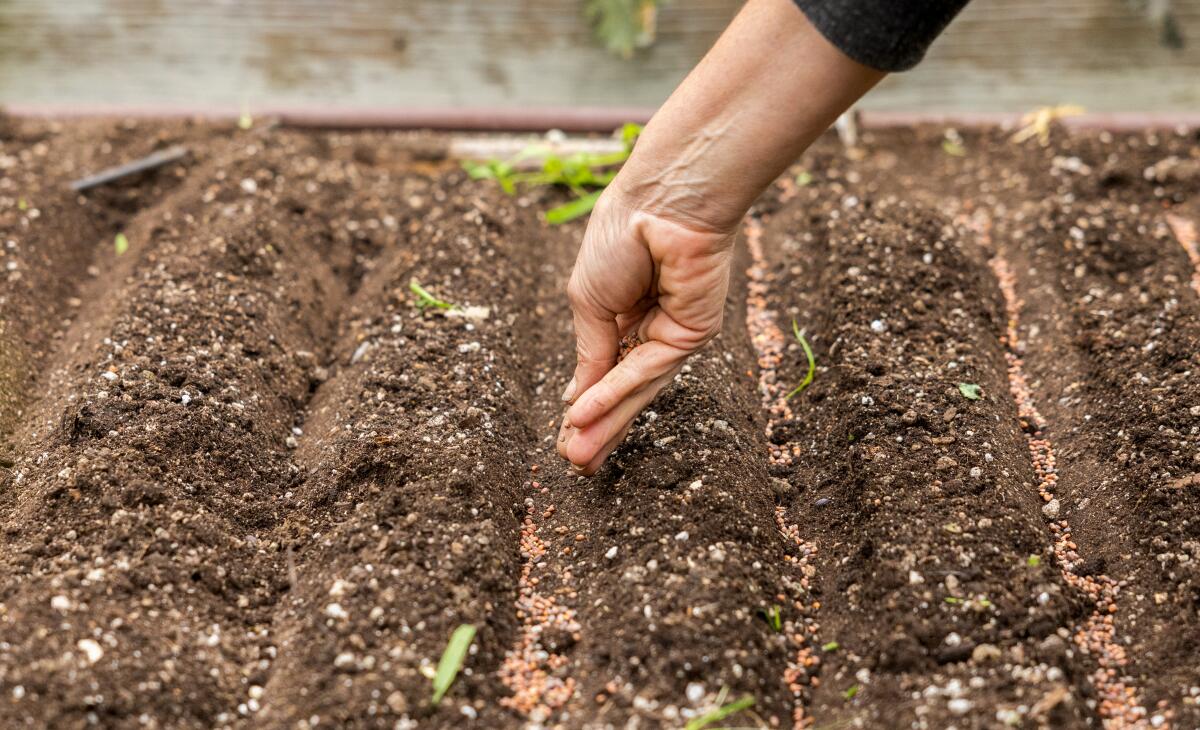
Salad mix seeds planted at Urban Homestead.



Britney Spears
Open to Treatment Plan After DUI Arrest, Source Says
Published
Britney Spears‘ team is hoping the judge mandates treatment for the pop star over jail time following her Wednesday DUI arrest … and Britney isn’t fighting them on that, TMZ has learned.
Sources familiar with the situation tell TMZ … Britney is willing to comply with a treatment and support plan.
We’re told her team is in the early stages of developing a plan and they’re exploring multiple options, including mental health services, detox, and dual-diagnosis programs.
It’s unclear whether she would do inpatient or outpatient treatment, and it’s also unclear whether she would enter treatment before her May 4 court date.
Broadcastify.com

We broke the story … Britney was pulled over by California Highway Patrol officers around 9:30 PM Wednesday in Westlake Village, CA, not far from her home. She was later taken to a hospital — not for any injuries, because we’re told she didn’t sustain any — but to draw her blood to determine her blood alcohol content.
According to CHP, she was arrested for “driving under the influence of a combination of drugs and alcohol.”
Sources familiar with the investigation told us an unknown substance was found in Britney’s car, which was sent to be tested.
Britney’s manager, Cade Hudson, previously told TMZ … “This was an unfortunate and inexcusable incident. Britney will take the right steps, comply with the law, and we hope this marks the start of long-overdue change in her life. She needs help and support during this difficult time. Her boys will be spending time with her, and her loved ones are putting a plan in place to set her up for success and well-being.”

Michael B. Jordan plays twin brothers Smoke and Stack in Sinners.
Warner Bros. Pictures
hide caption
toggle caption
Warner Bros. Pictures
Ryan Coogler’s supernatural horror stars Michael B. Jordan playing twin brothers who open a 1930s juke joint in Mississippi. Opening night does not go as planned when vampires appear outside. “In a straightforward metaphor for all the ways Black culture has been co-opted by whiteness, the raucous pleasures and sonic beauty of the juke joint attract the interest of a trio of demons … they wish to literally leech off of the talents and energy of Black folks,” writes critic Aisha Harris. The film made history with a record 16 Academy Award nominations.


We asked our NPR audience: What movie would you recommend to someone who loved Sinners? Here’s what you told us:
Near Dark (1987)
Directed by Kathryn Bigelow; starring Adrian Pasdar, Jenny Wright, Lance Henriksen
If you want another cool vampire movie with Western kind of vibes, check out Kathryn Bigelow’s Near Dark — super underseen and kind of hard to find, but really gritty and sexy and another very different take on what you might think is a genre that had been wrung dry. – Maggie Grossman, Chicago, Ill.
30 Days of Night (2007)
Directed by David Slade; starring Josh Hartnett, Melissa George, Danny Huston
It follows a group of people in a small Alaskan town as they struggle to survive an invasion of vampires who have taken advantage of the month-long absence of the sun. Both this and Sinners revolve around a vampire takeover and the people’s fight to outlast the “night.” – Nathan Strzelewicz, DeWitt, Mich.
The Wailing (2016)
Directed by Na Hong-jin; starring Kwak Do-won, Hwang Jung-min, Chun Woo-hee, Jun Kunimura
In this South Korean supernatural horror film, a mysterious illness causes people in a quiet rural village to become violent and murderous. A local police officer investigates while trying to save his daughter, who begins showing the same disturbing symptoms. The film blends folk horror, religion, and psychological dread, exploring themes of faith, evil, and moral weakness. Like Sinners, it centers on a supernatural force corrupting a close-knit community, builds slow-burning tension, and examines spiritual conflict and human frailty. – Amy Merke, Bronx, N.Y.
Fréwaka (2024)
Directed by Aislinn Clarke; starring Bríd Ní Neachtain, Clare Monnelly, Aleksandra Bystrzhitskaya
In this Irish folk horror film, a home care worker, Shoo, is assigned to stay with an elderly woman who’s convinced she’s under siege by malevolent fairies. Like Sinners, Fréwaka blends folk traditions and social commentary with horror. The social failures Shoo copes with (untreated mental health issues, religious abuse) are just as frightening as the supernatural forces. – Kerrin Smith, Baltimore, Md.
And a bonus pick from our critic:
Ma Rainey’s Black Bottom (2020)
Directed by George C. Wolfe; starring Viola Davis, Chadwick Boseman, Glynn Turman
This is an adaptation of August Wilson’s play about a legendary blues singer (Viola Davis) muscling through a recording session with white producers who want to control her music. Chadwick Boseman’s blistering in his final role. – Bob Mondello, NPR movie critic
Carly Rubin and Ivy Buck contributed to this project. It was edited by Clare Lombardo.

The tiny town of West Goshen, Calif., was exactly the kind of place that community solar was designed for.
Near Visalia, most of its 500 residents live in mobile homes, where companies won’t install rooftop panels without a solid foundation. And until recently, they used propane for heating and cooking, with price fluctuations in the winter posing hardships for low-income families.
Community solar, in which residents get a discount on their bills for subscribing as a group to small solar arrays nearby, was designed to help low-income residents, apartment dwellers, renters and others who can’t put panels on their own roofs.
Over the last 11 years, New York, Maine, Minnesota, Massachusetts and other states have built thriving community solar programs. But California has built, at most, only 34 projects since 2015, and experts say that’s a generous accounting.
“We’ve had community solar for a dozen years, and it simply has not produced anything of scale and anything of note,” said Derek Chernow, director of Californians for Local, Affordable Solar and Storage, a developer trade group that’s pushing to get a more robust program off the ground. “Projects don’t pencil out.”
The West Goshen residents were among the lucky few, becoming part of a community solar project in 2024.
“It has kind of allowed us to kind of breathe a little bit,” said resident and community organizer Melinda Metheney. Her bill has dropped by about $300 in the summer months, thanks to the 20% community solar discount, stacked with other low-income discounts and clean energy incentives, she said.
West Goshen’s panels sit about 10 miles out of town, in a field surrounded by farms. Energy and climate experts agree California must add much more clean energy to its grid, some 6 gigawatts by 2032, the California Public Utilities Commission said in a new plan last week.
Assemblymember Christopher M. Ward (D-San Diego), who in 2022 authored a bill to create a more effective community solar program, said the state needs to double its annual solar installation rate to reach that goal and is not on track to do that using only large utility-scale solar farms and individual rooftop arrays.
“We need mid-scale community solar,” he said.

Energy and climate experts agree California must add much more clean energy to its grid, some 6 gigawatts by 2032, the California Public Utilities Commission said in a new plan last week. Above, solar panels at Extra Space Storage in Pico Rivera.
(Kayla Bartkowski / Los Angeles Times)
He and a coalition of environmental groups, solar developers and the Utility Reform Network, a ratepayer advocacy group, worked to put his 2022 law into effect. They coalesced around requiring utilities to pay community solar developers and customers for the electricity they feed to the grid using the same formula they use for people who install rooftop solar.
But in May 2024, the California Public Utilities Commission decided to go with a late-in-the-game proposal backed by the state’s investor-owned utilities to pay community solar at a lower rate.
The agency, along with its public advocate’s office, argued that crediting solar developers at the higher rate would raise bills for customers who don’t have solar, who would still have to shoulder the cost of grid maintenance. It’s similar to the argument they’ve made to cut incentives for rooftop solar.
The new program relied on federal money, including the Biden administration’s Solar for All, to sweeten the deal for developers. But the utilities commission spent very little of the $250 million available under that grant before the Trump administration tried to claw it back last summer, and now it is held up in litigation.
At a legislative oversight hearing last week, Kerry Fleisher, the commission’s director of distributed energy resources, blamed the loss for the new program’s failure to launch.
“There’s been a tremendous amount of uncertainty in terms of the Solar for All funding that was intended to supplement this program,” Fleisher said. “That’s part of the reason why this has taken longer than normal.” She said the commission still plans to release a program in the next several months.
Ward, the San Diego lawmaker who wrote the community solar bill, called the program “fatally flawed” in an interview.
He’s now considering a bill to bring the community solar program more in line with what he initially envisioned — higher incentives, requirements for battery storage, and compliance with state law that mandates new houses be built with solar.
A study last year funded by a solar trade group found that could save California’s electric system $6.5 billion over 20 years. But Ward’s effort to revive his program last year failed to pass the Assembly appropriations committee.
“All the other states in our country that have adopted similar community solar program models, they are working,” said Ward, adding that 22 states have programs comparable to the one solar advocates want in California. “The writing on the wall suggests that, exactly as we feared years ago, this was not the way to go.”
California Public Utilities Commission spokesperson Terrie Prosper called California “a leader in cost-effective, least-cost solar deployment overall compared to any other state,” in an emailed statement.
Under the commission’s definition, the state has brought on 34 projects, representing 235 megawatts of community solar. But studies from groups such as the Institute for Local Self-Reliance and Wood Mackenzie use different definitions for community solar, and they show California far behind at least 10 other states.
Meanwhile, advocates and developers involved in successful community solar projects in California say they were difficult to get off the ground.

Homes in the Avocado Heights area of Los Angeles County are part of a community solar project.
(Kayla Bartkowski / Los Angeles Times)
One that came online in May in the unincorporated communities of Bassett and Avocado Heights in the San Gabriel Valley provides solar electricity to about 400 low-income residents. They get 20% discounts on their electric bills for subscribing to panels installed on two Extra Space Storage building rooftops in Pico Rivera.
Organizers said it took nearly five years to find the right location and comply with utility requirements. They also got a grant in addition to funding provided by the state utilities commission’s solar program.
It “would not have happened if it hadn’t been for the grant,” said Genaro Bugarin, a director at the Energy Coalition nonprofit that proposed and coordinated the project.
Brandon Smithwood, vice president of policy at Dimension Energy, the developer for the project in West Goshen, said he still hopes to see a community solar program in California that compensates projects for the way they help out the grid.
“We’ve seen it can work, and we know what we have won’t work,” Smithwood said at the hearing.

Britney Spears Open to Treatment Plan as Team Weighs Options

Anxiety grows among California Democrats as gubernatorial candidates rebuff calls to drop out
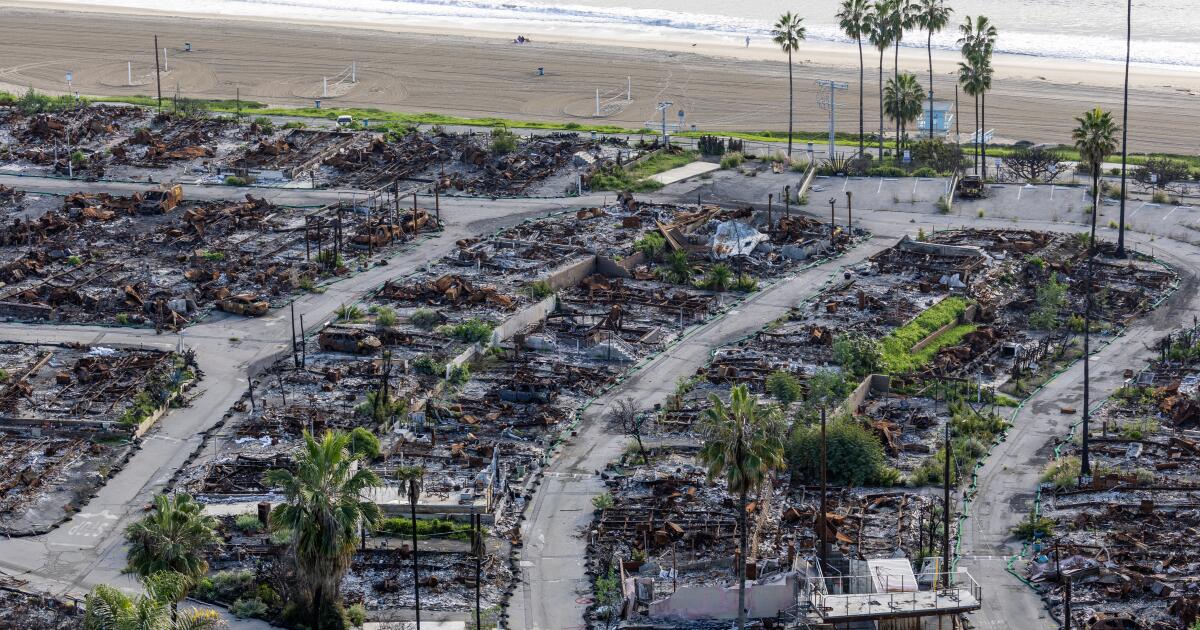
Owners of fire-destroyed Palisades mobile home park seek to displace residents for development deal

Fatigue a factor as early matches begin at Indian Wells
Fact check: Did French border guards mock influencers returning from Dubai amid Iran war?

Florida High School Football Rankings: Top 25 teams – Oct. 21

Cleary's 21 help Le Moyne down Central Connecticut State 69-64 in OT

How old is Bo Nix? What to know about Oregon quarterback ahead of 2024 NFL Draft

99th annual Pony Swim held in Virginia

Indiana Members Credit Union announced as new anchor tenant at Bottleworks District
Fact check: Did French border guards mock influencers returning from Dubai amid Iran war?

Iran’s fight for survival / The widening war / Trump’s nebulous goals : Sources & Methods

Map: 4.9-Magnitude Earthquake Shakes Louisiana

Paxton vows he’s ‘staying in this race’ even if Trump backs Cornyn in Texas GOP clash

Which Kurdish groups is the US rallying to fight Iran?
-

 World1 week ago
Exclusive: DeepSeek withholds latest AI model from US chipmakers including Nvidia, sources say
-

 Wisconsin4 days ago
Setting sail on iceboats across a frozen lake in Wisconsin
-

 Massachusetts1 week ago
Mother and daughter injured in Taunton house explosion
-

 Maryland5 days ago
AM showers Sunday in Maryland
-

 Massachusetts3 days ago
Massachusetts man awaits word from family in Iran after attacks
-

 Florida5 days ago
Florida man rescued after being stuck in shoulder-deep mud for days
-

 Denver, CO1 week ago
10 acres charred, 5 injured in Thornton grass fire, evacuation orders lifted
-

 Oregon6 days ago
2026 OSAA Oregon Wrestling State Championship Results And Brackets – FloWrestling