Lifestyle
Secret Tunnel Discovered Under Brooklyn Synagogue Sparks Chaos


A massive secret tunnel was discovered under a historic Jewish synagogue in NYC — and when the authorities tried to shut it down … sheer chaos ensued from the guys using it.
Wild footage is circulating online showing a frenetic scene Monday at the Chabad-Lubavitch World Headquarters in Brooklyn’s Crown Heights — serving as the meeting location and place of worship for Orthodox Jews in that area … and it all has to do with this hidden passage.

Long story short … this underground enclosure leading into the synagogue was stumbled upon last month by civilians who reported hearing weird noises under their homes.
There’s reports that a select group from this synagogue were using the tunnel to access a shuttered women’s bathing area … plus other areas in and around Brooklyn, it seems.
Anyway, leadership from this synagogue decided to shut this whole thing down — bringing in construction crews to seal up the tunnel with cement … but apparently, the fellas who’d been using were outraged and started rioting within their own holy institution, and cops came out.
That’s where all these clips come in — showing the Jewish clashing with cops, overturning furniture and seemingly trying to hunker down in their tunnel to avoid it being closed up.
At some point, someone went down into the tunnel itself and recorded a little walk-through — and you can see these fellas made themselves at home … draping their clothes all about.
In the end, it looks like they were able to close the lid on this secret hideout — probably for the best, TBH. The idea of dudes lurking around underground is … well, kinda ‘TMNT.’ 😅



Sunday Puzzle
NPR
hide caption
toggle caption
NPR
This week’s challenge
Every answer today is a flavor of ice cream or sorbet.
What flavor of ice cream …
1. … has a two-word name in which each word starts CH-?
2. … has a two-word name in which each word starts RO-?
3. … is hidden in this sentence: That’s the caravan I’ll announce.
4. … has the string of letters UTTI in its name twice?
5. … has a silent P as its fourth letter?
6. … would spell some men’s facial hair if you changed its first two letters from PI to MU?
7. … consists of the names of two trees starting with M and W?
8. … is a fruit flavor that would become the name of another fruit flavor if you interchanged its first and third letters?
9. … is an anagram of TEENAGER (2 wds.)?
Last week’s challenge
Last week’s challenge came from Michael Schwartz, of Florence, Ore. Think of a musical instrument. Add two letters at the end, and you’ll get the names of two popular automobile models reading left or right. What musical instrument is this?
Answer
Accordion –> (Honda) Accord + (Hyundai) Ioniq
Winner
Nell Newton of Austin, Texas
This week’s challenge
This week’s challenge comes from Benita Rice, of Salem, Ore. Name a famous foreign landmark (5,4). Change the eighth letter to a V and rearrange the result to make an adjective that describes this landmark. What landmark is it?
If you know the answer to the challenge, submit it below by Thursday, April 16 at 3 p.m. ET. Listeners whose answers are selected win a chance to play the on-air puzzle.
Lifestyle
Ask Imran Anything: On Boring Fashion, the Meaning of Luxury and Building Outside the System

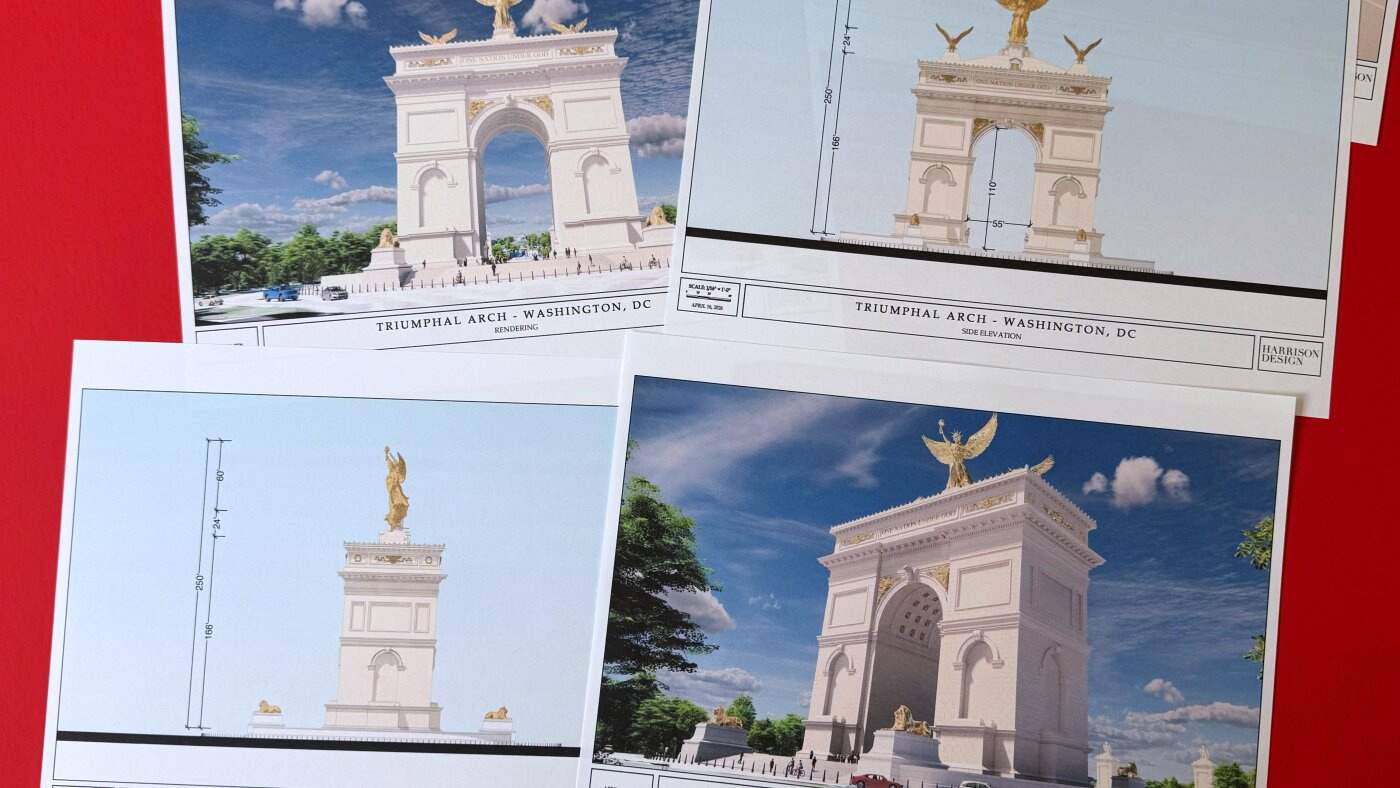
Artist renderings and diagrams for President Trump’s proposed triumphal arch released by the U.S. Commission of Fine Arts on April 10, 2026.
Jon Elswick/AP
hide caption
toggle caption
Jon Elswick/AP
President Trump on Friday unveiled official architectural renderings for the triumphal arch he plans to add to the National Mall in Washington, D.C.
The proposed monument would stand at one end of the Arlington Memorial Bridge next to the Arlington National Cemetery.
In addition to the president’s post on Truth Social, the plans were released by the Commission on Fine Arts, a federal agency that has review authority over the design and aesthetics of construction within Washington, D.C., and produced by Harrison Design, an architecture, interior and landscape design firm with offices in six U.S. cities, including D.C. The mockup shows a structure very similar to the 3D model that Trump touted at a fundraising dinner at the White House last October.
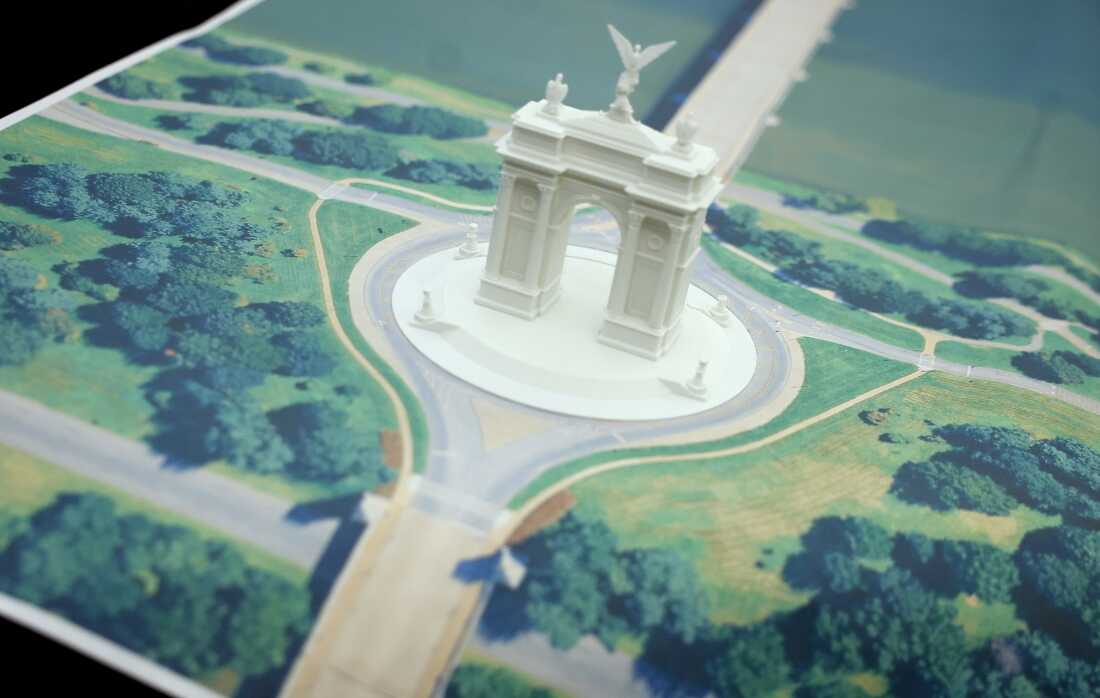
This model of President Trump’s proposed triumphal arch was shown at a White House press conference on Oct. 15, 2025.
Kevin Dietsch/Getty Images
hide caption
toggle caption
Kevin Dietsch/Getty Images
At 250 feet tall, the overall height of the structure is intended to serve as, “a fitting recognition of America’s 250th birthday,” the White House said in an email to NPR.
A monument aimed at honoring what and whom?
The proposed arch bears a striking resemblance to the Arc de Triomphe in Paris — though would stand almost 100 feet taller — and is topped with two golden eagles and a winged, crowned figure reminiscent of the Statue of Liberty (which was gifted to the U.S. by France in 1884.) On one side, the words “One nation under God” appear, with the phrase “Liberty and justice for all” on the other.
The structure would also loom over the nearby Lincoln Memorial — at more than twice the height.
“The Triumphal Arch in Memorial Circle is going to be one of the most iconic landmarks not only in Washington, D.C., but throughout the world,” said White House spokesperson Davis Ingle in an email to NPR. “It will enhance the visitor experience at Arlington National Cemetery for veterans, the families of the fallen, and all Americans alike, serving as a visual reminder of the noble sacrifices borne by so many American heroes throughout our 250 year history so we can enjoy our freedoms today. President Trump will continue to honor our veterans and give the greatest Nation on earth — America — the glory it deserves.”
When asked by CBS political correspondent Ed O’Keefe whom the monument was intended to honor after Trump initially unveiled his plans in October, Trump responded: “Me.” The exchange was captured in a social media video.
A group of Vietnam War veterans launched a lawsuit in February seeking to bar the Trump administration from constructing the arch. The plaintiffs argued the project violates statutes requiring express congressional authorization for the erection of commemorative works or any “building or structure” on federal park grounds in D.C., among other issues.
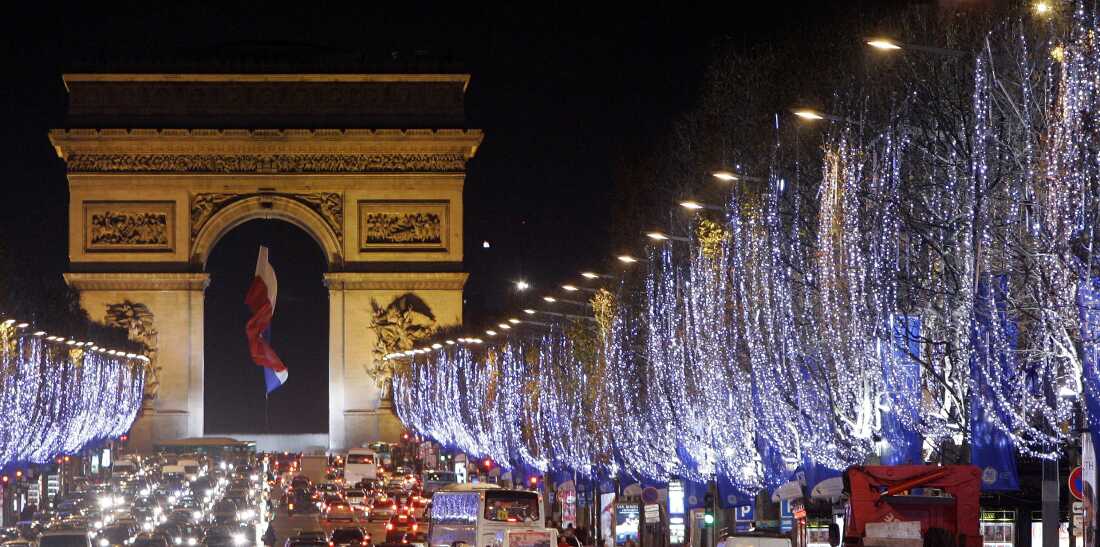
The Arc de Triomphe in Paris as part of the city’s Christmas celebrations (2007).
Christophe Ena/AP
hide caption
toggle caption
Christophe Ena/AP
“It’s textbook Trump,” said Sue Mobley, director of research at Monument Lab, of the proposed plans for the arch, in an interview with NPR. The nonprofit design studio based in Philadelphia reimagines public art and structures. “It has to be the biggest. That’s the authoritarian impulse.” Trump has repeatedly pushed back on accusations of authoritarianism, rejecting the label of dictator.
Mobley added that she doesn’t think the plans will come to fruition. “It will likely get tied up in court,” she said.
Approval process
The White House said it will “follow all legal requirements” in constructing the triumphal arch. As part of that process, it mentioned the National Park Service’s recent request to present potential designs to the Commission on Fine Arts. The plans are scheduled to be reviewed next week. At this point, that commission is composed entirely of members appointed by Trump. (In October 2025, Trump took the unusual step of firing six sitting members of the commission.) The National Capital Planning Commission, the federal government’s central planning agency for the National Capital Region, is also expected to weigh in on the plans.
The White House said the estimated cost of the project, which it anticipates will draw on a combination of public and private funds, is still being calculated. Harrison Design, the architecture firm behind the plans, did not immediately respond to NPR’s request for information about the price tag.
Multiple D.C. makeover projects
The arch plans are the latest in a series of current and potential architectural interventions from the White House in and around Washington, D.C.
Most dramatically, the administration is pushing for the creation of a $400 million neoclassical ballroom at the White House. A federal appeals court on Saturday temporarily allowed the construction of the ballroom to move forward while the administration challenges a March ruling that it required congressional approval. Whatever the outcome, the historic East Wing has already been demolished to make room for the new structure.
Trump has converted the White House Rose Garden into a stone-covered patio. He aims to shut down The Kennedy Center for two years to facilitate a major renovation (a coalition of groups including the National Trust for Historic Preservation, the American Institute of Architects, and the D.C. Preservation League, filed a lawsuit in the U.S. District Court for the District of Columbia in March opposing the plans.) And he has proposed architectural changes to the Washington Dulles International airport through an initiative the Department of Transportation launched late last year to overhaul the Northern Virginia airport. Several prominent architecture firms including Zaha Hadid Architects and Adjaye Associates have submitted proposals.
In August, the president also signed an executive order requiring that new federal buildings with construction budgets of more than $50 million be designed in “classical” or “traditional” styles.
Anastasia Tsioulcas contributed to this story.

Lawmakers close door on Massachusetts online casino legalization

Minnesota’s Pohlkamp helps Denver beat Wisconsin 2-1 for 11th national hockey title, 3rd in 5 years

Mississippi reveals its full history for America’s anniversary year, a contrast to federal efforts
KCPD investigating after 1 man hurt in Saturday shooting

The ugly truth behind ‘restoring Montana values’ • Daily Montanan

Florida High School Football Rankings: Top 25 teams – Oct. 21

How old is Bo Nix? What to know about Oregon quarterback ahead of 2024 NFL Draft

Cleary's 21 help Le Moyne down Central Connecticut State 69-64 in OT

99th annual Pony Swim held in Virginia

Indiana Members Credit Union announced as new anchor tenant at Bottleworks District

Carney casts himself as NATO defender amid Trump beef, despite Canada missing key benchmark for decades

‘Enough of war!’ says Pope Leo XIV who grows increasingly frustrated

Artemis II splashdown captures nationwide attention

Video: Police Fatally Shoot Man After Stabbings at Grand Central Subway Station

Trump blasts Spanberger ahead of Virginia meetings, says state faces tax base exodus like New York, California
-

 Atlanta, GA1 week ago
1 teenage girl killed, another injured in shooting at Piedmont Park, police say
-

 Georgia5 days ago
Georgia House Special Runoff Election 2026 Live Results
-

 Pennsylvania6 days ago
Parents charged after toddler injured by wolf at Pennsylvania zoo
-

 Arkansas2 days ago
Arkansas TV meteorologist Melinda Mayo retires after nearly four decades on air
-
 Milwaukee, WI6 days ago
Potawatomi Casino Hotel evacuated after fire breaks out in rooftop HVAC system
-

 Indianapolis, IN1 week ago
Fighting Illini begin Final Four preparations in Indianapolis
-

 Technology1 week ago
Anthropic essentially bans OpenClaw from Claude by making subscribers pay extra
-

 Detroit, MI1 week ago
Puppy rescued after getting stuck on chimney in Detroit