Lifestyle
Renting used to be a source of shame to this apartment manager’s daughter. Now it’s a knowing comfort

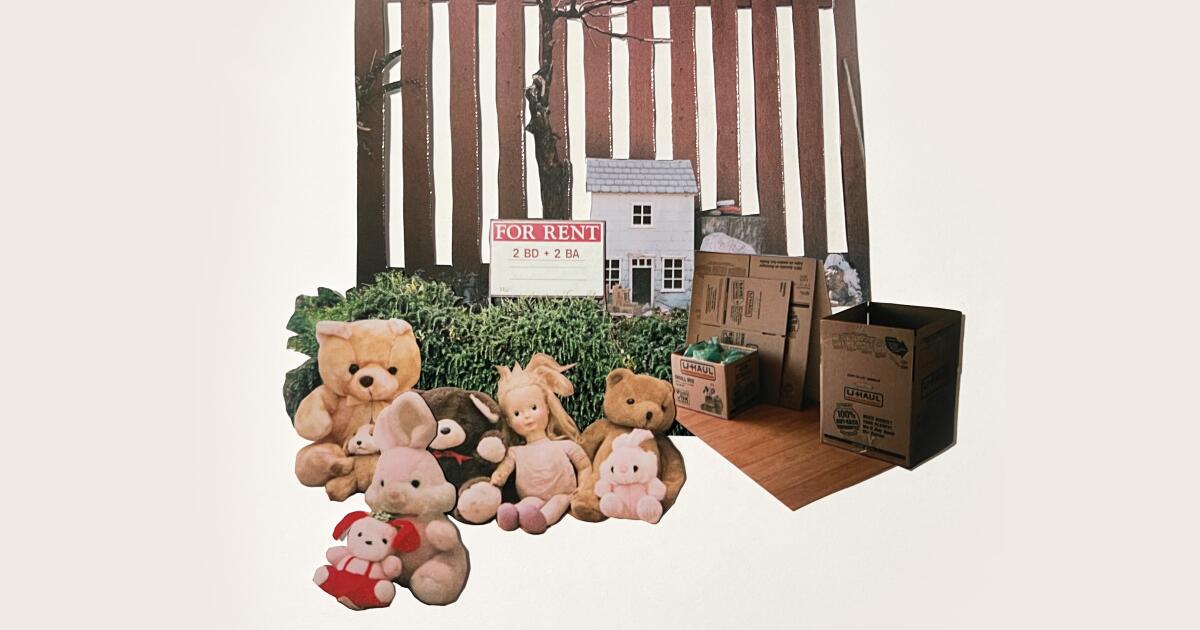
I can barely remember a time when we didn’t live where we worked. Our first property manager job was for a 30-unit apartment building between Beverly Hills and Pico-Robertson. My parents didn’t speak English but got the job anyway because they knew a guy who knew a guy who knew a guy. There was an elementary school at the end of our magnolia tree-lined street that I couldn’t go to because the Beverly Hills School District allowed only Beverly Hills addresses. I would walk down the block to visit my friend (another apartment manager’s daughter) or to buy a sleeve of blue raspberry sour straws at the Blockbuster around the corner and hear children playing in the well-manicured school yard, but I never once saw an actual child. This was how I learned to perceive wealth in Los Angeles: near, but just out of reach.
Even at the age of 6 or 7 or 8, I knew that this was all temporary. Renting is inherently provisional, especially when you’re not actually paying rent. I made the most of it. While my mother cobbled together a career as a bookkeeper and my father assumed the role of both the maintenance guy and the manager of the building, I stole CDs from the mailroom, Rollerbladed in the slick oil-stained subterranean parking garage and belted Spice Girls lyrics in the emergency stairwell with my cousin until a tenant would open the door and find us there alone in the dark. I still own contraband from that time: someone’s copy of the “City of Angels” soundtrack. Inside our apartment, I shared a room with my parents. Our beds were butted up against each other, as they had always been.
Before this job and this building we lived in a one-bedroom apartment in West Hollywood with brown shag carpet and a cardboard box as my toy chest. The apartment buildings on our block, once favored by up-and-coming movie stars and writer Eve Babitz, now were occupied by Eastern Europeans fleeing the collapse of the Soviet Union. “There comes a moment for the immigrant’s child when you realize that you and your parents are assimilating at the same time,” writes Hua Hsu in his memoir, “Stay True.” While I attended preschool at Plummer Park, my mother went to community college and my father painted houses for $5 an hour. Before the brown shag carpet, we slept on my aunt’s couch in Mid-City for six months. And before the couch, we lived in a brutalist Soviet government-issued apartment in Minsk, Belarus. From the beginning, my life was steeped in the impermanence of renting, which mirrored the impermanence of our immigrant experience.
All immigrants are opportunists. Or, at least all the ones I’ve encountered. They are keenly aware of how, at any moment, everything can change. “Immigration, exile, being uprooted and made a pariah may be the most effective way yet devised to impress on an individual the arbitrary nature of his or her own existence,” writes Serbian poet Charles Simic. With each move, I felt the arbitrary nature of our existence. And every time I translated a 30-day notice or drafted a memo and slipped it under a tenant’s door, I felt the pull of my parents’ ambition. “We came here for you.” They’d say it often. Lovingly piling on the pressure until I could no longer see a future where I didn’t have something to prove.
My father found the second property manager job listing in a local newspaper. A 50-unit building in the affluent neighborhood of Westwood. He brought Mama and me along to the interview, although technically the managers were not supposed to have a child. I was told that if I was on my best behavior, I would go to the sought-after public elementary school down the street and finally get my own room. The front of the building was covered in a flash of fuchsia bougainvillea, and the surrounding brick towers glowed with inviting warm windows and hints of crystal chandeliers. The owners of the building were a wealthy elderly Germanic-Jewish couple who met us outside and assessed my potential with war-weary eyes. I looked up at them dutifully, every butterfly clip I owned fluttering on my head like a migration. “She’s a mini you,” the woman said, noticing the quiet stoicism I’d picked up from my father. She looked at us as if she were looking into her own immigrant past, her harrowing escape from Austria as a teenager during the Holocaust. She smiled. Bent down. And handed me the keys.
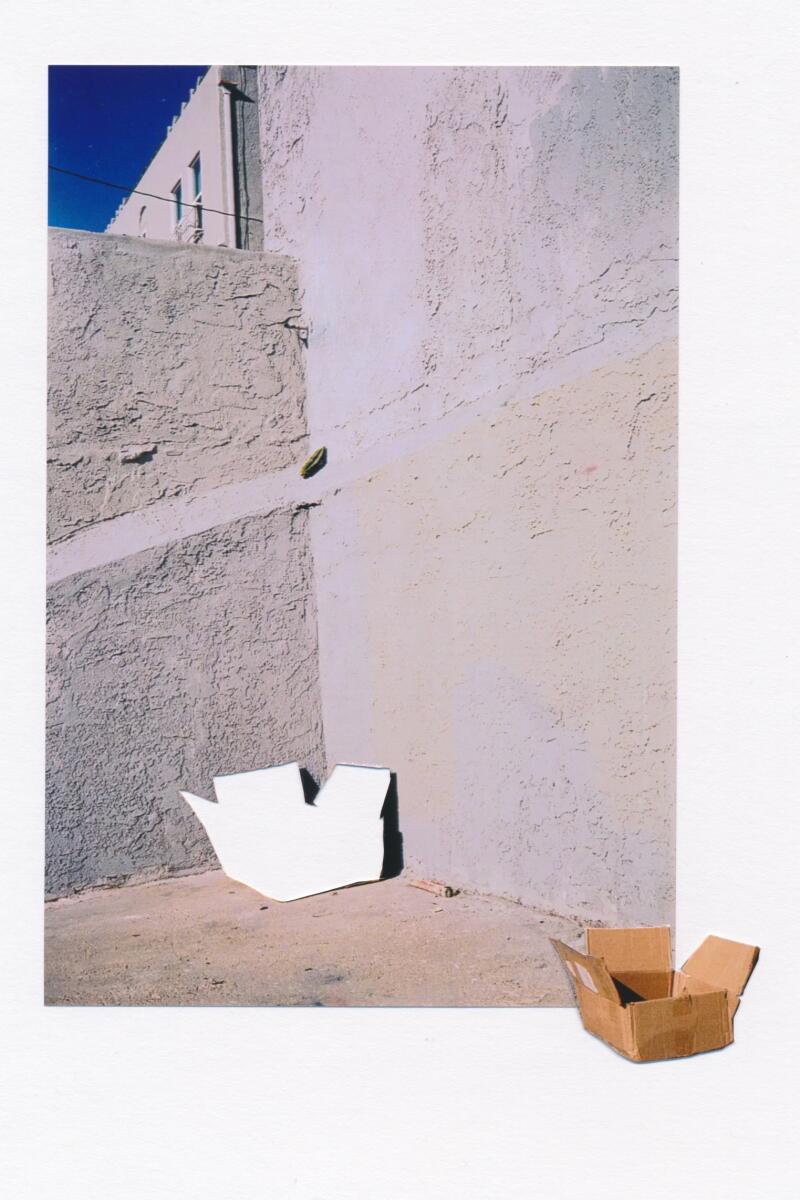
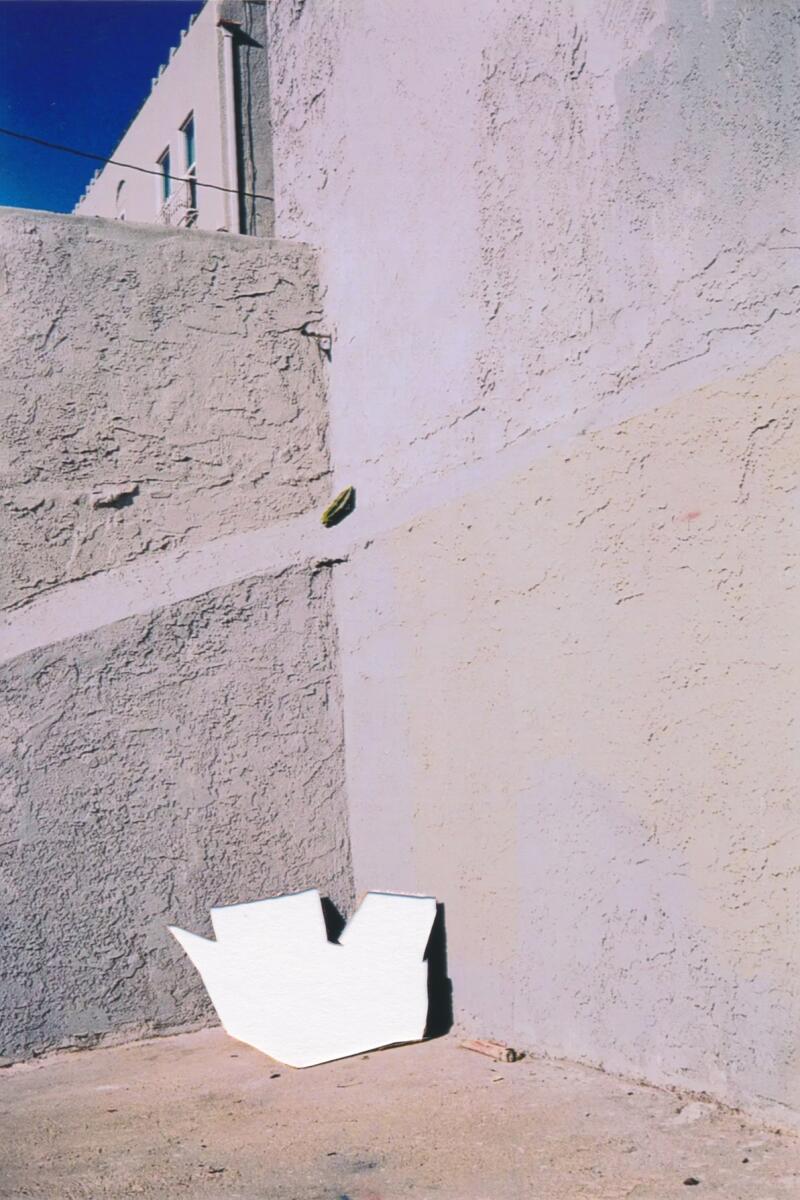
Los Angeles has been a haven for transplants and immigrants since the tail end of the Industrial Revolution and the introduction of the railroad. It was once advertised as a wellness paradise, the sanatorium capital of America, a temporary resort for turn-of-the-20th century tuberculosis patients eager to seek treatment in the form of sunshine and “fresh” air. Many of these patients got better and stayed. “Los Angeles, it should be understood, is not a mere city. On the contrary, it is, and has been since 1888, a commodity; something to be advertised and sold to the people of the United States like automobiles, cigarettes, and mouthwash,” writes Mike Davis in “City of Quartz.”
The commodification of Los Angeles and Hollywood, and the rising population, has made the city an expensive place to live. The majority of the population rents: According to a 2021 report, 63% of Los Angeles households are renter-occupied, while 37% are owner-occupied. And rent has more than doubled in the past decade, leading to an astonishing 57% of L.A. County residents being rent-burdened, meaning they spend a third or more of their income on rent. And yet people continue to move to Los Angeles, a place synonymous with liminal space — the space between who we are and who we want to become. Even if who you want to become is out of reach.
“If there is a predominant feeling in the city-state [Los Angeles], it is not loneliness or daze, but an uneasy temporariness, a sense of life’s impermanence: the tension of anticipation while so much quivers on the line,” writes Rosecrans Baldwin in “Everything Now: Lessons From the City-State of Los Angeles.”
Los Angeles is a city always on the edge of disaster: gentrification, housing shortages, unlawful evictions, homelessness (second largest homeless population outside of New York), greed, wildfire, earthquakes, floods, landslides, the imminent death of the legendary palm trees, the intangible but plausible possibility of breaking off from the continental United States and slipping into the Pacific Ocean. The city, like its residents, is impermanent, always shape-shifting, always on the verge of becoming something else.
“Our dwellings were designed for transience,” writes Kate Braverman about the midcentury West Los Angeles of her childhood in “Frantic Transmissions to and From Los Angeles: An Accidental Memoir.” “Apartments without dining rooms, as if anticipating a future where families disintegrated, compulsively dieted, or ate alone, in front of televisions.”
In Westwood, our living room was our dining room and our office. Leases were signed on the dinner table. At any moment, the phone or doorbell would ring with someone dropping off a rent check or complaining about a broken air conditioner or standing barefoot in a bathrobe locked out of their apartment. I would pretend to not care. I would eat my cheese puffs on the couch and stare attentively at the glowing TV, with the business of the building in my periphery. I would remind myself that this was temporary. Our liminal space. Maybe my parents would invest in an adult day care center like their friend Sasha? Maybe we would one day own a house? As I got older, I grew more ashamed. More aware of my own body and its presence. I would cower in my room or the hallway, shoveling Froot Loops into my mouth until the apartment was no longer an office but our home again. This shape-shifting was its own type of impermanence. One minute the apartment was a place where we lived and the next it was a place where we worked. The line was blurred and so was my idea of home. Of what is yours and what is mine.
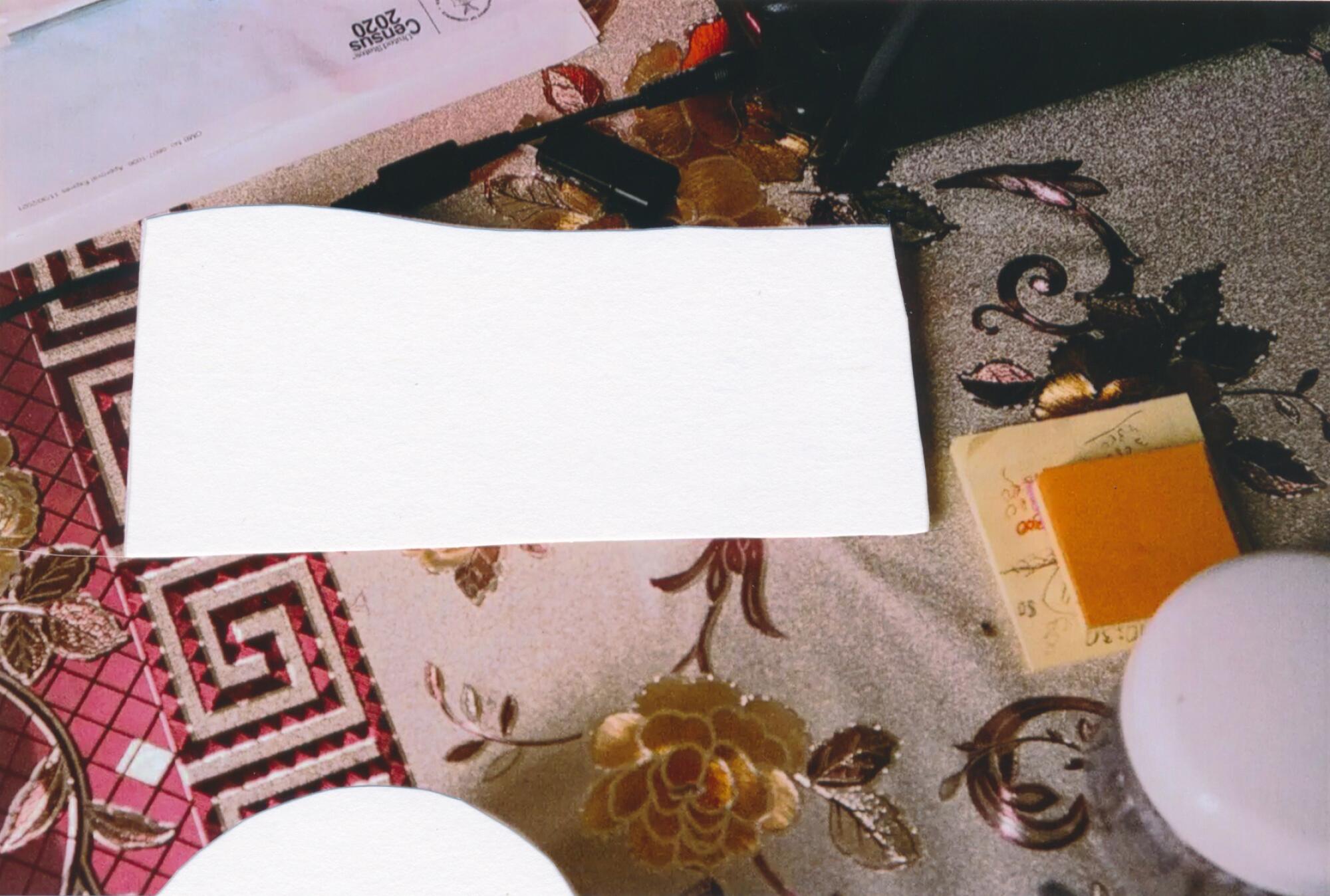
Some of the tenants were there before us and some were a rotating cast of characters. But all of them were strangers we shared walls with. Of course, we weren’t the only immigrant family. There were also Persian immigrants who fled Iran during the Islamic Revolution, but they mostly kept to themselves. Due to the nature of the job, we were always on display. My parents’ accents. My growing body. My father’s health. The mezuzah on our door frame. Our apartment, a collection of discarded furniture from vacated units. Early on, I was warned to not make friends with any of the tenants. I was told it was unprofessional. A trap. That they only wanted to be my friend so they could get special treatment. Sometimes, we broke the rules. I babysat the child star while his single mother “networked” (partied in the Hollywood Hills). I played Marco Polo in the pool with the Persian kids. I leafed through headshots with a Russian mail-order bride while my parents drank tea with her mother. They would all eventually move out and so would we.
I used to tell my friends that we owned the building. That I would one day inherit it. This was easier than saying that we lived there because we worked there. I’m not sure if anyone believed me anyway. Many of my friends lived in what I considered to be mansions with nannies and parents with six-figure dual incomes that afforded them trips to faraway destinations I couldn’t place on a map. When my friends were over and the landline would ring, I would rush them to my bedroom before they could hear my father answer the phone with, “Manager.”
The only property my parents own is a shared plot at Hollywood Forever Cemetery. When my father was diagnosed with a chronic disease, my mother was left to manage the Westwood building on her own. Eventually, my parents retired after 21 years and moved out of the building during the first few months of the pandemic. They still rent, and so do I.
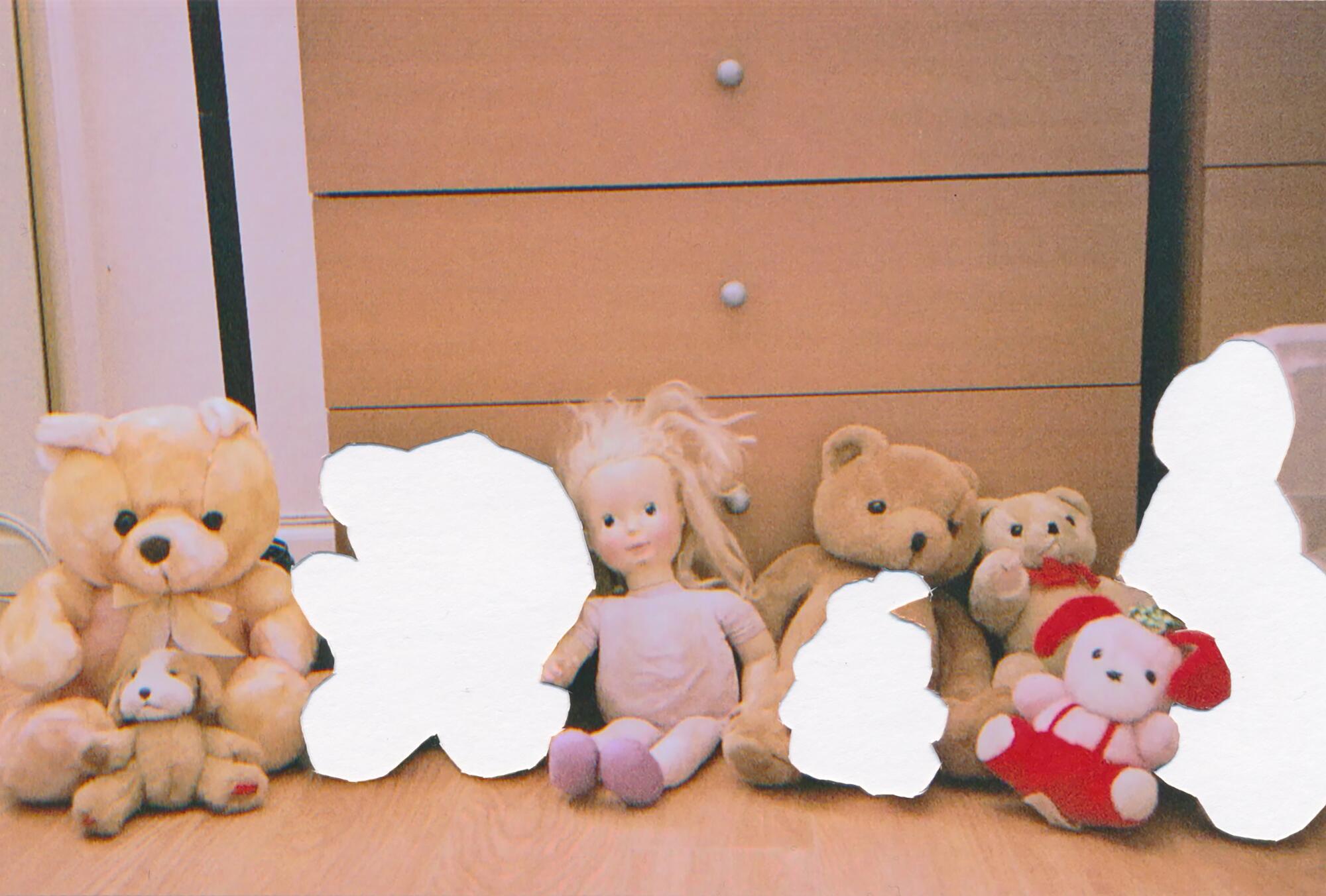
What is truly ours?
I’ve spent my life grappling with the concept of ownership. How our identity often gets wrapped up in what we own and what we don’t own. How in the U.S., ownership is the pinnacle of success. How there was no such thing as ownership in the failed Soviet experiment. How you could pick apples off any tree because they were there for everybody to enjoy. How owning a home in Los Angeles may forever be out of reach. How impermanent we are in the arbitrary nature of existence.
After I graduated from college and landed an office job in Los Angeles, I began renting apartments on my own. The eggshell walls painted over and over and over again. The rotating neighbors I still feared to befriend. The flying cockroaches. The broken laundry machines. The unabiding footsteps. The eternal sounds of other people’s lives. The possibility of moving out and starting all over again. It all felt so familiar. The impermanence I witnessed so often as a child was no longer a source of shame but a knowing comfort that at any moment everything could change.
Diana Ruzova is a writer from Los Angeles. She holds an MFA in literature and creative nonfiction from the Bennington Writing Seminars. Her writing has appeared in the Cut, Oprah Daily, Flaunt, Hyperallergic, Los Angeles Review of Books and elsewhere.


In central London’s Waterloo Place, a life-size statue that emerged overnight in late April has been creating a stir. When I visited a few weeks after it was erected, local authorities had already set up protective barriers around it.
The installation — signed by the famed street artist Banksy — depicts a man in a suit hoisting a flag as he strides over a precipice. As he marches on, the flag blows backward to cover his face, leaving him unaware he’s only a step away from a perilous fall.
Set among grand monuments celebrating Britain’s past, the “flag man” takes on a particular visual irony at a time when the country — and much of the world — is debating its path forward.
Like many viewers there, I found myself wondering whether this statue is Banksy’s warning about the consequences of uncritical nationalism, or simply a reflection on human shortsightedness. Or, perhaps, it is just prompting us to ponder a broader question: What happens when devotion to a symbol prevents us from seeing what lies ahead?
Whatever the message, the work feels remarkably attuned to the current moment.
For more Far-Flung Postcards, click here.
Lifestyle
Wait, it’s a candle? Her beeswax fruit and veggie ones look so real, you’ll want to take a bite
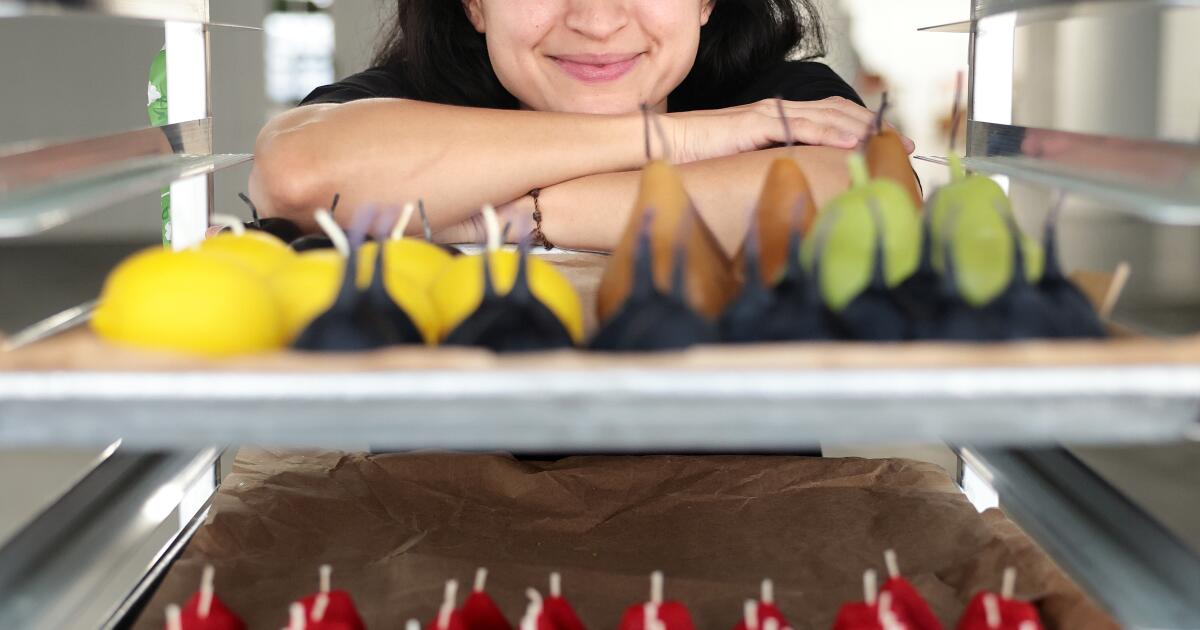
Jessica Gonzalez hustles behind her booth at the recent Renegade Craft Fair, frantically ringing up sales, answering questions and packaging her beeswax candles.
It’s hot on the grounds of the Los Angeles State Historic Park in April, but 35-year-old Gonzalez and her fiancé, Jordan Colindres, keep their cool as a crowd gathers to admire her Happy Organics candle collection, a homage to her family’s produce company in the Central Valley that looks like real fruits and vegetables.
“I love doing in-person events because it’s so fun to see people’s reactions,” she said a few months later. “It makes me feel good to see other people finding joy in my candles. They often say, ‘Oh, that’s really funny.’ And it is funny to have a cherry candle on top of your birthday cake.”

3

1. A staff member pulls a beeswax corn candle, $26, out of its mold at Happy Organics’ studio in downtown Los Angeles. 2. Each Beeswax Mixed Berry Birthday Candles set is cast from real mixed berries — strawberries, raspberries, blackberries, blueberries and cherries. A set of 10 is $30. 3. Bartlett green pears and heirloom tomatoes, $24 to $40.
Judging by the smiles and charmed looks on shoppers’ faces, her produce-inspired candles are less about illuminating rooms and more about sharing the joy she sought when she first started the company in 2018.
In this series, we highlight independent makers and artists, from glassblowers to fiber artists, who are creating original products in and around Los Angeles.
But then, it’s hard not to smile at the playfully elegant Bosc pears, puckered mandarins and green-and-purple asparagus taper candles which range in price from $12 to $40. Some are molded into corn on the cob, celery and rhubarb shapes. Others are made to look like mushrooms, figs, tomatoes and snap peas. The most popular are the small birthday candles shaped like raspberries, cherries and blackberries, packed in molded-pulp baskets just like you’d find at the grocery store or farmers market.

-
Share via
Gonzalez didn’t start out as a designer. The youngest of nine children, she was born in 1991 in Salinas and later moved to Merced, where she grew up on a 10-acre farm. She studied computer science at Mills College, then worked in tech consulting in the Bay Area and eventually became the CTO of an ag-tech company. When her mother, Angela, became ill in 2016, she returned to Merced to be with her family.
When her mom died suddenly soon after she moved home, Gonzalez left the tech industry. “I wasn’t connected with what I was doing,” she said. “I wanted to find something more meaningful; something I loved. I didn’t want my ego to keep me stuck in what I studied in college. I decided to let myself try new hobbies and passions and look for joy again.”
After her mother’s death, she began working with her father, Salvador, and her uncles at the family’s apiary, where they managed more than 30 hives. (Her grandfather was also a beekeeper in Michoacán, Mexico.) Soon, she began selling their raw honey at local farmers markets. In a heartbreaking turn, her father was diagnosed with cancer a year later, so she started making cannabis-infused honey, balms and chocolates to help ease his pain.
When she saw that the beeswax candles, which last significantly longer than paraffin candles, were selling faster than the honey, she decided to focus on making candles from the leftovers from her uncles’ hives.
She was only 25, but it was a turning point. “It was one of those moments where I felt like I needed to change my path,” she said. “I needed to change everything in my life.”

Jessica Gonzalez and her father Salvador on their family farm in Merced. (Gonzalez family)

Gonzalez at Happy Organics’ studio in downtown Los Angeles. (Christina House / Los Angeles Times)
When her father died in 2018, she inherited his bees and started Happy Organics, although she hadn’t planned on starting a business. After experiencing so much loss, making candles became a kind of therapy. “It felt great to work with my hands again, something I thought I’d never have time for,” she said.
Her oldest sister, Sonia Gonzalez, said Gonzalez reminds her a lot of their father, who reinvented himself many times over the years.


The nopal cactus is cast from a real nopal and hand-poured in 100% pure beeswax in the Los Angeles studio.
“He grew up as a village boy in the rural mountains of Michoacán, Mexico, and went on to work in restaurants, cut down Christmas trees and pick strawberries and broccoli in the fields of Salinas,” she wrote in an email. “From there, he started selling produce door-to-door, then at flea markets and eventually built his own produce distribution business from the ground up. As the youngest of nine kids from a working-class family, Jessica’s always been incredibly resourceful, responsible, and amazing at reinventing herself.”
Like a lot of millennials, Gonzalez taught herself how to make candles by watching YouTube videos. She started with hand-dipped tapers, working in the garage on the farm that helped her feel safe and connected to her parents. “It was a really nice environment to try something new and creative,” she said.
Inspired by her family’s produce, she cast real corn, strawberries and cherries in plaster, then made a silicone mold to create copies. Even when using the same mold, color can vary from batch to batch, and how it cools also affects the result. “That’s just how handmade things are,” she said. “There’s always some variation.”

Cherry molds make cherry candles at Happy Organics’ studio in downtown Los Angeles.

A variety of fruit and veggie candles.
When she moved to Los Angeles in 2023 to be with Colindres, her business took off. “L.A. is a great place to grow,” she said. “There’s so much opportunity here. When I go to a farmers market, I never know who I’ll meet.”
She sold her candles in person at craft shows, the Hollywood Farmers’ Market and most recently, during a residency at the P.F. Candle Co. showroom in Echo Park.

2

3

1. A staff member trims the wicks on a pair of carrot birthday candles, $22. 2. Gonzalez passes by shelves of candles at Happy Organics’ studio in downtown Los Angeles. 3. Asparagus taper candles, $30.
“I have a lot of respect for her as a fellow candle maker (making molds is not easy), but getting to know her story more and how her choice of foods and wax is reflective of her family’s history gave it so much meaning,” P.F. Candle Co. founder and creative director Kristen Pumphrey said in an email. “It’s been a tough couple of years for L.A. businesses, so we gotta stick together — there’s this wonderful sense of community hosting a local brand that’s so passionate about their work.”
As her business has expanded, her products are now available at Terrain, Joan’s on Third and the MoMA Design Store in addition to her website. She has also had to source beeswax from other vendors across the country to keep up with demand.
Kimberly Curtis, owner of Hide & Seek Vintage in Studio City, said Gonzalez’s strawberry and cherry birthday candles “flew off the shelves last year” during the holidays. “Our customers love them,” she added.

Gonzalez holds a cabbage candle.
Still, Gonzalez stays connected to her Central Valley roots. Everything she and her small team make in downtown Los Angeles is handmade and “takes time,” she said, describing the steps involved in crafting quality candles. Right now, her favorite is the Nopal Cactus candle, which she made using a clipping from an employee’s yard. While others help her with production, wholesale management and packaging, she focuses on sales, content and all-new product development.
When asked if she has advice for others who want to start their own business, Gonzalez admits she sometimes feels overwhelmed.

In 2013, Gonzalez and her family gathered at their Merced ranch to celebrate her parents’ anniversary.
(Gonzalez family)
“The biggest thing that has gotten me through the toughest spots is my why or my reason for starting,” she said. “I think that has to be really strong. That’s what brought me a lot of comfort when I felt like quitting: going back to the beginning and remembering why I started this.”
For Gonzalez, her reason is always close to her heart. “I wanted to feel connected to my parents in some way,” she said. “This was a good representation of my upbringing.”

The Kennedy Center, the facade of which remains covered with a tarp, is seen in Washington, DC, on June 28, 2026. A US federal judge asked on June 24 for an explanation for why a tarpaulin continues to cover the facade of the Kennedy Center where President Donald Trump’s name was recently removed. District Judge Christopher Cooper gave the board of trustees of the performing arts venue until the end of July to explain “the purpose for and status of the tarp and scaffolding that Defendants have erected on the front portico of the Center.”
ALEX WROBLEWSKI/AFP via Getty Images
hide caption
toggle caption
ALEX WROBLEWSKI/AFP via Getty Images
More than two weeks ago, President Trump’s name was removed from the Kennedy Center facade though it is still covered by a tarp and the legal battle continues.
On Monday, a U.S. Department of Justice filing on behalf of the Kennedy Center included some surprises. The document was submitted in response to issues raised by lawyers for ex-officio board member Rep. Joyce Beatty of Ohio who is suing to remove President Trump’s name from the center and stop its closure for renovations.
Among the revelations, the Kennedy Center admitted that, during a board meeting on December 18, 2025, Beatty had been “muted and prevented from speaking.” It was at that meeting that the board voted to add President Trump’s name to the center. The filing later acknowledges the congresswoman was “prevented from voicing her opposition.”
The John F. Kennedy Center for the Performing Arts is a living memorial to its namesake. The guidelines for how the theatre complex spends federal dollars are very specific. Among other rules, it states that “no additional memorials or plaques shall be designated or installed.” Beatty argues adding Trump’s name runs afoul of those rules and that any change requires approval from Congress.
According to one of Beatty’s filings, “There was no advance notice in the agenda that the Board would be considering a name change,” a statement the Kennedy Center now does not deny. The center admits that, prior to voting, there was “no discussion about potential risks or downsides of the vote to adopt a secondary name for the Center.” Nor was there a board discussion “about any potential conflict of interest that might result from the vote.”
The center’s lawyers previously contended that if Trump’s name were to be removed, it would “lose money from donors who support” him and “impede the Center’s fundraising efforts.”
Closing for renovations
Earlier this year, Trump announced on social media that the Kennedy Center would close for two years for renovations. He wrote that he made the decision after “a one year review” with “Contractors, Musical Experts, Art Institutions, and other Advisors and Consultants.”
But, according to the center’s lawyers, Trump’s announcement “was made without presenting any plans, analyses, timelines, or funding information to his cotrustees and without any Board vote.”
The Kennedy Center has long denied reporting by The Washington Post that ticket sales plummeted after President Trump became the Center’s board chair. In Monday’s legal filing, the Center admits that, by October 2025, “nearly half of the Center’s tickets were going unsold.”
-

 Los Angeles, Ca37 minutes ago
Knife-wielding man rushes at LAPD officers in tense body cam video
-

 Detroit, MI57 minutes ago
5 Potential Landing Spots For Former Detroit Lions CB Terrion Arnold
-

 San Francisco, CA1 hour ago
May 17 officially declared
-

 Dallas, TX1 hour ago
Dallas City Hall named to World Monuments Fund’s ‘Irreplaceable America’ list – Lake Highlands
-

 Miami, FL1 hour ago
Ex-con lists $138M in luxury penthouses, including Miami trophy condo
-

 Boston, MA1 hour ago
Celtics reportedly trading Jaylen Brown to 76ers for Paul George, picks
-

 Denver, CO1 hour ago
LeBron James to the Nuggets? Latest reports and betting odds
-

 Seattle, WA2 hours ago
Residents and activists clash over plan to curb SEPA appeals at Seattle hearing

