Lifestyle
Peru: Chicha, the electric pulse of cumbia

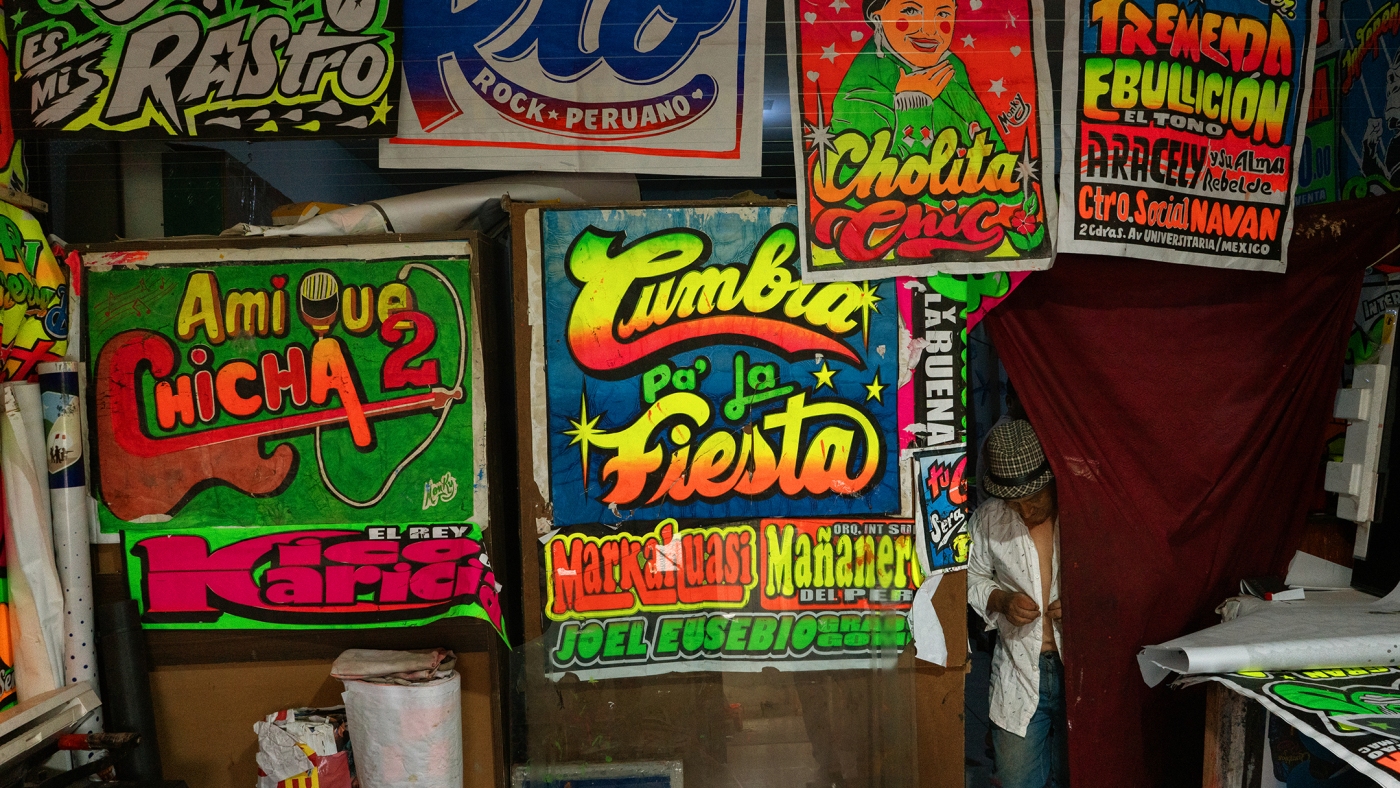
Pedro Tolomeo Rojas, known as Monky, enters his studio in Lima on Oct. 21, 2024. Monky was a pioneer in the making of the posters that publicize cumbia concerts and are now considered chicha art. His posters still cover Lima and cities beyond, advertising upcoming concerts.
Ivan Kashinsky
hide caption
toggle caption
Ivan Kashinsky
This is part of a special series, Cumbia Across Latin America, a visual report across six countries developed over several years, covering the people, places and cultures that keep this music genre alive.
The people of Peru have many definitions for the word chicha: a sacred fermented corn drink, popular culture, popular art and, of course, Peruvian cumbia. It has also been used as a derogatory term, mocking immigrant culture in Lima during the mass migrations of Indigenous Andean people to Lima in the 20th century. When it comes to music, the term has become extremely controversial.

High school students dance folkloric music, such as huayno, in the Plaza de Armas in Cusco, Peru, on Nov. 3, 2024.
Ivan Kashinsky
hide caption
toggle caption
Ivan Kashinsky

Women gather after a celebration for the 137th anniversary for the city of Sicuani, Peru, on Nov. 4, 2024. Armonía 10, a Peruvian orchestra that plays cumbia and was originally founded in 1972, played in Sicuani that night.
Ivan Kashinsky
hide caption
toggle caption
Ivan Kashinsky

Berardo Hernández Jr., known as Manzanita Jr., holds his guitar in his kitchen in Lima, Peru, on Nov. 2, 2024. Hernández’s father, Manzanita, is known for having a part in creating chicha’s sound.
Ivan Kashinsky
hide caption
toggle caption
Ivan Kashinsky
In a small peña, or neighborhood club, in Lima, two legends — Berardo Hernandez Jr., the son of Manzanita, and Pancho Acosta, of Compay Quinto — filled the venue with intricate and melodic electric guitar sounds, soloing at a rapid pace, using their fingers instead of picks. Fans smiled and danced, soaking in the magical sonic experience. Acosta, Manzanita and Enrique Delgado, of Los Destellos, all had a part in creating the chicha genre, which emphasized electric guitar and was uniquely Peruvian.
Berardo, known as Manzanita Jr., aligns with the theory that all Peruvian cumbia can be considered chicha. Pancho, on the other hand, insists that chicha is specifically Tropical Andina, a sub-genre that mixes Colombian cumbia with Andean folkloric music, known as huayno. Alfredo Villar, an author and art historian, says chicha “is the most complex moment of Peruvian identity, because it mixes everything — from its deepest roots to its most extreme and complex external influences. This is why it is so difficult to define … Chicha will always surprise you.”

People drink chicha in Calca, Peru, on Nov. 6, 2024. A fermented corn drink, chicha was sacred to the Indigenous of the region before it became a term to describe Peruvian cumbia.
Ivan Kashinsky
hide caption
toggle caption
Ivan Kashinsky

A woman stands next to an “Inca cuy” in Lamay, Peru, on Nov. 6, 2024. Like chica, the fermented corn drink, cuyes, or guinea pigs, were sacred to the Indigenous of the region.
Ivan Kashinsky
hide caption
toggle caption
Ivan Kashinsky

Helner Misael Sánchez Casanova, known as Tacto, a member of Los Wembler’s de Iquitos, plays a bombo in his house in Iquitos, Peru, on Oct. 26, 2024. Los Wembler’s was founded in 1968 and was one of the first to play a new sub-genre of Peruvian cumbia, known a cumbia Amazonica. The band mixed Colombian cumbia with Amazonian rhythms, psychedelic electric guitar, animal sounds from the jungle and other styles of music to create a unique genre.
Ivan Kashinsky
hide caption
toggle caption
Ivan Kashinsky

A view of the barrio of Belén seen from the city of Iquitos, Peru, on Oct. 26, 2024.
Ivan Kashinsky
hide caption
toggle caption
Ivan Kashinsky
The inconceivable mix of Colombian cumbia, Cuban guaracha, Andean huayno and psychedelic rock, as well as countless other genres, including jazz and bossa nova, that melted together in Lima at the end of the 1960s created a truly delicious sound. Chicha peaked in the ’80s as Lorenzo Palacios Quispe, known as Chacalón or El Faraón de la Cumbia, and Los Shapis, an Andean band from Huancayo, brought chicha to the masses.

Art by José “Ashuco” Araujo, a Amazonian chicha artist, covers the walls of El Refugio, a bar in Iquitos, Peru, that’s known for live cumbia as and couples dance and talk on Oct. 26, 2024.
Ivan Kashinsky
hide caption
toggle caption
Ivan Kashinsky

Alfredo Villar Luquin, a writer who has immersed himself in the world of chicha, puts his hand over a painting of Chacalón in his house on Nov. 11, 2024. The painting is by Pedro Tolomeo Rojas, the pioneering chicha artist better known by “Monky.” Lorenzo Palacios Quispe, known as Chacalón, brought chicha to the masses in Lima.
Ivan Kashinsky
hide caption
toggle caption
Ivan Kashinsky

Fans of Armonía 10 watch as the band plays at the 137th anniversary celebration for the city of Sicuani, Peru, on Nov. 4, 2024. A Peruvian orchestra that plays cumbia, Armonía 10 was originally founded in 1972.
Ivan Kashinsky
hide caption
toggle caption
Ivan Kashinsky
Chacalón, who was the son of migrant parents and grew up in a barrio on the cerro of San Cosme, working odd jobs, became a megastar among marginalized migrants in the capital. Thousands would come down from the barrios on the mountains above Lima to see him sing from the heart about the struggles of daily life and the migrant experience, giving birth to the saying, “When Chacolón sings, the mountains come down.” Los Shapis made history in 1983 when they filled a stadium in Lima, demonstrating the power of chicha and the new Andean residents of Lima. Chacalón died at the age of 44; 60,000 people attended his funeral. Los Shapis would go on to tour the world.

Estella Gonzalez, a member of Son Estrella, sings on the streets of Iquitos on Oct. 27, 2024, to promote the band.
Ivan Kashinsky
hide caption
toggle caption
Ivan Kashinsky

Jose Luis Mendoza Zapata, bongo player, and Leandro Lozada, singer of Armonía 10, pose for a photo in their hotel room before a concert in Sicuani, Peru, on Nov. 4, 2024.
Ivan Kashinsky
hide caption
toggle caption
Ivan Kashinsky

Pancho Acosta, of Compay Quinto, poses for a photo with his guitar in his home in Lima, Peru, on Nov. 2, 2024.
Ivan Kashinsky
hide caption
toggle caption
Ivan Kashinsky
Last November, in Lima’s cemetery of El Sauce, throngs of people crowded around graves bringing food and drink to the deceased during Dia de Todos los Santos, or All Saints’ Day. As the light began to fade over the desert mountains surrounding the capital, four saxophonists played huayno music from Huancayo. The sound echoed off the walls of graves as families danced and drank beer. Chacolón could be heard from the speakers of a street vendor, and a family played Los Shapis on portable speakers while visiting their loved ones. Forty years later, chicha was still very alive in the Peruvian capital.

People sell flowers outside of a cemetery as motorcycles drive by in the Iquitos, Peru, on Oct. 28, 2024.
Ivan Kashinsky
hide caption
toggle caption
Ivan Kashinsky

Helner Misael Sánchez Casanova, known as Tacto, a member of Los Wembler’s de Iquitos, visits the grave of his father, Salomon Sánchez Saavedra, at Lima’s cemetery of El Sauce on Oct. 28, 2024. Salomon founded the band with his five sons in 1968.
Ivan Kashinsky
hide caption
toggle caption
Ivan Kashinsky

Four saxophonists from Huancayo, Peru, play huayno music as a family dances while they visit their deceased loved ones on Día de Todos los Santos, or All Saints’ Day, in Lima’s cemetery of El Sauce on Nov. 1, 2024.
Ivan Kashinsky
hide caption
toggle caption
Ivan Kashinsky
This coverage was made with the support of the National Geographic Explorer program.
Ivan Kashinsky is a photojournalist based in Los Angeles. You can see more of his work on his website, IvanKphoto.com, or on Instagram, at @ivankphoto.



Millie Bobby Brown in the final season of Stranger Things.
Netflix
hide caption
toggle caption
Netflix
After five seasons and almost ten years, the saga of Netflix’s Stranger Things has reached its end. In a two-hour finale, we found out what happened to our heroes (including Millie Bobby Brown and Finn Wolfhard) when they set out to battle the forces of evil. The final season had new faces and new revelations, along with moments of friendship and conflict among the folks we’ve known and loved since the night Will Byers (Noah Schnapp) first disappeared. But did it stick the landing?
To access bonus episodes and sponsor-free listening for Pop Culture Happy Hour, subscribe to Pop Culture Happy Hour+ at plus.npr.org/happy.

JasonMartin
Adin Ross Disrespecting Doechii …
Will Not Be Tolerated!!!
Published
TMZ.com
JasonMartin is putting his foot down after hearing Adin Ross call Doechii a “bitch” one too many times … the culture’s not going for it in 2026!!!
TMZ Hip Hop caught up with JM in L.A. this week, and he says Adin being aggressively addressed is vital to preventing outsiders of Black culture from toeing the line in the future.
Adin Ross is lying about Doechii and one of the biggest Twitter Accounts is behind it… pic.twitter.com/VoAwGJefyV
— Mike Tee (@ItsMikeTee) January 5, 2026
@ItsMikeTee
Adin maintains Doechii targeted him on her new track, “Girl, Get Up,” when she blasted people labeling her “an industry plant” … and blamed Complex magazine for helping fuel the fire.
Joe Budden, Glasses Malone, Wack 100, and Top Dawg Entertainment execs have all chimed in on Adin’s comments, and Jason says it’s bigger than internet tough talk … and won’t allow Adin to hide behind religion or freedom of speech to drag Black women.
Adin went on to collaborate with Tekashi 6ix9ine and Cuff Em on an anti-Lil Tjay and Doechii song, but has since said he’ll stay out of the beef; his chat doesn’t matter to him, and it’s not that deep to him.
TMZ.com

War mongering isn’t Jason’s only goal this year. He released 5 albums — “A Hit Dog Gon Holla,“ “I Told You So,“ “Mafia Cafe,“ “O.T.,“ and “A Lonely Winter” — to close out the 4th quarter and just may be in the “Snowfall” reboot with his buddy, Buddy!!!

A firefighter works as homes burn during the Eaton fire in the Altadena area of Los Angeles County, Calif., on Jan. 7, 2025.
Josh Edelson/AFP via Getty Images
hide caption
toggle caption
Josh Edelson/AFP via Getty Images
On New Year’s Eve 2024, journalist Jacob Soboroff was sitting around a campfire with a friend when he made an offhand comment that would come back to haunt him: The last thing he wanted to do in the new year, Soboroff said, was cover a story that would require donning a fire-safe yellow suit.
Just one week later, Soboroff was dressed in the yellow suit, reporting live from a street corner in Los Angeles as fire tore through the Pacific Palisades, the community where he was raised.
“This was a place that I could navigate with my eyes closed,” Soboroff says of the neighborhood. “Every hallmark of my childhood I was watching carbonize in front of me. … There were firefighters there and first responders and other journalists there, but it was an extremely lonely, isolating experience to be standing there as everything I knew burned down around me in real time.”

In his new book, Firestorm: The Great Los Angeles Fires and America’s New Age of Disaster, Soboroff offers a minute-by-minute account of the catastrophe, told through the voices of firefighters, evacuees, scientists and political leaders. He says covering the wildfires was the most important assignment he’s ever undertaken.
“The experience of doing this is something that I don’t wish on anybody, but in a way I wish everybody could experience,” he says. “It’s given me insane reverence for our colleagues in the local news community here, who, I think, definitionally were exercising a public service in the street-level journalism that they were doing and are still doing. … It was actually beautiful to watch because they are as much a first responder on a frontline as anybody else.”
Interview highlights

On the experience of reporting from the fires
You’re choking with the smoke. And I almost feel guilty describing it from my vantage point because the firefighters would say things to me like: “My eyeballs were burning. We were laying flat on our stomach in the middle of the concrete street because it was so hot, it was the only way that we could open the hoses full bore and try to save anything that we could.” …
I could feel the heat on the back of my neck as we stood in front of these houses that I remember as the houses that cars and people would line up in front of for the annual Fourth of July parade or the road race that we would run through town. Trees were on fire behind us — we were at risk of structures falling at any given minute. It was pretty surreal because this is a place I had spent so much time as a child and going back to as an adult. … I had no choice but to just open my mouth and say what I saw to the millions of people that were watching us around the country.
On undocumented immigrants being central to rebuilding the city

These types of massive both humanitarian and natural disasters give us X-ray vision for a time into sort of the fissures that are underneath the surface in our society. And Los Angeles, in addition to being one of the most unequal cities between the rich and the poor, has more undocumented people than virtually any other city in the United States of America. Governor Newsom knew that with the policies of the incoming administration, some of the very people that would be responsible for the cleanup and the rebuilding of Los Angeles may end up in the crosshairs of national immigration policy. And I think that that was an understatement. …
Pablo Alvarado in the National Day Laborer Organizing Network said to me that often the first people into a disaster — the second responders after the first — are the day laborers. They went to Florida after Hurricane Andrew, to New Orleans after Katrina, and they’d be ready to go in Los Angeles. And I went out and I cleaned up Altadena and Pasadena with some of them in real time.
And only months later did this wide-scale immigration enforcement campaign begin … on the streets of LA as sort of the Petri dish, the guinea pig for expanding this across the country. And it’s not an exaggeration to say that the parking lots of Home Depots, where workers [were] looking to get involved in the rebuilding of Los Angeles, has been ground zero for that enforcement campaign.
On efforts to rebuild
The pace is slow and it’s sort of a hopscotch of development. And I think for people who do come back, for people who can afford to come back, it’s going to be a long road ahead. You’re going to have half the houses on your street under construction for years to come. And for people that do inhabit those homes, it’s going to an isolating experience. But there’s an effort underway to rebuild. …
There’s also a lot of for-sale signs. And that’s the sad reality of this, is that there are people who, whether it’s that they can’t afford to come back … or that they just can’t stomach it, I think, sadly, a lot people are not going to be returning to their homes.
On what the Palisades and Altadena look like today

They both look like very big construction sites in a way. There are still some facades, some ruins of the more historic buildings in the Palisades. … But mostly it’s just empty lots. And in Altadena, the same thing. If you drive by the hardware store, the outside is still there. But it’s a patchwork of empty lots. Homes now under construction. And lots and lots of workers. … There are still a handful of people who are living in both the Palisades and in Altadena, but for the most part, these are communities where you’ve got workers going in during the day and coming out at night. …
We have designed this community to be one that’s in the crosshairs of a fire just like the one we experienced and that we will certainly, certainly experience again, because nobody’s packing it up and leaving Los Angeles. People may not return to their communities after they’ve lost their homes, but the ship has sailed on living in the wildland urban interface in the second largest city in the country.
On seeing this story, personally, as his “most important assignment”

Jacob Soboroff is a correspondent for MS NOW, formerly MSNBC.
Jason Frank Rothenberg/HarperCollins
hide caption
toggle caption
Jason Frank Rothenberg/HarperCollins
I don’t think I realized at the time how badly I needed the connections that I made in the wake of the fire, both with the people who have lost homes and the firefighters, first responders who were out there, but also honestly with my own family, my immediate family, my wife and my kids, my mom and my dad and my siblings and myself. I think that this was a really hard year in LA, and I think in the wake of the fire, I was experiencing some level of despair as well. Then the ICE raids happened here and sort of turned our city upside down. And this book for me was just this amazing cathartic blessing of an opportunity to find community with people I don’t think I ever would have otherwise spent time with, and to reconnect with people who I hadn’t seen or heard from in forever.
Anna Bauman and Nico Wisler produced and edited this interview for broadcast. Bridget Bentz, Molly Seavy-Nesper and Beth Novey adapted it for the web.


Oregon National Guard troops begin demobilization after federal Title 10 deployment

Pennsylvania Gov. Shapiro has $30 million for his reelection bid, a new state record

Rhode Island weighs new tax on highest earners as Trump policy pressures mount

Joe Riley’s new memoir shares life leading Charleston for 40 years

As South Dakota legislative session nears, dozens of bills already filed

Florida High School Football Rankings: Top 25 teams – Oct. 21

Cleary's 21 help Le Moyne down Central Connecticut State 69-64 in OT

How old is Bo Nix? What to know about Oregon quarterback ahead of 2024 NFL Draft

99th annual Pony Swim held in Virginia

Video: ‘It Didn’t Have to Happen This Way:’ U.Va. Faculty Call for Review of Police Response to Protests

Video: Nvidia Shows Off New A.I. Chip at CES

Pelosi heir-apparent calls Trump’s Venezuela move a ‘lawless coup,’ urges impeachment, slams Netanyahu

EU Commission examines childlike sexual images created by Musk’s AI
Lawmakers split over Maduro’s seizure. And, CDC cuts childhood vaccine schedule

Federal officials to halt more than $10B in funding to 5 states over non-citizen benefit concerns: report
-

 World1 week ago
Hamas builds new terror regime in Gaza, recruiting teens amid problematic election
-

 Indianapolis, IN1 week ago
Indianapolis Colts playoffs: Updated elimination scenario, AFC standings, playoff picture for Week 17
-
 News1 week ago
For those who help the poor, 2025 goes down as a year of chaos
-

 World1 week ago
Podcast: The 2025 EU-US relationship explained simply
-
 Business1 week ago
Instacart ends AI pricing test that charged shoppers different prices for the same items
-
 Business1 week ago
Apple, Google and others tell some foreign employees to avoid traveling out of the country
-

 Technology1 week ago
ChatGPT’s GPT-5.2 is here, and it feels rushed
-

 Politics1 week ago
‘Unlucky’ Honduran woman arrested after allegedly running red light and crashing into ICE vehicle