Lifestyle
Painful sex? Broken vaginas? This underground zine normalizes the taboo


One night as she was lying in bed, Becky Feldman wondered, “Do I remember how to have sex?”
It had been at least a decade since the L.A.-based writer and performer tried to have intercourse. She had avoided it throughout her 20s for a few reasons: 1) She thought dating or being in a heterosexual relationship meant that she had to have penetrative sex, which wasn’t an option for her because it was too painful. 2) Several doctors had brushed off her pain, telling her that she just needed to relax. (After years of being misdiagnosed, she learned that she had a condition known as vulvodynia (a general term for chronic pain around the vulva). 3) All of the above weighed heavily on her self-esteem and confidence.
When Feldman turned 30, she realized that she didn’t want to spend the rest of her life closing herself off from intimacy and pleasure. That’s when she decided to take the advice of her sex therapist and connect with a high-class male escort, she said.
The night didn’t turn out exactly as she’d hoped. She and the guy made out but didn’t have sex. Her takeaway from the experience? For the first time, she was able to confidently tell a potential sex partner about her condition. Not only did he believe her, he tried to understand her pain unlike her previous partners or her doctors.
This is just one of the intimate stories featured in Opening Up, a zine created by grassroots organization Tight Lipped, which advocates for people with chronic vulvovaginal and pelvic pain. The 80-page zine, which was first published in 2020, is filled with art illustrations, Q&A interviews, handwritten letters and poems from people living with conditions including vulvodynia, vestibulodynia (a form of vulvodynia and a general term for pain in the vestibule), pelvic-floor dysfunction (when the pelvic floor muscles function abnormally) and vulvar lichen sclerosus (a skin condition that primarily affects the genital skin).
The cover of Tight Lipped’s zine Opening Up.
(Kelly Fry)
Up to 28% of women deal with these physical conditions, which affect people’s daily lives when it comes activities such as having sex, using tampons and wearing pants, according to a 2013 study published in the American Journal of Obstetrics & Gynecology that polled nearly 20,000 women. (This study doesn’t appear to be inclusive of all gender identities.)
Because these medical issues aren’t required study in most residency programs, including those for gynecologists, many patients are misdiagnosed or aren’t given a diagnosis at all from their doctor. Also, for some people, the shame and embarrassment related to having one of these conditions keeps them from seeking treatment altogether.
“It was the scariest thing I think I’ve ever done — ever,” Feldman said about sharing her story in the zine. She learned about Tight Lipped via its podcast and responded to a submissions call-out to contribute to the zine. But “I’m happy that people are able to feel seen and heard through this,” said Feldman, who also talks about her medical condition through her solo comedy show, “Tight: A Night of Painfully Sexy Stories” which she’s performed in small theaters around L.A.
“I think so many people just relate to it,” she said.
That was Noa Fleischacker’s hope when she and other members of the Tight Lipped community decided to create Opening Up. Since her younger years, Fleischacker, Tight Lipped’s founder and executive director, has struggled to use tampons. She also couldn’t complete pap smear exams and she found penetrative sex to be painful. She was eventually diagnosed with pelvic-floor dysfunction.
Shortly after, she launched the Tight Lipped podcast, which allows her to talk about how these conditions affect people’s relationships, gender and sexual identities, and their overall daily lives. She also formed the patient-led organization for people with similar conditions. In November 2019, she hosted a weekend-long workshop in New York for people with vulvovaginal and pelvic pain. She said hearing people’s stories inspired the zine.
“I saw what happens when you put people in a room, and they hear each other say the same things that they’ve only thought to themselves,” said Fleischacker, a former political organizer in Chicago. “So it felt like: ‘OK, we have to find a way of creating something that not just makes people feel less alone but makes people understand the kind of bigger and political story about their pain and the medical experiences that they’re having.’”
Tight Lipped used donations to make the Opening Up zine. Since publishing Opening Up, the organization has distributed more than 750 print copies of the zine to individuals and doctor’s offices. (It sells for a suggested donation of $30. A free digital version allows people to listen to the contributors read their stories.)
Opening Up features entries from more than 50 contributors of various ages and backgrounds who come from L.A., San Francisco, Seattle, Chicago, Brooklyn and Indianapolis as well Australia, Canada, France, the U.K. and Germany.
(Julianna Brion / For The Times)
In Opening Up, there’s an entry from a 78-year-old woman, who wrote about how vulvodynia affected her marriage. Another entry tells the story of a woman who added her conditions — vulvodynia and pelvic-floor pain — to her dating app profiles to inform potential suitors. Some of the entries are anonymous, and content warnings appear on stories that discuss sensitive topics such as sexual assault.
For Kevinn Poree, 37, of New Orleans, reading the zine brought her comfort.
“I felt like, ‘Oh my God, I understand where you’re coming from,’” said Poree, who discovered Tight Lipped on social media after she was diagnosed with vaginismus and later provoked vestibulodynia (vestibule pain that occurs with pressure). “Even if you don’t necessarily have the same condition or the same symptoms, it was just so shocking and alarming that most of us have gone through the exact same experiences with providers and with stigma and dealing with friends and family and partners.”
“It was just very cathartic,” said Poree, who has since become a community member of Tight Lipped.
It took nearly a decade and about a dozen doctors for Keena Batti, 33, of Los Angeles, to receive a diagnosis for vulvar lichen sclerosus, pelvic-floor dysfunction and hormonally mediated vestibulodynia (which causes urinary urgency and frequency as well as pain during urination and penetration). She developed the latter condition from taking birth control, she said. After reading Opening Up, she asked her pelvic-floor therapist and gynecologist if they could display the zines in their L.A. offices. They happily obliged.
After a series of unpleasant and embarrassing doctor’s visits, Batti said she wonders if having the zine sooner could’ve helped her prove to others that her “experience is not uncommon.”
“I think it’s really powerful as a patient to see a tangible example of your own experience in print,” said Batti, one of the team leaders for Tight Lipped’s L.A. chapter. (The organization has chapters in San Diego, New Haven, Conn., and New York. Additional chapters in the U.S. are expected to open this year.)
“So hopefully as we continue to distribute it, we can catch more of those people who are feeling isolated,” Batti said.
Dr. Rachel Rubin, a board-certified urologist and sexual medicine specialist, said she has seen the effect of having the zine available in her office has had on her Washington, D.C.-area patients.
“It’s really powerful and important,” said Rubin, one of a handful of physicians with training in sexual medicine for all genders, about the zine. (She completed her fellowship with Dr. Irwin Goldstein in San Diego.)
“We can’t know what questions need to be answered if we’re not talking to people who actually have the questions,” said Rubin, who’s also the chair of Tight Lipped’s medical advisory board of 14 health-care providers. “So it’s a no-brainer to work with [Tight Lipped] because the more the patient advocates and doctors that can work together, the more change that we’ll see faster.”
In 2022, Tight Lipped launched a campaign for OB-GYN residency programs to include vulvovaginal and pelvic pain curriculum. The organization’s first major win was at Yale School of Medicine, which will offer this area of study as an elective for residents, according to Dr. Yonghee Cho, an assistant professor of obstetrics, gynecology and reproductive sciences at the school.
Fleischacker said Tight Lipped is hoping to work with Cedars-Sinai Medical Center and USC on future curriculum.
Sarah Ponce, 25, initially planned to become a primary-care physician when she enrolled in medical school at USC in 2021. But after she was diagnosed with acquired neuroproliferative vestibulodynia (pain that begins as a severe allergic reaction to a topical medication or is stemmed from a severe yeast infection), she realized that she was most passionate about urology.
“I’ve experienced the health inequities and disparities that come with being a female with pain and I know a bunch of other patients who have too,” said Ponce, a third-year medical student at USC. She added that she wants to change that.
As a Tight Lipped organizer, she’s assisting with the group’s campaign at her school. She also has helped host free pelvic health workshops at Los Angeles General Medical Center.
Tight Lipped also wants to make change on a federal level. When President Biden announced the first White House initiative on women’s health in November, the organization sent a letter with signatures from more than 800 patients, medical students and healthcare experts to call for chronic vulvovaginal and pelvic pain to be included as a priority area of focus.
All of this gives Ponce, Feldman, Poree and others hope.
In the zine’s foreword, the creators make it clear that Opening Up isn’t just for people who are coping with these conditions. Rather they encourage people to share the publication with everyone they know including their romantic partners, doctors, high-school sex education teachers, family and friends.
“It’s going to take more than just all the patients,” Poree said. “I think that the more the general public knows about these conditions, the easier it is for people to talk about them and get directed to the help that they need.”



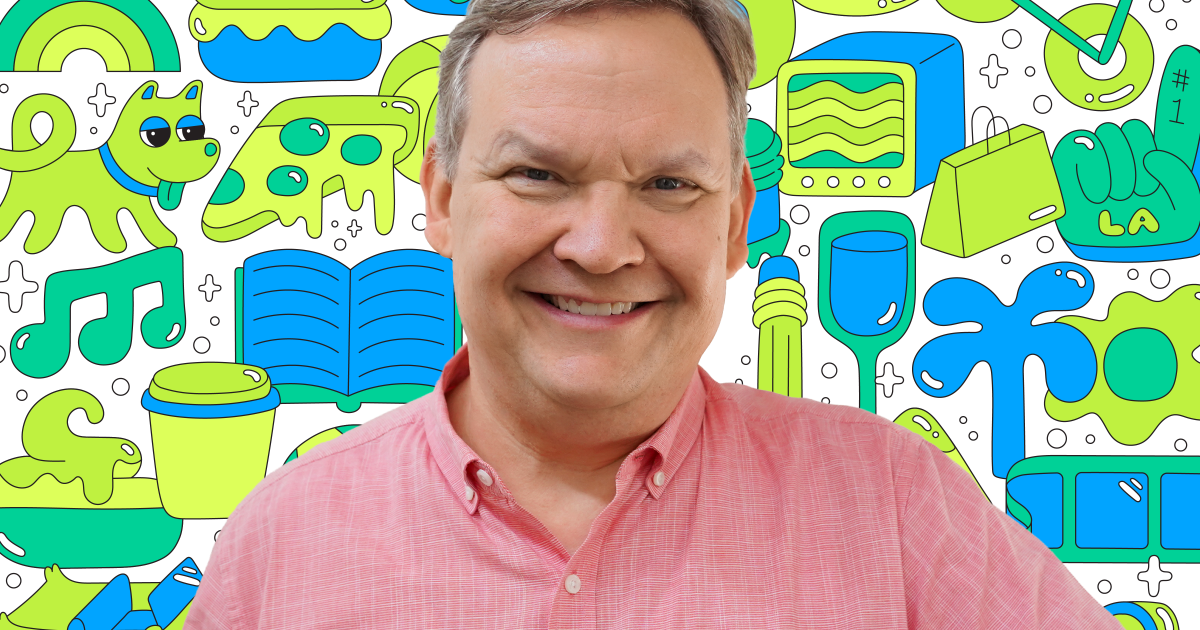
Andy Richter has found his place.
The Chicago area native previously lived in New York — where he first found fame as Conan O’Brien’s sidekick on “Late Night” — before moving to Los Angeles in 2001. Three years ago, he moved to Pasadena. “Now that I live here, I would not live anywhere else,” he says.
There are some practical benefits to the city. “I am such a crabby old man now, but it’s like, there’s parking, you can park when we have to go out,” Richter says. “The notion of going to dinner in Santa Monica just feels like having nails shoved into my feet.”

In Sunday Funday, L.A. people give us a play-by-play of their ideal Sunday around town. Find ideas and inspiration on where to go, what to eat and how to enjoy life on the weekends.
But he mostly appreciates that Pasadena is “a very diverse town and just a beautiful town,” he says.
For Richter, most Sundays revolve around his family. In 2023, the comedian and actor married creative executive Jennifer Herrera and adopted her young daughter, Cornelia. (He also has two children in their 20s, William and Mercy, from his previous marriage.)
Additionally, he’s been giving his body time to recover. Richter spent last fall training and competing on the 34th season of “Dancing With the Stars.” And though he had no prior dancing experience, he won over the show’s fan base with his kindness and dedication, making it to the competition’s ninth week.
He hosts the weekly show “The Three Questions” on O’Brien’s Team Coco podcast network and still appears in films and TV shows. “I’m just taking meetings and auditioning like every other late 50s white comedy guy in L.A., sitting around waiting for the phone to ring.”
This interview has been lightly edited and condensed for length and clarity.

7:30 a.m.: Early rising
It’s hard for me at this advanced age to sleep much past 7:30. I have a 5 1/2-year-old, and hopefully she’ll sleep in a little bit longer so my wife and I can talk and snuggle and look at our phones at opposite ends of the bed, like everybody.
Then the dogs need to be walked. I have two dogs: a 120-pound Great Pyrenees-Border Collie-German Shepherd mix, and then at the other end of the spectrum, a seven-pound poodle mix. We were a blended dog family. When my wife and I met, I had the big dog and she had a little dog. Her first dog actually has passed, but we like that dynamic. You get kind of the best of both worlds.

8 a.m.: Breakfast at a classic diner
Then it would probably be breakfast at Shakers, which is in South Pasadena. It’s one of our favorite places. We’re kind of regulars there, and my daughter loves it. It’s easy with a 5-year-old, you’ve got to do what they want. They’re terrorists that way, especially when it comes to cuisine.
I’ve lived in Pasadena for about three years now, but I have been going to Shakers for a long time because I have a database of all the best diners in the Los Angeles metropolitan area committed to memory. There’s just something about the continuity of them that makes me feel like the world isn’t on fire. And because of L.A.’s moderate climate, the ones here stay the way they are; whereas if you get 18 feet of winter snow, you tend to wear down the diner floor, seats, everything.
So there’s a lot of really great old places that stay the same. And then there are tragic losses. There’s been some noise that Shakers is going to turn into some kind of condo development. I think that people would probably riot. They would be elderly people rioting, but they would still riot.
11 a.m.: Sandy paws
My in-laws live down in Long Beach, so after breakfast we might take the dogs down to Long Beach. There’s this dog beach there, Rosie’s Beach. I have never seen a fight there between dogs. They’re all just so happy to be out and off-leash, with an ocean and sand right there. You get a contact high from the canine joy.

1 p.m.: Lunch in Belmont Shore
That would take us to lunchtime and we’ll go somewhere down there. There’s this place, L’Antica Pizzeria Da Michele, in Belmont Shore. It’s fantastic for some pizza with grandma and grandpa. It’s originally from Naples. There’s also one in Hollywood where Cafe Des Artistes used to be on that weird little side street.

4 p.m.: Sunset at the gardens
We’d take grandma and grandpa home, drop the dogs off. We’d go to the Huntington and stay a couple of hours until sunset. The Japanese garden is pretty mind-blowing. You feel like you’re on the set of “Shogun.”
The main thing that I love about it is the changing of ecospheres as you walk through it. Living in the area, I drive by it a thousand times and then I remember, “Oh yeah, there’s a rainforest in here. There’s thick stands of bamboo forest that look like Vietnam.” It’s beautiful. With all three of my kids, I have spent a lot of time there.

6:30 p.m.: Mall of America
After sundown, we will go to what seems to be the only thriving mall in America — [the Shops at] Santa Anita. We are suckers for Din Tai Fung. My 24-year-old son, who’s kind of a food snob, is like, “There’s a hundred places that are better and cheaper within five minutes of there in the San Gabriel Valley.” And we’re like, “Yeah, but this is at the mall.” It’s really easy. Also, my wife is a vegetarian, and a lot of the more authentic places, there’s pork in the air. It’s really hard to find vegetarian stuff.
We have a whole system with Din Tai Fung now, which is logging in on the wait list while we’re still on the highway, or ordering takeout. There’s plenty of places in the mall with tables, you can just sit down and have your own little feast there.
There’s also a Dave & Buster’s. If you want sensory overload, you can go in there and get a big, big booze drink while you’re playing Skee-Ball with your kid.
9 p.m.: Head to bed ASAP
I am very lucky in that I’m a very good sleeper and the few times in my life when I do experience insomnia, it’s infuriating to me because I am spoiled, basically. When you’ve got a 5 1/2-year-old, there’s no real wind down. It’s just negotiations to get her into bed and to sleep as quickly as possible, so we can all pass out.

new video loaded: Prada Peels Back the Layers at Milan Fashion Week
By Chevaz Clarke and Daniel Fetherston
February 27, 2026

Bill Cosby
Rape Accuser Says Cosby Won’t Take Stand At Trial
Published
Bill Cosby‘s rape accuser Donna Motsinger says the TV star can’t be bothered to show up to court for a trial in a lawsuit she filed against him.
According to new legal docs, obtained by TMZ. Motsinger says Bill will not testify in court … she claims it’s “because he does not care to appear.”

Motsinger says Bill won’t show his face at the trial either … and the only time the jury will hear from him will be a previously taped deposition.
As we previously reported, Motsinger claims Bill drugged and raped her in 1972. In the case, Bill admitted during a deposition that he obtained a recreational prescription for Quaaludes that he secured from a gynecologist at a poker game.
TMZ.com
Bill also said he planned to use the pills to give to women in the hopes of having sex with them.
Motsinger alleged Bill gave her a pill that she thought was aspirin. She claimed she felt off after taking it and said she woke up the next day in her bed with only her underwear on.
Here, it sounds like Motsinger wants to play the deposition for the jury.

Xiaomi 17 is a small(ish) phone with a big(ish) battery

World leaders split over military action as US-Israel strike Iran in coordinated operation

Iran fires missiles at US bases across Middle East after American strikes on nuclear, IRGC sites

Common nighttime noise exposure may trigger heart problems, study suggests

MLB pitcher Merrill Kelly says California tax rate swayed decision to reject Padres’ free agency offer

Florida High School Football Rankings: Top 25 teams – Oct. 21

Cleary's 21 help Le Moyne down Central Connecticut State 69-64 in OT

How old is Bo Nix? What to know about Oregon quarterback ahead of 2024 NFL Draft

99th annual Pony Swim held in Virginia

Indiana Members Credit Union announced as new anchor tenant at Bottleworks District
Iran fires missiles at US bases across Middle East after American strikes on nuclear, IRGC sites

Israel strikes two schools in Iran, killing more than 50 people

Anthropic CEO says he’s sticking to AI “red lines” despite clash with Pentagon

ICE blasts Washington mayor over directive restricting immigration enforcement

Did the EU bypass Hungary’s veto on Ukraine’s €90 billion loan?
-

 World2 days ago
Exclusive: DeepSeek withholds latest AI model from US chipmakers including Nvidia, sources say
-

 Massachusetts3 days ago
Mother and daughter injured in Taunton house explosion
-

 Montana1 week ago
2026 MHSA Montana Wrestling State Championship Brackets And Results – FloWrestling
-

 Louisiana5 days ago
Wildfire near Gum Swamp Road in Livingston Parish now under control; more than 200 acres burned
-

 Denver, CO3 days ago
10 acres charred, 5 injured in Thornton grass fire, evacuation orders lifted
-

 Technology1 week ago
YouTube TV billing scam emails are hitting inboxes
-

 Technology1 week ago
Stellantis is in a crisis of its own making
-

 Politics1 week ago
OpenAI didn’t contact police despite employees flagging mass shooter’s concerning chatbot interactions: REPORT