Lifestyle
Mickalene Thomas makes art that 'gives Black women their flowers'


Mickalene Thomas’ 2015 work “Afro Goddess Looking Forward.” Rhinestones, acrylic, and oil on wood panel
Mickalene Thomas/The Barnes Foundation
hide caption
toggle caption
Mickalene Thomas/The Barnes Foundation
In Mickalene Thomas’ art work, Black women are front and center. Her subjects are often at leisure, resting on couches and chairs, sometimes nude, and frequently accentuated by rhinestones and rich colorful patterns.
“I would describe my art as radically shifting notions of beauty by claiming space,” she says. “We’ve been supportive characters for far too long and … my art gives Black women their flowers and lets them know that they are the leading role.”
The scale of Thomas’ paintings, often made of unconventional materials like glitter, sequins, and yarn, makes them feel larger than life, with the eyes of her subjects gazing directly at the viewer. Each piece begins as a collage.
“I love the instant, tangible way having my hands at it, as if I’m sculpting with the paper, allows me the immediacy of the process,” she says. “My scissors are sort of a way of drawing.”
Thomas often recasts scenes from 19th-century French paintings, centering Black sensuality and power. She says her ultimate goal is to celebrate the “sisterhood” that exists between Black women, and which she grew up experiencing.

Mickalene Thomas describes her work as “radically shifting notions of beauty by claiming space.”
Arturo Holmes/Getty Images
hide caption
toggle caption
Arturo Holmes/Getty Images
“The trials and tribulations of my own life as a child did not negate the fact that there was a lot to love and care and family and support and comfort, even when there was struggle,” she says. “So that’s what I bring forth in my work.”
Thomas’ latest exhibition, “All About Love,” is midway through an international tour with stops in Los Angeles, Philadelphia (The Barnes Foundation, through Jan. 12, 2025), London and France. The Barnes exhibition features 50 paintings, collages, and photography spanning over two decades, inspired by the women in her life, including her mother, who died in 2012.
Interview highlights

Thomas’ 2010 “Le Déjeuner sur l’herbe: Les trois femmes noires” reinterprets Manet’s 1863 painting. Rhinestones, acrylic and enamel on wood panel.
Mickalene Thomas /Jean Pierre and Rachel Lehman Collection/The Barnes Foundation
hide caption
toggle caption
Mickalene Thomas /Jean Pierre and Rachel Lehman Collection/The Barnes Foundation
On her 2010 reinterpretation of Manet’s “Le Déjeuner sur l’herbe”
I decided to reinterpret or reclaim this space [by depicting] … three powerful women who are fully clothed, seated and not at a picnic, just lounging and giving each other their flowers.
On finding a home in art
I think that art has saved my life, for sure. Growing up, going to after school programs at the Newark Museum, it was, for me, this safe haven, this comfort, this refuge. I loved going there after school. I loved doing all the craft projects, the papier-mâché, exploring different ways of making self-portraits or building houses with popsicle sticks and all those things. … It was just an outlet, a way of expressing myself, but also a place to go after school until my mother got off work.
On using inexpensive craft supplies
When I was in Pratt, I couldn’t afford oil paint. I would rummage, often through the recycled stretcher bins, and gather my materials from that. And all I could afford was craft materials because they were cheaper than oil paint, like felt and different fabrics, glitter. … So I gravitated towards those materials because they were accessible and affordable for me. But what they did was open up a way of expressing myself. … There was a struggle of completing some assignments because some you had to use oil paint or some you had to use the traditional materials. … Sometimes people [would] throw away tubes of paint because they think it’s [finished] and [I’d] just cut it open, [and] there’s still paint in there.
[Now] I love using the high-end material and still the acrylic. I use both. But now I mix them up. And so you can’t tell what’s high or low, but that’s just part of life sometimes, right? You can wear H&M with a Prada jacket and still look fabulous. … Sometimes things that are so simplistic and that cost nothing are so much more rewarding.
On her late mother’s support of her work
She got to see it, experience it, celebrate it. She was celebrated for it. She was admired and adored. She loved the fact that she was a part of my art. She loved coming to the openings. She loved coming to my friends’ openings. She loved supporting my community. So whether it was my opening or one of my artist friends’, she would show up. And so I love that about her. She was a great advocate. She’s always been an advocate for the arts. She always supported that. When I decided I wanted to be an artist, she never looked at it as, “Why you want to go and do that?” Some of those things were in my head, but she never vocalized that. She was supportive.
Ann Marie Baldonado and Susan Nyakundi produced and edited this interview for broadcast. Bridget Bentz, Molly Seavy-Nesper and Beth Novey adapted it for the web.



The Tin Soldier, one of Nicolas Coppola’s marionette puppets, is the main character in The Steadfast Tin Soldier show at Coppola’s Puppetworks theater in Brooklyn’s Park Slope neighborhood.
Anh Nguyen for NPR
hide caption
toggle caption
Anh Nguyen for NPR
Every weekend, at 12:30 or 2:30 p.m., children gather on foam mats and colored blocks to watch wooden renditions of The Tortoise and the Hare, Pinocchio and Aladdin for exactly 45 minutes — the length of one side of a cassette tape. “This isn’t a screen! It’s for reals happenin’ back there!” Alyssa Parkhurst, a 24-year-old puppeteer, says before each show. For most of the theater’s patrons, this is their first experience with live entertainment.
Puppetworks has served Brooklyn’s Park Slope neighborhood for over 30 years. Many of its current regulars are the grandchildren of early patrons of the theater. Its founder and artistic director, 90-year-old Nicolas Coppola, has been a professional puppeteer since 1954.
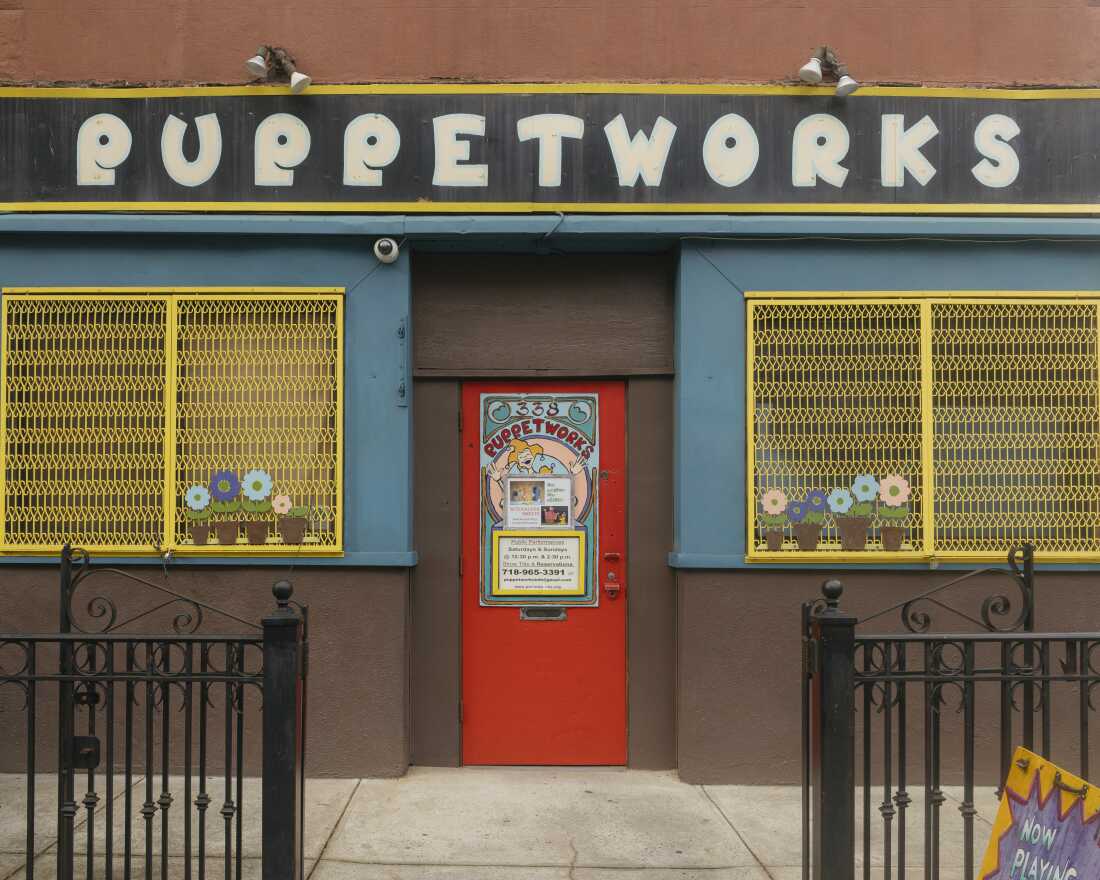
The Puppetworks theater in Brooklyn’s Park Slope neighborhood.
Anh Nguyen for NPR
hide caption
toggle caption
Anh Nguyen for NPR

A workshop station behind the stage at Puppetworks, where puppets are stored and repaired.
Anh Nguyen for NPR
hide caption
toggle caption
Anh Nguyen for NPR
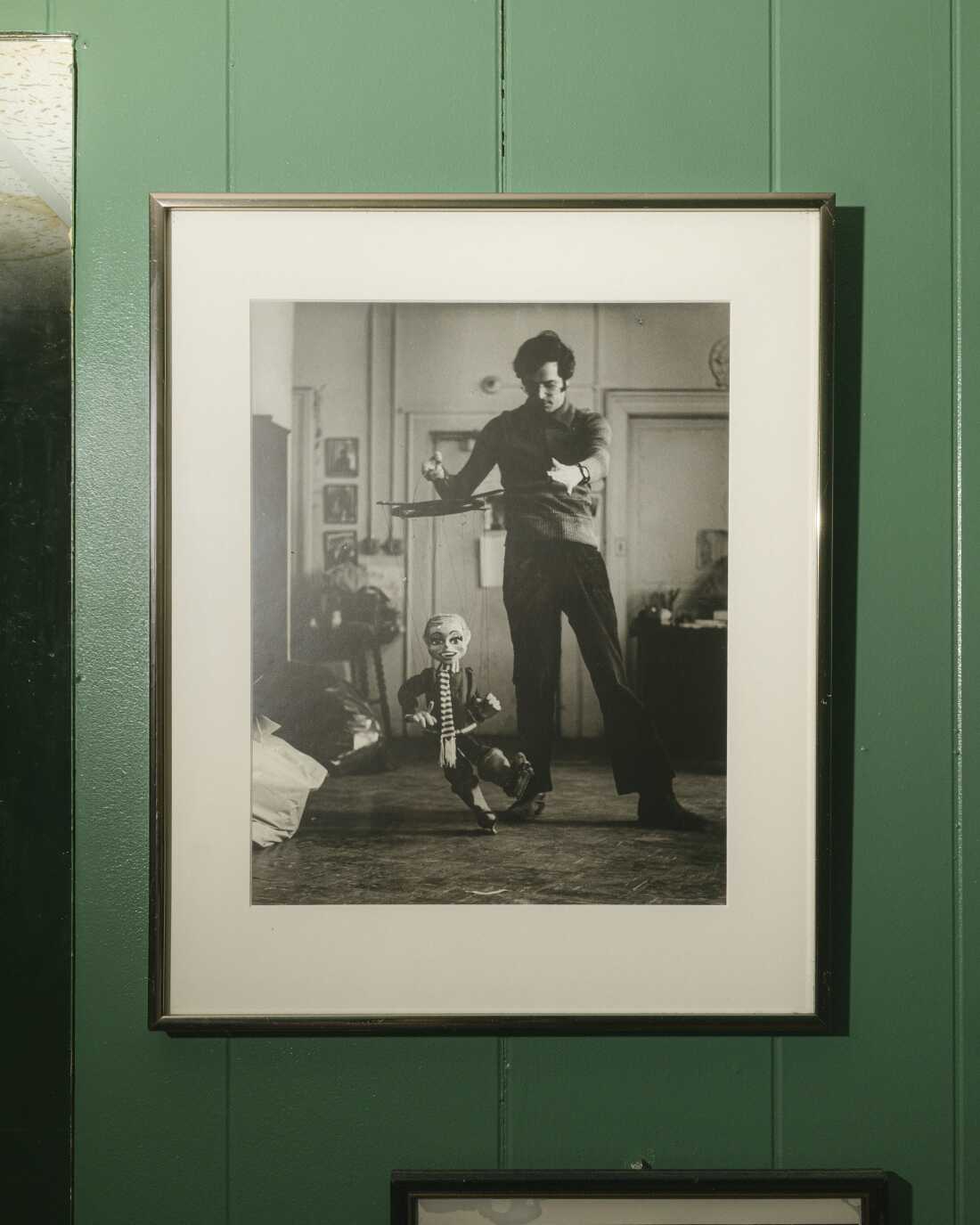
A picture of Nicolas Coppola, Puppetworks’ founder and artistic director, from 1970, in which he’s demonstrating an ice skater marionette puppet.
Anh Nguyen for NPR
hide caption
toggle caption
Anh Nguyen for NPR
For just $11 a seat ($12 for adults), puppets of all types — marionette, swing, hand and rod — take turns transporting patrons back to the ’80s, when most of Puppetworks’ puppets were made and the audio tracks were taped. Century-old stories are brought back to life. Some even with a modern twist.
Since Coppola started the theater, changes have been made to the theater’s repertoire of shows to better meet the cultural moment. The biggest change was the characterization of princesses in the ’60s and ’70s, Coppola says: “Now, we’re a little more enlightened.”

Right: Michael Jones, Puppetworks’ newest puppeteer, poses for a photo with Jack-a-Napes, one of the main characters in The Steadfast Tin Soldier. Left: A demonstration marionette puppet, used for showing children how movement and control works.
Anh Nguyen for NPR
hide caption
toggle caption
Anh Nguyen for NPR

Marionette puppets from previous Puppetworks shows hang on one of the theater’s walls.
Anh Nguyen for NPR
hide caption
toggle caption
Anh Nguyen for NPR

A child attends Puppetworks’ 12:30 p.m. showing on Saturday, Dec. 6, dressed in holiday attire that features the ballerina and tin soldier in The Steadfast Tin Soldier.
Anh Nguyen for NPR
hide caption
toggle caption
Anh Nguyen for NPR
Streaming has also influenced the theater’s selection of shows. Puppetworks recently brought back Rumpelstiltskin after the tale was repopularized following Dreamworks’ release of the Shrek film franchise.
Most of the parents in attendance find out about the theater through word of mouth or school visits, where Puppetworks’ team puts on shows throughout the week. Many say they take an interest in the establishment for its ability to peel their children away from screens.
Whitney Sprayberry was introduced to Puppetworks by her husband, who grew up in the neighborhood. “My husband and I are both artists, so we much prefer live entertainment. We allow screens, but are mindful of what we’re watching and how often.”

Left: Puppetworks’ current manager of stage operations, Jamie Moore, who joined the team in the early 2000s as a puppeteer, holds an otter hand puppet from their holiday show. Right: A Pinocchio mask hangs behind the ticket booth at Puppetworks’ entrance.
Anh Nguyen for NPR
hide caption
toggle caption
Anh Nguyen for NPR
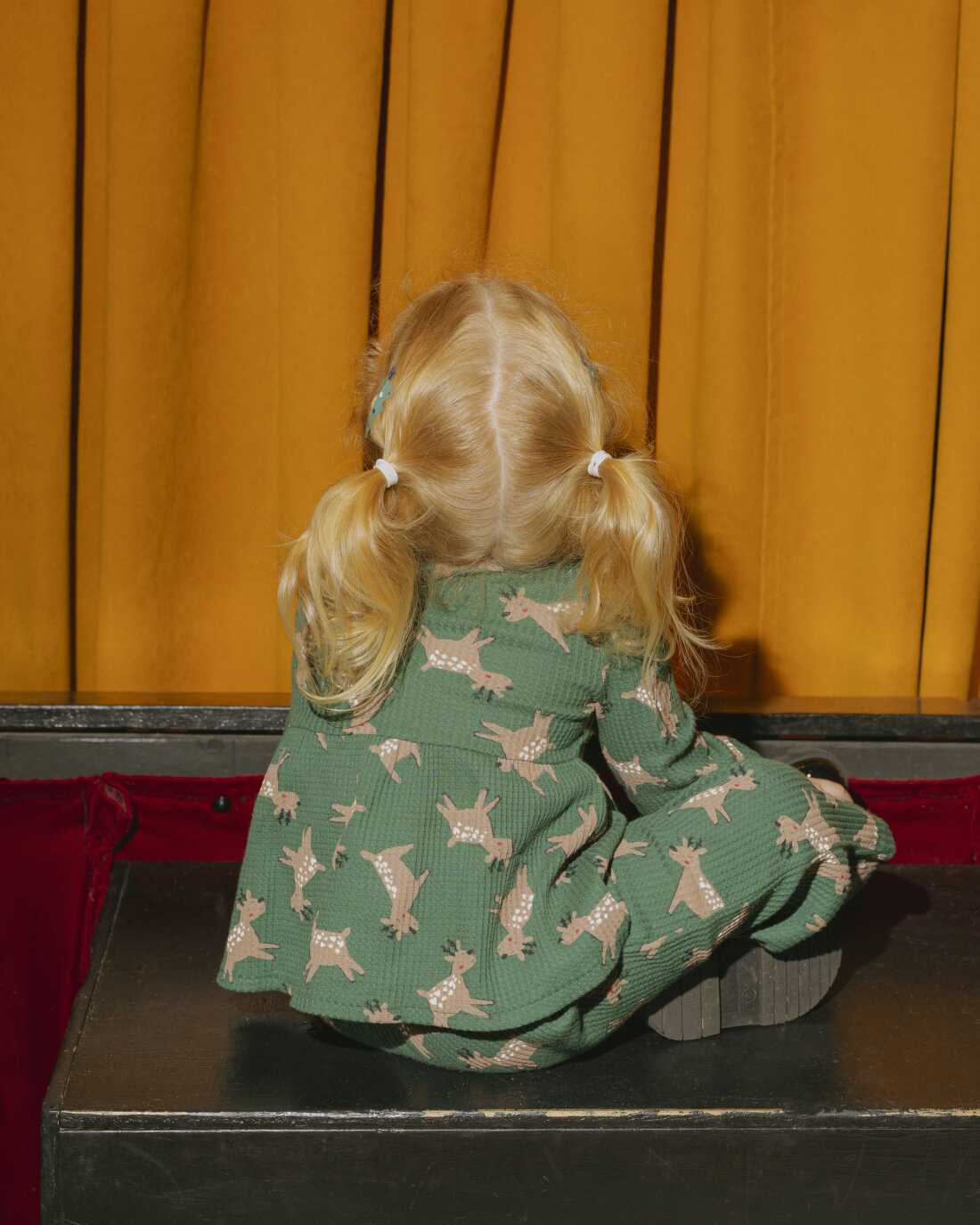
A child attends Puppetworks’ 12:30 p.m. showing on Saturday, Dec. 6, dressed in holiday attire.
Anh Nguyen for NPR
hide caption
toggle caption
Anh Nguyen for NPR

Left: Two gingerbread people, characters in one of Puppetworks’ holiday skits. Right: Ronny Wasserstrom, a swing puppeteer and one of Puppetworks’ first puppeteers, holds a “talking head” puppet he made, wearing matching shirts.
Anh Nguyen for NPR
hide caption
toggle caption
Anh Nguyen for NPR
Other parents in the audience say they found the theater through one of Ronny Wasserstrom’s shows. Wasserstrom, one of Puppetworks’ first puppeteers, regularly performs for free at a nearby park.
Coppola says he isn’t a Luddite — he’s fascinated by animation’s endless possibilities, but cautions of how it could limit a child’s imagination. “The part of theater they’re not getting by being on the phone is the sense of community. In our small way, we’re keeping that going.”
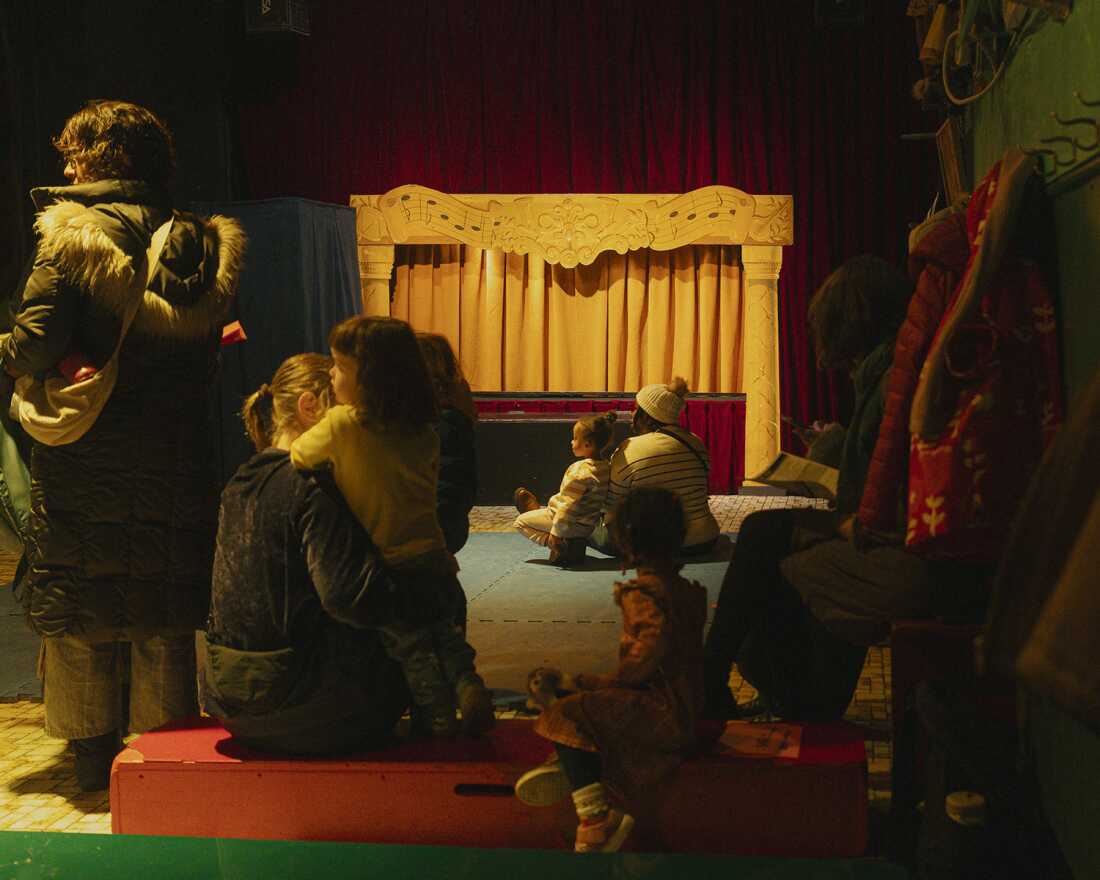
Puppetworks’ 12:30 p.m. showing of The Steadfast Tin Soldier and The Nutcracker Sweets on Saturday, Dec. 6.
Anh Nguyen for NPR
hide caption
toggle caption
Anh Nguyen for NPR
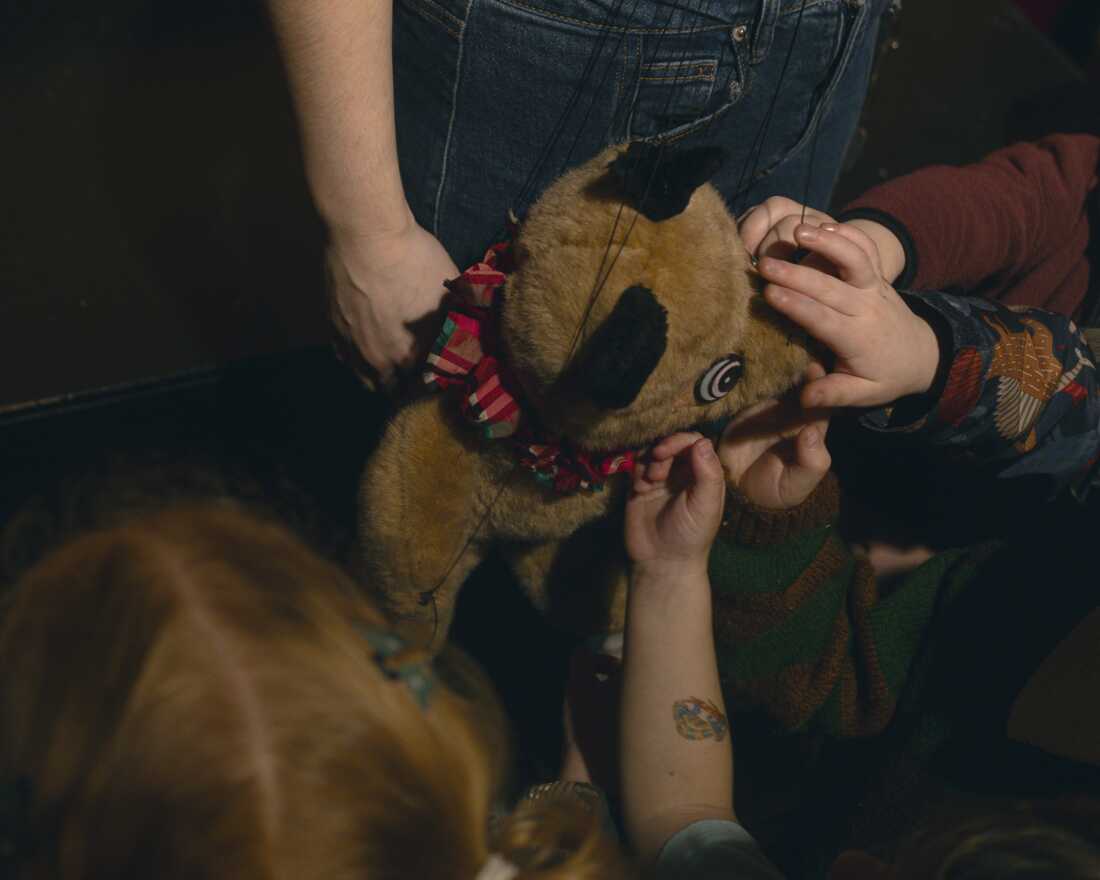
Children get a chance to see one of the puppets in The Steadfast Tin Soldier up close after a show.
Anh Nguyen for NPR
hide caption
toggle caption
Anh Nguyen for NPR
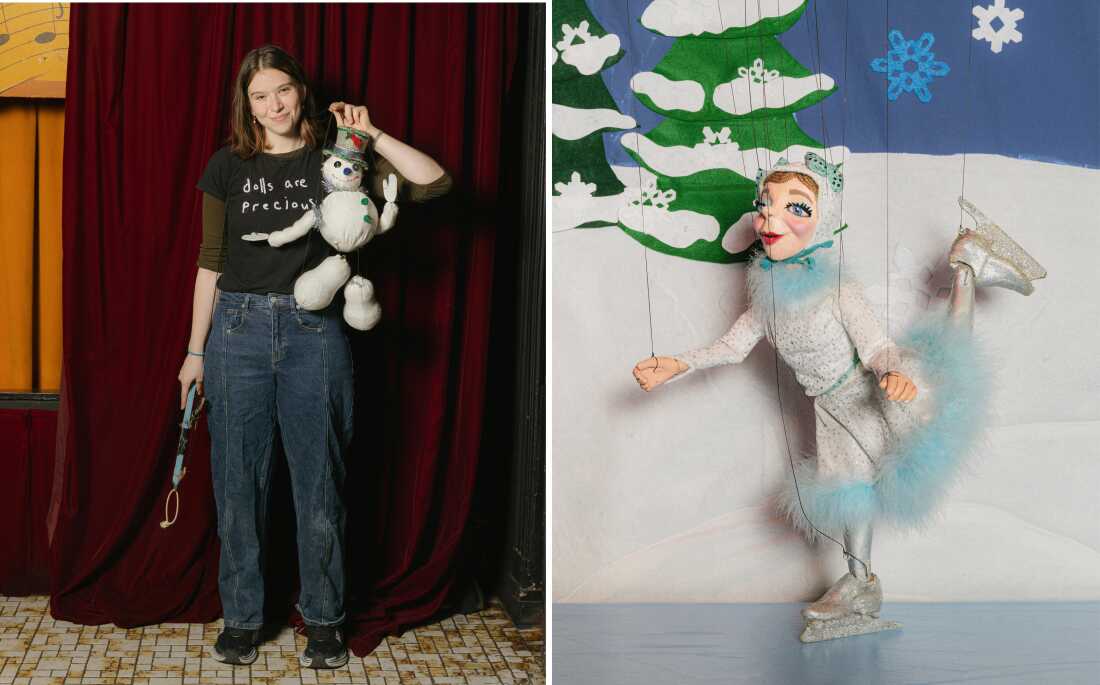
Left: Alyssa Parkhurst, Puppetworks’ youngest puppeteer, holds a snowman marionette puppet, a character in the theater’s holiday show. Right: An ice skater, a dancing character in one of Puppetworks’ holiday skits.
Anh Nguyen for NPR
hide caption
toggle caption
Anh Nguyen for NPR
Community is what keeps Sabrina Chap, the mother of 4-year-old Vida, a regular at Puppetworks. Every couple of weeks, when Puppetworks puts on a new show, she rallies a large group to attend. “It’s a way I connect all the parents in the neighborhood whose kids go to different schools,” she said. “A lot of these kids live within a block of each other.”

Three candy canes — dancing characters in one of Puppetworks’ holiday skits — wait to be repaired after a show.
Anh Nguyen for NPR
hide caption
toggle caption
Anh Nguyen for NPR
Anh Nguyen is a photographer based in Brooklyn, N.Y. You can see more of her work online, at nguyenminhanh.com , or on Instagram, at @minhanhnguyenn. Tiffany Ng is a tech and culture writer. Find more of her work on her website, breakfastatmyhouse.com.


California farmer arrested on suspicion of murder in wife’s death in Arizona

Colorado mom accused of killing 2 kids, fleeing to UK arrives back in US to face murder charges: ‘Momentous day’

At least four injured after multi-vehicle accident involving bus in Bridgeport, per police

GOVERNOR MEYER ORDERS LOWERING OF FLAGS FOR STATE TROOPER KILLED IN DMV SHOOTING

Florida man charged in racially motivated attack plot

Florida High School Football Rankings: Top 25 teams – Oct. 21

Cleary's 21 help Le Moyne down Central Connecticut State 69-64 in OT

How old is Bo Nix? What to know about Oregon quarterback ahead of 2024 NFL Draft

99th annual Pony Swim held in Virginia

Video: ‘It Didn’t Have to Happen This Way:’ U.Va. Faculty Call for Review of Police Response to Protests

A 3-D Look Inside Trump’s Revamped Oval Office

Trump admin sues Illinois Gov. Pritzker over laws shielding migrants from courthouse arrests

Europeans show solidarity with Denmark after Trump’s Greenland threat

Explosion at a Pennsylvania nursing home kills at least 2, governor says

What does Christmas look like for Ukraine? | Global News Podcast
-

 Iowa1 week ago
Addy Brown motivated to step up in Audi Crooks’ absence vs. UNI
-

 Maine1 week ago
Elementary-aged student killed in school bus crash in southern Maine
-

 Maryland1 week ago
Frigid temperatures to start the week in Maryland
-

 New Mexico1 week ago
Family clarifies why they believe missing New Mexico man is dead
-

 South Dakota1 week ago
Nature: Snow in South Dakota
-

 Detroit, MI1 week ago
‘Love being a pedo’: Metro Detroit doctor, attorney, therapist accused in web of child porn chats
-

 Health1 week ago
‘Aggressive’ new flu variant sweeps globe as doctors warn of severe symptoms
-

 Maine1 week ago
Family in Maine host food pantry for deer | Hand Off