Lifestyle
L.A. Affairs: I grew up on Disney princesses and fairy tales. Was I ready for my own happily ever after?


Marriage has been ingrained in me since I could form memories. That my purpose in life is to get married and have babies. I know this sounds old-fashioned and maybe that has something to do with the fact that I was born a girl in the Soviet Union to a Jewish family, but I’ve spent my life toggling between the tradition of marriage and the liberal Los Angeles ideologies I internalized. I’ve often found myself wondering if it is even possible to be a good writer, an artist and be married.
At 11 years old, I was a flower girl at my cousin’s wedding in Calabasas. I remember walking down the aisle with a tiny basket of rose petals, a pair of adult-sized breasts and a petrified look on my face, unable to smile even though I was a generally happy kid. The horse and carriage, the vintage bridal kimono, the perky orchids, the flash, flash, flash of cameras, the expectations on everyone’s faces, the stressful night’s sleep no amount of Valerian root could remedy — I wasn’t sure if all this was for me.
But I loved love. I had grown up on an unhealthy dose of Disney princesses and fairy tales and the idea that one day my prince will come. I memorized the entirety of the film “The Notebook.” I would often fantasize about lying on my deathbed with the love of my life, hand in hand, like Noah and Allie.
In my teens, I flirted for hours with strangers on AIM. I hooked up with boys in the landscaping at the Century City mall after sharing a bowl of orange chicken at Panda Express. I had boyfriends and friends with benefits and cutouts of my idols: Victoria’s Secret models like Adriana Lima taped to the walls of my childhood bedroom. I was fully liberated by the over-sexualized, MTV-obsessed early aughts.
Then I lost my virginity to my high school sweetheart who soon became my boyfriend of seven long years.
In a conversation I don’t remember having, my cousin asks me when I think I will be married. I reply matter-of-factly: “By 25.” She then scoffs and laughs in my face. “Yeah, right.”
By the time I reached my mid-20s, I had broken up with my high school sweetheart whom I had little in common with other than the fact that we were supposed to get married. I was living alone in a studio apartment in Palms, sleeping in the same room as my refrigerator. I had stacks of books near my bed, a county government temp job in a downtown L.A. skyscraper and a stream of notifications from a dating app lighting up my apartment at odd hours of the night.
Marriage was beginning to seem impractical, uncool. I was living a life my immigrant parents deemed “acceptable,” but what I really wanted was to be a writer, although I was too scared to even utter the fact that I was an artist back then. I honed my craft and spent my nights in adult-education writing classes.
Meanwhile, I dated plenty. A musician. A botanist. An artist. An art writer. I fawned over a co-worker, a photographer a decade older than me. Eventually I met someone my own age: a graphic designer from work who I ended up dating for 4 ½ years.
A year into my relationship with the graphic designer, marriage began to follow us around like a hungry dog. I was a bridesmaid in two different weddings, one week apart. I wore a grass-green, floor-length dress. I wore a lace, Champagne-colored floor-length dress. I got my face airbrushed. My lips lined. My eyes powdered. My cheeks contoured. My hair sprayed. I looked like a Russian mail-order bride. I was a reverse mail-order bride, born in Belarus, now an American. Actually, no one had ordered me. I had never been so unlike myself. My graphic designer boyfriend noticed. His knees buckled as he watched me dance the hora and attempt to catch the bouquet again and again.
What’s funny is that my own parents didn’t get married until their mid-30s. My dad was divorced, and my mom was an old maid by Belarusian standards. But I was raised on their love story: the couple of life-altering years in which they got married after three months of dating, had me and moved to the U.S.
The graphic designer and I broke up in 2020. I was a mess, but it was clearer than ever what I needed to do: stop trying to control everything and just let life happen. A few months later, a kind, gentle, handsome, funny, optimistic, wildly creative man replied to one of my prompts on Hinge, agreeing that mayonnaise was indeed disgusting.
Tyler and I fell in love and dated for four years. Together we lived through family tragedies, the worst of the COVID-19 pandemic, my grad school, his grad school, supporting each other’s creative practices, quitting jobs, finding jobs, moving in together, adopting our sweet mutt Agnes. In the summer of 2024, he proposed at Crater Lake, surrounded by a swarm of dragonflies.
At first, I felt weird talking to people about the engagement. Some of our friends were newly married, some were single by choice (or not), but most were in long-term monogamous relationships with no plans for marriage. I had never been happier, but I still housed the fear that getting married was too status quo, out of fashion, an uncool thing to do. My favorite writers certainly thought so with the most popular books that year being about divorce and self-actualization: “All Fours” by Miranda July, “Splinters” by Leslie Jamison and “Liars” by Sarah Manguso.
The Paris Review once asked writer Helen Garner whether being a writer and marriage are generally compatible. She replied: “They probably are, but it probably takes a lot of generosity and flexibility. If you’re burdened by a classic idea of the artist as a figure to whom everything is owed and whose prerogatives are enormous and can never be challenged, forget it.”
In one of her more judgmental essays titled “Marrying Absurd,” Joan Didion chastises those who choose to get married in Las Vegas. She insists that they are doing it not out of convenience, but because of the fact that they don’t know “how to make the arrangements, how to do it ‘right.’”
How do you do it right, Joan?
Tyler and I got married in January (nine years after the age I insisted to my cousin I would get married) in Las Vegas, by an Elvis impersonator singing “Can’t Help Falling in Love” at the famous Little White Chapel with three dozen of our closest friends and relatives in attendance, two weeks after L.A.’s devastating wildfires, and the week of Trump’s inauguration.
While I had my hair and makeup done in front of the hotel window overlooking the faux Eiffel Tower, with the Bellagio fountain going off every 30 minutes, I was weepy. But not because of the usual suspects: cold feet or the last-minute cancellations or the eczema reappearing after years of dormancy on my arms or the lack of sleep, although I did forget to pack some Valerian root.
At some point, I had convinced myself that getting married was uncool, not what an artist does, but here I was doing it. In fact, I was marrying the man who supported my creative pursuits the most. I had changed my mind about marriage yet again. It’s a symbol of hope in a hopeless world, a sacred pact between two people, and it can be whatever the hell you want it to be.
And yes, it might not work out, but also, it might.
Maybe the question isn’t: Does marriage make you less of an artist? Maybe the question is: Who gets to be an artist anyway?
The author is a freelance writer from Los Angeles. She’s on Instagram: @druzova_.
L.A. Affairs chronicles the search for romantic love in all its glorious expressions in the L.A. area, and we want to hear your true story. We pay $400 for a published essay. Email LAAffairs@latimes.com. You can find submission guidelines here. You can find past columns here.




On-air challenge
Every answer today is a familiar two-word phrase or name in which the first word starts BE- and the second word start D- (as in “bed”). (Ex. Sauce often served with tortilla chips –> BEAN DIP)
1. Sinuous Mideast entertainer who may have a navel decoration
2. Oscar category won multiple times by Frank Capra and Steven Spielberg
3. While it’s still light at the end of the day
4. Obstruction in a stream made by animals that gnaw
5. Actress who starred in “Now, Voyager” and “Whatever Happened to Baby Jane?”
6. Two-time Conservative prime minister of Great Britain in the 19th century
7. Italian for “beautiful woman”
8. Patron at an Oktoberfest, e.g.
9. Dim sum dish made with ground meat and fillings wrapped in a wonton and steamed
10. [Fill in the blank:] Something that is past its prime has seen ___
11. Like the engine room and sleeping quarters on a ship
Last week’s challenge
Last week’s challenge came from Robert Flood, of Allen, Texas. Name a famous female singer of the past (five letters in the first name, seven letters in the last name). Remove the last letter of her first name and you can rearrange all the remaining letters to name the capital of a country (six letters) and a food product that its nation is famous for (five letters).
Challenge answer
Sarah Vaughan, Havana, Sugar.
Winner
Josh McIntyre of Raleigh, N.C.
This week’s challenge (something different)
I was at a library. On the shelf was a volume whose spine said “OUT TO SEA.” When I opened the volume, I found the contents has nothing to do with sailing or the sea in any sense. It wasn’t a book of fiction either. What was in the volume?
If you know the answer to the challenge, submit it below by Wednesday, December 24 at 3 p.m. ET. Listeners whose answers are selected win a chance to play the on-air puzzle.

JoJo Siwa
Boyfriend Chris Hughes Reveals Engagement Plans …
Gotta Take Her By Surprise!!!
Published
JoJo Siwa and her man Chris Hughes have clearly discussed engagement details … because Hughes dished on a few specifics about a potential proposal.
The singer and beau gave The Sun an update on their relationship Sunday … and, the conversation turned to all things engagement — including the right and wrong time to pop the question.
Waiting for your permission to load the Instagram Media.
In the clip, Hughes says he’s against getting engaged on an obvious milestone day like Christmas for example … claiming it takes away the surprise from the proposal.
JS seemed into the idea … joking that Chris is trying to keep her guessing — though she did give it some thought before stamping the idea with a seal of approval.

However, one nontraditional engagement practice the two won’t participate in is Siwa popping the question to Hughes … because he says he wants to buy the ring and ask her to marry him.
JoJo won’t wait forever though … telling Hughes he’s got seven years to ask her — or she’ll ask him. Clock’s ticking down to 2032!
Anyhoo … keep your head on a swivel, JoJo — because a surprise engagement could be right around the corner!
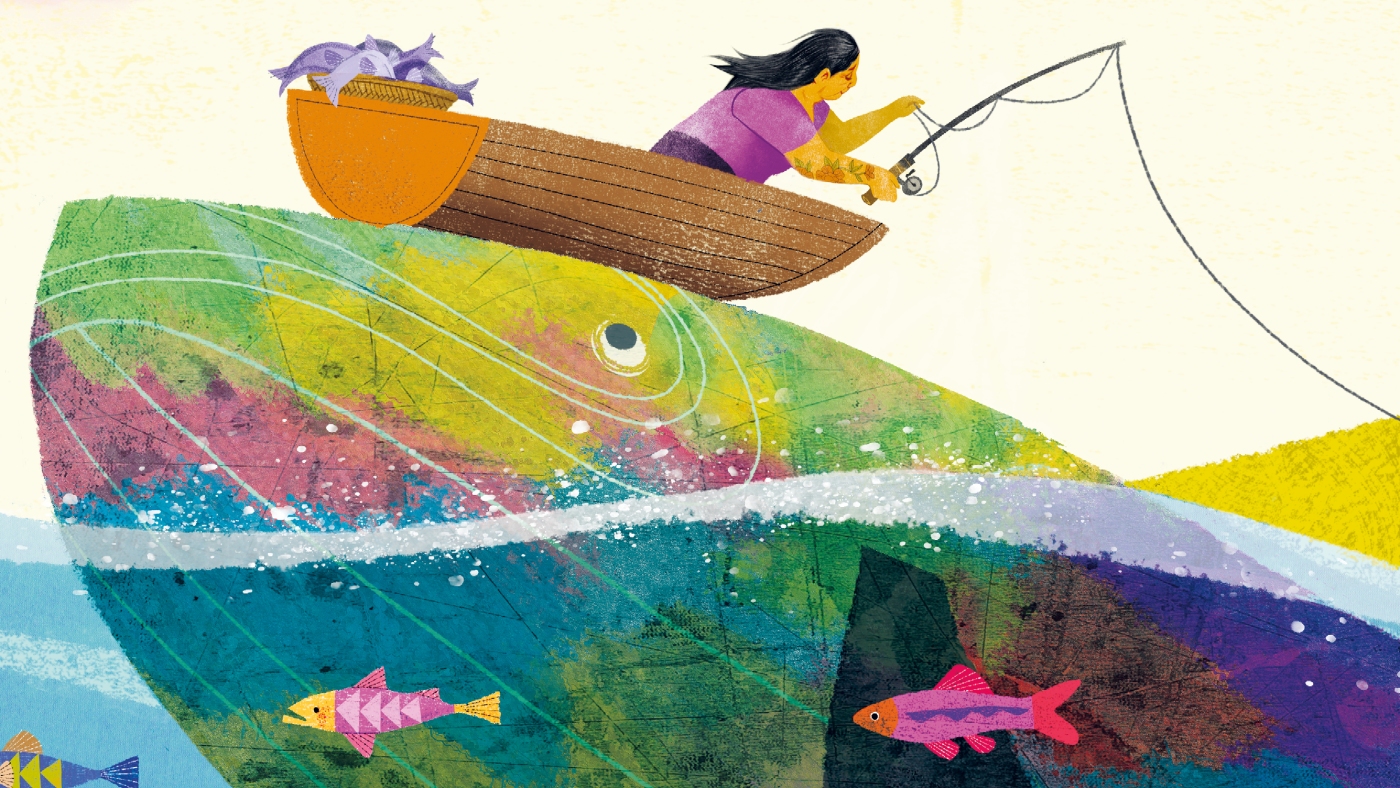
Rafael López / Roaring Brook Press
A couple of years ago, after his mom died, Fry Bread author Kevin Maillard found himself wondering, “but where did she go?”
“I was really thinking about this a lot when I was cleaning her house out,” Maillard remembers. “She has all of her objects there and there’s like hair that’s still in the brush or there is an impression of her lipstick on a glass.” It was almost like she was there and gone at the same time.
Maillard found it confusing, so he decided to write about it. His new children’s book is And They Walk On, about a little boy whose grandma has died. “When someone walks on, where do they go?” The little boy wonders. “Did they go to the market to thump green melons and sail shopping carts in the sea of aisles? Perhaps they’re in the garden watering a jungle of herbs or turning saplings into great sequoias.”

Rafael López / Roaring Brook Press
Maillard grew up in Oklahoma. His mother was an enrolled member of the Seminole Nation. He says many people in native communities use the phrase “walked on” when someone dies. It’s a different way of thinking about death. “It’s still sad,” Maillard says, “but then you can also see their continuing influence on everything you do, even when they’re not around.”
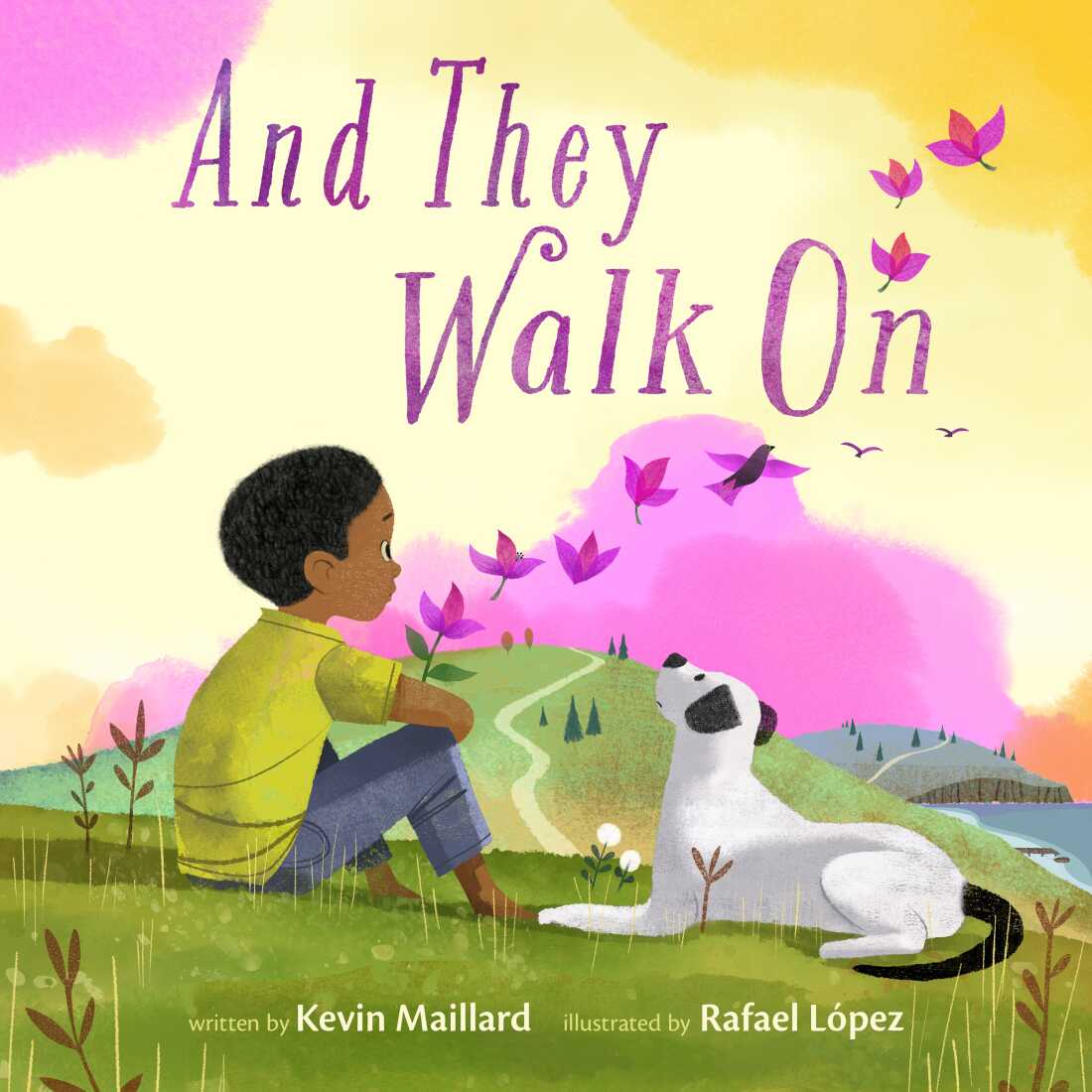
Rafael López / Roaring Brook Press
And They Walk On was illustrated by Mexican artist Rafael López, who connected to the story on a cultural and personal level. “‘Walking on’ reminds me so much of the Day of the Dead,” says López, who lost his dad 35 years ago. “My mom continues to celebrate my dad. We talk about something funny that he said. We play his favorite music. So he walks with us every day, wherever we go.”
It was López who decided that the story would be about a little boy: a young Kevin Maillard. “I thought, we need to have Kevin because, you know, he’s pretty darn cute,” he explains. López began the illustrations with pencil sketches and worked digitally, but he created all of the textures by hand. “I use acrylics and I use watercolors and I use ink. And then I distressed the textures with rags and rollers and, you know, dried out brushes,” he says. “I look for the harshest brush that I neglected to clean, and I decide this is going to be the perfect tool to create this rock.”
The illustrations at the beginning of the story are very muted, with neutral colors. Then, as the little boy starts to remember his grandmother, the colors become brighter and more vivid, with lots of purples and lavender. “In Mexico we celebrate things very much with color,” López explains, “whether you’re eating very colorful food or you’re buying a very colorful dress or you go to the market, the color explodes in your face. So I think we use color a lot to express our emotions.”

Rafael López / Roaring Brook Press
On one page, the little boy and his parents are packing up the grandmother’s house. The scene is very earthy and green-toned except for grandma’s brightly-colored apron, hanging on a hook in the kitchen. “I want people to start noticing those things,” says López, “to really think about what color means and where he is finding this connection with grandma.”
Kevin Maillard says when he first got the book in the mail, he couldn’t open it for two months. “I couldn’t look at it,” he says, voice breaking. What surprised him, he said, was how much warmth Raphael López’s illustrations brought to the subject of death. “He’s very magical realist in his illustrations,” explains Maillard. And the illustrations, if not exactly joyful, are fanciful and almost playful. And they offer hope. “There’s this promise that these people, they don’t go away,” says Maillard. “They’re still with us… and we can see that their lives had meaning because they touched another person.”

Rafael López / Roaring Brook Press

The Cryptocurrency That Could Be About to Explode 1,000% | The Motley Fool

Why investing in a Trump Account could complicate your taxes

I’ve been doing this standing exercise for six months and it’s transformed my core strength

Movie Review: The Voice of Hind Rijab

Patriots rookie RB Tre’Veyon Henderson sidelined against Ravens with head injury

Florida High School Football Rankings: Top 25 teams – Oct. 21

Cleary's 21 help Le Moyne down Central Connecticut State 69-64 in OT

How old is Bo Nix? What to know about Oregon quarterback ahead of 2024 NFL Draft

99th annual Pony Swim held in Virginia

Video: ‘It Didn’t Have to Happen This Way:’ U.Va. Faculty Call for Review of Police Response to Protests

DHS responds after reports CISA chief allegedly failed polygraph for classified intel access

EU plans to raise €90 billion in joint debt for Ukraine — here’s how

Lawmakers threaten Attorney General Bondi with contempt over incomplete Epstein files

DNI Gabbard warns ‘Islamist ideology’ threatens Western freedom at AmFest

Algeria bill seeks to criminalise French colonial rule: What to know
-

 Iowa7 days ago
Addy Brown motivated to step up in Audi Crooks’ absence vs. UNI
-

 Iowa1 week ago
How much snow did Iowa get? See Iowa’s latest snowfall totals
-

 Maine5 days ago
Elementary-aged student killed in school bus crash in southern Maine
-

 Maryland7 days ago
Frigid temperatures to start the week in Maryland
-

 South Dakota1 week ago
Nature: Snow in South Dakota
-

 New Mexico5 days ago
Family clarifies why they believe missing New Mexico man is dead
-

 Detroit, MI6 days ago
‘Love being a pedo’: Metro Detroit doctor, attorney, therapist accused in web of child porn chats
-

 Education1 week ago
Opinion | America’s Military Needs a Culture Shift