Lifestyle
I've been married 13 years. Why is vacation sex suddenly so fleeting?

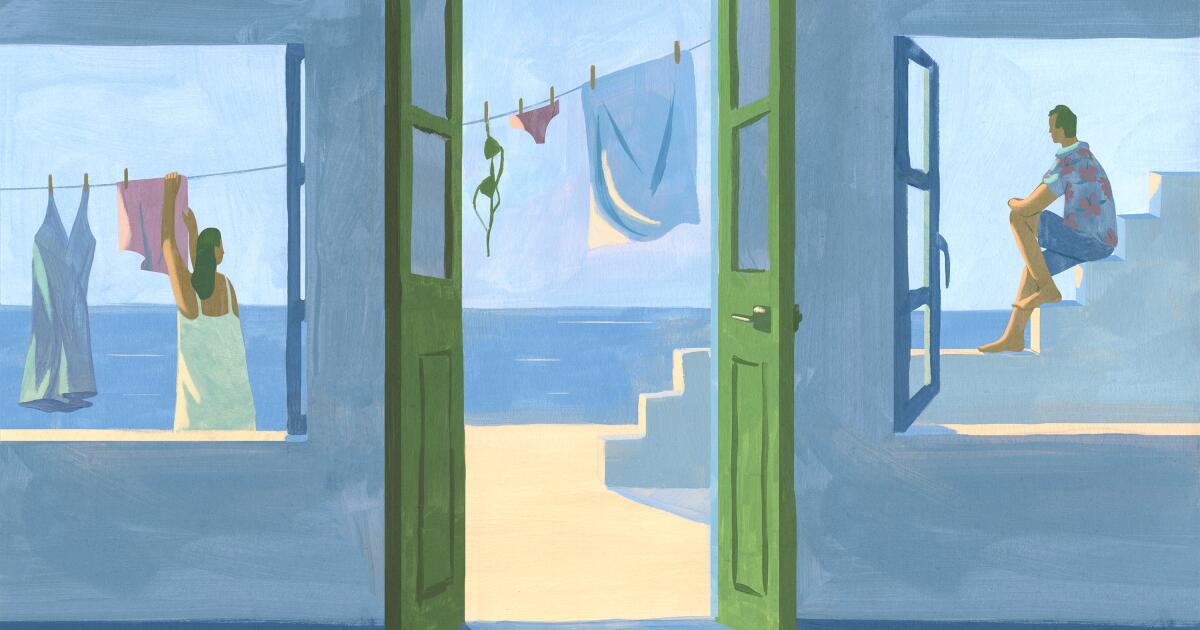
A funny thing happened almost a decade ago when I told my girlfriends that I was embarking on a two-week anniversary trip with my husband. Eyebrows were raised. One friend shook her head and said, “That would quickly become problematic.” Another said she never goes on vacation solely with her husband anymore because they always fight or he is “too needy sexually.” Still another told me I was brave because that was “too long,” and buried issues would start to rear their ugly heads. And these were the “happy couples” in my friend group!
I was intrigued by their reaction. When did we all start dodging our long-term partners? Was this another midlife obstacle that I had yet to confront? And was I going to experience it firsthand on this getaway with my husband?
The dynamic my friends were describing “is extremely common,” says Evans Wittenberg, a licensed marriage family therapist based in Los Feliz. “Vacations are a culturally sanctioned time to unwind, but the pressure to enjoy often backfires — especially in the bedroom. You cannot schedule desire, it much prefers breaking the rules rather than following them.”
My husband Rob and I have always bonded over a shared love of travel. We’ve loved exploring far-flung places, like Cambodia and Bora Bora, over nearly two decades together. How bad could it be?
With my friends’ voices in my head, we embarked on our journey to New Zealand in 2016. The plan was to spend a few days with my relatives who were living there and the rest of the time exploring a couple of lodges. We hadn’t slept well on the flight, and as soon as we landed, we had to be alert and drive on what felt like the wrong side of the road for four hours to our first stop. Amid the fog of jet lag, the squabbles began.
Why was it that despite our beautiful surroundings and swanky hotel rooms we couldn’t find a way to relax together?
First came the bickering over directions. Rob said my tone was edgy, and I thought the same about him. I often have strong opinions about where we should go and how, and he thinks my questioning him represents a lack of trust or that he can’t handle the task at hand. Much of our time spent navigating the lush green backroads of New Zealand was tense. Rob ignored me and blasted U2 at a volume he knew would make me nuts.
When we got to our destination, another point of disagreement came up: What to do that day. Rob wanted to bike ride. I wanted to spend our time exploring the parks along the Waikato River on foot. Luckily we were able to agree on exploring some thermal hot springs.
Finally, there was the question of intimacy. How much sex were we having — and when were we having it? When we arrived at the hotel, we upgraded to an even nicer, more expensive suite. Implicit in its price tag was the expectation that we’d have a fantastic time to justify it. Rob didn’t skip a beat getting into vacation mode and was keen to get the party started, while I needed a moment to shake off my fatigue and transition into feeling romantic. Our sex drives didn’t naturally sync up on that trip like they usually do and it bubbled up into a big, cranky fight leaving both of us feeling exhausted and miserable.
Rob likes to point out that in the early days of our relationship, when we went on our very first vacation, we’d have sex multiple times a day. It’s a benchmark he wishes we could revisit.
By the end of our trip, we were a bit sick of each other, and my girlfriends were proved right. Why was it that despite our beautiful surroundings and swanky hotel rooms we couldn’t find a way to relax together?
After New Zealand, we both agreed we should rethink how we traveled as a couple. We weren’t having as much fun as we could be. So we joined a travel group that offered curated activities to lessen the stress that comes with designing the trip ourselves. In the fall of 2019, we went on a weeklong vacation to Dubrovnik and Montenegro with a full agenda of boating excursions and hikes through vineyards with the hope that being surrounded by chatty fellow travelers and gorgeous sights would relieve some of the pressure to be everything for each other.
The hectic pace was a challenge for me. As an introvert, having a full schedule and breakfast, lunch and dinner with 20 strangers felt like a strain, despite how lovely the company was. But Rob seemed to be keeping up just fine. Toward the end, I was craving a day to relax at the hotel. But that day there was a kayaking adventure in Skadar Lake that would require three hours roundtrip in a van. It was more Rob’s thing than mine, and I encouraged him to go without me so I could have a day to myself.
Somehow this suggestion got lost in translation, and was processed as “Stay at the hotel with me so we can have sex all day!” That breakdown in communication kicked off one of the worst fights of our marriage. I felt boxed in; unable to take care of both of our needs at the same time. I needed to look after myself but couldn’t communicate that desire without it leading to a fight. Exhausted, backed into a wall and not seeing how we could move forward, I was mentally prepared to fly home alone the next day.
That night, as Rob engaged with everyone at the dinner but me, I comforted myself with a basket of bread rolls and thought about how we used to relish every minute together. We were one of those couples who clearly delighted in each other; other people would remark on our physical connection and say things like, “Come on you guys, you’re making us look bad.”
After dessert, with Rob still engrossed in conversation, I left the group, walked around the hotel grounds and found a quiet, deserted pool at the edge of a steep cliff. I peeled off my dress and had a solo late-night swim.
In earlier years, he would have come looking for me. I texted him and asked him to join me at the pool but unbeknownst to me he had left his phone in the room. I figured he was ignoring me. My stomach roiled from the stress. As the waves crashed cinematically on the rocks below, I thought that if we couldn’t get along in such a dreamy setting, then maybe it was an indication that we shouldn’t be together.
Exhausted, backed into a wall and not seeing how we could move forward, I was mentally prepared to fly home alone the next day.
I was also aware that my instincts might be mirroring those of my mother. She chose not to marry my father and raised me alone. There were only short-term partners until she finally walked down the aisle with my stepfather when I was 17. Sometimes I felt like the only thing I learned how to do in a relationship was leave.
For the next day, as I wrestled with whether to stay or to go, I contemplated my mother’s influence. I had inherited her avoidant tendencies and that urge to pull away, to run. Sticking around to resolve the fight might’ve been harder but would also be far more rewarding. I resolved to stay and see if we could work through it.
And we did. There might have been some makeup sex involved.
For a while after that, our solution was to not go away together at all — a decision only bolstered by the COVID-19 pandemic. We finally dipped our toes back into traveling in 2021. Still wary of our tendency to fight on vacation, we started off with three- or four-day trips, nothing too far or too taxing. They went well, but I was unsure about taking a bigger plunge. And I worried disagreements over sex would pop up again.
Eventually I sought out the advice of Kiana Reeves, an Ojai-based teacher of embodiment and intimacy. She put many of the feelings I’d been having around expectations into words.
“When stakes feel high everything goes sideways,” Reeves says. “We experience it as pressure, and pressure is a great libido killer, it’s a great intimacy killer and it often puts us in a position where we are blaming the other person for our feelings of pressure or not getting our needs met.”
The whole point of vacation is to relax and bring play into our lives, Reeves reminded me, noting that “libido thrives” in exactly those situations. She recommended that couples feeling vacation stress take the emphasis off sex and focus on connection, then “spend time making out, massage each other or lovingly touch each other. And see what happens from there.”
After trying a painful but productive couples retreat in Northern California, and even a few blissful guided healing sessions, we’ve focused in on Reeves’ advice to relax more, to be less hurried and to trust in our connection. It’s helping. I’ve nurtured a new appreciation for Rob; how giving he is, how much he strives to please me.
As for our differing appetites for activity, when one of us wants to go on a trip that appeals to only their personal interest, we find the right travel companions for the occasion. He does ski or boat trips with his buddies or his kids, while I might go visit my daughter at college or relatives in Australia. That way, we get to miss each other and feel fulfilled in our individual pursuits as well. When I’m excited about my own life, I’m more playful, curious and fun to be with. This approach has revitalized our relationship.
I don’t wing it and hope everything will turn out OK anymore. I communicate. Once I started verbalizing my need for alone time, and stopped tiptoeing around his feelings, I found that our relationship started to improve — both on vacations and in day-to-day life too. I got comfortable owning that I’m an introvert and being with a large group 24/7 or even just with my husband for every minute of the day is a lot for me. It’s no reflection on my feelings for him; it’s the way I’m built. We agreed in advance that I’ll tell him if I need to skip a group dinner or an activity to unwind and he now better understands why that’s important to me.
We still kick this subject of sex on vacation around a lot. Ignoring it gets in the way of an authentic connection. Not always comparing this version of us with earlier versions helps. When Rob gets nostalgic for our former sex life, I remind him that we’re now dealing with older, less compliant bodies. I’ve gone my rounds with perimenopause and menopause and he’s had his own battles with aging. That’s true when it comes to sex, but a whole lot more than that too. I’m not in the same headspace and neither is he.
Luckily, I picked a partner who is willing to evolve — and who also supports my own journey of evolution. Now, Rob and I have been together for 19 years and married for 13. It’s something that I never thought myself capable of, an achievement I’m proud of.
When I mentioned it recently to my mother, she said, “Oh, well. Time for a break then. Otherwise it’s like eating the same bowl of cornflakes every day for 19 years.”
When I’m confronted with her point of view, I see it as more evidence that keeping my relationship intact has been a true accomplishment. I love my husband and we like being together, even if it isn’t always perfect. We remain great partners.
Last month, in what has become our tradition, we went on an anniversary trip with a travel group, this time to Africa. In a nod to our differences, on Valentine’s Day I went on the morning elephant encounter and he went on the river rafting trip. He came back upset — and minus his wedding ring, a custom-made band that he loved dearly. It likely flew off in one of the pre-launch training exercises. In earlier years, the symbolism of this news would have absorbed and derailed me. I would have been wondering if it meant the end of us. This time I had to shrug and remind myself: It’s a good thing I like cornflakes.



Loretta Devine, Whitney Houston, Angela Bassett and Lela Rochon.
Merie W. Wallace/20th Century Fox
hide caption
toggle caption
Merie W. Wallace/20th Century Fox
Many (predominantly white) critics weren’t impressed with the movie Waiting to Exhale when it opened in 1995, but moviegoers turned up in droves, making it one of the year’s most profitable blockbusters. In a year in review, The Los Angeles Times dubbed the film a “social phenomenon,” and the NAACP lavished it with Image Awards for outstanding motion picture, lead actress and more.
Ten years after the acclaim and controversy of Alice Walker’s The Color Purple and long before Girlfriends and Girls Trip, the Black women’s ensemble feature was a rarity on American screens — until this modestly-budgeted, big studio adaptation of Terry McMillan’s popular novel made its splashy debut. Before Sex and the City delved into the sex lives and pitfalls of urban daters, audiences thrilled to the sight of Waiting to Exhale foregrounding the romantic lives and misadventures of four successful, single Black women, not just struggling to survive but striving for more.
“I haven’t gotten to the point where I’ll take whatever I can get,” Savannah (Whitney Houston) observes in the movie as she refuses to settle and moves from Denver to Phoenix. “There’s a big difference between being thirsty and being dehydrated.” Her words apply to people craving better representation just as they do women seeking a love connection. In the 1990s, even as Black women were often let down while longing to see themselves depicted fully and lovingly as the center of stories, they kept seeking, often practicing what cultural scholars like Stuart Hall called negotiated reading. As scholar Jacqueline Bobo wrote in 1988 about Black women’s reception of Steven Spielberg’s adaptation of The Color Purple, “we understand that mainstream media has never rendered our segment of the population faithfully … out of habit, as readers of mainstream texts, we have learnt to ferret out the beneficial and put up blinders against the rest.”
A humane and cheeky comedy, Waiting to Exhale exceeded expectations. So women showed up for this movie, surprising even executives at 20th Century Fox, who should have known better given the book’s fans, who swamped readings by the thousands. They gathered. They laughed. They talked. And they cried. And many saw themselves in these four women, regardless of whether they had the wardrobes and lifestyles. They knew the pain of working hard and successfully building a life, when all your family can see is that you don’t have the thing that was still so prized and validating in women’s lives — a socially approved, church-sanctified partner.
The resonance was so deep that, for years to come, the story’s reception and impact would be studied by cultural scholars. When Jacqueline Bobo published her book-length study of Black Women as Cultural Readers, Waiting to Exhale was a recurring reference point. And when Black women authors are asked about their influences, the movie Waiting to Exhale and the novel remain touchstones, the movie often the first point of entry. Danyel Smith called them “era-defining” and Tara M. Stringfellow wrote that McMillan taught her that “sisterhood is as necessary as air.”
Translating the 1992 novel to the big screen
Like its faithful film adaptation, Terry McMillan’s bestselling book is tart, a little raunchy and incisive. Her portraits of four successful, attractive middle class Black women reflected important social changes including dramatic increases in working women and educational attainment in the 1970s to 1990s. While sociologists were debating “the marriage gap” and declining rates of marriage for Black women, McMillan’s characters were commiserating, exploring their options, cracking jokes, and braving the messy realities of life in a series of poignant and laugh out loud funny vignettes.
It’s remarkable to see how well the film and book correspond: While the screenplay compressed some of the novel’s nuance and depth of the characters’ inner monologues and social observation, it retained and even amplified the emotional power. Despite some biases of the time – including fatphobia and the use of homophobic slurs – the themes hold up.
Casting was a major part of the charm. Still hot off her film debut opposite Kevin Costner in The Bodyguard in 1992, Whitney Houston gave the film unmistakable star power. As Savannah, she’s ambitious, the one who isn’t willing to settle no matter how much her mother pressures her, even as she recognizes dwindling odds of marriage and an abundance of frustrating suitors. She doesn’t need rescue or support. What she craves, what she’s holding out for, despite the insistent phone calls from her mother, is soul-deep love. In the book, Savannah admits to herself: “I worry. I worry about if and when I’ll ever find the right man, if I’ll ever be able to exhale… Never in a million years would I have ever believed that I would be thirty-six years old and still childless and single. But here I am.” On screen she’s just 33, and expresses these sentiments in conversation. The point lands just the same.
Savannah’s best friend Bernadine (Angela Bassett) is equal parts fierce and wounded — an impeccably groomed and soon-to-be divorced mother of two who helped build a business with her husband and then got unceremoniously dumped for a younger and whiter version of herself. Loretta Devine is striking as Gloria, a hair salon owner who has all but given up on romantic love, and dreads the looming empty nest after focusing all her attention on mothering her 17-year old son (flawlessly cast in Donald Faison of Clueless). Last, there’s the beautiful yet naive corporate underwriter Robin, played by Lela Rochon, whose taste in men leaves a lot to be desired and provides comic gold in her hapless dating adventures. Robin’s motley crew of suitors include Mykelti Williamson delivering an indelible comic turn, Leon Robinson and Wendell Pierce.


The creative talent behind the scenes was also crucial to the film’s success. It was actor Forest Whitaker’s directorial debut, working with a screenplay co-written by McMillan and Oscar-winning writer Ronald Bass, best known at the time for Rain Man. The film’s episodic structure centering milestone holidays is a little choppy and uneven, but many of the scenes deliver a gut punch or laugh out loud joy. The writing duo faithfully distilled the character and tone from the source material including much of the original dialogue. Scholars Tina M. Harris and Patricia S. Hill argue that McMillan also “influenced directorial decisions and character development” on set, enriching the story’s authentic portrayals of Black women.
In the movie’s single most enduring (and now iconic) scene, after Bernadine’s husband tells her he’s leaving her for the company accountant, she empties his closet and then burns his expensive belongings and car in their driveway. Clad in a black lace nightgown and silk robe, with a cigarette in her hand and a look of disgust and determination on her face, Angela Bassett vibrates with indignation — heightened with sound effects and camera angles, it’s a brilliantly provocative visual translation of the events McMillan imagined in print. In the book, McMillan paints a similar picture with words. Bernadine is “feeling antsy,” fuming over being left after putting up with so much. Anger rising, she reflects on the excessive power her husband had wielded in their home and takes stock — of the “close to a thousand books, most in alphabetical order” and of John’s closet, with shirts “grouped by color” and suits “in order by designer” and of how he “had even counted the number of times they made love.” Concluding, “there was too much order in this damn house,” she frees herself, lighting most of his stuff on fire and throwing a garage sale, pricing every remaining possession at a dollar.
Three decades later, the appeal endures, despite reviews like the one in Salon that likened gender representation in Waiting to Exhale to “male bashing taken to an extreme,” “crack for the female psyche” and “cheap thrills and psychological lies masquerading as social commentary.” Three years after Waiting to Exhale‘s debut, Sex and the City would use a similar formula. Mirroring Whitaker’s production, SATC centered four white professional women pursuing romance and experiencing raunchy, farcical dating and sexual disappointments while embracing each other. It also paired action with contemplative voice overs and gave the women even more upscale and enviable lifestyles. The HBO show premiered to popular delight and somewhat better reviews, eventually garnering 54 Emmy nominations and 7 wins. Today, I see Waiting to Exhale as blazing a trail and deserving appreciation as a deeply human work of commercial art that took Black women’s lives and concerns seriously and executed its vision with style.

Pat Finn
‘The Middle’ Actor Dead at 60
Published
Veteran comedic actor Pat Finn — who starred in sitcoms like “The Middle” and “The George Wendt Show” — is dead from a cancer battle … TMZ has confirmed.
Family sources tell us Pat passed away Tuesday morning at his home in Los Angeles, and he was surrounded by his family.
Pat came up in Hollywood around the same time as his good friend Chris Farley. He and Chris attended Marquette University in 1987, played rugby together there … and were roommates in Chicago when they both joined the Second City comedy troupe.
In the early 90s, Pat landed a guest role as Joe Mayo on “Seinfeld” … and went on to play Dan Coleman on “The George Wendt Show,” and Phil Jr. on “Murphy Brown.”
He’s probably best known for his role on “The Middle,” where he played Bill Norwood from 2011 to 2018.
I don’t like to be the guy who post pics with celebrities that pass. But this guy wasn’t just a celebrity to me. He was a friend. One of the best dudes I knew with a PERFECT sense of humor. I love you Pat Finn and I’ll see again in the after , we can sing together and shake our… pic.twitter.com/pQhobHKbCZ
— Jeff Dye (@JeffDye) December 24, 2025
@JeffDye
Several of his co-stars and friends, including comedian Jeff Dye, have posted online tributes.
While Pat’s family sources would not confirm what kind of cancer he’d been fighting, there are reports he was diagnosed with bladder cancer several years ago.
Pat is survived by his wife Donna — to whom he’d been married since 1990 — and their 2 children.
RIP

The Tin Soldier, one of Nicolas Coppola’s marionette puppets, is the main character in The Steadfast Tin Soldier show at Coppola’s Puppetworks theater in Brooklyn’s Park Slope neighborhood.
Anh Nguyen for NPR
hide caption
toggle caption
Anh Nguyen for NPR
Every weekend, at 12:30 or 2:30 p.m., children gather on foam mats and colored blocks to watch wooden renditions of The Tortoise and the Hare, Pinocchio and Aladdin for exactly 45 minutes — the length of one side of a cassette tape. “This isn’t a screen! It’s for reals happenin’ back there!” Alyssa Parkhurst, a 24-year-old puppeteer, says before each show. For most of the theater’s patrons, this is their first experience with live entertainment.
Puppetworks has served Brooklyn’s Park Slope neighborhood for over 30 years. Many of its current regulars are the grandchildren of early patrons of the theater. Its founder and artistic director, 90-year-old Nicolas Coppola, has been a professional puppeteer since 1954.
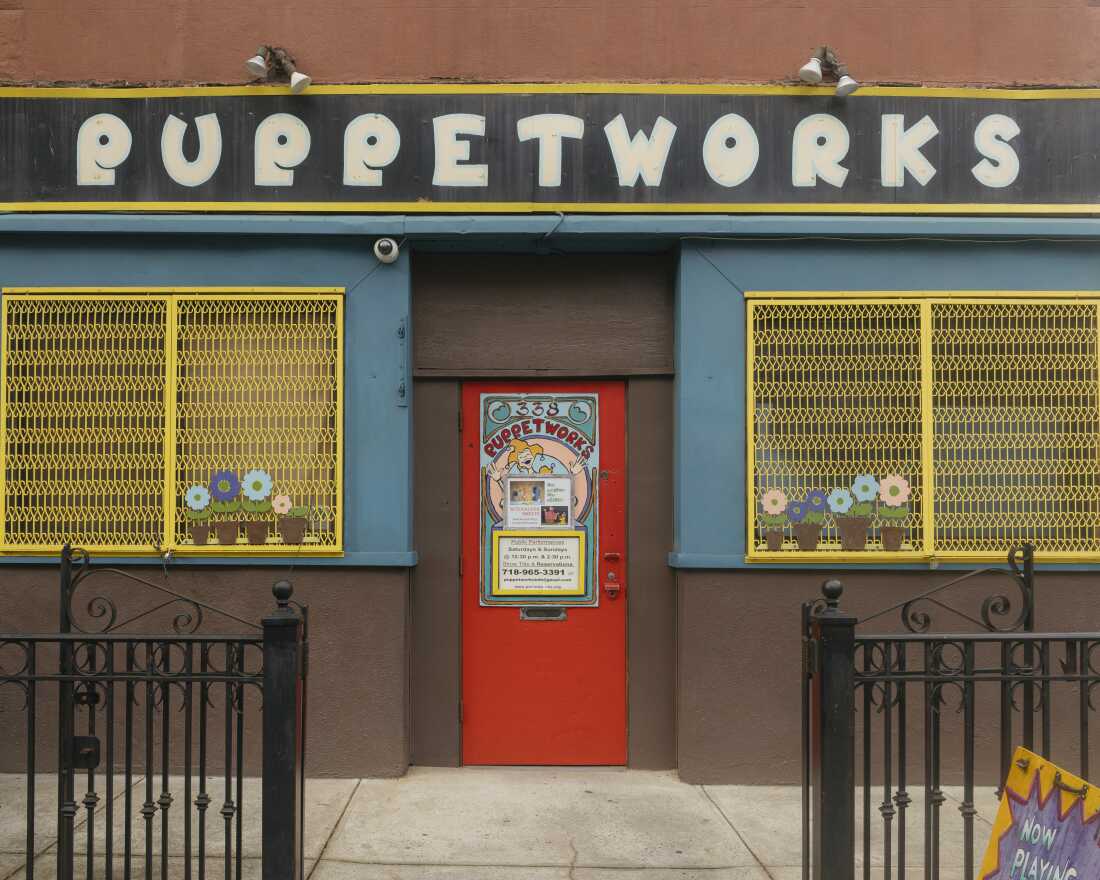
The Puppetworks theater in Brooklyn’s Park Slope neighborhood.
Anh Nguyen for NPR
hide caption
toggle caption
Anh Nguyen for NPR

A workshop station behind the stage at Puppetworks, where puppets are stored and repaired.
Anh Nguyen for NPR
hide caption
toggle caption
Anh Nguyen for NPR
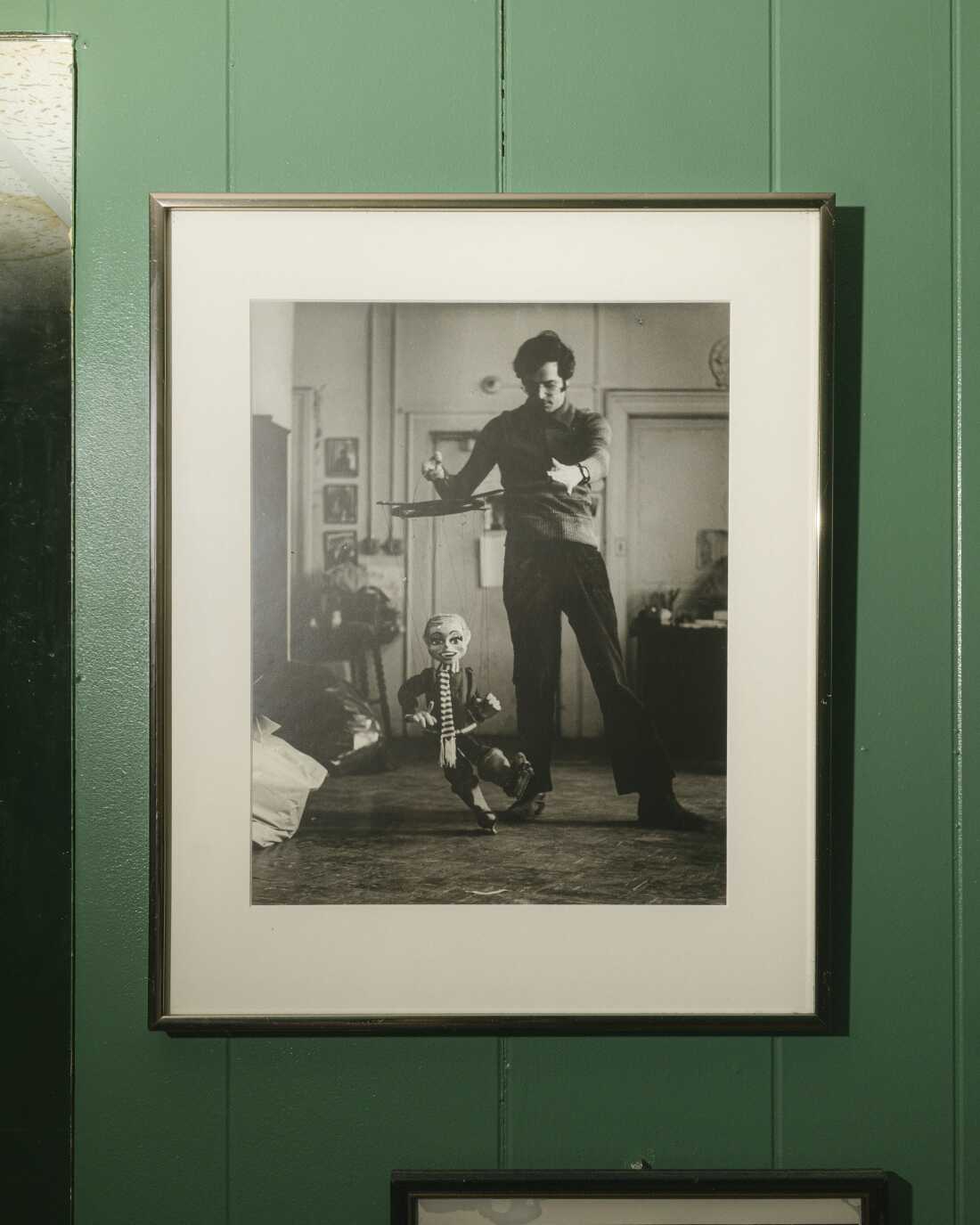
A picture of Nicolas Coppola, Puppetworks’ founder and artistic director, from 1970, in which he’s demonstrating an ice skater marionette puppet.
Anh Nguyen for NPR
hide caption
toggle caption
Anh Nguyen for NPR
For just $11 a seat ($12 for adults), puppets of all types — marionette, swing, hand and rod — take turns transporting patrons back to the ’80s, when most of Puppetworks’ puppets were made and the audio tracks were taped. Century-old stories are brought back to life. Some even with a modern twist.
Since Coppola started the theater, changes have been made to the theater’s repertoire of shows to better meet the cultural moment. The biggest change was the characterization of princesses in the ’60s and ’70s, Coppola says: “Now, we’re a little more enlightened.”

Right: Michael Jones, Puppetworks’ newest puppeteer, poses for a photo with Jack-a-Napes, one of the main characters in The Steadfast Tin Soldier. Left: A demonstration marionette puppet, used for showing children how movement and control works.
Anh Nguyen for NPR
hide caption
toggle caption
Anh Nguyen for NPR

Marionette puppets from previous Puppetworks shows hang on one of the theater’s walls.
Anh Nguyen for NPR
hide caption
toggle caption
Anh Nguyen for NPR

A child attends Puppetworks’ 12:30 p.m. showing on Saturday, Dec. 6, dressed in holiday attire that features the ballerina and tin soldier in The Steadfast Tin Soldier.
Anh Nguyen for NPR
hide caption
toggle caption
Anh Nguyen for NPR
Streaming has also influenced the theater’s selection of shows. Puppetworks recently brought back Rumpelstiltskin after the tale was repopularized following Dreamworks’ release of the Shrek film franchise.
Most of the parents in attendance find out about the theater through word of mouth or school visits, where Puppetworks’ team puts on shows throughout the week. Many say they take an interest in the establishment for its ability to peel their children away from screens.
Whitney Sprayberry was introduced to Puppetworks by her husband, who grew up in the neighborhood. “My husband and I are both artists, so we much prefer live entertainment. We allow screens, but are mindful of what we’re watching and how often.”

Left: Puppetworks’ current manager of stage operations, Jamie Moore, who joined the team in the early 2000s as a puppeteer, holds an otter hand puppet from their holiday show. Right: A Pinocchio mask hangs behind the ticket booth at Puppetworks’ entrance.
Anh Nguyen for NPR
hide caption
toggle caption
Anh Nguyen for NPR
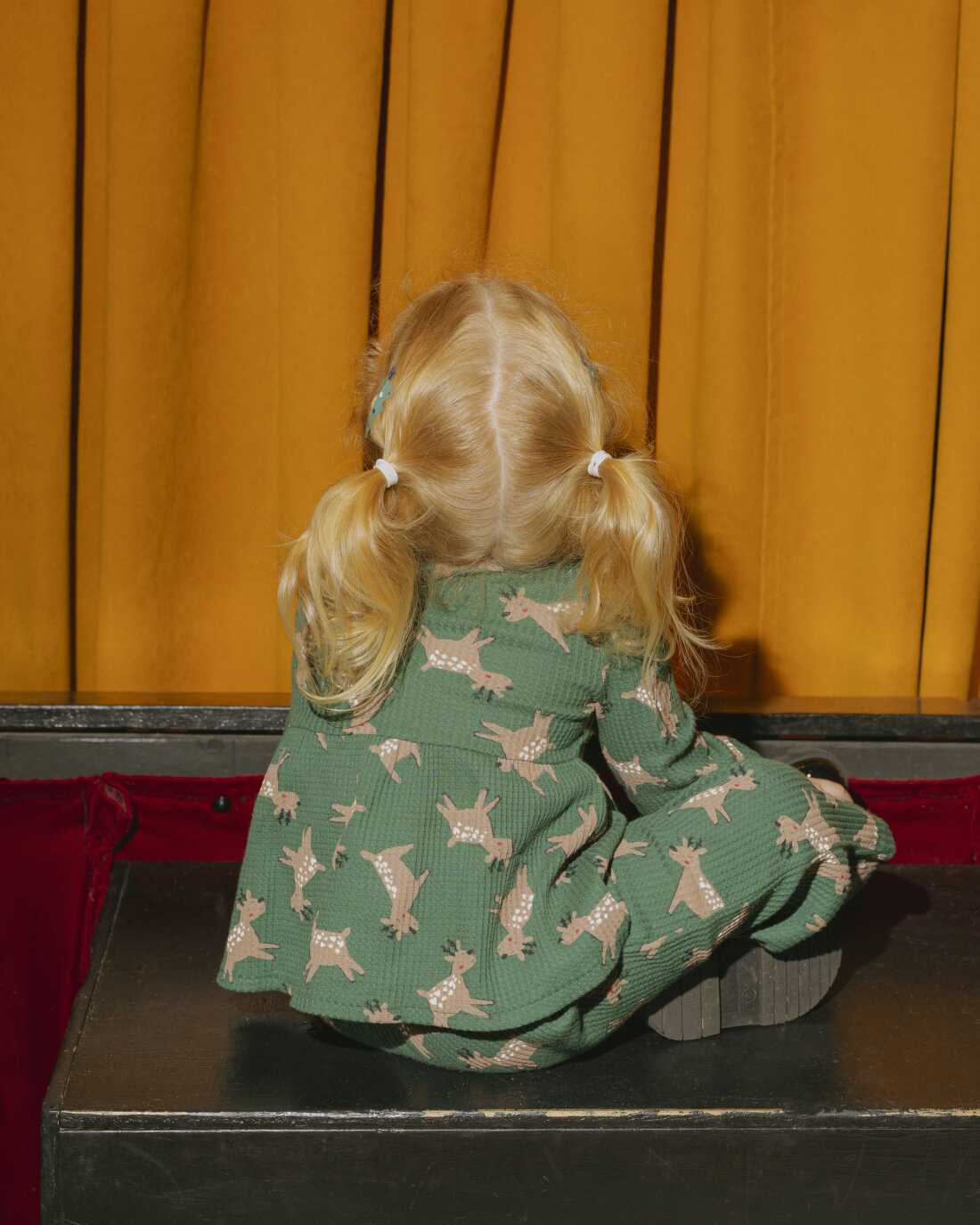
A child attends Puppetworks’ 12:30 p.m. showing on Saturday, Dec. 6, dressed in holiday attire.
Anh Nguyen for NPR
hide caption
toggle caption
Anh Nguyen for NPR

Left: Two gingerbread people, characters in one of Puppetworks’ holiday skits. Right: Ronny Wasserstrom, a swing puppeteer and one of Puppetworks’ first puppeteers, holds a “talking head” puppet he made, wearing matching shirts.
Anh Nguyen for NPR
hide caption
toggle caption
Anh Nguyen for NPR
Other parents in the audience say they found the theater through one of Ronny Wasserstrom’s shows. Wasserstrom, one of Puppetworks’ first puppeteers, regularly performs for free at a nearby park.
Coppola says he isn’t a Luddite — he’s fascinated by animation’s endless possibilities, but cautions of how it could limit a child’s imagination. “The part of theater they’re not getting by being on the phone is the sense of community. In our small way, we’re keeping that going.”
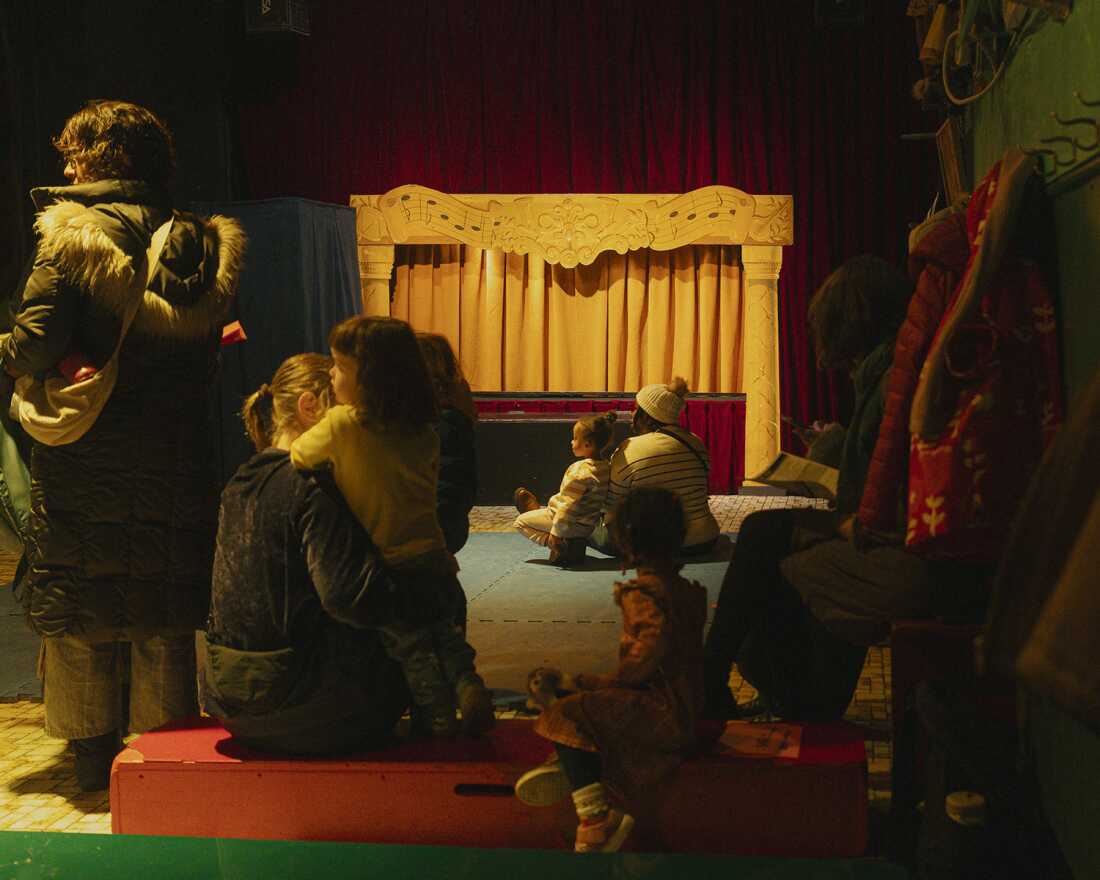
Puppetworks’ 12:30 p.m. showing of The Steadfast Tin Soldier and The Nutcracker Sweets on Saturday, Dec. 6.
Anh Nguyen for NPR
hide caption
toggle caption
Anh Nguyen for NPR
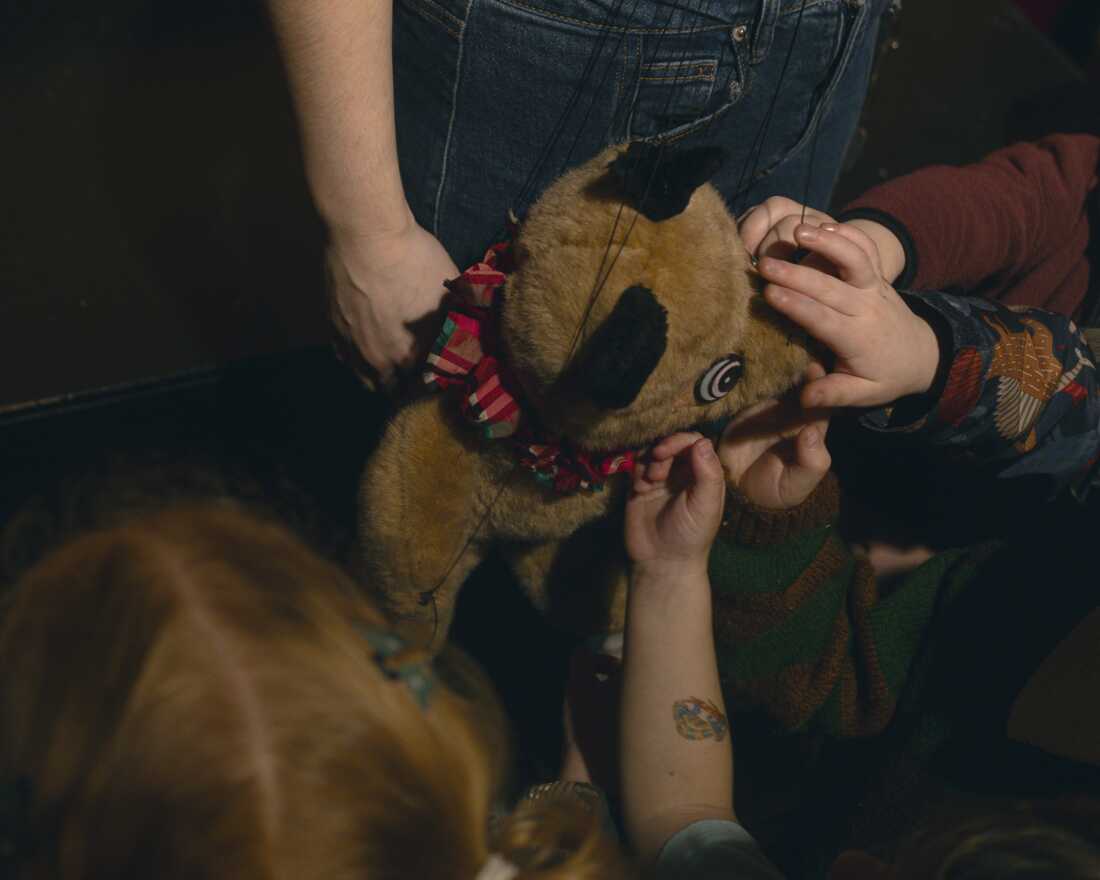
Children get a chance to see one of the puppets in The Steadfast Tin Soldier up close after a show.
Anh Nguyen for NPR
hide caption
toggle caption
Anh Nguyen for NPR
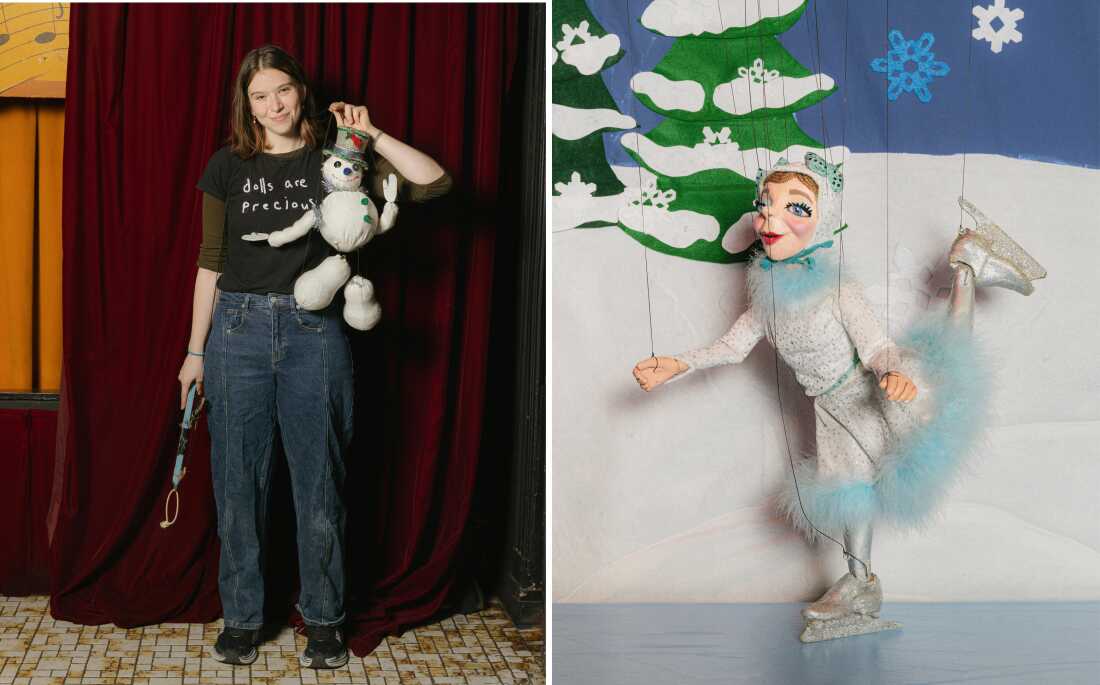
Left: Alyssa Parkhurst, Puppetworks’ youngest puppeteer, holds a snowman marionette puppet, a character in the theater’s holiday show. Right: An ice skater, a dancing character in one of Puppetworks’ holiday skits.
Anh Nguyen for NPR
hide caption
toggle caption
Anh Nguyen for NPR
Community is what keeps Sabrina Chap, the mother of 4-year-old Vida, a regular at Puppetworks. Every couple of weeks, when Puppetworks puts on a new show, she rallies a large group to attend. “It’s a way I connect all the parents in the neighborhood whose kids go to different schools,” she said. “A lot of these kids live within a block of each other.”

Three candy canes — dancing characters in one of Puppetworks’ holiday skits — wait to be repaired after a show.
Anh Nguyen for NPR
hide caption
toggle caption
Anh Nguyen for NPR
Anh Nguyen is a photographer based in Brooklyn, N.Y. You can see more of her work online, at nguyenminhanh.com , or on Instagram, at @minhanhnguyenn. Tiffany Ng is a tech and culture writer. Find more of her work on her website, breakfastatmyhouse.com.

What’s up with Matt Patricia, Sonny Styles and Ohio State’s defensive prep for Miami?: Buckeye Talk podcast

Giant leg lamp lights up small Oklahoma town, turning a Christmas classic into a year-round attraction

The longest whale migration in the world is passing Oregon. Here’s how to see it

Nursing assistant one of two killed in deadly Pennsylvania blast

Prominent Rhode Island Democrat caught on video telling officer, ‘You know who I am?’ during DUI stop

Florida High School Football Rankings: Top 25 teams – Oct. 21

Cleary's 21 help Le Moyne down Central Connecticut State 69-64 in OT

How old is Bo Nix? What to know about Oregon quarterback ahead of 2024 NFL Draft

99th annual Pony Swim held in Virginia

Video: ‘It Didn’t Have to Happen This Way:’ U.Va. Faculty Call for Review of Police Response to Protests

Nick Fuentes says he’ll campaign against Vivek Ramaswamy in Ohio in slur-laced rant

Libyan army chief killed in plane crash: What next?

U.S. and Ukraine reach consensus on key issues aimed at ending the war

A 3-D Look Inside Trump’s Revamped Oval Office

Trump admin sues Illinois Gov. Pritzker over laws shielding migrants from courthouse arrests
-

 Iowa1 week ago
Addy Brown motivated to step up in Audi Crooks’ absence vs. UNI
-

 Maine1 week ago
Elementary-aged student killed in school bus crash in southern Maine
-

 Maryland1 week ago
Frigid temperatures to start the week in Maryland
-

 New Mexico1 week ago
Family clarifies why they believe missing New Mexico man is dead
-

 Detroit, MI1 week ago
‘Love being a pedo’: Metro Detroit doctor, attorney, therapist accused in web of child porn chats
-

 Health1 week ago
‘Aggressive’ new flu variant sweeps globe as doctors warn of severe symptoms
-

 Massachusetts1 week ago
MIT professor Nuno F.G. Loureiro, a 47-year-old physicist and fusion scientist, shot and killed in his home in Brookline, Mass. | Fortune
-

 Maine1 week ago
Family in Maine host food pantry for deer | Hand Off