Lifestyle
30 years ago, ‘Waiting to Exhale’ was the blockbuster Hollywood didn’t anticipate


Loretta Devine, Whitney Houston, Angela Bassett and Lela Rochon.
Merie W. Wallace/20th Century Fox
hide caption
toggle caption
Merie W. Wallace/20th Century Fox
Many (predominantly white) critics weren’t impressed with the movie Waiting to Exhale when it opened in 1995, but moviegoers turned up in droves, making it one of the year’s most profitable blockbusters. In a year in review, The Los Angeles Times dubbed the film a “social phenomenon,” and the NAACP lavished it with Image Awards for outstanding motion picture, lead actress and more.
Ten years after the acclaim and controversy of Alice Walker’s The Color Purple and long before Girlfriends and Girls Trip, the Black women’s ensemble feature was a rarity on American screens — until this modestly-budgeted, big studio adaptation of Terry McMillan’s popular novel made its splashy debut. Before Sex and the City delved into the sex lives and pitfalls of urban daters, audiences thrilled to the sight of Waiting to Exhale foregrounding the romantic lives and misadventures of four successful, single Black women, not just struggling to survive but striving for more.
“I haven’t gotten to the point where I’ll take whatever I can get,” Savannah (Whitney Houston) observes in the movie as she refuses to settle and moves from Denver to Phoenix. “There’s a big difference between being thirsty and being dehydrated.” Her words apply to people craving better representation just as they do women seeking a love connection. In the 1990s, even as Black women were often let down while longing to see themselves depicted fully and lovingly as the center of stories, they kept seeking, often practicing what cultural scholars like Stuart Hall called negotiated reading. As scholar Jacqueline Bobo wrote in 1988 about Black women’s reception of Steven Spielberg’s adaptation of The Color Purple, “we understand that mainstream media has never rendered our segment of the population faithfully … out of habit, as readers of mainstream texts, we have learnt to ferret out the beneficial and put up blinders against the rest.”
A humane and cheeky comedy, Waiting to Exhale exceeded expectations. So women showed up for this movie, surprising even executives at 20th Century Fox, who should have known better given the book’s fans, who swamped readings by the thousands. They gathered. They laughed. They talked. And they cried. And many saw themselves in these four women, regardless of whether they had the wardrobes and lifestyles. They knew the pain of working hard and successfully building a life, when all your family can see is that you don’t have the thing that was still so prized and validating in women’s lives — a socially approved, church-sanctified partner.
The resonance was so deep that, for years to come, the story’s reception and impact would be studied by cultural scholars. When Jacqueline Bobo published her book-length study of Black Women as Cultural Readers, Waiting to Exhale was a recurring reference point. And when Black women authors are asked about their influences, the movie Waiting to Exhale and the novel remain touchstones, the movie often the first point of entry. Danyel Smith called them “era-defining” and Tara M. Stringfellow wrote that McMillan taught her that “sisterhood is as necessary as air.”
Translating the 1992 novel to the big screen
Like its faithful film adaptation, Terry McMillan’s bestselling book is tart, a little raunchy and incisive. Her portraits of four successful, attractive middle class Black women reflected important social changes including dramatic increases in working women and educational attainment in the 1970s to 1990s. While sociologists were debating “the marriage gap” and declining rates of marriage for Black women, McMillan’s characters were commiserating, exploring their options, cracking jokes, and braving the messy realities of life in a series of poignant and laugh out loud funny vignettes.
It’s remarkable to see how well the film and book correspond: While the screenplay compressed some of the novel’s nuance and depth of the characters’ inner monologues and social observation, it retained and even amplified the emotional power. Despite some biases of the time – including fatphobia and the use of homophobic slurs – the themes hold up.
Casting was a major part of the charm. Still hot off her film debut opposite Kevin Costner in The Bodyguard in 1992, Whitney Houston gave the film unmistakable star power. As Savannah, she’s ambitious, the one who isn’t willing to settle no matter how much her mother pressures her, even as she recognizes dwindling odds of marriage and an abundance of frustrating suitors. She doesn’t need rescue or support. What she craves, what she’s holding out for, despite the insistent phone calls from her mother, is soul-deep love. In the book, Savannah admits to herself: “I worry. I worry about if and when I’ll ever find the right man, if I’ll ever be able to exhale… Never in a million years would I have ever believed that I would be thirty-six years old and still childless and single. But here I am.” On screen she’s just 33, and expresses these sentiments in conversation. The point lands just the same.
Savannah’s best friend Bernadine (Angela Bassett) is equal parts fierce and wounded — an impeccably groomed and soon-to-be divorced mother of two who helped build a business with her husband and then got unceremoniously dumped for a younger and whiter version of herself. Loretta Devine is striking as Gloria, a hair salon owner who has all but given up on romantic love, and dreads the looming empty nest after focusing all her attention on mothering her 17-year old son (flawlessly cast in Donald Faison of Clueless). Last, there’s the beautiful yet naive corporate underwriter Robin, played by Lela Rochon, whose taste in men leaves a lot to be desired and provides comic gold in her hapless dating adventures. Robin’s motley crew of suitors include Mykelti Williamson delivering an indelible comic turn, Leon Robinson and Wendell Pierce.


The creative talent behind the scenes was also crucial to the film’s success. It was actor Forest Whitaker’s directorial debut, working with a screenplay co-written by McMillan and Oscar-winning writer Ronald Bass, best known at the time for Rain Man. The film’s episodic structure centering milestone holidays is a little choppy and uneven, but many of the scenes deliver a gut punch or laugh out loud joy. The writing duo faithfully distilled the character and tone from the source material including much of the original dialogue. Scholars Tina M. Harris and Patricia S. Hill argue that McMillan also “influenced directorial decisions and character development” on set, enriching the story’s authentic portrayals of Black women.
In the movie’s single most enduring (and now iconic) scene, after Bernadine’s husband tells her he’s leaving her for the company accountant, she empties his closet and then burns his expensive belongings and car in their driveway. Clad in a black lace nightgown and silk robe, with a cigarette in her hand and a look of disgust and determination on her face, Angela Bassett vibrates with indignation — heightened with sound effects and camera angles, it’s a brilliantly provocative visual translation of the events McMillan imagined in print. In the book, McMillan paints a similar picture with words. Bernadine is “feeling antsy,” fuming over being left after putting up with so much. Anger rising, she reflects on the excessive power her husband had wielded in their home and takes stock — of the “close to a thousand books, most in alphabetical order” and of John’s closet, with shirts “grouped by color” and suits “in order by designer” and of how he “had even counted the number of times they made love.” Concluding, “there was too much order in this damn house,” she frees herself, lighting most of his stuff on fire and throwing a garage sale, pricing every remaining possession at a dollar.
Three decades later, the appeal endures, despite reviews like the one in Salon that likened gender representation in Waiting to Exhale to “male bashing taken to an extreme,” “crack for the female psyche” and “cheap thrills and psychological lies masquerading as social commentary.” Three years after Waiting to Exhale‘s debut, Sex and the City would use a similar formula. Mirroring Whitaker’s production, SATC centered four white professional women pursuing romance and experiencing raunchy, farcical dating and sexual disappointments while embracing each other. It also paired action with contemplative voice overs and gave the women even more upscale and enviable lifestyles. The HBO show premiered to popular delight and somewhat better reviews, eventually garnering 54 Emmy nominations and 7 wins. Today, I see Waiting to Exhale as blazing a trail and deserving appreciation as a deeply human work of commercial art that took Black women’s lives and concerns seriously and executed its vision with style.


Can you say no to a friend’s wedding?
Getty Images/Getty images
hide caption
toggle caption
Getty Images/Getty images
Are we spending too much on other people’s weddings?
Going to a friend’s weddings can be so fun and meaningful… but it can also really hurt your wallet. A survey by LendingTree found that 31% of people who had been to a wedding in the past five years had accrued debt to attend. So what’s driving up the cost of weddings for guests? And what makes it so hard to say no to these expenses?
Brittany breaks it down with Allyson Rees, senior analyst at trend forecasting firm WGSN, and Annie Joy Williams, assistant editor at The Atlantic.
This episode was produced by Liam McBain, with additional support from Corey Antonio Rose. It was edited by Neena Pathak. Our Supervising Producer is Cher Vincent. Our Executive Producer is Barton Girdwood. Our VP of Programming is Yolanda Sangweni.
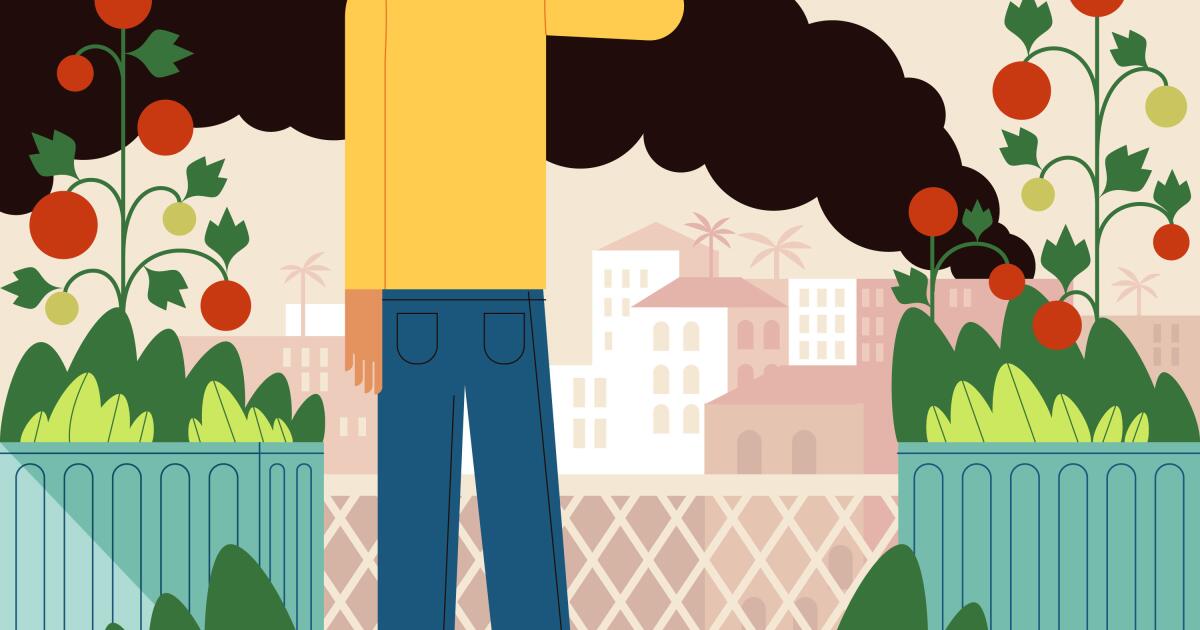
After the eight-day-long fire in a 500,000-square-foot Boyle Heights warehouse, eastern Los Angeles residents are contending with putrid smells, soot and potentially hazardous airborne chemicals after heavy plumes of smoke spread throughout the city. But those who grow food in nearby neighborhoods may also be wondering: How will the fires affect the plants and produce in my garden?
The Boyle Heights warehouse, owned by Lineage — a global temperature-controlled storage facility operator — housed 85 million pounds of frozen food and other products. In the days since the fire, local emergency visits for smoke inhalation and throat pain spiked while agencies still scramble to measure the amount of PM 2.5 — harmful fine particles — and heavy metals, like lead and arsenic, in the air.
According to researchers, any toxic airborne chemicals would likely stem from the charred foam insulation, metal exterior, burned solar panels and any lithium batteries that might have been present inside the warehouse.
After a fire, heavy metal particles can spread through ash and smoke over gardens and inhibit growth, said Olukayode Jegede, an agricultural toxicologist and assistant professor at UC Davis. Since the warehouse fire is so recent and cleanup has just begun, Jegede said the precise impact on gardens can’t be measured until comprehensive soil tests are conducted in the area.
While the L.A. city government hasn’t announced plans for soil testing, the Contaminant Level Evaluation and Analysis for Neighborhoods project at USC is offering free contaminant testing for Boyle Heights and East L.A. residents. Residents can collect soil samples and deliver them to Boyle Heights City Hall and other locations for an evaluation of lead, arsenic, chromium and mercury levels.
The good news is produce, plants and roots can still be preserved. According to Jegede, many of the soil tests conducted last year in the Altadena area after the Eaton fire showed that gardens and poultry were not as contaminated as one might expect.
“Quite a number of the soils we tested [in Altadena] were not really contaminated,” Jegede said. “We weren’t seeing many soils with concerning elevated levels of metal, so gardeners should not be too alarmed when these things happen.”
Nevertheless, there are several measures that gardeners can take to keep themselves, their children, plants and produce safe from potentially harmful contaminants stemming from the fire. Researchers, gardening experts and horticulturists offered some guidance on the handling, recultivation and cleanup that can keep you and your garden in good health.
How do I remove ash and contaminants from my garden?
Altadena horticulturist Leigh Adams said Boyle Heights plants and produce already live in a difficult environment, surrounded by industrial warehouses that spread contaminants daily.
“That area has been used industrially for 100 years, and the soil is impacted by many, many, many things,” Adams said. “Low-income neighborhoods and gardens usually don’t have a lot of resistance against dominant manufacturing.”
This means that the contamination of gardens in eastern L.A. won’t be as catastrophic as compared with those in Altadena, a more suburban environment, Adams said. But fallen ash still poses major health risks if ingested or inhaled.
An advisory from University of California Agricultural and Natural Resources last year recommended suiting up in an N95/KN95 mask, long sleeves, pants, close-toed shoes and gloves before attempting to deal with ash in the garden to limit exposure to potentially toxic contaminants. The advisory added that individuals should make sure all of this gear is cleaned thoroughly before bringing it back inside.
Once in the proper gear, Adams recommends removing the top two inches of topsoil from gardens, where the highest concentration of contaminants will settle after a fire. Using a plastic bag to collect the soil and disposing of it in the garbage — not green yard waste bins — will help to reduce the spread of airborne chemicals.
Gardeners with raised beds are advised to remove approximately six inches of soil, because excess ash can raise the pH level and prevent nutrients from soaking into the soil bed.
After this, watering the garden gently but plentifully will help to promote soil health and get rid of most of the ash present on plant leaves and stems. Adams said replacing the top two inches of soil with store-bought mulch or straw will help to contain any remaining ash and prevent it from spreading any further.
Experts say to avoid using leaf blowers if ash is present in the garden because they can send particles airborne. Doing so will increase the likelihood of heavy metal particles, which can carry lung irritants and carcinogens, being spread and inhaled.
A Boyle Heights resident keep a watchful eye on the fire at the 5,000-square-foot commercial building, which stores 85 million pounds of frozen food.
(Genaro Molina / Los Angeles Times)
Is it safe for me to eat produce from my garden?
Several studies, including one from the UC Cooperative Extension of Sonoma County, have shown that consuming produce in a fire-affected area poses minimal health risks.
Jegede said most root vegetables like potatoes and carrots, along with any fruit that has an outer layer, can be washed to remove potential contaminants, even if they were covered in ash. Peeling the outer layer of your produce can also help to reduce potential risks, he said.
Lettuce and other leafy foods with multiple layers pose a higher risk of contamination, but with a vigorous wash and peeling the outer layers, even the greens can be saved. The County of Los Angeles Department of Public Health recommends soaking leafy produce and fuzzy fruits like peaches in a 10% white vinegar and 90% water mixture.
Jegede said if the leaves or fruit are too delicate to wash or ash is still visible, it would be best to dispose of the produce.
How can I tell if my soil is contaminated?
After ridding your garden of visible ash, you might wonder how to tell if your plants will still thrive in the soil.
At-home soil tests that measure for alkaline, fertility and pH levels are widely available and can be purchased for $15 to $100 (for more detailed results) online. But Jegede said these tests can’t tell the full story of soil health.
Comprehensive soil testing is “something you can’t do properly at home,” Jegede said. “In labs, we are testing for metals like lithium and zinc, stuff that an at-home test will not show … If it comes to the point that you’re worried about your soil, I would just send it out to a lab.”
Wallace Laboratories in El Segundo, Babcock Laboratories in Riverside, Waypoint Analytical in Anaheim and other labs offer more detailed soil tests that measure heavy metal particles in addition to other fertility factors. Prices at Wallace Laboratories can range from $115 to $295 for a complete compost test.
The soil below two inches should be unharmed, Adams said, so long as new compost is set and plants are watered plentifully, which will promote natural biological cycles.
“What you’re doing is capping the soil, so that moisture stays in there, and instead of being dirt, it’s a living system called soil,” Adams said. “The more carbon we can get into our soil, the better.”
What can I do to help my soil recover?
For the last 12 years, Adams has been working with Metabolic Studio, a Los Angeles-based art and research hub focused on environmentalism, on methods for bioremediation, the practice of using additional fungi, plants and compost to decontaminate ash and break down contaminants.
Adams said straw, mushrooms, corn, rye and sunflowers are great bioremediators that can help to repair damage to soils. She said certain samples she’s worked on with Metabolic Studio have gone from testing at high heavy metal levels to nearly contaminant-free.
But for a more immediate fix, wash your produce, water your plants and have a little patience during ash cleanups. Your garden should look better in no time, Adams and Jegede said.

Inde Navarrette and Michael Johnston in Obsession.
Focus Features
hide caption
toggle caption
Focus Features
Two big horror films, Obsession and Backrooms, just smashed all box office expectations. So much of their success has been driven by Gen Z, which is now the biggest moviegoing demographic. But what makes a movie a Gen Z movie? Today we’re bringing you an episode of NPR’s It’s Been a Minute. Host Brittany Luse talks about this trend with Sam Adams and Reanna Cruz.
If you want to hear more about these movies, check out these episodes:
In ‘Obsession,’ love hurts. It really, really, really hurts.
‘Backrooms’ brings YouTube horror to the big screen
Zendaya brings ‘The Drama,’ we bring the spoilers
Connect with Pop Culture Happy Hour:
Letterboxd / Facebook
Our weekly newsletter
Support Pop Culture Happy Hour+
-

 New Hampshire5 minutes ago
New hampshire set to approve world’s first $100 million bitcoin-backed municipal bond
-

 New Jersey8 minutes ago
Police conclude investigation at Walmart in Cherry Hill, officials say
-

 New Mexico13 minutes ago
Monsoon high shifts slightly west but rain is still possible Wednesday in New Mexico
-

 North Carolina20 minutes ago
North Carolina Republican operative shaping the state’s early voting plans is reassigned
-

 North Dakota23 minutes ago
West Fargo Attorney Chosen for North Dakota Ethics Commission Position
-

 Ohio28 minutes ago
Jeff’s Donuts opens first Ohio location, open 24 hours
-

 Oklahoma35 minutes ago
5 Things To Know: Oklahoma County inmate death, deadly OKC hit-and-run
-

 Oregon38 minutes ago
Oregon to ask court to delay Paramount deal for 60 days while it reviews records

