Lifestyle
I've been married 13 years. Why is vacation sex suddenly so fleeting?

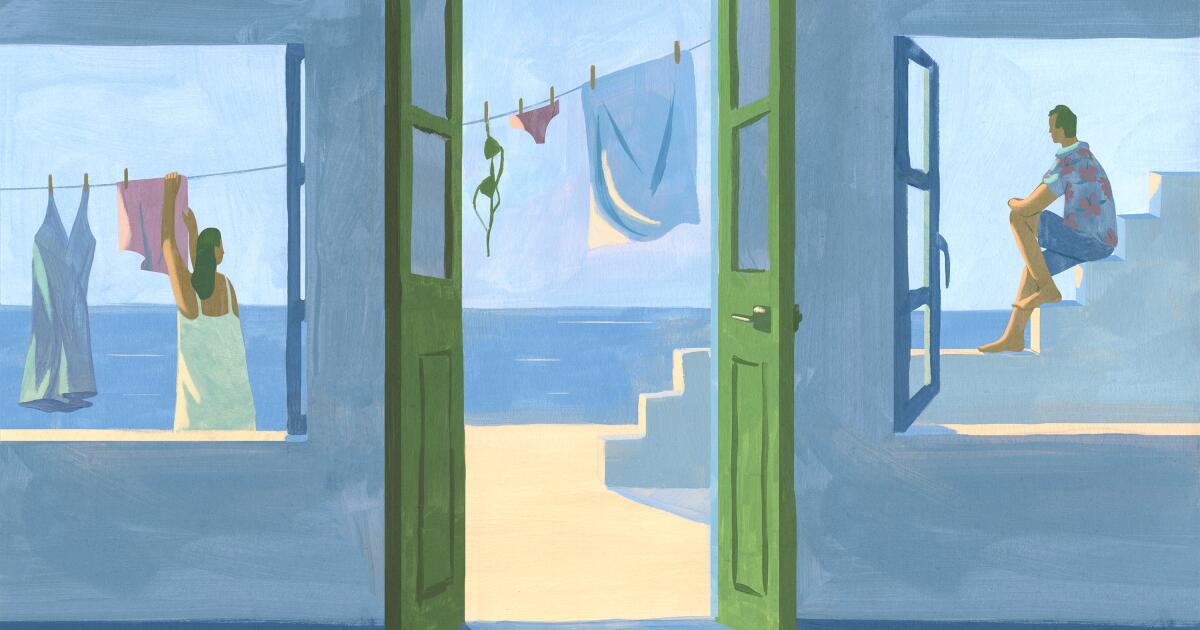
A funny thing happened almost a decade ago when I told my girlfriends that I was embarking on a two-week anniversary trip with my husband. Eyebrows were raised. One friend shook her head and said, “That would quickly become problematic.” Another said she never goes on vacation solely with her husband anymore because they always fight or he is “too needy sexually.” Still another told me I was brave because that was “too long,” and buried issues would start to rear their ugly heads. And these were the “happy couples” in my friend group!
I was intrigued by their reaction. When did we all start dodging our long-term partners? Was this another midlife obstacle that I had yet to confront? And was I going to experience it firsthand on this getaway with my husband?
The dynamic my friends were describing “is extremely common,” says Evans Wittenberg, a licensed marriage family therapist based in Los Feliz. “Vacations are a culturally sanctioned time to unwind, but the pressure to enjoy often backfires — especially in the bedroom. You cannot schedule desire, it much prefers breaking the rules rather than following them.”
My husband Rob and I have always bonded over a shared love of travel. We’ve loved exploring far-flung places, like Cambodia and Bora Bora, over nearly two decades together. How bad could it be?
With my friends’ voices in my head, we embarked on our journey to New Zealand in 2016. The plan was to spend a few days with my relatives who were living there and the rest of the time exploring a couple of lodges. We hadn’t slept well on the flight, and as soon as we landed, we had to be alert and drive on what felt like the wrong side of the road for four hours to our first stop. Amid the fog of jet lag, the squabbles began.
Why was it that despite our beautiful surroundings and swanky hotel rooms we couldn’t find a way to relax together?
First came the bickering over directions. Rob said my tone was edgy, and I thought the same about him. I often have strong opinions about where we should go and how, and he thinks my questioning him represents a lack of trust or that he can’t handle the task at hand. Much of our time spent navigating the lush green backroads of New Zealand was tense. Rob ignored me and blasted U2 at a volume he knew would make me nuts.
When we got to our destination, another point of disagreement came up: What to do that day. Rob wanted to bike ride. I wanted to spend our time exploring the parks along the Waikato River on foot. Luckily we were able to agree on exploring some thermal hot springs.
Finally, there was the question of intimacy. How much sex were we having — and when were we having it? When we arrived at the hotel, we upgraded to an even nicer, more expensive suite. Implicit in its price tag was the expectation that we’d have a fantastic time to justify it. Rob didn’t skip a beat getting into vacation mode and was keen to get the party started, while I needed a moment to shake off my fatigue and transition into feeling romantic. Our sex drives didn’t naturally sync up on that trip like they usually do and it bubbled up into a big, cranky fight leaving both of us feeling exhausted and miserable.
Rob likes to point out that in the early days of our relationship, when we went on our very first vacation, we’d have sex multiple times a day. It’s a benchmark he wishes we could revisit.
By the end of our trip, we were a bit sick of each other, and my girlfriends were proved right. Why was it that despite our beautiful surroundings and swanky hotel rooms we couldn’t find a way to relax together?
After New Zealand, we both agreed we should rethink how we traveled as a couple. We weren’t having as much fun as we could be. So we joined a travel group that offered curated activities to lessen the stress that comes with designing the trip ourselves. In the fall of 2019, we went on a weeklong vacation to Dubrovnik and Montenegro with a full agenda of boating excursions and hikes through vineyards with the hope that being surrounded by chatty fellow travelers and gorgeous sights would relieve some of the pressure to be everything for each other.
The hectic pace was a challenge for me. As an introvert, having a full schedule and breakfast, lunch and dinner with 20 strangers felt like a strain, despite how lovely the company was. But Rob seemed to be keeping up just fine. Toward the end, I was craving a day to relax at the hotel. But that day there was a kayaking adventure in Skadar Lake that would require three hours roundtrip in a van. It was more Rob’s thing than mine, and I encouraged him to go without me so I could have a day to myself.
Somehow this suggestion got lost in translation, and was processed as “Stay at the hotel with me so we can have sex all day!” That breakdown in communication kicked off one of the worst fights of our marriage. I felt boxed in; unable to take care of both of our needs at the same time. I needed to look after myself but couldn’t communicate that desire without it leading to a fight. Exhausted, backed into a wall and not seeing how we could move forward, I was mentally prepared to fly home alone the next day.
That night, as Rob engaged with everyone at the dinner but me, I comforted myself with a basket of bread rolls and thought about how we used to relish every minute together. We were one of those couples who clearly delighted in each other; other people would remark on our physical connection and say things like, “Come on you guys, you’re making us look bad.”
After dessert, with Rob still engrossed in conversation, I left the group, walked around the hotel grounds and found a quiet, deserted pool at the edge of a steep cliff. I peeled off my dress and had a solo late-night swim.
In earlier years, he would have come looking for me. I texted him and asked him to join me at the pool but unbeknownst to me he had left his phone in the room. I figured he was ignoring me. My stomach roiled from the stress. As the waves crashed cinematically on the rocks below, I thought that if we couldn’t get along in such a dreamy setting, then maybe it was an indication that we shouldn’t be together.
Exhausted, backed into a wall and not seeing how we could move forward, I was mentally prepared to fly home alone the next day.
I was also aware that my instincts might be mirroring those of my mother. She chose not to marry my father and raised me alone. There were only short-term partners until she finally walked down the aisle with my stepfather when I was 17. Sometimes I felt like the only thing I learned how to do in a relationship was leave.
For the next day, as I wrestled with whether to stay or to go, I contemplated my mother’s influence. I had inherited her avoidant tendencies and that urge to pull away, to run. Sticking around to resolve the fight might’ve been harder but would also be far more rewarding. I resolved to stay and see if we could work through it.
And we did. There might have been some makeup sex involved.
For a while after that, our solution was to not go away together at all — a decision only bolstered by the COVID-19 pandemic. We finally dipped our toes back into traveling in 2021. Still wary of our tendency to fight on vacation, we started off with three- or four-day trips, nothing too far or too taxing. They went well, but I was unsure about taking a bigger plunge. And I worried disagreements over sex would pop up again.
Eventually I sought out the advice of Kiana Reeves, an Ojai-based teacher of embodiment and intimacy. She put many of the feelings I’d been having around expectations into words.
“When stakes feel high everything goes sideways,” Reeves says. “We experience it as pressure, and pressure is a great libido killer, it’s a great intimacy killer and it often puts us in a position where we are blaming the other person for our feelings of pressure or not getting our needs met.”
The whole point of vacation is to relax and bring play into our lives, Reeves reminded me, noting that “libido thrives” in exactly those situations. She recommended that couples feeling vacation stress take the emphasis off sex and focus on connection, then “spend time making out, massage each other or lovingly touch each other. And see what happens from there.”
After trying a painful but productive couples retreat in Northern California, and even a few blissful guided healing sessions, we’ve focused in on Reeves’ advice to relax more, to be less hurried and to trust in our connection. It’s helping. I’ve nurtured a new appreciation for Rob; how giving he is, how much he strives to please me.
As for our differing appetites for activity, when one of us wants to go on a trip that appeals to only their personal interest, we find the right travel companions for the occasion. He does ski or boat trips with his buddies or his kids, while I might go visit my daughter at college or relatives in Australia. That way, we get to miss each other and feel fulfilled in our individual pursuits as well. When I’m excited about my own life, I’m more playful, curious and fun to be with. This approach has revitalized our relationship.
I don’t wing it and hope everything will turn out OK anymore. I communicate. Once I started verbalizing my need for alone time, and stopped tiptoeing around his feelings, I found that our relationship started to improve — both on vacations and in day-to-day life too. I got comfortable owning that I’m an introvert and being with a large group 24/7 or even just with my husband for every minute of the day is a lot for me. It’s no reflection on my feelings for him; it’s the way I’m built. We agreed in advance that I’ll tell him if I need to skip a group dinner or an activity to unwind and he now better understands why that’s important to me.
We still kick this subject of sex on vacation around a lot. Ignoring it gets in the way of an authentic connection. Not always comparing this version of us with earlier versions helps. When Rob gets nostalgic for our former sex life, I remind him that we’re now dealing with older, less compliant bodies. I’ve gone my rounds with perimenopause and menopause and he’s had his own battles with aging. That’s true when it comes to sex, but a whole lot more than that too. I’m not in the same headspace and neither is he.
Luckily, I picked a partner who is willing to evolve — and who also supports my own journey of evolution. Now, Rob and I have been together for 19 years and married for 13. It’s something that I never thought myself capable of, an achievement I’m proud of.
When I mentioned it recently to my mother, she said, “Oh, well. Time for a break then. Otherwise it’s like eating the same bowl of cornflakes every day for 19 years.”
When I’m confronted with her point of view, I see it as more evidence that keeping my relationship intact has been a true accomplishment. I love my husband and we like being together, even if it isn’t always perfect. We remain great partners.
Last month, in what has become our tradition, we went on an anniversary trip with a travel group, this time to Africa. In a nod to our differences, on Valentine’s Day I went on the morning elephant encounter and he went on the river rafting trip. He came back upset — and minus his wedding ring, a custom-made band that he loved dearly. It likely flew off in one of the pre-launch training exercises. In earlier years, the symbolism of this news would have absorbed and derailed me. I would have been wondering if it meant the end of us. This time I had to shrug and remind myself: It’s a good thing I like cornflakes.

Lifestyle
Terry Tempest Williams on why women with big ideas get labeled ‘crazy’ : Wild Card with Rachel Martin

A note from Wild Card host Rachel Martin: I met Terry Tempest Williams about 25 years ago at a writer’s conference in Yosemite Valley. I was a young reporter who was there to do a story about how literature was addressing climate change and she made such a huge impression on me. I had never heard someone talk about the natural world the way Terry did and she had a spiritual depth I hadn’t encountered in my life at that point.
To this day, Terry’s writing always reorients me towards what is good, what is beautiful, and what is true. Her newest book is called “The Glorians.”

For its upcoming Los Angeles venue, experiential art firm Meow Wolf will focus on the art of storytelling, with a specific eye toward skewering our city’s moviemaking magic. To help bring that vision to life, Meow Wolf has entered into a creative partnership with Titmouse, one of L.A.’s most renowned independent animation houses.
The Hollywood-based studio behind popular series such as “Big Mouth” and “Star Trek: Lower Decks” will create animation that will be shown throughout the West L.A. venue, which is on target for a late 2026 opening at the Howard Hughes entertainment complex.
It’s a move that represents a shift for Santa Fe, N.M.-based Meow Wolf. Over the last decade-plus, the art collective has grown beyond its anything-goes, punk-meets-psychedelic roots into an organization with full-scale, maximalist installations in its hometown, Denver, Las Vegas, Houston and the Dallas suburbs. In the past, Meow Wolf kept most of its media in-house.
As part of its larger-than-life participatory art installations, Meow Wolf L.A. will feature a mix of live action and animation, the former filmed by Meow Wolf in its Santa Fe studio. Meow Wolf’s James Stephenson, a senior VP with the company and its creative director of emerging media, said the degree to which the L.A. exhibition will lean into various animation styles necessitated an outside partner. Titmouse’s work, in development by a number of directors with contrasting tones, will be shown on a variety of formats, ranging from cinema screens to full-room projections.
“I really believe in animation as an art form, and I know the Titmouse folks do too,” Stephenson says. “Animation is made by artists. It’s made by artists with their own hands. It’s something that is still very rooted in craft.”
Meow Wolf’s L.A. space is set in a former cinema complex, and will champion its location, taking guests on a journey through a converted movie house and beyond, into a sci-fi-inspired fantasyland with sentient spaceships and a 30-foot-tall mushroom tower. Meow Wolf creatives have spoken of the fantastical movie theater as one that will feature animated, self-aware candy before attendees enter the main exhibition space, making Titmouse’s work some of the first art guests will encounter. Titmouse co-founder Chris Prynoski has said the studio has lined up at least six directors for the exhibit.
An in-progress art installation destined for Meow Wolf L.A. at the art collective’s Santa Fe, N.M., headquarters. The L.A. exhibition will feature animation from Titmouse.
(Gabriela Campos / For The Times)
Titmouse, says Stephenson, is the right partner because “they’re known less for a house style, and more for a house vibe.” Over the years, Titmouse has been behind such diverse shows as “Scavengers Reign,” owning a Jean Giraud influence rooted in French and Spanish surrealism, the lively “Jentry Chau vs. the Underworld,” with an unique color palette that took inspiration from anime and Chinese mythology, the exaggerated comic book feel of Adult Swim’s “Metalocalypse,” and the approachable yet expressive tone of “Star Trek: Lower Decks.”
“Meow Wolf’s vibe is similar to Titmouse’s vibe,” Stephenson says. “It’s artist-first, artist-driven, independent and kinda edgy. They are always trying to find the edge of what’s possible. They try to see how far they can go, and it’s done for fun and in the spirit of taking risks.”
Prynoski says working with Meow Wolf will give Titmouse a sense of artistic freedom it doesn’t always have when delivering content for more traditional Hollywood partners. He says the multi-director approach is a callback to the early days of Warner Bros. Animation, when individual creators put their own stamp on Looney Tunes material.
“I use Bugs Bunny as an example,” Prynoski says. “You’ve got a Friz Freleng Bugs Bunny short. You’ve got a Chuck Jones Bugs Bunny short. You’ve got a Tex Avery Bugs Bunny short. They’re all different versions of Bugs Bunny, and people who are really paying attention can tell which director directed each one. Even though to the layman, these are all Bugs Bunny, but if you lined them up, they are drawing in different styles, sensibilities and techniques.”
Prynoski says that was a centerpiece of his pitch to Meow Wolf, noting that characters will reappear in multiple installations, each handled by a different artist. Meow Wolf L.A., in fact, will be the firm’s most character-driven exhibition, as guests will follow the storylines of three main protagonists throughout the space.
In announcing the partnership, Meow Wolf and Titmouse released an image from an animated work directed by Luca Vitale. It features a key character having a moment with a hummingbird and it’s done in an elegant, slightly anime-influenced style. It’s an image full of movement, reflecting a character in transition with inviting pastels and bold dashes.
“I like that image because I think it captures some of the sense of wonder that we want people to feel,” Stephenson says. “The character is having an encounter with the elusive nature of creativity and reality in a way that makes them have a different perspective of what’s possible.”
Other contributing animation directors to Meow Wolf L.A. include Space Dawg, Felix Colgrave, Alexander Vanderplank and Phimémon Martin, and Jun Ioneda.
Titmouse’s partnership with Meow Wolf will extend beyond the L.A. exhibition. The two will be working on the development of Meow Wolf New York, which is slated to open some time after Los Angeles, and are collaborating on a planned animated series, which Prynoski is spearheading.
Meow Wolf exhibits are the result of sometimes hundreds of disparate artists coming together in a shared space. Distilling that into a signature, singular style for a series could be a challenge. Stephenson pinpoints some guiding principles.
“You really need to feel the hand of the artist,” he says. “You need to feel a DIY aesthetic. You need to feel the materiality. Those are very specific to what we are.”

The Kennedy Center on June 28, with its facade signage still covered by a tarp and scaffolding.
Alex Wroblewski/AFP via Getty Images
hide caption
toggle caption
Alex Wroblewski/AFP via Getty Images
On Wednesday, a federal appeals court denied President Trump’s request to stop the removal of his name from Washington, D.C.’s Kennedy Center. The signage on the building has been covered with tarp and scaffolding since June 13, but in a court filing last month, the center’s current executive director said that Trump’s name has been removed.
In their decision, three judges from the U.S. District Court of Appeals for the District of Columbia Circuit said that the president had failed to prove that the arts center would be “irreparably injured” without Trump’s name attached to it.

NPR requested comment from the Kennedy Center, but did not receive an immediate reply.
This latest round of court decisions is part of the ongoing litigation filed by Rep. Joyce Beatty, D-Ohio, against President Trump and the board of the Kennedy Center. In a statement emailed Wednesday to NPR, Beatty said: “Today’s ruling again affirms that this administration’s efforts to rename the Kennedy Center were unlawful. His name no longer desecrates this sacred memorial, which belongs to the American people. Now it is time for the Trump administration to accept this, comply with the law, and take the tarps down.”
In previous court filings, Trump’s legal team had asserted that removing the president’s name from the arts complex, both on the physical building and in its digital materials, would inflict irreparable harm in both time and money already spent. In the denial, the three judges — Patricia Millett, Robert Wilkins and Gregory Katsas — wrote that since Trump’s name has already been removed, “a stay would not avert those harms.”
Furthermore, Trump had claimed that without his name attached, future fundraising would be threatened “and [will] contribute to the financial decline of the Center.” In response, the appeals judges wrote: “Appellants, however, have failed to support this assertion with any specific facts or evidence. They offer only the conclusory assertions of the Kennedy Center’s Executive Director that were made in a factually unsupported declaration.” The center’s current executive director, Matt Floca, specializes in physical plant management.

The presiding judge in the case, Christopher R. Cooper, has ordered that the center provide him a status report on the center’s operation and programming before the end of this month. As of Wednesday, the center’s calendar lists a small roster of programs, including outdoor free movie screenings, workshops for children, and five free live performances in July on its Millennium Stage. In the past, the Kennedy Center presented over 2,000 arts and education events each year, including free daily Millennium Stage performances.

-
Culture36 minutes ago
Which Version of the ‘Odyssey’ Should You Read?
-
Lifestyle39 minutes ago
Terry Tempest Williams on why women with big ideas get labeled ‘crazy’ : Wild Card with Rachel Martin
-

 Technology51 minutes ago
Google’s Nest Thermostat has hit its best price of the year
-

 World54 minutes ago
Argentinian flight instructor jumps to death from plane, 22-year-old student forced to land alone
-

 Politics59 minutes ago
Omar’s disclosures erased millions, leaving her with potential negative net worth. She won’t explain why.
-

 Health1 hour ago
Dr Oz links obesity to chronic disease surge, says GLP-1s can ‘jumpstart’ better health
-

 Sports1 hour ago
Pirates star pitcher makes unfortunate history after being taken out in middle of perfect game bid
-

 Technology1 hour ago
Medical identity theft follows you into the doctor’s office

