Lifestyle
'It’s going to be the Wild West.' Devastated by fire, Altadena artists vow to rebuild

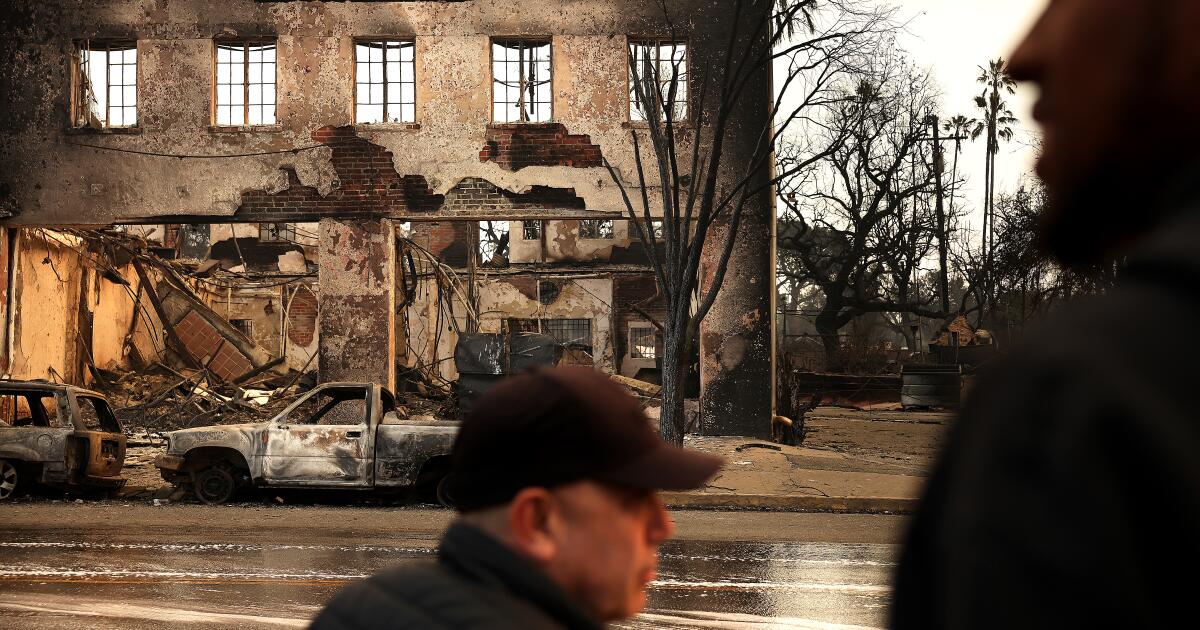
A week after the devastating Eaton fire tore through Altadena, killing 17, with 24 people missing as of this writing, and destroying more than 7,000 structures, cars were double-parked outside Knowhow Shop in Highland Park. People from all over Los Angeles, their faces obscured by masks due to raining ash, carried bags of toys and clothing to donate to Altadena Kindred, a fundraiser for Altadena children who have been displaced.
Just a month ago, one of the event’s organizers, Linda Hsiao, an Altadena ceramist and industrial designer, had helped host a similarly community-minded event in the foothill town. At the holiday craft fair at Plant Material, local artists shared handmade ceramics, knives, jewelry, hot sauce, embroidery and tie-dyed textiles. Adding to the family-friendly vibe, the St. Rita Cub Scout Pack showed up to sell mistletoe foraged from the nearby trails.
Bianca D’Amico, an artist who helped organize the December event — her son attended the preschool on Christmas Tree Lane that burned down — is proud of the hyperlocal market they created together in the former gas station, which amazingly survived, on Lincoln Avenue. “There is something deeply personal about our fellow vendors who pour so much of themselves into their work and are the spirit of Altadena,” D’Amico said, calling them a “creative, plant-loving, dog-friendly, kid-wrangling community of makers, artists and designers.”
In December, Altadena artists gathered at Plant Material on Lincoln Avenue to sell their handmade wares for the holidays. Many of them have lost their homes.
(Lisa Boone / Los Angeles Times)
Today, nearly all the vendors, including Hsiao; her husband, architect Kagan Taylor; and their two children, are homeless. “Our house is still standing, but it’s not safe for us to return,” she said of the smoke damage. “Right now, all I can think about is how we’ve lost our friends, our schools, our entire community.”
Hsiao’s shock was evident as she welcomed friends and accepted donations for Altadena Kindred. “This is where we were supposed to grow old,” she said haltingly. “This is where my son was supposed to ride his bike to school.”
With the loss of neighborhood schools, Hsiao is determined to find a way to create a place where all of the community’s children can gather.
But how do you create something like that when all of your neighbors are gone?
Located at the foot of the San Gabriel Mountains, the unincorporated community of more than 42,000 people has long been a refuge for artists, according to glass and metal artist Evan Chambers, who was born and raised in Altadena, just like his parents and grandparents.

“It’s always been a very accepting community of eccentric people of all types,” said Evan Chambers, pictured in his Pasadena studio.
(Evan Chambers)
“It’s always been a very accepting community of eccentric people of all types,” said Chambers, who purchased his home from the estate of the infamous compost czar Tim Dundon, also known as Zeke the Sheik.
He credits gallery owner Ben McGinty with creating a space for all artists at his Gallery at the End of the World, which survived the fire. “He accepted all of us,” Chambers said of the gallery, which has existed for more than two decades. “I had my first show there.”
Chambers, 44, grew up surrounded by river-rock walls and Arts and Crafts homes that have informed his aesthetic as a glassblower. He lost his home, including the ceramics studio he built for his wife, Caitlin, but is adamant that he will rebuild. “We’re going to rock this,” said the father of two. “With climate change, there is no safe place to go. All that matters is that you suffer with the people you want to help and be helped by. If you’re going to burn, you burn with your people.”
Born and raised in Los Angeles, ceramist Victoria Morris has lived in many neighborhoods throughout the city. But when she purchased a small midcentury house in Altadena a decade ago, the artist felt like she had found a home, personally and professionally. “I thought, ‘This is my last stop,’” Morris said.
The ceramist worked in a studio on Lake Avenue, two miles from her home, where she stored photographs and hard drives in the basement. Just a month ago, Morris hosted a holiday sale, and people packed the showroom to shop for her midcentury-inspired lamps and vases.
Today, it’s all gone.
Morris feels fortunate to have a second home in Ojai. Still, she grapples with the nightmare of evacuating on Jan. 7 and what she has lost. “My husband, Morgan [Bateman], said, ‘Grab your wedding ring, your passport, the animals, and get a jacket and some sturdy shoes.’ There was this beautiful vintage Japanese print that cost nothing, but I loved her so much. And as I was leaving, I thought, ‘Should I grab her?’ Something in my brain said no. I have a notebook where I write the formulas for all my work. It’s been my bible for the last 20 years. Did I grab that? No. Our hard drives? Gone.”
When Bateman finally managed to get access to their property, he found their home and beloved garden smoldering. “All our neighbors are gone,” he told her, rattled.


Brendan Sowersby and Annabel Inganni’s Altadena home, which burned down, was filled with custom furnishings and accessories designed by the couple. Their son Bird stands outside Lake Avenue’s Cafe de Leche, which is also gone. (Annabel Inganni)
On Wednesday, Wolfum textile designer Annabel Inganni was thinking about her 14-year-old son as she waited to pick up a free mattress and box spring at Living Spaces in Monrovia.
“He is in eighth grade, and his school in Pasadena has something like 67 families that have been impacted,” she said. “They are such a supportive community, but I’ve been burying my sadness just to get Bird back to school. And I know it’s not just us. It’s the entire town.”
Inganni lived in the Rubio Highlands neighborhood with her husband, furniture designer Brendan Sowersby of 100xbtr, their two dogs and three cats (all were evacuated safely). Their home was filled with custom furnishings the couple designed. Now, everything is gone. Many of her neighbors lived in their childhood homes. She describes the community as “heaven on earth.”
“Altadena is the most special, innovative, diverse, accepting, core-values town I’ve ever lived in,” she added. “The sense of community is strong. Now, we don’t even have a post office. I lost my home, studio and the archives of everything I’ve ever done. It’s a lot.”


Chris Maddox and Thomas Renaud lost their Altadena home in the Eaton fire. (Thomas Renaud)
After temporarily evacuating to Moorpark last Tuesday, Thomas Renaud returned to Altadena after learning his neighbors’ home was still standing.
“They wanted to go back and get some things, and I offered to drive them,” he said. Renaud was hopeful that the home he shared with his partner, Chris Maddox, and their dog, Van — who both got out safely — would also be left unscathed. But as he drove down Altadena Drive after dropping off his neighbors on Wednesday, all he could see was ash and fire. “When I rounded the corner to my street, I saw that the entire neighborhood was gone,” he said, “and I just lost it.”
When the LGS Studio ceramist and Maddox purchased their house about five years ago, they immediately fell in love with Altadena’s creative community.
“Many artists, musicians and writers live here, and we felt like we had our slice of that,” he said. “We put so much love into that house; it was a place for all our friends and family. It wasn’t just that we lost a house but a home.”
Although Renaud returned to work at his studio in Glassell Park this week, he said he is still in shock. “I don’t think I’ve slept more than one night in the past week,” he said. “Everything right now feels so overwhelming. All the support humbles us, but where do we begin?”
He said that, like many others without homes, finding semipermanent housing is a good start.

Ceramist Linda Hsiao with her children, Wawona, 3, and Saben, 5, in her Altadena home studio in November. Their home is still standing, but the family is unable to live there.
(Robert Hanashiro / For The Times)
As artists, it’s unsurprising that many are haunted by the things they left behind. For Morris, it’s a set of mugs by Los Angeles ceramists Kat and Roger, a quilt she made with her mother, a pencil drawing of her grandmother by her grandfather.
Chambers mentions a lamp by Pasadena artist Ashoke Chhabra and his great-uncle Charles Dockum’s mobile color projector, as well as Dockum’s correspondence with architect Frank Lloyd Wright.
The journals that Inganni had been keeping since she was 6, along with irreplaceable family mementos, are destroyed. “Brendan’s father passed away two years ago, and we had his ashes and photos, and they’re all gone,” she said. “That’s what gets him the most.”
When it came time to evacuate, Renaud grabbed one bag of clothes, the dog, the dog bed and his great-grandfather’s watch. “I didn’t think the fire would come this far,” he said. “My grandmother was a painter, and I had her original artwork. Those are the things I’m grieving for the most. I was thinking, ‘We’ll come back.’ But it’s family history that we can’t get back.”

“Everyone at the hardware store knew my name and would always offer my dog treats,” said artist Victoria Morris.
(Colleen Shalby / Los Angeles Times)
During the COVID-19 pandemic, Morris sought refuge in her studio. But now the businesses near her studio are gone, like Altadena Hardware on Mariposa Street, Grocery Outlet Bargain Market, Café de Leche and Steve’s Pets. Added Morris: “Everyone at the hardware store knew my name and would always offer my dog treats.”
Despite all they have lost, the artists acknowledge moments of grace. Friends have set up GoFundMe accounts to help them with their short-term needs. Chambers’ friends from preschool and elementary school built beds for him and his family. Morris has received notes that have brought her to tears.
“Two people sent me pictures of one of my vases and a bowl and told me they survived,” she said. “And it has brought them so much happiness. They offered them to me, and I told them no. I want them to keep them.”
Hsaio received a photo from a tequila maker in Altadena who went through his rubble and found one of her Tiki tumblers intact. “These people weren’t just my customers,” she said. “They were my community.”
Still, some are filled with trepidation about what comes next.
Renaud and Taylor have received text messages from strangers offering to purchase their damaged homes. “It’s still smoldering,” Renaud said in disbelief.
“It’s going to be the Wild West,” Inganni said. “Everyone I’ve spoken to is rebuilding. That’s what is percolating in the community. But I think people are very nervous about land grabs and worried about people who don’t have the financial capability to cover themselves.”
In the meantime, Morris just wants to get back to work. “I don’t want to miss being a part of rebuilding Altadena,” she said. “It may be a collective. It may be a store. There’s no way I can cut and run out of a place that’s so special.”
Inganni said Sowersby is considering building desks for the community and developing a fireproof home system.
Renaud, temporarily living in a friend’s accessory dwelling unit, or ADU, in Mount Washington, also wants to help.
“I needed to go and see our house because I needed to grieve,” he said. “If you don’t see what you’ve lost, it’s always a question mark in your mind. But now, I want to be a part of the rebuilding. I have a truck. I’m ready.”


Lifestyle
L.A. Affairs: It’s hot when a man drives to me. But would this new guy make the trek from the Valley?

I met Dan on Hinge.
He lives in Woodland Hills, and I live in Venice. In Los Angeles, this is considered a long-distance relationship. In another city it might be nothing. Here, it’s a factor.
But I believe that with the right person, you can make anything work, so I stay open. I’m a native New Yorker, and if I were living in Brooklyn and a guy lived on the Upper West Side, that would be a 45-minute subway ride, which is truly nothing in New York. So with that same logic, I try to have flexibility with men in L.A.
When we started planning our first date, Dan suggested three options: a hike on mushrooms, a wine tasting or a walk on the beach.
A hike on mushrooms is something I’d only do with someone I already trust, not someone I just met online. I don’t do first-date hikes because I don’t like feeling trapped if the guy’s a dud. So I chose the wine tasting.
Then I learned the wine tasting was in West Hills.
On a Friday night, driving there from Venice would be insane. So I said I didn’t want to meet there because of the traffic. He suggested Malibu. That was also not ideal on a Friday.
I was getting annoyed — this was a pink flag because in my dating world, the guy is supposed to come to the woman’s neighborhood in the early days. I’ve gone out with plenty of men from the Valley who effortlessly suggested they come to me. It’s not rare or impossible.
I suggested he come to the Westside. I didn’t specifically say Venice, and in hindsight, I probably should have. He landed on Brentwood, which was manageable for both of us. On our first date, we met at an Irish pub on Wilshire Boulevard. He was cuter and more interesting than I had expected, and with the Guinness flowing, we had fun.
When I got home, he texted me: “Well, I like you 🙂 Less the tik tok and the lack of rock music in your life, but it’s not a deal breaker — there are other qualities 🙂 What are your thoughts?”
I noticed the slight negativity but was mostly dazzled that a man texted immediately after the date to say he liked me. In the modern dating economy, this felt rare.
The next day, both of our evening plans fell through, so we made a last-minute date. The wine tasting he originally suggested still sounded like fun, and although it meant me driving to the Valley, I was up for it now that we’d met.
We sipped flights at Malibu Wines & Beer Garden in its airy, romantic courtyard and played a flirty version of Truth or Dare. Halfway through, he dared me to kiss him.
We ended with sushi on Ventura Boulevard and a short make-out session in his car. He invited me to Thanksgiving at his uncle’s, which felt too soon, but also sweet.
After the second date, he texted and said he had his kids that week and was also hosting an event on Thursday, so his only day to meet was Wednesday. I said great.
On Tuesday night, he checked if we were still on, and I said yes.
Then he texted: “I’m flexible on time but not on location. I have a big event on Thursday, hopefully you can come to me again.”
My stomach tightened. This again?
So I texted back: “I drove to you last time, which was a bit of an exception for me especially in the early days, but the wine tasting location sounded special. Usually guys come to my area. How about we switch it up this time?”
He replied: “I appreciate the effort! Because of my event, I’d rather be close to a computer just if needed … Here is what i offer:
— I’ll come to your area anytime next week/end
— Lunch/dinner on me
I want to continue where we stopped last time 😉 No pressure of course, but let’s snuggle”
I responded: “Ok let’s meet next week. Snuggles sound nice … let’s see what happens …”
Then he wrote: “So I won’t see you tomorrow?”
I replied: “Unless you wanna come to me and bring your laptop along, let’s rain check until you have more flexibility.”
He said: “Dang, you are hard. I’ll let you know tomorrow around midday if it’s ok.”
And then — surprise — he decided to come.
He drove to Venice for a 5 p.m. date. He said his ETA was 5 p.m., and it ended up being 5:25 p.m., typical 405 Freeway.
When he showed up, he was in a cranky mood. On our way to KazuNori in Marina del Rey, I thanked him for picking me up and told him I think it’s hot when the guy comes to the girl.
“You’re just saying that because you want me to come to you more,” he said, not playfully, but aggressively.
That was basically the end for me. But there I was, in his car, heading to dinner. So I stayed pleasant and tried to make the best of it.
I shared that in the early stages of dating, I find it’s good etiquette for the guy to come to the woman’s neighborhood. He immediately disagreed and started ranting about how dating rules are ridiculous and how they swing in women’s favor. He resented paying for dates and declared he wasn’t looking to “sponsor a woman’s life.”
“If women want equality and equal rights,” he said, “then it should apply all across the board, including dating, and the man shouldn’t have to pay.”
I said women don’t actually have equal rights because we get paid less than men and often receive lower salaries than men in the same position.
I tried to change the subject and reset the mood, but he insisted we keep hashing it out.
I tried to explain masculine/feminine dynamics: providing and protecting, giving and receiving.
“What does the man get out of this arrangement?” he asked.
It was like watching someone’s personality warp into Mr. Hyde. Then he brought up another point: He’s a single dad of two kids, so he gets tired; and because I don’t have kids, that should factor into who drives where.
At this point, I was barely engaging and focused on eating my hand rolls, and I couldn’t wait to get home.
The check came, and I happily split it, wanting nothing further from him.
In the car back to my place, he remarked: “It’s obvious we’re never gonna see each other again.”
Obvious, but did it need to be stated?
Then he showed me a Spotify playlist he’d made for me of his favorite electronic music, because he knows I like EDM.
“Oh, that’s sweet,” I said.
“Yeah, that’s how I show interest. Through things like this, not who drives to who,” he replied.
When I got out of the car, we wished each other luck, and I headed inside and shut the door.
Two hours later, he sent me the playlist. I’ve yet to listen to it.
It wasn’t the distance that ruined it. It was the resentment. I’m not looking for a man who feels burdened by the effort. I’m looking for a man who sees the value of courting a woman in the first place.
The author is a writer, comedian and former psychologist who lives in Venice. She is the creator of the new vertical series “Manfari.” She’s on Instagram: @solange_neue and @manfari.show.
L.A. Affairs chronicles the search for romantic love in all its glorious expressions in the L.A. area, and we want to hear your true story. We pay $400 for a published essay. Email LAAffairs@latimes.com. You can find submission guidelines here. You can find past columns here.

Lonnie Bunch III is the 14th Secretary of the Smithsonian. He’s pictured above in September 2017.
J. Scott Applewhite/AP
hide caption
toggle caption
J. Scott Applewhite/AP
In a memo addressed to staffers sent Tuesday, the secretary of the Smithsonian, Lonnie G. Bunch III, defended the institution after the White House issued a 162-page report that characterizes the National Museum of American History as a place which has become “subject to institutional capture by a radical, activist ideology that is fundamentally opposed to telling the noble, honest story of the great country we know and love.”
In his email, which NPR has obtained, Bunch wrote in part: “While there will always be room for improvement, this report is not a fair characterization of the work and totality of the National Museum of American History. At the Smithsonian, our work is driven by scholarship, accuracy and an uncompromising commitment to tell the fullness of America’s story. As public servants and the keepers of this institution, we are charged with helping a nation find understanding, hope and clarity and as part of that duty, we are dedicated to excellence, reflection and growth.”

He continued: “We remain focused on what grounds us: a steadfast commitment to scholarship, nonpartisanship, independence, accuracy and integrity. For nearly 180 years, the Smithsonian has worked alongside partners across government — from the White House to Congress to our governing Board of Regents — guided by our enduring mission to increase and diffuse knowledge. That purpose remains: to pursue knowledge with rigor and to serve the American public with clarity and care.”
The White House report was issued on July 4 by the Domestic Policy Council under the title “Saving America’s Story: How Ideological Capture at the Smithsonian Institution’s National Museum of American History Erases Our Heritage.”

The council faults the National Museum of American History on a multitude of fronts, saying it underemphasized the Founding Fathers and early colonial and Revolutionary history; was not sufficiently celebratory of the country’s 250th anniversary; and that it engaged in “anti-white,” “illegal alien” and transgender activism.
It also accuses the museum of trying to “indoctrinate” teachers and students through its exhibitions, programming and teaching resources.
In the report, the council also specifically criticizes museum director Anthea Hartig, who has led the National Museum of American History since 2019 and is concurrently the president of the Organization of American Historians, calling her “an activist advancing an ideological agenda contradictory to the museum’s founding purpose of fostering patriotism.”

The Trump administration has made the Smithsonian museums one of its primary targets in its efforts to reshape cultural narratives to align with its viewpoints. In August 2025, the White House requested a “comprehensive internal review” of eight Smithsonian museums, including the National Museum of American History, following an executive order issued by President Trump in March 2025 in which he called for the removal of “improper ideology” from the Smithsonian’s offerings.
According to the Smithsonian’s charter, all of its 21 museums, 14 education and research centers, and the National Zoo are meant to be run independently of the federal government. The Smithsonian is overseen by Bunch and a board of regents, which includes Vice President Vance, Supreme Court Chief Justice John Roberts and other members appointed by Congress.
In an interview with NBC’s Meet the Press on Sunday, Bunch spoke about the Smithsonian’s 250th anniversary special exhibition at the Smithsonian Castle, which is called “American Aspirations.”
He told NBC: “It’s really important for people to understand that America is much an ideal as it is a place, that it’s a series of aspirations that have really shaped who this country is. And so for me, what is so powerful is to say, ‘Let us honor the words of Thomas Jefferson and the founders, but let us use those to challenge us to be better.’”
Jennifer Vanasco edited this story.

-

 Los Angeles, Ca39 minutes ago
Knee irritation forces Shohei Ohtani out of Friday start, All‑Star game
-

 Detroit, MI1 hour ago
Detroit Evening Report: Waymo cars blocking first responders – WDET 101.9 FM
-

 San Francisco, CA1 hour ago
San Francisco Mayor Daniel Lurie Blocks Vacant Grocery Store Tax Proposal | KQED
-

 Miami, FL1 hour ago
Oregon Battling Miami, Mario Cristobal for Four-Star EDGE Recruit
-

 Dallas, TX1 hour ago
FC Dallas Forward Logan Farrington Inks Contract Extension
-

 Boston, MA1 hour ago
Red Sox face lengthy travel issues ahead of series vs. Mets
-

 Denver, CO2 hours ago
What’s going on with the Nuggets? Unpacking an NBA offseason on hold
-

 Seattle, WA2 hours ago
Seattle Kraken Sign Goaltender Victor Östman and Defenseman Ville Ottavainen to One-Year Deals | Seattle Kraken

