Lifestyle
‘It’s behind you!’ How Britain goes wild for pantomimes during the holidays


The Wicked Witch ‘Adelphaba’ (played by Gigi Zahir) on stage at the Pleasance Theatre in North London
Ella Carmen Dale/Handout
hide caption
toggle caption
Ella Carmen Dale/Handout
LONDON — Foreboding music begins. A scary green witch announces her arrival with a cackle. It’s the opening of Wicked Witches, a British holiday-time play known as a “pantomime,” at a North London theater.
But soon after she walks on stage, it’s clear the witch isn’t happy with the audience.
She says the audience is being too quiet, and should boo her as loudly as they can, because she is the “villain” of the pantomime. She leaves the stage and comes back on — and this time, the audience does what it’s told, heckling with loud boos.
Throughout the two-hour play, the audience is expected to join in, shouting out classic lines that most people who attend already know, even if they haven’t seen this play. Pantomimes are famous for crowds calling out catch phrases e like “it’s behind you!” — to alert the actors to something, or someone, they can’t see on stage.
All across Britain during the festive period, families attend pantomimes — often shortened to “pantos” — which help get them into the Christmas spirit. Pantomimes are usually based on a well-known story, often a fairy tale, which is then given a bawdy twist. Traditionally, they feature female characters, or “dames,” played by a man in drag, and include lots of music, particularly pop parodies.
The show at the Pleasance Theatre is inspired by The Wizard of Oz and Wicked. Its storyline imagines a blizzard that brings Dorothy (whose name has changed to Dor) back to Oz, 20 years after that first visit. But in many ways, the plot comes second to the silly jokes, innuendos, and songs.
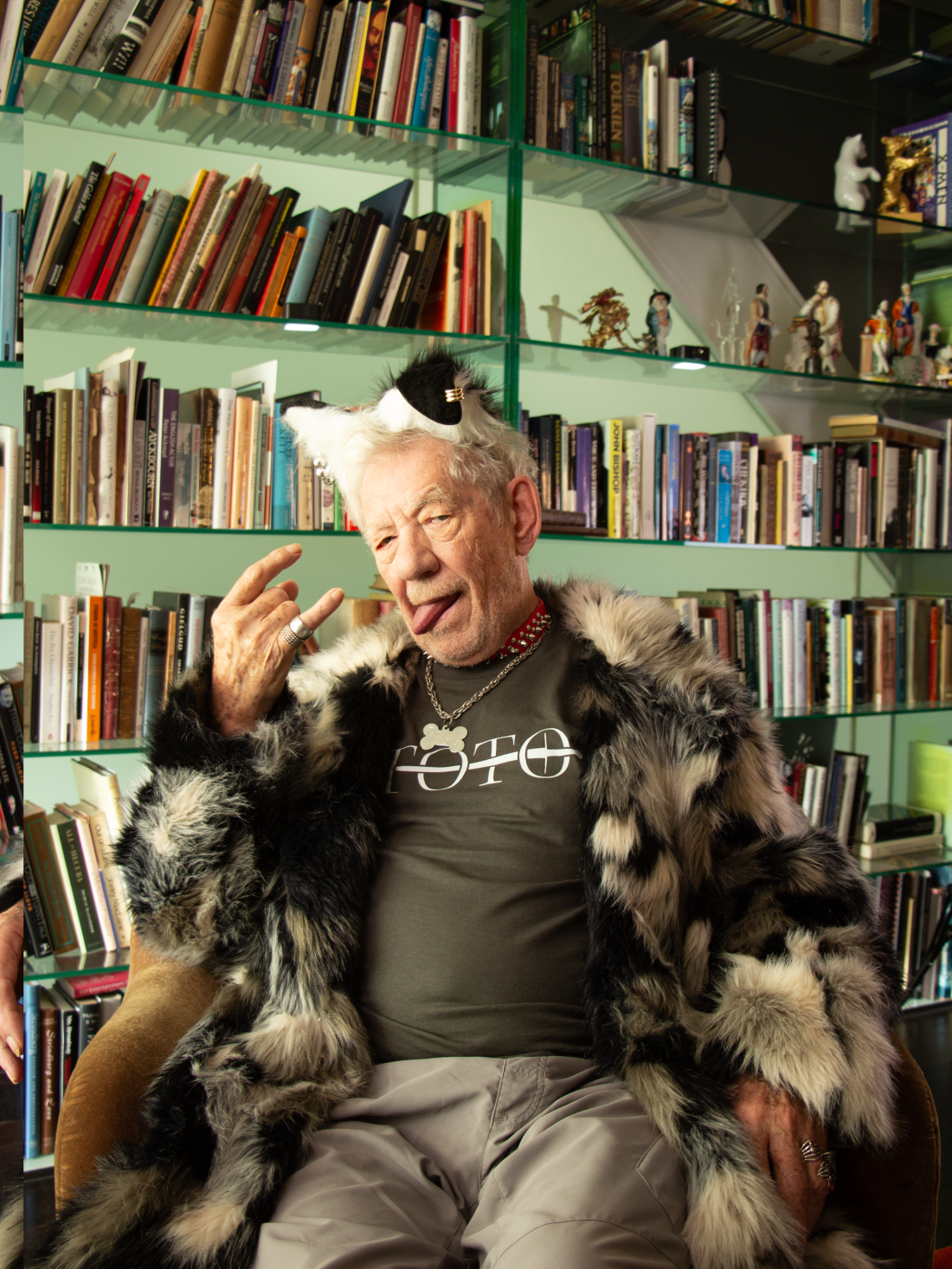
Actor Sir Ian McKellen playng Toto the Dog in a video clip for the Wicked Witches pantomime.
Pleasance Theatre
hide caption
toggle caption
Pleasance Theatre
Pantomimes are also known for featuring celebrities and public figures. This one features politician Jeremy Corbyn, who used to lead Britain’s Labour Party He appears on video as the Wizard of Oz-lington, a pun on Islington, the area of London he represents, now as an independent, in Parliament. Even more exciting is actor Ian McKellen — famous for playing Gandalf in the Lord of the Rings films — who is seen in a video clip as Toto the dog.
The Wicked Witches pantomime in North London was actually written by an American, Shane “ShayShay” Konno, who comes from California’s Bay Area but has lived in the United Kingdom for 12 years. “I didn’t grow up in the U.K., and when I moved here, starting to understand pantomime felt like a huge cultural hurdle,” Konno says.
Pantomime has its roots in Italian commedia dell’arte, a form of theater that dates back to the 16th century. In Britain, it has gradually developed over the years. “The actual history of pantomime is it started in East London, and it used to be this huge thing where the whole community would come together,” Konno explains.
Konno is nonbinary, and their pantomime is consciously inclusive of LGBTQ people, featuring a nonbinary character in the lead role of Dor, and a message that people should accept people who are different from them. “I wanted to make something that made an explicitly LGBT version of The Wizard of Oz and Wicked, because that’s such a beloved franchise for the queer community,” Konno says.
There are two versions: one for families with children, and one just for adults. But Konno says they aren’t as different as you might think. Many of the ruder jokes remain in the family-friendly show, but they are carefully disguised. “When a quite rude joke is said, but one that goes over the kids’ heads, it does tickle the adults in the room more than it would in an adult show because they’re like, ‘Oh my goodness, I can’t believe that they said that in front of the children,’” Konno says.

Characters perform on stage at the Wicked Witches pantomime in north London, on Dec. 6.
Robbie Griffiths/NPR
hide caption
toggle caption
Robbie Griffiths/NPR
Most theaters around Britain have an annual pantomime in the festive period — and it’s often their most popular production of the year. Johnny McKnight, from Paisley, a town near Glasgow, Scotland, has been performing and writing pantomimes in Scotland for 20 years, and says it’s a vital part of many British people’s Christmas celebrations.
“I’ve always said to everybody, when you do a pantomime, and you’re doing 12 shows a week, you’re giving people the gift of their Christmas ritual, their Christmas night out,” McKnight says. McKnight often plays the role of the dame, dressing up in drag.
McKnight has seen different generations of the same families grow up watching his shows, and explains that pantomime is often the first time that children in Britain ever visit the theater. “A lot of the time it’s a child’s first entry point,” McKnight says. “It was certainly mine — my first entry point into live theater.”
At the Wicked Witches show in North London, there are lots of children at the theater for the first time. Imogen Coackley is 8 years old, and attending with her father Alex and 5-year-old sister Emily. Imogen explains that she likes the pantomime because “they say very funny jokes and talk to the audience.”
McKnight says that seeing children enjoy his shows is one of the best parts of the job. “There’s something … magical in that, that you’re creating something accessible that talks to its audience rather than at them, that asks them to participate,” he says.



Millie Bobby Brown in the final season of Stranger Things.
Netflix
hide caption
toggle caption
Netflix
After five seasons and almost ten years, the saga of Netflix’s Stranger Things has reached its end. In a two-hour finale, we found out what happened to our heroes (including Millie Bobby Brown and Finn Wolfhard) when they set out to battle the forces of evil. The final season had new faces and new revelations, along with moments of friendship and conflict among the folks we’ve known and loved since the night Will Byers (Noah Schnapp) first disappeared. But did it stick the landing?
To access bonus episodes and sponsor-free listening for Pop Culture Happy Hour, subscribe to Pop Culture Happy Hour+ at plus.npr.org/happy.

JasonMartin
Adin Ross Disrespecting Doechii …
Will Not Be Tolerated!!!
Published
TMZ.com
JasonMartin is putting his foot down after hearing Adin Ross call Doechii a “bitch” one too many times … the culture’s not going for it in 2026!!!
TMZ Hip Hop caught up with JM in L.A. this week, and he says Adin being aggressively addressed is vital to preventing outsiders of Black culture from toeing the line in the future.
Adin Ross is lying about Doechii and one of the biggest Twitter Accounts is behind it… pic.twitter.com/VoAwGJefyV
— Mike Tee (@ItsMikeTee) January 5, 2026
@ItsMikeTee
Adin maintains Doechii targeted him on her new track, “Girl, Get Up,” when she blasted people labeling her “an industry plant” … and blamed Complex magazine for helping fuel the fire.
Joe Budden, Glasses Malone, Wack 100, and Top Dawg Entertainment execs have all chimed in on Adin’s comments, and Jason says it’s bigger than internet tough talk … and won’t allow Adin to hide behind religion or freedom of speech to drag Black women.
Adin went on to collaborate with Tekashi 6ix9ine and Cuff Em on an anti-Lil Tjay and Doechii song, but has since said he’ll stay out of the beef; his chat doesn’t matter to him, and it’s not that deep to him.
TMZ.com

War mongering isn’t Jason’s only goal this year. He released 5 albums — “A Hit Dog Gon Holla,“ “I Told You So,“ “Mafia Cafe,“ “O.T.,“ and “A Lonely Winter” — to close out the 4th quarter and just may be in the “Snowfall” reboot with his buddy, Buddy!!!

A firefighter works as homes burn during the Eaton fire in the Altadena area of Los Angeles County, Calif., on Jan. 7, 2025.
Josh Edelson/AFP via Getty Images
hide caption
toggle caption
Josh Edelson/AFP via Getty Images
On New Year’s Eve 2024, journalist Jacob Soboroff was sitting around a campfire with a friend when he made an offhand comment that would come back to haunt him: The last thing he wanted to do in the new year, Soboroff said, was cover a story that would require donning a fire-safe yellow suit.
Just one week later, Soboroff was dressed in the yellow suit, reporting live from a street corner in Los Angeles as fire tore through the Pacific Palisades, the community where he was raised.
“This was a place that I could navigate with my eyes closed,” Soboroff says of the neighborhood. “Every hallmark of my childhood I was watching carbonize in front of me. … There were firefighters there and first responders and other journalists there, but it was an extremely lonely, isolating experience to be standing there as everything I knew burned down around me in real time.”

In his new book, Firestorm: The Great Los Angeles Fires and America’s New Age of Disaster, Soboroff offers a minute-by-minute account of the catastrophe, told through the voices of firefighters, evacuees, scientists and political leaders. He says covering the wildfires was the most important assignment he’s ever undertaken.
“The experience of doing this is something that I don’t wish on anybody, but in a way I wish everybody could experience,” he says. “It’s given me insane reverence for our colleagues in the local news community here, who, I think, definitionally were exercising a public service in the street-level journalism that they were doing and are still doing. … It was actually beautiful to watch because they are as much a first responder on a frontline as anybody else.”
Interview highlights

On the experience of reporting from the fires
You’re choking with the smoke. And I almost feel guilty describing it from my vantage point because the firefighters would say things to me like: “My eyeballs were burning. We were laying flat on our stomach in the middle of the concrete street because it was so hot, it was the only way that we could open the hoses full bore and try to save anything that we could.” …
I could feel the heat on the back of my neck as we stood in front of these houses that I remember as the houses that cars and people would line up in front of for the annual Fourth of July parade or the road race that we would run through town. Trees were on fire behind us — we were at risk of structures falling at any given minute. It was pretty surreal because this is a place I had spent so much time as a child and going back to as an adult. … I had no choice but to just open my mouth and say what I saw to the millions of people that were watching us around the country.
On undocumented immigrants being central to rebuilding the city

These types of massive both humanitarian and natural disasters give us X-ray vision for a time into sort of the fissures that are underneath the surface in our society. And Los Angeles, in addition to being one of the most unequal cities between the rich and the poor, has more undocumented people than virtually any other city in the United States of America. Governor Newsom knew that with the policies of the incoming administration, some of the very people that would be responsible for the cleanup and the rebuilding of Los Angeles may end up in the crosshairs of national immigration policy. And I think that that was an understatement. …
Pablo Alvarado in the National Day Laborer Organizing Network said to me that often the first people into a disaster — the second responders after the first — are the day laborers. They went to Florida after Hurricane Andrew, to New Orleans after Katrina, and they’d be ready to go in Los Angeles. And I went out and I cleaned up Altadena and Pasadena with some of them in real time.
And only months later did this wide-scale immigration enforcement campaign begin … on the streets of LA as sort of the Petri dish, the guinea pig for expanding this across the country. And it’s not an exaggeration to say that the parking lots of Home Depots, where workers [were] looking to get involved in the rebuilding of Los Angeles, has been ground zero for that enforcement campaign.
On efforts to rebuild
The pace is slow and it’s sort of a hopscotch of development. And I think for people who do come back, for people who can afford to come back, it’s going to be a long road ahead. You’re going to have half the houses on your street under construction for years to come. And for people that do inhabit those homes, it’s going to an isolating experience. But there’s an effort underway to rebuild. …
There’s also a lot of for-sale signs. And that’s the sad reality of this, is that there are people who, whether it’s that they can’t afford to come back … or that they just can’t stomach it, I think, sadly, a lot people are not going to be returning to their homes.
On what the Palisades and Altadena look like today

They both look like very big construction sites in a way. There are still some facades, some ruins of the more historic buildings in the Palisades. … But mostly it’s just empty lots. And in Altadena, the same thing. If you drive by the hardware store, the outside is still there. But it’s a patchwork of empty lots. Homes now under construction. And lots and lots of workers. … There are still a handful of people who are living in both the Palisades and in Altadena, but for the most part, these are communities where you’ve got workers going in during the day and coming out at night. …
We have designed this community to be one that’s in the crosshairs of a fire just like the one we experienced and that we will certainly, certainly experience again, because nobody’s packing it up and leaving Los Angeles. People may not return to their communities after they’ve lost their homes, but the ship has sailed on living in the wildland urban interface in the second largest city in the country.
On seeing this story, personally, as his “most important assignment”

Jacob Soboroff is a correspondent for MS NOW, formerly MSNBC.
Jason Frank Rothenberg/HarperCollins
hide caption
toggle caption
Jason Frank Rothenberg/HarperCollins
I don’t think I realized at the time how badly I needed the connections that I made in the wake of the fire, both with the people who have lost homes and the firefighters, first responders who were out there, but also honestly with my own family, my immediate family, my wife and my kids, my mom and my dad and my siblings and myself. I think that this was a really hard year in LA, and I think in the wake of the fire, I was experiencing some level of despair as well. Then the ICE raids happened here and sort of turned our city upside down. And this book for me was just this amazing cathartic blessing of an opportunity to find community with people I don’t think I ever would have otherwise spent time with, and to reconnect with people who I hadn’t seen or heard from in forever.
Anna Bauman and Nico Wisler produced and edited this interview for broadcast. Bridget Bentz, Molly Seavy-Nesper and Beth Novey adapted it for the web.


DMV-chain Compass Coffee files for Chapter 11 Bankruptcy

Cleveland Cavaliers get Max Strus injury update that fans won’t want to hear

Lawsuit: Brianna Aguilera’s parents allege underage alcohol service at Austin tailgate contributed to daughter’s death

Alabama offensive lineman transferring to Georgia Tech

Dozens of vehicle accidents reported, Anchorage after-school activities canceled, as snowfall buries Southcentral Alaska

Florida High School Football Rankings: Top 25 teams – Oct. 21

Cleary's 21 help Le Moyne down Central Connecticut State 69-64 in OT

How old is Bo Nix? What to know about Oregon quarterback ahead of 2024 NFL Draft

99th annual Pony Swim held in Virginia

Video: ‘It Didn’t Have to Happen This Way:’ U.Va. Faculty Call for Review of Police Response to Protests

Video: Nvidia Shows Off New A.I. Chip at CES

Pelosi heir-apparent calls Trump’s Venezuela move a ‘lawless coup,’ urges impeachment, slams Netanyahu

EU Commission examines childlike sexual images created by Musk’s AI

Lawmakers split over Maduro’s seizure. And, CDC cuts childhood vaccine schedule

Federal officials to halt more than $10B in funding to 5 states over non-citizen benefit concerns: report
-

 World1 week ago
Hamas builds new terror regime in Gaza, recruiting teens amid problematic election
-
 News1 week ago
For those who help the poor, 2025 goes down as a year of chaos
-
 Business1 week ago
Instacart ends AI pricing test that charged shoppers different prices for the same items
-

 World1 week ago
Podcast: The 2025 EU-US relationship explained simply
-
 Business1 week ago
Apple, Google and others tell some foreign employees to avoid traveling out of the country
-

 Technology1 week ago
ChatGPT’s GPT-5.2 is here, and it feels rushed
-

 Politics1 week ago
‘Unlucky’ Honduran woman arrested after allegedly running red light and crashing into ICE vehicle
-

 Health1 week ago
Did holiday stress wreak havoc on your gut? Doctors say 6 simple tips can help