Lifestyle
Is print dead? Not at this indie bookstore publishing L.A.'s untold stories


Donato Martinez reads his poetry at the Libros Lincoln Heights bookshop.
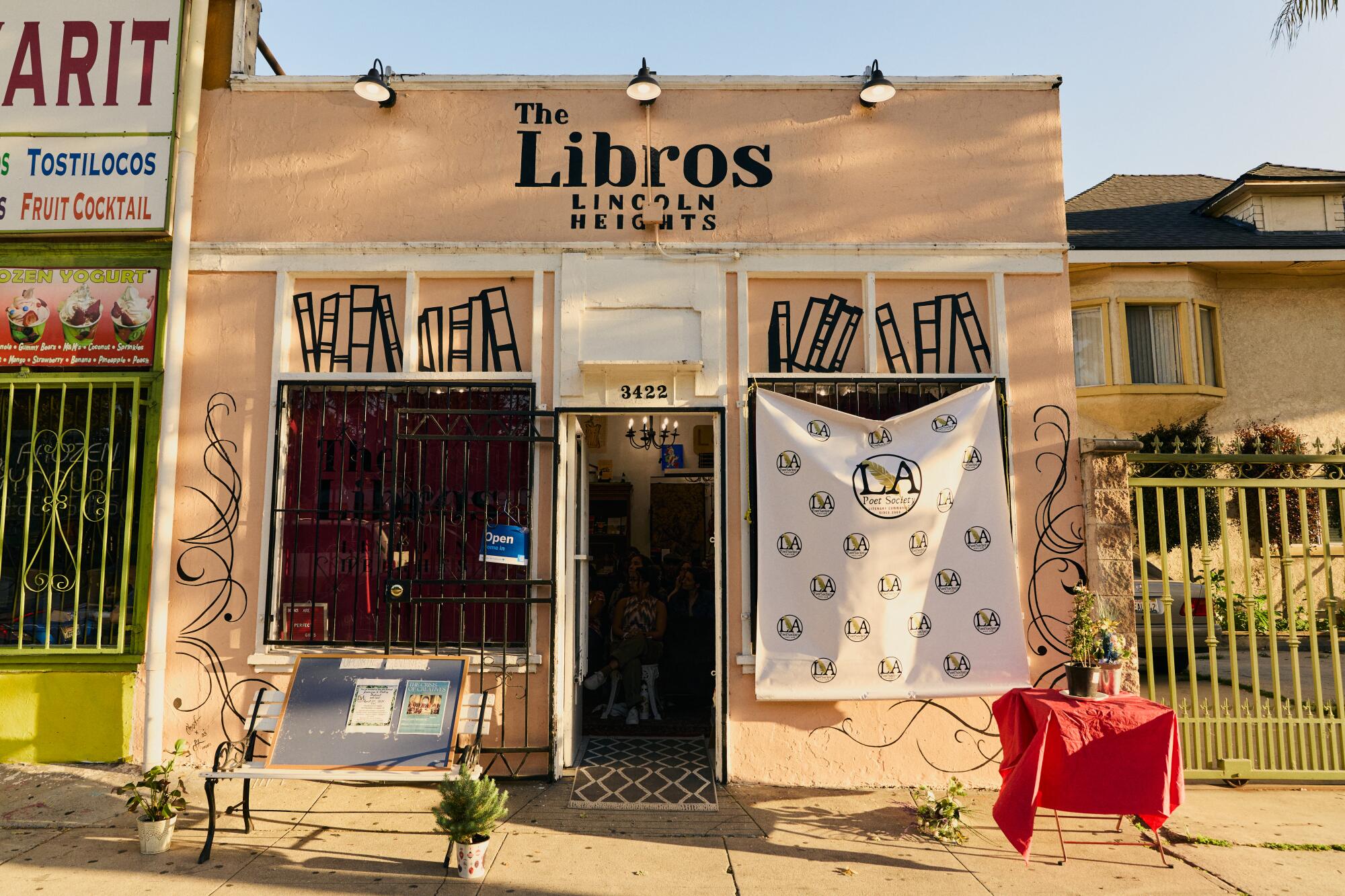
On a Saturday evening in late April, the door of the Libros Lincoln Heights is propped open. Inside, 18 local poets pack the narrow single-room bookstore, waiting for a chance to read a poem or two at this month’s open mic in front of an enthusiastic audience.
Donato Martinez, an English professor at Santa Ana College, is the third poet to take the podium. He reads from a stack of loose papers, his hands moving in time with the stanzas he spits like rap bars.
“All street vendors are allowed. / taco stands that never get shut down / Free zone any time / Patrolled by our own. That means Elotes. Churros. Bacon wrapped hot dogs / Fruit cocktails anytime,” Martinez recites from his new poem, titled “If I Was God I Would Visit the Hood.”
The audience snaps and hums, layering their own harmony over the soft whir of the ceiling fan and the cars rushing down North Broadway.
Martinez’s poetry collection “Touch the Sky” can be found on the surrounding shelves, along with collections from three other of the night’s readers. Their presence speaks to the driving ethos behind the Libros: 80% to 90% of the merchandise on the bookstore’s mismatched shelves are written by residents of Lincoln Heights and nearby neighborhoods.
“I don’t just have one little shelf for local authors. The whole place is local authors,” Jesse Marez, the owner of the Libros, said. “It blends in with the neighborhood.”
Marez, an electrical engineer by trade and lifelong book lover, opened the Libros last November, in an effort to consolidate the bookshelves he’d been curating at cafes across the Eastside since late 2021. He estimates that it is the first bookstore in Lincoln Heights in upwards of 70 years.
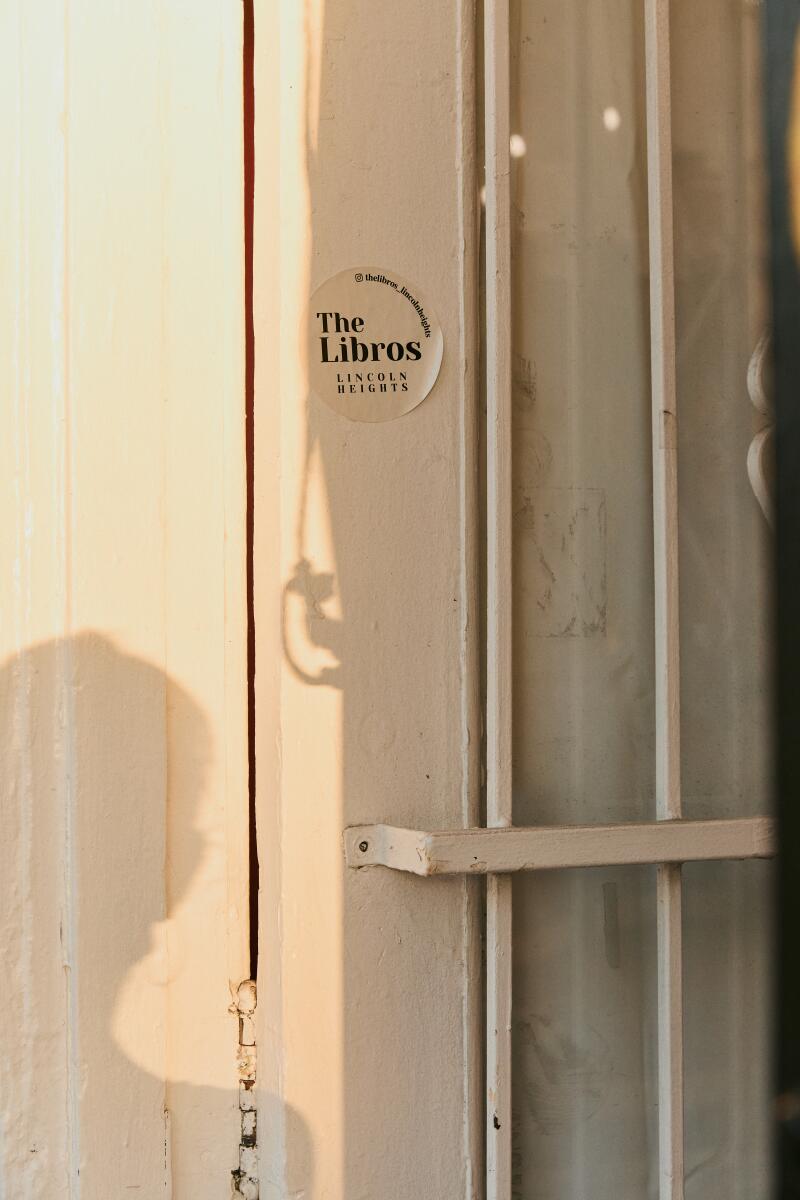
A sticker for the Libros on the doorway of the shop.
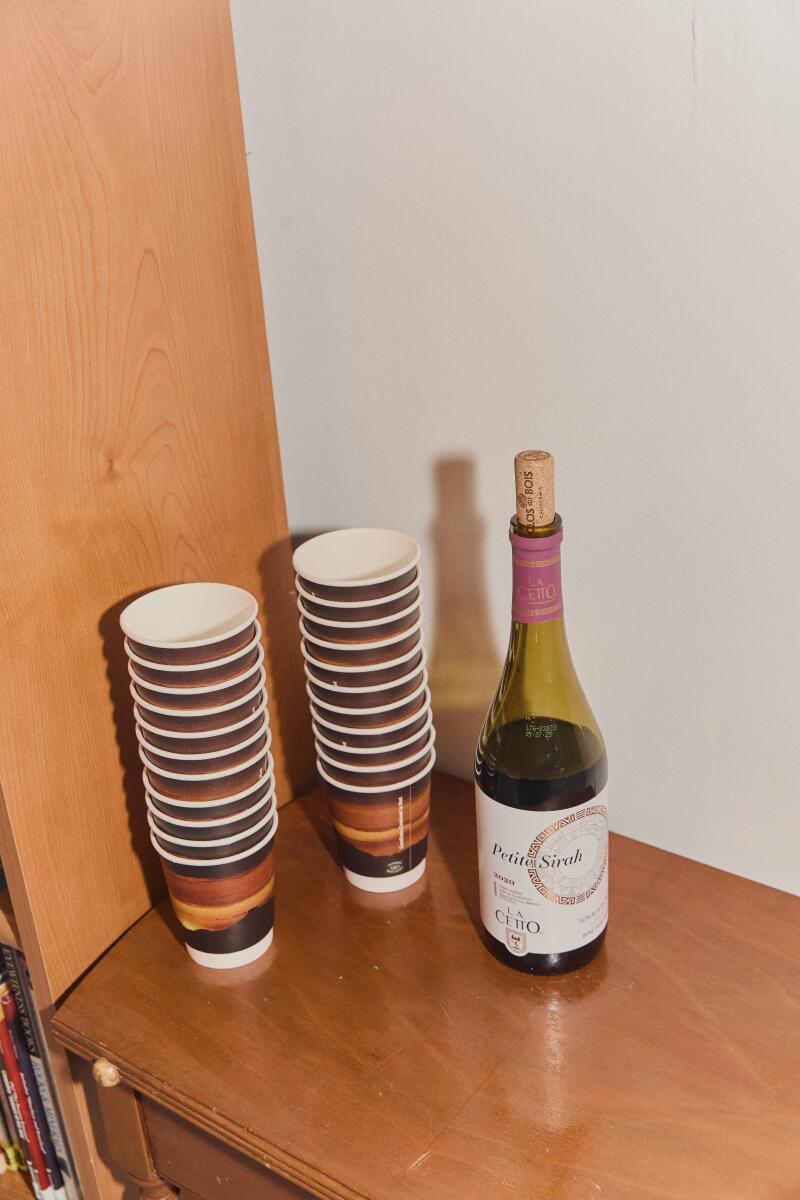
Beverages at the open mic poetry reading.
Growing up in Lincoln Heights and neighboring El Sereno, where his family settled after immigrating from Mexico in 1969, Marez experienced this paucity firsthand. Now he’s determined to be at least one place where local authors can share their stories and readers can find a book across a variety of languages and genres.
“We didn’t grow up going to a bookstore or having books, so for me I think it’s valuable for a child,” Marez paused, ducking his head to wipe away tears. “I think it’s important for them to know they can have a book of their own, and it not to be a used book because we’re all used to hand-me-downs. I think in a neighborhood like this, people need to know that they can get a new book, especially at an early age.”
In the months since opening, the Libros has become a neighborhood hub, spotlighting books and authors that can’t always be found on the shelves of other bookstores. Collections of self-published poetry and family histories of Lincoln Heights sit alongside multi-award-winning books by Viet Thanh Nguyen and Kelly Lytle Hernández (also L.A. residents). On a table in the center of the room are copies of “Violet’s First Big Goodbye,” a picture book written by the bookstore’s youngest author, 8-year-old Luna Yanez-Cuestas.
Yanez-Cuestas, who lives in Burbank, wrote and self-published the book with her mother, Adriana Cuestas, to share the grief she felt after saying goodbye to her old neighborhood.
“It’s about saying goodbye to what you really love,” Yanez-Cuestas said.
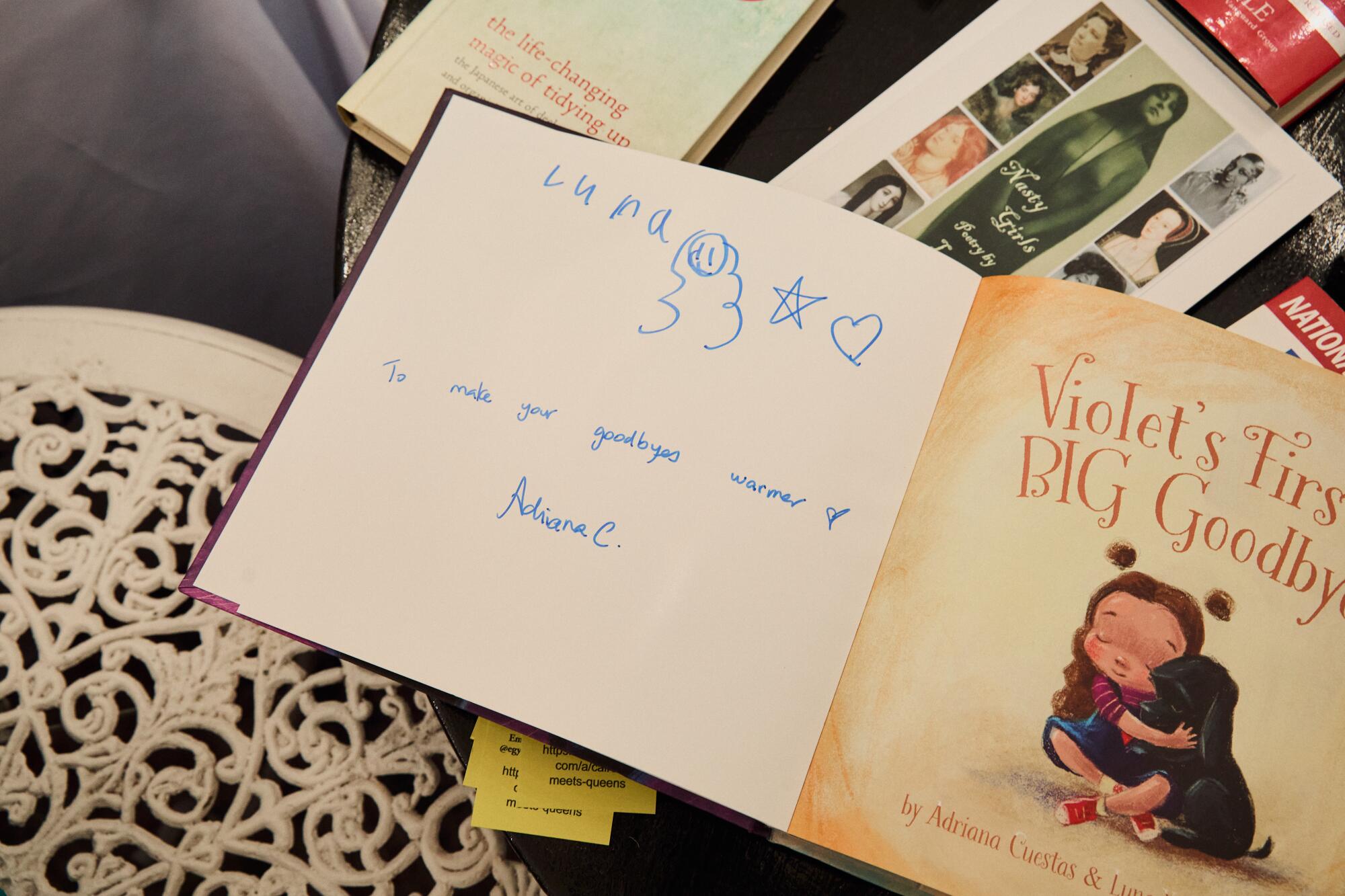
A signed copy of “Violet’s First Big Goodbye” by Luna Yanez-Cuestas lies on a table at the Libros bookshop.
Customers come to the store for this wide selection of books, many of which have been signed by their authors. Marez said most of the books sell quickly because they are local.
Readers aren’t the only ones who frequent the store. Authors regularly stop by with books tucked under their arms, shyly asking whether Marez will sell their memoir or poetry collection. His answer is always an enthusiastic yes, even as shelf space becomes increasingly limited.
Marez has a knack for finding local writers, too. He met Lluvia Arras, L.A.-based author of “A Kids Book About Blended Families,” when their sons were playing soccer together. A few months later, he connected with Joseph Robledo at an exhibit on the Olympic Auditorium at La Plaza de Cultura y Artes.
Robledo is the author of “Blood on the Canvas,” a book commemorating his father, local boxing legend Canto ‘TNT’ Robledo. The son of Mexican immigrants, the elder Robledo became an amateur boxer at 15, turned pro at 16 and won the Pacific Coast Bantamweight Championship at 19. He was on his way to the world championship when a series of injuries left him permanently blind.
“Blood on the Canvas,” guides readers through backyard gyms in South Pasadena to the World Boxing Hall of Fame to tell the story of his father’s transformation from would-be champion to inspirational trainer who touched the lives of hundreds.
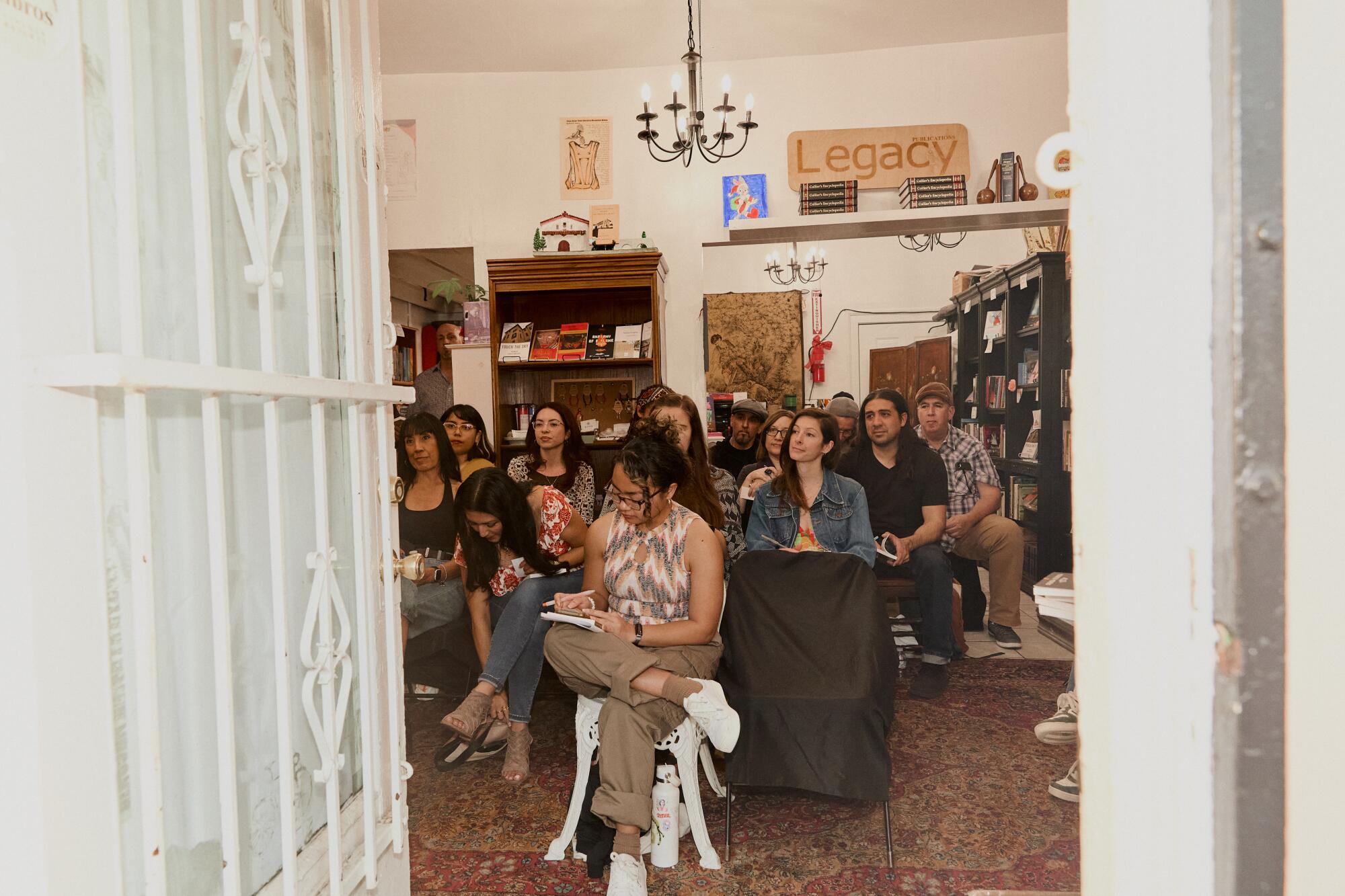
Attendees write poems during a poetry reading and open mic night at the Libros bookshop.
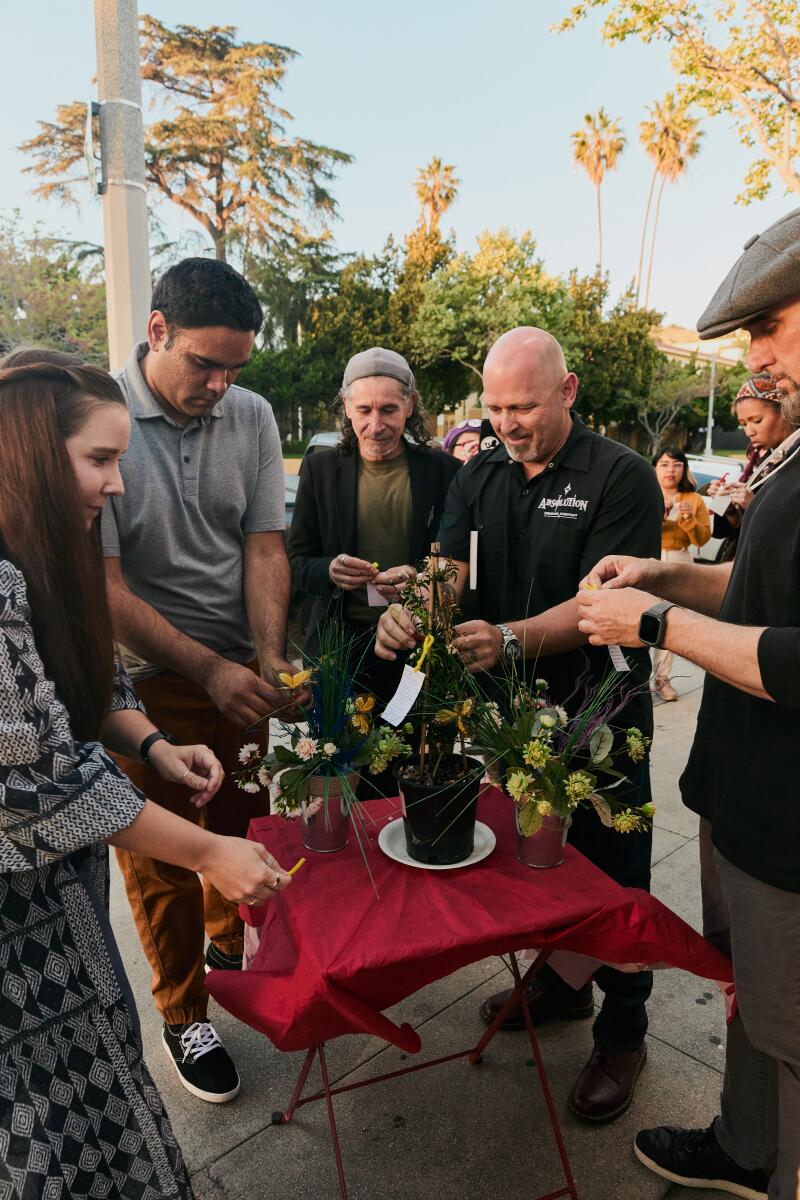
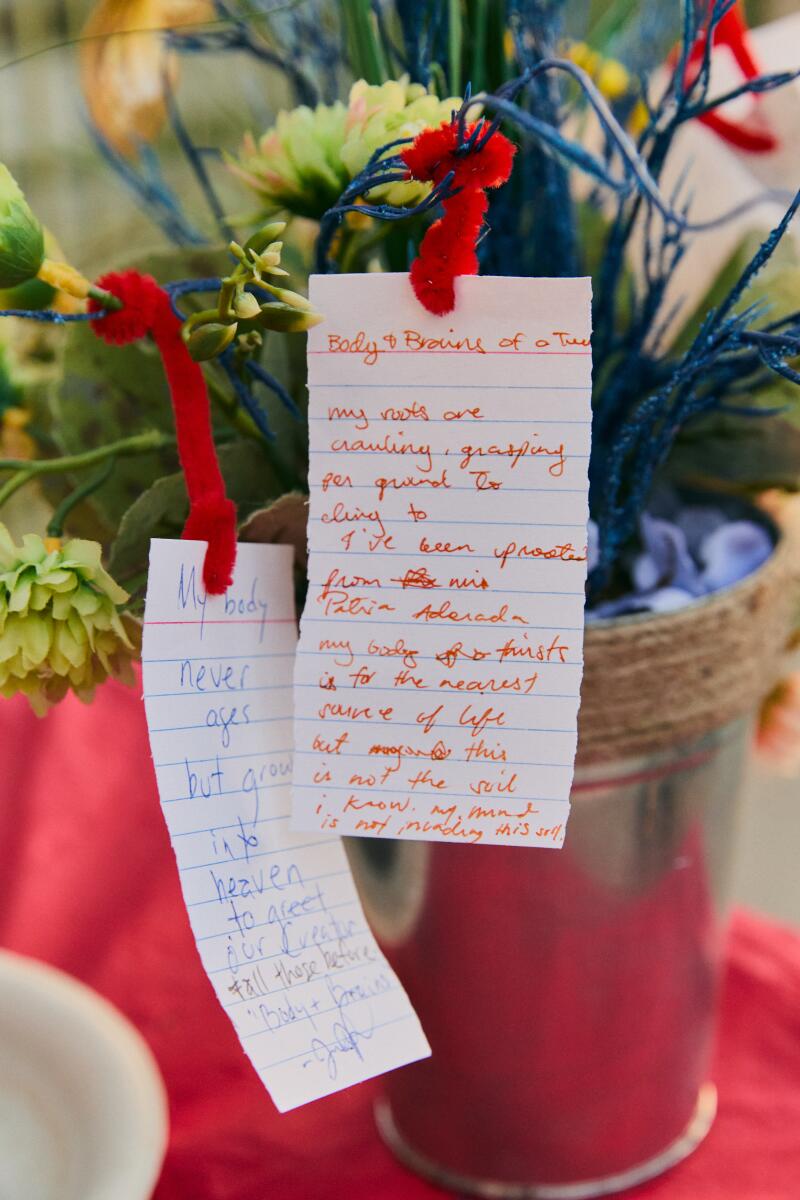
Attendees place their poems on plants outside the Libros bookshop.
Meeting authors like Robledo and Arras has drawn Marez into L.A.’s literary world and taught him tricks of a trade that is often opaque to outsiders.
Behind each book on the store’s shelves is a journey scattered with roadblocks. It’s challenging to break into the mainstream publishing world and, according to a new survey, the industry remains overwhelmingly white.
“I was obsessed with self-publishing because I thought based on how I hear things go for authors in our society, it just didn’t seem fair to give such a big part of your work to another person,” said Cuestas.
For these reasons, authors like Cuestas turn to independent or self-publishing to get their books out into the world. The latter, which has recently become increasingly popular, gives authors creative control and the potential to earn a greater share of the profits, said Brenda Vaca, an author based in Whittier who created her own publishing house to publish her poetry collection titled “Riot of Roses.”
But that creative control comes at the cost of donning all the hats: writer, publisher, distributor and marketer. Stewart J. Zully, who self-published a memoir about the 40 years he spent vending in Yankee Stadium, says he’s spent a large part of his writing career hustling alone and hoping for a break.
“The creativity and the work [to get] it done is one side of the brain and then the business side is completely different,” Zully said.
At the Libros, Marez is trying to lift a few of these hats off the authors’ heads by launching his own publishing company, Legacy Publications.
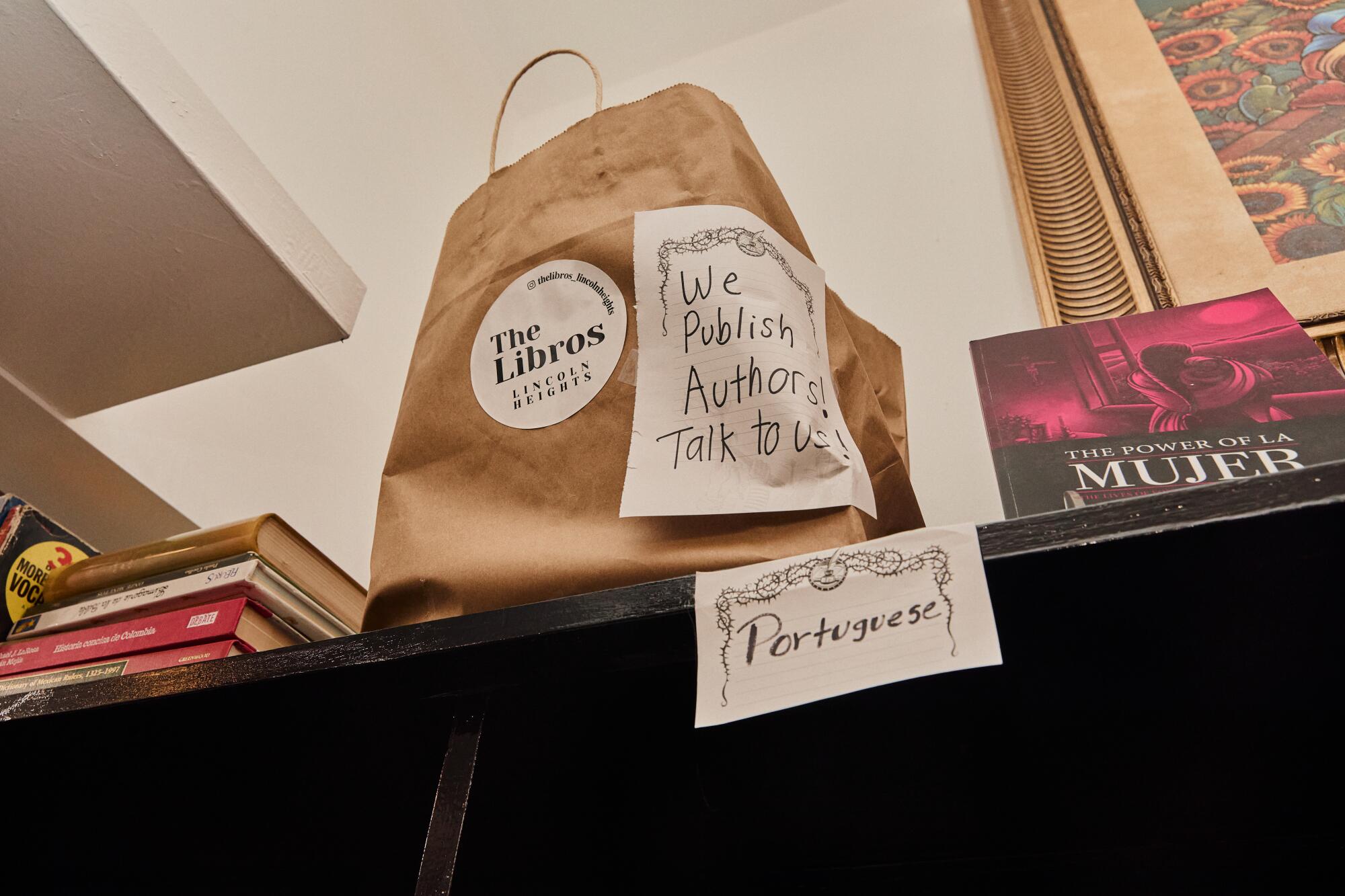
A paper bag with a sign that reads “We publish authors, talk to us” sits atop a shelf at the Libros bookshop.
“What we’re trying to do is help these authors with the distribution and the printing and the publishing,” he said. “Because they’re more worried about how to make a dollar or how to do the distribution, where they should be worried about their second book.”
Like the bookstore, Legacy Publications is deeply rooted in Marez’s pride for the Eastside neighborhoods he grew up in.
“I want to feature people that have actually made our community,” Marez said. “We want to talk about people who have left a legacy in our neighborhoods.’”
In launching this new branch of the business, Marez aims to highlight local voices, help authors make a profit and ensure the books themselves are made with high-quality materials. He prioritizes working with local printers such as Litho Press and Paperleaf Press and plans to release at least three books by the new year.
In his dual roles, Marez is filling Lincoln Heights with books that take readers to distant countries and eras, opening up new worlds. Alongside them, are stories that bring readers home with untold histories of the neighborhoods that have raised them and their families. The authors themselves find solace in knowing that, at least at the Libros, their books will be read and shared.
“Our books, they don’t appear at Barnes & Noble,” Martinez said, referencing how stories by authors of color have largely been kept out of mainstream publishing, and thus bookstores, for generations. “I wish they did and I think our stories belong there. If they’re not at Barnes & Noble, we need these independent bookstores to house our books. We support Libros and then Libros provides a safe space for the writers and poets. I think that right there is a relationship.”




Andy Richter has found his place.
The Chicago area native previously lived in New York — where he first found fame as Conan O’Brien’s sidekick on “Late Night” — before moving to Los Angeles in 2001. Three years ago, he moved to Pasadena. “Now that I live here, I would not live anywhere else,” he says.
There are some practical benefits to the city. “I am such a crabby old man now, but it’s like, there’s parking, you can park when we have to go out,” Richter says. “The notion of going to dinner in Santa Monica just feels like having nails shoved into my feet.”

In Sunday Funday, L.A. people give us a play-by-play of their ideal Sunday around town. Find ideas and inspiration on where to go, what to eat and how to enjoy life on the weekends.
But he mostly appreciates that Pasadena is “a very diverse town and just a beautiful town,” he says.
For Richter, most Sundays revolve around his family. In 2023, the comedian and actor married creative executive Jennifer Herrera and adopted her young daughter, Cornelia. (He also has two children in their 20s, William and Mercy, from his previous marriage.)
Additionally, he’s been giving his body time to recover. Richter spent last fall training and competing on the 34th season of “Dancing With the Stars.” And though he had no prior dancing experience, he won over the show’s fan base with his kindness and dedication, making it to the competition’s ninth week.
He hosts the weekly show “The Three Questions” on O’Brien’s Team Coco podcast network and still appears in films and TV shows. “I’m just taking meetings and auditioning like every other late 50s white comedy guy in L.A., sitting around waiting for the phone to ring.”
This interview has been lightly edited and condensed for length and clarity.

7:30 a.m.: Early rising
It’s hard for me at this advanced age to sleep much past 7:30. I have a 5 1/2-year-old, and hopefully she’ll sleep in a little bit longer so my wife and I can talk and snuggle and look at our phones at opposite ends of the bed, like everybody.
Then the dogs need to be walked. I have two dogs: a 120-pound Great Pyrenees-Border Collie-German Shepherd mix, and then at the other end of the spectrum, a seven-pound poodle mix. We were a blended dog family. When my wife and I met, I had the big dog and she had a little dog. Her first dog actually has passed, but we like that dynamic. You get kind of the best of both worlds.

8 a.m.: Breakfast at a classic diner
Then it would probably be breakfast at Shakers, which is in South Pasadena. It’s one of our favorite places. We’re kind of regulars there, and my daughter loves it. It’s easy with a 5-year-old, you’ve got to do what they want. They’re terrorists that way, especially when it comes to cuisine.
I’ve lived in Pasadena for about three years now, but I have been going to Shakers for a long time because I have a database of all the best diners in the Los Angeles metropolitan area committed to memory. There’s just something about the continuity of them that makes me feel like the world isn’t on fire. And because of L.A.’s moderate climate, the ones here stay the way they are; whereas if you get 18 feet of winter snow, you tend to wear down the diner floor, seats, everything.
So there’s a lot of really great old places that stay the same. And then there are tragic losses. There’s been some noise that Shakers is going to turn into some kind of condo development. I think that people would probably riot. They would be elderly people rioting, but they would still riot.
11 a.m.: Sandy paws
My in-laws live down in Long Beach, so after breakfast we might take the dogs down to Long Beach. There’s this dog beach there, Rosie’s Beach. I have never seen a fight there between dogs. They’re all just so happy to be out and off-leash, with an ocean and sand right there. You get a contact high from the canine joy.

1 p.m.: Lunch in Belmont Shore
That would take us to lunchtime and we’ll go somewhere down there. There’s this place, L’Antica Pizzeria Da Michele, in Belmont Shore. It’s fantastic for some pizza with grandma and grandpa. It’s originally from Naples. There’s also one in Hollywood where Cafe Des Artistes used to be on that weird little side street.

4 p.m.: Sunset at the gardens
We’d take grandma and grandpa home, drop the dogs off. We’d go to the Huntington and stay a couple of hours until sunset. The Japanese garden is pretty mind-blowing. You feel like you’re on the set of “Shogun.”
The main thing that I love about it is the changing of ecospheres as you walk through it. Living in the area, I drive by it a thousand times and then I remember, “Oh yeah, there’s a rainforest in here. There’s thick stands of bamboo forest that look like Vietnam.” It’s beautiful. With all three of my kids, I have spent a lot of time there.

6:30 p.m.: Mall of America
After sundown, we will go to what seems to be the only thriving mall in America — [the Shops at] Santa Anita. We are suckers for Din Tai Fung. My 24-year-old son, who’s kind of a food snob, is like, “There’s a hundred places that are better and cheaper within five minutes of there in the San Gabriel Valley.” And we’re like, “Yeah, but this is at the mall.” It’s really easy. Also, my wife is a vegetarian, and a lot of the more authentic places, there’s pork in the air. It’s really hard to find vegetarian stuff.
We have a whole system with Din Tai Fung now, which is logging in on the wait list while we’re still on the highway, or ordering takeout. There’s plenty of places in the mall with tables, you can just sit down and have your own little feast there.
There’s also a Dave & Buster’s. If you want sensory overload, you can go in there and get a big, big booze drink while you’re playing Skee-Ball with your kid.
9 p.m.: Head to bed ASAP
I am very lucky in that I’m a very good sleeper and the few times in my life when I do experience insomnia, it’s infuriating to me because I am spoiled, basically. When you’ve got a 5 1/2-year-old, there’s no real wind down. It’s just negotiations to get her into bed and to sleep as quickly as possible, so we can all pass out.

new video loaded: Prada Peels Back the Layers at Milan Fashion Week
By Chevaz Clarke and Daniel Fetherston
February 27, 2026

Bill Cosby
Rape Accuser Says Cosby Won’t Take Stand At Trial
Published
Bill Cosby‘s rape accuser Donna Motsinger says the TV star can’t be bothered to show up to court for a trial in a lawsuit she filed against him.
According to new legal docs, obtained by TMZ. Motsinger says Bill will not testify in court … she claims it’s “because he does not care to appear.”

Motsinger says Bill won’t show his face at the trial either … and the only time the jury will hear from him will be a previously taped deposition.
As we previously reported, Motsinger claims Bill drugged and raped her in 1972. In the case, Bill admitted during a deposition that he obtained a recreational prescription for Quaaludes that he secured from a gynecologist at a poker game.
TMZ.com
Bill also said he planned to use the pills to give to women in the hopes of having sex with them.
Motsinger alleged Bill gave her a pill that she thought was aspirin. She claimed she felt off after taking it and said she woke up the next day in her bed with only her underwear on.
Here, it sounds like Motsinger wants to play the deposition for the jury.

Xiaomi 17 is a small(ish) phone with a big(ish) battery

World leaders split over military action as US-Israel strike Iran in coordinated operation

Iran fires missiles at US bases across Middle East after American strikes on nuclear, IRGC sites

Common nighttime noise exposure may trigger heart problems, study suggests

MLB pitcher Merrill Kelly says California tax rate swayed decision to reject Padres’ free agency offer

Florida High School Football Rankings: Top 25 teams – Oct. 21

Cleary's 21 help Le Moyne down Central Connecticut State 69-64 in OT

How old is Bo Nix? What to know about Oregon quarterback ahead of 2024 NFL Draft

99th annual Pony Swim held in Virginia

Indiana Members Credit Union announced as new anchor tenant at Bottleworks District
Iran fires missiles at US bases across Middle East after American strikes on nuclear, IRGC sites

Israel strikes two schools in Iran, killing more than 50 people

Anthropic CEO says he’s sticking to AI “red lines” despite clash with Pentagon

ICE blasts Washington mayor over directive restricting immigration enforcement

Did the EU bypass Hungary’s veto on Ukraine’s €90 billion loan?
-

 World2 days ago
Exclusive: DeepSeek withholds latest AI model from US chipmakers including Nvidia, sources say
-

 Massachusetts3 days ago
Mother and daughter injured in Taunton house explosion
-

 Montana1 week ago
2026 MHSA Montana Wrestling State Championship Brackets And Results – FloWrestling
-

 Louisiana5 days ago
Wildfire near Gum Swamp Road in Livingston Parish now under control; more than 200 acres burned
-

 Denver, CO3 days ago
10 acres charred, 5 injured in Thornton grass fire, evacuation orders lifted
-

 Technology1 week ago
YouTube TV billing scam emails are hitting inboxes
-

 Technology1 week ago
Stellantis is in a crisis of its own making
-

 Politics1 week ago
OpenAI didn’t contact police despite employees flagging mass shooter’s concerning chatbot interactions: REPORT