Lifestyle
How to create a DIY water feature for a habitat garden without breaking the bank

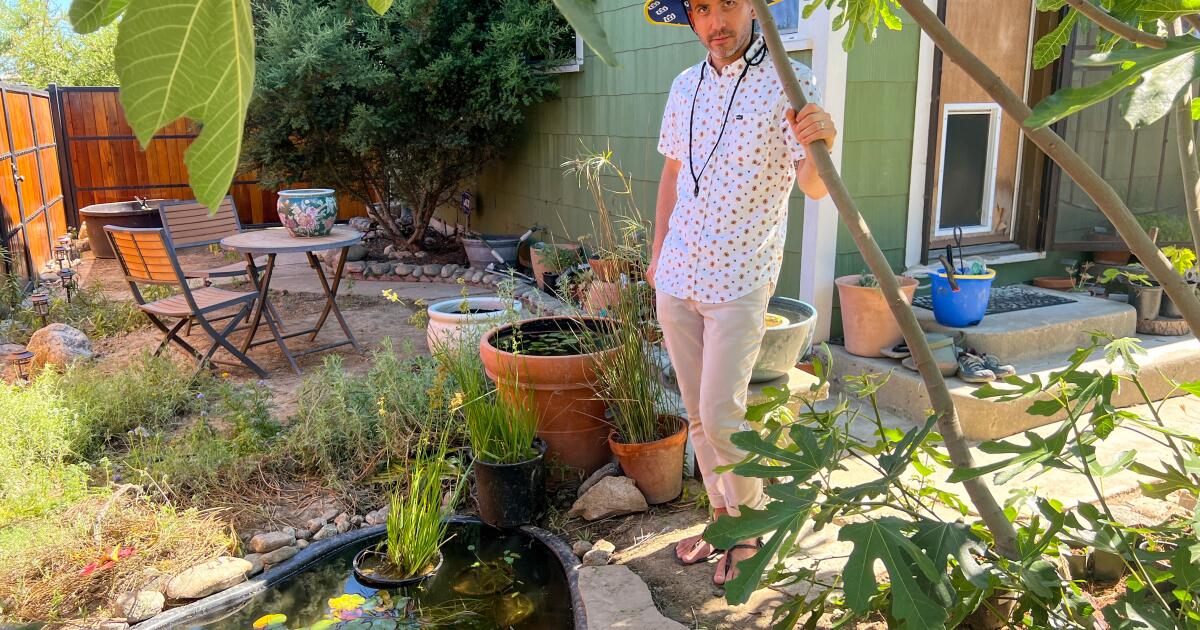
These days, habitat gardens are all the rage among eco-conscious Californians. They add native plants to their yards, patios or even balconies to provide food and shelter for wildlife.
But here’s the bitter truth: It’s not a real habitat garden if it doesn’t have a water source, as in a place where bees and butterflies can reliably sip without drowning or where birds can splash and preen.

In L.A., water rules everything around us. Drink up, cool off and dive into our stories about hydrating and recreating in the city.
I have been pining for a water feature for years, but I’ve always been too intimidated to proceed. Store-bought fountains are pricy and their setup seems daunting. And while I’ve long lusted over hand-built fountains and elaborate ponds, I’m a klutz when it comes to building things from scratch.
All I wanted was a simple recirculating fountain near my bedroom window, so I could fall asleep to the soothing sounds of gurgling water. But the fear of failure always stopped me until I talked to people who have created their own water features and learned a few crucial tips:
- You don’t need a dedicated water line or even electricity and a pump to create a simple water feature. All you need is a big, watertight pot, wider than deep, a few water plants and a handful of little fish to keep mosquitoes at bay.
- Anyone with time, muscle and access to YouTube (or the library) can build a small pond or simple water feature, but there will be some labor and unavoidable expenses, so try to have all your materials assembled before you engage — unless you like interrupting your project to dash to the store.
- Proceed boldly, but prepare yourself mentally, because something always goes wrong, said Chris Elwell, co-owner (with his husband, Kory Odell) of the fabled Casa Apocalyptica, an arresting landscape of salvaged rubble, water features and native plants around their home in Mid-Wilshire.
“Just know you’re going to make a lot of mistakes,” said Odell, a civil engineer who built an 8-by-12-foot in-ground pond for their front yard. “You’ll screw it up, and then you’re going to fix it, and that’s how you’re going to learn.”
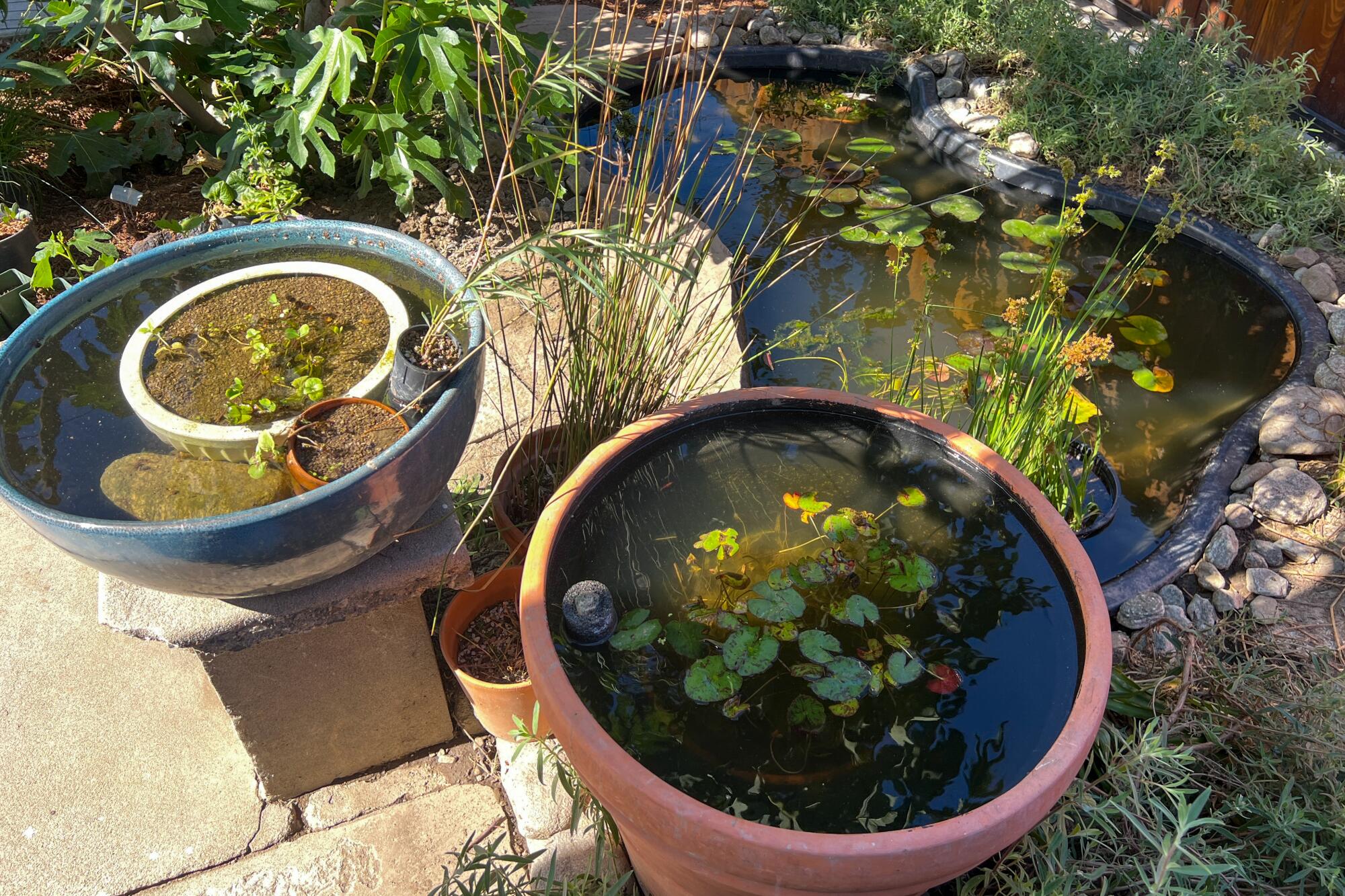
DIY water features instructor Andrew Chaves has created water gardens in recycled plant pots in his Long Beach yard.
(Jeanette Marantos / Los Angeles Times)
Stand-alones are simplest
Experimentation and patience are the most important tools for creating your own water feature, said DIY water features instructor Andrew Chaves, director of operations at Rancho Los Alamitos Historic Ranch and Gardens in Long Beach. He’s offering a class called Water Gardening in Small Spaces at the rancho on Aug. 4, and expects to teach another this fall at his former place of employment, the Theodore Payne Foundation.
Chaves doesn’t object to fountains with pumps, but he prefers the simplicity of still water features so he doesn’t have to worry about power cords or special water lines.
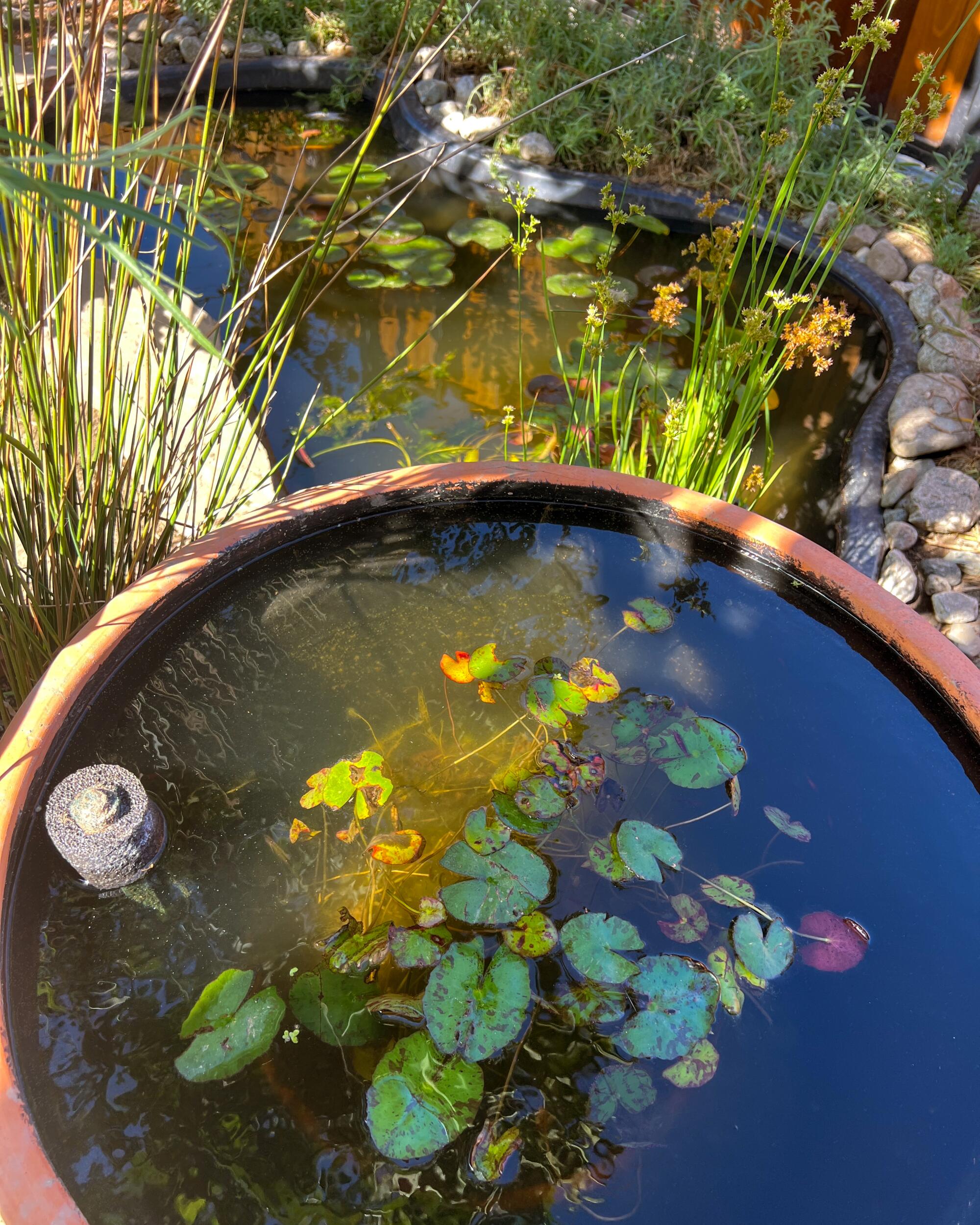
Andrew Chaves’ water garden, in a 24-inch-tall sealed clay pot, is a simple, serene way to bring water to a habitat garden.
(Jeanette Marantos / Los Angeles Times)
He creates “water gardens” in large, watertight pots with (mostly) native water plants that give insects and other tiny drinkers a safe place to perch on floating plants like duckweed (Lemna minor), mosquito fern (Azolla filiculoides) and miniature water lilies, which also shade the water and keep it cool. He keeps mosquitoes away with a dozen or so tiny fish that devour their larvae.
Chaves and his wife, Amanda, also dug out a roughly 4-foot-by-6-foot hole for a preformed plastic pond that a colleague gave them when he couldn’t use it. Fitting the pond into the ground was a difficult project, they said, because the hole had to align with the inflexible contours of the pond and sit flush against the ground. If he did it again, he said, he probably would use a heavy-duty pond liner instead, because it would be easier to press the liner into the hole and disguise the edges with rocks and plants.
Covering the edges of a pond is always a challenge, said Elwell, even if you use a pond liner, because it’s hard to make it look natural. People buy decorative rocks or materials that look pretty in the store “but end up looking hokey around the pond because you don’t see those materials anywhere else in the yard,” he said. “You’re better off using something from your yard, even if it’s ugly, because it looks like it belongs.”
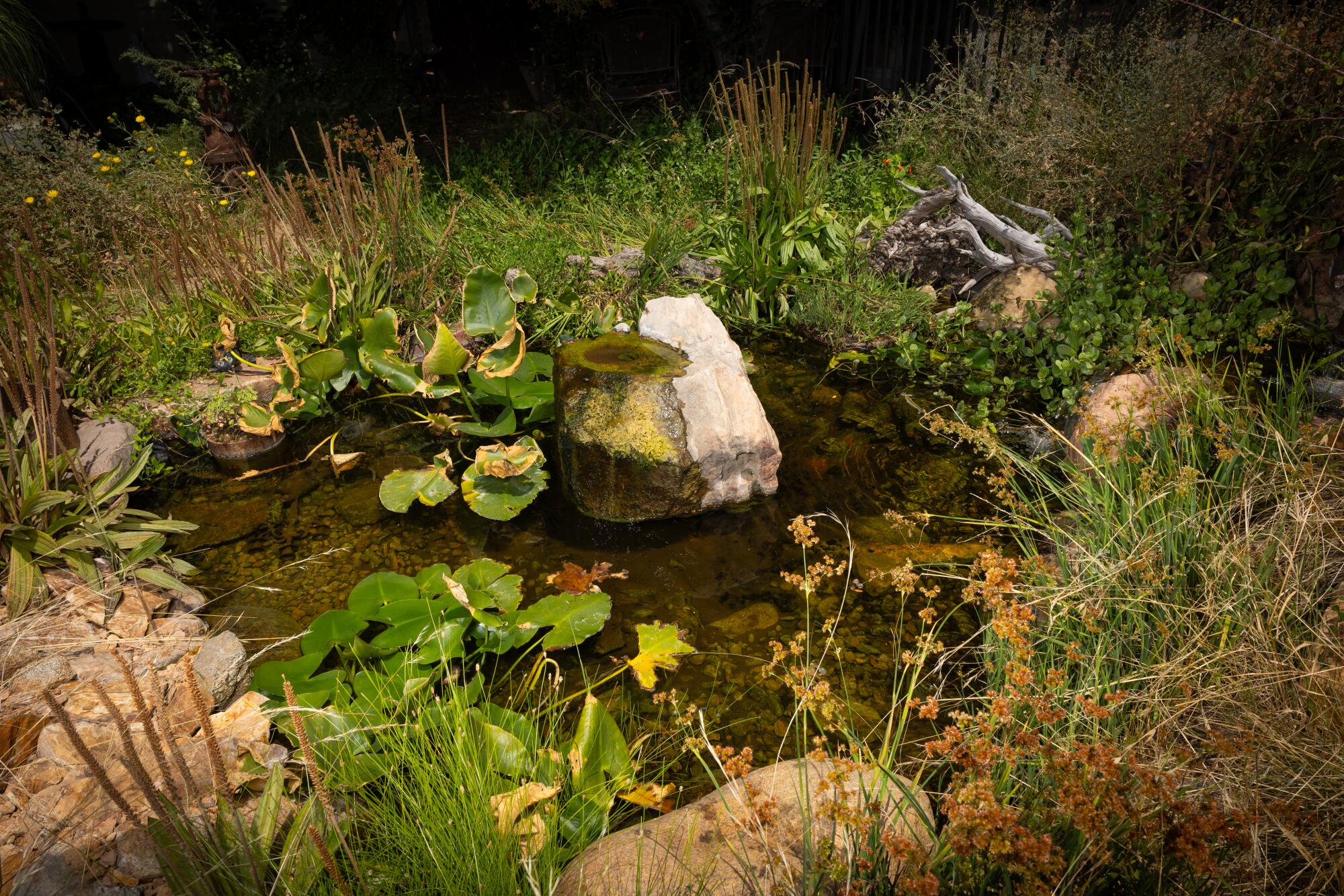
Kory Odell built this small pond with help from his husband, Chris Elwell, in their Mid-Wilshire yard to create a habitat of native plants, water features and salvaged rubble dubbed Casa Apocalyptica.
(Christina House / Los Angeles Times)
At night, their ponds are alive with frog song, and they do whatever they can to nurture their croakers. That’s why Elwell, Odell and Chaves don’t keep fish in their ponds; they don’t want hungry fish to gobble up frog eggs or tiny tadpoles.
Elwell and Odell have a recirculating waterfall in their pond that provides enough movement to deter mosquitoes. Chaves uses mosquito dunks, beige, doughnut-shaped floats that kill mosquito larvae but are nontoxic to other creatures.
In his small water gardens, however, Chaves prefers to use Japanese rice fish, which come in several colors, grow about an inch long and tend to leave beneficial insects alone, unlike mosquito fish, which eat almost anything in their path, he said. Tiny snails and shrimp known as daphnia eat algae and provide additional food for the fish.
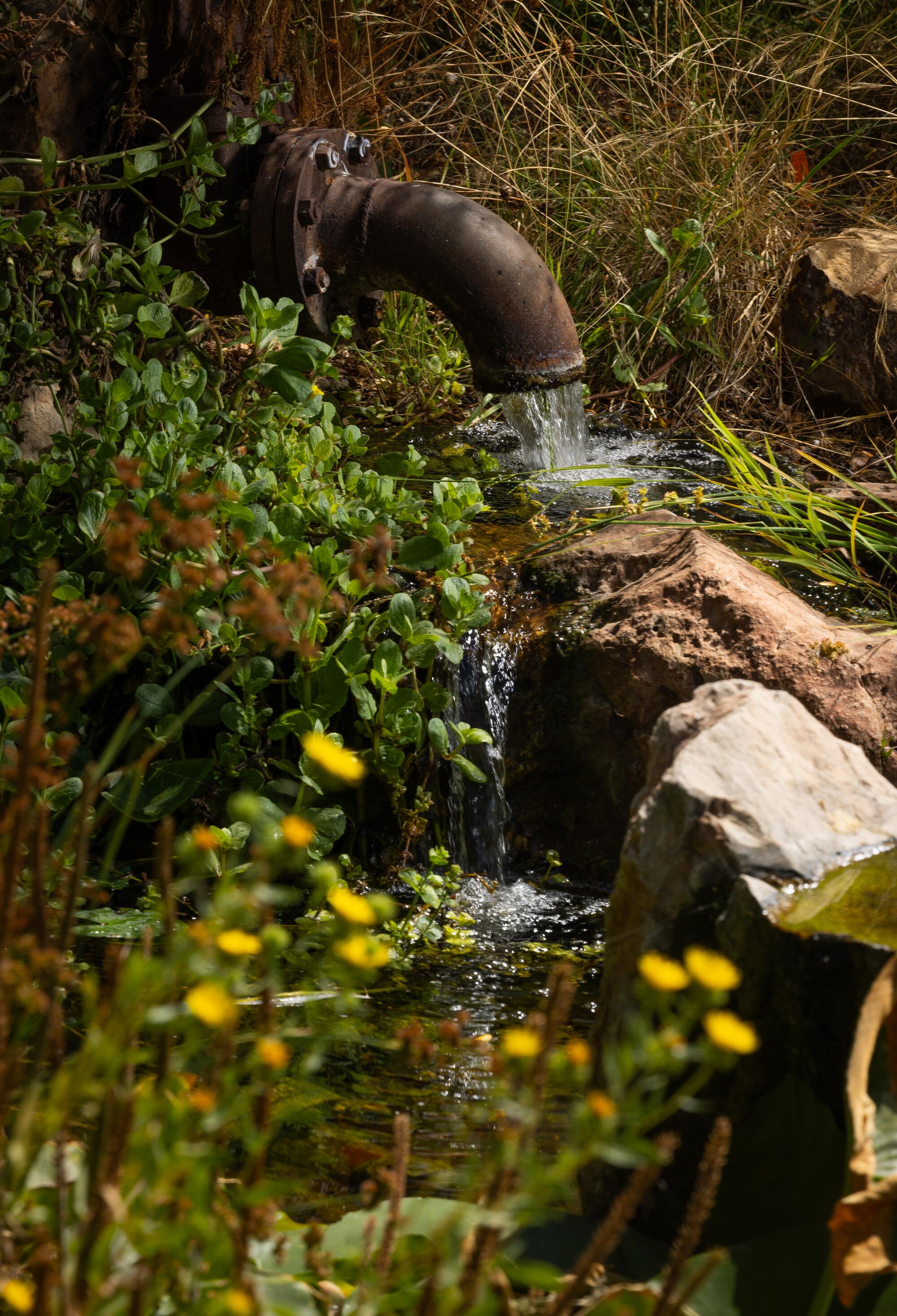
A rusty repurposed industrial-sized spigot spills recirculating water into a small waterfall and pond at Casa Apocalyptica.
(Christina House / Los Angeles Times)
He has several other tips:
- The best pots are wider than they are deep to give plants more surface space, but the best depth is 18 inches, to give the fish room to dive into cooler waters and hide. If you want to use deeper pots, you’ll need a brick or shelf at the bottom so plants that like their roots submerged, like water lilies, can still reach the surface.
- Unglazed pots like terracotta should be sealed on the inside with a rubber-based paint like Flex Seal, which the company says is safe around plants and animals once it’s fully cured (after at least 24 hours). The sealant is expensive — about $35 a quart — but Chaves has covered three large clay pots with that amount. He uses Gorilla epoxy stick putty to fill the container holes.
- Some water plants like to have their roots totally submerged, but you can’t grow them in ordinary potting soil, which will just float away. Some people use special potting soils for pond plants or pea gravel, but Chaves prefers a fragrance-free clay kitty litter, which is less expensive and heavy enough to stay in place in the water.
- Water should be dechlorinated before you add fish, by using special tablets or letting the water sit in an open bucket for at least 24 hours so the chlorine can dissipate. Chaves also recommends adding the plants and snails a week or two before adding a few fish, to build up a culture of bacteria that can consume the poop the fish will produce. Otherwise the fish could die from ammonia poisoning.
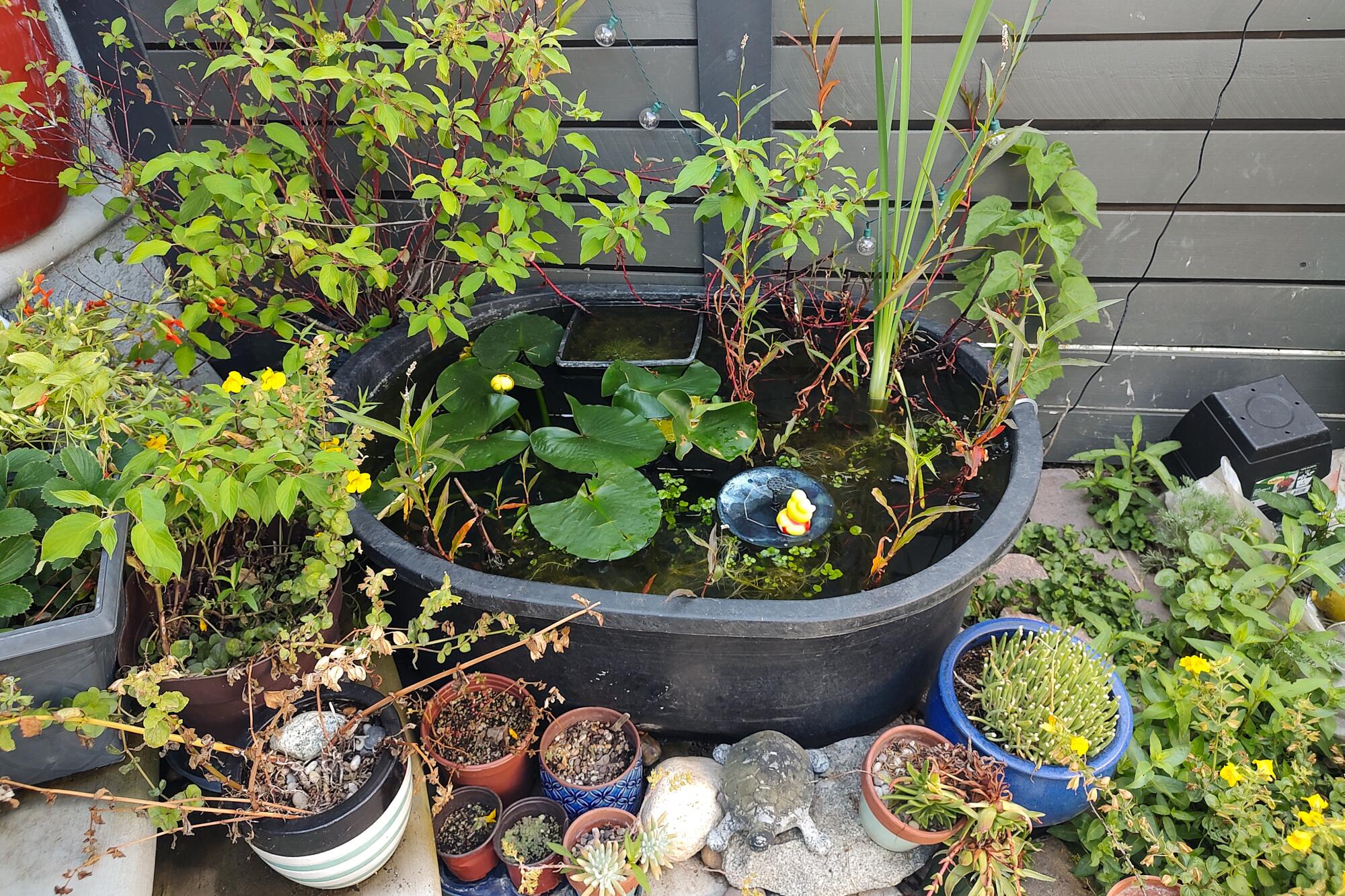
Jesse Chang’s oval tub pond stands about 18 inches above the ground in his Monterey Park yard, surrounded by tall, California-native water plants to attract pollinators.
(Jesse Chang)
Ponds can be above ground
Jesse Chang, executive director of Catalyst San Gabriel Valley, is another fan of experimentation, along with heavy research. He credits “The Tub Pond Handbook” by Ted Coletti and the “California Native Water Plants and Life” Facebook group with helping him maintain the 85-gallon aboveground “tub pond” he installed outside his Monterey Park home.
Chang bought his roughly 3-by-4-foot oval tub secondhand for under $100 (a similar tub costs $133 new on DK Hardware) at the handbook’s recommendation because he wanted to discourage raccoons. Those animals can be pretty destructive, moving around rocks and plants in search of food — both Chaves and Casa Apocalyptica have had to contend with prying paws — but it’s harder for them to mess with a pond that stands 18 inches above the ground, Chang said.
Instead of lining his pond with rocks, he’s surrounded the tub with water-loving potted plants like monkey flowers and rushes to draw in pollinators and soften the hard edges.
He’s using plain old minnows in his pond for now to deter mosquitoes because he was worried that dragonfly larvae would eat his tiny fish. Minnows are much less expensive than rice fish — “about 20 cents versus $4” — so he started with minnows in case his investment got eaten. He’s lost a few, but most are looking healthier than the ones in the store.
Taking the plunge
These water gardens were lovely and relatively simple, but I still wanted the soothing sound of burbling water.
So summoning up my courage, I followed Elwell’s advice and began scouring YouTube for easy DIY fountains. That’s how I found a cheerful tutorial by permaculture landscape designer Daryl Lindsey of Yardfarmer in Salt Lake City with a title right up my alley: “Make This EASY, FAST, DIY Water Feature for Local Wildlife!”
Astonishingly, I did, although it wasn’t as easy or fast as I had hoped. It took me most of a weekend, multiple trips for things I forgot and a hard lesson in pump mechanics, but by Sunday evening, my little turquoise fountain was ready to turn on.
Following Lindsey’s advice, I rummaged through my collection of containers and found a large ceramic pot without a drain hole to use as my reservoir — saving myself at least $50 to $100 — and purchased the following:
- A submersible recirculating pump with 6.5 feet of half-inch tubing and several connectors ($30 from Amazon).
- A tall black pot to fit upside down in my reservoir, to cover the pump and give my water feature some extra height ($20 on sale at Lowe’s).
- Three black bricks to give the internal pot even more height (about $4 at Lowe’s).
- Three glazed plant saucers to stack above the black pot and hold pretty rocks I’ve been collecting for years. Deciding what to use took most of the day. ($47 from Green Thumb Ventura).
- A half-inch titanium drill bit to drill holes in my saucers ($15 at Lowe’s).
- A tube of silicone adhesive and a couple of half-inch clamps to make sure the hose stayed attached ($8 and $5, respectively, at Lowe’s).
The total? About $130, plus a day of wandering around garden centers fretting about what saucers and pots to choose and how to stack them.
The hardest part was drilling holes in the middle of the glazed saucers. You must drill slowly to avoid cracking or chipping the ceramic plates and spray the surface frequently with water so it doesn’t get too hot.
When the holes were drilled and the fountain was assembled, it weighed a ton, even without water. (Pro tip: Do your assembling where you plan to keep the fountain, or be sure you have a dolly or Hercules to move it.)
Finally, with the reservoir filled with water, I plugged in the pump and stood over my creation with bated breath. I expected to see a gently gurgling fountain. I had purchased a submersible recirculating water pump that moves 880 gallons per hour — I reasoned that bigger was better, right?
Wrong. After a few seconds I was hit full force by an 8-foot-tall geyser, and there wasn’t any lever on the pump that reduced the force. In desperation I piled some bigger rocks on top of the spout, which forced the water into submission. I’m hoping the rocks will keep Old Faithful under control until I can purchase a pump that only moves about 100 gallons per hour.
At long last, however, I went to sleep listening to the soothing babble of running water outside my bedroom window. And I dreamed about using that 880-gallon-per-hour pump to create a little waterfall and pond in my front yard.



Under the glow of fluorescent lights at Seafood City market in North Hills, packages of pre-made adobo, salted shrimp fry and and dried anchovies glisten in meat coolers.
A DJ, dressed in a traditional barong, blasts a dance remix of Whitney Houston’s “I Wanna Dance with Somebody” as a crowd gathers to take a shot of fish sauce together.
“That was disgusting!” a man shouts into the mic, flashing a grimacing expression.

At Seafood City, DJs 1OAK, left, EVER ED-E and AYMO spin in barongs, the Philippines’ national formal shirt.
The smells of lechon and lumpia float through the air. Smiling children munch on halo-halo (a Philippine dessert made with ube ice cream, leche flan and shaved ice). Flags of the Philippines wave in the air as a man in UCLA Health scrubs hops into the center of an energetic dance circle. Employees shoot store coupons out of a money gun and toss bags of Leslie’s Clover Chips into the crowd. Fathers hold their children on their shoulders as a group of college students perform a Tinikling routine, a traditional Philippine dance in which performers step and hop over and between bamboo poles.
“This is so Filipino,” a woman says, in awe of the scene.

Sabria Joaquin, 26, of Los Angeles, left, and Kayla Covington, 19, of Rancho Cucamonga hit the dance floor at “Late Night Madness” in North Hills.
“I came here for groceries,” explains an elderly man, adding that he decided to stay for the party.
Seafood City, the largest Philippine grocery store chain in North America, typically closes at 9 p.m. But on certain Friday and Saturday nights, its produce or seafood aisle turns into a lively dance floor for “Late Night Madness.” On social media, where the gathering has exploded, it looks like a multigenerational nightclub that could use dimmer lighting. But for attendees who frequent the store, it’s more than that. It’s a space for them to celebrate their Filipino heritage through food, music and dance in a familiar setting.
“This is something that you would never expect to happen — it’s a grocery store,” says Renson Blanco, one of five DJs spinning that night. He grew up going to the store with his family. “My mom would [put] us all in the minivan and come here, and she’d let us run free,” he adds. “It’s comfortable here. It’s safe here.”
1

2

3

1. Rhianne Alimboyoguen, 23, of Los Angeles follows an employee through the produce section. 2. Allison Dove, 29, left, and Andrea Edoria, 33, both of Pasadena, enjoy Philippine street food. 3. Katie Nacino, 20, left, Daniel Adrayan, 21, and Sean Espiritu, 21, of the Filipino American Student Assn. at Cal State Northridge, practice tinikling, a traditional Philippine folk dance, in an aisle.
The first Seafood City location opened in 1989 in National City, a suburb of San Diego, which has a nearly 20% Asian population including a rich Filipino community. For its founders, the Go family, the mission was simple: to provide a market where Filipinos and people within the diaspora could comfortably speak their native language and buy familiar products. It’s since become a community anchor. Of the nearly 40 locations in Northern America, at least half of them are based in California, which has the highest population of Asian Americans in the United States.

-
Share via
The first “Late Night Madness” event happened in September in Daly City, Seafood City’s newest location. The company wanted to launch a street food program at the store’s food hall in a fun and creative way.
The DJ played a selection of hip-hop, pop, soul and classic Pinoy records like VST & Company’s “Awitin Mo, Isasayaw Ko.” Hundreds of people showed up, and videos of people of all ages turning up in the popular supermarket spread like wildfire. So the company decided to continue hosting the event in October during Filipino American History Month and for the rest of the year. It’s since expanded to more locations around the country and in L.A., including Eagle Rock.
By 10 p.m. at the Seafood City in North Hills, at least 500 people are dancing in the produce section, next to rows of saba bananas, fresh taro leaves and bok choy. The lively crowd forms dance circles throughout the night, taking turns jumping in the center to show off their moves to songs like Earth, Wind & Fire’s “Let’s Groove,” “Nokia” by Drake and Justin Bieber’s “I Just Need Somebody to Love.” At one point, TikToker and artist Adamn Killa hops on the mic and says “If you a Filipino baddie, this is for you,” before doing his viral dance.

Among the Philippine street food offerings were pandesal sliders, lumpia-style nachos, lobster balls and various skewers.
A group of employees dance behind the counter as they serve hungry patrons who fill their trays with various Filipino street food including pandesal sliders (soft Philippine bread filled with adobo, lechon or longganisa) and Lumpia Overload (think nachos, but a bed of lumpia instead of tortilla chips), lobster balls and barbecue chicken skewers. (No alcohol is served.) Meanwhile, a few lone shoppers sprinkle into the store to get their weekly groceries as music blasts through the speakers.
First-generation Filipino American Andrea Edoria of Pasadena says “Late Night Madness” reminded her of the family parties she attended as a child in L.A. and in Manila, where her parents are from.
“Growing up as a child of immigrants, I was kind of self conscious about displaying too much of my culture,” she says between bites of spiral fried potato. She went to the Eagle Rock event with her mother last month as well. “So it kind of fed my inner child to see so many people celebrating this shared culture and experience that we each grew up [with].”

A multi-generational crowd is drawn to the dance floor. At center is Jade Cavan, 44, of Chatsworth.

Members of the Filipino American Student Assn. at Cal State Northridge perform a tinikling performance.
She adds, “I think it’s so important especially now at a time where our country is so divisive and culture is kind of being weaponized, I think it’s a beautiful reminder that we can come together and find something that unites us.”
About 10 minutes before midnight, the grocery store is still bustling with activity. A dance battle breaks out and people begin hyping up the young women. The DJ transitions into slower tracks like Beyoncé’s “Love on Top” and Mariah Carey’s “All I Want for Christmas is You.” The remaining folks sing along loudly as they walk toward the exit, smiles imprinted on their faces. Staff rush to clean up, then huddle together for group photos to memorialize the evening.

After the final song is played, employees rush to clean up the supermarket.
Patrick Bernardo, 34, of Van Nuys looks at the counter, where a man had been chopping lechon, before stepping outside.
“There’s barely anything left on that pig,” he says, pointing to it as proof that the night was a success.

With the nation’s big 2-5-0 coming up next year, NPR staff and critics recommended a lot of U.S.-focused titles for Books We Love, our annual year-end reading guide. Below you’ll find 10 favorites — perfect for the history buff on your gift list, or anyone looking to learn more about how the U.S got to where it is today. Read on, or check out our full 2025 list here.

American Grammar: Race, Education, and the Building of a Nation, by Jarvis R. Givens
In this deeply researched book, Harvard University professor of education and African American studies Jarvis R. Givens locates 1819 as a “crossroads” in the history of education in the United States. That year, Congress passed the Civilization Fund Act, providing funding for assimilative boarding schools for Native American children, and the governor of Virginia signed an anti-literacy law that made it a crime to teach enslaved people to read and write in schools. Amid the Trump administration’s effort to dismantle the Department of Education, Givens’ clear-eyed assessment of American education offers an opportunity to reflect on the long-standing relationships among race, power and schooling in the U.S. — Kristen Martin, book critic and author of The Sun Won’t Come Out Tomorrow: The Dark History of American Orphanhood

The Fate of the Day: The War for America, Fort Ticonderoga to Charleston, 1777-1780, by Rick Atkinson
I’ve been eagerly waiting years for this book! This is the second volume of Rick Atkinson’s trilogy on the American Revolution. Atkinson makes good use of letters and diaries. You feel like you’re in the middle of a battle, with all the sights, sounds and tragedy. Harrowing tales of hand-to-hand fighting, scalping and desperate evacuations. Fine detail: the waxed mustaches of the Hessian forces, the number of rum barrels distributed to weary and ill-clad troops, the dull thud of cannonballs smacking into ships. The stench of makeshift hospitals, with piles of limbs stacked outside. He carefully lays out how the battles began, and the successes, mistakes and missed opportunities – on both sides. — Tom Bowman, Pentagon reporter

History Matters, by David McCullough, Dorie McCullough Lawson (contributor), and Michael Hill (contributor)
If history can be a comfort read, this is it. David McCullough’s daughter Dorie McCullough Lawson and his longtime researcher, Michael Hill, assembled this posthumous collection over two years. Some of the historian’s old manuscripts and files were kept in a New England barn, so the occasional acorn and nest turned up along with the historian’s glorious observations about Americans and their history. The essay subjects are diverse – painter Thomas Eakins, Harriet Beecher Stowe in Paris, “A Book on Every Bed” (it will melt your heart). One theme emerges that you might find reassuring in its own way: There was no “simpler time.” — Shannon Rhoades, supervising senior editor, Weekend Edition

Last Seen: The Enduring Search by Formerly Enslaved People to Find Their Lost Families, by Judith Giesberg
In 2017, historian Judith Giesberg and her team of graduate student researchers launched a website called the “Last Seen” project. It now contains over 5,000 ads placed in newspapers by formerly enslaved people hoping to find family members separated by slavery. The ads span the 1830s to the 1920s and serve as portals “into the lived experience of slavery.” In Last Seen, her book drawn from that monumental website, Giesberg closely reads 10 of those ads placed in search of lost children, mothers, wives, siblings and comrades who served in the United States Colored Troops during the Civil War. — Maureen Corrigan, book critic, Fresh Air

Medicine River: A Story of Survival and the Legacy of Indian Boarding Schools, by Mary Annette Pember
Mary Annette Pember, a citizen of the Red Cliff Band of Wisconsin Ojibwe and a national correspondent at ICT News, grew up in the 1950s and 1960s as her mother’s “secret confessor,” listening to fairy-tale-like stories of the horrors she endured at an assimilative boarding school. In Medicine River, Pember traces the repercussions of her mother’s maltreatment, situating her family’s story within the United States’ systemic use of education to eradicate Native cultures. Through an approach that is “part journalistic research, part spiritual pilgrimage,” Pember provides a cuttingly personal account of the history of federally funded Indian boarding schools and a moving look at how Indigenous traditions and rituals can light the path for healing. — Kristen Martin, book critic and author of The Sun Won’t Come Out Tomorrow: The Dark History of American Orphanhood

Mother Emanuel: Two Centuries of Race, Resistance, and Forgiveness in One Charleston Church, by Kevin Sack
There was great symbolism when a white supremacist targeted Charleston’s Mother Emanuel African Methodist Episcopal Church, killing nine Black worshippers as a means to ignite a race war. As we learn in this deeply researched history, the congregation has been involved in the struggle for racial justice ever since it was founded in an “act of bold subversion” by enslaved and free African Americans in the 1800s. I am struck by the stories of clergy and members who fought against seemingly insurmountable odds at nearly every turn of history, truly living out their faith and believing in a better America. — Debbie Elliott, correspondent, National Desk

There Is No Place for Us: Working and Homeless in America, by Brian Goldstone
In this paradigm-shifting, immersive book, journalist and anthropologist Brian Goldstone follows five families in Atlanta who, despite working full time, struggle to stay housed amid gentrification, a lack of tenants’ rights and low wages. These families, all Black, fall into a “shadow realm” – they are not considered officially homeless by the federal government, but lack a fixed living place as they double up with friends and family, sleep in their cars, or pay exorbitant rates at extended-stay hotels. Woven throughout their stories is a trenchant exploration of how America’s disinvestment in public housing and relentless pursuit of free-market growth have fueled housing insecurity for poor working families. — Kristen Martin, book critic and author of The Sun Won’t Come Out Tomorrow: The Dark History of American Orphanhood

The War of Art: A History of Artists’ Protest In America, by Lauren O’Neill-Butler
This book is about the creative – if often short-lived and not always successful – ways in which artists have fought for social change in the U.S. since the 1960s. Personal favorite: a chapter on how the scrappy video collective, Top Value Television (TVTV), changed the public’s view of political conventions. With artist-led protests once again becoming a thing – from the thousands of actors and filmmakers who recently pledged to boycott the Israeli movie industry in response to the humanitarian crisis in Gaza, to the presence of a 12-foot statue depicting President Trump and the late sex offender Jeffrey Epstein frolicking on the National Mall, this book about the past provides a powerful frame for thinking about artist-led actions today. — Chloe Veltman, correspondent, Culture Desk

We the People: A History of the U.S. Constitution, by Jill Lepore
As the U.S. approaches the 250th anniversary of its founding, it feels like an appropriate time to reflect on where we’re at as a country and how we got here. We the People, by Jill Lepore, a history and law professor at Harvard University, helps satisfy that impulse. It tells the story of the U.S. Constitution, which is among the world’s oldest constitutions. Lepore focuses on battles over amendments, which were fought not just by politicians but by ordinary Americans. The founders designed the Constitution to be amended, but it has become much more difficult to do so over the years. As the Constitution becomes harder to amend, Lepore writes, the risk of political violence becomes greater. — Milton Guevara, producer, Morning Edition and Up First

Who Is Government?: The Untold Story of Public Service, by Michael Lewis (editor)
Thousands of unsung heroes in the government are making life better for Americans. But because of bureaucracies being made up of bureaucrats, we rarely hear those stories. This book showcases them. Like a coal-mining safety official who helped the U.S. reach zero mine-collapse deaths. Or the man who has led the National Cemetery Administration to the top of the American Customer Satisfaction Index. As the federal government is in its biggest shake-up in a generation, it’s worth learning about where the bright spots are. — Darian Woods, host, The Indicator from Planet Money
This is just a fraction of the 380+ titles we included in Books We Love this year. Click here to check out this year’s titles, or browse nearly 4,000 books from the last 13 years.


6 die in South Arkansas car wrecks –

Missing California 9-year-old Melodee Buzzard found dead, grandmother says

Where did Colorado’s wolves spend time in December?

Owls, Storytimes, Lights, And Countdown Fun: Here’s What’s Happening Across Connecticut This Weekend

Delaware state police trooper killed in active shooter incident at DMV facility; suspect also dead

Florida High School Football Rankings: Top 25 teams – Oct. 21

Cleary's 21 help Le Moyne down Central Connecticut State 69-64 in OT

How old is Bo Nix? What to know about Oregon quarterback ahead of 2024 NFL Draft

99th annual Pony Swim held in Virginia

Video: ‘It Didn’t Have to Happen This Way:’ U.Va. Faculty Call for Review of Police Response to Protests
404 | Fox News

Trump says Greenland ‘essential’ for security: Could he take it by force?

BBC Verify: Satellite image shows tanker seized by US near Venezuela is now off Texas

20% of NYC mayor-elect Mamdani transition appointees have anti-Zionist ties: ADL

Exclusive: Former MEP Kaili doubles down on ‘Belgiangate’
-

 Iowa1 week ago
Addy Brown motivated to step up in Audi Crooks’ absence vs. UNI
-

 Maine1 week ago
Elementary-aged student killed in school bus crash in southern Maine
-

 Maryland1 week ago
Frigid temperatures to start the week in Maryland
-

 New Mexico7 days ago
Family clarifies why they believe missing New Mexico man is dead
-

 South Dakota1 week ago
Nature: Snow in South Dakota
-

 Detroit, MI1 week ago
‘Love being a pedo’: Metro Detroit doctor, attorney, therapist accused in web of child porn chats
-

 Health1 week ago
‘Aggressive’ new flu variant sweeps globe as doctors warn of severe symptoms
-

 Maine7 days ago
Family in Maine host food pantry for deer | Hand Off