Lifestyle
Hollywood’s quirky leading lady, Diane Keaton, dies aged 79

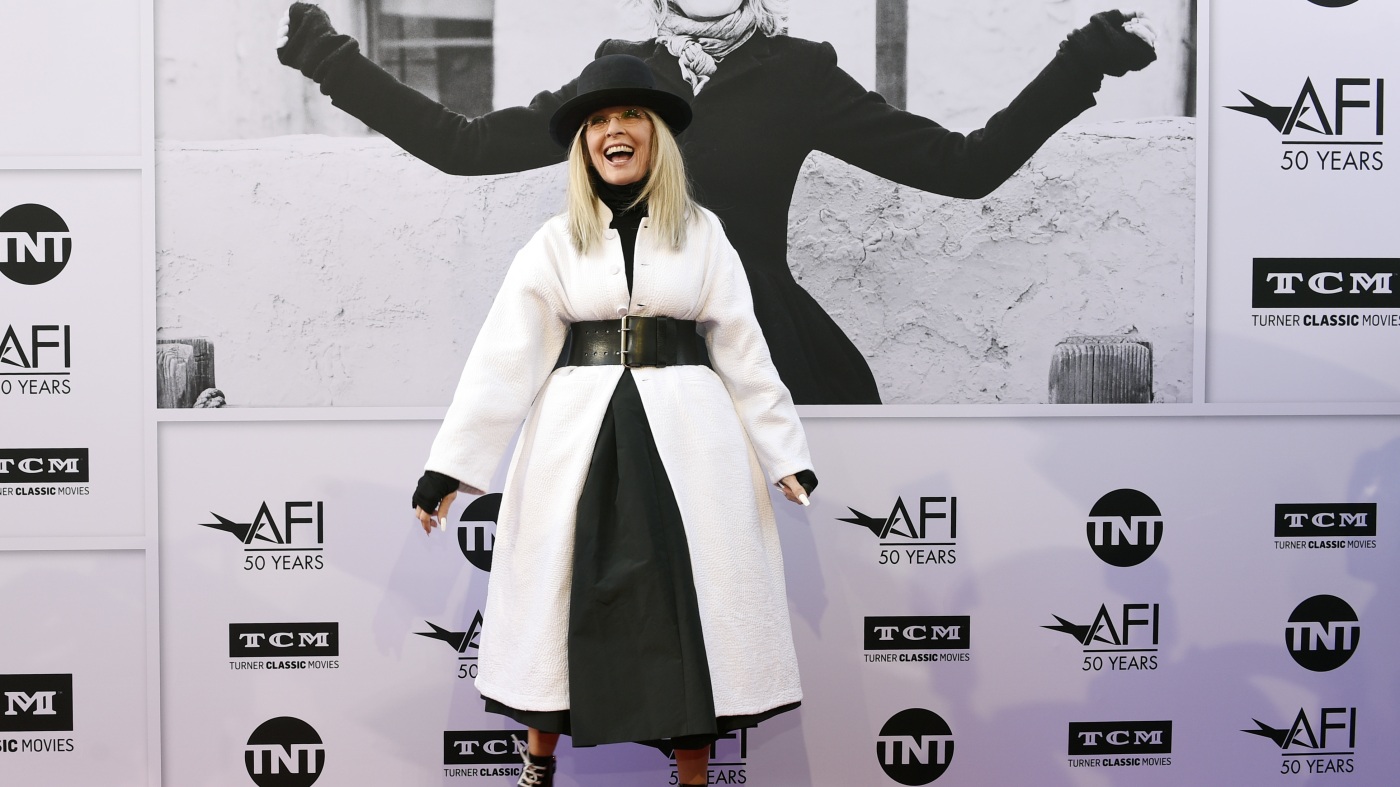
Actress Diane Keaton poses at the 45th AFI Life Achievement Award Tribute to Keaton at the Dolby Theatre on Thursday, June 8, 2017, in Los Angeles.
Chris Pizzello/Invision/AP
hide caption
toggle caption
Chris Pizzello/Invision/AP
Diane Keaton, who remained one of Hollywood’s quirkiest and most beloved actors decades after her Academy Award-winning performance in the movie Annie Hall, has died aged 79.
Her film producer confirmed her death to NPR Saturday.
When I met Keaton for an interview in 2014, she was sporting her trademark look: a bowler hat, tinted glasses and oversized clothes.

“Clothing that actually hides the body,” she half-joked. “There’s a lot to hide in my case, so I’m the only remaining person on Earth with this particular look.”
Keaton was really something of a fashionista, inspiring generations of women with her unconventional lifestyle. Onscreen, she was known for playing endearing, unique and sometimes eccentric characters.
In one of her memoirs, Keaton wrote about aging and love in Hollywood and becoming a parent late in life. She was also upfront about some of her insecurities; she fretted about aging, her hair thinning, her eyes drooping. But Keaton told me that later in life, she had finally come to accept that all flaws are beautiful.
“I feel that wrong can be right. It can be right in a lot of ways,” she said. “So all those things that you’re disappointed with in yourself can work for you.”

FILE – Oscar winners Charles H. Joffe, winner of best picture for “Annie Hall,” left, and Diane Keaton, winner of best actress for “Annie Hall,” poses with presenter Jack Nicholson, and producer Jack Rollins at the Academy Awards in Los Angeles on April 3, 1978.
Uncredited/AP
hide caption
toggle caption
Uncredited/AP
She was born Diane Hall in Los Angeles in 1946, the daughter of real estate broker and civil engineer Jack Hall. Her mother Dorothy was once crowned Mrs. Los Angeles.
Keaton said her mom cheered her on as she pursued her dreams of becoming a singer and performer in New York. After studying at the Neighborhood Playhouse in the 1960’s, Keaton ended up an understudy in the original Broadway production of the rock musical Hair.
“It was wild. It was unexpected,” she said. “But I could see that I really wasn’t a hippie. I knew that I wasn’t a hippie in Hair.”
Keaton famously refused to go onstage nude for the final scene of Hair.
Then, along came Woody Allen, with whom she had a romantic relationship. Allen cast her in Play It Again, Sam, his play, then his movie. Also his film comedies Sleeper, Love and Death, Manhattan, and, of course, Annie Hall.
Keaton’s kooky, quirky role as Annie Hall and her “lah-de-dah” charm won her a best actress Oscar in 1978. She thanked Woody Allen in her acceptance speech and later, for her entire career. She stood by him throughout the controversy over allegations that Allen once molested his daughter, which the director denies.
“That’s never going to change,” Keaton said of her support for Allen. “He’s my very, very good friend.”
In Annie Hall, Keaton showed off her comedy and singing chops. But she also had dramatic film roles, most famously in The Godfather trilogy. Her character marries into the Corleone mafia family.
Her Godfather costar, Al Pacino, was one of her boyfriends in real life. Another of her real life loves, Warren Beatty, directed her in his 1981 film Reds.

FILE – Filmmaker Woody Allen, left, greets actress Diane Keaton onstage to present her with the 45th AFI Life Achievement Award on June 8, 2017, in Los Angeles.
Chris Pizzello/Invision/AP
hide caption
toggle caption
Chris Pizzello/Invision/AP
In the historical drama about journalist John Reed, Keaton played his love interest, activist Louise Bryant.
“I loved her position in life,” Keaton said of her character, which she said played second fiddle to Reed (played by Beatty.) “And she wanted to be great. She wanted greatness in her. And fighting for herself, and failing and failing. I loved her for that. I loved her for her flaws. She was a difficult person who wasn’t very likable, yet I loved her.”
Jack Nicholson was also in Reds. He teamed up with Keaton again in 2003 for the comedy Something’s Gotta Give. In that movie, Keaton also played opposite Keanu Reeves.
Diane Keaton never married, though in films, she was one of the very few older American actresses who still got leading romantic roles. That was something actress Carol Kane, Keaton’s long-term friend, raved about at the time.
“She’s playing the love interest a lot,” Kane said. “You know, kind of passionately kissing and swooping into the bedroom…at an age when most people just sort of say, ‘OK, well, that part is over.’ I mean, she just gets more and more beautiful because she’s more and more herself.”

Diane Keaton attends the premiere of “Book Club: The Next Chapter” at AMC Lincoln Square on Monday, May 8, 2023, in New York.
Evan Agostini/Invision/AP
hide caption
toggle caption
Evan Agostini/Invision/AP
For years, Keaton acted in such films as Looking For Mr. Goodbar, The First Wives Club and Baby Boom. She directed the documentary Heaven in 1987. She also wrote books about her life, about architecture, photography and beauty; she collected photos of beautiful men, she renovated beautiful houses, and as a single mother, raised two beautiful children. When she turned 50, she adopted her daughter, Dexter and five years later, her son Duke.
“It’s an unconventional life, it’s true,” she told me. “But I don’t really see it that way, because I just think everybody has a pretty– is there a life that doesn’t have a story that isn’t pretty astonishing? I’ve never come across anybody who hasn’t. I just worked my way into the life that I have because I had a goal and it was very simple: I wanted to be in the movies.”
Keaton told me she was a late bloomer. But her fans might say death came to her far too soon.




On-air challenge
I’m going to give give you clues for two words. Switch the first and last letters of the answer to the first clue to get the answer to the second. (Ex. Nutmeg or ginger / Long, heroic poems –> SPICE & EPICS)
1. Make a grand speech / Muse of love poetry
2. What a skull and crossbones signifies / Wandered around
3. Words to a song / Saint for whom the Russian alphabet is named
4. Yell / Amounts equal to ten $100 bills
5. Assignments for delivery drivers / Former Supreme Court Justice David ______
6. Small bag with a shoulder strap / Some gate fasteners
Last week’s challenge
Last week’s challenge came from Al Gori, of Cozy Lake, N.J. Name a place where games are played. Move the last two letters to the beginning. Change the new last letter to an “H.” The result, sadly, is what you might have when you leave this place.
Challenge answer
Casino, no cash
Winner
Mike Rombach of Pleasanton, California.
This week’s challenge
This week’s challenge comes from Mike Reiss, who’s a showrunner, writer, and producer for “The Simpsons.” Think of a famous living singer. The last two letters of his first name and the first two letters of his last name spell a bird. Change the first letter of the singer’s first name. Then the first three letters of that first name and the last five letters of his last name together spell another bird. What singer is this?
If you know the answer to the challenge, submit it below by Thursday, December 11 at 3 p.m. ET. Listeners whose answers are selected win a chance to play the on-air puzzle.
Lifestyle
Barbra Streisand Reveals Her Deep Regret Over Selling Priceless Gustav Klimt Painting | Celebrity Insider

Instagram/@barbrastreisand
Barbra Streisand has now come out of the closet with a very deep and tiring to tell remorse from her past—the once sold, now cherished, Gustav Klimt painting. The public has been granted access to the performer’s extensive emotions, and thoughts connected to the loss of this painting, which she bought in 1969 for $17,000 but sadly sold a few decades later. The star’s candid and honest confession has not only invited sympathy but, to a certain degree, has also made listeners share similar situations.
Advertisement
Streisand pointed out that her long time assistant was the one that prompted her to gather a collection of artworks that she had previously loved but eventually sold. One of the included works was Klimt’s “Miss Ria Munk on her Deathbed,” a painting that she acquired in her early days. Even though the $17,000 price for the painting was not her saying it was easy to part with, she still sold her Klimt in 1998 as she started to change her artistic likes to Frank Lloyd Wright and the Arts & Crafts movement. She rarely lets anyone know, she just says, “Oh how I regret selling her.” The title of the book her assistant assembled is not much different from her regret – ”You should never sell art you love.”
Very soon after, the post received immediate and emotional response. Most of them were sympathetic, one person commented, ”Perfect title, your assistant is telling the truth!” Another one pointed out that art has through the years always been characterized by the quality of being a story and therefore could be re-told in music.”
Streisand’s financial revelations have prompted plenty of comments and now they are especially relevant since Klimt’s masterpieces have become even more expensive and sought after. One person said, ”Today $17,000 looks like a large sum of money to almost everyone.” Someone else said even more strongly, ”Hey, if a Klimt painting comes my way, I will never be letting it go. In those days $17,000 was already a steal.”
A very smart statement gave an additional perspective about the time being right for Streisand to think back. The person referred to the auction news, saying, “A Gustav Klimt painting has been sold for a record $236.4m, making it the second most expensive artwork ever sold at auctions.” This mind-boggling sum allows one to see, in a way, the almost tragic story of Streisand’s buying and selling of her painting.
The story of the painting proved to be a true global one. A user, writing in her German language, expressed the same feeling of sadness as was, “Yes, it is indeed a big pity you have sold this picture. It is a wonderful testimony and… I am from Austria and I can tell you.” This response validates the idea of the painting being an important cultural artifact that is worth much more than just a monetary value.
Nevertheless, in calling the sympathies, some comments were slightly teasing the situation. One user said, “I don’t want to make your pain worse, but YOU SOLD THAT!!” Another replied, ”You should never sell Klimts they would be worth millions today.” Such humorous replies illustrate, to a degree, the almost incredulous financial hindsight surrounding the decision.
Moreover, Streisand’s post made people wonder about her collection of art in general. One of her fans even asked, “Barbra do you like paintings of Frida Kahlo?” while another one, was talking about her favorite artist saying, “The other one is Egon Schiele?” This has truly shown how the star’s personal taste still continues to fascinate and provoke curiosity among people. Her reflections on legacy extend beyond art, as seen in her mourning the loss of her White House rose garden legacy.
Advertisement
Ultimately, Barbra Streisand’s open and honest post is not just a case of a missed financial opportunity but also. It is, rather, a collective saga of the emotional burden of the things we throw away. The price at which her loss is counted is very high since it is a strong reminder that some of the things we love most are worth a lot more than the price tag on them. Her initiated communication suggests that the relationship between an artist and a collector can be very profound and lasting, even when the work is no longer physically present. She has also honored Nancy Pelosi for their shared fight for women’s health.

Rosemead stars Lucy Liu and Lawrence Shou as mother and son. The movie is out in New York now and in Los Angeles on Dec. 12.
Lyle Vincent
hide caption
toggle caption
Lyle Vincent
Based on a 2017 Los Angeles Times article by Frank Shyong, the new movie Rosemead dramatizes a true and tragic story of a single Taiwanese American mother named Irene (Lucy Liu) who has cancer, and her teenage son, Joe (Lawrence Shou). A star student and swimmer, Joe begins to have increasing symptoms of his diagnosed schizophrenia, which intensify after the passing of his father (Orion Lee). As Joe’s hallucinations, delusions and outbursts become more frequent and intense, Irene struggles to support her son while dealing with her own terminal illness. If the premise of director Eric Lin’s feature debuts sounds bleak, that’s because it is.

Whether in the form of teachers, social services, or cultural shame, Rosemead highlights how external actors repeatedly fail Joe — driven not by compassion, but by their own internalized fears, exposing the lengths to which institutions will go to protect themselves from those they deem dangerous. After a school shooting drill triggers Joe in an early scene, prompting hallucinations, an administrator suggests that he transfer schools. “We all have his best interests at heart here,” he says with a false authenticity to an already-strained Irene.
The story of Rosemead is about a teenager with mental illness just as much as it is the Asian-American community, in a rare thematic combination that showcases the challenges facing both. Irene projects a composed public front and keeps her sorrow private, reflecting a culture in which shame often wears the mask of secrecy. At a party, other Asian-American families quietly gossip behind Irene’s back, raising questions about Joe seeing a psychiatrist. Instead of standing up for Joe, Irene insists that he’s attending the Family Center out of an interest in psychology, not because he needs therapy.
Meanwhile, when Joe is at school, Irene confesses to a friend who runs an herbal medicine shop that she’s avoided telling her son about her cancer diagnosis because she doesn’t want him to worry. She waves away her friend’s urging to be honest with him, saying she’s already doing all she can. Part of what makes Liu’s performance as an immigrant mother feel true is that the film doesn’t try to appease Western audiences with English-language dialogue. “I’ll make you another tincture,” her friend says in Chinese, as Liu dutifully sips a medicinal remedy from a cup — one of many nods to the divergence between cultures in the East and West. Another: their views on talk therapy, as Irene refuses to accompany Joe in his sessions, despite suggestions from his psychiatrist, Dr. Hsu (James Chen), to do so as a way to show support. Irene stubbornly claims that Joe is getting better on his own.

Dr. Hsu plays an integral role in the film, as perhaps the only character who truly sees Joe without judgment, and in turn, tries his best to tear through the family’s walls. In a pivotal scene, Irene discloses to Dr. Hsu that Joe’s internet search history is riddled with queries on school shootings and is worried that he might hurt someone. “Most people with schizophrenia don’t engage in violence,” Dr. Hsu says. “In fact it’s quite rare. We have no reason to believe that Joe is any different.”
Shyong’s original Los Angeles Times article notes that although mental illnesses such as schizophrenia are not significant contributors to violence in America, media reports tying mental illness and violence have increased in recent years. Rosemead‘s strength lies in its ability to dispel such narratives, however, the film’s portrayal of someone diagnosed with schizophrenia is less nuanced than the portrait it paints of Irene. Liu’s understated performance empathetically captures the resilience and sense of duty often associated with Asian mothers, while steering clear of tired on-screen tropes of strict parenting in Eastern cultures. However, the story would be far stronger with a more deliberate effort to challenge one-dimensional portrayals of mental illness. The film uses a range of camera angles and shaky movements to place the viewer in Joe’s mind, putting Lin’s background as a cinematographer on display. When Joe bolts from the classroom in the midst of the drill, the camera clings close, moving with him as if sharing the pulse of his panic. But viewers get little insight into Joe’s internal thoughts and struggles.
If you’re looking for a happy ending or an inspirational arc, Rosemead might not be for you. What Rosemead offers instead, is something real — a critique on a society that doesn’t know what to do with those that are outside the bounds of what is considered normative, and the compounded effects of shame and silence. What may seem to be one family’s tragedy is often a collective failure, born and bred by the same agents that pretend to offer a lifeline, only to yank it away as soon as you try to take hold.


Movie review: Jay Kelly – Baltimore Magazine

Chiefs’ offensive line woes deepen as Wanya Morris exits with knee injury against Texans
Sunday Puzzle: Swapped first and last letters

Netflix CEO made a visit to the White House before buying Warner Bros.

Chechen leader threatens Zelenskyy amid drone strike, echoes alleged assassination plot

Florida High School Football Rankings: Top 25 teams – Oct. 21

Cleary's 21 help Le Moyne down Central Connecticut State 69-64 in OT

How old is Bo Nix? What to know about Oregon quarterback ahead of 2024 NFL Draft

99th annual Pony Swim held in Virginia

Video: ‘It Didn’t Have to Happen This Way:’ U.Va. Faculty Call for Review of Police Response to Protests

NYC mayor-elect tells residents how to resist ICE agents knocking at their door in new video

Hamas and Israel move towards phase two of US-backed Gaza plan

Ilhan Omar says Trump’s anti-Somali tirade ‘completely disgusting’

Congress faces holiday crunch as health care fix collides with shrinking calendar

European Greens declare Usula von der Leyen`’s EPP enemy number one
-

 Alaska1 day ago
Howling Mat-Su winds leave thousands without power
-

 Politics5 days ago
Trump rips Somali community as federal agents reportedly eye Minnesota enforcement sweep
-

 Ohio3 days ago
Who do the Ohio State Buckeyes hire as the next offensive coordinator?
-

 News5 days ago
Trump threatens strikes on any country he claims makes drugs for US
-

 World5 days ago
Honduras election council member accuses colleague of ‘intimidation’
-

 Texas1 day ago
Texas Tech football vs BYU live updates, start time, TV channel for Big 12 title
-

 Politics6 days ago
Trump highlights comments by ‘Obama sycophant’ Eric Holder, continues pressing Senate GOP to nix filibuster
-

 Politics7 days ago
War Sec Pete Hegseth shares meme of children’s book character firing on narco terrorist drug boat