Lifestyle
Happy Arbor Day! These 20 books will change the way you think about trees


The trees in this photo are amazing (and not just because they happen to be growing in a very Instagrammable heart shape around Baker Lake in Quebec, Canada.) Read on for a tree appreciation reading list for Arbor Day.
Sebastien St-Jean/AFP via Getty Images
hide caption
toggle caption
Sebastien St-Jean/AFP via Getty Images

The trees in this photo are amazing (and not just because they happen to be growing in a very Instagrammable heart shape around Baker Lake in Quebec, Canada.) Read on for a tree appreciation reading list for Arbor Day.
Sebastien St-Jean/AFP via Getty Images
Trees communicate. They migrate. They protect. They heal. This year for Arbor Day this year we climbed into the NPR archives to find our favorite arboreal fiction, nonfiction and kids’ books.
Scroll down to find excerpts from interviews and reviews, plus recommendations from Books We Love — NPR’s annual, year-end books guide.
Nonfiction

Twelve Trees: The Deep Roots of Our Future by Daniel Lewis, 2024
There are tens of thousands of tree species on Earth, but writer Daniel Lewis focused in on just a dozen in his book, Twelve Trees. Lewis spoke with Ari Shapiro on All Things Considered in March: “The natural world needs our attentions, plural …” he said. “I want people to understand that the salvation of trees can be our salvation.”
Lewis believes trees and people have more in common than you might think. “These 12 trees each say something about ourselves because trees are not just about trees. … We live among them, and they live among us, so I think we have an obligation to understand them better.”
Better Living Through Birding: Notes from a Black Man in the Natural World by Christian Cooper, 2023
Christian Cooper was birdwatching in Central Park in 2020 when a white woman falsely accused him of threatening her. His book Better Living Through Birding chronicles life as a Black birder, gay activist and Marvel comics writer and editor. In 2023 he told Terry Gross on Fresh Air: “Birds belong to no one. They are for everyone to enjoy. And it is an incredibly healing thing to be out there in whatever habitat the birds are in, to connect with the wild and to just see these feathered wonders going about their business of life.”
The Treeline: The Last Forest and the Future of Life on Earth by Ben Rawlence, 2022
Trees are on the move — in ways they shouldn’t need to be. Structured as a study of half a dozen trees from the boreal forest – the wide band of trees near the Arctic Circle – The Treeline traces the canopy around the world, noting where trees have vanished or are creeping ever northward. But this isn’t just a landscape diary; whether in Canada, Greenland, or Norway, author Ben Rawlence emphasizes portraits of people, especially Indigenous communities facing the front lines of climate change, and scientists chronicling the imminent, dramatic changes ahead of us. A sounding alarm, and a call to action.
— Genevieve Valentine, author and book critic
Finding the Mother Tree: Discovering the Wisdom of the Forest by Suzanne Simard, 2021
Trees are “social creatures” that communicate with each other in cooperative ways ecologist Suzanne Simard told Dave Davies on Fresh Air in 2021. Her memoir Finding the Mother Tree describes her research on cooperation and symbiosis in the forest, and shares how her study of trees took on a new resonance when she was diagnosed with breast cancer. Simard explained that trees in a forest are often linked to each other via an older tree she calls a “mother” or “hub” tree. “The seedlings will link into the network of the old trees and benefit from that huge uptake resource capacity,” Simard said. “And the old trees would also pass a little bit of carbon and nutrients and water to the little seedlings, at crucial times in their lives, that actually help them survive.”
The Journeys of Trees: A Story About Forests, People, and the Future by Zach St. George, 2020
Forests migrate: They are on the move away from danger and always have been. Now, these are not the dour-faced Ents of J.R.R. Tolkien’s Lord of the Rings, who are downright speedy compared to the agonizingly slow march of Earth’s trees and forests. But the journeys of trees, and the forces that drive that titular phrase, are an engrossing tale of nature’s survival, the increasing speed of climate change and of the people working to preserve these most ancient creatures. Author and reporter Zach St. George presents a thoroughly researched story about what we can learn from some of Earth’s oldest residents if we just stop and listen.
— Steve Mullis, former editor/producer, Morning Edition
Hanging Tree Guitars by Freeman Vines with Zoe van Buren, photography by Timothy Duffy, 2020
Part memoir, part photo essay, Hanging Tree Guitars is the story of North Carolina luthier Freeman Vines. He crafts guitars from found materials and hunks of old wood, including some from a tree once used for a lynching. Vines, 78, explains how the wood talks to him, and he reflects on growing up in a sharecropper’s family under Jim Crow. “I had learned that the white man was what controlled the code,” he says. Timothy Duffy’s tintype images of Vines and his guitars are stunning, including one where Vines is sitting in a field with his guitars strung on a frame overhead.
— Debbie Elliott, correspondent, National Desk
Forest Bathing: How Trees Can Help You Find Health and Happiness by Qing Li, 2018
In 2018, Marcelo Gleiser wrote an essay for NPR about the practice of forest bathing. Gleiser wrote: “In Japan, the country that has the highest population density in the world but also vast expanses of green forests (about 3,000 miles of them), an ancient tradition tries to balance out the crush from urban living. It’s known as shinrin-yoku, or ‘forest bathing.’ It’s the practice of spending prolonged periods of time with trees in order to gain from their many health benefits. … Dr. Qing Li, the world’s foremost expert in forest medicine, introduces readers to the healing practice of forest bathing — and the art and science of how trees can enrich your life. … Dr. Li’s book is itself a tribute to forests and the magnificence of trees, featuring more than 100 color photographs of forests around the world.”
Urban Forests: A Natural History of Trees and People in the American Cityscape by Jill Jonnes, 2016
Next time you’re outside, look up. Trees are so ubiquitous that it’s easy to take them for granted. But Urban Forests makes you stop and pay attention to the “living landmarks” standing tall in America’s cities. From Thomas Jefferson’s time to present day, Jill Jonnes explores the essential roles trees play in urban centers — filtering air, providing habitat, offering shade, calming nerves and more. I loved this book because it’s both for history lovers and for tree devotees. It’s a good read — best done under the canopy of your favorite tree.
— Jeanine Herbst, news anchor
The Hidden Life of Trees: What They Feel, How They Communicate―Discoveries from A Secret World by Peter Wohlleben, translated by Jane Billinghurst, 2016
In 2016, Alva Noë wrote an essay for NPR about Peter Wohlleben’s book The Hidden Life of Trees. Noë said: “The book is dreamy and strange; it tells about trees and their tightknit communities in the forest. The book is full of science. But it’s written from the standpoint of a person who lives and works with trees in the forest rather than someone who studies them. … The Wood Wide Web he describes is a community of trees and microbes, aphids, fungi and birds, one in which dense connectivity and mutual interdependence are the norm (and are missing in the forest-farms of the modern world). Communication, shared and competing interests, learning and adaptation, all play a critical role.”
Fiction
The Tree Doctor by Marie Mutsuki Mockett, 2024
A woman returns to her California hometown to help her ailing mother move into a care facility. Dismayed by the condition of her mother’s garden, she calls a nursery for help and meets Dean — the tree doctor. As book critic Michael Schaub wrote: “Her attempt to save the fuchsias leads her to a whirlwind relationship that confirms to her what she already, in the back of her mind, knows: Her life as a wife and mother has caused her to neglect herself, and she needs to save herself even more urgently than she needs to rescue her mother’s flowers. The Tree Doctor is an excellent novel, one that beautifully chronicles one woman’s response to a series of life-changing crises.”
The Island of Missing Trees by Elif Shafak, 2021
The characters in this book are immigrants from Cyprus, the Mediterranean island where Greece and Turkey went to war in the 1970s. But the narrator? It’s a fig tree. Novelist Elif Shafak spoke with Morning Edition‘s Steve Inskeep in 2021 about her decision tell the story from a tree’s perspective. “I wanted an observer that lives longer than human beings,” Shafak said. “Trees have this longevity. They were here before us, and they will most probably be here long after we humans have disappeared. … What does it mean to be rooted, uprooted and rerooted?”
The Overstory: A Novel by Richard Powers, 2018
The Overstory begins with the nine characters whose lives will intersect as the novel unfolds. Each has some kind of connection with a tree. These stories, so beautifully told and intricately crafted, perfectly set the stage for this saga about a small band of radical environmentalists who are determined to save an old-growth forest in the Pacific Northwest. They pay a heavy price for their determination. As Richard Powers pulls you into their lives and fills you with astonishing facts about trees, he deftly pits that price against the cost of allowing these magnificent forests to be destroyed.
— Lynn Neary, former correspondent, Culture Desk
The Lie Tree by Frances Hardinge, 2016
Frances Hardinge’s Gothic fantasy The Lie Tree starts in the middle of a dreary downpour and feels like it ought only to be read during one as well. It’s the story of Faith Sunderly, her naturalist father’s mysterious murder and the magical tree that grows truth-revealing fruits only when Faith whispers lies to it. This book feels destined to be read in the middle of a dark and stormy night, preferably under the covers and with a secret flashlight. However, Hardinge’s writing is so beautiful and her atmosphere so evocative that it could probably leave you shivering even if you read it on a sunny tropical beach.
— Margaret Willison, librarian and book critic
Kids’ Books
Listen to the Language of the Trees: A Story of How Forests Communicate Underground by Tera Kelley, illustrated by Marie Hermansson, 2022
If you know about the “Wood Wide Web,” then you know that trees communicate through the fungi that connect their roots. Still, did you know about how they support one another with extra food? How they can tell their offspring apart from other trees? How they can warn other trees when insects attack? Consider this the preeminent book for kids on the topic, complemented with illustrations both beautiful and clear-cut, making a tangle of a topic as easy as (forgive me) falling off a log! (For ages 4 to 8)
— Betsy Bird, book critic and author of Long Road to the Circus
Little, Brown Books for Young Readers
Berry Song by Michaela Goade, 2022
Radiant illustrations by Caldecott-winning illustrator Michaela Goade (We Are Water Protectors) practically leap from the pages of her latest picture book with joy and warmth. Goade’s first foray into authorship is a triumphant love song to the Tlingit people. A heartwarming story of a girl and her grandmother, and the joy they get from nature’s offerings. A rich and beautiful book meant to be shared. (For ages 4 to 8)
— Juanita Giles, executive director, Virginia Children’s Book Festival
The Tree in Me by Corinna Luyken, 2021
“The first thing you will notice about Corinna Luyken’s The Tree in Me is the pink,” wrote Juanita Giles, executive director of the Virginia Children’s Book Festival, in 2021. “Not a soft, gentle pink; not an Easter egg pink, but NEON PINK, and lots of it. Pink cheeks, pink flowers, pink trees, pink AIR. Neon pink is practically bursting from the cover like, well, like happiness.”
In spare, poetic text, the book describes how every child is like a tree, rooted in nature. “In all of my original sketches for the book, I was using shades of green,” Luyken told Giles. “But as the visual story started to develop, I realized that the green was making the book feel too literal … and I wanted it to be much more expansive and universal than that. I wanted it to be a larger, shape shifting, timeless tree.” (For ages 4 to 8)
Everything You Need for a Treehouse by Carter Higgins, illustrated by Emily Hughes, 2018
Get ready for your imagination to explode! Read this book, and pass out the crayons — or set up a library fort! Everything You Need for a Treehouse is all about seeing something that’s not there and imagining your world as you want it to be. From building treehouses to just lying on your back and telling stories about clouds — anything is possible. I wasn’t surprised to get to the end and see that it was written by a librarian, because every imagined treehouse feels like a book in itself, capturing a mood or a need. The one made of glass and filled with flowers, the one that looks like a library, they’re all cozier and more fun than the next. (For ages 3 to 6)
— Justine Kenin, editor, All Things Considered
Wishtree by Katherine Applegate, 2017
Did you know trees can talk? An impressive, more-than-200-year-old oak named Red is the narrator of Katherine Applegate’s Wishtree. For centuries, neighbors have been leaving their wishes on scraps of paper and cloth in Red’s hallows and branches. When Samar and her Muslim family move nearby, they are met with intolerance and hostility. Red is touched by Samar’s simple wish and determined to make it come true, even at the risk of being cut down. This tender story is powerful without being preachy. (For ages 8 to 12)
— Lisa Yee, author of Maizy Chen’s Last Chance
Frances Lincoln Children’s
The Night Gardener by Terry Fan and Eric Fan, 2016
Beautifully drawn, this evocative book is deceptively simple. When a boy discovers that the tree outside his window has been magically transformed into an owl, he seeks to find the reason why. As more and more wondrous topiaries appear all along Grimloch Lane, the mystery deepens. That’s when the boy, William, meets an enigmatic man who enlists his help. In The Night Gardener, brothers Terry and Eric Fan have created a gorgeous book about a small town that comes alive, and a young boy whose life has been irrevocably changed. (For ages 4 to 8)
— Lisa Yee, author of Maizy Chen’s Last Chance
Tap the Magic Tree by Christie Matheson, 2013
Who wouldn’t want the opportunity to take a tree from a bare trunk to spring blossoms, to fruitful summer, to loss in autumn, to winter snow, and back to spring beginnings again? Simple instructions in spare, rhyming text encourage readers to add and subtract elements — tap once to add a leaf, touch buds to turn them into flowers, shake the tree to make the apples kerplop to the ground. Christie Matheson offers children the opportunity to help a tree grow and change throughout a year — what a powerful feeling! (For ages 4 to 8)
— Mara Alpert, children’s librarian, Los Angeles Public Library



new video loaded: Prada Peels Back the Layers at Milan Fashion Week
By Chevaz Clarke and Daniel Fetherston
February 27, 2026

Bill Cosby
Rape Accuser Says Cosby Won’t Take Stand At Trial
Published
Bill Cosby‘s rape accuser Donna Motsinger says the TV star can’t be bothered to show up to court for a trial in a lawsuit she filed against him.
According to new legal docs, obtained by TMZ. Motsinger says Bill will not testify in court … she claims it’s “because he does not care to appear.”
Motsinger says Bill won’t show his face at the trial either … and the only time the jury will hear from him will be a previously taped deposition.
As we previously reported, Motsinger claims Bill drugged and raped her in 1972. In the case, Bill admitted during a deposition that he obtained a recreational prescription for Quaaludes that he secured from a gynecologist at a poker game.
TMZ.com
Bill also said he planned to use the pills to give to women in the hopes of having sex with them.
Motsinger alleged Bill gave her a pill that she thought was aspirin. She claimed she felt off after taking it and said she woke up the next day in her bed with only her underwear on.
Here, it sounds like Motsinger wants to play the deposition for the jury.
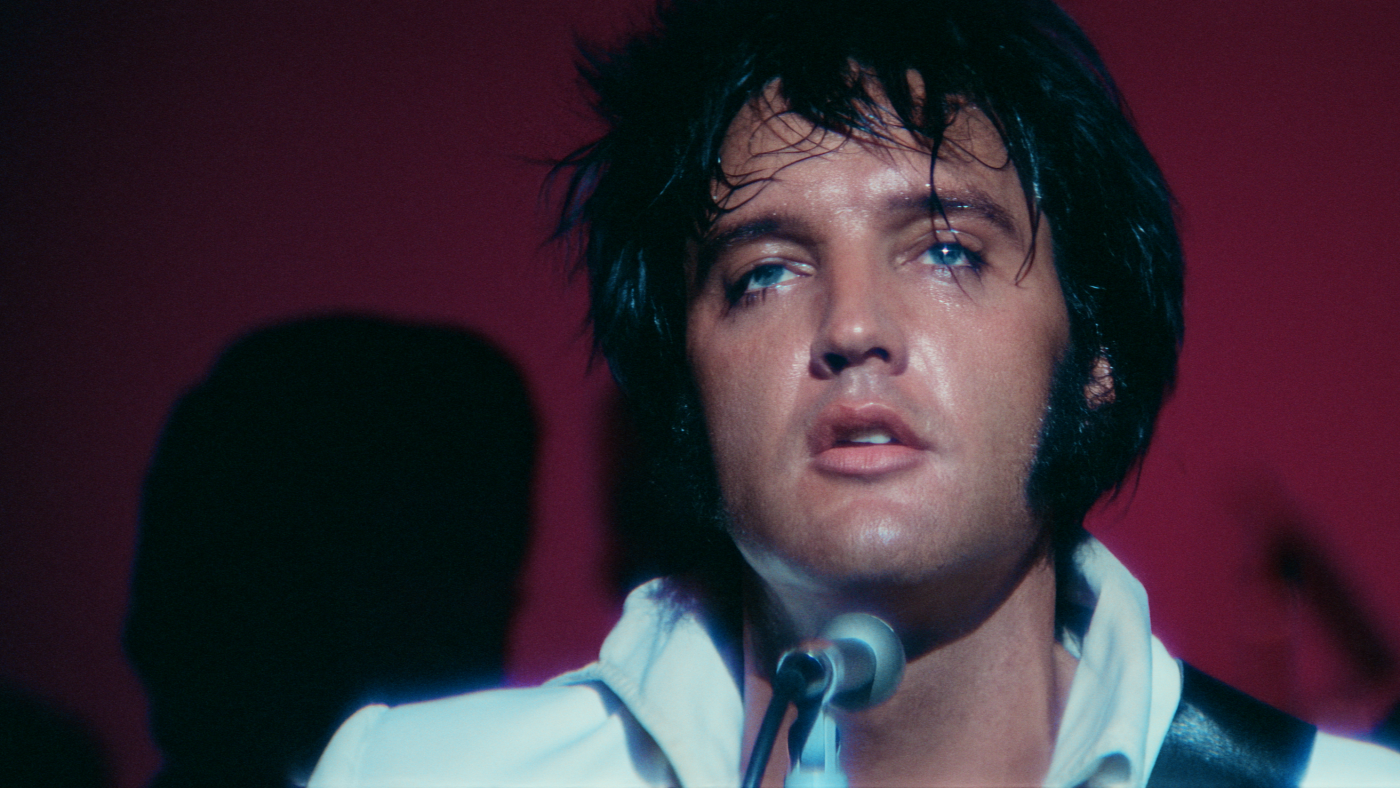
Elvis Presley in Las Vegas in Aug. 1970.
NEON
hide caption
toggle caption
NEON
“You are my favorite customer,” Baz Luhrmann tells me on a recent Zoom call from the sunny Chateau Marmont in Hollywood. The director is on a worldwide blitz to promote his new film, EPiC: Elvis Presley in Concert — which opens wide this week — and he says this, not to flatter me, but because I’ve just called his film a miracle.
See, I’ve never cared a lick about Elvis Presley, who would have turned 91 in January, had he not died in 1977 at the age of 42. Never had an inkling to listen to his music, never seen any of his films, never been interested in researching his life or work. For this millennial, Presley was a fossilized, mummified relic from prehistory — like a woolly mammoth stuck in the La Brea Tar Pits — and I was mostly indifferent about seeing 1970s concert footage when I sat down for an early IMAX screening of EPiC.
By the end of its rollicking, exhilarating 90 minutes, I turned to my wife and said, “I think I’m in love with Elvis Presley.”
“I’m not trying to sell Elvis,” Luhrmann clarifies. “But I do think that the most gratifying thing is when someone like you has the experience you’ve had.”
Elvis made much more of an imprint on a young Luhrmann; he watched the King’s movies while growing up in New South Wales, Australia in the 1960s, and he stepped to 1972’s “Burning Love” as a young ballroom dancer. But then, like so many others, he left Elvis behind. As a teenager, “I was more Bowie and, you know, new wave and Elton and all those kinds of musical icons,” he says. “I became a big opera buff.”
Luhrmann only returned to the King when he decided to make a movie that would take a sweeping look at America in the 1950s, ’60s, and ’70s — which became his 2022 dramatized feature, Elvis, starring Austin Butler. That film, told in the bedazzled, kaleidoscopic style that Luhrmann is famous for, cast Presley as a tragic figure; it was framed and narrated by Presley’s notorious manager, Colonel Tom Parker, portrayed by a conniving and heavily made-up Tom Hanks. The dark clouds of business exploitation, the perils of fame, and an early demise hang over the singer’s heady rise and fall.
It was a divisive movie. Some praised Butler’s transformative performance and the director’s ravishing style; others experienced it as a nauseating 2.5-hour trailer. Reviewing it for Fresh Air, Justin Chang said that “Luhrmann’s flair for spectacle tends to overwhelm his basic story sense,” and found the framing device around Col. Parker (and Hanks’ “uncharacteristically grating” acting) to be a fatal flaw.
Personally, I thought it was the greatest thing Luhrmann had ever made, a perfect match between subject and filmmaker. It reminded me of Oliver Stone’s breathless, Shakespearean tragedy about Richard Nixon (1995’s Nixon), itself an underrated masterpiece. Yet somehow, even for me, it failed to light a fire of interest in Presley himself — and by design, I now realize after seeing EPiC, it omitted at least one major aspect of Elvis’ appeal: the man was charmingly, endearingly funny.
As seen in Luhrmann’s new documentary, on stage, in the midst of a serious song, Elvis will pull a face, or ad lib a line about his suit being too tight to get on his knees, or sing for a while with a bra (which has been flung from the audience) draped over his head. He’s constantly laughing and ribbing and keeping his musicians, and himself, entertained. If Elvis was a tragedy, EPiC is a romantic comedy — and Presley’s seduction of us, the audience, is utterly irresistible.
Unearthing old concert footage
It was in the process of making Elvis that Luhrmann discovered dozens of long-rumored concert footage tapes in a Kansas salt mine, where Warner Bros. stores some of their film archives. Working with Peter Jackson’s team at the post-production facility Park Road Post, who did the miraculous restoration of Beatles rehearsal footage for Jackson’s 2021 Disney+ series, Get Back, they burnished 50-plus hours of 55-year-old celluloid into an eye-popping sheen with enough visual fidelity to fill an IMAX screen. In doing so, they resurrected a woolly mammoth. The film — which is a creative amalgamation of takes from rehearsals and concerts that span from 1970 to 1972 — places the viewer so close to the action that we can viscerally feel the thumping of the bass and almost sense that we’ll get flecked with the sweat dripping off Presley’s face.
This footage was originally shot for the 1970 concert film Elvis: That’s The Way It Is, and its 1972 sequel, Elvis on Tour, which explains why these concerts were shot like a Hollywood feature: wide shots on anamorphic 35mm and with giant, ultra-bright Klieg lights — which, Luhrmann explains, “are really disturbing. So [Elvis] was very apologetic to the audience, because the audience felt a bit more self conscious than they would have been at a normal show. They were actually making a movie, they weren’t just shooting a concert.”
Luhrmann chose to leave in many shots where camera operators can be seen running around with their 16mm cameras for close-ups, “like they’re in the Vietnam War trying to get the best angles,” because we live in an era where we’re used to seeing cameras everywhere and Luhrmann felt none of the original directors’ concern about breaking the illusion. Those extreme close-ups, which were achieved by operators doing math and manually pulling focus, allow us to see even the pores on Presley’s skin — now projected onto a screen the size of two buildings.
The sweat that comes out of those pores is practically a character in the film. Luhrmann marvels at how much Presley gave in every single rehearsal and every single concert performance. Beyond the fact that “he must have superhuman strength,” Luhrmann says, “He becomes the music. He doesn’t mark stuff. He just becomes the music, and then no one knows what he’s going to do. The band do not know what he’s going to do, so they have to keep their eyes on him all the time. They don’t know how many rounds he’s going to do in ‘Suspicious Minds.’ You know, he conducts them with his entire being — and that’s what makes him unique.”

Elvis Presley in Las Vegas in Aug. 1970.
NEON
hide caption
toggle caption
NEON
It’s not the only thing. The revivified concerts in EPiC are a potent argument that Elvis wasn’t just a superior live performer to the Beatles (who supplanted him as the kings of pop culture in the 1960s), but possibly the greatest live performer of all time. His sensual, magmatic charisma on stage, the way he conducts the large band and choir, the control he has over that godlike gospel voice, and the sorcerer’s power he has to hold an entire audience in the palm of his hands (and often to kiss many of its women on the lips) all come across with stunning, electrifying urgency.
Shaking off the rust and building a “dreamscape”
The fact that, on top of it all, he is effortlessly funny and goofy is, in Luhrmann’s mind, essential to the magic of Elvis. While researching for Elvis, he came to appreciate how insecure Presley was as a kid — growing up as the only white boy in a poor Black neighborhood, and seeing his father thrown into jail for passing a bad check. “Inside, he felt very less-than,” says Luhrmann, “but he grows up into a physical Greek god. I mean, we’ve forgotten how beautiful he was. You see it in the movie; he is a beautiful looking human being. And then he moves. And he doesn’t learn dance steps — he just manifests that movement. And then he’s got the voice of Orpheus, and he can take a song like ‘Bridge Over Troubled Water’ and make it into a gospel power ballad.
“So he’s like a spiritual being. And I think he’s imposing. So the goofiness, the humor is about disarming people, making them get past the image — like he says — and see the man. That’s my own theory.”
Elvis has often been second-classed in the annals of American music because he didn’t write his own songs, but Luhrmann insists that interpretation is its own invaluable art form. “Orpheus interpreted the music as well,” the director says.
In this way — as in their shared maximalist, cape-and-rhinestones style — Luhrmann and Elvis are a match made in Graceland. Whether he’s remixing Shakespeare as a ’90s punk music video in Romeo + Juliet or adding hip-hop beats to The Great Gatsby, Luhrmann is an artist who loves to take what was vibrantly, shockingly new in another century and make it so again.

Elvis Presley in Las Vegas in Aug. 1970.
NEON
hide caption
toggle caption
NEON
Luhrmann says he likes to take classic work and “shake off the rust and go, Well, when it was written, it wasn’t classical. When it was created, it was pop, it was modern, it was in the moment. That’s what I try and do.”
To that end, he conceived EPiC as “an imagined concert,” liberally building sequences from various nights, sometimes inserting rehearsal takes into a stage performance (ecstatically so in the song “Polk Salad Annie”), and adding new musical layers to some of the songs. Working with his music producer, Jamieson Shaw, he backed the King’s vocals on “Oh Happy Day” with a new recording of a Black gospel choir in Nashville. “So that’s an imaginative leap,” says Luhrmann. “It’s kind of a dreamscape.”
On some tracks, like “Burning Love,” new string arrangements give the live performances extra verve and cinematic depth. Luhrmann and his music team also radically remixed multiple Elvis songs into a new number, “A Change of Reality,” which has the King repeatedly asking “Do you miss me?” over a buzzing bass line and a syncopated beat.
I didn’t miss Elvis before I saw EPiC — but after seeing the film twice now, I truly do.

Video: Prada Peels Back the Layers at Milan Fashion Week

Defense secretary Pete Hegseth designates Anthropic a supply chain risk

UN Human Rights Council chief cuts off speaker criticizing US-sanctioned official

ICE blasts Washington mayor over directive restricting immigration enforcement

‘SuperAgers’ stay mentally sharp well past 80, as scientists reveal the reason

Florida High School Football Rankings: Top 25 teams – Oct. 21

Cleary's 21 help Le Moyne down Central Connecticut State 69-64 in OT

How old is Bo Nix? What to know about Oregon quarterback ahead of 2024 NFL Draft

99th annual Pony Swim held in Virginia

Indiana Members Credit Union announced as new anchor tenant at Bottleworks District
ICE blasts Washington mayor over directive restricting immigration enforcement

Did the EU bypass Hungary’s veto on Ukraine’s €90 billion loan?

How the federal government is painting immigrants as criminals on social media

Where Iran’s ballistic missiles can reach — and how close they are to the US

Has India’s influence in Afghanistan grown under the Taliban?
-

 World2 days ago
Exclusive: DeepSeek withholds latest AI model from US chipmakers including Nvidia, sources say
-

 Massachusetts2 days ago
Mother and daughter injured in Taunton house explosion
-

 Montana1 week ago
2026 MHSA Montana Wrestling State Championship Brackets And Results – FloWrestling
-

 Louisiana5 days ago
Wildfire near Gum Swamp Road in Livingston Parish now under control; more than 200 acres burned
-

 Oklahoma1 week ago
Wildfires rage in Oklahoma as thousands urged to evacuate a small city
-

 Denver, CO2 days ago
10 acres charred, 5 injured in Thornton grass fire, evacuation orders lifted
-

 Technology7 days ago
YouTube TV billing scam emails are hitting inboxes
-

 Technology7 days ago
Stellantis is in a crisis of its own making