Lifestyle
Far from the front lines, Ukrainians fight a war to preserve their culture


In a remote region of western Ukraine, far from where the violent conflict of war with Russia is taking place and destroying human lives, Ukrainians are fighting a different type of battle: for culture and dignity.
In this area of Transcarpathia, a historical region in Eastern Europe that is now primarily part of modern-day Ukraine, there are local residents holding onto their history, traditional lifestyle, crafts and cultural identity. After coming under threat during Soviet times, they face stark new dangers. Since Russian President Vladimir Putin launched a full-scale invasion of Ukraine in February 2022, Ukrainians have feared that he is determined to wipe out their culture and statehood. Millions of Ukrainians have left the country. Many others have joined the army — with many killed on the front lines — and war efforts have soaked up people’s energy and resources. As they defend their territory from advancing Russian forces, many in Ukraine are also fighting to preserve a cultural heritage in peril.
The Transcarpathian Folk Choir performs a song and dance for a music video that they are working on to share their music. Ukraine’s St. Miklos Castle, which is now an arts exhibit space, a meeting place and museum for local history, provides the backdrop.
Claire Harbage/NPR
hide caption
toggle caption
Claire Harbage/NPR
Like many in this region, Joseph Bartosh, 67, believes he’s fighting on a sort of cultural front line. “In 2000,” Bartosh says, “my war actually started that year.” That was when Bartosh started his effort to preserve the medieval St. Miklos Castle in the town of Chynadiiovo, Ukraine. When he began the project, the castle was in disrepair. He says he found signs that in Soviet times, it had been used as a horse stable, with a lack of respect given to its history.

St. Miklos Castle in Chynadiiovo, Ukraine, was in disrepair when Joseph Bartosh decided to work on restoring it. He says that during Soviet times, it was used as a horse stable. Even now, more than 20 years since he started the project, there is still more work to be done to preserve parts of the castle.
Claire Harbage/NPR
hide caption
toggle caption
Claire Harbage/NPR

Joseph Bartosh stands in a patch of window light at St. Miklos Castle in Chynadiiovo, a town in western Ukraine. Since 2000, he’s taken on the effort of restoring the medieval castle, whose earliest known mention is believed to be around 1450.
Claire Harbage/NPR
hide caption
toggle caption
Claire Harbage/NPR
With the restoration well underway, the inside has already been transformed into a space for art exhibitions, community events and a museum where people can learn about the castle’s history. During this visit by NPR, the Transcarpathian Folk Choir is performing in the castle’s yard and filming for a music video, as Bartosh closes up for the day.
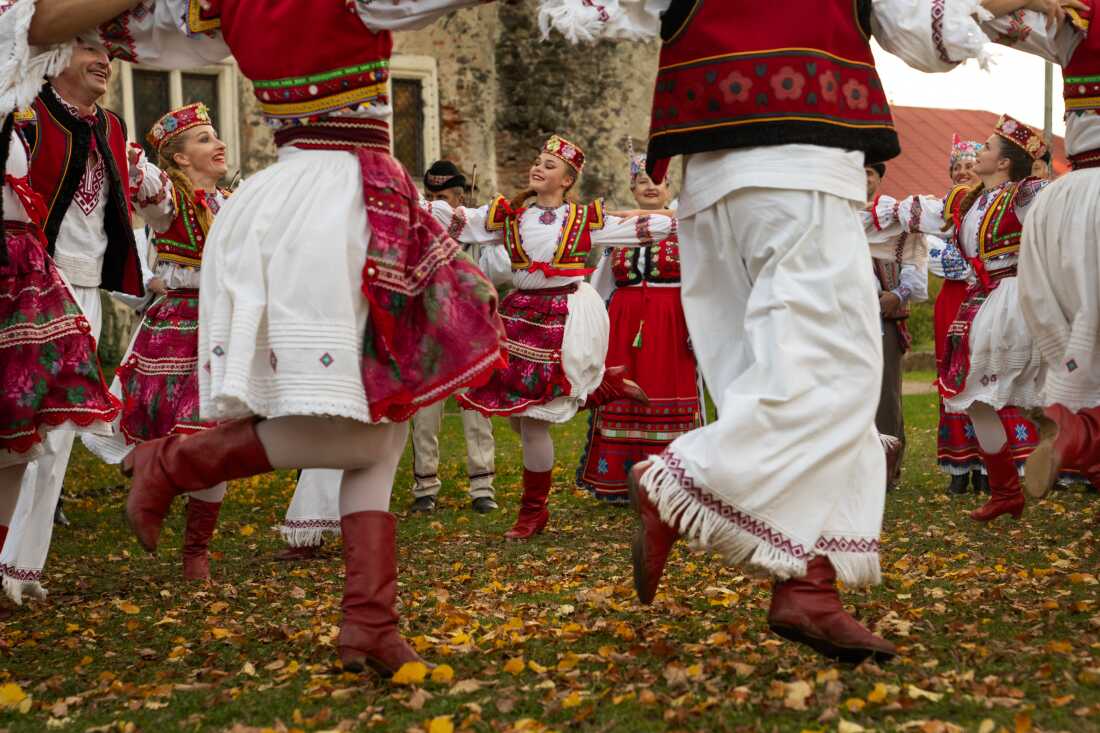
The Transcarpathian Folk Choir performs a dance while filming a music video.
Claire Harbage/NPR
hide caption
toggle caption
Claire Harbage/NPR
There are instances throughout Ukraine’s history in which the people were spurred into action to preserve their culture. Villagers here remember the Soviet history of Ukraine as a time of erasure of unique regional traditions. Hanna Haiduk recalls her relatives having to hide their embroidered shirts, called a vyshyvanka, to save them from being destroyed by Soviet troops. “People were putting [vyshyvankas] inside of glass jars, sealing those jars, digging holes underground trying to hide those vyshyvankas there. And people were trying to save vyshyvanka for years for the next generations in this way,” Haiduk recounts over tea in her kitchen.

Hanna Haiduk grew up learning traditional Hutsul embroidery techniques. She is part of the Hutsul ethnic group from the Transcarpathian region, which is mainly part of modern-day Ukraine.
Claire Harbage/NPR
hide caption
toggle caption
Claire Harbage/NPR
Haiduk, 60, is from the Hutsul ethnic group, from a village in the Carpathian Mountains called Kosivska. She remembers learning to embroider as a child, alongside her whole community. They would often gather under one large tree in the village to work on communal projects, chatting and laughing together as she and other kids would help, and learning different embroidery techniques as their parents directed them. They embroidered towels, rugs and vyshyvankas.

Hanna Haiduk uses a needle and thread to form intricate designs, many of which she copies from historical works she finds in books or those she saved from her family’s past work.
Claire Harbage/NPR
hide caption
toggle caption
Claire Harbage/NPR
Haiduk passed her love of tradition to her eldest son, Taras. He was a tour guide, showing off regional culture to people from around the world. He was killed while serving in the Ukrainian army, just one month after the war began in 2022, at age 34. He was supportive of her work and, before his death, he was building a website for Haiduk, to help her sell her vyshyvankas. But he never got to finish it, she says. She recounts all this with tears in her eyes.
“The war touches everywhere in this country; it’s a misconception that we are free from it here,” Haiduk says.

Hanna Haiduk does her embroidery mostly at home in Uzhhorod, a city in western Ukraine. She lost her son when he went to fight at the beginning of Russia’s full-scale invasion in 2022.
Claire Harbage/NPR
hide caption
toggle caption
Claire Harbage/NPR
But not every part of the region’s cultural heritage has been successfully preserved, as the war has taken its toll.
Richka is known locally as the village that makes hunias, traditional fluffy wool coats. Olha Mys and her mother and sisters used to make hunias, but the tradition is dying out. Even before the war, Mys says, fewer people were producing and wearing hunias because of how time-consuming and meticulous it is to make them.
“It’s not easy work to do this,” Mys says.

Olha Mys, wearing a fluffy wool hunia coat, and her sister walk near their house in Richka, Ukraine, down to where a valylo is built into the side of a stream. They use the valylo to wash wool and then to wash hunias for hours after they are woven.
Claire Harbage/NPR
hide caption
toggle caption
Claire Harbage/NPR
Making a hunia takes months just to complete one coat. After gathering the sheep’s wool, it is washed and dried in the sun, then combed and woven on a loom that takes up an entire room. The woven fabric is then washed for multiple hours in a valylo, a kind of natural washing machine that people construct on the side of a mountain stream. Valylos can only be used when the stream is very full and the water runs clear to keep dirt out of the materials. The hours of washing in the valylo helps with felting the woven fabric, creating a material that is dense and spongy.

Olha Mys shows a photo of her grandmother wearing a hunia. The tradition of crafting the coats has been in the family for generations.
Claire Harbage/NPR
hide caption
toggle caption
Claire Harbage/NPR

Many people have moved out of Richka, a small village in western Ukraine. Villagers estimate more than half of the population has left since Russia’s invasion of Ukraine in 2022.
Claire Harbage/NPR
hide caption
toggle caption
Claire Harbage/NPR
Adding to the difficulties, the war has shrunk the population of Richka, as people have fled Ukraine altogether. Many people in the village, roughly counting their neighbors, estimate that over half have left since the war started nearly three years ago.
Lubov Hychka, who still occasionally makes hunias, says that this population drop affects the materials she needs for the process.
“All those people that left because of the war, many of them had sheep, even despite the fact they weren’t producing hunias,” Hychka says. “When they left they sold their sheep or rented them to people in other villages, in other areas. Now if you want to start to produce hunia, you don’t have this amount of choice [in wool].”

Wool from local sheep is used in making a hunia.
Claire Harbage/NPR
hide caption
toggle caption
Claire Harbage/NPR

Lubov Hychka demonstrates how to weave the hunia fabric while Vasyl Hychka (unrelated), who takes care of the property where the loom is housed, helps with the rickety old machine.
Claire Harbage/NPR
hide caption
toggle caption
Claire Harbage/NPR
Traditionally, large flocks of sheep used to ramble through the Carpathian Mountains, spending summers on wide alpine meadows while shepherds lived alongside them. Now they dot the area, with usually just a few nibbling on grasses together on the outskirts of each village.

Mikhailo Bilak sits to smoke a cigarette after walking all morning with his flock of sheep. Mykola Yakbuk (right) has come to take one of the ewes and her lambs back to a barn where they can be more closely cared for.
Claire Harbage/NPR
hide caption
toggle caption
Claire Harbage/NPR
Mikhailo Bilak, a man wearing knee-high mud boots, watches over his flock of more than a hundred sheep. He says he and his friend, Mykola Yakbuk, are some of the rare shepherds who still raise sheep in this way, grazing them near the village of Yavoriv.

Mikhailo Bilak holds two lambs while their mother looks on.
Claire Harbage/NPR
hide caption
toggle caption
Claire Harbage/NPR
Even on this remote mountaintop, the war still looms. At 59, Bilak has nearly aged out of the military draft, which goes up to 60, but the country’s mobilization remains a threat.
“Pretty much if they mobilize me, these sheep will be packed immediately for slaughterhouse. Nobody will take care of them,” Bilak says bluntly, before he runs after his moving flock down the mountain, waving goodbye and apologizing at the hasty exit.
A few villages away in Krasnoillya, a small wooden museum is tucked into a valley that curls around a flowing stream, between the pine-covered peaks of the mountains. In the museum, actors who perform Hutsul theater are having a modest feast after rehearsal. A variety of cured meats and cheeses are stacked on thick, buttered slices of white bread.

Vasyl Zhykaliak, 15, and his 11-year-old brother, Dmytro, prepare to rehearse a play at Hutsul Theater.
Claire Harbage/NPR
hide caption
toggle caption
Claire Harbage/NPR
Their kind of theater was created over 100 years ago based on the culture and stories of the Hutsul ethnic group, who live in these mountains. The theater nearly went extinct during both World War I and II, but each time, after a long hiatus, dedicated enthusiasts revived it once the wars ended. During the current war, they have fewer shows and rehearsals, but still on an average Sunday in early November they were able to gather a handful of performers to rehearse.

Volodymyr Sinitovych, director of the Hutsul Theater, greets his son and grandchild outside the small museum in Krasnoillya, where the history of Hutsul theater is documented and sometimes performed.
Claire Harbage/NPR
hide caption
toggle caption
Claire Harbage/NPR
“I don’t think that it can cease to exist this time,” says Roman Sinitovych, the museum director and one of the actors in the troupe. He says this is because people have learned from the past. They care more about preserving cultural identity during this war. Sinitovych served in the territorial defense in eastern Ukraine’s Donetsk region during the first year of Russia’s full-scale invasion, but upon returning home, he went straight back to acting.
The difficulties during wartime never dampen his optimism.
“Many people say, ‘Oh, it’s a war now, it’s a difficult time. Why do you need plays? Why do you need to perform?’ But you know actually we need, because those are the things that unite us, that keep us together.”
They pour shots of a local alcohol made with galangal, making enthusiastic toasts to meeting, to friendship and to love. And one last time before parting, the sweet notes of a flute waft through the air. The group embraces, singing and spinning in a large circle, round and round until they merge into a blur.

Volodymyr Sinitovych ties up traditional shoes that are part of his costume.
Claire Harbage/NPR
hide caption
toggle caption
Claire Harbage/NPR

After rehearsal, the theater troupe has drinks and shares some meats and cheeses together.
Claire Harbage/NPR
hide caption
toggle caption
Claire Harbage/NPR



There’s a three-story house in Baltimore that looks a bit imposing. You walk up the stone steps before even getting up to the porch, and then you enter the door and you’re greeted with a glass case of literary awards. It’s The Clifton House, formerly home of Lucille Clifton.
The National Book Award-winning poet lived there with her husband, Fred, starting in 1967 until the bank foreclosed on the house in 1980. Clifton’s daughter, Sidney Clifton, has since revived the house and turned it into a cultural hub, hosting artists, readings, workshops and more. But even during a February visit, in the mid-afternoon with no organized events on, the house feels full.

The corner of Lucille Clifton’s bedroom, where she would wake up and write in the mornings
Andrew Limbong/NPR
hide caption
toggle caption
Andrew Limbong/NPR
“There’s a presence here,” Clifton House Executive Director Joël Díaz told me. “There’s a presence here that sits at attention.”
Sometimes, rooms where famous writers worked can be places of ineffable magic. Other times, they can just be rooms.

Princeton University Press
Katie da Cunha Lewin is the author of the new book, The Writer’s Room: The Hidden Worlds That Shape the Books We Love, which explores the appeal of these rooms. Lewin is a big Virginia Woolf fan, and the very first place Lewin visited working on the book was Monk’s House — Woolf’s summer home in Sussex, England. On the way there, there were dreams of seeing Woolf’s desk, of retracing Woolf’s steps and imagining what her creative process would feel like. It turned out to be a bit of a disappointment for Lewin — everything interesting was behind glass, she said. Still, in the book Lewin writes about how she took a picture of the room and saved it on her phone, going back to check it and re-check it, “in the hope it would allow me some of its magic.”
Let’s be real, writing is a little boring. Unlike a band on fire in the recording studio, or a painter possessed in their studio, the visual image of a writer sitting at a desk click-clacking away at a keyboard or scribbling on a piece of paper isn’t particularly exciting. And yet, the myth of the writer’s room continues to enrapture us. You can head to Massachusetts to see where Louisa May Alcott wrote Little Women. Or go down to Florida to visit the home of Zora Neale Hurston. Or book a stay at the Scott & Zelda Fitzgerald Museum in Alabama, where the famous couple lived for a time. But what, exactly, is the draw?

Lewin said in an interview that whenever she was at a book event or an author reading, an audience question about the writer’s writing space came up. And yes, some of this is basic fan-driven curiosity. But also “it started to occur to me that it was a central mystery about writing, as if writing is a magic thing that just happens rather than actually labor,” she said.
In a lot of ways, the book is a debunking of the myths we’re presented about writers in their rooms. She writes about the types of writers who couldn’t lock themselves in an office for hours on end, and instead had to find moments in-between to work on their art. She covers the writers who make a big show of their rooms, as a way to seem more writerly. She writes about writers who have had their homes and rooms preserved, versus the ones whose rooms have been lost to time and new real estate developments. The central argument of the book is that there is no magic formula to writing — that there is no daily to-do list to follow, no just-right office chair to buy in order to become a writer. You just have to write.

Bruce Johnston
I’m Riding My Last Wave With The Beach Boys
Published
Bruce Johnston is riding off into the California sunset … at least for now.
The Beach Boys legend announced Wednesday he’s stepping away from touring after six decades with the iconic band. The 83-year-old revealed in a statement to Rolling Stone he’s hanging up his touring hat to focus on what he calls part three of his long music career.

“It’s time for Part Three of my lengthy musical career!” Johnston said. “I can write songs forever, and wait until you hear what’s coming!!! As my major talent beyond singing is songwriting, now is the time to get serious again.”
Johnston famously stepped in for co-founder Brian Wilson in 1965 for live performances, becoming a staple of the Beach Boys’ touring lineup ever since. Now, he says he’s shifting gears toward songwriting and even some speaking engagements … with occasional touring member John Stamos helping him craft what he’ll talk about onstage.
“I might even sing ‘Disney Girls’ & ‘I Write The Songs!!’” he teased.
But don’t call it a full-on farewell tour just yet. Johnston made it clear he’s not shutting the door completely, saying he’s excited to reunite with the band for special occasions, including their upcoming July 2-4 shows at the Hollywood Bowl as part of the Beach Boys’ 2026 tour. The run celebrates both the 60th anniversary of “Pet Sounds” and America’s 250th birthday.
“This isn’t goodbye, it’s see you soon,” he wrote. “I am forever grateful to be a part of the Beach Boys musical legacy.”
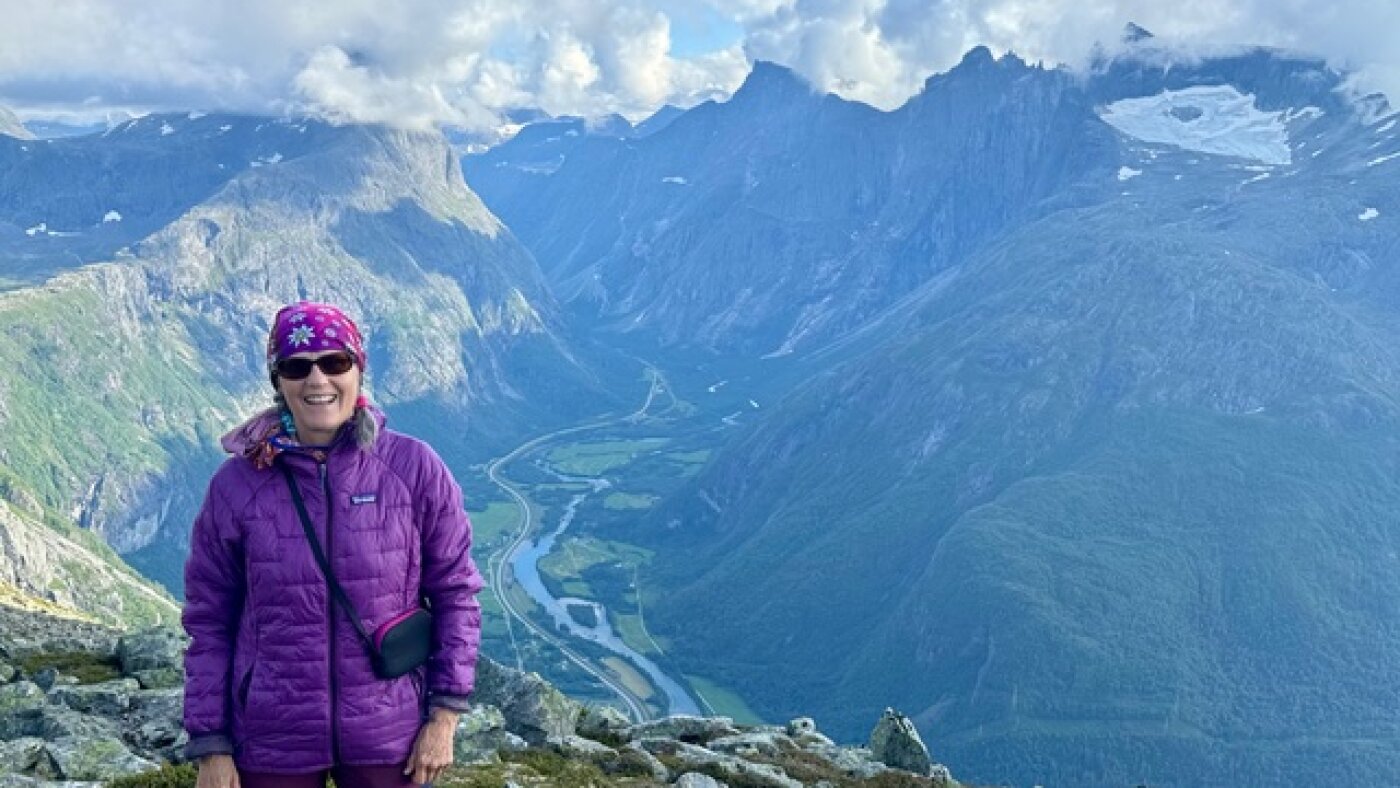
In 1982, Jean Muenchrath was injured in a mountaineering accident and on the brink of death when a stranger and his family went out of their way to save her life.
Jean Muenchrath
hide caption
toggle caption
Jean Muenchrath
In early May 1982, Jean Muenchrath and her boyfriend set out on a mountaineering trip in the Sierra Nevada, a mountain range in California. They had done many backcountry trips in the area before, so the terrain was somewhat familiar to both of them. But after they reached one of the summits, a violent storm swept in. It began to snow heavily, and soon the pair was engulfed in a blizzard, with thunder and lightning reverberating around them.
“Getting struck and killed by lightning was a real possibility since we were the highest thing around for miles and lightning was striking all around us,” Muenchrath said.
To reach safer ground, they decided to abandon their plan of taking a trail back. Instead, using their ice axes, they climbed down the face of the mountain through steep and icy snow chutes.
They were both skilled at this type of descent, but at one particularly difficult part of the route, Muenchrath slipped and tumbled over 100 feet down the rocky mountain face. She barely survived the fall and suffered life-threatening injuries.

This was before cellular or satellite phones, so calling for help wasn’t an option. The couple was forced to hike through deep snow back to the trailhead. Once they arrived, Muenchrath collapsed in the parking lot. It had been five days since she’d fallen.
”My clothes were bloody. I had multiple fractures in my spine and pelvis, a head injury and gangrene from a deep wound,” Muenchrath said.
Not long after they reached the trailhead parking lot, a car pulled in. A man was driving, with his wife in the passenger seat and their baby in the back. As soon as the man saw Muenchrath’s condition, he ran over to help.
”He gently stroked my head, and he held my face [and] reassured me by saying something like, ‘You’re going to be OK now. I’ll be right back to get you,’” Muenchrath remembered.
For the first time in days, her panic began to lift.
“My unsung hero gave me hope that I’d reach a hospital and I’d survive. He took away my fears.”
Within a few minutes, the man had unpacked his car. His wife agreed to stay back in the parking lot with their baby in order to make room for Muenchrath, her boyfriend and their backpacks.
The man drove them to a nearby town so that the couple could get medical treatment.
“I remember looking into the eyes of my unsung hero as he carried me into the emergency room in Lone Pine, California. I was so weak, I couldn’t find the words to express the gratitude I felt in my heart.”

The gratitude she felt that day only grew. Now, nearly 45 years later, she still thinks about the man and his family.
”He gave me the gift of allowing me to live my life and my dreams,” Muenchrath said.
At some point along the way, the man gave Muenchrath his contact information. But in the chaos of the day, she lost it and has never been able to find him.
”If I knew where my unsung hero was today, I would fly across the country to meet him again. I’d hug him, buy him a meal and tell him how much he continues to mean to me by saving my life. Wherever you are, I say thank you from the depths of my being.”
My Unsung Hero is also a podcast — new episodes are released every Tuesday. To share the story of your unsung hero with the Hidden Brain team, record a voice memo on your phone and send it to myunsunghero@hiddenbrain.org.

Iowa House OKs ‘3 strikes’ bill with 20-year prison terms. What to know

RESULTS: NE Kansas high schools to play Saturday after Wednesday sub-state wins

Northern Kentucky claims 4 titles at Class 3A indoor track state meet

Shavers leads ULM past Louisiana 79-63

NECEC conservation plan will not protect Maine’s mature forests | Opinion

Florida High School Football Rankings: Top 25 teams – Oct. 21

Cleary's 21 help Le Moyne down Central Connecticut State 69-64 in OT

How old is Bo Nix? What to know about Oregon quarterback ahead of 2024 NFL Draft

99th annual Pony Swim held in Virginia

Indiana Members Credit Union announced as new anchor tenant at Bottleworks District

DHS defends McLaughlin against allegations husband’s company profited millions from ad contracts: ‘Baseless’

Sánchez defies Trump in political gamble as Madrid say no to war

Satellite images show Iran school strike hit more buildings than earlier reported

US submarine sinks Iranian warship by torpedo in a first since World War II

Which oil and gas facilities in the Gulf have been attacked?
-

 World1 week ago
Exclusive: DeepSeek withholds latest AI model from US chipmakers including Nvidia, sources say
-

 Massachusetts1 week ago
Mother and daughter injured in Taunton house explosion
-

 Wisconsin3 days ago
Setting sail on iceboats across a frozen lake in Wisconsin
-

 Maryland4 days ago
AM showers Sunday in Maryland
-

 Denver, CO1 week ago
10 acres charred, 5 injured in Thornton grass fire, evacuation orders lifted
-

 Florida4 days ago
Florida man rescued after being stuck in shoulder-deep mud for days
-

 Oregon6 days ago
2026 OSAA Oregon Wrestling State Championship Results And Brackets – FloWrestling
-

 Massachusetts2 days ago
Massachusetts man awaits word from family in Iran after attacks