Lifestyle
Do you know the Issey Miyake dress that was set on fire? Pechuga Vintage has a treasure-trove of stories

This story is part of Image’s April issue, “Reverie” — an invitation to lean into the spaces of dreams and fantasy. Enjoy the journey.
When Johnny Valencia was 14, a kid growing up in Koreatown obsessed with biology and entomology, he learned about a rare butterfly, the Papilio hospiton, that was endemic to the French island of Corsica. “I love the rarest of the rare,” Valencia says. “I’ve always loved the rarest of the rare.”
He thought about the butterfly for 10 years, until he eventually made it to Corsica while studying abroad and was able to acquire it for himself. Today, the delicate creature sits in a frame hung on the wall behind the desk in his sun-drenched L.A. showroom. It’s a totem that represents Valencia’s dedication to the rare, the special, the hard-to-get — and it’s found a home among the many other grails of the vintage collector. In this room you’ll find a Vivienne Westwood “SEX” choker, John Galliano-era Dior logo rings, a Gucci silver crystal mesh mask from fall/winter 2017, a pair of spring/summer 2017 Saint Laurent roller skate shoes, original Marc Jacobs Kiki boots from fall/winter 2016 and pieces from Jean Paul Gaultier’s cyberdot 1995 collection. The list goes on, and it goes deep.
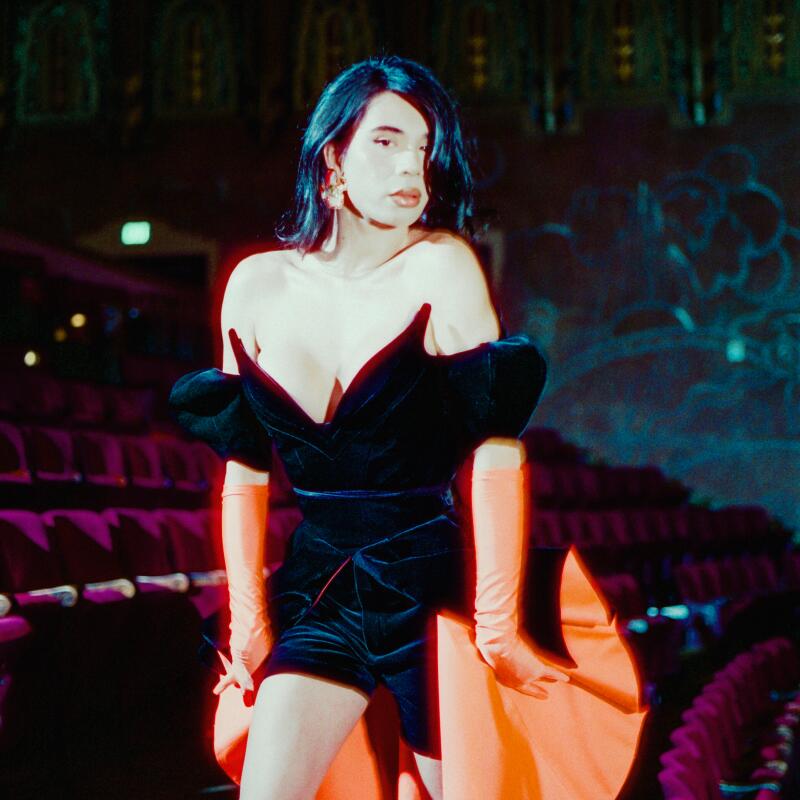
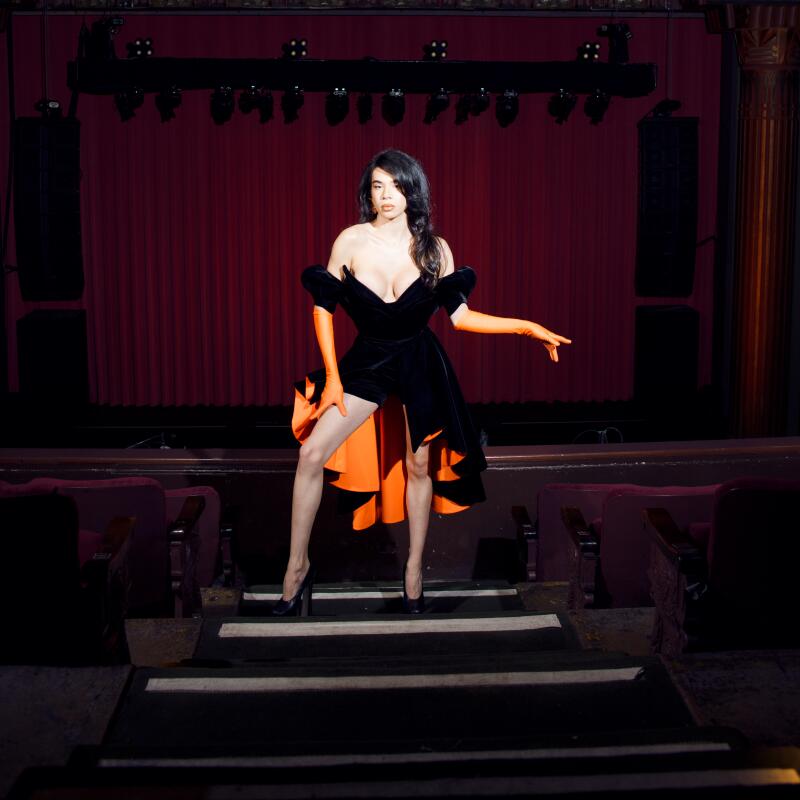
Vivienne wears Thierry Mugler AW90/91 dress, shorts and gloves, Vivienne Westwood AW93/94 pumps, Schiaparelli SS23 earrings.
Valencia, who was dubbed the King of Corsets by Vogue for his deep knowledge and archive of the signature Vivienne Westwood pieces, is also the king of his self-created universe, his Bichon Lucas lounging on a custom-made dog bed like one of Marie Antoinette’s pugs while classical music purrs softly in the background. The collection that surrounds him is the result of his obsession with acquiring precious things, which may have started with butterflies but has grown to include rare vintage runway pieces from Comme des Garçons, Chanel, Louis Vuitton, Alexander McQueen and Saint Laurent. “I look around me and I’m like, ‘Yeah, there has to be a touch of madness to pursue something you’re so passionate about,” Valencia says. “Not only to pursue it, but to have it come to fruition and materialize. It’s a whole different thing.”
Pechuga Vintage, Valencia’s vintage archive and business, has become a go-to for amateur fashion freaks and professionals alike. Stylists, hardcore collectors, It girls: They all flock to Johnny. Last year, Beyoncé purchased a pair of Vivienne Westwood fall/winter ’10 Red Label armor boots from Valencia. On a red carpet recently, Katy Perry wore the Vivienne Westwood mock croc Super Elevated Court Pumps from his shop. Rihanna recently was spotted with a Dior Hardcore fall/winter ’03 bag she purchased from the archive.
Before Valencia became the source for rare designer pieces, he studied animal sciences while living on a farm at UC Davis, and later studied international relations and economics, which led him to attending Sciences Po in France. He would end up working for the Salvadoran Consulate. He once harbored ambitions to become a vet, or, as his grandma would have hoped, the president of El Salvador, where his family immigrated to L.A. from. But in fashion — using Vivienne Westwood as his gateway drug — Valencia found it all: history, politics, nature, curiosity and, ultimately, freedom.
While he was pursuing his diplomatic ambitions, Valencia took a role as an unpaid intern at Vivienne Westwood and switched his focus to fashion, working his way up to being a buyer. (Before starting his business, Valencia also dabbled in PR and event marketing.) “In Westwood’s designs, I found a lot of liberty because it was so well made,” Valencia says. “It fit into every portion of life.”
Oscars weekend was on the horizon, and Valencia would end up working with Adore the Couture to get a pair of vintage couture silk Chanel opera gloves to supermodel Irina Shayk for the Vanity Fair Oscars party. On Instagram, Valencia posted a screenshot of a last-minute request from Shayk’s team, and the process of making a pull like that happen — which he does all the time with the help of his staff and Virgo moon.
It was a particularly insane week at Pechuga. Oscars weekend was on the horizon, and Valencia would end up working with Adore the Couture to get a pair of vintage couture silk Chanel opera gloves to supermodel Irina Shayk for the Vanity Fair Oscars party. On Instagram, Valencia posted a screenshot of a last-minute request , and the process of making a pull like that happen — which he does all the time with the help of his staff and Virgo moon. (For the record, Pechuga is a Scorpio sun and Leo rising, evident in his deeply mystic undertones and great hair.) He regularly gives followers a backstage pass to his process, highlighting the community that keeps Pechuga going behind the scenes, which often includes Latinos and trans women. “I’m so passionate about dressing women and being there for women,” Valencia says. “It spills over to my love for the trans community. I see that connection with marginalized communities, and I’m so impassioned to stand up for people that have been historically neglected.”
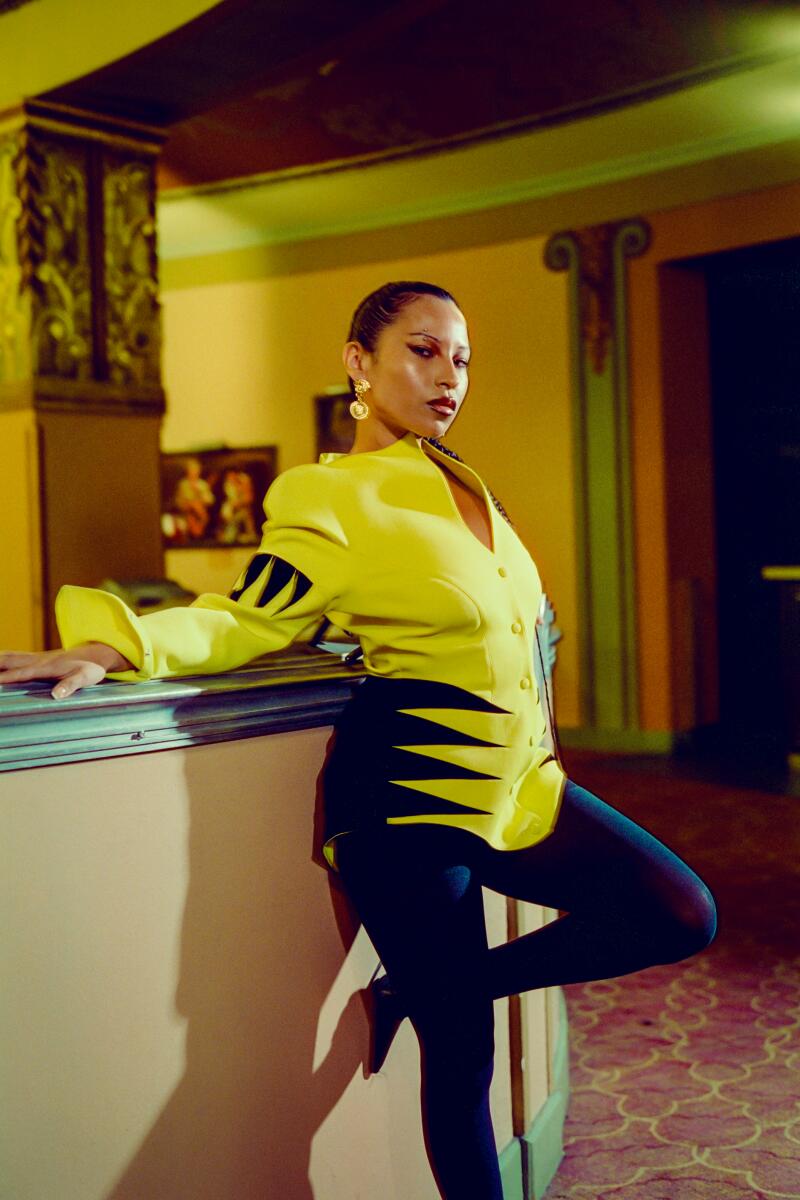
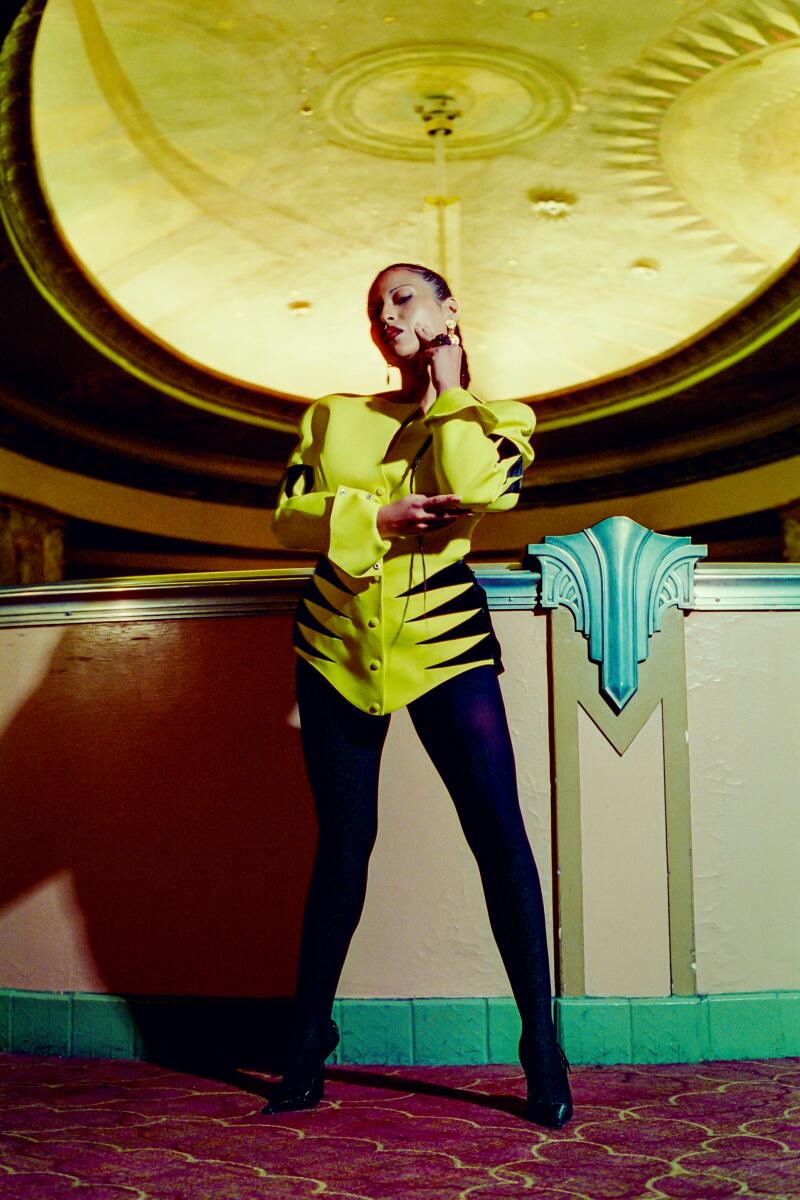
Mercy wears Thierry Mugler AW90/91 jacket, Versace SS92 earrings, Saint Laurent heels, Wolford tights, Valentino ring.
Pechuga enthusiasts will recognize Valencia’s two assistants and friends, Priscilla Yael and Sophia Jaime, who make regular appearances on his social channels, along with endearing videos of his grandmother trying on pieces from the shop. What did she think of the Marni X No Vacancy Inn orange raffia hat with cutout sunglasses that Valencia had her wear? “Esta pretty.”
“For a very long time, until recently, she thought it was still a hobby,” Valencia says of his grandmother, whom he considers one of his first mentors. “One day — this was fairly recent — I was like, ‘I’m very stressed out. I have a lot of work.’ And she was like, ‘Why? This is your hobby.’ I had to make the distinction for her. Hobbies don’t pay you. This might be a passion. But I’m working.”
If Pechuga’s Instagram and TikTok are our classroom, Valencia is our teacher in Tabis, doing deep dives into specific eras in fashion history — like Marc Jacobs’ time at Louis Vuitton — or giving context to an item that’s re-entered the discourse, like that Alexander McQueen Dante mask from ’96. But it’s his unboxing videos that are truly addicting, almost as if we, the viewer, were absorbing that surge of dopamine that comes from finally opening up something special we bought off the internet. Valencia has a distinctive, infectious giggle that serves as the soundtrack to these videos. It’s like watching a little kid open a new toy. He holds up pieces he won at auction or scored through private collectors — like the armor jacket from Vivienne Westwood’s ’88/’89 Time Machine collection, or a dress from Thierry Mugler’s fall/winter ’86 collection. “I live for documentation,” Valencia says. “It’s a natural thing.”
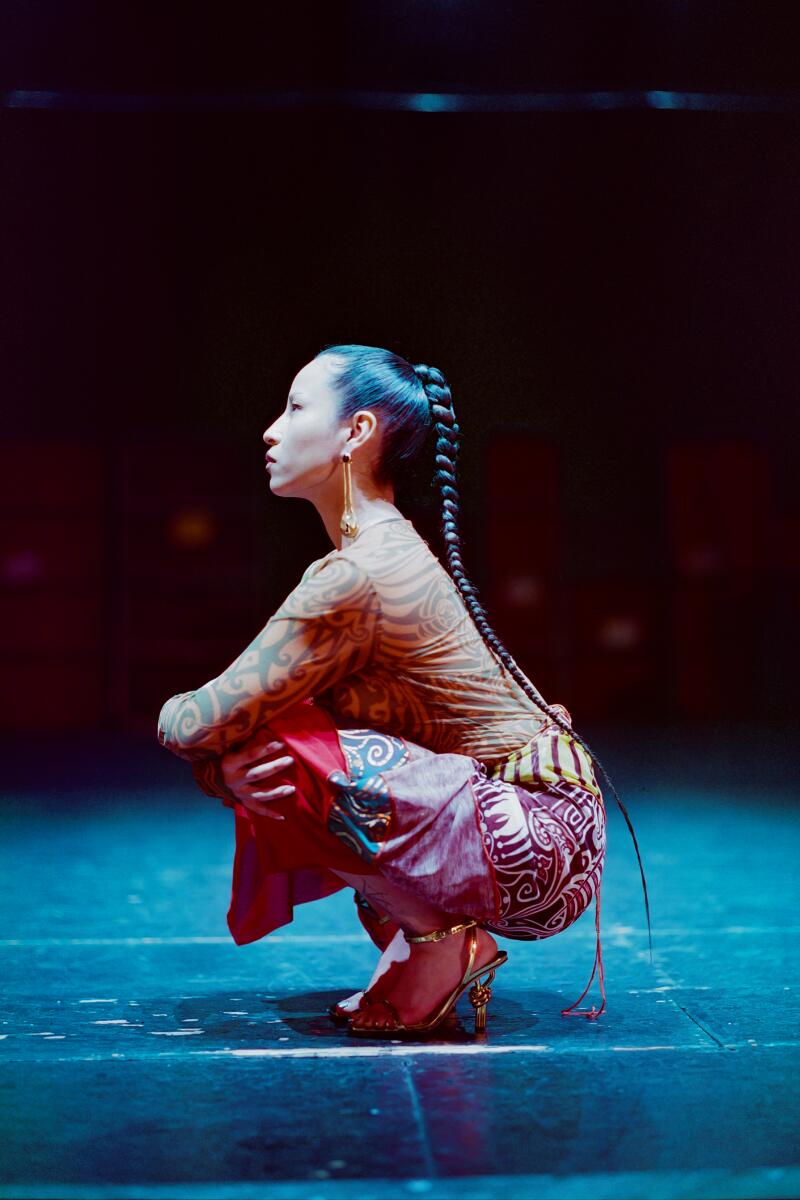
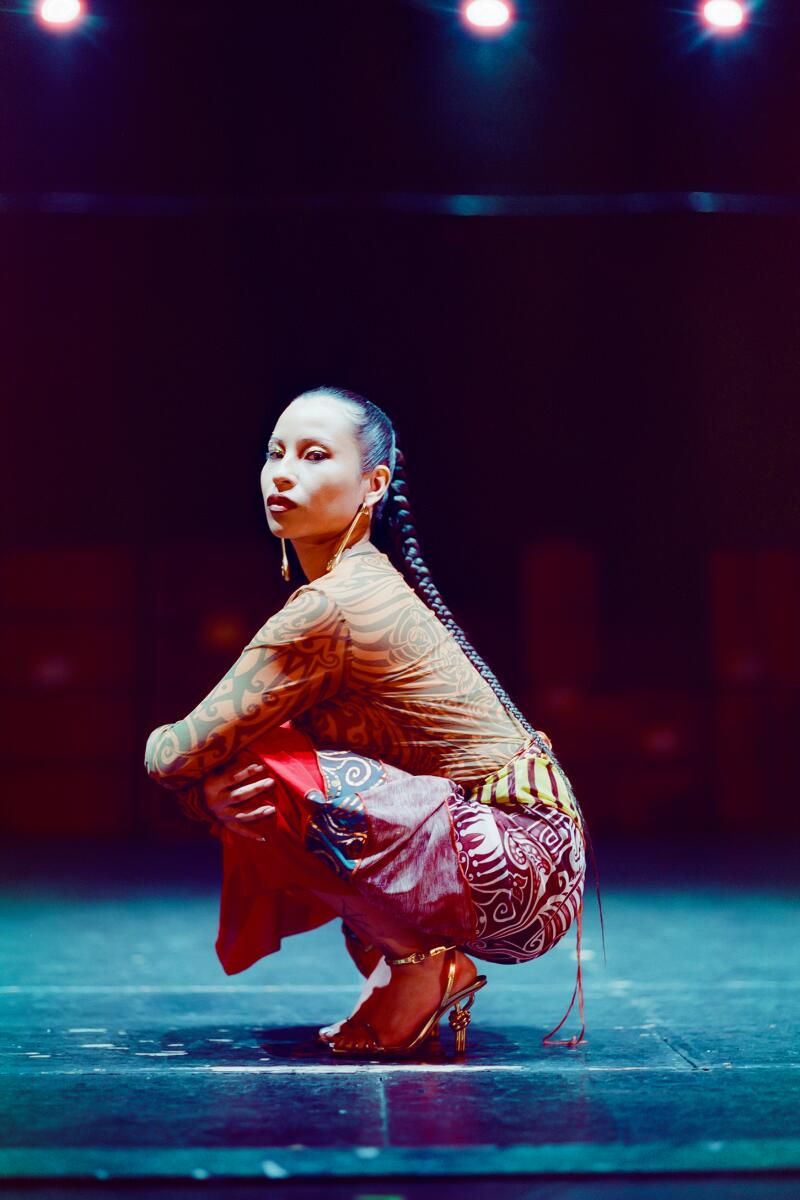
Mercy wears Jean Paul Gaultier SS96 top and bottom, Schiaparelli AW21 earrings, Bottega Veneta heels.
Any fashion addict visiting the Pechuga showroom will clock a palpable energy radiating from the clothes — tension, desire, amazement filling the showroom. (Listening back on my audio recording from our interview, I’m pretty sure I audibly moaned when Valencia pulled out a Comme des Garçons latex vest from its fall 2019 ready-to-wear collection. Embarrassing, but valid.) When John Galliano paid Valencia’s showroom a visit last year, he summed it up: “There’s magic here,” Valencia remembers the designer saying.
The way Valencia sees it, he’s only the latest stop in a long journey that these pieces have taken throughout history. “It precedes me,” he says. “Westwood had to make those boots and those shoes. And women in the 18th century had to make those corsets. There’s a lot that’s implied with the items that we see.”
We asked Valencia to give us brief history lessons and share memories of some of the most special pieces in his archive, the grails that still spark that same level of curiosity and desire he had as a kid chasing rare butterflies.
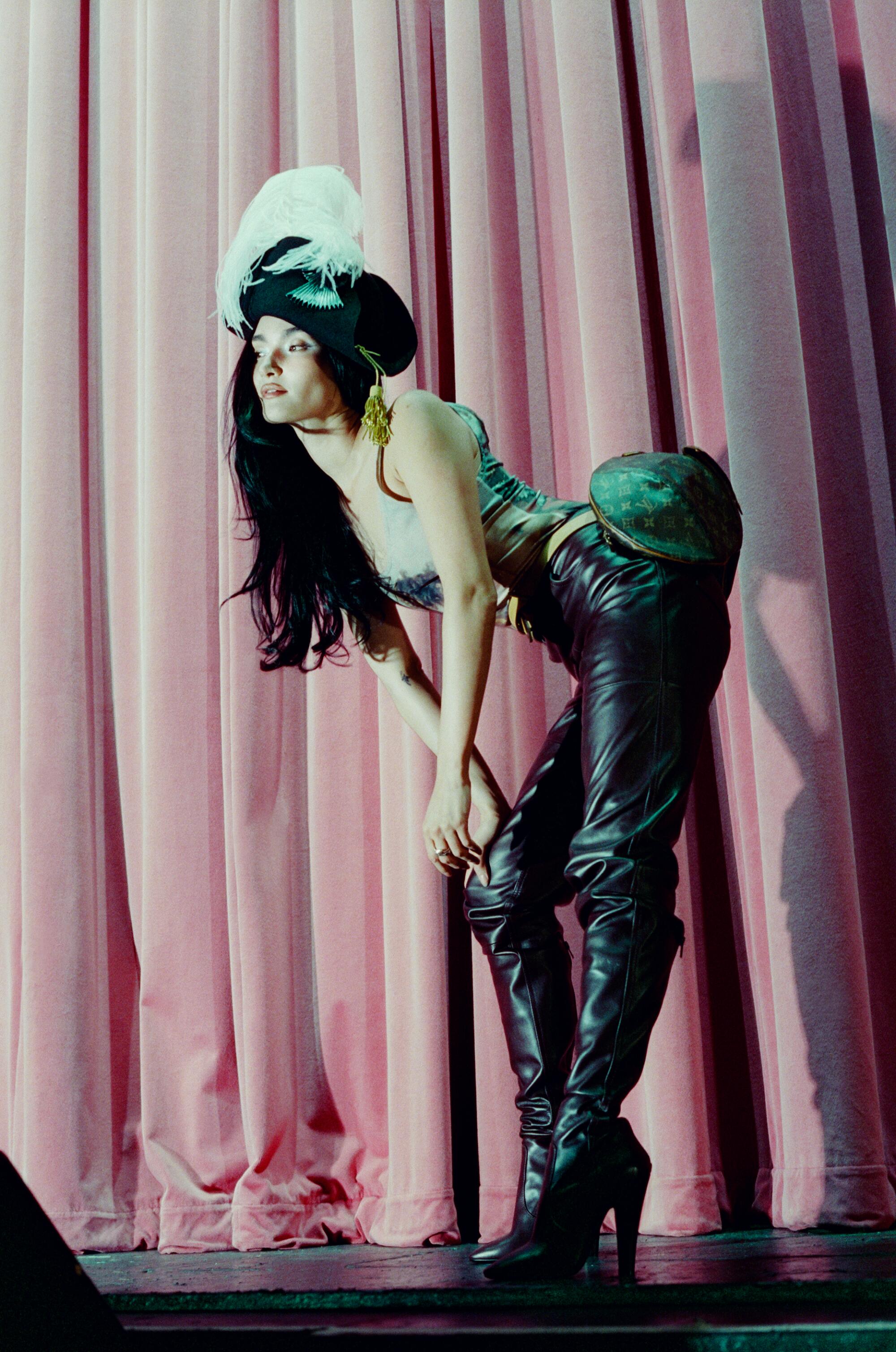
Minji wears Vivienne Westwood Pirate Hat, Saint Laurent pantaboots, Vivienne Westwood SS91 bodysuit, Vivienne Westwood X Louis Vuitton 1996 bum bag, Dilitru “City Ring,” Gucci “Chicken” ring.
Louis Vuitton X Vivienne Westwood Bum Bag (1996)
There were only 100 made. [We have the 84th piece.] Vivienne Westwood made it in collaboration with Louis Vuitton to celebrate their centenary — the monogram was turning 100 in 1996. The shape of it: Vivian took inspiration from the bustle. In essence, she was the designer that brought back that silhouette in 1995. And her logic was that she wanted the silhouette to look like a sketch. She was like, “I want my women to look like croquis.” She accentuated the bum. The bust. In hindsight, everything aligned. The first time I encountered [one], I sold it immediately. [This is the second Louis Vuitton X Vivienne Westwood bum bag Valencia has had in his collection.]
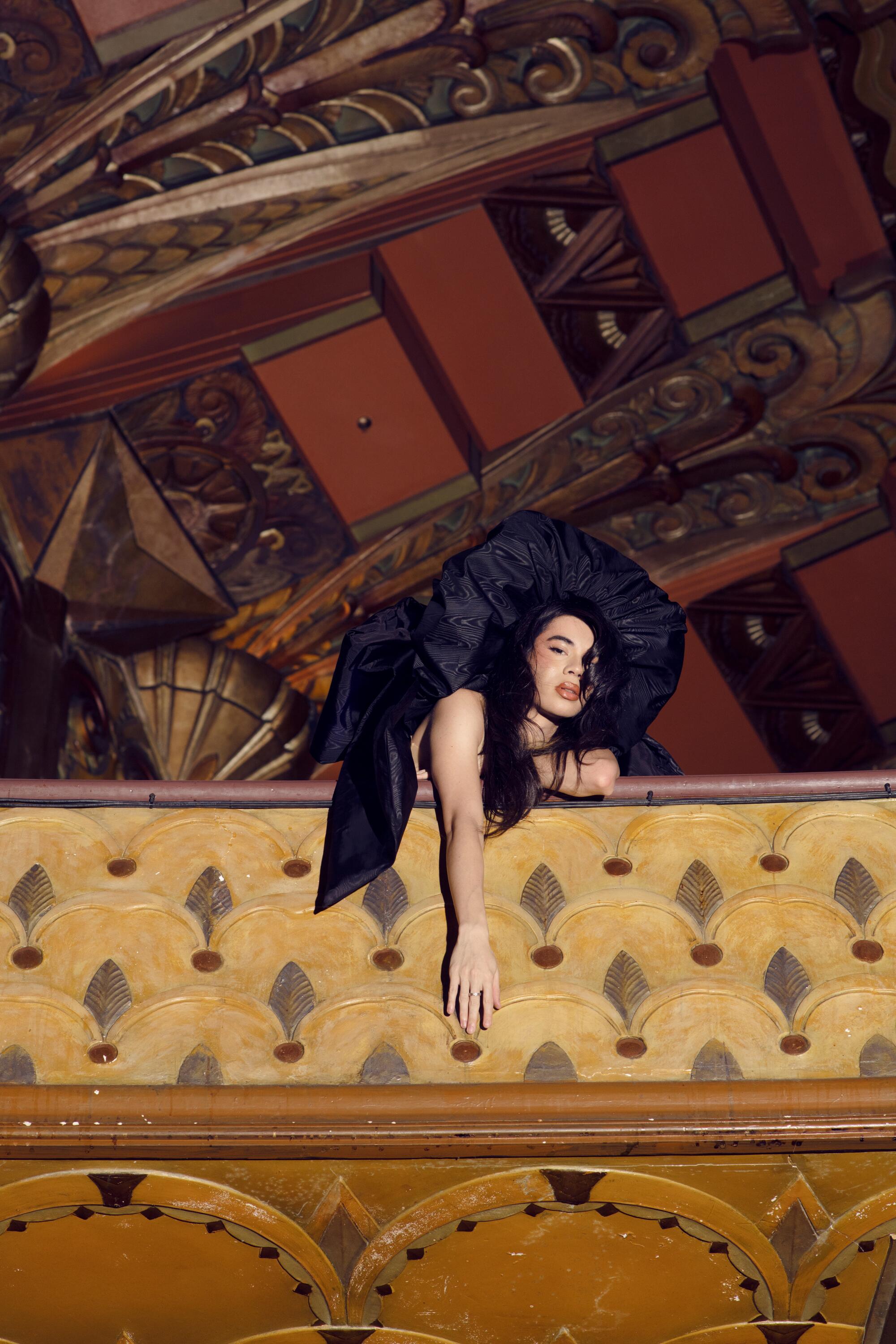
Vivienne wears Alexander McQueen AW98 “Life is Pain” top, Andrew James hat.
Alexander McQueen “Life Is Pain” shirt (Fall/Winter ’96)
That was an ego purchase. I was going through a really difficult time in my life and I related to the message a lot. There’s a fascination with it. I purchased it, got out of the turmoil that I was in. It’s like, pain is inevitable, but suffering is optional. I think the experience you feel when you put something on can be very spiritual because everything has an energy.
Vivienne Westwood Silver Horn Tiara With Orb (Fall/Winter ’05)
It’s interesting, because people think that it has some sort of allusion to the devil but it’s the complete opposite of that. They represent satyr horns. In the ’90s, Westwood took a lot of inspiration from pagans. Even with the draping of her garments, she looked at Grecian and Roman paintings and emulated that style. And one of the things to come out of that exploration were these horns. They represented, for her, fecundity and paganism. It alludes to the horn of plenty — the cornucopia and abundance.
Issey Miyake Plastic Body bodice (Fall/Winter ’80/’81)
I love corsets. I love what they do to the body. And I love Issey Miyake’s intention with that particular collection. One, because it came as a series. In the ’80s, Issey was exploring different materials. He would make pieces out of straw. Then Plastic Body came out. I love the juxtaposition. There’s clearly a feminine aspect to it, or what we attribute to feminine energy. And then the hard exterior. I told myself if I ever find this piece, I have to buy it. It’s probably one of my most expensive pieces — 50 grand.
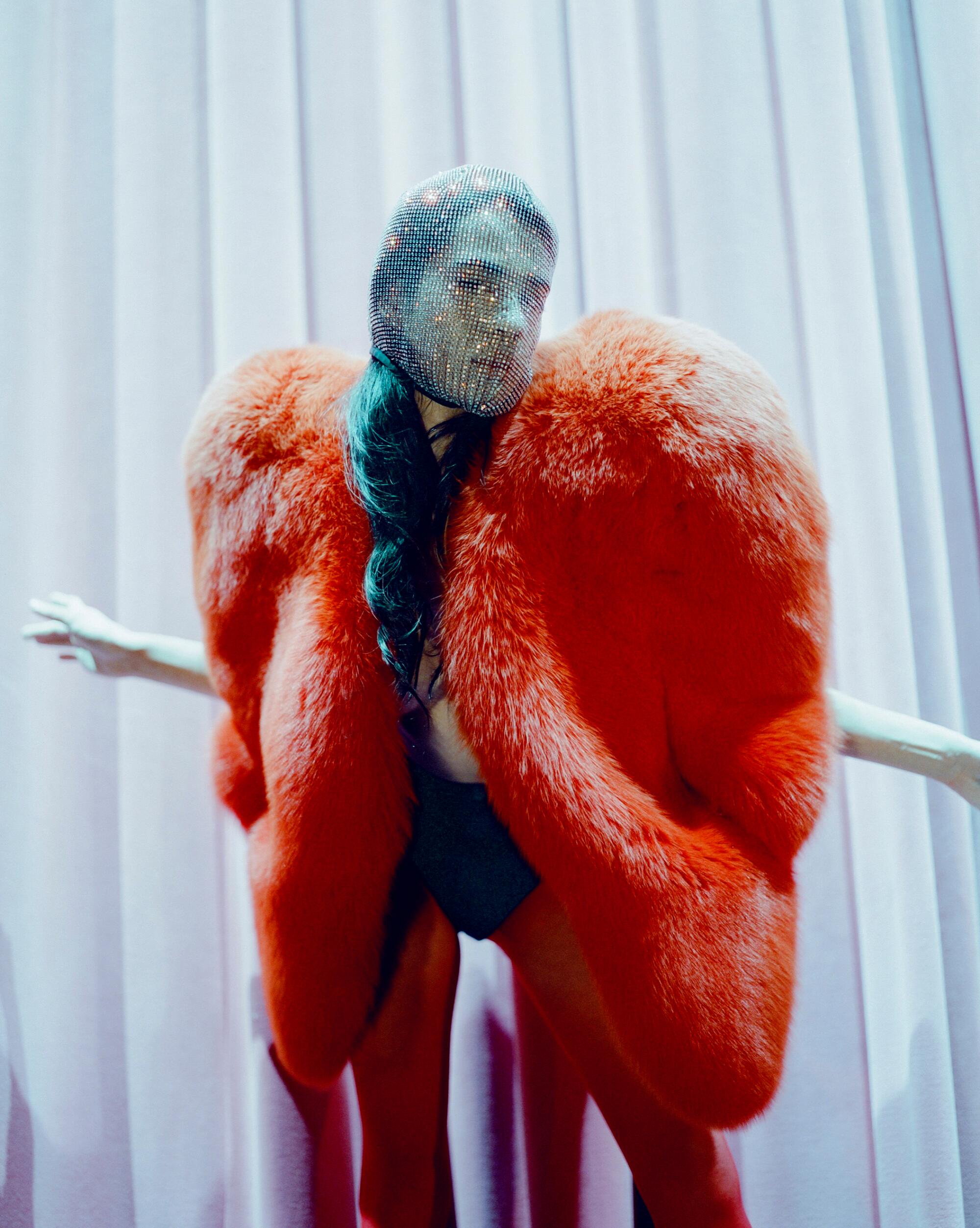
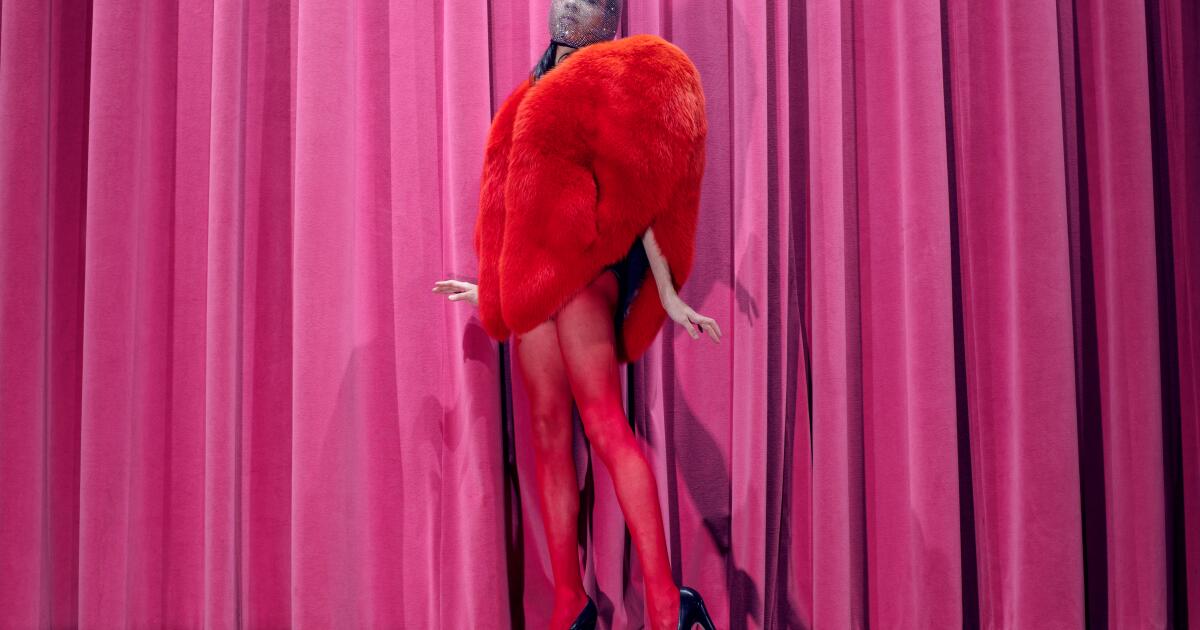
Vivienne wears Gucci AW17 mask, Saint Laurent AW16 heart coat, Claude Montana X Byronesque tights, Y/Project mini-shorts.
Gucci Silver Mesh Mask (Fall/Winter ’17)
There was such a transition from Tom Ford’s Gucci to Alessandro Michele’s Gucci. To me, it’s embodied in this. Because how do we go from Gucci ’96, the wet look, to this? I mean, it’s also really cool. Rihanna wearing it [to Coachella in 2017] makes it so [powerful].
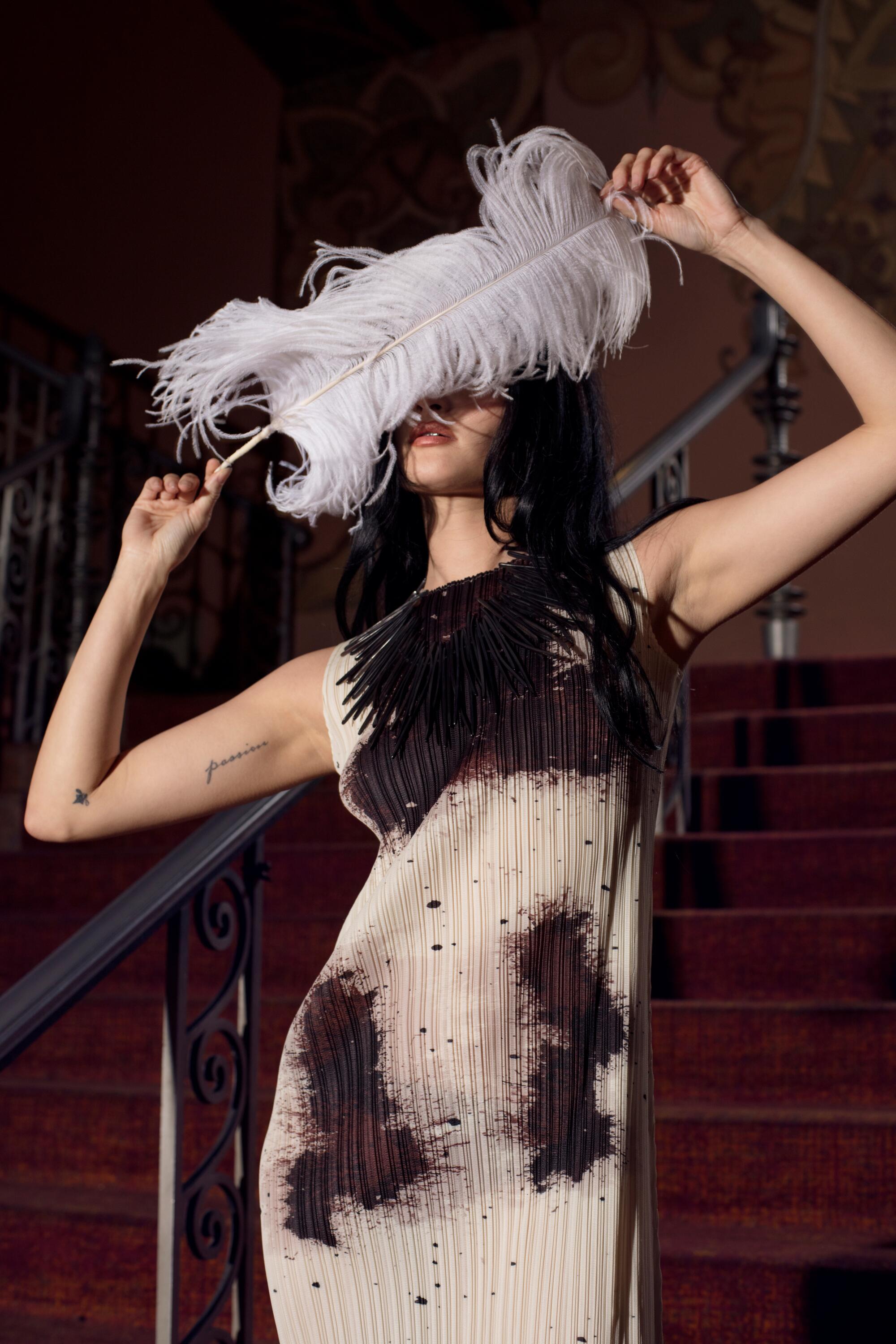
Minji wears Issey Miyake AW98 dress, Monies necklace.
Issey Miyake Gunpowder dress (1998)
With Issey and Cai Guo-Qiang [the artist who collaborated with Miyake on this Pleats Please collection] there was such an elaborate setting for [the process]. Guo-Qiang set down all this pleated fabric on the floor and put gunpowder on it, then he set it on fire. And the imprint that was left behind was then translated onto the garment, like printing. It’s my mission to tell you about this process because in the moment it was happening, yes, it was quite the spectacle. But it’s gone. And who knows how that conversation was initiated? We know that Issey started the artists series and this was one of the installations. I believe there were four [in total]. What does it mean now to wear it in 2024?
Location: The Wiltern
Producer: Mere Studios
Models: Vivienne Gomez, Minji M., Mercy Rivera
Makeup: Jaime Diaz
Hair: Belen Gomez
Photo assistant: Brandon Young
Styling assistant: Sophia Jaime


The Late Show with Stephen Colbert on Monday May 18, 2026.
Scott Kowalchyk/CBS Broadcasting Inc.
hide caption
toggle caption
Scott Kowalchyk/CBS Broadcasting Inc.
The Late Show With Stephen Colbert comes to an end this week amid a lot of changes in the business and the country. Some of the sources of tension include the economics of late night, the approaching merger of Paramount and Warner Brothers, and President Donald Trump’s constant criticism of late-night hosts. But for Colbert’s fans, it’s the end of a friendly, funny, candid show. So we’re talking about the legacy of Stephen Colbert in late night.


Kars4Kids advertisements, like this TV commercial on a hot-pink set, feature children turning the charity’s phone number into a catchy jingle. But they do not disclose that most of the proceeds go to a Jewish nonprofit that supports programming for young adults.
Kars4Kids/Screenshot by NPR
hide caption
toggle caption
Kars4Kids/Screenshot by NPR
The “Kars4Kids” jingle — with its chipper melody and high-pitched, pre-tween singers — has been wedged firmly in many Americans’ heads for two decades. But it may soon go off the air in California after a judge banned it for being “deceptive.”

Judge Gassia Apkarian of the Orange County Superior Court ruled earlier this month that the ad violates California’s laws against unfair competition and false advertising because it does not disclose Kars4Kids’ religious affiliation.
The case has put the jingle — and the charity behind it — in the headlines. And it inspired us to check in on some other nostalgic favorites (more on that below).
The Kars4Kids case, explained
Kars4Kids says it gives most of its proceeds from used-car donations to Oorah, an Orthodox Jewish nonprofit based in New Jersey that provides opportunities like summer camps, adult matchmaking services and trips to Israel.
Kars4Kids makes the connection to its “sister nonprofit” clear on its website, though not in its infamous jingle: “1-877-Kars4Kids / K-A-R-S Kars for Kids / 1-877-Kars4Kids / Donate your car today.”
That omission prompted California resident Bruce Puterbaugh to sue Oorah in 2021.
According to the judge’s order, Puterbaugh testified that he donated a 2001 Volvo station wagon after hearing the Kars4Kids advertisement “over and over,” believing the money would benefit California kids in need. Puterbaugh, a self-described “not a computer person” in his 70s, said he never visited the charity’s website and only learned the truth from a casual conversation with his Lake County neighbor after the car was picked up.
“He testified that he felt ‘taken advantage of’ upon discovering — only after the donation — that the funds did not stay in California but supported a specific religious mission in the Northeast,” Apkarian wrote.
The neighbor, Neal Roberts, is a lawyer who went on to represent him in the case. Roberts told NPR that the ad — which has aired on the radio since the turn of the millennium and on TV since 2014 — is ubiquitous in California. But he said Apkarian, the judge in the case, doesn’t watch TV and hadn’t heard the jingle until it was played at the four-day trial in November.
“She heard it the first time, and then she heard it the second time, and then the rule in the court was, ‘Do not play that jingle again,’” he said with a laugh. “So I thought that gave us some idea that we might have a chance.”
According to the judge’s order, Kars4Kids’ Chief Operating Officer Esti Landau confirmed at trial that the charity’s primary function is not helping economically disadvantaged children but “Jewish kids and families throughout their lives.” She said the charity has “no functional programs in California beyond a ‘backpack giveaway’ characterized as a branding exercise,” the judge wrote.
Landau confirmed on the stand that in 2022 — among other expenditures — Oorah transferred $16,500,000 to North Africa and the Middle East, and spent $16.5 million to purchase a building in Israel. She testified that while the Kars4Kids ad features kids ages 8 to 10, the programs Oorah funds “often target young adults (17-18) and matchmaking as well as Jewish families.” And she conceded that a donor would “have to go to the website” for that information.
Neither Kars4Kids nor Oorah responded to NPR’s requests for comment. But in a lengthy statement on its website, Kars4Kids said the judge mischaracterized its work and its testimony at trial.
“Kars4Kids’ ads have one purpose: to remind listeners that Kars4Kids offers a quick and easy way to dispose of an unused vehicle,” it wrote. “The ads are targeted to vehicle owners, not specifically to people considering donating to charity.”
The charity said “helping children often means engaging parents and families as well,” and stressed that its mission and religious affiliation are prominently stated on its website.
But the judge ultimately sided with Puterbaugh, writing that “a reasonable consumer is not required to be ‘computer savvy.’” She gave the charity 30 days to stop airing the ad in California unless it is updated to include an “audible disclosure of its religious affiliation and the geographic location of its primary beneficiaries and the age of the beneficiaries.”
The judge also ordered the charity to pay Puterbaugh $250, the value of the car he donated, though acknowledged that “money cannot ‘un-donate’ a car or restore the donor’s belief that they were helping a local, needy child.”
Kars4Kids says on its website that it plans to appeal the ruling, which it said is “deeply flawed, ignores and misrepresents the facts that were presented at trial, and misapplies the law.”
The charity also called the case as “a lawyer-driven attempt to siphon off charitable funds for their own gain.” Roberts dismissed that accusation, saying the only money his client stands to gain is the $250 for the car and lawyers’ fees. The bigger win, he said, is putting Kar4Kids — and potentially other charities nationwide — on notice about the consequences of false advertising.
“I think anyone who knows the facts would think that there was wool being pulled over people’s eyes,” Roberts said.
Where are they now?

J.G. Wentworth’s catchy “Viking Opera” commercial, featuring elaborately costumed, structured settlement-winning opera singers in need of cash, has been airing on and off since 2008.
J.G. Wentworth/Screenshot by NPR
hide caption
toggle caption
J.G. Wentworth/Screenshot by NPR
This story sent us down a head-bopping rabbit hole of nostalgic jingles, confirming they never truly leave the depths of your brain. And it turns out, some of them are — in a sense — new again.
Remember Zoo Pals, the early-aughts, dipping sauce-friendly paper plates shaped like animals (pig, bee, frog, duck) that, per their peppy theme song, “make eating fun!”? Hefty discontinued the onetime birthday-party staple in 2014, but brought the plates back in 2023 — and has also introduced disposable cups and plastic bags in the years since. No word yet on whether the commercial might make a comeback too.
Folgers, the coffee brand, has had people humming “The best part of wakin’ up / is Folgers in your cup” since the cozy jingle first aired in 1984. Its various iterations have managed to hold viewers’ attention in the years since (the 2009 sibling version inspired a slew of parodies and fan fiction). In 2021, public performance royalties for the song — which is actually titled “Real Snowy Morning” — were auctioned off online. The winning bidder, identified as “Josh C.,” paid $90,500.
And earlier this year, the brand released remixed versions of the ad, fusing the original jingle with several popular wake-up songs spanning genres and generations (including the Everly Brothers’ “Wake Up Little Susie” and “Bring Me to Life” by Evanescence).
Just this week, comedian John Oliver parodied JG Wentworth’s Viking opera (“877-cash-now”) jingle for an episode examining the structured settlement factoring industry. Oliver’s version, warning people to be skeptical of such companies, features stars like singer Megan Hilty, actor Victor Garber and Larry David, in a nod to the original earworm’s prominent cameo in the final season of Curb Your Enthusiasm.
Sometimes a jingle outlives the very thing it’s advertising. Consider: “I’m a Toys R Us Kid,” the toy store ditty belted enthusiastically by generations of trike-riding kiddos since the 1980s. The franchise shuttered due to bankruptcy in 2018, though it has since been partially revived through a partnership with Macy’s. The jingle has staying power — much to the delight of prolific thriller author James Patterson, who helped write the lyrics in his early career in advertising.
“That’s a big moment in my life,” Patterson said when asked about it in a 2024 appearance on Live with Kelly and Mark. “That’s a fun one, and kids obviously loved it. And we do remember it, which is great.”
-
 News4 minutes ago
The Girls: “If it was your daughter” : Embedded
-

 Los Angeles, Ca2 hours ago
2 red-tailed hawk nestlings rescued after 63-foot fall in Santa Clarita
-

 Detroit, MI2 hours ago
Former Detroit Mayor Mike Duggan drops out of Michigan governor race
-

 San Francisco, CA2 hours ago
San Francisco Sheriff discusses security at houses of worship, pickpocket arrests
-

 Dallas, TX2 hours ago
3 Dallas Cowboys UDFAs Who Could Steal a Spot on 53-Man Roster
-

 Miami, FL2 hours ago
Man accused of following woman in his Tesla, exposing himself to her in South Miami
-

 Boston, MA3 hours ago
What’s happening in and around Boston during the World Cup
-

 Denver, CO3 hours ago
Denver weather: More sunshine, high plains storms

