Lifestyle
Can an LED therapy face mask really transform your skin?


Health and wellbeing reporter
 Getty Images
LED technology has been used to address a number of skin issues, such as eczema, mild to moderate acne, psoriasis and sun damage in a medical setting.
But the at-home LED market is on the verge of becoming a massive industry – with masks and other devices retailing for anything from £40 to £1,500.
The technology harnesses the power of light-emitting diodes (LEDs), which then stimulate skin cells when they are exposed to the skin repeatedly.
Mask developers make big claims that at-home LED masks can be used to treat acne scars, sun damage and fine lines – but does this stand up to scrutiny?
 Getty Images
The LED market is set to be worth £600m globally by 2032 – which is nearly double what airflow technology like the Dyson Airwrap will be worth at the same point.
According to consultant dermatologist Dr Jonathan Kentley, LED technology works by causing the skin to absorb light energy, which then triggers cellular changes in a process known as photobiomodulation (PBM).
“This allows new blood vessels and skin cells to be formed, along with more collagen and elastin,” he tells the BBC.
“PBM has also been used to treat acne as it has anti-inflammatory effects and reduces the amount of oil in the skin,” he adds.
A recent comprehensive study of PBM stated that more clinical trials on humans need to take place to fully understand how it actually works.
US space agency Nasa first began studying the effect of LEDs in the 1990s to see if it could help in cell regeneration.
Since then, medical-grade devices have been used by dermatologists “for many years”, according to Dr Kentley.
But at-home masks have only been on the retail market for about five years and cost a fraction of the medical devices.
The main differences between medical devices and High Street masks are the strength of the LEDs, the number of bulbs on the device and how close they sit to the skin’s surface when being used.
LED therapy masks are ‘visually interesting’
Dr Justine Kluk, who runs her own dermatology clinic and specialises in treating acne, believes that while at-home masks “sound promising”, mask wholesale manufacturers are “speculating” about their benefits.
“I don’t believe anyone has run clinical trials of the LED mask at home to see if it is the same dose as a device you would use in a clinic or hospital,” she tells the BBC.
“No-one is testing these devices in big enough sample sizes for long enough periods of time for us to feel really confident.
“So I believe the benefits from using one of these masks is probably very modest,” she adds.
Skincare makes up nearly half of all global sales in the beauty industry – and is set to continue to grow more than the likes of haircare, make-up and fragrance in the next year.
This is being boosted by Generation Z (those born between 1995 and 2009) and even Generation Alpha (born 2010 to now) whose skincare fascination is said to be fuelled by social media trends.
Dr Kluk says she has noticed “that people’s interest in at-home skin care and treatments has increased hugely since Covid” and believes the “visually interesting” element of the at-home LED mask makes it such an eye-catching product to sell online.
“People sitting watching TV wearing a red LED mask increases people’s curiosity.
“Every other consultation I’ve had for the last six months, has involved people asking me about LED masks,” she adds.
 Getty Images
When you search LED masks on social media platforms such as TikTok, you will be met with hundreds of videos with users showing off their results after using one of these at-home devices.
Natalie O’Neill, 29, tells the BBC she started to use a mask “out of curiosity to see if I would notice any difference” and did not use it to treat an existing skin condition like acne.
The skincare content creator says: “I noticed a change in my skin after a couple of weeks and felt it prevented breakouts really well.”
She adds that the mask has helped to “keep my skin tone looking more even” and faded marks on her face more quickly.
O’Neill was not paid to promote a particular mask and caveats all her content on this technology by saying she uses it alongside a consistent skincare routine.
“Getting red light or LED therapy in a clinic is not immediately transferable to a mask, which a lot of consumers don’t realise – I’m OK with that because I have the right expectations,” she adds.
Part of the appeal of LED masks is that they are easy to use and therefore have a low barrier to entry for potential buyers.
Laurence Newman is the chief executive of CurrentBody, whose at-home LED mask is one of the world’s best sellers.
He started selling professional equipment to clinics more than 25 years ago and began developing an at-home LED mask in 2009, bringing out the company’s first device just under 10 years later.
“We see that people use it for 10 minutes and get an instant glow afterwards,” he tells the BBC.
Newman says that women in particular “are moving towards totally non-invasive skincare” and looking for ways to improve their skin without botox and fillers.
Newman says the masks his company sells have been developed using the same technology as medical devices, which have a minimum requirement light wavelengths.
He emphasises that the at-home LED mask market and indeed at-home beauty technology market are in their infancy, with “a real movement of education” growing.
‘This is a lot of money to spend’
Dr Kentley concludes that “PBM is mostly considered safe, even at high levels” so using any form of LED technology is unlikely to “cause damage to cells”, however more research into how exactly PBM works is needed to understand what it can do.
“There have been many experimental and clinical studies into the use of PBM for various dermatologic conditions, however they have varied in the parameters of the device and treatment protocols,” he adds.
“Many of these studies were small and unstandardised and often paid for by the manufacturers so it is difficult to draw concrete conclusions”.
He says if someone is keen to buy a device they should make sure they choose one that has EU safety certifications and a high density of LED bulbs on the mask to ensure enough energy is being delivered to the skin.
Dr Kluk also says that she does not “want to discourage anyone” who is intrigued by the technology but wants “them to understand that this is a lot of money to spend on a device, which could potentially support a good skincare routine, or if it’s severe like acne, a good prescription regimen and some lifestyle measures – but it’s unlikely to do enough on its own.”



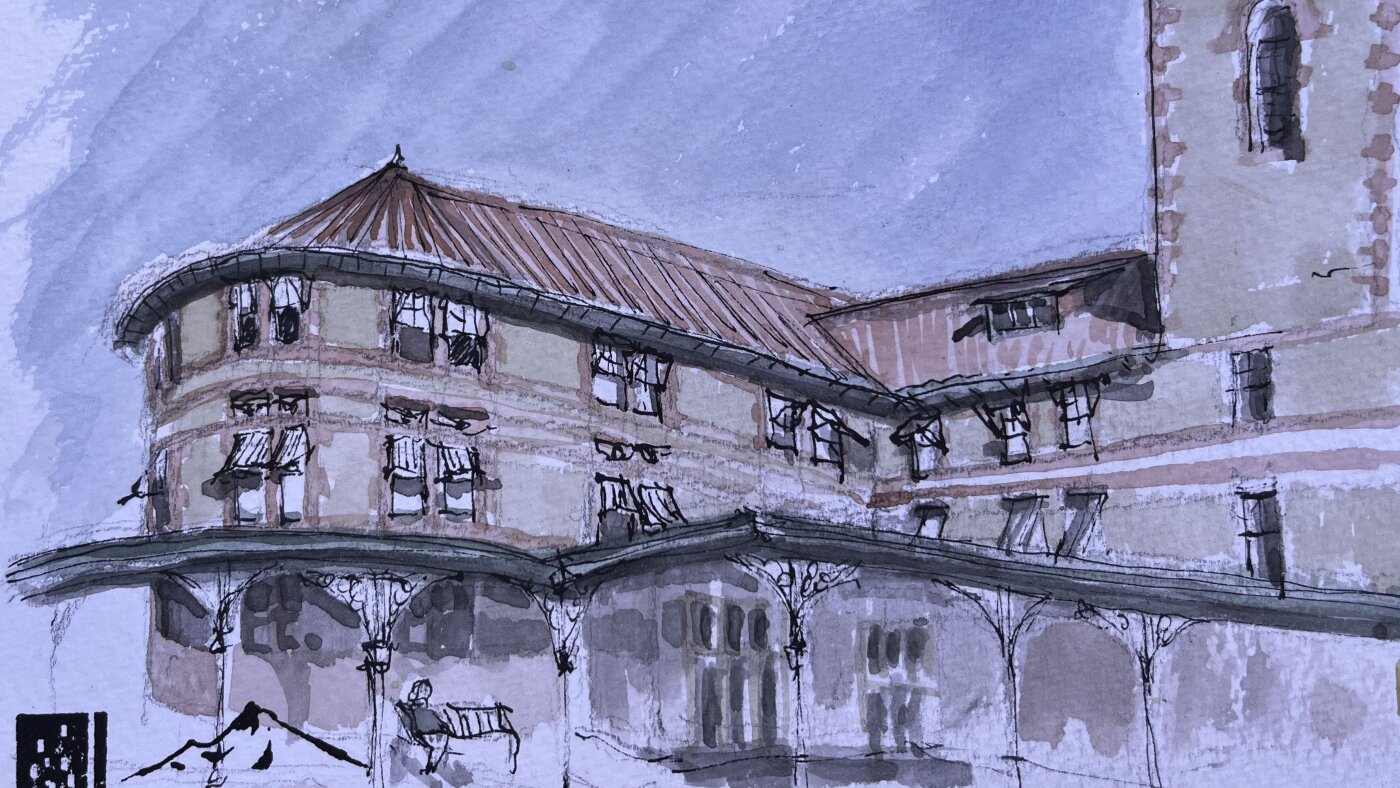
Portland’s Union Station, captured in watercolor and pen by an artist at the Urban Sketchers Portland event.
Deena Prichep
hide caption
toggle caption
Deena Prichep
Great landscape art can take you into a world: the majestic hills of Georgia O’Keeffe’s Southwestern sublime; the pastoral calm of Monet’s water lilies. But for years now, groups of amateurs have been gathering with sketchbooks in cities across the world to turn their artistic gaze to the everyday sights of skyscrapers and sidewalks — and find beauty there.
The idea of “urban sketchers,” or the name at least, started almost 20 years ago. Gabriel Campanario was looking to get to know his new home — and improve his drawing skills.
“We had just moved to Seattle, and I started drawing. Like every day I drew the commuters on the bus, I would draw the mountains, the buildings,” remembered Campanario.
He posted his drawings on the website Flickr and invited other artists to join the online group, which led to in-person groups. And then more chapters, and then international gatherings. Urban Sketchers now reports more than 500 chapters in over 70 countries.
“You can go to another town and meet up with a Sketchers group there,” said Campanario. “And you may not speak the language, but they all can look at your sketchbook and somewhat relate.”
Urban Sketchers Portland was one of the earliest chapters. They meet up monthly. Amy Stewart is one of the organizers.
“We’ll just pick a different neighborhood to explore, where we might be drawing old houses, or little corner markets, or maybe there’s a cool old movie theater to draw,” said Stewart.
Stewart is a writer by profession and says a lot of the sketchers who show up (usually about 50 or so) are similarly amateurs, along with a few more-experienced artists.

Karen Hansen, who discovered Urban Sketchers last year, came prepared with a folding chair and a magnetic watercolor paint palette, so she could pop in the colors she wanted to use for today’s painting.
Deena Prichep
hide caption
toggle caption
Deena Prichep
At a recent meetup at Portland’s Union Station, self-described recovering architect Bob Boileau appreciated that after a career spent drawing straight lines, “It’s nice to just get some squiggly in there and, and put some color and draw how I feel.”
Others, like sketcher Karen Hansen, noted that stopping and really paying attention to a scene helped her see the details that she had taken for granted in everyday life.
“When you’re drawing and painting something, you’re really looking at the shapes and the shadows and the textures,” said Hansen.
At the Portland meetup, sketchers were gathered in little clusters around the train station, capturing its red bricks and tall clock tower with watercolors, or pen and ink, or colored pencils.
It’s arguably not as majestic as most rural landscapes, but Noor Alkurd, drawing at his second Urban Sketchers meetup, said that the boxes and lines of cities are great for beginning artists. And besides, landscapes are overrated.

Urban Sketchers events end with a “throwdown,” where all the artists lay out their sketchbooks and share their work with each other.
Deena Prichep
hide caption
toggle caption
Deena Prichep
“I mean, come on — cityscapes are so fun!” Alkurd said with a laugh. “I think drawing has helped me just see more of everyday life. It kind of helps you train your own eye for what you find beautiful.”
At the end of the sketch session, all of the participants laid their finished art side by side to compare and admire.
There was some shop talk among sketchers about technique and materials, and some recognition of progress for sketchers who had been coming for a while. But mostly, sketchers said it’s just a chance to create a record of a moment, to take in other perspectives, and to notice a little bit more about the city they see every day.

Marilyn Monroe
Former Palm Springs Home Lists For $3.3M!!!
Published
If you ‘Like It Hot’ and ‘Prefer Blondes’ — and have $3.3 million — boy do we have the house for you! Marilyn Monroe‘s former Palm Springs home just hit the market.
Located in the iconic Vista Las Palmas neighborhood of Palm Springs, California … this internationally recognized architectural residence — known as the Marilyn Monroe Doll House — occupies a rare elevated lot with sweeping mountain views.

This majestic pad encompasses just under 3,000 square feet, featuring 4 bedrooms, 4 bathrooms, vaulted ceilings, multiple entertaining spaces and a private pool.
And the neighborhood is swanky! Residents enjoy immediate access to acclaimed restaurants, boutique shopping, art galleries and resort amenities.
Marilyn lived at the property in the early 60’s, but it’s currently owned by the founder of M Star Studios Nick Adler.
The property is listed by David Emerson at Coldwell Banker Realty.
TMZ.com
David tells TMZ… “Marilyn Monroe remains one of the most recognized figures in the world, and this home connects people to that legacy in a tangible way. It is a place where Hollywood history and Palm Springs lifestyle meet, framed by timeless Midcentury architecture, expansive mountain views, and the iconic setting of Vista Las Palmas.”

Of course now was the moment for a Charli xcx-assisted ‘Wuthering Heights’: Pop fandoms and literary ones have rarely had more in common
Charli xcx’s original soundtrack serves as a kind of secondary narrator for Emerald Fennell’s adaptation of Wuthering Heights. The film arrives in a landscape where the fan cultures of pop music and romance literature have already been intertwining in striking ways.
Paul Kooiker
hide caption
toggle caption
Paul Kooiker
This essay first appeared in the NPR Music newsletter. Sign up for early access to articles like this one, listening recommendations and more.
This past Valentine’s Day weekend, a common sight in the usual places where hand-holding pairs wander on afternoon dates broke the mold for conventional coupling: groups of young women celebrating the holiday in the spirit of both romance and friendship. They entered theaters bearing popcorn and tissues, ready for a group cry to Emerald Fennell’s florid cinematic update of Emily Brontë’s foundational anti-romance, Wuthering Heights. And in the romance-oriented bookstores increasingly popping up across America, they shopped together for spicy novels about hockey players coming to terms with their mutual attraction or dragon riders stealing kisses while saving their kingdoms. Someone running across a phalanx of these self-professed “book nerds” wouldn’t be wrong to sense a connection to 21st century pop music fandoms, the social networks supporting artists like Taylor Swift or Charli xcx. Bookstores with names like Slow Burn or Lovestruck sell bookmarks or other trinkets emblazoned with Swift lyrics alongside those with quotes from leading romantasy author Sarah J. Maas. One I recently visited in Nashville had heartthrob-themed votive candles for sale on the counter, featuring Wuthering Heights star Jacob Elordi, perennial internet’s boyfriend Pedro Pascal — and Bad Bunny. Pop icons can serve as ideal Male Main Characters alongside the usual movie stars.
Fennell understands how this decade’s resurgence of interest in literary love stories is connected to the phenomenon of music fans forming robust communities. Most pop hits are love stories, after all, and in the minds of romance readers, music plays behind each climactic kiss. In Wuthering Heights, with its Harlequin-cover imagery and a contemporary take on Brontë’s twisted, infernal view of erotic desire that turns it into 50 Shades of Victorian Fog, Fennell creates a setting that’s as much about today’s fashions and pop references as it is about the muck and intrigue of Brontë’s time. Doing so connects this Wuthering Heights with the bibliophile demographic that’s inseparably intertwined with the Swifties and Angels and other robust pop affinity groups that have redefined 21st century consumer culture. She even commissioned Charli xcx to write songs for the film, a challenge the inventor of Brat Summer eagerly accepted as a way to step aside from her club and drug era and into something more redolent of history and high art. Having closed the door on pop stardom temporarily with her pseudo-documentary film The Moment, the always experimental diva declared herself inspired by Velvet Underground violist and general art god John Cale’s description of his legendary former band’s music as “elegant and brutal,” a blend she hoped for on this new project. Her collaboration with Cale, the tone poem “House,” emulates Cale’s way of blending classical tropes with Leonard Cohen-like rock balladry. Its use in the grisly-sexy opening scene of Wuthering Heights sets the film’s mood as pure pop — grounded in pastiche and anachronisms, unconcerned with formal or historical accuracy, dedicated to bringing its story into the present moment.
YouTube
The album Wuthering Heights is a circuitous journey, really a series of approaches to the inner world of Catherine Earnshaw, an anti-heroine whom Charli clearly finds sympathetic if sometimes also pathetic. Fitting its role as both part of and companion to the film (all three singles from the album get screen time, though folk songs and a deliberately sentimental score by Fennell’s longtime collaborator Anthony Willis more openly advance the plot), it alternates fully formed singles with short set pieces that sonically answer the lushly creepy imagery Fennell favors. There is one banger, the Eurodisco redux “Dying For You,” which taps the dopamine vein in romantic suffering. The strings-driven pop of “Seeing Things” suggests what Charli’s former friend Taylor Swift might have done with this story, but most of the album is far murkier and more fatalistic than anything that usually makes today’s pop charts. It’s closer to Charli’s own formative hyperpop forays, and to the post-punk experiments that leaked into the mainstream back when Kate Bush, music’s eternally unrivaled Brontë interpreter, wrote her 1978 breakthrough fantasia named after the novel.
While nothing on Charli’s album reaches the great Kate’s apex of enthrallment and abandon, she does connect with the spirit of those days when new wave was new and arty girls and boys were making grand gestures, from Pat Benatar’s rock to the maudlin lyricism of synth-driven bands like Talk Talk. On the impeccable playlist that Charli assembled for Spotify with help from Fennell, dream pop originators Cocteau Twins sit next to David Lynch soundtracker Julee Cruise, original abject rocker Iggy Pop, cloud rapper Yung Lean and costume punks Shakespears Sister. The playlist’s motivation resembles that of Charli’s original music, and Fennell’s film: to yank the gothic out of any one period, be it the 19th century or the 1980s, and follow its dim light through all kinds of sonic passages.
While sticklers for historical accuracy have found much to criticize in Wuthering Heights — despite the stylized scare quotes reinforcing Fennell’s insistence that her Heathcliff and Cathy are constructed from her own reference points alone, debate has raged about everything from Heathcliff’s racial identity to whether this is a love story at all — it is, in fact, tailor-made for the blissfully recombinant world of current romance reading. Enter a bookstore with a spicy focus and you’ll discover myriad variations on what the critic Shawna Lipton called “the bodice-ripper rebrand,” from updates on all-American faves like cowboys and quarterbacks to “dark romance” set in libraries and castles, sci-fi crossovers, and explicit quests to figure out the anatomy of sex with monsters, fairies or werewolves. Music occasionally becomes the subject of these novels, with aspiring songwriters and bad-boy rockstars serving as main characters. But whether it’s a plot point or not, choosing music to read by and to flesh out further dreams about their favorite characters is a major aspect of romance readers’ leisure time.
While I waited for the release of Wuthering Heights, I grew curious about the intersection of reading and listening to music at a time when high romance has taken over far more than Emerald Fennell’s fancy. I cast my net for other playlists and discussions about music to read by. I found much more than I expected — and frankly, I expected a lot. While my own taste in genre fiction runs more to murder than romance or fantasy, I’m fascinated by the burgeoning subcultures keeping bookstores — and, arguably, publishing — alive through their avid pursuit of all things wild, dark and spicy. What I’ve learned in my limited research is that these intersecting communities of readers do much more to celebrate their affinities than drop reviews on Goodreads; for many, reading is the heart of a sparkling creative lifestyle. And music is a big part of the cozy bibliophile’s world.
Besides Charli’s official playlist, for example, dozens of user-generated Wuthering Heights playlists appear across streaming services, most of which predate the existence of Fennell’s film. Dozens more surface in a simple search for “reading” and “romance,” with titles like “Booktok songs that destroy me,” “POV: a vampire is in love with you” and “reading cute romance books at 1 a.m.” A whole subset of playlists is designed to soundtrack specific books or series. Attached to this playlist-making surge is the use of music on #BookTok, where certain songs and artists become deeply linked with the novels and series fans celebrate. Some musicians are learning to take advantage of this connection: the Irish singer-songwriter Dermot Kennedy, for example, is often cited on Reddit as a bibliophile favorite, and maintains an Instagram “book club” where fans can see what he’s got on his own bookshelf. Literary websites also often make playlists devoted to a particular genre or author, some historically accurate (Jane Austen playlists abound, focusing on the music of Regency England) while others are more like fan lists — which, like Charli’s album, range freely throughout genres and periods.
Among lovers of contemporary genre fiction, certain musical styles have gained favor. Progressive metal, for example, syncs up well for readers of stories about fairies and dragons. A Reddit thread tagged “Sleep Token + Romantasy = Perfection” has readers matching songs by that popular if critically unloved band to various MMC’s, or male main characters. Some participants in the thread went so far as to connect specific scenes with passages in Sleep Token songs, and vice versa. “I literally just requested a book rec where the relationship feels like 4:15 to 5:20 of ‘Emergence,’ ” one fan wrote, citing a particularly bombastic, drum-driven climax. Other frequently cited metal and adjacent bands include the Deftones and the symphonic Nightwish.
YouTube
The metalheads I know are uniformly bookish, so this alignment doesn’t surprise me — but if I’m being honest, nods go far more frequently to balladeers who fit the MMC mold, like Kennedy, Alex Warren and the lord of them all, Hozier. Playlists vary by genre according to who’s reading. Adjacent to romance are sci-fi authors like Nnedi Okorafor, whose followers bring an Afrofuturist sensibility to their playlisting, favoriting techno-savvy musicians like Sudan Archives. My NPR Music colleague Nikki Birch is a major fantasy fan, and she polled her friend group of BIPOC romance and fantasy fans for their picks. They listed a lot of classic R&B — Sade, Maxwell, Luther, Janet — alongside some jazz and contemporary classical artists like Tony Ann. There’s definitely a subset of bibliophiles who prefer instrumental music to read by, and a cohort of classical-lite composers and instrumentalists like Ann, Joel Sunny, Kelsey Woods and Taylor Ash have found success connecting with these listeners. Ash even has a lush, synth-driven song called “A Court of Thorns and Roses.”
Most often, readers sharing music through playlists and forums cite women as their musical inspiration. Florence Welch deserves special mention, not only because her Pre-Raphaelite persona predated the romantasy craze and probably helped feed it, but because she has written songs inspired by the works of Shakespeare, Virginia Woolf and Kazuo Ishiguro. (Florence’s fans made a book club in her honor, Between Two Books, focusing on her favorites but eventually expanding to include an array of contributors.) In the past year, a new rival has emerged for Florence’s crown among book lovers: Paris Paloma, whose fans attend her concerts wearing hodgepodge period garb and dance in “fairy rings” after each show. Paloma’s 2023 song “Labour” swept across social platforms as a rallying cry for Gen Z women discovering, and enraged by, the double standard of work in many heterosexual relationships. As Paloma put it, “All day, every day, therapist, mother, maid / Nymph, then a virgin, nurse, then a servant.”
Last year, Paloma released a short film celebrating her fans; as images of shouting, smiling young women turned toward each other fill the screen, the songwriter intones, “At every single show, every night, I’m reminded of the power we have in our community and solidarity with each other.” This feminist pronouncement recalls the way romance readers talk about their bonds. As with many pop worlds, this one does break down into identity clusters — most of Paloma’s fans are white, as is the public face of the cozy bibliophile craze. BIPOC writers and readers of romance and fantasy are claiming space in bookstores and online, however, and, as I noted above, making their own playlists. One interesting subset of musicians who frequently appear on romance readers’ lists consists of Black and brown artists whose music defies easy categorization. FKA twigs, Spellling and Doechii, all artists who entertain the fabulous within their music, show up on many playlists.
The most recent artist to enter this space is Hemlocke Springs — the performing alter ego of Isimeme “Naomi” Udu — whose rococo dance-pop has won a strong fanbase among bibliophiles. Her just-released debut album the apple tree under the sea includes “sever the blight,” a truly gothic account of erotic thrall that, unlike most attempts to glom on to her glory, captures the nervous magic of Kate Bush. With a Game of Thrones-meets-Guy Maddin video that fully locates its story in a non-white universe, recalling Doechii’s fever dreams, and lyrics that infuse the gothic with intersectional awareness (“You see, I’m not Snow White / The fairest of our land,” Udu sings, Heathcliffing it up), “sever the blight” takes pop romantasy in a promising new direction.
As Emerald Fennell certainly understands, romance novels restage women’s fight for independence within environments far more exciting than the offices and apartments where readers might be living through similar power dynamics. The theatrical pop songs of artists like Paris Paloma and Hemlocke Springs do the same, adding a supernatural kick to the often frustrating struggles of women’s daily lives. Emily Brontë showed her genius for confronting the tangle of gender, class and racial hierarchies within a classic ghost story when she wrote Wuthering Heights; no matter how campy or sexy or pastiche-y a contemporary reinterpreter renders her tale, that mess, which we as humans are perennially trying and failing to clean up, lies at the heart of it.
Romance novels both acknowledge this human predicament and allow for some escape from it. Fantasy takes readers to another plane. Wuthering Heights, as an historical text with supernatural elements, addresses real inequities and oppression within a heightened framework. The dislocated music Charli xcx brings to Fennell’s version of the tale further destabilizes a story that has rattled readers for two centuries. But even in a far more comprehensible romance, the sensory immediacy of music can evoke and intensify an emotional shift in ways that up the stakes both within a story and beyond it. Bibliophiles creating needle drops to soundtrack their reading experiences subtly change the meanings of both the books and the songs they bring together.
This can happen in other media, too: Just consider Heated Rivalry, the homoerotic hockey drama that was also pulled from the bookshelf, and which has become streaming culture’s latest major thirst trap. That show’s revival of the 20-year-old Wolf Parade song “I’ll Believe in Anything” is a perfect instance of a needle drop enhancing high romance; playing behind a cathartic embrace that changes its main characters’ lives, the song conveys the queasy interplay of urgency and fear that Charli xcx captures differently in her Wuthering Heights songs. “Give me your eyes, I need sunshine,” sings Wolf Parade’s Spencer Krug, “your blood, your bones, your voice and your ghost.” What was it that Heathcliff said? “Haunt me, then!” Call it love or desperation — desire can feel this way. Like a chorus that doesn’t fade.
YouTube

Lake Of Nightmares: Jennifer Van Gesell’s ‘WATER HORSE’ (2024) – Movie Review – PopHorror

‘Peaky Blinders’ Movie Trailer: Cillian Murphy’s Tommy Shelby Goes to War Against His Son, Played by Barry Keoghan

Video: What to Know About Trump’s ‘Board of Peace’
Urban sketchers find the sublime in the city block

It’s MAGA v Broligarch in the battle over prediction markets

Florida High School Football Rankings: Top 25 teams – Oct. 21

Cleary's 21 help Le Moyne down Central Connecticut State 69-64 in OT

How old is Bo Nix? What to know about Oregon quarterback ahead of 2024 NFL Draft

99th annual Pony Swim held in Virginia

Indiana Members Credit Union announced as new anchor tenant at Bottleworks District

DC Mayor Bowser declares emergency over Potomac sewage spill, asks for federal help

Israel installed security at Epstein’s Manhattan apartment for ex-PM Barak

Iran and the US lean into gunboat diplomacy as nuclear talks hang in balance

Democrats risk FEMA disaster funding collapse as DHS shutdown hits Day 5

Fact check: Will Spain’s regularised migrants be allowed to vote?
-

 Illinois1 week ago
2026 IHSA Illinois Wrestling State Finals Schedule And Brackets – FloWrestling
-

 Culture1 week ago
Try This Quiz on Passionate Lines From Popular Literature
-

 Oklahoma1 day ago
Wildfires rage in Oklahoma as thousands urged to evacuate a small city
-

 Health1 week ago
James Van Der Beek shared colorectal cancer warning sign months before his death
-
![“Redux Redux”: A Mind-Blowing Multiverse Movie That Will Make You Believe in Cinema Again [Review]](https://i1.wp.com/www.thathashtagshow.com/wp-content/uploads/2026/02/Redux-Redux-Review.png?w=400&resize=400,240&ssl=1 "“Redux Redux”: A Mind-Blowing Multiverse Movie That Will Make You Believe in Cinema Again [Review]")
![“Redux Redux”: A Mind-Blowing Multiverse Movie That Will Make You Believe in Cinema Again [Review]](https://i1.wp.com/www.thathashtagshow.com/wp-content/uploads/2026/02/Redux-Redux-Review.png?w=80&resize=80,80&ssl=1 "“Redux Redux”: A Mind-Blowing Multiverse Movie That Will Make You Believe in Cinema Again [Review]") Movie Reviews1 week ago
Movie Reviews1 week ago“Redux Redux”: A Mind-Blowing Multiverse Movie That Will Make You Believe in Cinema Again [Review]
-

 Technology1 week ago
HP ZBook Ultra G1a review: a business-class workstation that’s got game
-
 Science1 week ago
A SoCal beetle that poses as an ant may have answered a key question about evolution
-
 Politics7 days ago
Culver City, a crime haven? Bondi’s jab falls flat with locals