News
Zuckerberg grilled about Meta’s strategy to target ‘teens’ and ‘tweens’


Meta CEO Mark Zuckerberg arrives at the Los Angeles Superior Court ahead of the social media trial tasked to determine whether social media giants deliberately designed their platforms to be addictive to children on Feb. 18, 2026. Zuckerberg is scheduled to testify Wednesday.
Frederic J. Brown/AFP via Getty Images
hide caption
toggle caption
Frederic J. Brown/AFP via Getty Images
Meta CEO Mark Zuckerberg was clearly getting testy.
“That’s not what I’m saying at all,” said the tech billionaire. “I think you’re misunderstanding what I’m saying,” Zuckerberg responded. “You’re mischaracterizing what I’m saying,” he shot back.

The executive was testifying on Wednesday before a jury in Los Angeles in a marquee social media trial accusing Meta of deliberately designing features of Instagram to addict children, and the legal team for the family suing was intent on showing that Zuckerberg’s fingerprints were all over the company’s big decisions.
Mark Lanier, a Texas trial lawyer and pastor with a folksy courtroom demeanor, directed Zuckerberg’s attention to a 2020 internal Meta document showing that 11-year-olds were four times as likely to keep coming back to Facebook, compared to older users. Instagram’s minimum age for signing up is 13.
“People who join Facebook at 11 years old? Lanier asked Zuckerberg. “I thought y’all didn’t have any of those?”
Lanier then went over Meta internal documents highlighting goals to increase the time 10-year-olds spend on Instagram.
“I don’t remember the context of this email from more than ten years ago,” Zuckerberg said. “I think the way we should build things is to build useful services for people to connect with their family and friends and learn about the world.”
One 2018 internal Meta document stated “If we wanna win big with teens, we must bring them in as tweens,” Lanier pointed out, saying that undercut Meta’s own policies.
The legal team representing the plaintiff, a 20-year-old California woman known in court documents as “Kaley,” attempted to demonstrate that the top-down goal of Meta has always been to encourage users to get on their platforms as young as possible, and once there, to figure out ways to keep them around. Often features like “beauty filters,” made the app more alluring, Lanier argued.
When the company hired experts who affirmed that such appearance-enhancing filters contributed to body-image issues among young girls, Zuckerberg would not dispense with the filters tools, calling getting rid of them was “paternalistic.”
Under questioning in court, the billionaire Facebook founder responded: “What we allowed was letting people use those filters if they wanted but deciding not to recommend them to people,” he said. “So that was the balance we came to to let people express themselves the way they want.”
Kaley, who’s also identified as KGM in court documents, often used these filters, which her lawsuit says contributed to body dysmorphia and other mental health issues.
Had Zuckerberg looked at Kaley’s Instagram posts before the trial, Lanier asked? His staff had shown him some, he responded.

Files are brought inside the Los Angeles Superior Court on Feb 18, 2026 as part of a major trial involving Meta and Google over whether their products harm young people.
Jill Connelly/Getty Images
hide caption
toggle caption
Jill Connelly/Getty Images
That’s when Lanier, who is known for orchestrating spectacles at trial, had five lawyers unspool a roughly 20-foot collage of hundreds of photos that Kaley posted to Instagram. Lanier implored Zuckerberg to dwell on the posts. Other observers in the room, including the media, were not able to see the photos.
When it was time for Meta’s lawyer to ask Zuckerberg questions, he emphasized that the company does not have an incentive for people to have harmful experiences on its services.
“From a business perspective, people think if we maximize the amount of attention people spend, that that’s good for us,” Zuckerberg said. “But if people feel like they’re not having a good experience, why would they keep using the product?”
Keeping users safe, especially teen users, has always been a priority, Zuckerberg said.
“Questions about well-being I consider part of this for sure,” he said. “If you build a community and people don’t feel safe, that’s not sustainable and eventually people go and join another community.”
1,600 other plaintiffs
The appearance of Zuckerberg, the star witness of the trial, came in the second week of what’s expected to be a six-week proceeding. Other tech executives, social media specialists, addiction experts and others have also testified.
Kaley, the plaintiff, is expected to deliver the most emotional testimony later in the trial. Her lawsuit claims she began using social media at age 6, including YouTube, Instagram, TikTok and Snap. After becoming hooked on the platforms, she said her body image issues, depression and suicidal thoughts worsened. The suit points to features like beauty filters, infinite scroll and auto-play as being tantamount to a “digital casino.” Evidence of the harms of these features were concealed from the public, the lawsuit says.

Julianna Arnold, whose daughter died from fentanyl she bought from someone on Instagram, talks about watching Mark Zuckerberg testify outside the Los Angeles Superior Court on Feb. 18, 2026.
Jill Connelly/Getty Images
hide caption
toggle caption
Jill Connelly/Getty Images
In response, Meta and Google, which owns YouTube, have said the accusations over-simplify the complexity of adolescent mental health issues. The companies argue social media use does not directly cause young people to be mentally unwell, so they should not be held legally liable for a user’s mental health struggles.
Kaley’s legal team called expert witnesses who described multiple studies linking regular social media use with worsening depression, anxiety and body image issues.
The jury will determine to what degree social media platforms should be held legally culpable for plaintiff Kaley’s struggles. The trial is a bellwether case tied to 1,600 similar suits filed by families and school districts. How the jury decides is expected to influence settlement talks in all those pending cases.
While debates about social media addiction have raged for decades, it has taken until now for a major trial on the issue to unfold largely due to a federal legal shield that has protected Silicon Valley. A law known as Section 230 of the 1996 Communications Decency Act has allowed tech companies to fend off lawsuits over what users post to their sites. Social media firms have also won legal battles, including a key Supreme Court case, that have found how companies curate content on platforms is a type of protected free speech.
Despite these protections, the plaintiff’s lawyers in the Los Angeles case found a way to legally attack tech giants: by treating social media apps as unsafe products, viewing Instagram, YouTube and other services as defective under product liability law. The argument is that tech companies deliberately designed social media sites as harmful and dismissed internal warnings that the services could be problematic for teenagers.
The jury will ultimately have to assess Zuckerberg’s credibility, which was under attack on Wednesday.
Lanier, Kaley’s lawyer, brought up an internal document showing how Meta communications staffers have pushed Zuckerberg to portray himself as more “human” and “relatable,” and “empathetic, and less “fake,” and “corporate,” and “cheesy.”
When questioned about his performance in various other public settings, whether in courtrooms or before Congress, Zuckerberg showed some humility.
He said: “I think I’m known to actually be pretty bad at this,” which drew some laughter from the courtroom.


The nation’s capital may be the focal point of the 250th Independence Day celebration, but people all across America have plans to mark the occasion, from boisterous public parades to quiet personal reflections on history.
Julia Demaree Nikhinson/AP
hide caption
toggle caption
Julia Demaree Nikhinson/AP
As the United States turns 250 years old, Americans across the country are spending the holiday thinking about what the big birthday means to them, with reflections and celebrations as diverse as the nation itself.
NPR’s member station reporters fanned out to collect snapshots of the occasion from sea to shining sea.
In one ‘City of Presidents,’ Main Street is decorated for a party
At least two cities in the U.S.call themselves the “City of Presidents” and Cuba City, in Wisconsin, is one of them, largely due to its patriotic Main Street decorations. Every year from Memorial Day through Veteran’s Day, red, white, and blue shields, one for each U.S. president, are prominently displayed high up on the light poles lining Main Street.
It’s a tradition that began in 1976 to commemorate the country’s bicentennial, says Donna Rogers, who is president of the ongoing project but admitted that when it first started, she wasn’t particularly tuned-in to the display.
“I was raising three little boys and working at John Deere, so I didn’t really pay too much attention to community service at that time,” she said.
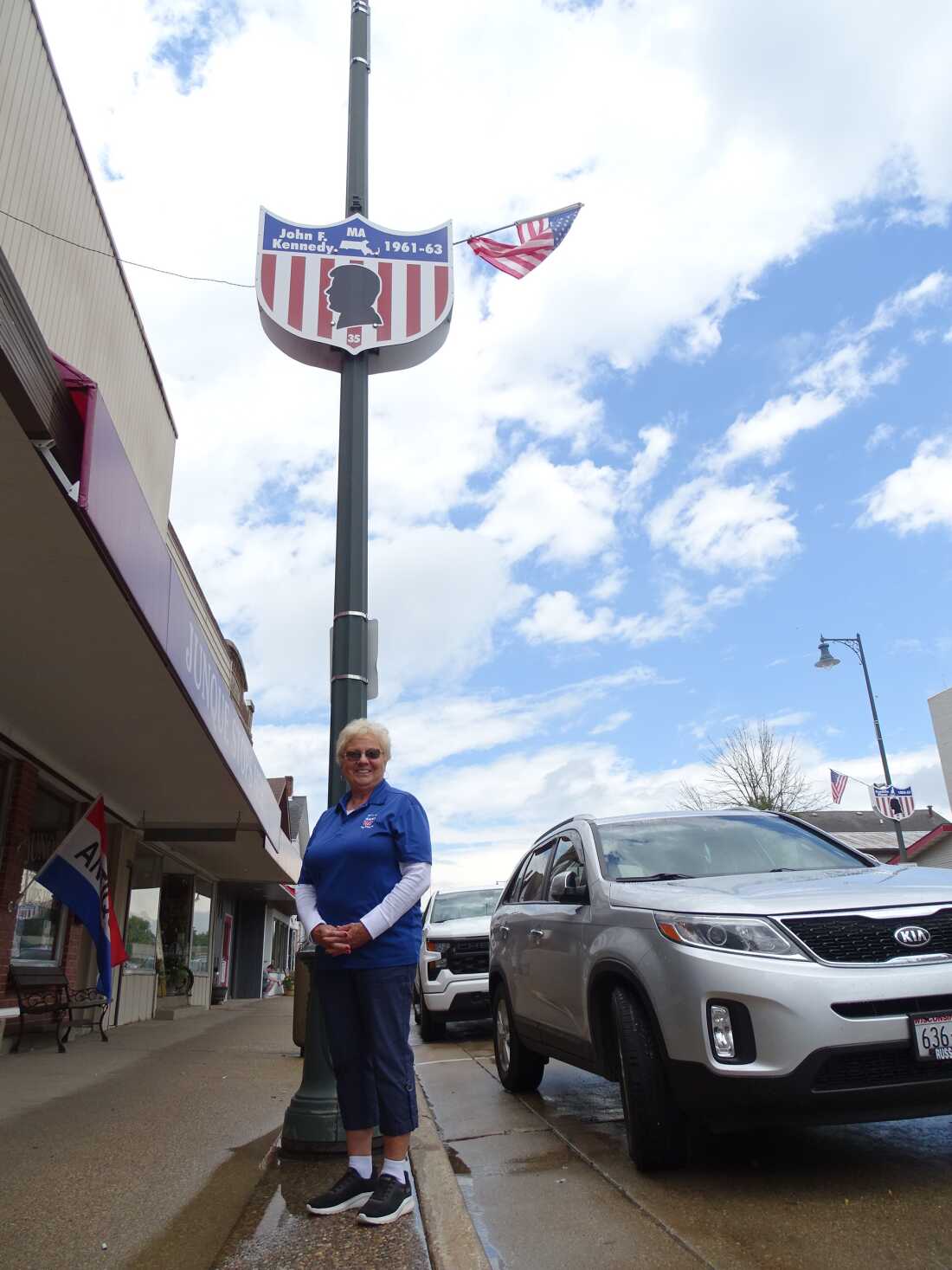
Donna Rogers shows off one of Cuba City’s presidential lampposts.
Susan Bence/WUWM
hide caption
toggle caption
Susan Bence/WUWM
A few years later, she was tapped to help keep the initiative alive.
When she thinks of the country’s history, she says the signing of the Declaration of Independence and abolition of slavery top her list, plus a current event–
“Of course, now, our nation’s 250th birthday. I think those three would be the three most important things in history to me,” she said, quickly adding “[the] right for women to vote, don’t forget that, right?”
Rogers and Cuba City are pulling out all the stops for the 250th, with a parade and a mac-and-cheese festival, because “that was some of our founding fathers favorite foods, along with turkey and cranberries and other items.”
She laughed and admitted she googled that. True or not, Rogers says they’ll go all-out to celebrate the 250th in her “City of Presidents”.
WUWM’s Susan Bence reported from Cuba City, Wisconsin.
In Georgia, a civics competition inspires hope for future generations
At the Georgia state finals of the National Civics Bee, middle school students were peppered with questions about the U.S. government.
Like this one: why is a single energetic executive desirable?
The answer: it promotes accountability and decisive leadership.

9th grader Ella Hummel got it right.
“I’ve always kind of had the idea of serving in politics,” she said after the competition. “And I really think that civics has opened my mind.”
Ella will advance to the civics bee finals later this fall, with her grandmother, Peggy Farmer, cheering her on. Farmer remembers the excitement around the bicentennial in 1976, but said she feels a different energy around this year’s anniversary.
“It’s a togetherness type of thing that’s really not around all the time now,” she mused. “I think it’s just the world’s changed a lot.”
But there is something Farmer will celebrate about America on this Independence Day: her grandkid, the Georgia Civics Bee Champion.
“Maybe she and the kids that was sitting up there, they can change [the country] a little bit. I mean, they seem to be having a ball with each other up there today, so that’s a good thing.”
GPB’s Sofi Gratas reported from Atlanta.
In Texas, appreciating the process of patriotism

Rodney Ellis, who has served 43 years in public office, is guardedly optimistic that America will stay on a path towards progress.
John Burnett
hide caption
toggle caption
John Burnett
Rodney Ellis will celebrate at picnics around his precinct in Houston with barbecue pork ribs and ice tea, and a heaping helping of worry about the nation’s future. The tall, garrulous 72-year-old county commissioner is guardedly patriotic.
“We should be celebrating that America is a process,” he said. “Patriotism is telling the truth, and doin’ the work to repair the harms that have come about over these 250 years.”
The son of a maid and a landscaper, Ellis has served 43 years in public office, first as a Houston city councilman, then state senator, and now as a Harris County commissioner.
Fifty years ago, during the bicentennial, Ellis was a public affairs graduate student at the University of Texas in Austin. In 1976, there were 18 Black representatives in Congress; today there are 67.
“We’ve made tremendous progress since then, tremendous gains,” he said. “And so when I compare what was happening then to what’s happening now, I look at how quickly a lot of those fundamental rights, those gains that we’ve taken for granted have rolled back so quickly.”
He ticked off areas where he believes America has lost ground: clean air and clean water, people of color in key positions in government, owning up to uncomfortable U.S. history, and selfless public service.
But, said the commissioner with a broad grin, that’s how it’s always been in America.
“Progress is made but along the way sometimes you take two steps forward and 10 steps back, but you don’t give up.”
John Burnett reported from Houston, TX.
In Milwaukee, Fourth of July tacos with a big helping of pride

Gissell Vera is proud to be both American and Mexican. She plans to celebrate both of her cultures with a Fourth of July carne asada cookout.
Maayan Silver/WUWM
hide caption
toggle caption
Maayan Silver/WUWM
Gissell Vera ordered carne asada tacos on her favorite patio in Milwaukee, a vibrant spot punctuated with strings of international flags and a steady cumbia drumbeat.
“The music, the colors, the language, all of it is part of me and I am a proud American,” she said.
Vera is a U.S. citizen from a mixed status family; her parents emigrated from Veracruz, Mexico.
“My family has particularly always been grateful for this country and the opportunities that it’s provided us,” said the 25 year-old. “Although there is always the fear and uncertainty of what immigration reform could, how it could impact us, we choose to live every day without fear.”
Vera said there’s a phrase she’s heard many immigrants use to describe their relationship to the United States, “ni de aquí ni de allá,”, meaning ‘neither from here or there.’
“It’s almost like a limbo in which we existed,” she explained. “And I think that now I’m very proud to say that I am ‘de aquí’ and ‘de allá’. So I am proud to be from here and from there.”
She said she’ll join her family for a cookout to celebrate America’s 250th birthday, but instead of hot dogs, they’ll be grilling carne asada.
WUWM’s Maayan Silver reported from Milwaukee.
In the Mountain West, a closer look at a national myth
As America turned 250 this year, historian Megan Kate Nelson used the occasion to take a closer look at a foundational myth of the country’s history and ask, “what stories do we carry forward?”
Her new book ‘The Westerners’ profiled pioneers who, according to Nelson, don’t fit “the narrative of white Easterners moving westward in covered wagons with a nuclear family in tow, engaging with a series of challenges.”
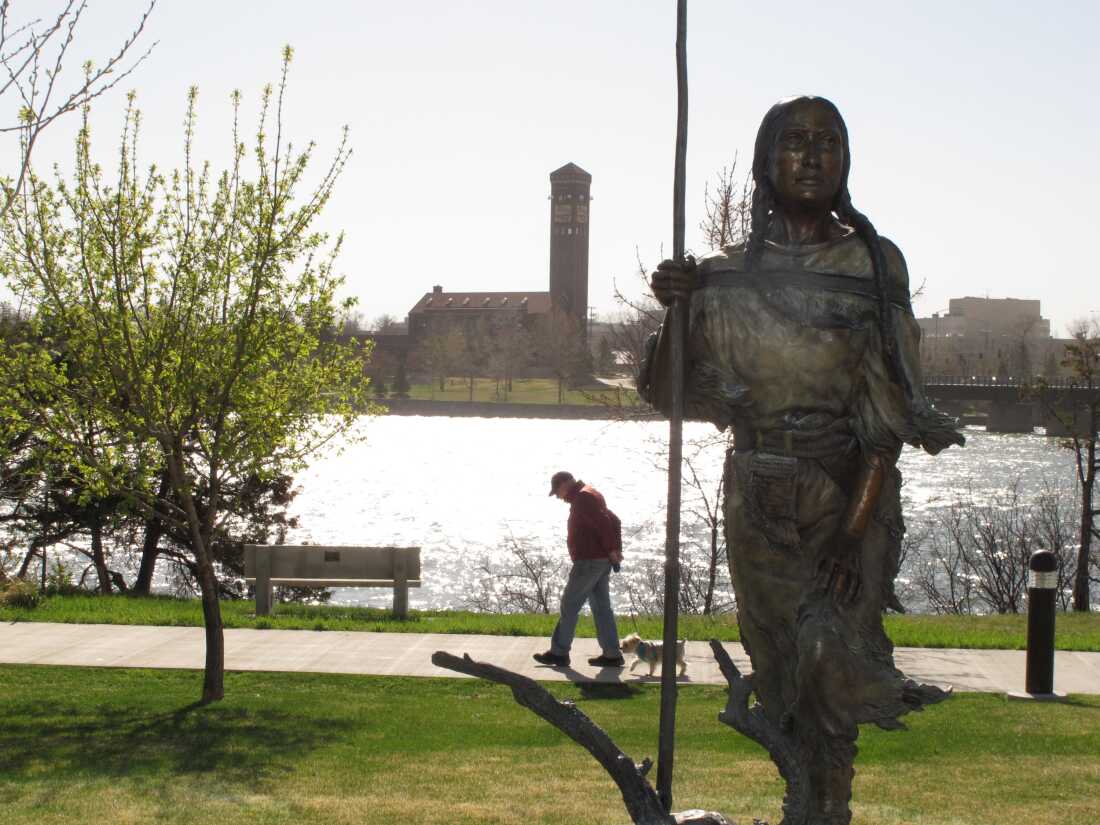
A statue of Sacagawea along the banks of the Missouri River in Great Falls, Mont. Sacajawea was a Lemhi Shoshone woman, who accompanied Lewis and Clark as an interpreter and guide. Her role in the expedition is reexamined in Megan Kate Nelson’s book.
Matt Volz/AP
hide caption
toggle caption
Matt Volz/AP
That includes historical figures like Polly Bemis, who was trafficked from China to the Idaho frontier, and María Gertrudis Barceló, a Santa Fe saloon owner and professional gambler.
Even the well-known figure, Sacagawea, gets another look.
“I read through the Lewis and Clark journals. They mention her more than 150 times, and she is always doing something or saying something,” said Nelson. “My favorite part: when they arrive on the western coast, they set up camp a couple miles away from the ocean, and she yells at William Clark. ‘You are going to take me to go see the ocean! I did not travel all this way not to see the ocean!’”
Nelson said it’s more important than ever to elevate a fuller picture of westward expansion, and to challenge the frontier myth that “there’s only one white pioneer; there’s only one kind of story of American greatness.”
Ryan Warner reported from Crested Butte, Colorado.
In Rhode Island, the parade is nearly as old as the nation itself

Every Independence Day, the yellow stripes dividing Hope Street get a patriotic makeover.
David Wright/Ocean State Media
hide caption
toggle caption
David Wright/Ocean State Media
The town of Bristol, Rhode Island, lays claim to the nation’s oldest Independence Day celebration. This year, they will celebrate America’s 250th with their 241st birthday bash for the country, an effort that brought together over 100 volunteers as part of the Fourth of July committee.
Plans include a parade with at least 34 floats, a golf tournament, a “Miss Fourth of July” beauty pageant, and a gala ball.
Even the double yellow line down Hope Street got its annual red, white and blue makeover for the parade.
For the past decade, Heidi Vermilyea has been in charge of the parade souvenirs, selling hats, t-shirts, and Christmas tree ornaments out of a blue trailer.
“I think I’ve missed the parade once when I was in Europe for the Fourth of July,” Vermilyea admits. “But otherwise, I have been either watching the parade or working the parade my whole life.”
Even when she’s not working the events, she’s decked out in stars-and-stripes, all the way down to her patriotic pedicure.

Heidi Vermilyea runs the souvenir truck for Bristol’s parade every July 4th. But her American flag outfits are year-round display of her patriotism.
David Wright/Ocean State Media
hide caption
toggle caption
David Wright/Ocean State Media
“Politics you can be left, right, moderate, whatever,” Vermilyea explains. “Patriotism is just loving your community. Helping out to make your community, your country a better place.”
The way she sees it, she’s flying the flag for Bristol, her family and friends.
This story was reported by Ocean State Media’s David Wright.
In Oregon, grappling with a complicated history
Some of Mitchell S. Jackson’s fondest childhood memories are of the Fourth of July.
“My mother would always buy me an outfit that had a red, white, and blue color scheme,” Jackson, who is now 50 years old, remembered. “And it was joyous, you know, to don those colors.”
But as the Pulitzer Prize-winning writer grew up, he learned more about America’s history of slavery and racism. Jackson said that made his relationship to his country more complicated, especially after he was convicted on drug and weapons charges as a 21-year-old and imprisoned for over a year.
“I lost my right to vote before I ever voted, before it ever dawned on me that my suffrage was important,” remembers Jackson. “And I would say that that is an American project, that a young Black boy loses his right to vote.”
Jackson said these inequalities, both historical and modern, call into question the very anniversary we’re celebrating.
“When I hear 250, I know that that’s a false number, right?”

Mitchell S. Jackson at the 60th anniversary of the March on Washington. For Jackson, the 250th is not a true celebration of American freedom, since so many people were enslaved at the time.
Erwin JT Trollinger
hide caption
toggle caption
Erwin JT Trollinger
Jackson said that to him, true freedom in America only goes back 160 years, to when the 14th amendment granted everyone equal protection under the law. Or even just 62 years to the Civil Rights Act, which outlawed segregation.
“If you love something, you’re also critical of it,” he pointed out. “You don’t just love it blindly, or I hope you don’t just love it blindly. So if you truly love America, then you gotta tell the truth about America.”
Jackson says there are ways for Black Americans to make the Fourth of July, and America itself, their own. But it’s a group project to understand who we are, and who we’ve been, and who we can become.
Deena Prichep reported from Portland, Oregon.
News
Family-owned company prepares to put on the largest fireworks display in history: “It is the biggest show that we’ve ever done”

Washington — There are fireworks, and then there’s what’s in store for Saturday in Washington, D.C.
When the sun goes down on Independence Day, the skies of Washington are expected to fill with a record-setting 850,000 individual fireworks for a 40-minute spectacle like no one has seen before.
A company called Pyrotecnico will attempt the biggest fireworks show in history, using five generations of family know-how and a background in Super Bowls and large musical acts to help America celebrate its 250th birthday with a bang.
“I mean, it is the biggest show that we’ve done,” Rocco Vitale, president of Pyrotecnico, told CBS News. “…My earliest memories of fireworks displays and doing the Fourth of July was here.”
Pyrotecnico has been planning this year’s show since January, using computers to simulate the display. But now it’s time for the real thing.
Vitale gave CBS News an exclusive look at his not-so-secret weapons: eight barges out on the Potomac River, each one ready to light up the night sky.
“Each firing location has a communication device, and its all set on GPS. And once the time of the show is put into the system, it goes at that time,” Vitale explained.
According to Freedom 250, the organizer of the “Salute to America 250 Celebration & Fireworks” on the National Mall, President Trump will deliver remarks at 9:45 p.m. Eastern Time, and the fireworks display will get underway at 10:45 p.m. The event is expected to draw hundreds of thousands of people.
Join CBS for “The Great American Block Party 250,” a primetime special on Saturday, July 4, hosted by CBS Evening News anchor Tony Dokoupil and Entertainment Tonight’s Nischelle Turner, featuring live musical performances, celebrations around the country, and the largest fireworks show in history in the skies over the nation’s capital. Tune in July 4 at 8 p.m. ET on CBS and stream it on Paramount+ and CBS News 24/7.

A national physician staffing firm tried to take over the contract held by Eugene Emergency Physicians to work in local hospitals. The local physicians used a new state law to oppose the move.
sorbetto/Digital Vision Vectors/Getty Images
hide caption
toggle caption
sorbetto/Digital Vision Vectors/Getty Images
For the latest stories on the science of healthy living, subscribe to NPR’s Health newsletter.
In between shifts in the emergency room, Dr. Dan McGee was in an Oregon courtroom. He was fighting for his practice — Eugene Emergency Physicians (EEP). The group of more than 40 doctors and physician assistants work at multiple emergency departments; it was being replaced by a national company.
“This was big time, David and Goliath stuff,” McGee said. “You see 14 of their lawyers sitting there and you see three of ours.”
Those lawyers argued that ApolloMD, the national company, violated Oregon’s corporate practice of medicine law. The 2025 law bans corporations from taking control of a medical practice’s operations and finances.
The case garnered national interest because Oregon’s new law targets the loopholes large staffing firms have been employing to circumvent state corporate medicine laws.

Money for control
Most states have laws requiring that doctors own medical practices, not corporations. These rules aim to put patient interests ahead of profit motives. Over the last several years, companies have used a model where a doctor technically owns the local practice, but as Erin Fuse Brown, a professor at Brown University, explains, those physician owners are often not involved in care and cede hiring, firing and other operational functions to the corporation.
Fuse Brown said these arrangements are attractive to hospitals because these companies often promise more revenue and take over the responsibilities that come with running an ER.
“There’s worry that these investors or these corporate management companies should not be totally controlling the operations and the clinical decisions of those who are trained to deliver patient care,” Fuse Brown said.
The connection to patient care concerned Dr. Jonas Pologe, who works for Eugene Emergency Physicians, in the Eugene, Ore., area. ApolloMD offered local doctors jobs, but Pologe worried that if he pushed back on decisions ApolloMD made, he could lose work hours.
“There’s certainly a chance that if you make enough of a stink, you think that something needs to change, they can just stop giving you shifts,” said Pologe.

ApolloMD’s CEO, Dr. Yogin Patel, said the group doesn’t infringe on the way its doctors practice. He says the company is being unfairly lumped in with broader concerns over physicians’ feelings of disempowerment at the hands of corporate medical takeovers.
A closely watched experiment
Fuse Brown, policy experts and independent physicians theorized that updating state corporate medicine laws could be a fix to limit the control management companies can exert over medical doctors.
Oregon’s the first state to try this, and the case brought by the Eugene doctors group is the first test of that law. McGee, who leads the Eugene physicians group, says colleagues at other hospitals around the state were literally tuning in to their case.
“You could hear it almost like background music on an elevator,” McGee says he was told. “At key moments, all of a sudden the nurses would break out in a cheer.”
Before any ruling, the hospital system dropped its plan to work with ApolloMD and struck a deal to stick with McGee’s local group of doctors.
“This is a big victory for independent physician groups over corporate medicine,” McGee said. “This is a game changer.”
The American Academy of Emergency Medicine (AAEM) supported the Eugene doctors as part of the organization’s strategy to protect independent practices. The AAEM president, Dr. Vicki Norton, said Oregon has the strongest law in the country.
“This signals that that law works and we need it replicated in other states to really strengthen their corporate practice laws,” said Norton.
California and Vermont have passed similar legislation to Oregon, and lawmakers in other states, including Rhode Island and New Mexico, are considering related bills.
In Virginia, an independent group of ER doctors who were replaced by a large staffing firm is meeting with state legislators to try to change their laws.
Impact on Oregon physicians
Back in Oregon, the open question is about how the law may impact the physician practice market.
A few of the largest companies, Envision Healthcare, TeamHealth and USACS, declined to answer NPR’s questions about whether this case or the new law changed their outlook on investing in Oregon practices.
Opponents of the legislation warned lawmakers that many physician groups depend on outside investment to survive.
-

 Los Angeles, Ca14 minutes ago
Motorcyclist struck, killed by driver making U-turn in L.A. neighborhood
-

 Detroit, MI34 minutes ago
GameThread: Detroit Tigers vs. Texas Rangers, 4:05 p.m.
-

 San Francisco, CA44 minutes ago
Why Vogue World Should Definitely Head to San Francisco Next
-

 Dallas, TX49 minutes ago
Mistake avoided? Cowboys FA signing could’ve been drafted… but fate
-

 Miami, FL56 minutes ago
No Room For LB Ronnie Harrison In Miami?
-

 Boston, MA59 minutes ago
Celtics’ Jaylen Brown trade leaves Boston fans, community feeling bankrupt: ‘A huge void’
-

 Denver, CO1 hour ago
Kalshi Promo Code DENVER: Claim $10 Bonus for July 4th World Cup, MLB Trades – Denver Stiffs
-

 Seattle, WA1 hour ago
Experts release new WNBA predictions for Portland Fire vs. Seattle Storm tonight

