Politics
DC Mayor Bowser declares emergency over Potomac sewage spill, asks for federal help


NEWYou can now listen to Fox News articles!
Washington, D.C. Mayor Muriel Bowser declared a disaster emergency over the Potomac sewage spill on Wednesday and requested federal assistance with the cleanup.
The sewage spill has now become the largest in U.S. history, dumping over 240 million gallons of raw sewage into the Potomac River. President Donald Trump has already lashed out at Maryland Gov. Wes Moore for his handling of the spill, saying he is concerned the river winding around the nation’s capital will still stink when America250 celebrations kick off this summer.
Bowser wrote a letter to Trump on Wednesday formally requesting that he issue an emergency disaster declaration, freeing up federal resources to help deal with the spill.
White House press secretary Karoline Leavitt emphasized Trump’s concerns in a press conference on Wednesday. Fox News’ Peter Doocy asked Leavitt if Trump is concerned the nation’s capital will “smell like poop.”
TRUMP EPA SLASHES 12 YEARS OFF SEWAGE CLEANUP CRISIS THAT HAS ROCKED CALIFORNIA FOR DECADES
District of Columbia Mayor Muriel Bowser called for a federal emergency disaster declaration on Wednesday. (Oliver Contreras/AFP via Getty Images)
“Yeah, he is worried about that,” Leavitt said. “Which is why the federal government wants to fix it. And we hope that the local authorities will cooperate with us in doing so.”
Leavitt called on leaders in Maryland, Virginia and D.C. to “step forward and to ask the federal government for help and to ask for the Stafford Act to be implemented here so that the federal government can go and take control of this local infrastructure that has been abandoned and neglected by Governor Moore in Maryland for far too long.”
“It’s no secret that Maryland’s water and infrastructure have been in dire need of repair,” Leavitt said. “Their infrastructure has received a nearly failing grade in the 2025 report card from the American Society of Civil Engineers. This is the same grade they’ve received, five years earlier. There has been no improvement under the leadership of Governor Moore. He’s clearly shown he’s incapable of fixing this problem, which is why President Trump and the federal government are standing by to step in.”
TRUMP SAYS HE COULD SEND THE NATIONAL GUARD TO MARYLAND TO ADDRESS CRIME
Repair work continues on the broken section of the Potomac Interceptor, a six-foot-wide sewage pipe that collapsed on January 19, in between the Clara Barton Parkway and the C&O Canal on Feb. 16, 2026 in Cabin John, Maryland (Chip Somodevilla/Getty Images)
Moore’s office has pushed back on the administration’s rhetoric surrounding the leak, claiming the federal government has oversight over DC Water, the District’s water and sewer utility.
“Since the last century, the federal government has been responsible for the Potomac Interceptor, which is the origin of the sewage leak. For the last four weeks, the Trump Administration has failed to act, shirking its responsibility and putting people’s health at risk,” a representative from Moore’s office said on Monday. “Notably, the president’s own EPA explicitly refused to participate in the major legislative hearing about the cleanup last Friday.”
Leavitt continued Wednesday that environmentalists should “pray” that local jurisdictions call on Trump to step in and shore up infrastructure and carry out clean up.
President Donald Trump is worried the Potomac River will still stink when America250 celebrations kick off this summer following a sewage leak that dumped millions of gallons of raw filth into the river, according to the White House. (Saul Loeb/Getty Images/Andrew Caballero-Reynolds/Getty Images)
CLICK HERE TO DOWNLOAD THE FOX NEWS APP
“For all of the environmentalists in the room and across the District of Columbia, let’s all hope and pray that this governor does the right thing and ask President Trump to get involved, because it will be an ecological and environmental disaster if the federal government does not step in to help,” she said. “But of course, we need the state and local jurisdictions to make that formal request.”
Read Bowser’s letter to Trump below (App users click here)



Supreme Court justices are asking lawmakers on Capitol Hill to increase their 2027 budget, with most of the additional funding earmarked for security. Ann E. Marimow, a New York Times reporter, explains why the justices say these measures are necessary to protect them from rising threats.

GOP scrambles to replace Sen. Lindsey Graham
Former Kevin McCarthy communications director Mark Bednar discusses the urgent political scramble to replace Sen. Lindsey Graham in South Carolina. He emphasizes President Donald Trump and Gov. McMaster’s need to quickly coordinate an interim appointment and rally around a strong Republican candidate for the impending special election. Potential candidates include Lt. Gov. Pamela Evette and Rep. Russell Fry, with warnings against infighting.
NEWYou can now listen to Fox News articles!
President Donald Trump teased who he may like to see as a long-term replacement for the late Sen. Lindsey Graham, R-S.C., as a special election to lock in a candidate for the seat fast approaches.
Private and public jockeying is already underway to snag Trump’s coveted endorsement in the special election, which is slated for Aug. 11, with two lawmakers already expressing interest in launching a campaign.
And as members of the South Carolina GOP congressional delegation and beyond line up for the race, the president hinted that he may already have a favorite: Rep. Russell Fry, R-S.C.
GRAHAM ALLY RIPS ‘THIRSTY’ REPUBLICANS JOCKEYING TO REPLACE LATE SENATOR
Sen. Lindsey Graham speaks with reporters aboard Air Force One with President Donald Trump and Secretary of Commerce Howard Lutnick on the way back to Washington, D.C., on Jan. 4, 2026. (Jim Watson/AFP via Getty Images)
“I think Russell Fry, a young congressman, is outstanding, and that could happen. I could see that happening,” Trump told Newsmax on Monday night. “I think he’s a very, very talented person.”
Trump backed Fry in his first bid for Congress in 2022, where he toppled former Rep. Tom Rice, R-S.C., in the primary. Rice was one of 10 House Republicans to vote to impeach Trump following the Jan. 6, 2021, riots on Capitol Hill.
‘THE HALLS OF THE SENATE ALREADY FEEL EMPTY’: TEARFUL THUNE HONORS LINDSEY GRAHAM AS SISTER TAKES HIS SEAT
“He took the place of somebody that was — I mean, he’s doing much better than the person that preceded him,” Trump said. “He’s been very popular in the state, so I think a name like Russell Fry is somebody you can watch out for and there are probably some others.”
Trump’s comments on Fry come after Politico reported that the lawmaker has been communicating with the White House about a run and was viewed as a top contender for the president’s stamp of approval. Fox News Digital did not immediately hear back from the White House or Fry on whether he’s being eyed for the special election.
LINDSEY GRAHAM’S SISTER APPOINTED TO SENATE AS GOP RUSHES TO PROTECT FRAGILE MAJORITY
Rep. Russell Fry, R-S.C., arrives for a House Republican Conference caucus meeting at the Capitol Hill Club in Washington on May 13, 2026. (Bill Clark/CQ-Roll Call, Inc. via Getty Images)
In the meantime, Trump threw his support behind Graham’s sister, Sen.-designate Darline Graham, to take over the lawmaker’s seat for the remainder of his term. South Carolina Gov. Henry McMaster appointed her on Monday, and she’ll be sworn in to the role Tuesday afternoon.
Trump said that he believed Graham would be there “only on an interim basis.”
CLICK HERE TO DOWNLOAD THE FOX NEWS APP
Meanwhile, Reps. Nancy Mace, R-S.C., and Ralph Norman, R-S.C., are eyeing the race, too. Norman has gone so far as to ask Trump for his endorsement.
Both Mace and Norman failed to clinch the GOP nomination for governor in South Carolina, which ultimately went to South Carolina Attorney General Alan Wilson, who toppled Trump-backed South Carolina Lt. Gov. Pam Evette.
Politics
Commentary: Two Lorenzos from Mexico. One fulfilled his American dream. ICE killed the other
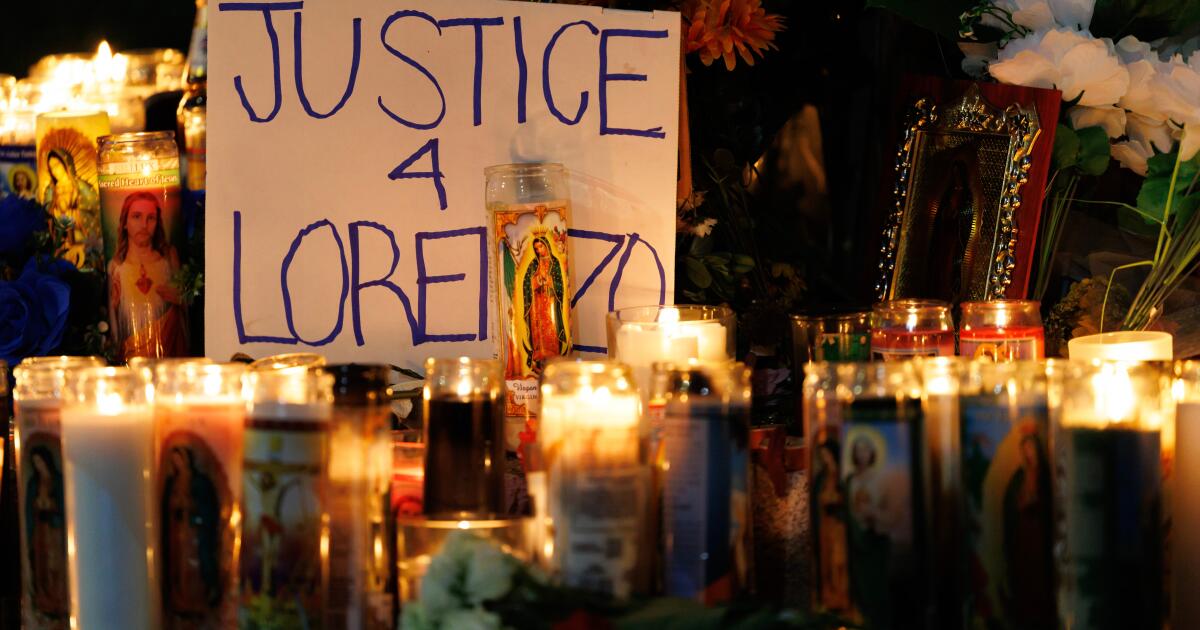
They were Mexican immigrants, both named Lorenzo.
They came to this country without papers as teenagers. Lack of legal status didn’t stop them from building beautiful lives — a wife, a home, a loving dog. A blue-collar job that paid the bills, weekend carne asadas with friends and family, children who followed their father’s example of hard work.
The Lorenzos enjoyed the fruits of their labor in their adopted land, even as they battled to become American citizens while politicians demonized immigrants as invaders and worse.
Lorenzo Arellano arrived in the United States in 1968 and didn’t get his citizenship until nearly 30 years later. Back then, the path to naturalization was far easier.
Lorenzo Salgado Araujo arrived in the early 1990s, when those opportunities were becoming severely limited.
Lorenzo Arellano is my father, a happily retired truck driver living in Anaheim.
Lorenzo Salgado Araujo, 52, who ran his own construction crew, was on his way to a job with his brother and two other men when an Immigration and Customs Enforcement agent shot him dead on July 7 in Houston.
When I see a photo of Salgado Araujo beaming in front of a cake with the number 52 on it at the well-kept home he built with his own hands, I’m reminded that we’ll be celebrating my father’s 75th birthday next month. When I see video of Salgado Araujo’s feet twitching on the ground with two ICE agents next to him as he bleeds out and moans for help, I weep.
Only geography, age and Donald Trump separated the Lorenzos. Even their children — he had three boys, while my father had two boys and two girls — are similar. The Salgado Araujos, like the Arellanos, are college-educated. The eldest son, Ronaldo, is a teacher like my sisters. He wears glasses like me and is now telling the story of his father to the nation, as I have for decades.
I write about my Papi as the puckish personification of immigrant America.
Ronaldo is eulogizing his dad way too soon.
“He wanted nothing else in life but to provide for his wife and see his sons become great people,” Ronaldo said proudly at a news conference the day after his father’s death — words I’ve always said about my Papi. “He did not deserve to be reduced to a headline of ‘Mexican man shot and killed by ICE’” — words I hope to never utter but can sadly see as a possibility given la migra’s unapologetic shoot-first approach and indiscriminate targeting of anyone brown.
Salgado Araujo’s killing came as part of the Trump administration’s newest deportation surge — the New York Times reported that the feds have arrested nearly 2,000 people a day since the end of June. The rate is higher than ICE’s campaign of terror last summer, yet it hasn’t drawn the same attention, fulfilling the promise of newish Homeland Security Secretary Markwayne Mullin that la migra would operate far more quietly and efficiently than under his reckless predecessor, Kristi Noem.
Those quiet times are over.
Ronaldo Salgado, son of Lorenzo Salgado Araujo, dries his tears while talking at a news conference on July 8 in Houston. His father was shot and killed by ICE agents the day before.
(David J. Phillip / Associated Press)
Vigils are popping up across the country in Salgado Araujo’s name. Stories about his life and death have replaced those about Mexico’s World Cup run on my social media timelines. They are heartbreaking, infuriating and a baleful reminder for Mexican Americans that these last five weeks of soccer, as joyful as they were, didn’t change our precarious status in this country under President Trump.
“He deserved to live a quiet life as a husband, a father and a job creator for dozens of men who also wanted the American dream,” Ronaldo said at the news conference through tears as his younger brother, Lorenzo Jr., comforted him. That their father never will — that the Department of Homeland Security is now smearing his name by claiming he “weaponized” his van by trying to run over an agent, even though video evidence proves no such thing — is the latest indictment against the Trump administration’s cruelty toward the undocumented.
Salgado Araujo wasn’t even the target of ICE’s operation. His family said he had applied for a work permit and was on his way toward finally obtaining legal status.
We should heed Ronaldo’s words about his father. As people protest and seek justice, we should also hail the life of Lorenzo Salgado Araujo the way we one day will hail the life of Lorenzo Arellano — as Mexicans who made it, challenges be damned. And we should continue to fight for immigrants who remain in legal limbo, afraid for their lives more than ever.
I called my father to ask how he felt about a tocayo — someone with the same first name — losing his life to la migra.
“I put myself in his place and lament that ese [that] Lorenzo couldn’t get the citizenship that I could,” Papi said in Spanish.
He remembered how immigration agents “did it with respect” when they caught him living in this country illegally in the 1970s and 1980s.
“They asked you for your papers, and if you didn’t have them, they put handcuffs on you, you got deported and that was that. None of these beatings or shootings that are happening now under Trump,” he said. The worst it ever got was when he said he was going to Los Angeles, and an agent snapped that he was going to L.A. but now had to return to Mexico.
Papi asked me what justification ICE has offered for killing Salgado Araujo.
“I hope they put those people who killed him in prison for many years,” he said with disgust. “Will they?”
I replied that probably wasn’t going to happen. ICE has shot and killed 11 people during Trump’s second term, both citizens and noncitizens, and scores more have died in immigration detention. No agents have faced charges for any of these deaths. The agents involved in Salgado Araujo’s killing didn’t even have dashboard cameras or body cameras, a convenient oversight that a Department of Homeland Security spokesperson blamed on “multiple government shutdowns.”
“Pues, Dios sabe que todo se paga en la vida,” my dad responded. Well, God knows you reap what you sow.

Ronaldo Salgado and Lorenzo Jr., sons of Lorenzo Salgado Araujo, hold a photograph of their father during a news conference July 8 in Houston.
(David J. Phillip / Associated Press)
Nothing can bring Lorenzo Salgado Araujo back to his loved ones. But I hope they find solace in his namesake, St. Lawrence. Tradition has it that Roman authorities roasted the Spanish deacon to death after Emperor Valerian demanded that he turn over the treasures of the Church. Instead, Lawrence presented the emperor with the city’s poor and maligned, insisting that he confront the oppression he had forced on them.
May we remember Lorenzo Salgado Araujo as a modern-day martyr, killed because our government refused to give him and so many others a chance at living in this country without fear.
May his name resonate through the ages as embodying the promise and tragedy of the American dream.
-

 Connecticut8 seconds ago
Connecticut Sun hold off Portland Fire on Camp Day at Mohegan Sun Arena
-

 Delaware6 minutes ago
Harrington-area man killed after truck hits him after lying on roadway
-

 Florida12 minutes ago
Man, 74, becomes oldest inmate executed in Florida in state’s 10th lethal injection this year
-

 Georgia18 minutes ago
Athlon Sports tabs Florida-Georgia among SEC’s best games in 2026
-

 Hawaii24 minutes ago
4,000 troops lose air conditioning in Hawaii
-

 Idaho30 minutes ago
Idaho is home to the nation's first DarkSky Reserve. Now it's home to the nations first DarkSky Certified Resort
-

 Illinois36 minutes ago
2 teens hospitalized after being rescued by bystanders from Lake Michigan at Illinois Beach State Park near Zion
-

 Indiana42 minutes ago
‘Big Boy’ locomotive returns for overnight stay in northeast Indiana

