Lifestyle
Are you truly infatuated with your co-worker, or do you just see them 40 hours a week?


Does having an affair with a married co-worker (who is in a loveless marriage, and whose wife is having an affair too, but they’re staying together for their child) make me, morally, a bad person?

That depends on what you believe a “bad” person to be. If your married co-worker and their spouse have both communicated and acknowledged the refined terms of their relationship to each other — that their romantic relationship is over, and that they are both free to pursue connections outside of their marriage while continuing their domestic partnership and performing whatever outer auspices of their relationship to ensure their child has a stable home until they come of age — then your co-worker and their spouse are essentially in an open relationship that prioritizes co-parenting. But the nature of this agreement, and the consequences of actions stemming from it, all depends on whether this agreement is mutually consensual and clear.
The word “morally” carries a weight with different subjective meanings. Generally it refers to undertaking an action in accordance with certain principles or values decided by an individual. So in that sense, what is “moral” in this situation can take on a variety of forms, depending on which definition of what is “right” is prioritized in your own mind.
Oftentimes we decide what is “wrong” for us based on how a certain idea or action makes us feel. That feeling can present in many ways — rumination, a knot in your throat or your chest, an unease in your stomach, the tensing of muscles. The fact that you’re asking this question tells me that something about this situation is likely making you feel a certain way. I invite you to explore what shape that feeling takes, not just in your mind, but in your body.
Instead of obsessively over-rationalizing or avoiding, try making friends with that feeling. If it’s uncomfortable or unsustainable to live with continuously, ask your body why — and how it can help you make decisions that are the kindest possible to your nervous system.
I would encourage you to get more clarity from your co-worker on the terms of their marriage, and exactly how open and honest they and their wife have been with each other. Have they both acknowledged to each other that they are seeing other people? If so, does their agreement have a “don’t ask, don’t tell” clause, or is your co-worker being asked to give details on the who, when, or how?
If one party isn’t as aware of what’s going on as the other party, this isn’t an objectively “right” or “wrong” vignette, per se. But it does mean that your new partner may come with some baggage, and perhaps with some growth opportunities in the area of communication. Ethical open relationships (ethical meaning different from morality, meaning more about a general societal consensus around what’s most evolved versus an individual’s codes for behavior) take a lot of maturity, humility, honesty and willingness to constantly grow. Taking on a partner in an open marriage, especially if a child and mutual source of income are involved, will likely present a certain requirement of effort for your heart and mind. And I would contend that even if you’ve already set a mental boundary that this relationship will be short-term or temporary, or purely sexual, chances are you’ll still have to undertake a degree of risk tolerance and emotional navigation through it, given the unique circumstances of the situation. Are you comfortable taking that on? Only you can answer this question for yourself.
Oftentimes we decide what is “wrong” for us based on how a certain idea or action makes us feel. That feeling can present in many ways — rumination, a knot in your throat or your chest, an unease in your stomach, the tensing of muscles. … I invite you to explore what shape that feeling takes, not just in your mind, but in your body.

Goth Shakira wears a Miss Claire Sullivan corset and skirt, Shushu/Tong shoes, Blumarine earring, Hirotaka earring, Pianegonda ring, Xeno underwear and stylist’s own collar.
The most important question here becomes: Is this a situation that is sustainable for you? Are you comfortable with the degree of honesty present among all three people involved in this (four, counting the child)? If there’s something that bothers you about it, what is it exactly that leaves you unsettled? Sitting with these questions will lead you to the best course of action for you, because you are the only person who has to live with you at the end of the day.
And if you were my friend, what I would say to you is this — are you truly infatuated with your co-worker, or do you just see them 40 hours a week? Consistency and proximity, especially in the professional context of teamwork, collaboration and problem-solving, can make a work connection feel like it has more potential for romantic intimacy, depth and longevity than it actually does. Dating your co-worker can be hard (there’s no workplace escape from your personal life if you get into a fight, and one or both of you can find your material stability threatened if the romantic relationship sours). Dating someone with a child can be hard. Dating someone in an open marriage can be hard. In your mind, body and heart, is your connection with this person worth what it comes with? Considering all angles of the situation through the lens of your own well-being first and foremost will give you all the answers you need.
Photography Eugene Kim
Styling Britton Litow
Hair and makeup Jaime Diaz
Visual direction Jess Aquino de Jesus
Production Cecilia Alvarez Blackwell
Photo assistant Joe Elgar
Styling assistant Wendy Gonzalez Vivaño



Sunday Puzzle
NPR
hide caption
toggle caption
NPR

This week’s challenge
Today’s puzzle is a tribute to Mimi. Every answer is a familiar two word phrase or name in which each word starts with the letters MI-.
Ex. Assignment for soldiers –> MILITARY MISSION
1. Pageant title for a contestant from Detroit
2. One of the Twin Cities
3. Nickname for the river through New Orleans
4. Super short skirt
5. Neighborhood in Los Angeles that contains Museum Row
6. Just over four times the distance from the earth to the moon
7. Goateed sing-along conductor of old TV
8. American financier who pioneered so-called “junk bonds”
9. Little accident
10. Land-based weapon in America’s nuclear arsenal
11. In “Snow White,” the evil queen’s words before “on the wall”
Last week’s challenge
Last week’s challenge comes from Benita Rice, of Salem, Ore. Name a famous foreign landmark (5,4). Change the eighth letter to a V and rearrange the result to make an adjective that describes this landmark. What landmark is it?
Answer
Notre Dame –> Renovated
Winner
Chee Sing Lee of Bangor, Maine
This week’s challenge
This week’s challenge comes from James Ellison, of Jefferson City, Mo. Think of a popular movie of the past decade. Change the last letter in its title. The result will suggest a lawsuit between two politicians of the late 20th century — one Republican and one Democrat. What’s the movie and who are the people?
If you know the answer to the challenge, submit it below by Thursday, April 23 at 3 p.m. ET. Listeners whose answers are selected win a chance to play the on-air puzzle.
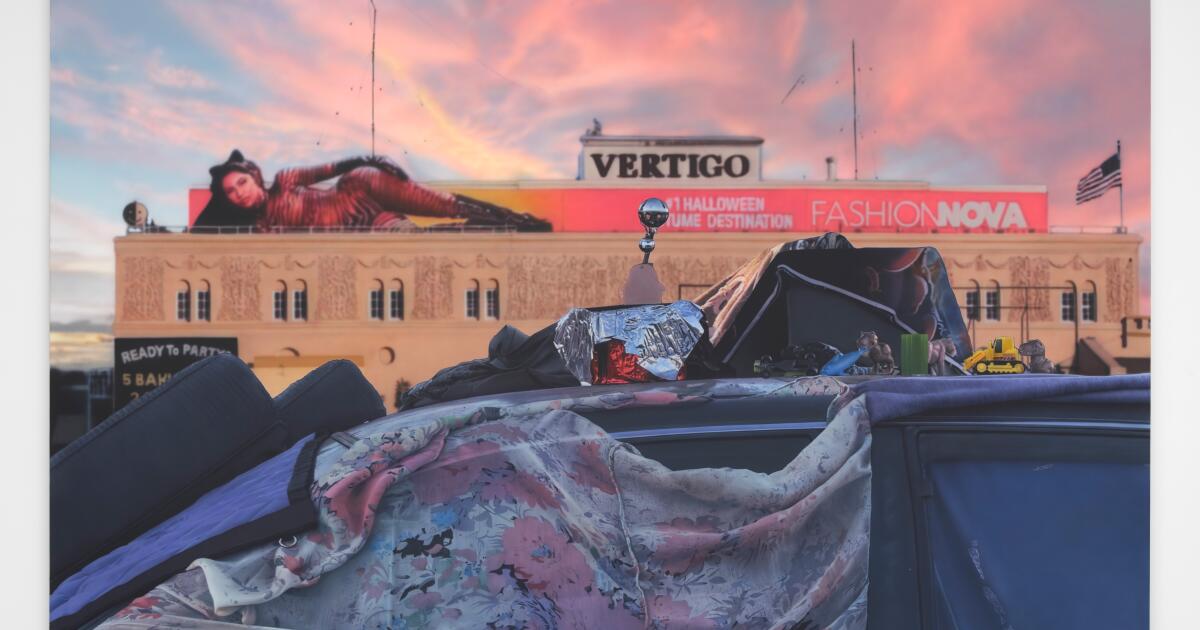
This story is part of Image’s April’s Thresholds issue, a tour of L.A. architecture as it’s actually experienced.
A landmark is a landmark because it tells you that you’re home now — the piece of earth you’ve chosen to inhabit saying, “You’ve made it back, congratulations.” We identify our cities with their landmarks, and because we identify with our cities, we identify with the landmarks too. They are us and we are them, mirroring each other through eternity. A city like New York or Chicago, with the Chrysler Building, the Bean, etc., has landmarks that exist in the world’s popular consciousness. But L.A.’s most cherished landmarks belong to us and us alone, a secret you’re let in on if you live here long enough and pay attention.
The Fashion Nova baddie in horizontal sprawl off the Vertigo, for example, is an emblem for those in the know. Our twisted version of a capitalist guardian angel, patron saint of spandex in a cropped matching set. Welcome to El Pueblo de Nuestra Señora la Reina de los Ángeles de Fashion Nova. Merging on the 110 South from the 10 East while the sunset burns and traffic thickens is a miracle in more ways than one, and in the spirit of compulsively performing the sign of the cross when you pass a church on the freeway, this billboard is deserving of its own acknowledgment.
It may not be the landmark L.A. asked for, but in Sayre Gomez’s painting “Vertigo,” you begin to understand why it’s the one we deserve. At the opening for “Precious Moments,” Gomez’s solo show at David Kordansky, the room was vibrating. A game of energetic ping-pong unfolded underneath the gallery’s fluorescent light, beams of identification, recollections or stabs of grief bouncing off each piece in the exhibition. People were seeing hyperspecific parts of a city they love reflected in a hyperspecific way — for better and for worse. Recognition has two edges and they both happen to be sharp. Gomez twists the knife deeper for a good cause: He wants you not just to look but to really see.
In his work exist iconic signs of beloved local establishments — like the Playpen — the blinding glint reflecting off downtown’s skyline, telephone poles regarded as totems. The line to see Gomez’s replica of L.A.’s graffiti towers, “Oceanwide Plaza,” snaked through the gallery’s courtyard. Once inside, at least three graffiti writers whose names were blasted on the replica pointed it out proudly, even gave out stickers to take home. The truth can be beautiful and it can be ugly — in this case it’s both — on the flip side showing up in the form of smog, tattered flags and an abandoned graffiti tower that starkly represents the pitfalls of capitalism and greed, a neon arrow pointing to the homelessness crisis.
Because the Vertigo is something everybody who lives here recognizes as central to a sort of framework of Los Angeles. And I think the encampment has become that as well. It’s connecting these integral components — something that’s more revelatory and more fun with something that’s more grave.
— Sayre Gomez
In the main gallery, I was stuck on “Vertigo.” On the 12-foot canvas, my eye went to the place out of focus: the thin strip of billboard in the background featuring a young woman with sand-dune hips, patent knee-high boots and long black hair laid up on her side, wearing cat ears and a tiger bodysuit as flush as second skin. The model made the kind of eye contact that felt dangerous — might cause an accident if you’re not careful. “#1 Halloween Destination … FASHION NOVA,” it read. I knew her, anyone who has driven through the two main arteries of Los Angeles knows her. The black-and-white smiley motif of the Vertigo, an events space, sat right next to her face, just happy to be there, it seemed, above a painted sign that says “Ready to Party?”
The sky was the color of cotton candy, but the stale kind that’s been hardening in a plastic bag for days after the fair. Something rancid about it. In the foreground of the painting was a car encampment with a tattered floral sheet woven through the windows, cloth tarps and couch cushions creating a shield against the elements. Small plastic children’s toys lined at the top of the car — dinosaurs and dump trucks and sharks — creating their own shrunken skyline in front of the Vertigo, signaling that young kids likely lived there. It’s less juxtaposition for juxtaposition’s sake and more an accurate reflection of the breakneck duality of living in a place like L.A.
Even angels exist within the context of their environments. Our Fashion Nova baddie hangs off the Vertigo, a building that has used its ad space as physical clickbait and political posturing for over a decade. It’s promoting the kind of fast fashion brand that’s been regarded as a case study on the industry’s environmental impact. In the years the billboard has been up, it’s looked over dozens and dozens of car encampments like the one depicted in Gomez’s piece.
She feels dubious, yes. But no less like ours.
Julissa James: I’ve lived in L.A. for 13 years now. For me, the city and the architecture of the city is less the Frank Lloyd Wrights and Frank Gehrys — there’s that — but other landmarks that signal, “Oh, I’m home.” The Fashion Nova baddie above the Vertigo has always been that for me. Your piece is layered and there’s so much more to it than just that, but that’s the first thing I saw and was like, “Whoa. I need to talk to Sayre. We need to talk about ‘Vertigo.’”
Sayre Gomez: It’s like L.A.’s Statue of Liberty. It’s the city of anti-landmarks, you know what I mean? I mean, there’s the Hollywood sign, which I think is so telling, because it’s the remnants of a real estate venture. The city is built by real estate schemes and 100 years later we’re feeling the effects of it. You’ve got empty skyscrapers and a massive homeless catastrophe. L.A. doesn’t really have real landmarks. It has anti-landmarks.
JJ: When did the Fashion Nova billboard above the Vertigo click for you as something that felt representative of the city, or something that you wanted to depict?
SG: My studio is in Boyle Heights, so I pass that billboard multiple times a week. This is my 20th year in L.A. and that building’s always been a big mystery to me. It was empty when I moved here before this guy Shawn Farr bought it and turned it into Casa Vertigo. I think he probably makes more money on it with the ad space than anything. I know nobody who has ever been there. Very mysterious to me. So that’s what I was drawn to.

(Paul Salveson from David Kordansky Gallery)
The Vertigo has always been mysterious to me. And that whole fashion industry is mysterious to me — the kind of shmatta, American Apparel-adjacent, or maybe coming out of the wake of that. These kinds of businesses, or the representations of these businesses, how do they function and how do they flourish? Is it aboveboard? What more perfectly encapsulates that than that building? It’s this weird thing you can’t quite figure out but somehow it has a lot of money and then it’s an event space, supposedly billed as that. Clearly it’s this big ad thing, and I’m very interested in the changing dynamics of capital. The capital of yesteryear, which was based on the brick and mortar, where things are being made in a specific location, maybe on an assembly line or in a specific way, to a kind of capital that is based solely on advertising or on viewership. These beautiful buildings acting as pedestals for some kind of ad space, you know? It becomes an anti-landmark for me. Something where I’m like, “Oh, there’s that thing again.”
JJ: It’s this gorgeous Beaux Arts building …
SG: It’s a Freemason building!
JJ: When I’ve talked to some people about the Vertigo, they’re like, “the Fashion Nova building?”
SG: They always have the woman in the same pose — same pose, different clothes. If you remember before Fashion Nova, they would have these provocative ad campaigns or provocative slogans. “Twerk Miley” was up, remember that? They did a Trump one: “TRUMP NOW.” They did one for Kanye when he ran for president. The 10 and the 110 are literally the crossroads of the city, so it’s really poised to be a special building. It has a special designation because of the location.
JJ: Talk to me about the process of doing this piece. Where did it start and how did it evolve?
SG: I was cruising around that vicinity trying to see if I could get a good vantage point to take photos of Vertigo. And then I stumbled upon this car — the car that’s in the foreground of the painting. Anytime I see an encampment that has kids’ toys, things that reference back to the lives of children, it hits hard. But I like to lay it all out there. I like to make things confrontational. I want it to be difficult. The painting isn’t based on a one-to-one photo [Gomez paints from a composite rendering of images he’s taken around town], but I knew that I wanted to use that car, and I knew I wanted to get the Vertigo building, and so I started just messing around with different iterations. I could never find a good angle to take a good photo of the building, so I just went on Vertigo’s website and I was like, “I’m just using these.” I switched the sky and put a more moody, atmospheric sky in.
JJ: Which I loved, because we know that feeling — you’re merging onto the 110 and you see a beautiful sunset. The euphoria of like, “L.A. is the best city in the world.” But you know what? What I found so interesting about your piece is that it was revealing to me about myself, but also about so many of us that live in L.A. and have lived here for years and have developed a jadedness. When I saw your piece, immediately I was like, “Oh my God, the Vertigo! The Vertigo! The Vertigo!” And then I was like, “OK, wait, hold on, there’s so much more going on here.” But the fact that my eye went to that first instead of the car encampment, the kids’ toys, brought up a lot of questions about my own relationship to the city and the things that we choose to see, the things that maybe we’ve seen so much of that we subconsciously filter it out. Why was it important for you to put these two things up against each other in this way?
SG: Because the Vertigo is something everybody who lives here recognizes as central to a sort of framework of Los Angeles. And I think the encampment has become that as well. It’s connecting these integral components — something that’s more revelatory and more fun with something that’s more grave. That’s what I’m doing in my work at large. I use the sunsets and the beauty to create a dialogue, to entice people to sort of look a little bit at how things are contextualized, how things act, what’s actually happening. I don’t make things in a vacuum. I was working on this show and I was going to really push this agenda of incorporating more of my experience with my kids into the work. That’s also a double-edged sword. I wanted to interject some levity, because the work can get so dark. I wanted to bring in some iconography from their world and things that they get excited about. When you’re juxtaposing that with really stark things, it becomes darker. I want to thicken the stock a little bit. Make things a little more complex.

Phil Pritchard of the Hockey Hall of Fame works the 2019 NHL Awards at the Mandalay Bay Events Center on June 19, 2019 in Las Vegas, Nevada. (Photo by Bruce Bennett/Getty Images)
Bruce Bennett/Getty Images
hide caption
toggle caption
Bruce Bennett/Getty Images
This week’s show was recorded in Chicago with host Peter Sagal, judge and guest scorekeeper Alzo Slade, Not My Job guest Phil Pritchard and panelists Alonzo Bodden, Adam Burke, and Dulcé Sloan. Click the audio link above to hear the whole show.
Who’s Alzo This Time
The Don Vs The Poppa; World’s Worst Doctor; Should We Eat That?
Panel Questions
Big Cheese News!
Bluff The Listener
Our panelists tell three stories about someone missing a huge opportunity in the news, only one of which is true.
Not My Job: Phil Pritchard, the NHL’s Keeper of the Stanley Cup, answers three questions about the other NHL, National Historic Landmarks
Peter talks to Phil Pritchard, the NHL’s Keeper of the Stanley Cup. Phil plays our game called, “Let’s Go Visit The NHL” Three questions about National Historic Landmarks.
Panel Questions
The Trump Dump and Air Traffic Control Becomes Animal Control
Limericks
Alzo Slade reads three news-related limericks: Spice Up Your Spring Cleaning; A Fizzy Meaty Drink; The Right Way to Eat Peeps.
Lightning Fill In The Blank
All the news we couldn’t fit anywhere else
Predictions
Our panelists predict the next big AirBnB story in the news
-
 News21 minutes ago
Communities launch cleanup after severe weather and tornadoes churn across Midwest
-

 Detroit, MI2 hours ago
Game 21: Tigers at Red Sox, Garrett Crochet battles both Detroit and the weather
-

 San Francisco, CA3 hours ago
Why do gray whales keep dying in San Francisco’s waters?
-

 Dallas, TX3 hours ago
Dallas Mavericks Owners Might Be Making Big Mistake in Search for New GM
-

 Miami, FL3 hours ago
Defense dominates, Mensah flashes in Miami’s spring game – The Miami Hurricane
-
Boston, MA3 hours ago
A crowd scientist is helping the Boston Marathon manage a growing field of 30,000-plus runners
-

 Denver, CO3 hours ago
Denver Nuggets Altitude broadcasts now being offered in Spanish for first time ever
-

 Seattle, WA3 hours ago
Need to shred? Free drive-up/ride-up shredding Wednesday at Village Green West Seattle