Lifestyle
After 103 years, this L.A. prop maker finds new success freeze-drying dead pets


In a room inside a North Hollywood warehouse, dozens of pets are ready for their owners to take them home.
Boots, a young black-and-white domestic shorthair cat, lies on his back, pawing playfully at the air. A trio of red, yellow and green parrots and cockatiels sit on wooden perches, oblivious to the piercing stare of a blue-eyed feline a few feet away. Princess, a senior Chihuahua, rests with her eyes closed and body curled into a tight cocoon, as a frenetic hamster named Ponby stands upright, his eyes bulging. There’s a naked guinea pig, a giant red macaw and an adorably chunky pit bull named Messy.
Eyes, such as those shown here on Messy the pit bull, are made of glass and closely match the animal’s original colors.
(Myung J. Chun / Los Angeles Times)
All of these animals are loose, liberated from the confines of cages and leashes, and yet no havoc has ensued.
These animals are also all dead.
It’s an everyday scene at Bischoff’s the Animal Kingdom, a Los Angeles taxidermy business that has been preserving animals for 103 years. The business is multifold — Bischoff’s creates and rents out prop animals to film studios, museums and nature centers. Posters on the lobby walls boast the company’s work on shows like “American Horror Story” and “Westworld.” But in recent years, a bulk of its taxidermy requests now come from bereaved pet owners, those willing to shell out thousands of dollars for a tangible commemoration of their late “fur babies.”

Birds are commonly preserved at Bischoff’s, but the business has made mementos of more obscure pets, including chameleons, roosters and hairless guinea pigs.
(Myung J. Chun / Los Angeles Times)
From full-body taxidermy to partial mementos — skulls, bronzed hearts or freeze-dried paws, for example — such services provide closure in ways that, clients say, traditional burials or urns cannot.
“It was honestly really comforting to have her back, and just be able to touch her and, in a sense, talk to her too,” said Bischoff’s customer Zoe Hays of the preservation of her Chihuahua-Yorkie mix Pixie. “She was a great little dog — also a menace to society, for sure — but she’s still with me, and she always will be.”
Bodily preservation, beyond the ashes or cemented paw prints offered by veterinarians and animal hospitals, has become a growing facet in the world of pet aftercare, with traditional taxidermists fulfilling many of the niche requests.

-
Share via
Inside Bischoff’s, the L.A. taxidermy company that preserves dead pets
Redlands business Precious Creature initially only offered full-body taxidermy of pets until customers started suggesting other ideas, such as lockets containing patches of fur and cat-tail necklaces. (Most recently, owner Lauren Kane sewed a zippered pillowcase using the black-and-white fur of a rescue named G-Dog, or, as his owner fondly called him, “Fluffy Butt.”) In her documentary “Furever,” filmmaker Amy Finkel explores the lengths to which pet preservationists will go, asking, “Who decides what kind of grief is acceptable, or appropriate?”

Bischoff’s co-owner Ace Alexander had a songwriting career before transitioning to taxidermy.
(Myung J. Chun / Los Angeles Times)
Ace Alexander, 40, and Rey Macias, 55, the fourth owners in Bischoff’s long history, have steered the company to meet the new demand. Describing each other as “good friends,” the two men dress similarly in unofficial uniforms of black T-shirts and black pants, and they’re so in sync they sometimes finish each other’s thoughts. Since taking over the business, both have transitioned to primarily vegan diets.
“Bischoff’s used to be taxidermists to the stars in the trophy era, but now we’re taxidermists in the pet preservation era,” Alexander said. “People no longer hunt. Now they just love their pets.”
Hollywood needs supporting actors, even if they’re stuffed
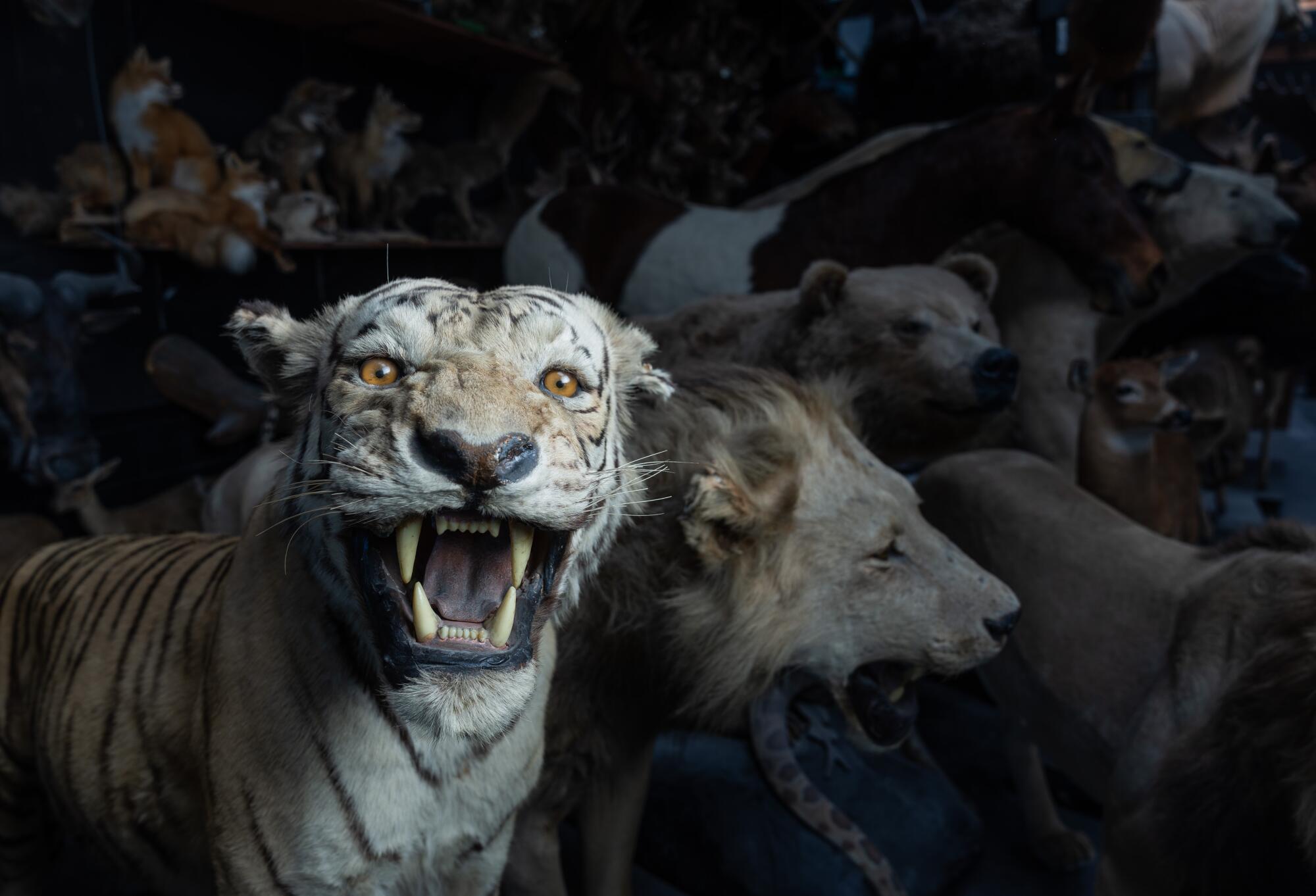
Over the decades, Bischoff’s has preserved hundreds of animals. The Sumatran tiger has made many appearances in films and TV shows, including “Snowfall,” “Palm Royale” and “Welcome to Chippendales.”
(Myung J. Chun / Los Angeles Times)
In 1922, when Al Bischoff first opened the business on Sunset Boulevard in Hollywood, he’d stuff and plaster any animal brought to him. Most of the time, that meant trophies from hunting and safari trips, but it also included beloved pets owned by Hollywood elite. Roy Rogers used Bischoff’s to preserve his co-stars Trigger the horse and Bullet the dog. Buck — the dog from “Married with Children” — also got the Bischoff’s treatment.
Under Alexander and Macias’ tutelage, that’s still the case. They’ll preserve any animal you bring them — so long as it is not a protected species or an illegal pet. They’ll even make you a unicorn or a sasquatch or a wearable Velociraptor costume that roars and can open and close its jaws. The largest animal Alexander and Macias have preserved was an 11-foot-long buffalo, while the smallest, not including insects, was a hummingbird. Off the top of their heads, the only animal they haven’t preserved — yet — is the genetically rare white tiger.

Bischoff’s owners Ace Alexander, left, and Rey Macias show off a custom order of a pink peacock (sans tail) for a film.
(Myung J. Chun / Los Angeles Times)
The majority of Bischoff’s clientele still comes from Hollywood. Due to federal and state laws, as well as industry regulators like the American Humane Association, it often makes more sense to use body doubles for animals when filming and is occasionally mandatory (such as scenes that involve roadkill or drowning incidents).
On a recent Wednesday, Alexander fielded calls from studios about the types of snake skins in stock, how to clean dirt off a rented coyote and the particular body poses of their turkeys.
“So what are you thinking?” Alexander said, talking on the phone. “Turkeys in flight? Perched? Or did you need a floppy version?”
As for the pet sector, which accounts for around 40% of their business, dogs and cats, unsurprisingly, make up the majority of the preservations, but the team has also worked on rabbits, rodents, chameleons and roosters. And although they will preserve your pet goldfish, they will strongly encourage you to consider having a synthetic version made of it due to the oils in the scales, which inevitably lead to deterioration.
Bischoff’s works on pets shipped from around the country as well as overseas. Dr. Xanya Sofra, who is based in Hong Kong, has had at least half a dozen of her papillons preserved by Bischoff’s. Another client, who was an avid hiker, had Bischoff’s preserve his golden retriever in an upright position so that he could carry it in his backpack on his treks.
Neither Alexander nor Macias had a background in taxidermy when they started working at Bischoff’s. They were both musicians, which is how they initially met. Macias also owned an auto shop and has been taking apart and fixing appliances from a young age.
Alexander picked up jobs at Bischoff’s when it was owned by the previous owner, Gary Robbins. The pay was good, the work interesting and he realized he had a knack for airbrushing and sculpting. In 2017, when Robbins was ready to retire, Alexander and Macias, who by then had also started working there, decided to buy the business.
Blending artistic skill with scientific knowledge

Each multi-level freeze-dryer can fit around a dozen pets at a time. Smaller pets need three to four months to dry out, while larger animals take nearly a year.
(Myung J. Chun / Los Angeles Times)
Bischoff’s specializes in a form of hybrid taxidermy, incorporating traditional techniques with the more new-fangled freeze-drying process. The results are not only more lifelike and long-lasting than the standard gut-and-stuff method, but it also allows for the bulk of the original animal to remain, including the skeletal structure, toenails, whiskers, eyelids, nose and teeth. The eyes, however, are made of glass.
The method leaves room for error. Water can be used to dampen and repose the body and paint can be removed or retouched.
“You can definitely backpedal,” Alexander said, making a note to check the texture of the preserved hearts on sticks in the next 24 hours.
Alexander credits this attention to detail to his predecessors, former owner Robbins and then-main taxidermist Larry Greissinger, who taught him the trade. Strict in their teachings, Robbins and Greissinger emphasized getting every bodily facet correct: from recreating the natural anatomy to sewing the perfect hidden stitch to making sure the eyes looked right.
“That’s where the emotion is,” Alexander said. “You can get the perfect body pose, but if the eyes aren’t sitting well or don’t carry any emotion, then the animal will never look alive.”
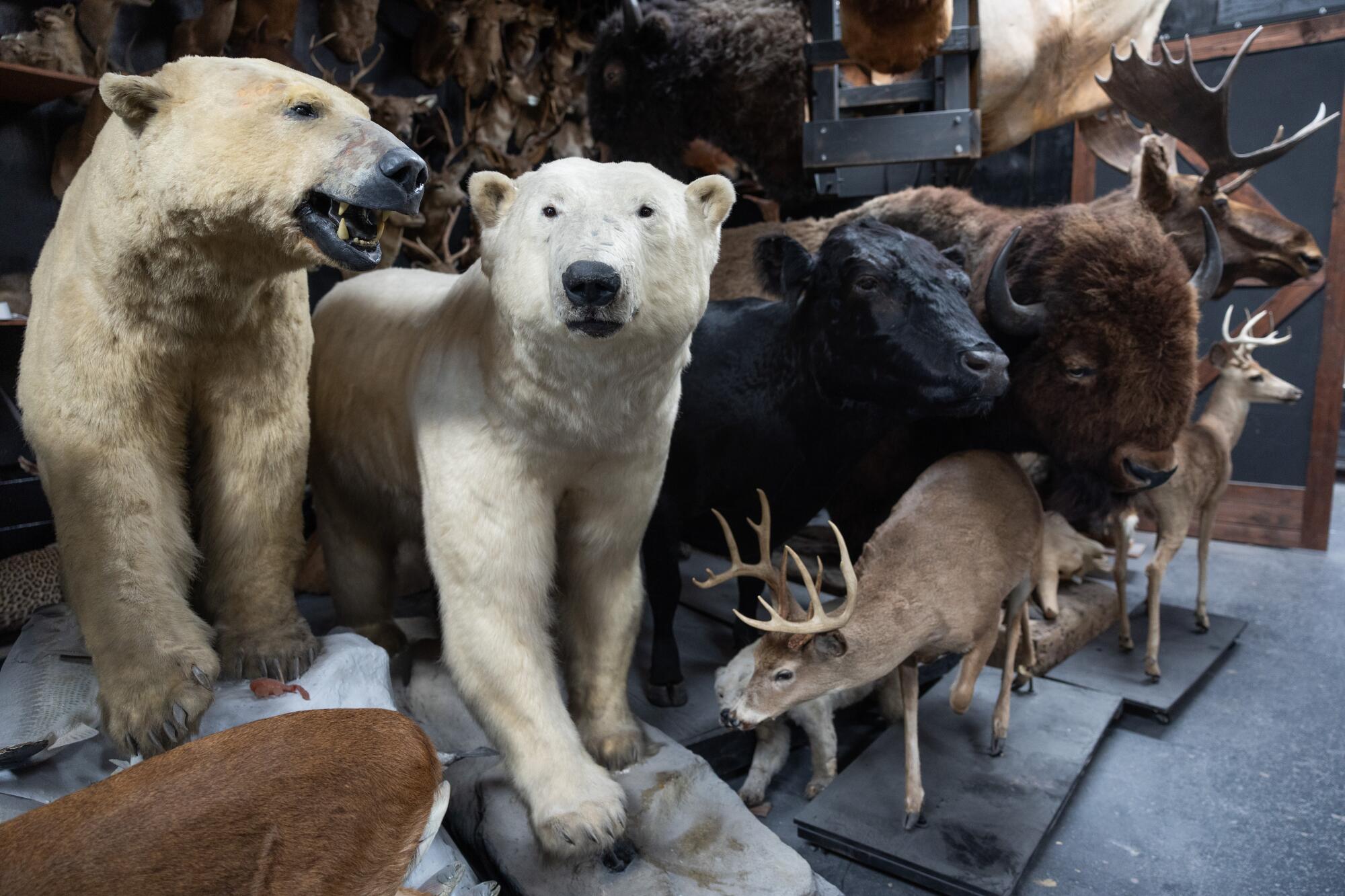
Bischoff’s has old and new taxidermy, including two polar bears from the 1940s and 1950s, a bull created in 2013 for the “Yellowstone” prequel “1923” and a buffalo that appeared in “The Lone Ranger.”
(Myung J. Chun / Los Angeles Times)
A few of Bischoff’s early taxidermy pieces are still on display, including a dog, which looks more like a cross between a wolf and a baboon, dating to the 1920s. Its plaster interior, an old taxidermy technique, gives it a stiff visage and makes it exceedingly heavy.
Bischoff’s prices reflect its modernized techniques, as well as the amount of time and attention to even the smallest of details required to make a dead pet come back to life. The cost for a fully preserved cat or a small dog like a Chihuahua starts at $2,640, with small birds, like a budgie, starting at $850.
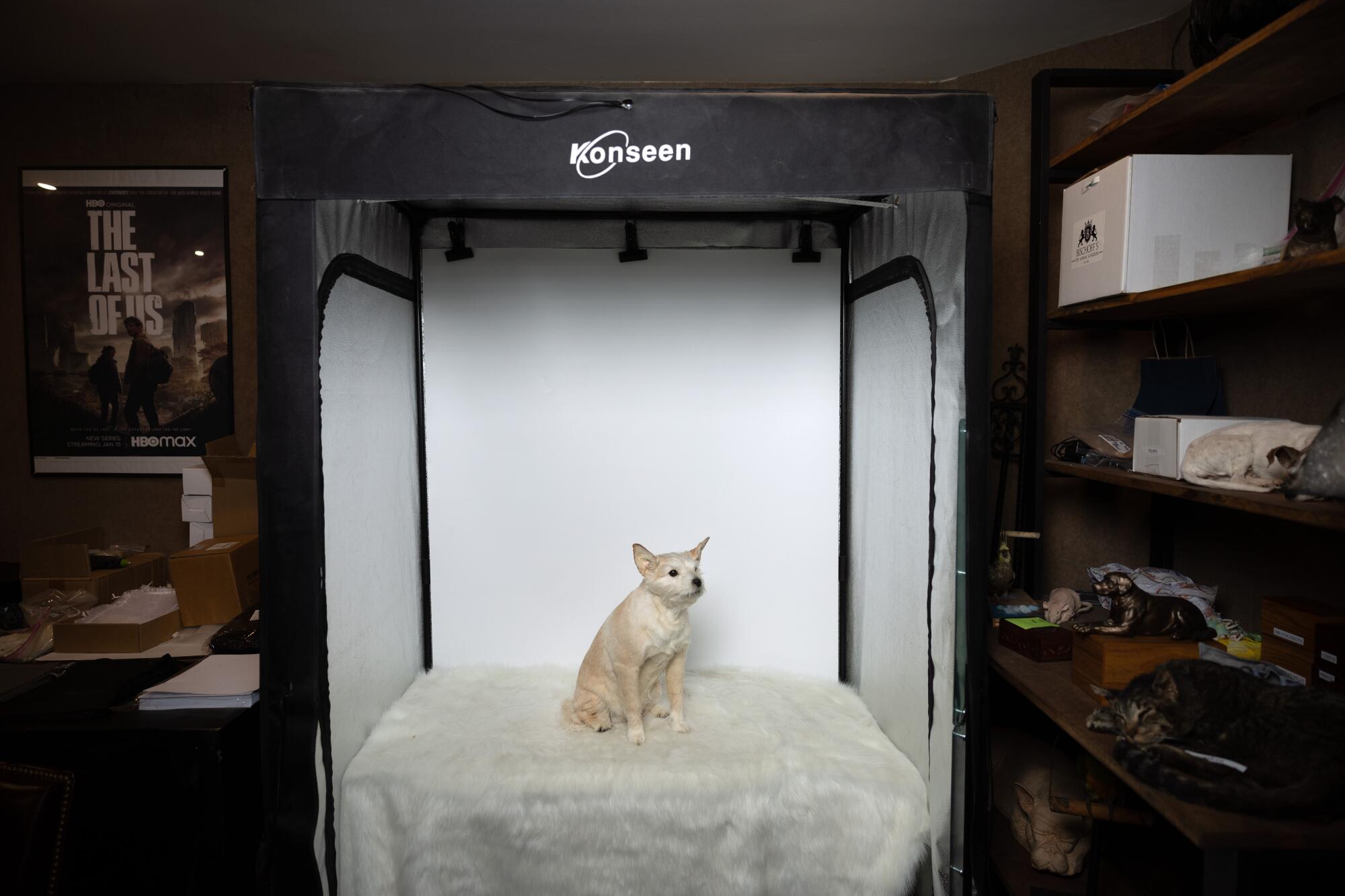
A photo booth is set up in Bischoff’s warehouse, where images of the completed pets are taken.
(Myung J. Chun / Los Angeles Times)
Although most customers order full-body taxidermy, an “a la carte” menu has expanded over the years with jars of whiskers or fur, bundles of bones tied in a bow and, the most recent addition, freeze-dried hearts, which come mounted inside of a glass cloche. Bischoff’s also offers cloning services through its Texas-based affiliate Viagen Pets, to whom they send the pet’s skin tissues.

Pelts, paws and bronzed skulls are among the smaller items purchased by pet owners.
(Myung J. Chun / Los Angeles Times)

Bischoff’s in-house artist Laischa Ramirez creates hand-drawn portraits of pets for owners who request it.
(Myung J. Chun / Los Angeles Times)
Costly though their work is, Alexander and Macias see it as an investment. Pets, they point out, are friends you look at every day. You’re intimately aware of their nuances and quirks, like how their left ear might curl back more than the right one or the way their nose tilts ever-so-subtly upwards. Entrust their preservation to a novice or lower-cost taxidermist, and you risk losing some of the elements that made your pet who they were.
Bischoff’s has seen its share of people who’ve preserved their pets with budget taxidermists only to be disappointed. “It’s unfortunate because at that point, there’s not much we can do,” Alexander said. Such pets are cremated “because they just can’t stand to look at them.”
Bischoff’s key component? Compassion
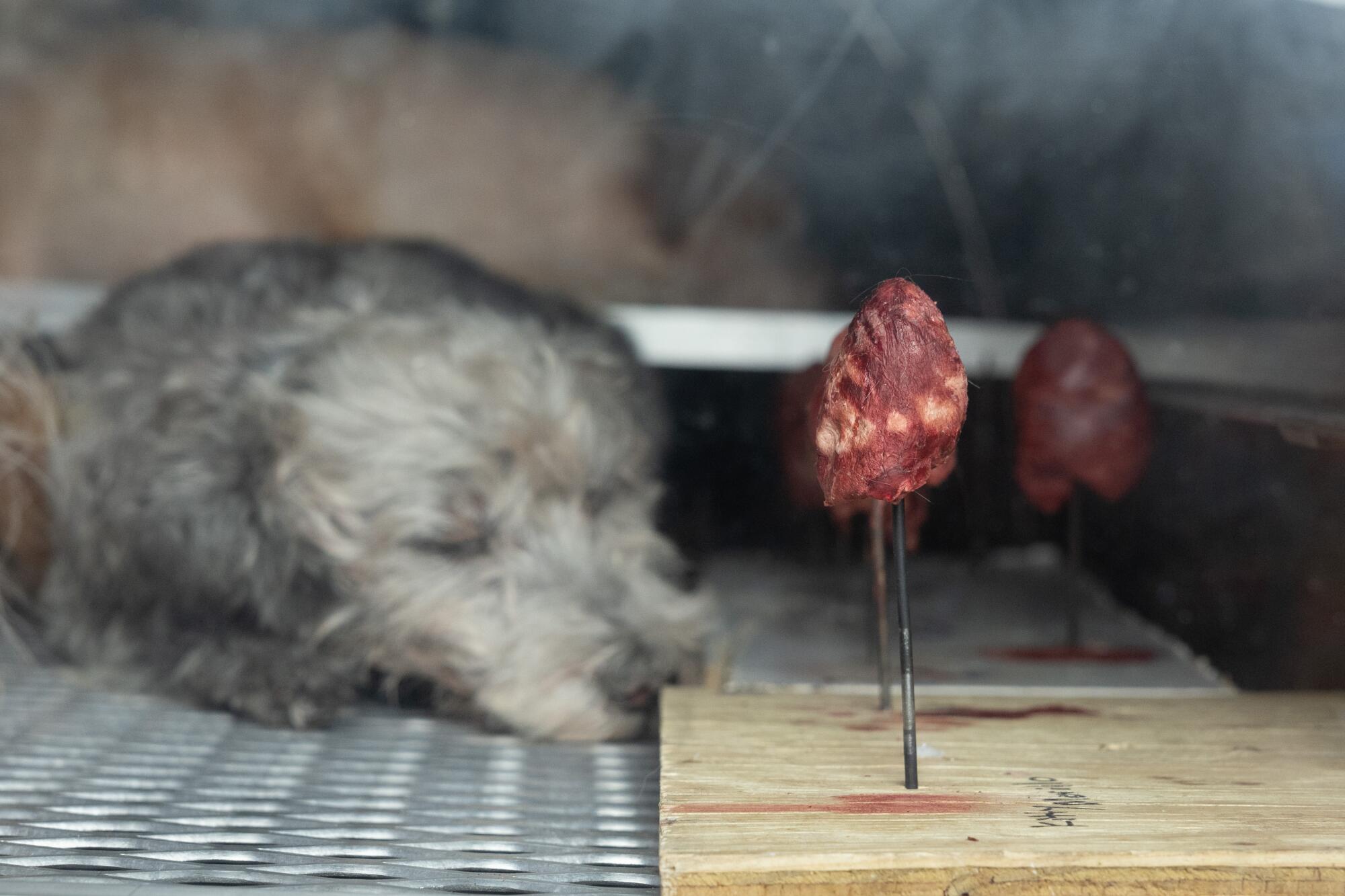
Pets and pet hearts sit in a freeze-dryer at Bischoff’s.
(Myung J. Chun / Los Angeles Times)
In the back of Bischoff’s warehouse is where the equipment resides and the smells of the oils running the machines permeates the space. The company has one aquamation machine that uses alkali solution, heat and pressure to break down the organic material into ashes. With interior chambers lined with perforated metal walls, the contraption somewhat resembles a fast-food restaurant’s deep fryer. Except, one taxidermist notes, when the process is done, instead of having golden fried potato strips in each basket, all that is left are bones.
Oftentimes at the ends of these processes, Bischoff’s workers will find inorganic remnants from the pets, such as microchips, metal plates or orthopedic screws. They give them to their owners as keepsakes.
Macias’ son, 29-year-old Chris Macias, works alongside his dad at Bischoff’s. He started helping out to make extra money while attending nursing school, but when business picked up, he decided to transition fully into the taxidermy business. He does a little bit of everything — recently, it was prepping a seal pelt for the San Pedro Marine Mammal Care Center — but tends to do pet pickups the most. Less technical though it may be, it is more emotionally taxing as he’s interfacing with grieving clients who might still be in shock or confused as to what exactly they want to do with their late pets.

Two calico cats were returned to Bischoff’s by the children of the woman who owned them after her death.
(Myung J. Chun / Los Angeles Times)
“Everybody’s different, but I just try to be there for them,” Chris said. “Their pet was part of their family, so I totally understand. Because all of us here, we have our own pets as well. We get it.”
Though Alexander never imagined building a career out of preserving dead pets, he said, “We’ve found joy in this work and we just see preservation as another form of art.”
It’s that art that is helping keep the memories of beloved pets alive — for generations even. Hays, the owner of Chihuahua-Yorkie mix Pixie, already has a contingency plan in place for Pixie’s taxidermy upon her own death. It will be “adopted” by another family member. Her daughter has already called dibs.
And many of Bischoff’s pet preservation customers are repeat clients, which is something that Alexander and Macias take pride in. Two women picking up the taxidermy body of their late cat recently chatted with Alexander about their newest rescue, a diabetic stray cat burnt in the Altadena fires. They couldn’t help but comment on the “beautiful bone structure” of the feline, still very much alive.
“I was like, ‘Hmm, you’re definitely going on the altar some day,’” one of the women said.



The Tin Soldier, one of Nicolas Coppola’s marionette puppets, is the main character in The Steadfast Tin Soldier show at Coppola’s Puppetworks theater in Brooklyn’s Park Slope neighborhood.
Anh Nguyen for NPR
hide caption
toggle caption
Anh Nguyen for NPR
Every weekend, at 12:30 or 2:30 p.m., children gather on foam mats and colored blocks to watch wooden renditions of The Tortoise and the Hare, Pinocchio and Aladdin for exactly 45 minutes — the length of one side of a cassette tape. “This isn’t a screen! It’s for reals happenin’ back there!” Alyssa Parkhurst, a 24-year-old puppeteer, says before each show. For most of the theater’s patrons, this is their first experience with live entertainment.
Puppetworks has served Brooklyn’s Park Slope neighborhood for over 30 years. Many of its current regulars are the grandchildren of early patrons of the theater. Its founder and artistic director, 90-year-old Nicolas Coppola, has been a professional puppeteer since 1954.
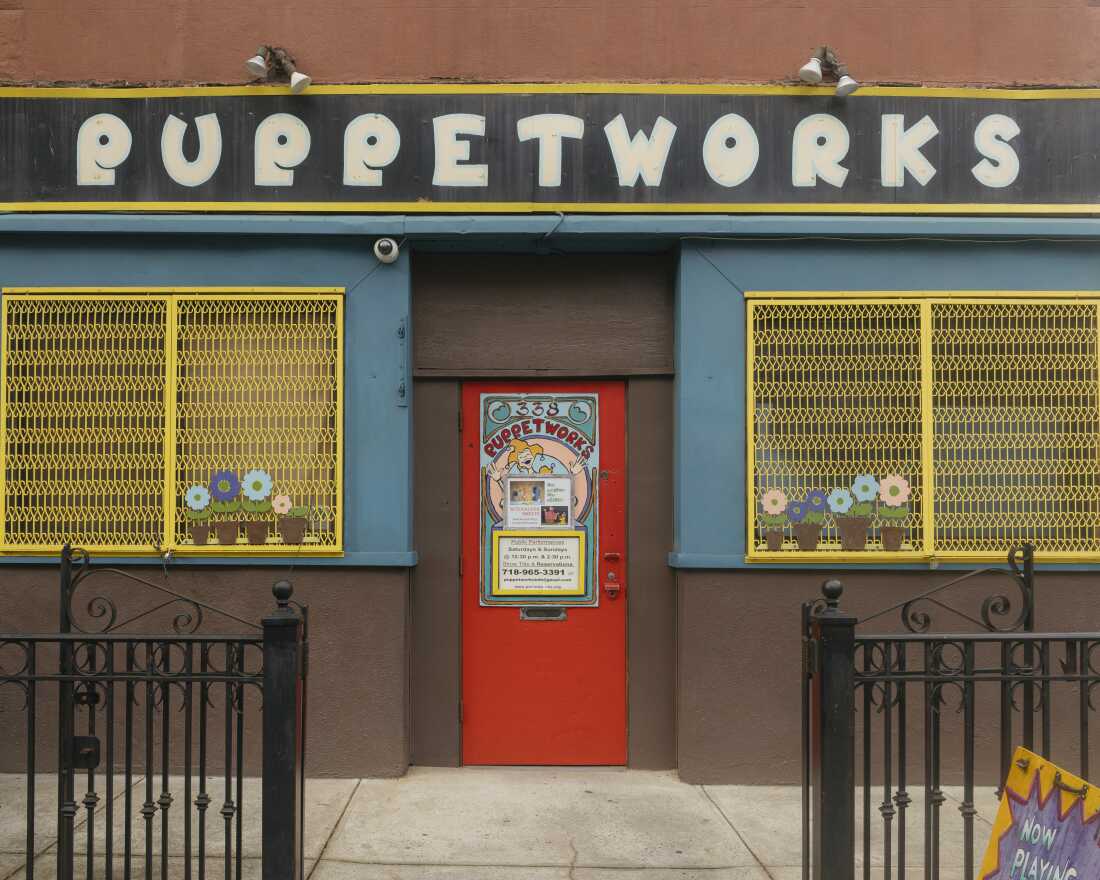
The Puppetworks theater in Brooklyn’s Park Slope neighborhood.
Anh Nguyen for NPR
hide caption
toggle caption
Anh Nguyen for NPR

A workshop station behind the stage at Puppetworks, where puppets are stored and repaired.
Anh Nguyen for NPR
hide caption
toggle caption
Anh Nguyen for NPR
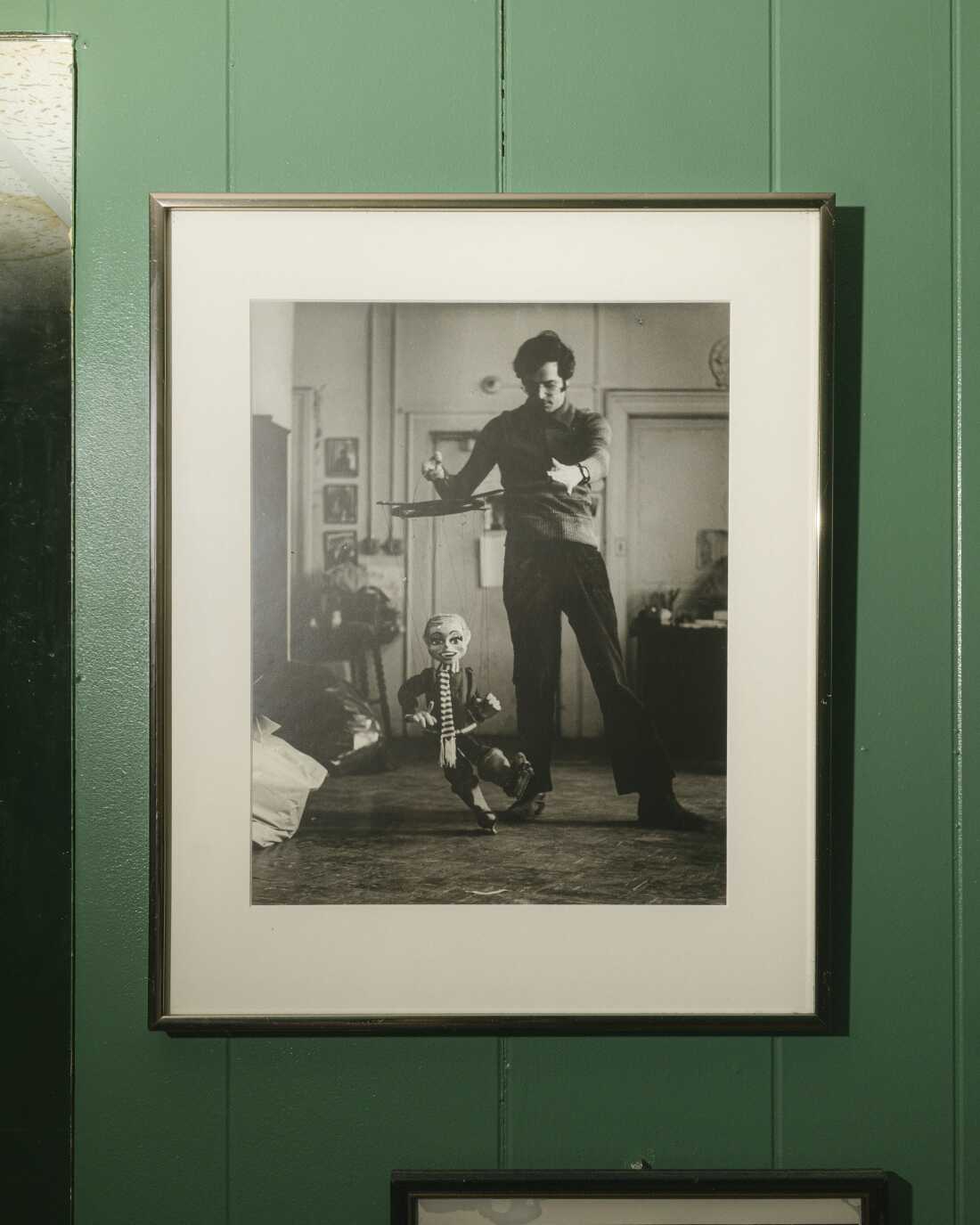
A picture of Nicolas Coppola, Puppetworks’ founder and artistic director, from 1970, in which he’s demonstrating an ice skater marionette puppet.
Anh Nguyen for NPR
hide caption
toggle caption
Anh Nguyen for NPR
For just $11 a seat ($12 for adults), puppets of all types — marionette, swing, hand and rod — take turns transporting patrons back to the ’80s, when most of Puppetworks’ puppets were made and the audio tracks were taped. Century-old stories are brought back to life. Some even with a modern twist.
Since Coppola started the theater, changes have been made to the theater’s repertoire of shows to better meet the cultural moment. The biggest change was the characterization of princesses in the ’60s and ’70s, Coppola says: “Now, we’re a little more enlightened.”

Right: Michael Jones, Puppetworks’ newest puppeteer, poses for a photo with Jack-a-Napes, one of the main characters in The Steadfast Tin Soldier. Left: A demonstration marionette puppet, used for showing children how movement and control works.
Anh Nguyen for NPR
hide caption
toggle caption
Anh Nguyen for NPR

Marionette puppets from previous Puppetworks shows hang on one of the theater’s walls.
Anh Nguyen for NPR
hide caption
toggle caption
Anh Nguyen for NPR

A child attends Puppetworks’ 12:30 p.m. showing on Saturday, Dec. 6, dressed in holiday attire that features the ballerina and tin soldier in The Steadfast Tin Soldier.
Anh Nguyen for NPR
hide caption
toggle caption
Anh Nguyen for NPR
Streaming has also influenced the theater’s selection of shows. Puppetworks recently brought back Rumpelstiltskin after the tale was repopularized following Dreamworks’ release of the Shrek film franchise.
Most of the parents in attendance find out about the theater through word of mouth or school visits, where Puppetworks’ team puts on shows throughout the week. Many say they take an interest in the establishment for its ability to peel their children away from screens.
Whitney Sprayberry was introduced to Puppetworks by her husband, who grew up in the neighborhood. “My husband and I are both artists, so we much prefer live entertainment. We allow screens, but are mindful of what we’re watching and how often.”

Left: Puppetworks’ current manager of stage operations, Jamie Moore, who joined the team in the early 2000s as a puppeteer, holds an otter hand puppet from their holiday show. Right: A Pinocchio mask hangs behind the ticket booth at Puppetworks’ entrance.
Anh Nguyen for NPR
hide caption
toggle caption
Anh Nguyen for NPR
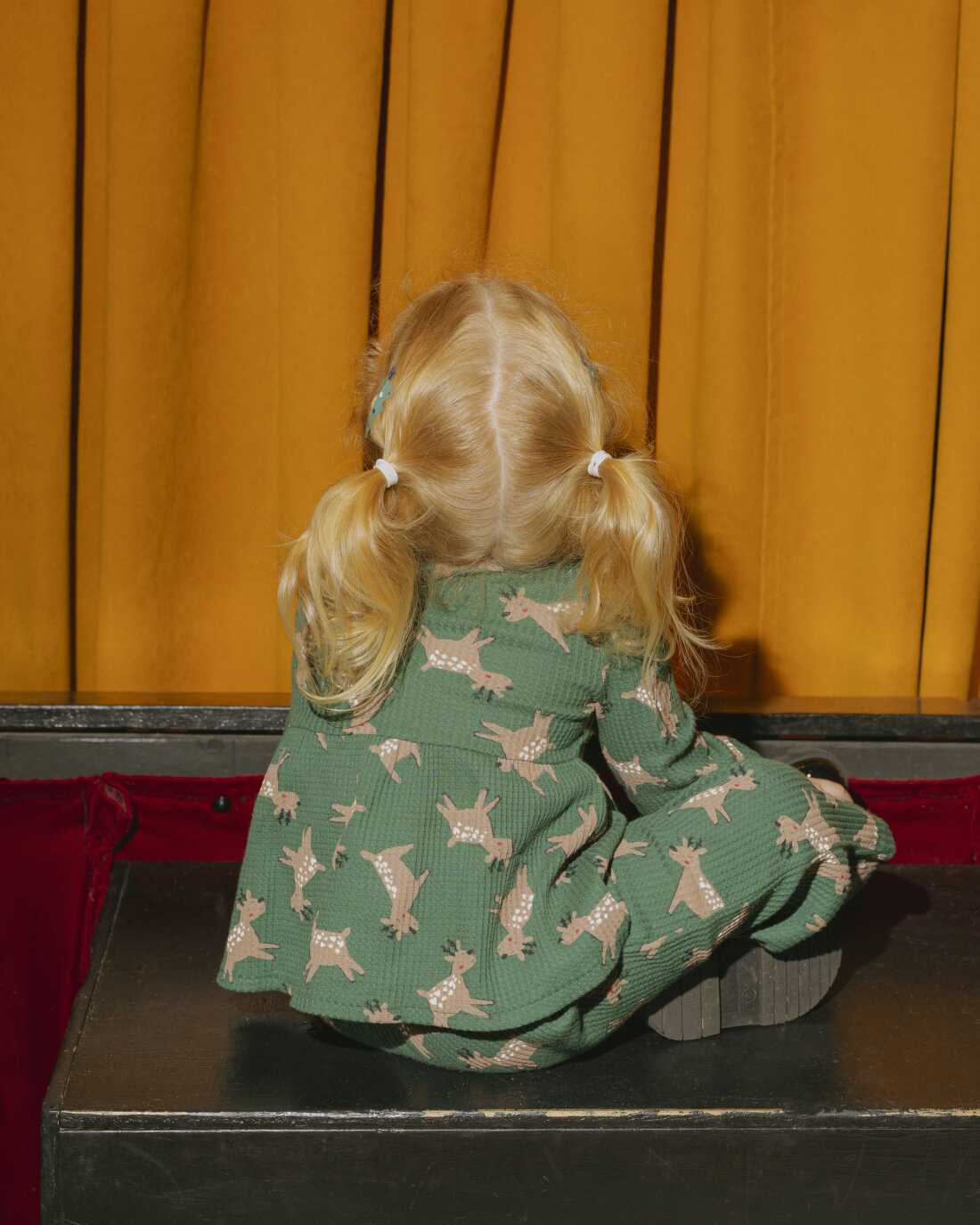
A child attends Puppetworks’ 12:30 p.m. showing on Saturday, Dec. 6, dressed in holiday attire.
Anh Nguyen for NPR
hide caption
toggle caption
Anh Nguyen for NPR

Left: Two gingerbread people, characters in one of Puppetworks’ holiday skits. Right: Ronny Wasserstrom, a swing puppeteer and one of Puppetworks’ first puppeteers, holds a “talking head” puppet he made, wearing matching shirts.
Anh Nguyen for NPR
hide caption
toggle caption
Anh Nguyen for NPR
Other parents in the audience say they found the theater through one of Ronny Wasserstrom’s shows. Wasserstrom, one of Puppetworks’ first puppeteers, regularly performs for free at a nearby park.
Coppola says he isn’t a Luddite — he’s fascinated by animation’s endless possibilities, but cautions of how it could limit a child’s imagination. “The part of theater they’re not getting by being on the phone is the sense of community. In our small way, we’re keeping that going.”
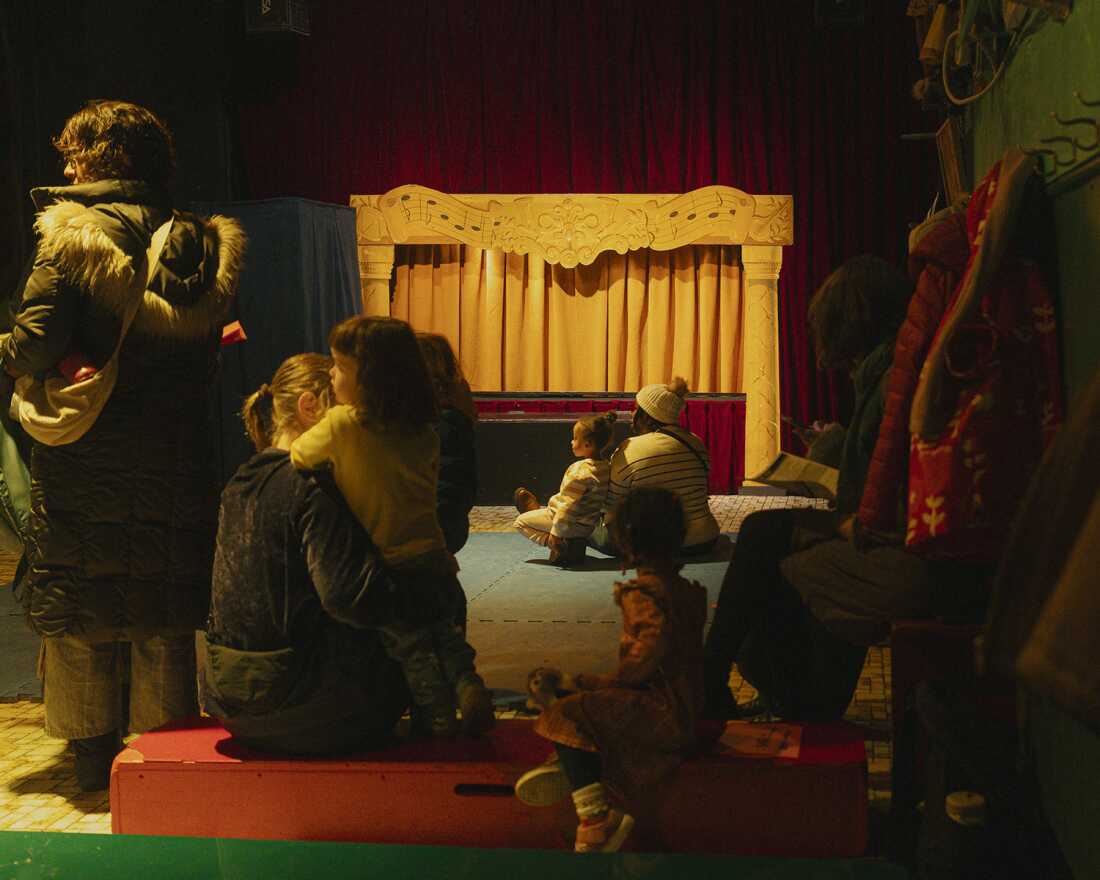
Puppetworks’ 12:30 p.m. showing of The Steadfast Tin Soldier and The Nutcracker Sweets on Saturday, Dec. 6.
Anh Nguyen for NPR
hide caption
toggle caption
Anh Nguyen for NPR
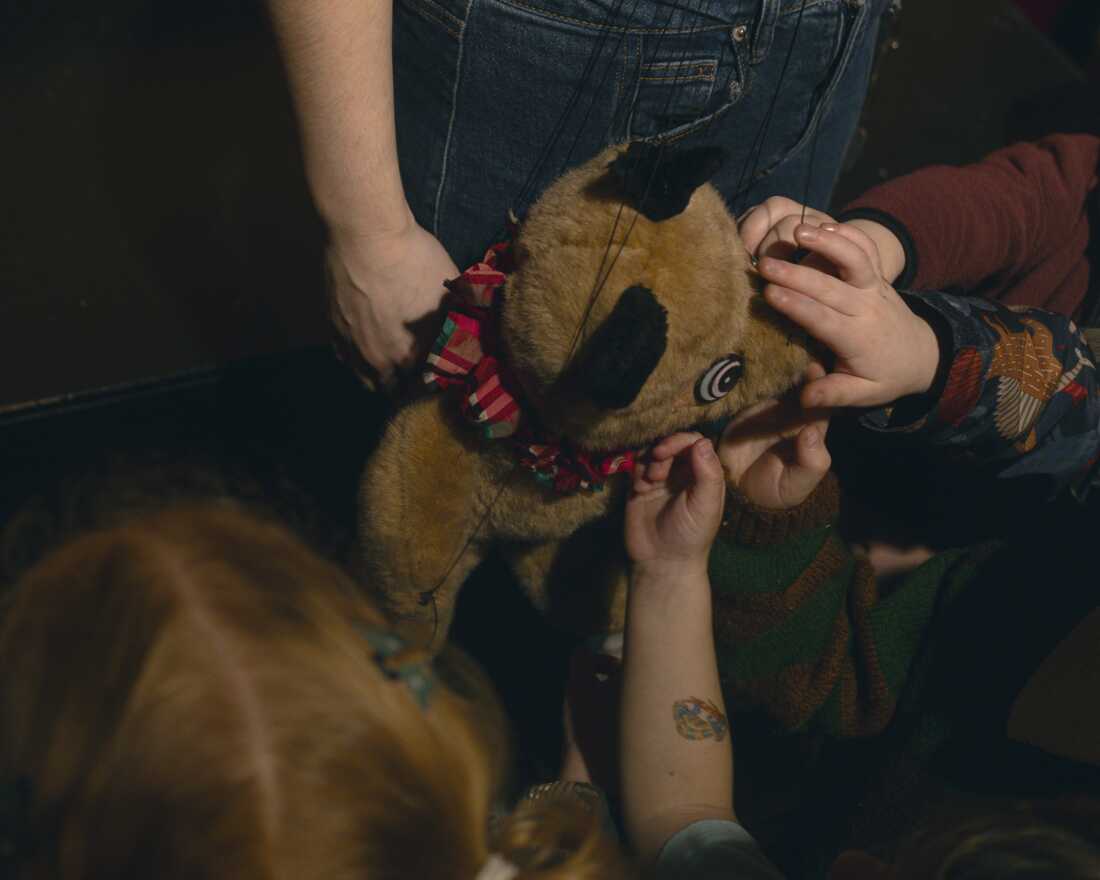
Children get a chance to see one of the puppets in The Steadfast Tin Soldier up close after a show.
Anh Nguyen for NPR
hide caption
toggle caption
Anh Nguyen for NPR
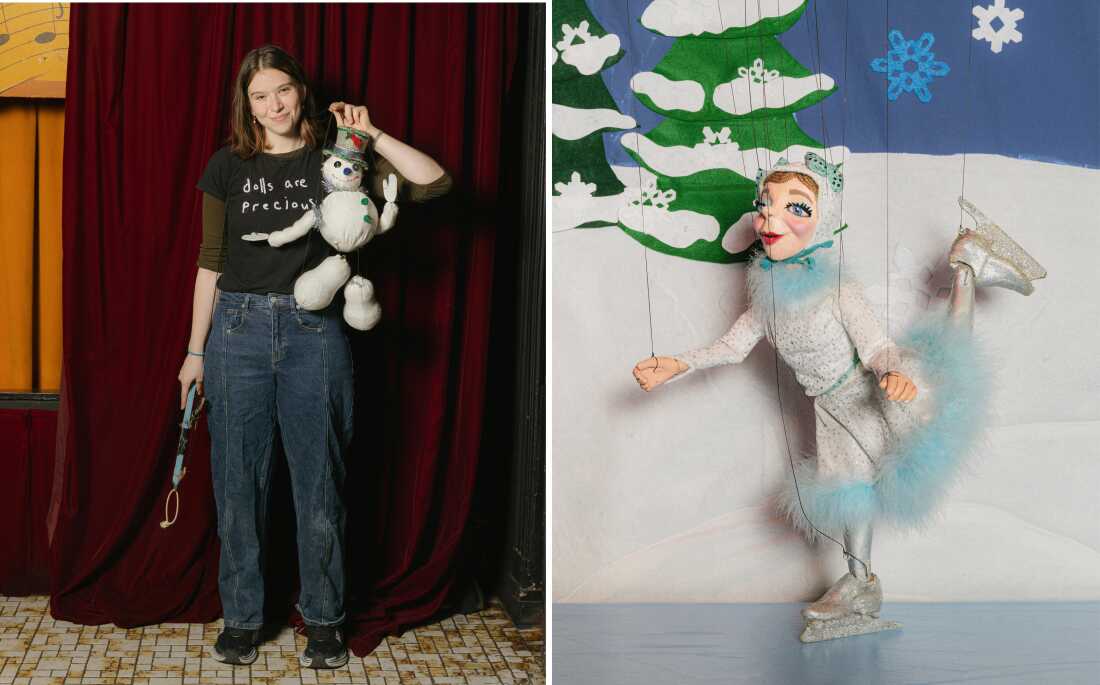
Left: Alyssa Parkhurst, Puppetworks’ youngest puppeteer, holds a snowman marionette puppet, a character in the theater’s holiday show. Right: An ice skater, a dancing character in one of Puppetworks’ holiday skits.
Anh Nguyen for NPR
hide caption
toggle caption
Anh Nguyen for NPR
Community is what keeps Sabrina Chap, the mother of 4-year-old Vida, a regular at Puppetworks. Every couple of weeks, when Puppetworks puts on a new show, she rallies a large group to attend. “It’s a way I connect all the parents in the neighborhood whose kids go to different schools,” she said. “A lot of these kids live within a block of each other.”

Three candy canes — dancing characters in one of Puppetworks’ holiday skits — wait to be repaired after a show.
Anh Nguyen for NPR
hide caption
toggle caption
Anh Nguyen for NPR
Anh Nguyen is a photographer based in Brooklyn, N.Y. You can see more of her work online, at nguyenminhanh.com , or on Instagram, at @minhanhnguyenn. Tiffany Ng is a tech and culture writer. Find more of her work on her website, breakfastatmyhouse.com.


In Brooklyn’s Park Slope neighborhood, children’s entertainment comes with strings

Read Oklahoma Student Samantha Fulnecky’s Essay on Gender

Trump administration bars former EU official and anti-disinformation and hate researchers from US

Pope Leo XIV says he’s ‘very disappointed’ after Illinois approves assisted suicide law

Trump admin sues Illinois Gov. Pritzker over laws shielding migrants from courthouse arrests

Florida High School Football Rankings: Top 25 teams – Oct. 21

Cleary's 21 help Le Moyne down Central Connecticut State 69-64 in OT

How old is Bo Nix? What to know about Oregon quarterback ahead of 2024 NFL Draft

99th annual Pony Swim held in Virginia

Video: ‘It Didn’t Have to Happen This Way:’ U.Va. Faculty Call for Review of Police Response to Protests
Trump admin sues Illinois Gov. Pritzker over laws shielding migrants from courthouse arrests

Europeans show solidarity with Denmark after Trump’s Greenland threat

Explosion at a Pennsylvania nursing home kills at least 2, governor says

What does Christmas look like for Ukraine? | Global News Podcast
404 | Fox News
-

 Iowa1 week ago
Addy Brown motivated to step up in Audi Crooks’ absence vs. UNI
-

 Maine1 week ago
Elementary-aged student killed in school bus crash in southern Maine
-

 Maryland1 week ago
Frigid temperatures to start the week in Maryland
-

 New Mexico7 days ago
Family clarifies why they believe missing New Mexico man is dead
-

 South Dakota1 week ago
Nature: Snow in South Dakota
-

 Detroit, MI1 week ago
‘Love being a pedo’: Metro Detroit doctor, attorney, therapist accused in web of child porn chats
-

 Health1 week ago
‘Aggressive’ new flu variant sweeps globe as doctors warn of severe symptoms
-

 Maine7 days ago
Family in Maine host food pantry for deer | Hand Off