Lifestyle
After 103 years, this L.A. prop maker finds new success freeze-drying dead pets


In a room inside a North Hollywood warehouse, dozens of pets are ready for their owners to take them home.
Boots, a young black-and-white domestic shorthair cat, lies on his back, pawing playfully at the air. A trio of red, yellow and green parrots and cockatiels sit on wooden perches, oblivious to the piercing stare of a blue-eyed feline a few feet away. Princess, a senior Chihuahua, rests with her eyes closed and body curled into a tight cocoon, as a frenetic hamster named Ponby stands upright, his eyes bulging. There’s a naked guinea pig, a giant red macaw and an adorably chunky pit bull named Messy.
Eyes, such as those shown here on Messy the pit bull, are made of glass and closely match the animal’s original colors.
(Myung J. Chun / Los Angeles Times)
All of these animals are loose, liberated from the confines of cages and leashes, and yet no havoc has ensued.
These animals are also all dead.
It’s an everyday scene at Bischoff’s the Animal Kingdom, a Los Angeles taxidermy business that has been preserving animals for 103 years. The business is multifold — Bischoff’s creates and rents out prop animals to film studios, museums and nature centers. Posters on the lobby walls boast the company’s work on shows like “American Horror Story” and “Westworld.” But in recent years, a bulk of its taxidermy requests now come from bereaved pet owners, those willing to shell out thousands of dollars for a tangible commemoration of their late “fur babies.”

Birds are commonly preserved at Bischoff’s, but the business has made mementos of more obscure pets, including chameleons, roosters and hairless guinea pigs.
(Myung J. Chun / Los Angeles Times)
From full-body taxidermy to partial mementos — skulls, bronzed hearts or freeze-dried paws, for example — such services provide closure in ways that, clients say, traditional burials or urns cannot.
“It was honestly really comforting to have her back, and just be able to touch her and, in a sense, talk to her too,” said Bischoff’s customer Zoe Hays of the preservation of her Chihuahua-Yorkie mix Pixie. “She was a great little dog — also a menace to society, for sure — but she’s still with me, and she always will be.”
Bodily preservation, beyond the ashes or cemented paw prints offered by veterinarians and animal hospitals, has become a growing facet in the world of pet aftercare, with traditional taxidermists fulfilling many of the niche requests.

-
Share via
Inside Bischoff’s, the L.A. taxidermy company that preserves dead pets
Redlands business Precious Creature initially only offered full-body taxidermy of pets until customers started suggesting other ideas, such as lockets containing patches of fur and cat-tail necklaces. (Most recently, owner Lauren Kane sewed a zippered pillowcase using the black-and-white fur of a rescue named G-Dog, or, as his owner fondly called him, “Fluffy Butt.”) In her documentary “Furever,” filmmaker Amy Finkel explores the lengths to which pet preservationists will go, asking, “Who decides what kind of grief is acceptable, or appropriate?”

Bischoff’s co-owner Ace Alexander had a songwriting career before transitioning to taxidermy.
(Myung J. Chun / Los Angeles Times)
Ace Alexander, 40, and Rey Macias, 55, the fourth owners in Bischoff’s long history, have steered the company to meet the new demand. Describing each other as “good friends,” the two men dress similarly in unofficial uniforms of black T-shirts and black pants, and they’re so in sync they sometimes finish each other’s thoughts. Since taking over the business, both have transitioned to primarily vegan diets.
“Bischoff’s used to be taxidermists to the stars in the trophy era, but now we’re taxidermists in the pet preservation era,” Alexander said. “People no longer hunt. Now they just love their pets.”
Hollywood needs supporting actors, even if they’re stuffed
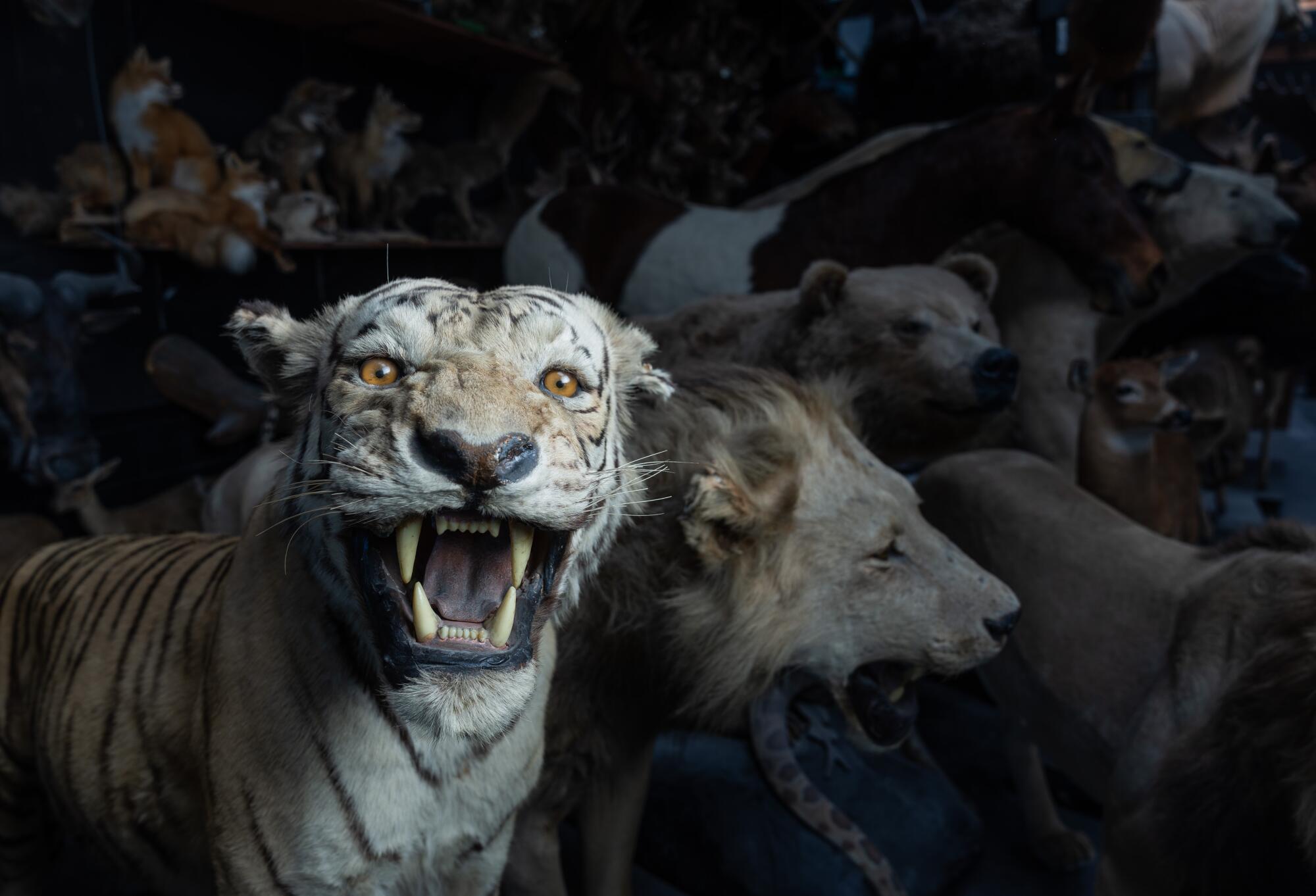
Over the decades, Bischoff’s has preserved hundreds of animals. The Sumatran tiger has made many appearances in films and TV shows, including “Snowfall,” “Palm Royale” and “Welcome to Chippendales.”
(Myung J. Chun / Los Angeles Times)
In 1922, when Al Bischoff first opened the business on Sunset Boulevard in Hollywood, he’d stuff and plaster any animal brought to him. Most of the time, that meant trophies from hunting and safari trips, but it also included beloved pets owned by Hollywood elite. Roy Rogers used Bischoff’s to preserve his co-stars Trigger the horse and Bullet the dog. Buck — the dog from “Married with Children” — also got the Bischoff’s treatment.
Under Alexander and Macias’ tutelage, that’s still the case. They’ll preserve any animal you bring them — so long as it is not a protected species or an illegal pet. They’ll even make you a unicorn or a sasquatch or a wearable Velociraptor costume that roars and can open and close its jaws. The largest animal Alexander and Macias have preserved was an 11-foot-long buffalo, while the smallest, not including insects, was a hummingbird. Off the top of their heads, the only animal they haven’t preserved — yet — is the genetically rare white tiger.

Bischoff’s owners Ace Alexander, left, and Rey Macias show off a custom order of a pink peacock (sans tail) for a film.
(Myung J. Chun / Los Angeles Times)
The majority of Bischoff’s clientele still comes from Hollywood. Due to federal and state laws, as well as industry regulators like the American Humane Association, it often makes more sense to use body doubles for animals when filming and is occasionally mandatory (such as scenes that involve roadkill or drowning incidents).
On a recent Wednesday, Alexander fielded calls from studios about the types of snake skins in stock, how to clean dirt off a rented coyote and the particular body poses of their turkeys.
“So what are you thinking?” Alexander said, talking on the phone. “Turkeys in flight? Perched? Or did you need a floppy version?”
As for the pet sector, which accounts for around 40% of their business, dogs and cats, unsurprisingly, make up the majority of the preservations, but the team has also worked on rabbits, rodents, chameleons and roosters. And although they will preserve your pet goldfish, they will strongly encourage you to consider having a synthetic version made of it due to the oils in the scales, which inevitably lead to deterioration.
Bischoff’s works on pets shipped from around the country as well as overseas. Dr. Xanya Sofra, who is based in Hong Kong, has had at least half a dozen of her papillons preserved by Bischoff’s. Another client, who was an avid hiker, had Bischoff’s preserve his golden retriever in an upright position so that he could carry it in his backpack on his treks.
Neither Alexander nor Macias had a background in taxidermy when they started working at Bischoff’s. They were both musicians, which is how they initially met. Macias also owned an auto shop and has been taking apart and fixing appliances from a young age.
Alexander picked up jobs at Bischoff’s when it was owned by the previous owner, Gary Robbins. The pay was good, the work interesting and he realized he had a knack for airbrushing and sculpting. In 2017, when Robbins was ready to retire, Alexander and Macias, who by then had also started working there, decided to buy the business.
Blending artistic skill with scientific knowledge

Each multi-level freeze-dryer can fit around a dozen pets at a time. Smaller pets need three to four months to dry out, while larger animals take nearly a year.
(Myung J. Chun / Los Angeles Times)
Bischoff’s specializes in a form of hybrid taxidermy, incorporating traditional techniques with the more new-fangled freeze-drying process. The results are not only more lifelike and long-lasting than the standard gut-and-stuff method, but it also allows for the bulk of the original animal to remain, including the skeletal structure, toenails, whiskers, eyelids, nose and teeth. The eyes, however, are made of glass.
The method leaves room for error. Water can be used to dampen and repose the body and paint can be removed or retouched.
“You can definitely backpedal,” Alexander said, making a note to check the texture of the preserved hearts on sticks in the next 24 hours.
Alexander credits this attention to detail to his predecessors, former owner Robbins and then-main taxidermist Larry Greissinger, who taught him the trade. Strict in their teachings, Robbins and Greissinger emphasized getting every bodily facet correct: from recreating the natural anatomy to sewing the perfect hidden stitch to making sure the eyes looked right.
“That’s where the emotion is,” Alexander said. “You can get the perfect body pose, but if the eyes aren’t sitting well or don’t carry any emotion, then the animal will never look alive.”
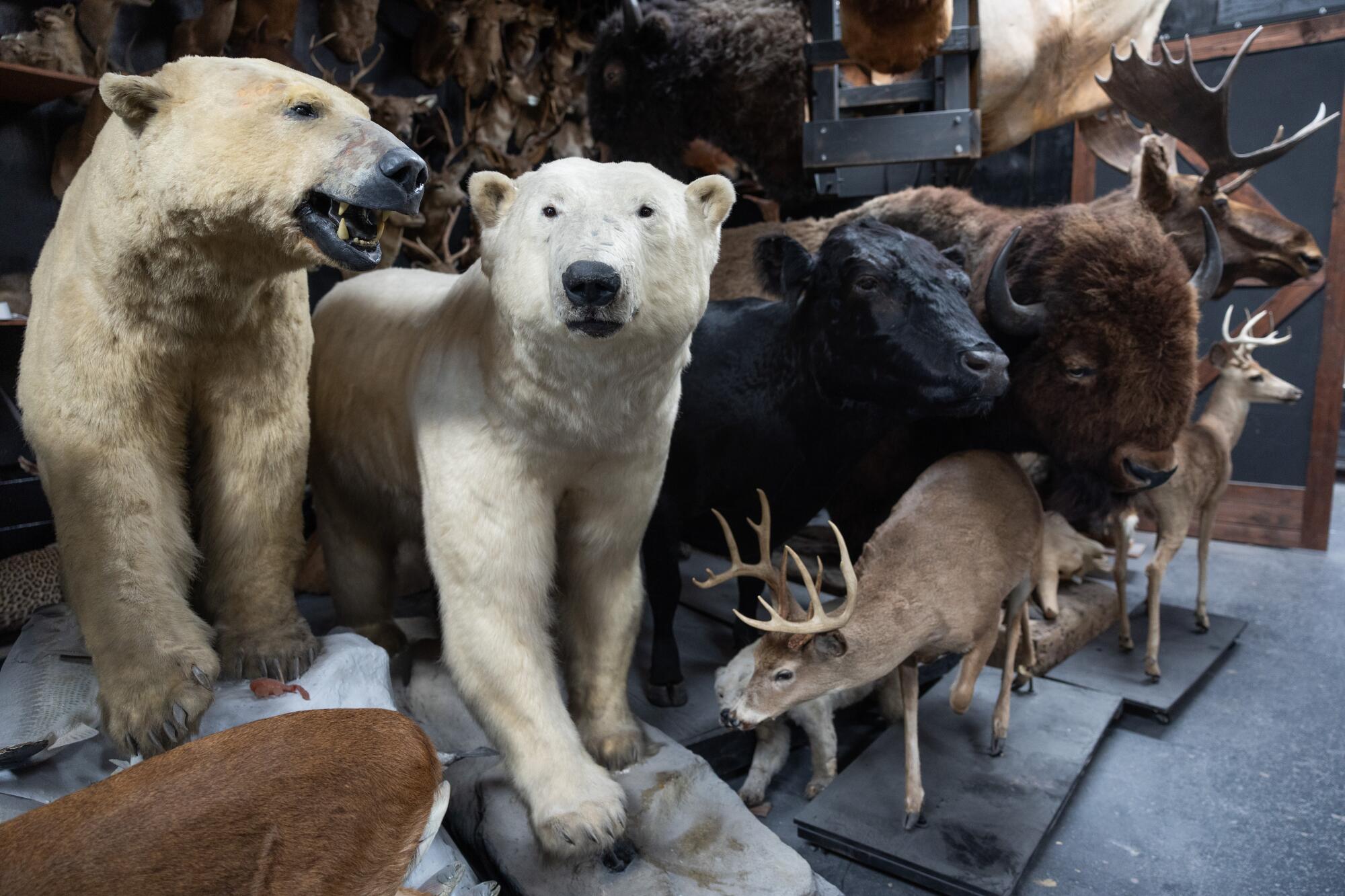
Bischoff’s has old and new taxidermy, including two polar bears from the 1940s and 1950s, a bull created in 2013 for the “Yellowstone” prequel “1923” and a buffalo that appeared in “The Lone Ranger.”
(Myung J. Chun / Los Angeles Times)
A few of Bischoff’s early taxidermy pieces are still on display, including a dog, which looks more like a cross between a wolf and a baboon, dating to the 1920s. Its plaster interior, an old taxidermy technique, gives it a stiff visage and makes it exceedingly heavy.
Bischoff’s prices reflect its modernized techniques, as well as the amount of time and attention to even the smallest of details required to make a dead pet come back to life. The cost for a fully preserved cat or a small dog like a Chihuahua starts at $2,640, with small birds, like a budgie, starting at $850.
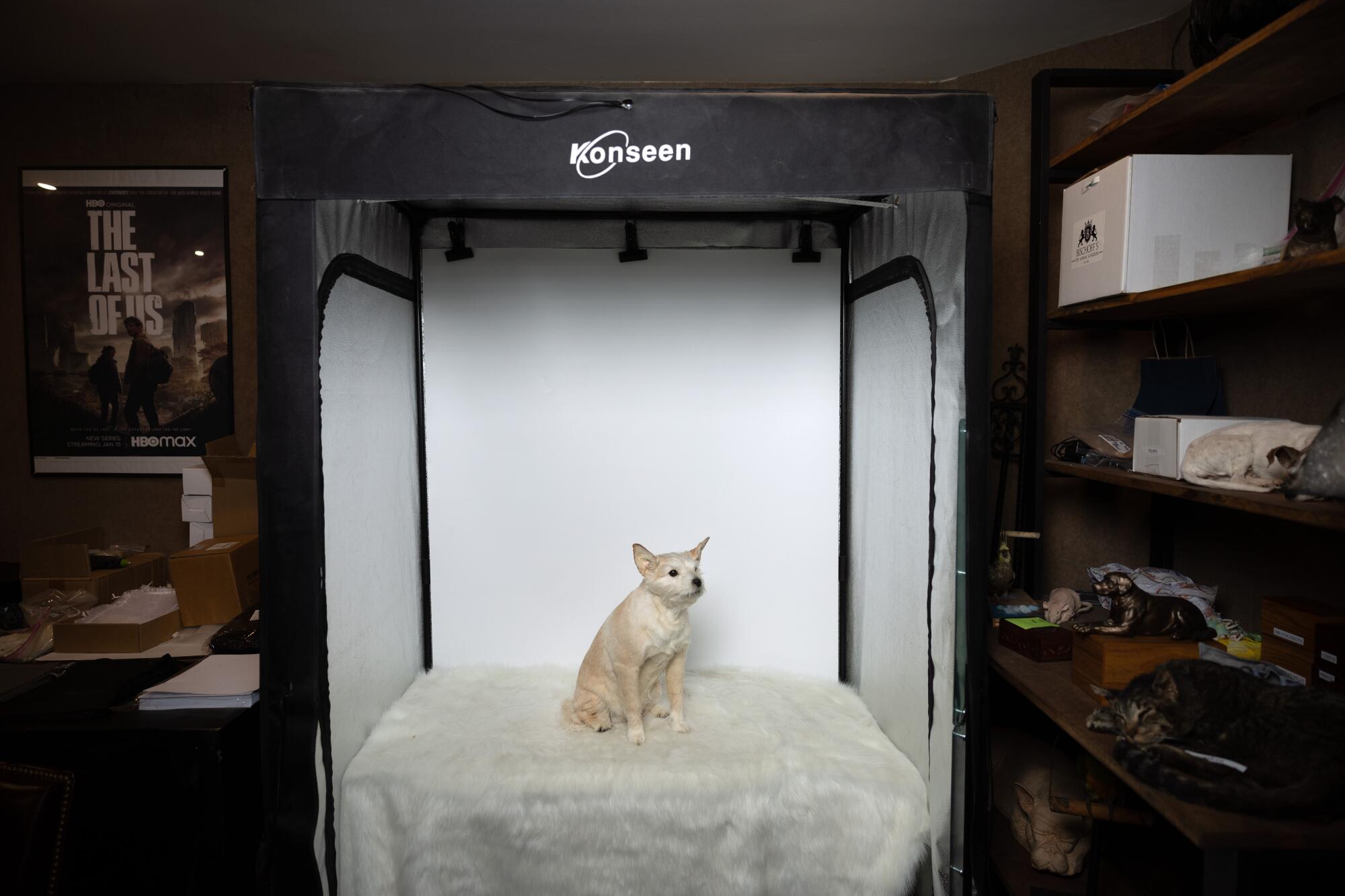
A photo booth is set up in Bischoff’s warehouse, where images of the completed pets are taken.
(Myung J. Chun / Los Angeles Times)
Although most customers order full-body taxidermy, an “a la carte” menu has expanded over the years with jars of whiskers or fur, bundles of bones tied in a bow and, the most recent addition, freeze-dried hearts, which come mounted inside of a glass cloche. Bischoff’s also offers cloning services through its Texas-based affiliate Viagen Pets, to whom they send the pet’s skin tissues.

Pelts, paws and bronzed skulls are among the smaller items purchased by pet owners.
(Myung J. Chun / Los Angeles Times)

Bischoff’s in-house artist Laischa Ramirez creates hand-drawn portraits of pets for owners who request it.
(Myung J. Chun / Los Angeles Times)
Costly though their work is, Alexander and Macias see it as an investment. Pets, they point out, are friends you look at every day. You’re intimately aware of their nuances and quirks, like how their left ear might curl back more than the right one or the way their nose tilts ever-so-subtly upwards. Entrust their preservation to a novice or lower-cost taxidermist, and you risk losing some of the elements that made your pet who they were.
Bischoff’s has seen its share of people who’ve preserved their pets with budget taxidermists only to be disappointed. “It’s unfortunate because at that point, there’s not much we can do,” Alexander said. Such pets are cremated “because they just can’t stand to look at them.”
Bischoff’s key component? Compassion
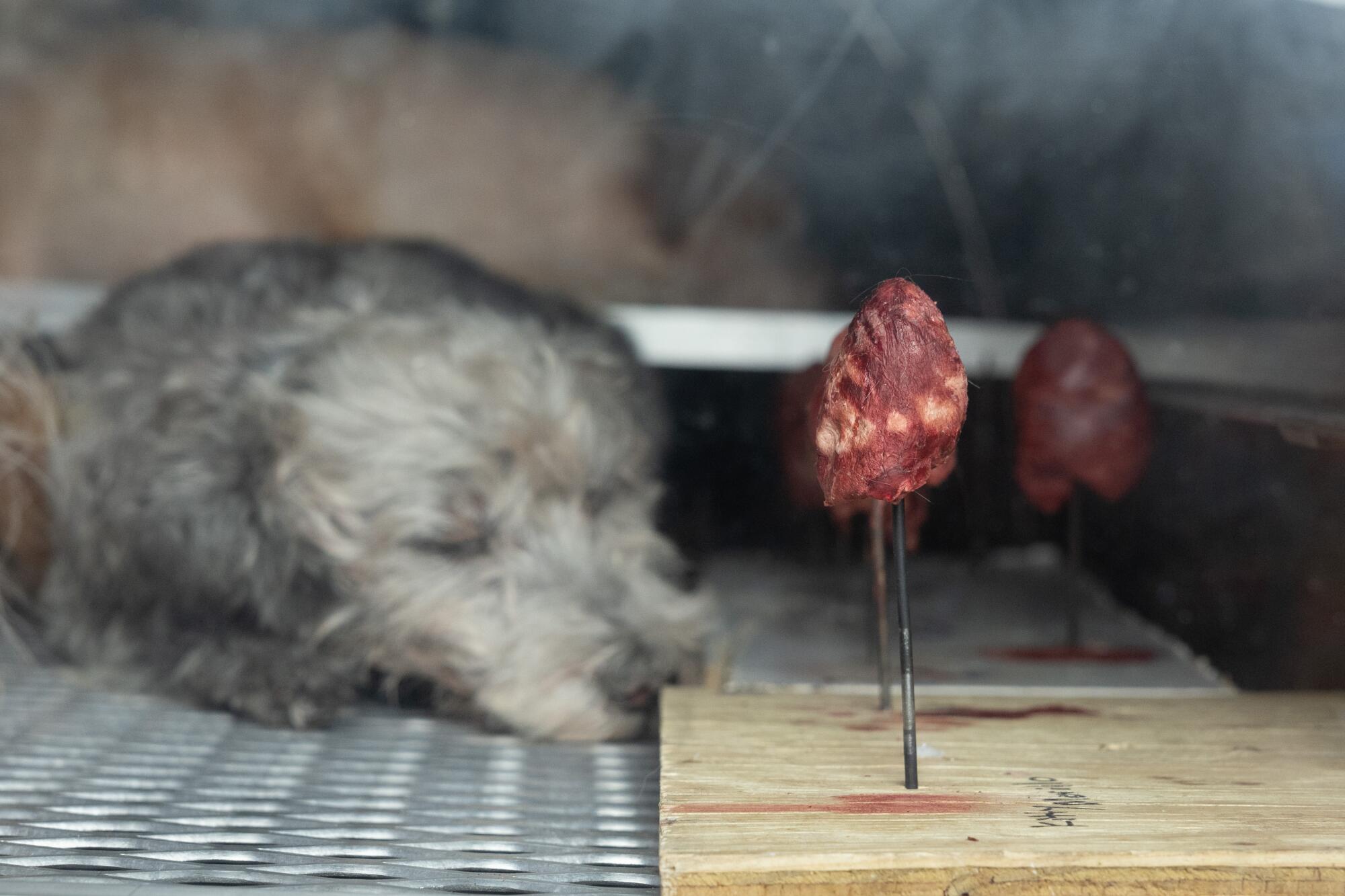
Pets and pet hearts sit in a freeze-dryer at Bischoff’s.
(Myung J. Chun / Los Angeles Times)
In the back of Bischoff’s warehouse is where the equipment resides and the smells of the oils running the machines permeates the space. The company has one aquamation machine that uses alkali solution, heat and pressure to break down the organic material into ashes. With interior chambers lined with perforated metal walls, the contraption somewhat resembles a fast-food restaurant’s deep fryer. Except, one taxidermist notes, when the process is done, instead of having golden fried potato strips in each basket, all that is left are bones.
Oftentimes at the ends of these processes, Bischoff’s workers will find inorganic remnants from the pets, such as microchips, metal plates or orthopedic screws. They give them to their owners as keepsakes.
Macias’ son, 29-year-old Chris Macias, works alongside his dad at Bischoff’s. He started helping out to make extra money while attending nursing school, but when business picked up, he decided to transition fully into the taxidermy business. He does a little bit of everything — recently, it was prepping a seal pelt for the San Pedro Marine Mammal Care Center — but tends to do pet pickups the most. Less technical though it may be, it is more emotionally taxing as he’s interfacing with grieving clients who might still be in shock or confused as to what exactly they want to do with their late pets.

Two calico cats were returned to Bischoff’s by the children of the woman who owned them after her death.
(Myung J. Chun / Los Angeles Times)
“Everybody’s different, but I just try to be there for them,” Chris said. “Their pet was part of their family, so I totally understand. Because all of us here, we have our own pets as well. We get it.”
Though Alexander never imagined building a career out of preserving dead pets, he said, “We’ve found joy in this work and we just see preservation as another form of art.”
It’s that art that is helping keep the memories of beloved pets alive — for generations even. Hays, the owner of Chihuahua-Yorkie mix Pixie, already has a contingency plan in place for Pixie’s taxidermy upon her own death. It will be “adopted” by another family member. Her daughter has already called dibs.
And many of Bischoff’s pet preservation customers are repeat clients, which is something that Alexander and Macias take pride in. Two women picking up the taxidermy body of their late cat recently chatted with Alexander about their newest rescue, a diabetic stray cat burnt in the Altadena fires. They couldn’t help but comment on the “beautiful bone structure” of the feline, still very much alive.
“I was like, ‘Hmm, you’re definitely going on the altar some day,’” one of the women said.


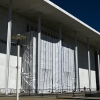
The Kennedy Center on June 28, with its facade signage still covered by a tarp and scaffolding.
Alex Wroblewski/AFP via Getty Images
hide caption
toggle caption
Alex Wroblewski/AFP via Getty Images
On Wednesday, a federal appeals court denied President Trump’s request to stop the removal of his name from Washington, D.C.’s Kennedy Center. The signage on the building has been covered with tarp and scaffolding since June 13, but in a court filing last month, the center’s current executive director said that Trump’s name has been removed.
In their decision, three judges from the U.S. District Court of Appeals for the District of Columbia Circuit said that the president had failed to prove that the arts center would be “irreparably injured” without Trump’s name attached to it.
NPR requested comment from the Kennedy Center, but did not receive an immediate reply.
This latest round of court decisions is part of the ongoing litigation filed by Rep. Joyce Beatty, D-Ohio, against President Trump and the board of the Kennedy Center. In a statement emailed Wednesday to NPR, Beatty said: “Today’s ruling again affirms that this administration’s efforts to rename the Kennedy Center were unlawful. His name no longer desecrates this sacred memorial, which belongs to the American people. Now it is time for the Trump administration to accept this, comply with the law, and take the tarps down.”
In previous court filings, Trump’s legal team had asserted that removing the president’s name from the arts complex, both on the physical building and in its digital materials, would inflict irreparable harm in both time and money already spent. In the denial, the three judges — Patricia Millett, Robert Wilkins and Gregory Katsas — wrote that since Trump’s name has already been removed, “a stay would not avert those harms.”
Furthermore, Trump had claimed that without his name attached, future fundraising would be threatened “and [will] contribute to the financial decline of the Center.” In response, the appeals judges wrote: “Appellants, however, have failed to support this assertion with any specific facts or evidence. They offer only the conclusory assertions of the Kennedy Center’s Executive Director that were made in a factually unsupported declaration.” The center’s current executive director, Matt Floca, specializes in physical plant management.
The presiding judge in the case, Christopher R. Cooper, has ordered that the center provide him a status report on the center’s operation and programming before the end of this month. As of Wednesday, the center’s calendar lists a small roster of programs, including outdoor free movie screenings, workshops for children, and five free live performances in July on its Millennium Stage. In the past, the Kennedy Center presented over 2,000 arts and education events each year, including free daily Millennium Stage performances.
Lifestyle
A meal with an animated Mona Lisa? Immersive dining goes high tech — but will L.A. eat it up?
My dinner course is served. It is a Campbell’s-inspired soup can, lightly angled so strands of broccoli are peeking out. I lift the can to uncover a slow-braised short rib and mashed potatoes. An American dish to represent an American artist, here Andy Warhol.
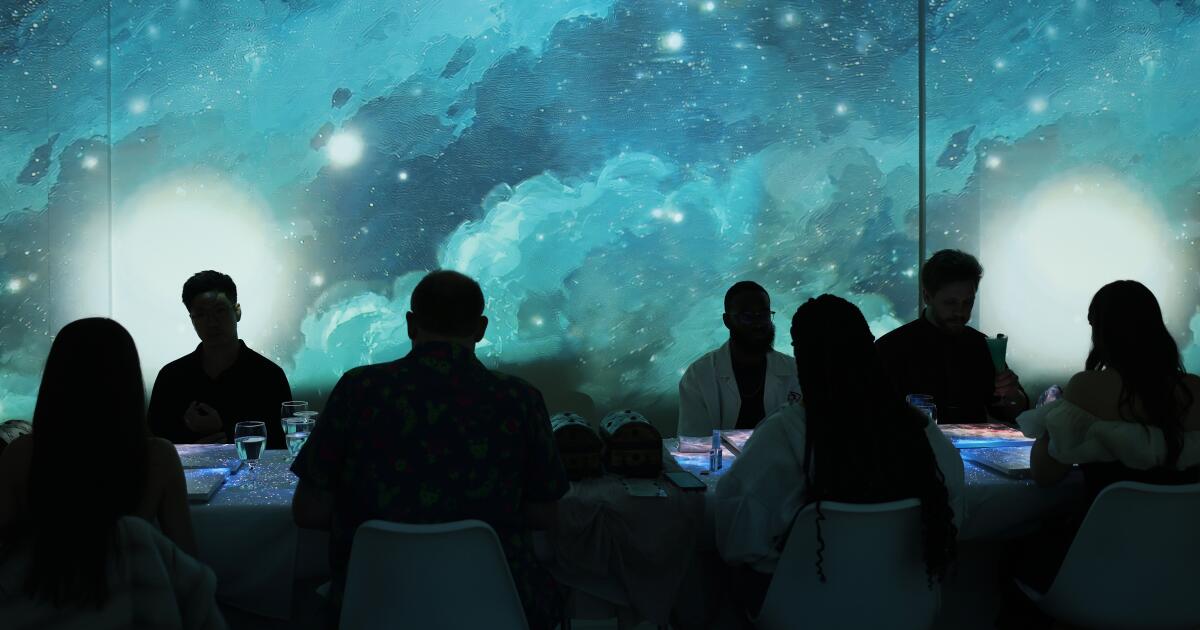
The room is overtaken with projections, scenes of bustling New York traffic paired with bachelor-pad-like guitar riffs. Shown on a wall above a dinner table is a selection of Warhol silkscreens. It’s a Friday night in West Hollywood, and I’m surrounded by a mix of out-of-towners and those celebrating an anniversary. And while this is a special occasion, we’re urged to get a little messy with our food — to use our hands, to paint with a salad, to draw on a cookie.
The main course: A tomato soup can? “7 Paintings” is an immersive event that occasionally hides dishes in artist-inspired presentations.
(Christina House / Los Angeles Times)
Play is the primary side dish at “7 Paintings,” a tech-infused dinner theater that aims to be a crash course in fine art. That selection of veggies paired with multiple mini cups of colorful dressings? Guests are encouraged to mix and match the vinaigrettes into a mess of hues, a nod to abstractionist Jackson Pollock. And yellowfin tuna with dashes of avocado and taro chips? That’s an edible tribute to Banksy, of course. What does raw fish have to do with stenciled street art? It’s bold, heavily angled and has a short shelf life? Maybe? Perhaps don’t overthink it.

Even the paper is edible.
(Christina House / Los Angeles Times)
“Have you ever eaten a painting before?” says Nadine Beshir, the Dubai-based creator of “7 Paintings.” “We try to get people out of their comfort zones and eating paper. I want to bring out the child in them.”
“7 Paintings,” held at Sunset House L.A. through the end of August, is the latest example of immersive dining to arrive in this city. These experiences often involve guest participation and are accentuated with advanced multimedia technology and sometimes theatrical elements.
Worldwide, there have been standouts. For instance, Eatrenalin at Germany’s Europa-Park, a dining room-meets-ride where participants are whisked around the space on trackless “floating chairs,” has just received a coveted Michelin star. Ibiza’s Sublimotion has similar haute ambitions, pairing 12 diners together in a room that will come alive with otherworldly projections and performers. At times, diners will win don virtual reality headgear.
But tech-driven immersive dining experiences have never quite taken off in Los Angeles as a trend. Last year, the Gallery, where fantastical cityscapes and projections surrounded downtown L.A. diners, stood just a couple months before the concept was abandoned.

“7 Paintings” pairs food with art and music. It’s “fun dining, not fine dining,” says its founder.
(Christina House / Los Angeles Times)

Bartender Luca Famulari shakes a cocktail at the immersive dining event.
(Christina House / Los Angeles Times)
“The economics of a restaurant are not the same as the economics of theater and the challenge of combining the two lies in thinking outside the box with respect to pricing and cost structure, such that the customer perceives high value from both the food and the experience,” says the Gallery co-founder Daren Ulmer.
Entrepreneurs keep aiming for that careful balance. “Le Petit Chef and Friends” is currently running at Tangier at downtown’s Hotel Figueroa, an event in which a fully animated film is projected on our plates and tables. Long-running pop-up event Fork N’ Film leans more dinner and movie, pairing dishes directly inspired by what is happening on screen. Upcoming films include “Ratatouille” and “Lilo and Stitch.”
The field comes with challenges. “The costs are very high,” says Joanna Garner, an immersive designer and former creative director with experiential art firm Meow Wolf. Garner has been experimenting herself with communal, immersive dinner events, and her next, the flirtatious “Please Open Your Mouth,” is set for July 11. (No tech there, as Garner is after a more sensual, adult-focused gathering.) Tickets for her event are $150 and a spot in the “7 Paintings” dining room runs $175, priced on par with a number of city’s most acclaimed restaurants.
There is also the reality that all public dining is in some fashion immersive, usually requiring varying combinations of engagement, communication and presentation. And then, are all these added elements distracting?

An animated Mona Lisa sits on the wall as guests enjoy their meals. Throughout the dinner, the painting provides factoids on various artists.
(Christina House / Los Angeles Times)
Throughout “7 Paintings,” for instance, an animated Mona Lisa, situated on the wall next to the main dinner table, will provide brief biographical details of each artist represented.
“Being able to nail the food, and nail the story, those are two very difficult threads to weave,” Garner says. “I do think, ultimately, people come to a dinner table to talk to the people at the table and to have intimate experiences. To have an experience where you’re constantly being taken away from the food, I’m not so sure if that’s what people are looking for.”
Food is framed as a star of “7 Paintings” but tasting it is just one component. At one point, we must uncover a cheese course in a tiny treasure chest, the code for the lock hidden in the projections (don’t stress, it’s not a hard puzzle). Beshir highlights the Pollock-inspired salad course, which is accentuated with a jazz soundtrack, as the thesis of the evening.
1

2

1. A guest uses a silicon brush to apply sauces onto an entree, a nod to abstractionist Jackson Pollock. 2. Projections fill up the dining table during meals.
“This course is really about getting people to free their minds from preconceived ideas,” Beshir says. “Like, you have to eat with a fork and knife, or the salad comes and then the dressing. No, the dressing comes and then the salad, and it’s trying with big brushes to paint the way he did. A lot of people do not understand Abstract Expressionism, and they think it’s people just splashing colors around. But when you understand the link between the rhythm of the music and painting, you live it. We give you time to paint with your salad dressing.”
In L.A., Beshir has partnered with nightlife impresario Kim Kelly, who is plotting a “Sleep No More”-inspired walk-around theatrical show for the Sunset House venue later this year. “7 Paintings,” however, is fully seated, and purposefully a little silly. Beshir and Kelly have been evolving it during its L.A. run, recently adding a stronger painting component by giving guests their own canvas to work on throughout the evening. Each night crowns a winner.
“Everyone comes over to look at their art,” Kelly says. “It just kind of changed the whole thing, to be honest. People are now being creative throughout the entire evening. Instead of just watching and occasionally painting, you’re now painting the whole time.”
As for what, perhaps, soba noodles with edamame and mushrooms have to do with Pablo Picasso, or why Salvador Dali gets an unexpected dessert course of a white chocolate potato souffle, Beshir clarifies the goal of the evening. While the animated Mona Lisa will provide backstories on each painter, this isn’t an educational night. “It’s fun dining, not fine dining,” Beshir says.
And by the end of my night, strangers were socializing, showing off their painted cookie creations, sharing Banksy tidbits and asking for recommendations on various vinaigrette combinations. Ultimately, it’s an evening of discovery, packed with surprises like finding an entire course hidden under a canvas.

Darryl Mayes of Charlotte, N.C., left, and Taylor Smith of North Hollywood, right, uncover their course.
(Christina House / Los Angeles Times)
“We try not to have too much sophistication, like fried ants or something. I’m personally very adventurous in how I eat, but if I want to have this in 100 cities around the world, I cannot be too meticulous.”
And Beshir has big goals.
“I want this be your movie and dinner thing,” Beshir says. “I want people to be waiting for our next show, and to be able to afford to come every couple months.”
And to come home not with leftovers, but perhaps a painting of their own.
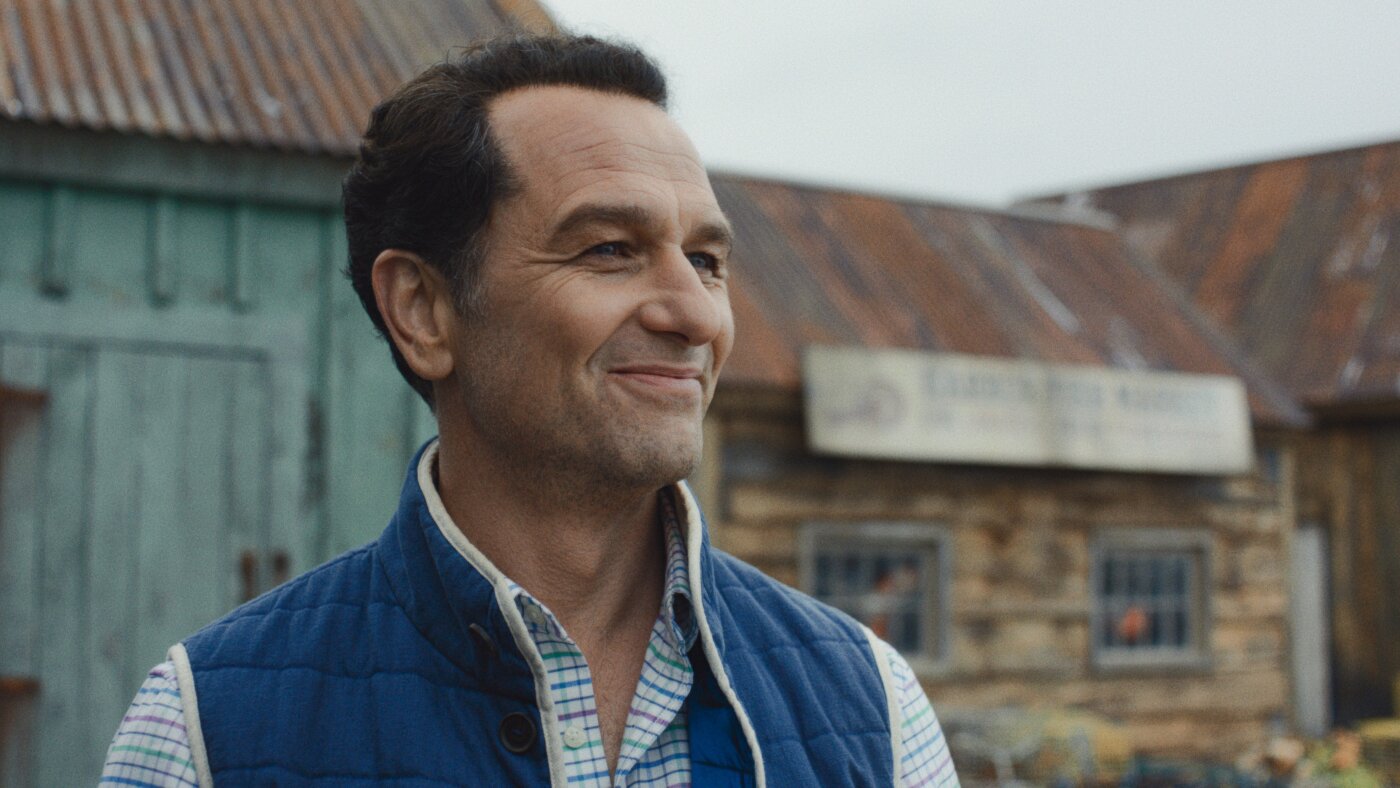
Matthew Rhys was nominated for his role in Widow’s Bay.
Apple TV
hide caption
toggle caption
Apple TV
The 2026 Emmy nominations are here. We’re unpacking the record-breaking nominations for Hacks, plus a big day for Widow’s Bay, The Pitt, and The Bear. We’ll also talk about the snubs and make some early predictions of who will win.
Connect with Pop Culture Happy Hour:
Letterboxd / Facebook
Our weekly newsletter
Support Pop Culture Happy Hour+
-

 Wisconsin33 seconds ago
New Wisconsin AD Shawn Eichorst: Badgers Need ‘Texas Swagger’ And Less Humility
-

 West Virginia6 minutes ago
West Virginia retailers told to allow people to purchase soda with SNAP benefits
-
 Wyoming13 minutes ago
Wyoming women escape black bear attack on their tents in the Big Horn Mountains
-

 Crypto16 minutes ago
Binance maintains commitment to EU, seeking more licences in Asia
-

 Finance21 minutes ago
How Banreservas mobilised diaspora capital
-

 Fitness28 minutes ago
I’d Fallen Into an Exercise Rut—Until Trail Running Reminded Me How Joyful Movement Could Be
-

 Movie Reviews36 minutes ago
Movie review: Supergirl is a blast
-

 World41 minutes ago
Trump Says He Thinks He Will Remove Syria From US Terrorism Sponsor List

