Lifestyle
Acclaimed playwright Tom Stoppard dies at 88


Tom Stoppard’s plays include Arcadia, Rosencrantz and Guildenstern Are Dead and The Coast of Utopia. He’s pictured above in London in 2017.
Justin Tallis/WPA Pool/Getty Images
hide caption
toggle caption
Justin Tallis/WPA Pool/Getty Images

Tom Stoppard’s plays include Arcadia, Rosencrantz and Guildenstern Are Dead and The Coast of Utopia. He’s pictured above in London in 2017.
Justin Tallis/WPA Pool/Getty Images
For more than a half century, Tom Stoppard was one of the most acclaimed playwrights in the English-speaking theater. He has died at age 88. Stoppard won a Laurence Olivier Award and five Tony Awards for Best Play. His work, including Travesties, The Real Thing and The Invention of Love was known for its language, wit and intellectual curiosity.
Stoppard’s death was reported by his agent.
Stoppard wrote erudite plays that touched on a broad range of topics – from his 1966 absurdist comedy Rosencrantz and Guildenstern Are Dead about two minor characters from Hamlet — to his 1993 drama Arcadia which included dialogue about Chaos Theory and Garden Landscaping. But when Arcadia opened in New York, Stoppard told me his plays were always about people, not abstract ideas.
“I’m not some kind of intellectual who’s importing very special ideas into the unfamiliar terrain of the theater. I don’t see it like that at all,” he said. “There’s something about the way the plays are written about which makes people think that they’re somewhat exclusive. And an exclusive playwright is a contradiction in terms.”
In 1999, Stoppard won an Oscar — shared with co-writer Marc Norman — for his verbal gymnastics in their screenplay for Shakespeare in Love, starring Joseph Fiennes as the young playwright and Gwyneth Paltrow as his inspiration for Juliet.
Tom Stoppard in 1981.
Roy Jones/Evening Standard/Getty Images
hide caption
toggle caption
Roy Jones/Evening Standard/Getty Images
Tom Stoppard in 1981.
Roy Jones/Evening Standard/Getty Images
English was not Stoppard’s first language. He was born Tomáš Sträussler in Czechoslovakia in 1937 to a Jewish family. When he was still a baby, his family fled to Singapore to escape the Nazis. When his father died, the family moved to India, where his mother remarried a British officer named Stoppard. In 1946, they settled in England. His family assimilated and Stoppard said he didn’t learn of his Jewish heritage until his 50s.
“It was a combination of my mother not looking backwards and liking to talk about the past, on the one hand,” Stoppard told Jeff Lunden in 2022. “On the other hand, there was my strange lack of curiosity. I’d been turned into a little English boy. I was very happy being a little English boy. I didn’t need to become somebody else. I already was somebody else.”
Stoppard never attended university. At 17, he began work as a journalist. Later he went on to become a theater critic, and finally a playwright.
“It’s a strange art form, isn’t it?” Stoppard mused during a rehearsal break in 2006. “There’s a lot of people in a large room, watching a few people at one end of the room dressing up and talking. And you’ve got to hear everything they say — you get to hear it once, you can’t turn the page back.”
Stoppard was talking about the difficulty of holding the audience’s attention through his epic nine-hour trilogy, The Coast of Utopia, about 19th-century Russian intellectuals. Movie star Ethan Hawke gave up seven months of more lucrative work to perform in The Coast of Utopia. He said the chance to read Stoppard’s lines was worth it.
“We’re used to being talked down to. We’re used to very simple ideas. We’re used to people not challenging us,” Hawke said. “I feel the great thing about watching Tom Stoppard, when you watch it, it makes you feel incredibly intelligent. Because you do get it. The ideas aren’t that complicated.”
In 1995, Stoppard said he loved the theater in all its forms.
“Things are done well, or they’re done not so well,” he said. “And that’s the only distinction which matters in the theater. I think that I consider myself to be at some place in the spectrum of entertainers. Theater is a popular art form. If I didn’t think that, I’d be trying to write some kind of book of essays perhaps. I don’t know. I love the theater. I’m a theater animal.”
And the theater loved him back. The adjective “Stoppardian” entered the Oxford English Dictionary in 1978. It means to employ elegant wit while addressing philosophical concerns — in the style of Tom Stoppard.
In a statement from Buckingham Palace issued to reporters via WhatsApp on Saturday, King Charles said he and the Queen were “deeply saddened” by Stoppard’s death.
“A dear friend who wore his genius lightly, he could, and did, turn his pen to any subject, challenging, moving and inspiring his audiences, borne from his own personal history,” said King Charles. “Let us all take comfort in his immortal line: ‘Look on every exit as being an entrance somewhere else.’ “



Timothée Chalamet plays a shoe salesman who dreams of becoming the greatest table tennis player in the world in Marty Supreme.
A24
hide caption
toggle caption
A24
Last year, while accepting a Screen Actors Guild award for A Complete Unknown, Timothée Chalamet told the audience, “I want to be one of the greats; I’m inspired by the greats.” Many criticized him for his immodesty, but I found it refreshing: After all, Chalamet has never made a secret of his ambition in his interviews or his choice of material.
In his best performances, you can see both the character and the actor pushing themselves to greatness, the way Chalamet did playing Bob Dylan in A Complete Unknown, which earned him the second of two Oscar nominations. He’s widely expected to receive a third for his performance in Josh Safdie’s thrilling new movie, Marty Supreme, in which Chalamet pushes himself even harder still.
Chalamet plays Marty Mauser, a 23-year-old shoe salesman in 1952 New York who dreams of being recognized as the greatest table-tennis player in the world. He’s a brilliant player, but for a poor Lower East Side Jewish kid like Marty, playing brilliantly isn’t enough: Simply getting to championship tournaments in London and Tokyo will require money he doesn’t have.

And so Marty, a scrappy, speedy dynamo with a silver tongue and inhuman levels of chutzpah, sets out to borrow, steal, cheat, sweet-talk and hustle his way to the top. He spends almost the entire movie on the run, shaking down friends and shaking off family members, hatching new scams and fleeing the folks he’s already scammed, and generally trying to extricate himself from disasters of his own making.
Marty is very loosely based on the real-life table-tennis pro Marty Reisman. But as a character, he’s cut from the same cloth as the unstoppable antiheroes of Uncut Gems and Good Time, both of which Josh Safdie directed with his brother Benny. Although Josh directed Marty Supreme solo, the ferocious energy of his filmmaking is in line with those earlier New York nail-biters, only this time with a period setting. Most of the story unfolds against a seedy, teeming postwar Manhattan, superbly rendered by the veteran production designer Jack Fisk as a world of shadowy game rooms and rundown apartments.
Early on, though, Marty does make his way to London, where he finagles a room at the same hotel as Kay Stone, a movie star past her 1930s prime. She’s played by Gwyneth Paltrow, in a luminous and long-overdue return to the big screen. Marty is soon having a hot fling with Kay, even as he tries to swindle her ruthless businessman husband, Milton Rockwell, played by the Canadian entrepreneur and Shark Tank regular Kevin O’Leary.
Marty Supreme is full of such ingenious, faintly meta bits of stunt casting. The rascally independent filmmaker Abel Ferrara turns up as a dog-loving mobster. The real-life table-tennis star Koto Kawaguchi plays a Japanese champ who beats Marty in London and leaves him spoiling for a rematch. And Géza Röhrig, from the Holocaust drama Son of Saul, pops up as Marty’s friend Bela Kletzki, a table tennis champ who survived Auschwitz. Bela tells his story in one of the film’s best and strangest scenes, a death-camp flashback that proves crucial to the movie’s meaning.
In one early scene, Marty brags to some journalists that he’s “Hitler’s worst nightmare.” It’s not a stretch to read Marty Supreme as a kind of geopolitical parable, culminating in an epic table-tennis match, pitting a Jewish player against a Japanese one, both sides seeking a hard-won triumph after the horrors of World War II.

The personal victory that Marty seeks would also be a symbolic one, striking a blow for Jewish survival and assimilation — and regeneration: I haven’t yet mentioned a crucial subplot involving Marty’s close friend Rachel, terrifically played by Odessa A’zion, who’s carrying his child and gets sucked into his web of lies.
Josh Safdie, who co-wrote and co-edited the film with Ronald Bronstein, doesn’t belabor his ideas. He’s so busy entertaining you, as Marty ping-pongs from one catastrophe to the next, that you’d be forgiven for missing what’s percolating beneath the movie’s hyperkinetic surface.
Marty himself, the most incorrigible movie protagonist in many a moon, has already stirred much debate; many find his company insufferable and his actions indefensible. But the movies can be a wonderfully amoral medium, and I found myself liking Marty Mauser — and not just liking him, but actually rooting for him to succeed. It takes more than a good actor to pull that off. It takes one of the greats.


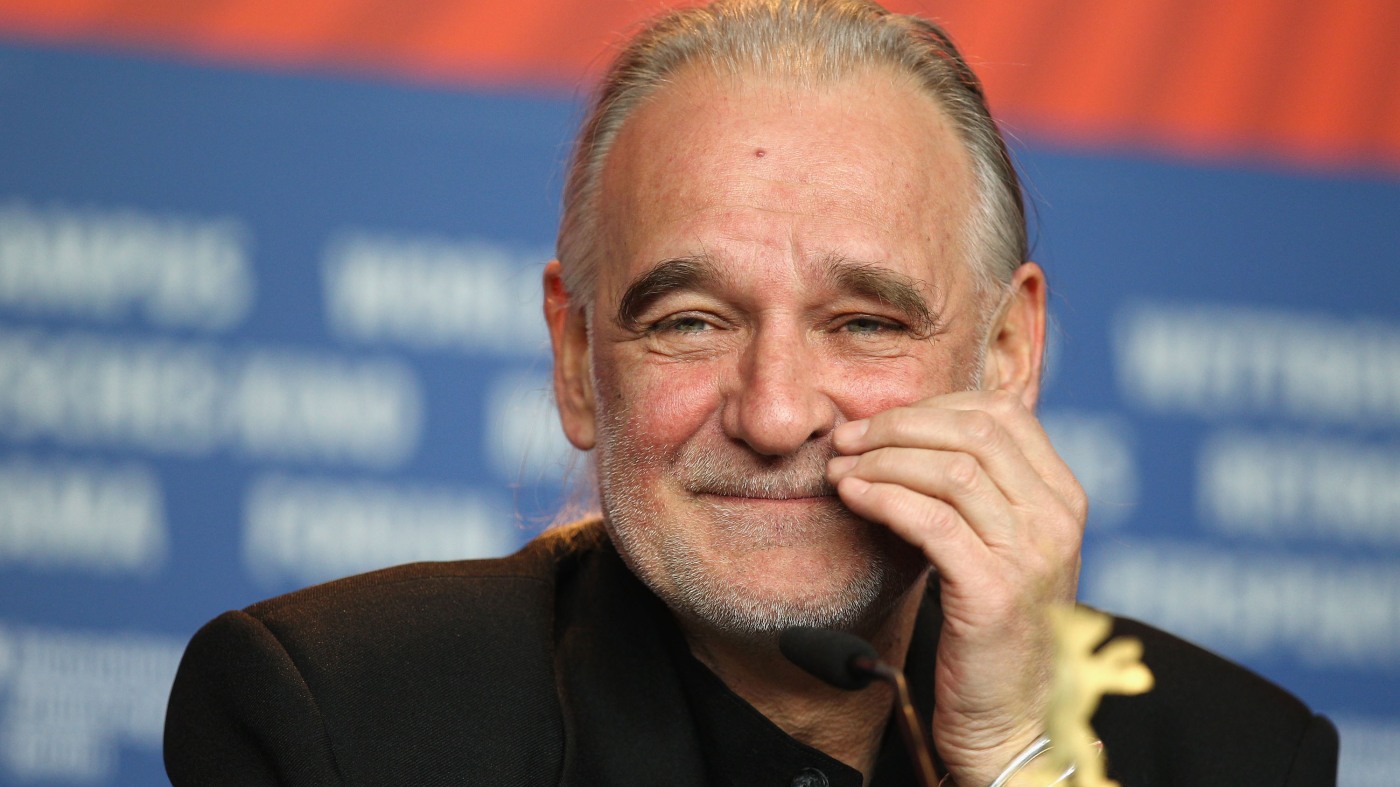
Hungarian director Béla Tarr at the Berlin International Film Festival in 2011.
Andreas Rentz/Getty Images
hide caption
toggle caption
Andreas Rentz/Getty Images
Béla Tarr, the Hungarian arthouse director best known for his bleak, existential and challenging films, including Sátántangó and Werckmeister Harmonies, has died at the age of 70. The Hungarian Filmmakers’ Association shared a statement on Tuesday announcing Tarr’s passing after a serious illness, but did not specify further details.
Tarr was born in communist-era Hungary in 1955 and made his filmmaking debut in 1979 with Family Nest, the first of nine feature films that would culminate in his 2011 film The Turin Horse. Damnation, released in 1988 at the Berlin International Film Festival, was his first film to draw global acclaim, and launched Tarr from a little-known director of social dramas to a fixture on the international film festival circuit.
Tarr’s reputation for films tinged with misery and hard-heartedness, distinguished by black-and-white cinematography and unusually long sequences, only grew throughout the 1990s and 2000s, particularly after his 1994 film Sátántangó. The epic drama, following a Hungarian village facing the fallout of communism, is best known for its length, clocking in at seven-and-a-half hours.
Based on the novel by Hungarian writer László Krasznahorkai, who won the Nobel Prize in Literature last year and frequently collaborated with Tarr, the film became a touchstone for the “slow cinema” movement, with Tarr joining the ranks of directors such as Andrei Tarkovsky, Chantal Akerman and Theo Angelopoulos. Writer and critic Susan Sontag hailed Sátántangó as “devastating, enthralling for every minute of its seven hours.”
Tarr’s next breakthrough came in 2000 with his film Werckmeister Harmonies, the first of three movies co-directed by his partner, the editor Ágnes Hranitzky. Another loose adaptation of a Krasznahorkai novel, the film depicts the strange arrival of a circus in a small town in Hungary. With only 39 shots making up the film’s two-and-a-half-hour runtime, Tarr’s penchant for long takes was on full display.
Like Sátántangó, it was a major success with both critics and the arthouse crowd. Both films popularized Tarr’s style and drew the admiration of independent directors such as Jim Jarmusch and Gus Van Sant, the latter of which cited Tarr as a direct influence on his films: “They get so much closer to the real rhythms of life that it is like seeing the birth of a new cinema. He is one of the few genuinely visionary filmmakers.”
The actress Tilda Swinton is another admirer of Tarr’s, and starred in the filmmaker’s 2007 film The Man from London. At the premiere, Tarr announced that his next film would be his last. That 2011 film, The Turin Horse, was typically bleak but with an apocalyptic twist, following a man and his daughter as they face the end of the world. The film won the Grand Jury Prize at the Berlin International Film Festival.
After the release of The Turin Horse, Tarr opened an international film program in 2013 called film.factory as part of the Sarajevo Film Academy. He led and taught in the school for four years, inviting various filmmakers and actors to teach workshops and mentor students, including Swinton, Van Sant, Jarmusch, Juliette Binoche and Gael García Bernal.
In the last years of his life, he worked on a number of artistic projects, including an exhibition at a film museum in Amsterdam. He remained politically outspoken throughout his life, condemning the rise of nationalism and criticizing the government of Hungarian leader Viktor Orbán.

Nick Saban gives thoughts on Kalen DeBoer, Alabama’s blowout loss to Indiana

Univ. of Iowa students practice life-saving skills through realistic medical simulations

Arizona-Kansas State free livestream: How to watch Big 12 basketball game, TV, time

Kentucky vs Missouri score today, UK basketball game updates

USDA picks Louisiana lawmaker to lead state’s rural development efforts. See who it is.

Florida High School Football Rankings: Top 25 teams – Oct. 21

Cleary's 21 help Le Moyne down Central Connecticut State 69-64 in OT

How old is Bo Nix? What to know about Oregon quarterback ahead of 2024 NFL Draft

99th annual Pony Swim held in Virginia

Video: ‘It Didn’t Have to Happen This Way:’ U.Va. Faculty Call for Review of Police Response to Protests

San Diego sues to stop border barrier construction

How Ukraine is shaping Europe’s response to Trump’s Greenland threats

GOP gearing up to face tough midterms. And, Pentagon reviews women in ground combat

Wyoming Supreme Court rules laws restricting abortion violate state constitution

How strong are Latin America’s military forces, as they face US threats?
-

 World1 week ago
Hamas builds new terror regime in Gaza, recruiting teens amid problematic election
-
 News1 week ago
For those who help the poor, 2025 goes down as a year of chaos
-

 Science1 week ago
We Asked for Environmental Fixes in Your State. You Sent In Thousands.
-
 Business1 week ago
A tale of two Ralphs — Lauren and the supermarket — shows the reality of a K-shaped economy
-

 Detroit, MI4 days ago
2 hospitalized after shooting on Lodge Freeway in Detroit
-
 Politics1 week ago
Commentary: America tried something new in 2025. It’s not going well
-

 Politics1 week ago
Marjorie Taylor Greene criticizes Trump’s meetings with Zelenskyy, Netanyahu: ‘Can we just do America?’
-

 Health1 week ago
Record-breaking flu numbers reported in New York state, sparking warnings from officials