Lifestyle
A slime museum is coming to L.A. — and it’s bringing the healing power of play

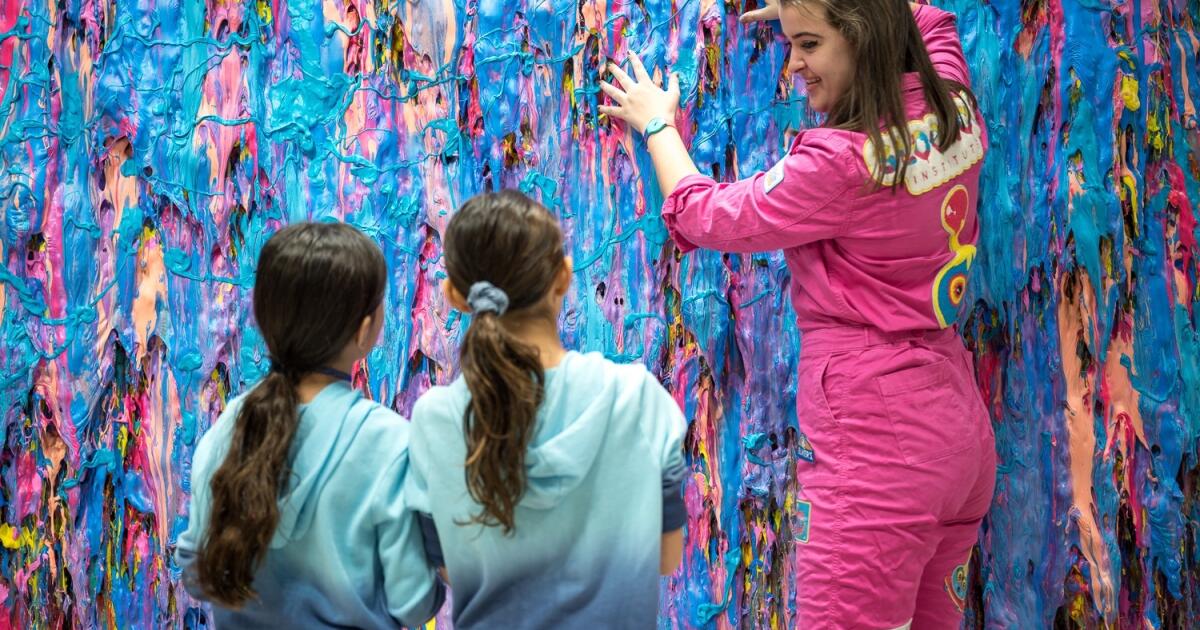
When it comes to healing from grief, there’s often not a simple answer, but there are some recommended standbys. Therapy, of course, is essential, and maintaining close contact with a community also is often recommended.
And maybe, perhaps, a bit of slime?
Such was the case for Karen Robinovitz, one of the co-founders of the Sloomoo Institute, a playful palace dedicated to all things gooey and goopy, where guests can toss slime, mold it, walk on it, get drenched by it and even experience the ASMR benefits of it. Los Angeles soon will be home to the fifth Sloomoo Institute in the U.S. — an outpost on Fairfax Avenue across from the Original Farmers Market opens this summer.
Kids play with slime at Sloomoo Institute’s Atlanta location.
(Sloomoo Institute)
Before the interactive, make-a-mess emporiums became a reality, Robinovitz was struggling to simply get through the day. A survivor of multiple tragedies, Robinovitz seven years ago lost her husband. Months later, a cousin was killed in the 2018 high school shooting in Parkland, Fla. She was living, she says, with “a very deep and dark depression,” talking to someone — a therapist or various support groups — five days a week.
“I was really struggling,” Robinovitz says. “You’re talking about it all the time. In my home, I’m reminded of it in every corner of my house. In my neighborhood, everything reminds you of the person that you lost.”
Healing came in an unexpected place — and a surprising substance. A friend visited with her then-10-year-old daughter, who brought some slime with her for solo playtime while the adults talked. Robinovitz, however, found herself transfixed by the ooze.
Sloomoo Institute guests in Chicago get drenched with slime.
(Grace Pisula)
“I sat on the floor with her, and four hours later I realized I was in a complete state of joy,” Robinovitz says. “I had unleashed a part of myself that I never thought I’d see again, which was the inner child. I was happy playing. When they were leaving, I said that this did more for me than all the therapy, all the experts and all the support groups I had been seeing. I said I need to keep this. I became what is known affectionately as an ‘adult slimer.’”
Robinovitz and her longtime friend Sara Schiller created the Sloomoo Institute. The first location launched in late 2019 in New York, and Sloomoo Institutes in Atlanta, Chicago and Houston followed.
This is no mere immersive “pop-up,” says Robinovitz, as the two have signed a long-term lease with the intention of being in L.A. to stay — perhaps even tapping into the city’s creative class to expand their slimy mascots and creatures into other media. But for now, their mission is to merge silly with a bit of science, and to explore the importance of play for play’s sake.
A visit to a Sloomoo Institute takes guests through various slime stations, some that are very hands-on and others that resemble a light obstacle course. Some are just goofy, such as a slime slingshot, which allows participants to catapult slime at someone else. (Don’t worry, they’re tucked safely behind plexiglass.) Stations may focus on touch, such as a blindfolded journey through various gloppy textures, while others are directed toward more aural sensations. New for Los Angeles is a sound bath, with art from Randy Polumbo — think reflective surfaces, amorphic shapes and synchronized sound.
Karen Robinovitz, left, and Sara Schiller founded the Sloomoo Institute to celebrate the power of play.
(Lanna Apisukh)
Built into the room will be bowls and meditation-ready balls, which guests will be able to strike to create their own personal symphonies. One can imagine a cacophony of noise on a crowded day, but Robinovitz and Schiller also speak of it as an event space, a potential home for yoga or more relaxing, psychedelic-inspired sound baths. It taps into the Sloomoo Institute’s underlying mission, as the firm collaborates with psychiatrists such as Dr. Judith Joseph to better understand the importance of sensory play.
“Adults, we need this,” says Robinovitz. “I started to talk to a psychiatrist friend of mine because I wanted to understand what was happening. At once, you’re tapping into three or four of your five senses. It’s tactile. It makes sounds when you touch it. All the slimes we make are scented, so they smell really yummy, and scent is the sense that’s most closely tied to memory.”
L.A. ticket prices haven’t been announced yet, but based on admission in other cities, expect to spend around $40 for a general admission Sloomoo Institute ticket. Those who want to get rained on by slime — an experienced dubbed Sloomoo Falls — will need to pay for an “enhanced experience,” which can double the ticket price. Important to note: One shouldn’t come wearing a favorite outfit to the Sloomoo Institute, even though ponchos will be provided for the slime showers.
A shop inside Sloomoo Institute.
(Sloomoo Institute)
Schiller had her own personal connection to slime, noticing that play allows participants to get out of their head. Vulnerability, for instance, can come naturally in a state of play. Schiller’s eldest daughter has Angelman syndrome, a genetic disorder that can leave children unable to communicate via speech or writing, and her husband has survived multiple bilateral strokes. Slime, she says, has helped foster connections, helping her family better deal with disabilities and stressful moments.
“The great thing that I say about slime is that when you’re playing with slime, you can have difficult conversations or meaningful conversations without them being awkward,” Schiller says, theorizing that when we are in a relaxed, playful state — and focused on a group activity — we feel more at ease. “But you’re not on your device. You’re not distracted. You’re connected to yourself and you’re connected to the other person.”
The two founders are eager to talk about their history, noting they don’t want their personal stories divorced from the Sloomoo Institute. Longtime friends, Robinovitz and Schiller have entrepreneurial backgrounds. Robinovitz, for instance, launched a talent firm dedicated to digital influencers, while Schiller has an extensive history in the hospitality and art worlds. Together, they’re proud to note that the Sloomoo Institute workforce is about 10% neurodivergent, as they wanted the spaces to be inclusive and accessible (there are scent blockers available, for instance, for those sensitive to Sloomoo Institute’s smell-heavy focus).
While they are still places full of picture-friendly moments ripe for social media — one area is filled with gargantuan-sized slime-inspired chairs — the two clearly are wary of their slime boutiques going the way of so many so-called “Instagram museums,” spaces that used “immersive” as a buzzword for little more than photo opportunities. The centerpiece of the Sloomoo Institute, perhaps, is a do-it-yourself “slime bar,” where guests can explore 40 colors of slime, 60 fragrances and dozens of textures to build their own take-home creation.
“I know when I was going through my own personal grief, talking to other women who lost their husbands at young ages was really powerful to me,” Robinovitz says. “I had people going through the same kind of grief, and I could see there was potentially a way to live a life when you’re not in pain 24/7. It makes our brand important. This brand wouldn’t mean anything without the hardship. It’s not just a fun candy-colored universe with cute things.”
Sensory play is at the heart of the museum.
(Sloomoo Institute)
That’s not to say Sloomoo Institutes are purely mindful places for serious play, though there are references to the science of slime and what chemical mixtures may result in a substance that’s more sticky or more bubbly. With a contemporary, space-age sheen — Robinovitz and Schiller stress they designed the spaces to be inviting to adults — Sloomoo Institutes allow for unexpected moments to occur: the sensation, for instance, of walking barefoot on slime, or ASMR-focused installations that allow guests to experience the pleasing, tingling sound sensations of slime.
Well, mostly pleasing. One of the ASMR sounds asks guests to imagine what it sounds like when slime farts.
“It’s a whole fart soundtrack,” says Schiller. “It’s loved by kids and adults.”
Play may have rejuvenating powers, but no one said it need always be sophisticated. Sometimes the best healing prescription may be to simply giggle like an 8-year-old.


Once rivals on the tennis court, Martina Navratilova, left, and Chris Evert have become close friends in retirement. They are pictured above at the French Open in 1986.
Trevor Jones/Getty Images Europe
hide caption
toggle caption
Trevor Jones/Getty Images Europe
Chris Evert and Martina Navratilova were the most successful women’s tennis champions of their generation. Both were 18-time Grand Slam tournament winners — and each other’s greatest rivals.
Evert, a Florida native, became a tennis star in her teens. Navratilova was born in communist Czechoslovakia, and emerged as a player after Evert was established. They first faced off during a match in Akron, Ohio, in 1973, when Evert was 18, and Navratilova was 16. Evert won, but Navratilova left an impression.
“I remember thinking to myself, holy cow, when this young girl gets into better shape, she is going to be a force to be reckoned with,” Evert says. “She had so much talent. Her hands were quick, she had a big first serve, she had a big forehand, and she just was so powerful.”

Two years later, on the day she lost a semifinals match to Evert at the U.S. Open, Navratilova defected to the U.S. In the years that followed, her tennis game improved. Though she and Evert had initially been friendly, the friendship cooled as their rivalry heated up.
“Playing Chris was difficult because how can you not like Chris? What’s not to admire?” Navratilova says. “She was like the epitome of cool.”
The new Netflix documentary Chris & Martina: The Final Set tells the story of how Evert and Navratilova re-established their friendship and how they both faced cancer in retirement. Evert was diagnosed with ovarian cancer in 2021; Navratilova was diagnosed with throat and breast cancer in 2022.
“I can’t get away from her,” Evert jokes. “We had a 15-year career, and then we got cancer at the same time. It really is freaky, but I always say: If I want someone to be in the trenches with me, it’s Martina because she has been so supportive and so understanding.”

Navratilova agrees: “We have such a level of trust that we know whatever we say to each other, it stays there. We give each other the best advice we know how to. And there is no ulterior motive, no playing games.”
At the time that this interview was taped, Evert and Navratilova were both in remission from cancer. But late last week, Evert disclosed she’d recently been diagnosed with a recurrence of ovarian cancer.

“We know whatever we say to each other, it stays there,” Martina Navratilova says of her friendship with Chris Evert.
Netflix
hide caption
toggle caption
Netflix
Interview highlights
On supporting each other through cancer
Evert: There are a lot of phone calls between us. … I don’t cook, but Martina would bake bread for me, and her wife Julia would cook, make some chicken soup. … I got a lot of food from Martina. She got a necklace from me.
Navratilova: I get jewelry from Chris, she gets food from me.
Evert: Martina’s and my relationship — because we’ve had one for 50 years — is not the type where we have to talk to each other every day to maintain the closeness. I always knew she was there. She always knew I was there if we needed to talk, and that was that.
On the weakness they experienced with cancer
Navratilova: Chris’ diagnosis and treatment was much more life-threatening than mine, percentage wise, but my treatment was more difficult physically. … I was in New York for seven weeks and I literally sat on a yoga mat, maybe half an hour of the seven weeks, and did some stretching. I couldn’t even do the down dog pose because I would have fallen down. I had absolutely zero strength left.
Evert: The chemo kicked my butt, let’s put it that way. … It left me very weak, very, very weak. After chemo I would have three or four days of intense nausea and I just would feel tingling in my body and it just wasn’t nice. I didn’t have the energy. To walk six blocks was a big deal for me. And it was foreign. You know, it felt like it wasn’t my body, for sure.
On watching the old footage of their matches together for the documentary
Navratilova: For me, it was fun watching with Chris, because we had different reactions to what happened on the court. But what impressed me is how well we played with those wooden rackets. Because you know what? Those rackets are not easy to play with. But you try to put yourself in there physically, what it was like, mentally, what it is like. And it’s like, “Oh, I should have gone down the line,” or, “I can’t believe I missed that shot.” Or “Chris, you had such a great pass.” It was amazing. So it was impressive. … I wish I could still have that six-pack, but anyhow.

Evert: I remember feeling genuinely happy for her. I remember it was her first Wimbledon. That’s always been her dream since she defected. Her family couldn’t be there to watch her. She was all alone. And I just was happy for it. And I knew that this was gonna be one of many for her to win.
On defecting to the U.S. in 1975 when she was 18 years old
Navratilova: I was thrilled to be in the States. I always loved American cars. And when you ordered a ham sandwich, you got, like, two inches of ham and two slices of bread. Whereas growing up, you had thick bread and one slice of ham. So I thought I was in heaven. And it was $2.30 for that sandwich. I still remember it. I couldn’t believe how much ham I was getting.
Lauren Krenzel and Nico Gonzalez Wisler produced and edited this interview for broadcast. Bridget Bentz, Molly Seavy-Nesper and Beth Novey adapted it for the web.


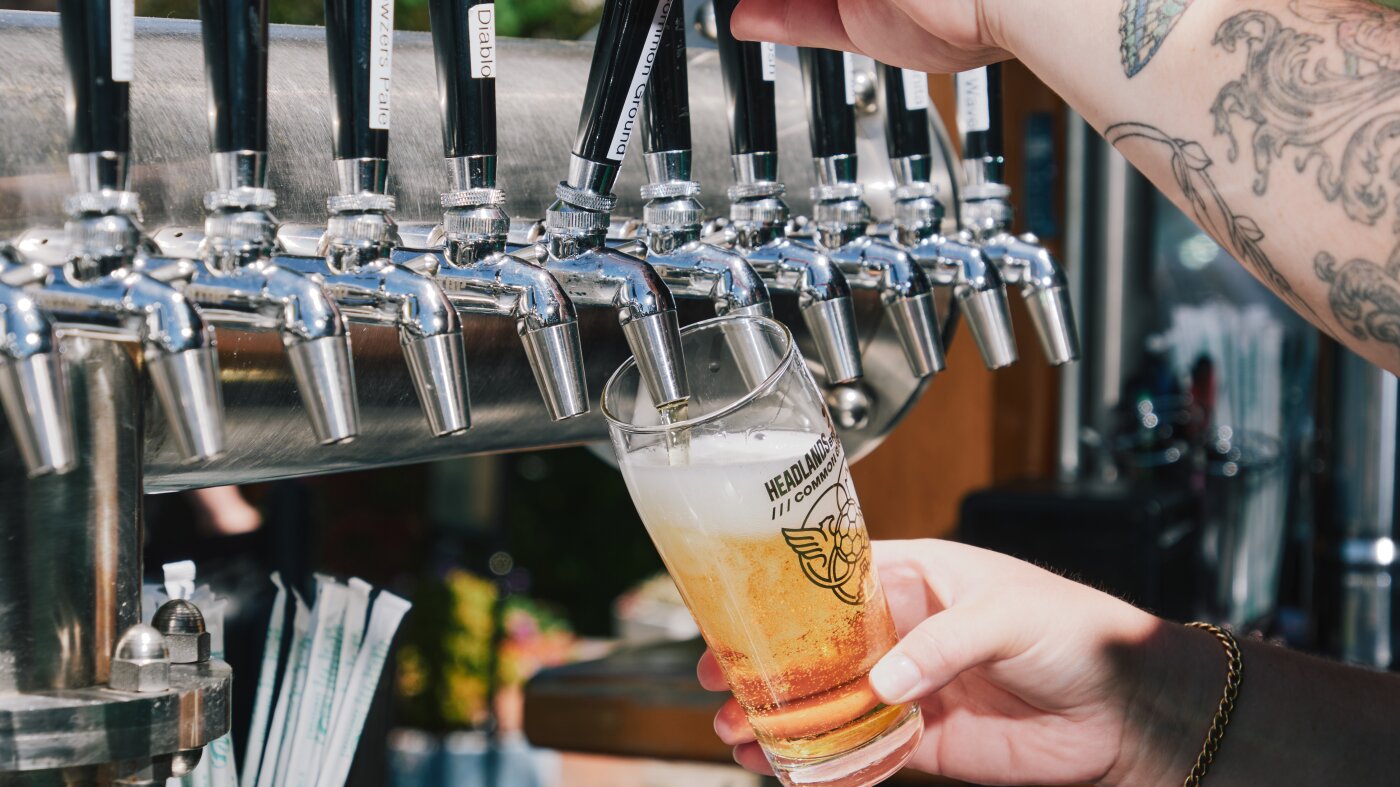
Headlands Brewing launched its World Cup-themed beer Common Ground ahead of the first World Cup game in June.
Justin Gellerson for NPR
hide caption
toggle caption
Justin Gellerson for NPR
The British betting company William Hill predicts that soccer fans will throw back more than 5 million pints of beer in stadiums and fan zones during this year’s World Cup. And that number doesn’t even account for the millions of pints being poured in bars as fans tune in to the global soccer event.
But while international soccer crowds are focusing on goals and penalties, a trio of craft breweries from the tournament’s three host nations are using the tournament to brew something increasingly rare: cross-border solidarity.

A shared recipe with local spin
The collaboration began months ago over a flurry of video chats and emails. The beermakers at Rey Árbol Brewing Co. in Mexico, Headlands Brewing in the United States, and Cabin Brewing Co. in Canada set out to design a single, unified recipe representing the brewing traditions of all three nations.
“It’s a Mexican lager,” said Alejandro Gomez, founder of Rey Árbol.
“That’s like a West Coast IPA,” said Ryan Frank, chief operating officer and brewmaster for Headlands.
“And up in Canada, most of our beers are hop driven,” said Haydon Dewes, co-founder of Cabin. “So we thought, let’s go for a dry-hopped Mexican lager.”
While all three breweries share the exact same recipe, each is giving the final product a distinct local spin, including unique, regionally designed labels. A four-pack of the U.S version costs $15.99. Frank said Headlands has produced about 130 cases of the limited-run brew.
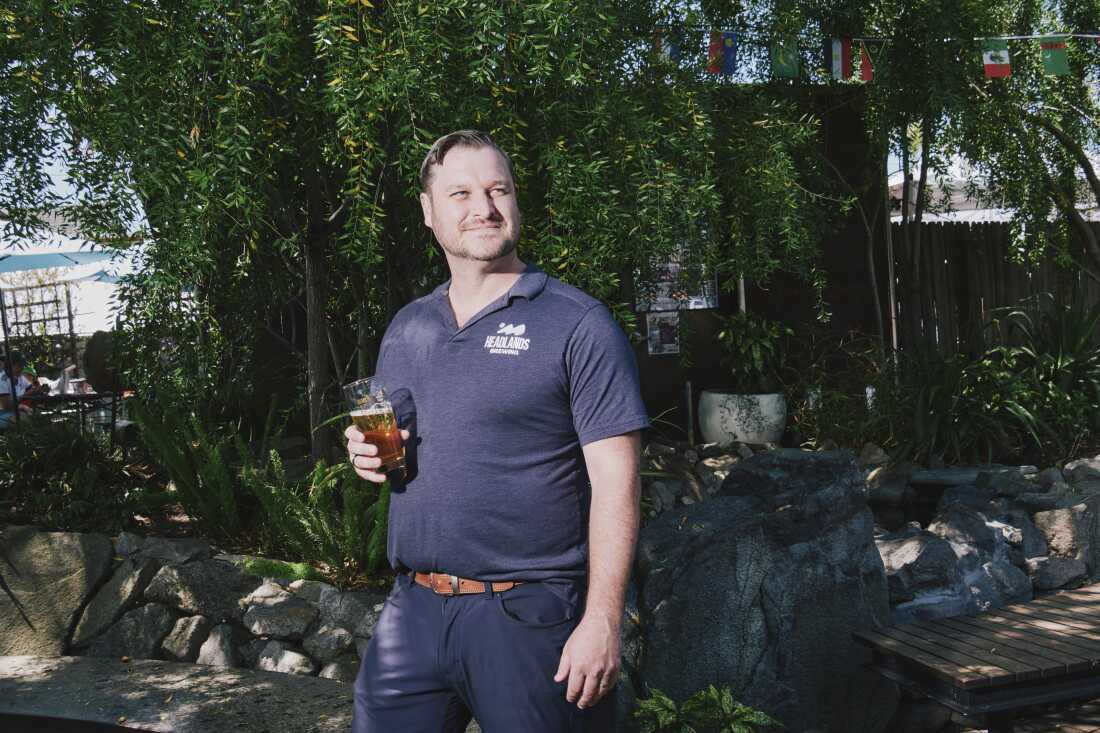
Headlands Brewing COO and brewmaster Ryan Frank drinks a Common Ground beer in Berkeley, Calif., on June 11.
Justin Gellerson for NPR
hide caption
toggle caption
Justin Gellerson for NPR
For the brewers, however, the project is less about marketing and more about connection: They named the multinational beer “Common Ground.”
“When I go to California or Canada, they will treat me like family,” Gomez said.
“It makes the world feel so much smaller,” said Dewes.
“It’s about building bridges and knowing what’s important in life,” said Frank. “And for us, that’s soccer and beer.”
Geopolitical friction in the taproom
The official rhetoric surrounding World Cup 2026 mirrors the brewers’ optimism, with promotional materials promising a tournament where billions are “united as individuals, united as billions.”
Yet this idealistic messaging stands in sharp contrast to a prickly geopolitical reality. Tensions between the U.S., Mexico and Canada have mounted over trade tariffs and auto manufacturing standards as the three nations renegotiate long-standing trade agreements.
The independent brewers behind Common Ground are feeling that friction firsthand through the rising costs of aluminum cans and raw ingredients.
“There are 15% tariffs slapped on any European-grown hops, which are really critical to some of our core brands,” Frank said.

Headlands Brewing brewmaster Ryan Frank and CEO Austin Sharp share a Common Ground beer in Berkeley, Calif., ahead of the first World Cup game on June 11.
Justin Gellerson for NPR
hide caption
toggle caption
Justin Gellerson for NPR
The political discord hasn’t just been confined to trade boards.
When signing an executive order to establish a White House Task Force for the World Cup in March 2025, President Trump suggested that cross-border hostilities might actually benefit the tournament. “Oh, I think it’s gonna make it more exciting,” the president said.
A bittersweet reminder
Tension on the soccer field is one thing; between nations, it’s another.
“It’s true that when it comes to the actual soccer, we’ve developed a very healthy, vibrant rivalry between the three countries,” said Andrés Martinez, the author of The Great Game: A Tale of Two Footballs and America’s Quest to Conquer Global Sport and co-director of Arizona State University’s Great Game Lab, which studies the intersection of sports, media and geopolitics. “But we’re also linked together in this very symbiotic relationship.”
Martinez said that when the U.S., Canada and Mexico initially launched their collaborative bid to host the World Cup back in 2017, the political climate was warmer.
“It was meant to showcase these tight bonds that had developed between the three countries,” Martinez said.

The makers of Common Ground used a shared recipe, but all created their own distinct packaging for the beer: Canada’s Cabin Brewing Co.; Mexico’s Rey Árbol Brewing Co.; the United States’ Headlands Brewing.
Cabin Brewing Company, Rey Árbol Brewing Company, Headlands Brewing
hide caption
toggle caption
Cabin Brewing Company, Rey Árbol Brewing Company, Headlands Brewing
But relations have soured since then, making cross-border business collaborations like Common Ground an anomaly rather than the norm for this tournament.
“To see craft beers across the three countries coming together like this, it’s a bittersweet reminder of what we were hoping to see a lot more of,” Martinez said.
Finding the real common ground
If trade wars and political posturing are looming large in Washington, D.C., Ottawa and Mexico City, they feel a world away at Headlands Brewing’s busy North Berkeley location.
As fans gathered to watch a crucial match between Mexico and South Africa at the start of the tournament, the sunny patio erupted into cheers and shrieks of “Goal!” when Mexico found the back of the net.

Headlands Brewing hosts a screening of the first World Cup game on June 11 in Berkeley, Calif.
Justin Gellerson for NPR
hide caption
toggle caption
Justin Gellerson for NPR
Hovering over a pint of the collaborative brew, soccer fan Roberto Mandujano reflected on the cross-border experiment.
“Three different ways, three different taste buds come together to make something cool,” he said.
When asked about the underlying political tensions between the host nations, Mandujano shrugged off the discord.
“We live in a world where everyone wants to make everything political,” Mandujano said. “But I think we’re all here for soccer. So I guess that’s the common ground.”
-

 Milwaukee, WI2 minutes ago
Milwaukee Barbecue: A Legacy of Smoke
-

 Atlanta, GA7 minutes ago
Georgia Haitian communities face sudden July 27 deportation deadline
-

 Minneapolis, MN14 minutes ago
Broken A/C leaves 75-year-old cancer patient sweltering at north Minneapolis apartments
-

 Indianapolis, IN17 minutes ago
Jazz saxophonist Jared Thompson shares journey of self-acceptance and artistry
-

 Pittsburg, PA22 minutes ago
Trash pickup schedules adjusted in Pittsburgh-area communities due to impending heat wave
-

 Washington, D.C27 minutes ago
D.C.’s July 4th fireworks will have “TSA-style” security, won’t start until 11 p.m.
-

 Augusta, GA29 minutes ago
16-year-old wanted in aggravated assault case in Augusta
-
Cleveland, OH37 minutes ago
Earth and Essence IV Spa Launches Free GLP-1 Weight Loss Consultation in Cleveland


