Lifestyle
A Fashion Reporter Considers the Ways Trends Trickle Down


Times Insider explains who we are and what we do and delivers behind-the-scenes insights into how our journalism comes together.
On a chilly day in December, Jacob Gallagher, a men’s fashion reporter for the Styles desk of The New York Times, is wearing a button-up shirt and black slacks, one of about a dozen pairs he owns. The look is put together, but casual.
His love for style, Mr. Gallagher said in an interview that day, began with tailored suits and Italian shoes. His father, a museum exhibition designer, has worn such a uniform “every day to work for decades,” Mr. Gallagher said.
It was that influence, and Mr. Gallagher’s immersion in skateboarding culture and the hardcore punk scene growing up in Maryland — subcultures in which, he said, image and how you carry yourself is very important — that led him to his beat: analyzing fashion as an expression of political, social and cultural identity.
Mr. Gallagher, 33, joined The Times in October, after nearly a decade covering men’s fashion for The Wall Street Journal. In recent months, he has written about the rise of the sinewy male stars that he calls noodle boys, the symbolism of the black sweatshirts and puffer jackets worn by rebels in Syria, and the cloaks on display in the papal drama “Conclave.”
In an interview, he reflected on how men’s wear has evolved, why he believes scrutinizing style matters, and the fashion advice he would give now to his 20-year-old self. These are edited excerpts from the conversation.
Where do you find your story ideas?
We’ll often look at the news of the day, or what’s occurring in pop culture, and think, “What’s the story off it that we can do that’s style-focused?” I also spend a lot of time talking to retailers, and going to stores to try to figure out what’s selling and what’s not selling.
Had you worked in the fashion industry before you became a journalist?
When I was in college at The New School, I worked at a few mass retailers, and a men’s wear boutique, in New York City. That was a pivotal moment in my life because it instilled in me the importance of understanding how people really shop, the way trends trickle down. I still think about those truisms a lot: If men find the right pair of pants, they will always buy that pair of pants.
Some people think of fashion as fluffy. Why does fashion coverage matter?
Fashion is one of the biggest industries in the world — one of the richest men on earth, Bernard Arnault, runs a luxury conglomerate. After language and beyond how we carry ourselves, what they wear is the first thing people interpret about each other when they interact. There’s so much messaging and self-identity that’s reflected through clothing.
Your beat spans many cultural spheres, including politics, sports and film. Is there one you’re particularly fascinated by?
I love looking at politics, because there’s such a narrow box of what politicians can quote-unquote wear. So any minor change, a different way of appearing, or a different way of dressing, is always going to reverberate and be super interesting to write about.
And I think athletes are the most important people in men’s wear right now. They’re having the most fun, universally, and being the most experimental. You can find every microtrend in existence in tunnel-walk outfits.
They’re definitely taking more risks than I would say most, but certainly not all, actors do. They’re often doing the shopping for themselves, and that is always ripe for coverage. I might be sitting at a show in Paris and thinking, “Oh, that’s wild. Who would ever wear that?” Six months later, it’s on a football or basketball player.
It seems like we’re in something of a golden age for male athlete fashion.
There was a time when people had a very narrow view of what kind of man was into clothes. That, in my experience, has withered.
A lot of people in the fashion industry keep it simple style-wise, like wearing all black. How do you think about dressing?
Certainly I would not wear everything that I cover, nor do I cover everything that I wear. I’m extremely particular about the brands I wear. That’s a form of expression for me. I understand why other fashion reporters sometimes stick to a uniform, but I get a kick out of it.
What fashion advice would you give your 20-year-old self?
Fewer zany pants. I wore patterned pants for too long.
Is there something you wish you would have taken a class on in college?
The ability to comb through documents and legal cases is such an impressive skill. It’s something that I’m still learning. It took me some time to learn how to read an earnings report for a company. That level of investigative work is something I think every reporter is going to have to be skillful at, because our nation is so litigious, and there are fascinating legal wrinkles to almost every story. I definitely speak with more lawyers for reporting purposes than I had ever thought I would.



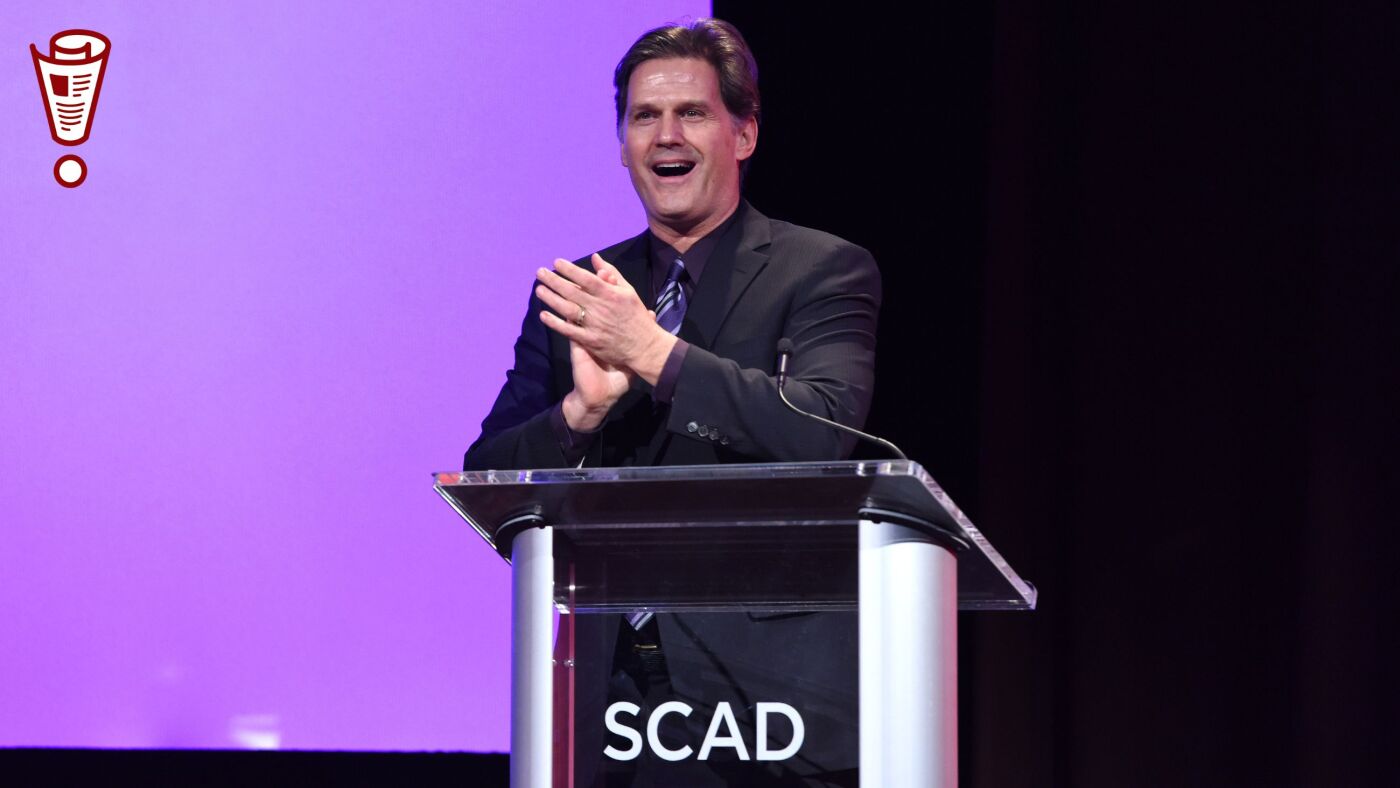
Actor, director, chair of film and television department, SCAD, D.W. Moffett speaks on stage during Rising Star Award presentation to “Star” on Day Three of aTVfest 2017 presented by SCAD at SCADshow on February 4, 2017 in Atlanta, Georgia. (Photo by Vivien Killilea/Getty Images for SCAD)
Vivien Killilea/Getty Images
hide caption
toggle caption
Vivien Killilea/Getty Images
This week’s show was recorded in Savannah with host Peter Sagal, judge and scorekeeper Alzo Slade, Not My Job guest D.W. Moffett and panelists Adam Burke, Shantira Jackson, and Joyelle Nicole Johnson. Click the audio link above to hear the whole show.
Who’s Alzo This Time
Flotus and Robotus, Ineligible Bachelorette, and a Change of Season
Panel Questions
Fold-out Coach
Bluff The Listener
Our panelists tell us three stories about a hot new dining destination, only one of which is true.
Not My Job: Actor, director, and chair of the film and television department at SCAD, D.W. Moffett, answers our questions about melees
Actor D.W. Moffett, part of the cast of One Battle After Another, plays a game called “Lots of Battles All At Once.”
Panel Questions
Hairless Whisper, Signing Off
Limericks
Alzo Slade reads three news-related limericks: Buns on the Runway, Constructive Play, Getting Work Done at Work.
Lightning Fill In The Blank
All the news we couldn’t fit anywhere else
Predictions
Our panelists predict, after the Bachelorette, what’ll be the next TV season to get cancelled at the last minute.

We are more connected than ever before, with our high-speed internet, pinging smartphones and ever-updating apps and social media networks. (iPhone 17e, anyone?!)
And yet, we are also lonelier than ever, especially younger generations who are even more likely to be on their digital devices for longer periods of time. Gen Z, it turns out, is the loneliest generation of them all, according to the 2025 Cigna Group report “Loneliness in America.” It found that 67% of Gen Zers reported being lonely (65% of millennials, who also grew up with digital technologies, did as well, as compared with 60% of Gen Xers and 44% of baby boomers).
What’s more, about 1 in 5 teenagers ages 13 to 17 experiences high rates of loneliness, according to a World Health Organization’s 2025 report; and according to the Centers for Disease Control and Prevention, 40% of high school students reported “persistent feelings of sadness and hopelessness” in 2023.
Dr. Shairi Turner, chief health officer of the nonprofit Crisis Text Line — a free, 24-7 text-based mental health service — calls it “a public health crisis” that is especially affecting Gen Z for a reason.
“They’re 14-29 now, so they’re digital natives, very comfortable with being connected to people by phone,” she says. “But that connection isn’t a replacement for human connection. It gives the illusion of being close, but without real interpersonal interaction.”
That’s compounded by the COVID-19 pandemic and increased single parent households, she says.
“This is a generation that lived through the pandemic during some key developmental years — some of their formative years may have been in lockdown, using smartphones, [instead of] developing critical social skills,” Turner says. “And Gen Z is more likely to have been raised in single-parent households, and may have come home to an empty home where one parent was working or they were going back and forth between homes.”
So where to go from here? Note the warning signs, Turner says.
“Is your child spending more time with their phone than their friends?” she says. “Are your kids coming home upset about interactions at school or with their friends more times than not? And: Are they avoiding in-person extracurricular activities like sports or clubs? These are all things to look out for.”
Here are Turner’s top three tips for helping your Gen Z kids cope with loneliness.
Be present and engage in active listening
“Give them the space to share their feelings. Just be present and listen to your child — don’t put words in their mouth. Create that safe space so they know they can share with you that they’re feeling lonely. Ask open-ended questions. Instead of saying ‘did you have a good day?’ where they can say ‘yes’ or ‘no,’ ask a question that elicits more: ‘What did you do today that you enjoyed?’ Or: ‘Is there anything you found challenging today?’ Brainstorm with them options or ways that they could have handled a situation differently; or do some role playing with your child, so they feel prepared the next day.”
Plan outdoor social activities
“That can be with your child or with your child and their friends. Connect in a low-pressure way: ‘Let’s bring some kids over and go to the park.’ Plan something around a shared interest, like soccer or baseball, where they’re enjoying the sport together and they don’t have to sit and talk in a high-pressure way — they can just have fun. Our report on young people in crisis shows that outdoor third space areas — parks and recreation — help young people cope with their mental health. These same young people identified sports and opportunities for social connection as helpful to their mental health and well-being.”
Explore mental health resources
“Know what the school resources are, what’s available, before your child needs mental health support. Are there counselors, school psychologists? What’s the bevy of resources in school or in the community if my child is in need — therapists, local support groups? Our Crisis Text Line is great because it’s on the phone and most young people are comfortable with that and they can text our volunteers and it’s confidential. It’s about being prepared and aware.”
Ultimately, Turner says, young people are resilient — their brains are still growing — and intentional parenting goes a long way toward offsetting the effects of digital devices and social media.
“It’s never too late to encourage — and model — positive interpersonal skills,” Turner says. “Meaning: human to human connection.”

Michelle Pfeiffer stars as Stacy Clyburn in The Madison.
Emerson Miller/Paramount+
hide caption
toggle caption
Emerson Miller/Paramount+
Since introducing his Yellowstone TV series, starring Kevin Costner, in 2018, Taylor Sheridan has made a very successful career of building dramas around veteran stars. Now Sheridan has a new official sequel series — Marshals, on CBS — and a seemingly unrelated series, The Madison, that I suspect will connect to the Yellowstone storyline before too long.
The Madison is a six-episode drama, starring Michelle Pfeiffer and Kurt Russell. It streamed half its episodes when it premiered March 14 on Paramount+ and has been renewed already for a second season. All six episodes were written by Sheridan and directed by Christina Alexandra Voros, who directed many episodes of both Yellowstone and its prequel, 1883.

The Madison is set up as a sort of dramatic Green Acres, and presents Pfeiffer and Russell as Stacy and Preston, wealthy New Yorkers who are close to approaching their 50th wedding anniversary. They have daughters, and granddaughters, and Preston also has a cabin and some land he shares with his brother Paul in Madison River Valley, Mont. He goes there when he can to relax; when he does, his wife Stacy stays behind in the city.
Before long, Stacy decides to take her daughters and granddaughters to see the Montana cabins for the first time. The whole family is there: One older divorced daughter with two girls — a teenager, and one in grade school — and the younger married daughter, who has just been mugged.

The Madison, like Yellowstone and all its prequel series, is all about legacy and responsibility and relationships — but focusing on the women instead of the men. Some scenes and concepts in The Madison are absurd in the extreme, like the idea that the streets of New York are more dangerous than any wild west. But there also are moments of true beauty and calm — and the valley setting itself, I suspect, eventually will link to previous series in the Yellowstone canon.
Fly-fishing figures prominently here, as it does in most other Yellowstone-connected series — but Sheridan and The Madison, with Russell fully enjoying the peace of the river, nails the emotion. The new CBS sequel, Marshals, which also has a male-bonding fly-fishing scene, does not.

Luke Grimes plays Kayce Dutton in Marshals.
Sonja Flemming/CBS Entertainment
hide caption
toggle caption
Sonja Flemming/CBS Entertainment
Marshals, which premiered March 1 on CBS, stars Luke Grimes as Kayce Dutton, one of the sons of Costner’s John Dutton from Yellowstone. Sheridan co-wrote the first episodes, but Marshals isn’t nearly as good a series as The Madison. It finds a way to get Kayce hired as a U.S. Marshal, but mostly to give the character a chance to run around with more advanced weaponry. And his relationship with his son Tate, played by Brecken Merrill from Yellowstone, is explored a lot less credibly, and dramatically, than the maternal dynamics on The Madison.
Marshals adds to the Yellowstone legacy, with its allusions to long-established storylines like a seventh-generation land surrender, and modern clashes that echo deadly standoffs of old. But it’s The Madison, like 1883 and 1923, that brings the best out of Sheridan. And bringing back veteran movie stars Pfeiffer and Russell? Even in a modern Western, that’s a real Bonanza.



Ken Roczen wins second race of 2026 in Detroit, Hunter Lawrence crashes and loses points lead

San Francisco’s 5 Best Affordable Places To Stay On A Tight Budget, According To Guests – Islands

DAL@PIT Postgame: Glen Gulutzan | Dallas Stars

1 dead, 9 injured in 3-vehicle crash in southwest Miami-Dade

+)WAY TO WATCH Free Boston Legacy FC vs Utah Royals LIVE

Florida High School Football Rankings: Top 25 teams – Oct. 21

How old is Bo Nix? What to know about Oregon quarterback ahead of 2024 NFL Draft

Cleary's 21 help Le Moyne down Central Connecticut State 69-64 in OT

99th annual Pony Swim held in Virginia

Indiana Members Credit Union announced as new anchor tenant at Bottleworks District

Jeffries declines to break with indicted Democrat after ethics panel’s guilty verdict

Hundreds of thousands march through London in stand against the far right

2 students killed, 7 other people injured in Tennessee bus crash during school field trip

Dem senators dodge crucial question on illegal alien accused of killing Chicago college student

EU Parliament unblocks key political hurdle in digital euro talks
-

 Movie Reviews1 week ago
‘Youth’ Twitter review: Ken Karunaas impresses audiences; Suraj Venjaramoodu adds charm; music wins praise | – The Times of India
-

 Sports1 week ago
IOC addresses execution of 19-year-old Iranian wrestler Saleh Mohammadi
-

 New Mexico6 days ago
Clovis shooting leaves one dead, four injured
-
 Business1 week ago
Disney’s new CEO says his focus is on storytelling and creativity
-

 Tennessee5 days ago
Tennessee Police Investigating Alleged Assault Involving ‘Reacher’ Star Alan Ritchson
-

 Technology6 days ago
YouTube job scam text: How to spot it fast
-

 Minneapolis, MN3 days ago
Boy who shielded classmate during school shooting receives Medal of Honor
-

 Texas1 week ago
How to buy Houston vs. Texas A&M 2026 March Madness tickets