Lifestyle
‘Modern Love’ Podcast: Finding the Magic, Just in Time


This transcript was created using speech recognition software. While it has been reviewed by human transcribers, it may contain errors. Please review the episode audio before quoting from this transcript and email transcripts@nytimes.com with any questions.
[CHIMES TINKLE]
- archived recording 1
-
Love, now and always.
- archived recording 2
-
Did you fall in love last night?
[OVERLAPPING SPEECH]
- archived recording 3
-
Love was stronger than anything you can think of.
- archived recording 4
-
For the love of —
- archived recording 5
-
And I love you more than anything.
- archived recording 6
-
(SINGING) What is love?
- archived recording 7
-
Here’s to love.
- archived recording 8
-
Love.
[MELLOW MUSIC]
From “The New York Times,” I’m Anna Martin. This is “Modern Love.” Each week, we bring you stories inspired by the “Modern Love” column. We talk about love, lust, heartbreak, and all the messiness of relationships. When Clare Cory was a young girl growing up on a farm in Montana, she dreamed about falling in love.
We lived in a single-wide trailer. It was a little bit crowded, so I slept on the couch. And I would often look out the window at the full moon. And it’s very beautiful. And I would watch the moon sail across the sky. And me being the hopeless romantic child that I was, I envisioned that somewhere out there, under that same moon, was the man for me.
Just after she graduated college, Clare got engaged. But then, right before the wedding, her fiancé called it off. After that, she spent years, decades, even, trying to make various relationships work. But none of them did. So eventually, she stopped worrying about it and decided to focus on her career.
After her 50th birthday, she looked back on her life and felt happy.
You think, wow, I’ve come a long way in life, and I still have a long way to go.
That feeling led Clare to write in to the “Modern Love” column, saying she’d finally fallen in love but not with some guy. Instead, it was a love for life itself. She thought maybe her love story was over. But then —
The most improbable, bizarre series of events occurred.
Some of those bizarre events were scary. Her health took a dramatic turn. But some were beautiful beyond anything she could have ever imagined. Today we tell you the rest of Clare’s love story. Stick with us.
[MELLOW MUSIC]
[MELLOW MUSIC]
Clare Corey, welcome to “Modern Love.”
Thank you so much. And I really appreciate this opportunity.
So, Clare, we’re here to talk about your love story. There are twists. There are turns. Things do not go as you expect. But I want to start at the beginning. When you were a kid growing up, you dreamed about falling in love. Paint a picture of that for me.
Yeah. So I’m the oldest of seven children, and we grew up on a little farm in Montana. So I remember a lot of thoughts of romance rolling through my brain in those early years. And my sister and I, we were out on our fake horses that we had made out of sticks — our stick horses, basically.
Of course.
And so we both had husbands along for the ride. And mine was Jim, and hers was Steve. And so [LAUGHS]: I just imagined that, one day, I was going to be riding around in a truck with Jim. And we were going to have a happily ever after.
[LAUGHS]: I mean, I know that years later, when you were in your 20s, you did have a brief engagement to a man. His name was not Jim. His name was Roger. But that engagement didn’t work out. Tell me, what did you love about Roger?
Well, Roger was just a ton of fun. He was always laughing, and he was always up for adventure. He was very funny. And we were in very different fields. He’s in engineering, and I was in psychology. But we supported one another through grad school.
And so I thought I felt like we were really good together. We were really solid. I believed that we would grow old together.
Where did that certainty come from?
Good question. Because apparently, I was wrong.
So our wedding was scheduled in May, and we had spent a lot of time preparing for that. And so we had everything lined up. And at the end of March, Roger woke up in the middle of the night. And he said, I can’t do this. I said, what do you mean? You can’t do what?
And he said, well, I can’t get married. I can’t go through with this wedding. And that began a whole lot of, shall we say, painful discussions about why. And I never got a really good answer as to why until a year later, when we actually met in a park.
Because I was going to sell the dress. I actually ended up giving it to somebody. But we met in a park. And I said, do you want to see the dress? And so I pulled the dress out. And he said, oh, my gosh. He said, it’s so beautiful. And he said, do you know what we were missing?
And I was like, no. And he said, we were missing the magic. We didn’t have the magic.
Did you know what he meant when he said we were missing the magic? Did that track for you?
It did. To some degree, yes. I mean, to some degree, I was still trying to understand what had gone wrong. But yeah, I did. Because [LAUGHS]: in between that time, I actually had met Don.
OK, who’s Don? Who’s he?
So I went to a training, and the trainer was a man named Don. And so I remember — I’m a shy person, but I did approach him at the training to ask him a question about something. And we had a brief little conversation. And I didn’t think much of it.
But I thought, oh, wow, that’s a really cool guy. But I think it was — the training was a couple days. And so when the training ended, I remember he said something to me. And he said, hey, do you want to get together for dinner sometime? And we had a lot in common.
We work in similar fields. We just had a very deep connection. And I’ve often said to people that it was the best days of my life.
And what were you thinking as that was happening? Did you feel like those were the best days?
What I thought to myself was, oh, now I understand. This is why the relationship with Roger didn’t work out. Because actually, the real person for me, the real — the man who really was the one for me was still out there, and I just hadn’t met him yet. And so that’s how that romance began, which was a wonderful romance but was also a brief romance.
Can you tell me why it ended? Why did you guys stop being in contact or seeing each other?
It was complicated by a lot of things. He was traveling a lot, and I had my job. And so it ended, basically, by lack of communication and letters. Again, this is in the days before email and cell phones and that kind of thing.
So I remember writing him a letter and saying how hurt that I was. And I, then, was very depressed. [LAUGHS]
Did you try to get back out there, dating-wise, at this time? Or was that not at all a priority?
No, it was not. I was way too brokenhearted to even think about that. And here I thought that I had found the answer to the whole reason why my relationship with Roger hadn’t worked out. And now I really had found a relationship that was magical. And then it ended. And I really felt like, how could this happen to me twice?
These two heartbreaks, relatively close to each other, almost back to back in the grand scheme, did you feel your heart harden? Were you like, that’s it? I’m not doing this anymore. It’s not worth it.
I would say, at that time, no, I was not ready to be done. It took probably another decade or so. And in the intervening years, I did have some men in my life who were truly good men. But the relationships didn’t last. I would say maybe by the time I was in my mid 40s and I really started asking myself, what are you trying to do here?
Looking back, I can see that my life shifted tracks at that time from a future that was about creating marriage and a family and a home to my being more of a career person, focused on my career and not so much a relationship.
Hmm. What were some of the things you were telling yourself that made you OK with this new version of your future, this version where you wouldn’t find someone? How did it become all right?
[LAUGHS]: Well, because I had to ask myself, what are you missing in your life? I have a lot of good things in my life, and my life is going along very well. And yeah, I had this empty spot in my heart or this empty place in my heart where I felt like a relationship would fill it up.
But I thought, is something really missing in your life? And as I started looking around, I thought, I’m very content with where I am and who I am. And no, there’s really nothing missing at all. And it felt like I had been beating my head against a wall for years, trying to figure out how to make this relationship thing happen.
And at some point, you think, wait a minute. Why are you beating your head all the time? You know? Is this really worth it? And what are you missing when you’re not beating your head? And well, you’re missing living. You’re missing life itself.
Did you ever feel lonely, though?
No.
Really? Really?
Yeah. I’ve never felt lonely. And maybe that’s because I have a lot of siblings and friends and things. No, I did not feel lonely. Did I miss having a romantic partner in my life? Yes.
Huh.
And I just want to be clear that this was not an easy process. Everything I let go of has claw marks all over it. So I can say that this idea of a fulfilling, romantic relationship had claw marks all over it. It was clawed to pieces before I could let go of it, yeah. So yeah.
And when you did let this claw-marked thing go, was it liberating?
Yeah, absolutely. And I realized that there is a freedom in that and that I did feel liberated. Because I’m like, hey, I don’t need to be looking for anybody. But it was hard to put hope back in the basket and shut the basket.
Hope.
Hope of having a romance. Hope of having that fulfilling relationship that I’d always dreamed of. And I just stuffed it in the basket and shut the lid. But every now and again, hope, it just keeps coming. And it would stick its head out of the basket and be waving at me. I’m like, get back in there. Shut that thing.
When you hit this coming to terms with being single for the rest of your life, putting hope in the basket for the rest of your life, this hope for a romantic partner, did you take a look back on your life at that point and assess it? And if so, what did you see?
Well, I remember the year that I turned 50 was also the first time I ever traveled to Europe. And my brother and his wife were living in Germany, and my mom and I went to Europe. And that was a dream that I’d always had. And I remember thinking that my life was very full.
Things were good, and I was looking forward to a future that seemed wide open with possibility, not the possibility, necessarily — because again, hope is — you know, stay in the basket, hope, all right — but a future of continuing to work. And someday, I was going to retire. And what was I going to do then?
And I had goals for myself — pay off my house, those kinds of things. 50 was a beautiful time.
And then just after you turned 52, you found out you have a rare type of breast cancer.
Yes.
What was that moment like for you?
Well, it changes your life forever. There’s no doubt about it. It’s the most aggressive form of breast cancer. It’s called inflammatory breast cancer. And so I knew then that my life was contracting. And what happened was my life went from looking a decade or more ahead to looking a day at a time.
[MELLOW ELECTRONIC MUSIC]
Clare, when you got this diagnosis, what did that change for you?
It’s really interesting because I learned a lot about myself. You really don’t know how you’ll react until those situations happen. So I said a couple things to myself. Well, I’m just going to keep working until I can’t anymore. And I’m going to keep exercising until I can’t anymore. And I’ll just keep doing what I’m doing until I can’t anymore.
So they scheduled chemo in such a way that your down days would be on the weekend. So I was able to continue working. And I’d go to chemo, and go to work, and then come down on the weekend. And by Sunday afternoon, I was coming back up.
I mean, you’re saying all of this like it’s just a routine. You know, I’m doing this, I’m doing that. But there had to be hard parts of this.
Oh, yeah. There are hard parts of it. Inflammatory breast cancer is a beast. It’s a challenge. And I will say this. Inflammatory breast cancer, your breast enlarges. The cancer turns the breast purple. It was hard as a rock. I could feel it turning hard.
It’s ugly. And you have to walk around with it every single day. And so you start to realize that today is all that you’ve got. And if today is all that I’ve got, then I damn well better make this a good day because I’m not giving up what I got right now.
And so what happened is that I realized that I had fallen in love with life itself. And I remember the day that I found out that I had progressed to stage IV, I came home. And I opened the door to my house, and I looked around at all my possessions. And I thought, wow, somebody’s going to have to come in and give all of these things away.
And so I started to look around at all the things that I was going to miss. And I thought, wow, I’m really going to miss that sunrise. I’m going to miss that sunset. I’m going to miss my colleagues at work. I’m going to miss my nieces and nephews growing up. That’s still a real hard one for me.
I’m going to miss just these everyday moments of where you’re talking a walk and there’s a beautiful flower or you run into somebody. Just so many things like that. I had a friend who was diagnosed with inflammatory breast cancer, and she’s passed away now. But she said to me, if I could turn back time and change this, I wouldn’t.
She said, it’s given me too much. And I’m crying and crying and saying, how can you say that? I’m sure I’ll never feel that way. But if I could turn back time, I wouldn’t change it. It’s given me too much. It’s given me an appreciation for life. I got out of the hospital in September.
And for various reasons, they hadn’t let me take a shower. And, oh, my god, I came home. I jumped in the shower. I was able to get in my car and drive my car to work. And I thought, this is one of the best days of my life, you know? And I am showered.
Shower and a commute, mm.
Yeah, uh-huh. Yeah. And so it’s not like I don’t get frustrated or upset or sad about things. Because I do. But I’ve become more at peace with knowing that my life will end. But that also gives me the freedom to know how much I love this life and how much I love being alive. And I’m willing to fight for it with all I got because I just — I love it so much.
[GENTLE MUSIC]
When we come back, Clare’s life takes a totally unexpected turn towards romance. Stay with us.
[GENTLE MUSIC]
[MELLOW MUSIC]
Clare, all through your 30s and 40s, you were hoping you’d fall in love. And then in your 50s, you’re facing terminal cancer. And it sounds like you did find love, just not how you expected. You found this love for life. And I feel like I can see the headline now. It’s like, Woman Falls in Love with Life, which would be a beautiful end to your story — except it’s not the end to your story, right?
Yes, that is correct. So my heart was completely full, I want to say that. Because I have found a love for life. But at the most unexpected time in my life, when I don’t feel good about my body and I cannot imagine that anybody is going to find me attractive, certainly as a romantic partner, suddenly and very unexpectedly, I did find romance again. And it happened to be Don.
It happened to be a guy we’ve heard about before, Don. Remind us who Don is to you.
So Don was a person that I had a relationship with 27 years ago.
And I was completely heartbroken when it ended. But I had gone on and made my peace with that.
Moved on, yeah.
Yeah. And I’m a kind of person who always stays friends with people. And so we work in similar fields, and we were in one another’s orbit, but we didn’t talk very much, maybe a couple times a year. I do remember I called him when I found out that I had cancer and let him know.
Hmm. So when did Don come back into the picture? Like, how long after your diagnosis? Also, I just want to note for the listeners out there that every time I say his name, you smile in this beautiful way that lights you up. And it’s lighting me up too. How long after your diagnosis did he re-enter your life?
Well, it was one year ago. And by this time, I’m well into a stage IV situation, stage IV metastatic breast cancer. And so that’s not exactly the kind of thing you put on your dating profile, you know?
Might be a little tough, yeah.
What had happened was he was going to be in Phoenix for a conference. And he said, oh, well, jeez, we ought to get together for dinner. I haven’t seen him for a long time. And so we did. And we had a nice little dinner, whatever. And when I said goodbye to him, I honestly thought to myself, I’ll probably never see him again.
I think that this is it. But then this really weird thing happened. And it is kind of a little bit embarrassing. But so my employer was having the employee Christmas party. And I have gone alone to every single employee event for years. And so I thought, you know what, I want to go with somebody that I would enjoy going with. And I’m just — I would like to just go once to the employee Christmas party with somebody. And I remember I was driving to work, and it popped into my head to ask him to go with me. And I was like, no, no, no, no, no, no, no, no. Because he doesn’t even live in the same state.
But it just kept bugging me and bugging me. And so I have to say that I felt like a high school girl at the Sadie Hawkins dance or whatever, when you call and you ask the guy to go with you. And so I called him up. And I said, you know, I’ve always wanted to go to the Christmas party with somebody, and would you go with me? And it’s in a few weeks.
And he said, yeah, sure.
And we had this great time.
Was it everything you’d hoped for?
[LAUGHS]: I like a lot of glitter and sparkle, and you get a lot of that on Christmas. And our employee Christmas party was held at this really lovely hotel. And it was full of all the lights and all the sparkle. And I just — I don’t know. I’m just a fan of that kind of thing.
And so it was just really fun to go with him, and to be in this beautiful place, and to have this experience. And the next day, we met up for breakfast. And so he starts saying to me he’s been having — he’s older than I am, and he’d been having a few health issues of his own.
And he said, I think I’m going to be moving. And I said, oh. And he mentioned a few possible places, and Arizona was one of them. And I said, well, why would you want to go anywhere else? And I was kind of joking with him. Well, about a month, six weeks later, I hear, well, I’m going to move to Arizona.
How did you react when you got that news? That’s kind of, like, great news.
Yeah. Well, I was shocked. I was completely shocked because I wasn’t sure he was really serious. I said, well, look, I’ll help you look for a place, and I’m here for you. And so he rented a house, and he wasn’t here yet. And he said, look, could you go pick up the keys for me?
And I said, oh, yeah, I’ll do that. And then I got this idea. And I said, do you know what? I should get him a few things for when he gets here —
That is so sweet. [LAUGHS]
— so that — you know, when you move in and you don’t have anything, right?
But, Clare, you got a lot going on. You got a lot going on. You have your full-time job. You have your treatment. You have your own health. It means something that you saw this empty house and you were like, you know what, amidst my full schedule, I think I’m going to go out and buy him a blender or whatever you got him, you know?
Well, it was kind of like that. And my cousin has said to me since, oh, yeah, going to fix up a guy’s house before he moves in, yeah, you think that’s just platonic, right? But it did come to pass that I was putting up a shower curtain in his vacant bathroom on Valentine’s Day.
No way! [LAUGHS]
And he wasn’t in town. And I said to myself, how crazy is this? And so — but that is exactly what happened.
It’s clear you and Don are reconnecting in a friendship way. When did you start — when did it start to become romantic? Was there a time you can point to where you were like, oh, there’s more here than just two old friends coming back into each other’s lives?
Well, ironically, it was about a week or two after my story was published, which is about being single. But we got this idea to go to this — it’s called the Butterfly Wonderland, I think, is what it’s called. But we went. And it is actually — it’s just such a lovely place. And there’s just butterflies everywhere, and it’s beautiful.
There’s flowers and greenery. It’s a very lush place compared to everywhere else in Arizona. And I felt this energy start to shift. And I’m saying to myself, what is happening here? What is going on? There is something happening. Now I felt like there was a door starting to open and I wasn’t going to be able to shut it.
And perhaps the old me would have said, I’m not walking through that because of all the complications and the messiness of it. Because it was going to be messy. Truthfully, we’re both in probably the final seasons of our life. Because he is older than I am, and, of course, I have stage IV cancer. And so the door opened, and I felt like I had to walk through it.
When you say you felt the energy shift, there was a door opening, did you have what we call a define-the-relationship conversation? Did you turn to him on that bench and say, clearly, something’s happening, we should talk about it?
Well, I wish I could say I was that mature.
But apparently, I’m not.
This stuff never gets any easier.
And so, no, we didn’t. Yeah. And no, I’m still in high school. So we didn’t have a conversation on the bench, no. But I felt it and I knew it. But later, within a day or two, we did. And I said, [LAUGHS]: well, let’s just see if we can make it 90 days.
So he keeps joking with me that we keep saying, OK, 90 more days and 90 more days. I said, well, what if we’re not speaking to each other in 90 days? So he said, well, let’s just give it a go and see what happens.
Do you guys eat dinner together most nights?
Mm-hmm. Yeah, we do.
Is he cooking for you?
Yeah. And I’m kind of ashamed to say that I’ve never cooked for him once. But no, he’s been cooking a lot, yeah.
What does Don make you?
Oh, I love his sloppy joes.
Yum.
[LAUGHS]: And then kielbasa and sauerkraut. I can’t help it.
I’m coming over.
I’m Polish, you know? So yeah. So those are my two favorites that he makes. And then he makes me breakfast and peeling oranges for me and things like that. I can’t explain it. I don’t know how this happened.
[GENTLE MUSIC]
Right after we got back together, in June, I already had an existing appointment to go to the mortuary and make my funeral arrangements.
Oh, my gosh.
And so we had barely gotten back together. And I said, well, I’ve got an appointment in the mortuary.
No.
Do you want to come with me?
Mortuary date.
Yeah. So pretty much our first, quote, “date” was going to the mortuary.
Tell me that he also took you to dinner or something, it wasn’t just mortuary dates. Tell me that you also went to a nice Italian restaurant.
Oh, yeah, well, we — in fact, yes.
OK. [LAUGHS]
My sisters are like, only you. That’s just the way that you would roll, yeah.
I mean, I’m thinking about how this was an appointment that you had on the books. You had made this appointment when you were single and handling the stuff yourself. And the thing I really look up to is it’s you’re kind of telling him, this is my life. I was already doing these things.
You are welcome to come along for the ride, basically. And the thing that I find remarkable from his end is he’s like, yeah, I’m there.
And that’s one of the things that — we had about six good weeks [LAUGHS]: of things being relatively normal. And then it all crashed, and I got really sick with the flu. And the next thing, I was in the hospital, and the cancer has progressed. And I’m looking really bad on paper.
And he was staying in the hospital with me and sleeping in a chair, and that bothered me. I’m like, no, I don’t want you sleeping in a chair. But my sister came from out of town. And then I said to him, go home and sleep in your own bed for one night. Because by now, he’d been at the hospital with me for probably four or five nights.
So he went home. And that was the day that the results of my brain MRI came back. And my sister, we were out walking in the garden at the hospital. And she said, your MRI came back. And I saw from the look on her face. And she said, yeah, you’ve got a lesion in your brain.
And that was the last thing that I wanted to hear. I felt like I could deal with anything but brain metastasis. And I said, well, what does Don say? Because I kind of figured she had told him already. And we were standing and looking out the window. I remember the elevator door opened, and there he was.
He came back.
[GENTLE MUSIC]
You did so much work in this middle part of your life to move on from your desire to have a romantic partner. And now you have that. You have Don. You have a romantic partner. I just want to know, what does it feel like to open back up that possibility and to let it be fulfilled? What does that feel like?
Well, on the one hand, it’s kind of scary because you’re opening your heart again. But I also think that it’s not worth it to walk around with a closed heart.
It’s hard to overstate the importance of that feeling of safety and belonging that I think that we all look for and that I’d probably been looking for for so much of my life.
And to find that, it’s a little bit of like you’re swirling around on a merry-go-round, going, what just happened here? It’s hard to get your head around too. My life is very different than it was eight months ago, a year ago. It’s very different because it’s a whole different way of — than I’ve been used to living.
And we’re not living together, but we spend a heck a lot of time together. And I honestly thought — we had this joke that I would be smothered if he was around too much. And so he kept asking me, do you need some alone time? Do you need some alone time?
So, much to my utter shock and surprise, I have found that I really — I’m OK with him being here or me being at his place or whatever. I got to tell you, I’m a little surprised at how much I’ve enjoyed it. The other night I said, well, I just would have come home and forgotten to eat.
And he’s like, no, no, we have to make dinner.
He’s like, I’m making you sloppy joes, and you are eating them.
Yeah. But it’s just been a real joy, I think, to share with somebody the ups and downs. And just to share in life with somebody, it’s way more fun than I actually thought. [LAUGHS]
You know, a big part of — for most couples, a big part of starting a relationship or being in the early stages of a relationship, like you and Don are, is talking about the future and all the time that you’re going to spend with them. What about you and Don? Do you talk about the future?
You know, right now, I’m responding to treatment, and things are going well. That can change very quickly. I’m very aware of that. I hope it doesn’t, but it could. And certainly, he’s not a young person, and his own health could change very quickly. But the truth is that we don’t know what kind of future we have, if any.
And so I find that I’m not very troubled about who’s taking out the trash kind of thing. It’s not like we’re building a relationship to last through decades because we’re not likely to have decades. And so, really, it’s about today.
Was there a recent moment where the two of you were together and you thought, oh, this is the magic? Like, this is what it is.
Yeah, well, I’d say there’s quite a lot of those moments. And maybe they’re not the ones that you’d expect. But we’ve seen some beautiful sunsets together and watched the moon rise, which was just beautiful, watching a full moon rise. And then I think about — I want to have more time for more conversations and more time to do this.
And it’s nice to do, I guess, what I call normal couples things together, yeah, which is a very new experience for me. Yeah.
I am going to assume that when you were first diagnosed and you started thinking about your own death, that looked a certain way to you. And then you meet Don. And over the past few months, as things have grown and deepened as much as they have, that picture of your passing must look a little different.
And I want to know, has it changed for you? And if so, how?
I consider myself realistically optimistic. And so I’m optimistic, and I will take every single treatment that they offer me. I will do everything. But I’m also realistic. And so I know that the day may come when there are no more treatments available and that I will have to gracefully — I hope I can gracefully accept that at that time.
And I’ve said I hope the gods will be kind to me as I leave this world. I also feel that I don’t want to let anybody down, my family in particular and now Don, frankly, by dying. And I feel like, oh, jeez, I’m going to put them through a lot. And so I do talk to him about it. And he says, I’m in it with you, and I’ll be there regardless.
One of the things that I’ve said to myself since I was first diagnosed with cancer — literally the first week — well, there’s millions of other women who have been faced with breast cancer. And if they got through it, I can do it too. There’s millions of other women who have had chemo. If they got through it, I can do it too. Or surgeries, radiation.
There are many women living with stage IV metastatic breast cancer. If they’re doing it, I can do it too. And what’s also true is that there are many, many women who have died from stage IV metastatic breast cancer. And if they did it, well, I can do it too. And I just hope that I can do it gracefully. And I hope that — well, jeez, I really hope that I won’t disappoint anybody and let anybody down. Because I really do want to keep living.
Clare, I do think it speaks to the kind of person you are that when we’re talking about your own mortality, the first thing that comes to mind for you is other people. It’s the people that you love. And I just want to say, I think Don is very lucky to count himself in that group of people who you love.
When you wrote in to “Modern Love,” it was actually before you and Don had reconnected. And I think it might have a different feeling now that we know what happened after you wrote it. So I wonder if you could read it for us.
I will happily read it, yeah. Yeah. Who knew what was coming after this? [LAUGHS]
[GENTLE MUSIC]
“Finally Finding ‘The Magic.’ Since childhood, I yearned for love. Once, I came within weeks of marriage before it abruptly fell apart. He said we were missing ‘the magic,’ and, admittedly, he was right.
A few men came and went. I’m now 59 with stage IV metastatic breast cancer. I still don’t have a partner, but I’ve fallen desperately in love with life. Exquisite beauty emerges everywhere — my cat on my lap, a cashier extending an unexpected smile, sunlight skipping across a lake. I use each day to soak up the world’s splendor. ‘Not yet,’ I whisper to the heavens. ‘I love it here.’”
Oh. There’s such a new depth to it after our conversation. I mean, it’s just remarkable. There’s so much. I understand the context and the history and, also, the chapter that comes after it, which you did not know when this was published. It’s just remarkable.
Yes.
Clare Cory, thank you so much for this conversation. I’m really, really grateful.
Well, I am as well. It’s a delight to speak with you.
[THEME MUSIC]
This episode of “Modern Love” was produced by Amy Pearl and Davis Land. It was edited by our executive producer, Jen Poyant. Production management by Christina Djossa. The “Modern Love” theme music is by Dan Powell.
Original music by Pat McCusker, Dan Powell, Rowan Niemisto, and Marion Lozano. This episode was mixed by Daniel Ramirez with studio support from Maddy Masiello and Nick Pitman. Special thanks to Mahima Chablani, Nell Gallogly, Jeffrey Miranda, and Paula Szuchman.
The “Modern Love” column is edited by Daniel Jones. Miya Lee is the editor of “Modern Love” projects. If you want to submit an essay or a Tiny Love Story to “The New York Times,” we’ve got the instructions in our show notes. I’m Anna Martin. Thanks for listening.
[THEME MUSIC]



Lifestyle
L.A. Affairs: It’s hot when a man drives to me. But would this new guy make the trek from the Valley?
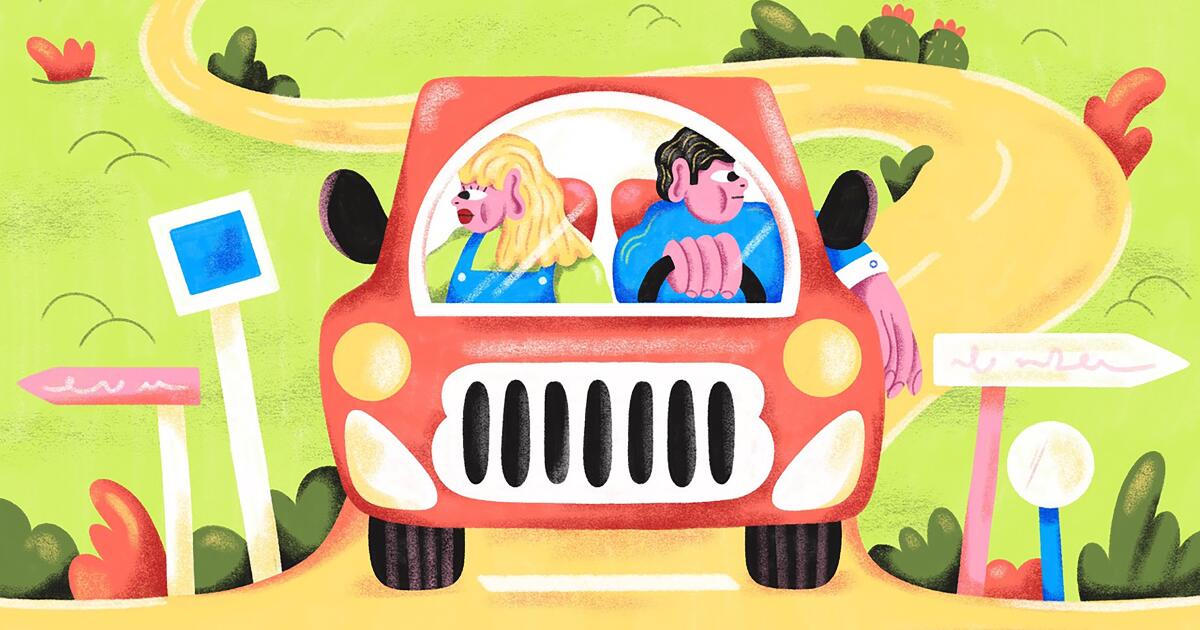
I met Dan on Hinge.
He lives in Woodland Hills, and I live in Venice. In Los Angeles, this is considered a long-distance relationship. In another city it might be nothing. Here, it’s a factor.
But I believe that with the right person, you can make anything work, so I stay open. I’m a native New Yorker, and if I were living in Brooklyn and a guy lived on the Upper West Side, that would be a 45-minute subway ride, which is truly nothing in New York. So with that same logic, I try to have flexibility with men in L.A.
When we started planning our first date, Dan suggested three options: a hike on mushrooms, a wine tasting or a walk on the beach.
A hike on mushrooms is something I’d only do with someone I already trust, not someone I just met online. I don’t do first-date hikes because I don’t like feeling trapped if the guy’s a dud. So I chose the wine tasting.
Then I learned the wine tasting was in West Hills.
On a Friday night, driving there from Venice would be insane. So I said I didn’t want to meet there because of the traffic. He suggested Malibu. That was also not ideal on a Friday.
I was getting annoyed — this was a pink flag because in my dating world, the guy is supposed to come to the woman’s neighborhood in the early days. I’ve gone out with plenty of men from the Valley who effortlessly suggested they come to me. It’s not rare or impossible.
I suggested he come to the Westside. I didn’t specifically say Venice, and in hindsight, I probably should have. He landed on Brentwood, which was manageable for both of us. On our first date, we met at an Irish pub on Wilshire Boulevard. He was cuter and more interesting than I had expected, and with the Guinness flowing, we had fun.
When I got home, he texted me: “Well, I like you 🙂 Less the tik tok and the lack of rock music in your life, but it’s not a deal breaker — there are other qualities 🙂 What are your thoughts?”
I noticed the slight negativity but was mostly dazzled that a man texted immediately after the date to say he liked me. In the modern dating economy, this felt rare.
The next day, both of our evening plans fell through, so we made a last-minute date. The wine tasting he originally suggested still sounded like fun, and although it meant me driving to the Valley, I was up for it now that we’d met.
We sipped flights at Malibu Wines & Beer Garden in its airy, romantic courtyard and played a flirty version of Truth or Dare. Halfway through, he dared me to kiss him.
We ended with sushi on Ventura Boulevard and a short make-out session in his car. He invited me to Thanksgiving at his uncle’s, which felt too soon, but also sweet.
After the second date, he texted and said he had his kids that week and was also hosting an event on Thursday, so his only day to meet was Wednesday. I said great.
On Tuesday night, he checked if we were still on, and I said yes.
Then he texted: “I’m flexible on time but not on location. I have a big event on Thursday, hopefully you can come to me again.”
My stomach tightened. This again?
So I texted back: “I drove to you last time, which was a bit of an exception for me especially in the early days, but the wine tasting location sounded special. Usually guys come to my area. How about we switch it up this time?”
He replied: “I appreciate the effort! Because of my event, I’d rather be close to a computer just if needed … Here is what i offer:
— I’ll come to your area anytime next week/end
— Lunch/dinner on me
I want to continue where we stopped last time 😉 No pressure of course, but let’s snuggle”
I responded: “Ok let’s meet next week. Snuggles sound nice … let’s see what happens …”
Then he wrote: “So I won’t see you tomorrow?”
I replied: “Unless you wanna come to me and bring your laptop along, let’s rain check until you have more flexibility.”
He said: “Dang, you are hard. I’ll let you know tomorrow around midday if it’s ok.”
And then — surprise — he decided to come.
He drove to Venice for a 5 p.m. date. He said his ETA was 5 p.m., and it ended up being 5:25 p.m., typical 405 Freeway.
When he showed up, he was in a cranky mood. On our way to KazuNori in Marina del Rey, I thanked him for picking me up and told him I think it’s hot when the guy comes to the girl.
“You’re just saying that because you want me to come to you more,” he said, not playfully, but aggressively.
That was basically the end for me. But there I was, in his car, heading to dinner. So I stayed pleasant and tried to make the best of it.
I shared that in the early stages of dating, I find it’s good etiquette for the guy to come to the woman’s neighborhood. He immediately disagreed and started ranting about how dating rules are ridiculous and how they swing in women’s favor. He resented paying for dates and declared he wasn’t looking to “sponsor a woman’s life.”
“If women want equality and equal rights,” he said, “then it should apply all across the board, including dating, and the man shouldn’t have to pay.”
I said women don’t actually have equal rights because we get paid less than men and often receive lower salaries than men in the same position.
I tried to change the subject and reset the mood, but he insisted we keep hashing it out.
I tried to explain masculine/feminine dynamics: providing and protecting, giving and receiving.
“What does the man get out of this arrangement?” he asked.
It was like watching someone’s personality warp into Mr. Hyde. Then he brought up another point: He’s a single dad of two kids, so he gets tired; and because I don’t have kids, that should factor into who drives where.
At this point, I was barely engaging and focused on eating my hand rolls, and I couldn’t wait to get home.
The check came, and I happily split it, wanting nothing further from him.
In the car back to my place, he remarked: “It’s obvious we’re never gonna see each other again.”
Obvious, but did it need to be stated?
Then he showed me a Spotify playlist he’d made for me of his favorite electronic music, because he knows I like EDM.
“Oh, that’s sweet,” I said.
“Yeah, that’s how I show interest. Through things like this, not who drives to who,” he replied.
When I got out of the car, we wished each other luck, and I headed inside and shut the door.
Two hours later, he sent me the playlist. I’ve yet to listen to it.
It wasn’t the distance that ruined it. It was the resentment. I’m not looking for a man who feels burdened by the effort. I’m looking for a man who sees the value of courting a woman in the first place.
The author is a writer, comedian and former psychologist who lives in Venice. She is the creator of the new vertical series “Manfari.” She’s on Instagram: @solange_neue and @manfari.show.
L.A. Affairs chronicles the search for romantic love in all its glorious expressions in the L.A. area, and we want to hear your true story. We pay $400 for a published essay. Email LAAffairs@latimes.com. You can find submission guidelines here. You can find past columns here.

Lonnie Bunch III is the 14th Secretary of the Smithsonian. He’s pictured above in September 2017.
J. Scott Applewhite/AP
hide caption
toggle caption
J. Scott Applewhite/AP
In a memo addressed to staffers sent Tuesday, the secretary of the Smithsonian, Lonnie G. Bunch III, defended the institution after the White House issued a 162-page report that characterizes the National Museum of American History as a place which has become “subject to institutional capture by a radical, activist ideology that is fundamentally opposed to telling the noble, honest story of the great country we know and love.”
In his email, which NPR has obtained, Bunch wrote in part: “While there will always be room for improvement, this report is not a fair characterization of the work and totality of the National Museum of American History. At the Smithsonian, our work is driven by scholarship, accuracy and an uncompromising commitment to tell the fullness of America’s story. As public servants and the keepers of this institution, we are charged with helping a nation find understanding, hope and clarity and as part of that duty, we are dedicated to excellence, reflection and growth.”

He continued: “We remain focused on what grounds us: a steadfast commitment to scholarship, nonpartisanship, independence, accuracy and integrity. For nearly 180 years, the Smithsonian has worked alongside partners across government — from the White House to Congress to our governing Board of Regents — guided by our enduring mission to increase and diffuse knowledge. That purpose remains: to pursue knowledge with rigor and to serve the American public with clarity and care.”
The White House report was issued on July 4 by the Domestic Policy Council under the title “Saving America’s Story: How Ideological Capture at the Smithsonian Institution’s National Museum of American History Erases Our Heritage.”

The council faults the National Museum of American History on a multitude of fronts, saying it underemphasized the Founding Fathers and early colonial and Revolutionary history; was not sufficiently celebratory of the country’s 250th anniversary; and that it engaged in “anti-white,” “illegal alien” and transgender activism.
It also accuses the museum of trying to “indoctrinate” teachers and students through its exhibitions, programming and teaching resources.
In the report, the council also specifically criticizes museum director Anthea Hartig, who has led the National Museum of American History since 2019 and is concurrently the president of the Organization of American Historians, calling her “an activist advancing an ideological agenda contradictory to the museum’s founding purpose of fostering patriotism.”

The Trump administration has made the Smithsonian museums one of its primary targets in its efforts to reshape cultural narratives to align with its viewpoints. In August 2025, the White House requested a “comprehensive internal review” of eight Smithsonian museums, including the National Museum of American History, following an executive order issued by President Trump in March 2025 in which he called for the removal of “improper ideology” from the Smithsonian’s offerings.
According to the Smithsonian’s charter, all of its 21 museums, 14 education and research centers, and the National Zoo are meant to be run independently of the federal government. The Smithsonian is overseen by Bunch and a board of regents, which includes Vice President Vance, Supreme Court Chief Justice John Roberts and other members appointed by Congress.
In an interview with NBC’s Meet the Press on Sunday, Bunch spoke about the Smithsonian’s 250th anniversary special exhibition at the Smithsonian Castle, which is called “American Aspirations.”
He told NBC: “It’s really important for people to understand that America is much an ideal as it is a place, that it’s a series of aspirations that have really shaped who this country is. And so for me, what is so powerful is to say, ‘Let us honor the words of Thomas Jefferson and the founders, but let us use those to challenge us to be better.’”
Jennifer Vanasco edited this story.

-

 Dallas, TX19 seconds ago
FC Dallas Forward Logan Farrington Inks Contract Extension
-

 Boston, MA8 minutes ago
Red Sox face lengthy travel issues ahead of series vs. Mets
-

 Denver, CO15 minutes ago
What’s going on with the Nuggets? Unpacking an NBA offseason on hold
-

 Seattle, WA18 minutes ago
Seattle Kraken Sign Goaltender Victor Östman and Defenseman Ville Ottavainen to One-Year Deals | Seattle Kraken
-

 San Diego, CA23 minutes ago
An executive shuffle at San Diego’s Sempra
-
Milwaukee, WI30 minutes ago
Survey finds less than half of Jews in Milwaukee identify as Zionists | The Jerusalem Post
-

 Atlanta, GA33 minutes ago
Atlanta Hawks Showing Interest In Denver’s Peyton Watson, But Is The Price Too High?
-

 Minneapolis, MN38 minutes ago
Uptown businesses push to delay Lyndale Avenue project


